
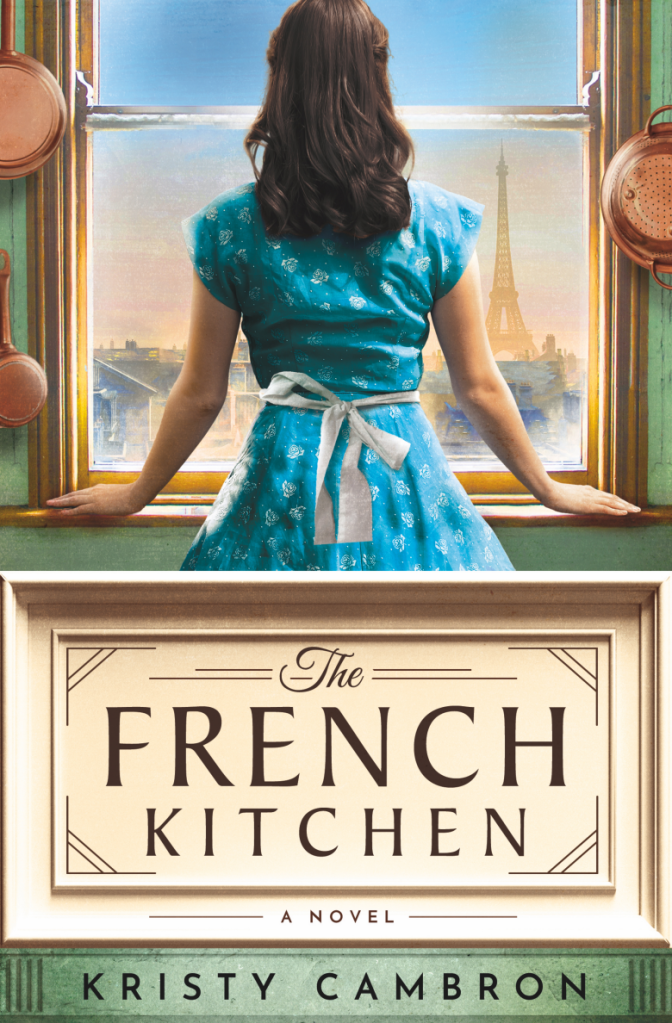
The French Kitchen by Kristy Cambron is a novel set mostly in two timelines in France–one in 1943, during WWII, and one after the war in 1952.
Kat Harris likes to work in her deceased father’s garage in Boston, but her high-society French mother wants to turn her into a debutante. Her brother, Gavin, stops by to say he’s going on a trip with friends for a couple of weeks and will write. But he never does. Kat learns that he joined the military to fight in the war, but he’s missing. Kat is recruited by the Office of Strategic Services (OSS) and is sent to France.
Due to an accident on her way to her assignment, she is injured. She wakes up in the house of the Vichy captain in a small French village. Since Manon, the chef at the nearby Chateau du Broutel–also an operative–was expecting a replacement who didn’t arrive, she claims Kat is the person she was expecting, named Celene. Kat aids the OSS and the French Resistance under the noses of the Nazis while also learning to cook French Cuisine.
In 1953, Kat receives a telegram saying her brother is alive. She believes it was from the same Vichy captain. When she confronts him, he neither confirms nor denies it. But they decide to enter a marriage of convenience to help each of them with their pursuits.
Then Kat runs into the man that betrayed her during the war. He goes by a different name now, and they can’t let on that they know each other. But now she wonders if he sent the telegram for his own purposes. In addition to searching for her brother, she has to keep one wary eye in what this man is doing.
Kat’s friend, Mimi, talks Kat into coming to cooking classes with her, taught by Julia Child–before she was known as the Julia Child. As Julia and Kat become friends, Kat learns she has more in common with Julia than a knowledge of French cooking: Julia also worked for the OSS during the war.
Kristy Cambron is one of my favorite authors. I would almost buy a new book from her before knowing what it was about. I liked the overall story here, but I found it very hard to follow. I’ve read many books with dual timelines–and even a few of Kristy’s with three–without any trouble. But I think the fact that these two timelines were close together, involved many of the same people, many of whom had two different names due to their espionage, and both timelines involved looking for Kat’s brother, made them so similar that it was hard to distinguish them at first. I had to make a point of looking at the dates before each chapter to get oriented.
Plus there were a lot of details and surprises of discovering who certain persons were and where their loyalties unexpectedly leaned.
Also, Kristy usually writes Christian fiction. There’s little mention of anything Christian here besides an occasional reference to prayer or a “God help him.”
The book did have its bright spots. It was fun to discover who some of the people really were. I liked the unfolding relationship between Kat and her husband. And though I know nothing about French cooking and little about Julia Child, I enjoyed seeing her in the pages.
I didn’t dislike the book–I just didn’t enjoy it as much as some of Kristy’s others. But lots of other readers did, so you might, too.
Kristy wrote a fun article about what she learned from Julia while writing this book here.
 Stray Thoughts