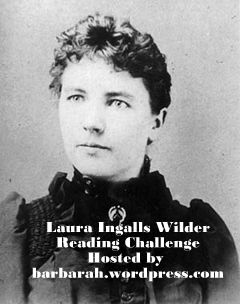
The Laura Ingalls Wilder Reading Challenge 2015 Sign-up Post

Welcome to the fourth annual Laura Ingalls Wilder Reading Challenge! We hold it in February because her birthday  (February 7, 1867) and the day of her death (February 10, 1957) both occurred in February, so this seemed a fitting time to commemorate her.

Many of us grew up reading the Little House books. I don’t know if there has ever been a time when there wasn’t interest in the Little House series since it first came out. They are enjoyable as children’s books, but they are enjoyable for adults as well. It’s fascinating to explore real pioneer roots and heartening to read of the family relationships and values.

For the reading challenge in February, you can read anything by, about, or relating to Laura. You can read alone or with your children or a friend. You can read just one book or several throughout the month — whatever works with your schedule. If you’d like to prepare some food or crafts somehow relating to Laura or her books, that would be really neat too.

If you’d like to read something other than the Little House books, I’ve listed a few others under Books Related to Laura Ingalls Wilder, but that list is by no means exhaustive.

Let us know in the comments whether you’ll be participating and what you think you’d like to read this month. That way we can peek in on each other through the month and see how it’s going (that’s half the fun of a reading challenge). On Feb. 28, I’ll have another post where you can share with us links to your posts or let us know what you read for the month. Of course if you want to post through the month as you read, that would be great. You don’t have to have a blog to participate: you can just leave your impressions in the comments if you like. And I just may have a prize at the end of the month for one participant. 🙂

My own plans are to read By the Shores of Silver Lake and possibly The Long Winter if time allows. I’ve ordered Pioneer Girl, the recently published annotated manuscript of Laura’s first autobiographical writing from which sprang the Little House books, but it is out of stick and not expected to ship until the end of February. But maybe it will get here in enough time for the challenge.

Feel free to grab the button for the challenge to use in your post:

Laura Ingalls Wilder Reading Challenge
<div align="center"><https://barbarah.wordpress.com/2015/01/19/the-laura-ingalls-wilder-reading-challenge-2015/" title="Laura Ingalls Wilder Reading Challenge"><img src="https://barbaraleeharper.com/wp-content/uploads/2011/11/liw.jpg"   alt="" width="144" height="184""" alt="Laura Ingalls Wilder Reading Challenge" style="border:none;" /></a></div>

The Laura Ingalls Wilder Reading Challenge 2015

The month of February contains the dates of Laura Ingalls Wilder’s birth and death, so it seems a fitting month to focus on her life and writings. This is our fourth year to do so, and I have enjoyed it each time. Many of us grew up reading the Little House books. I don’t know if there has ever been a time when there wasn’t interest in the Little House series since it first came out. They are enjoyable as children’s books, but they are enjoyable for adults as well. It’s fascinating to explore real pioneer roots and heartening to read of the family relationships and values.

On Feb. 1 I’ll have a sign-up post where you can let us know if you’ll be participating and what you’d like to read. That way we can peek in on each other through the month and see how it’s going (that’s half the fun of a reading challenge). You can read anything by or about Laura. You can read alone or with your children or a friend. You can read just one book or several throughout the month — whatever works with your schedule. If you’d like to prepare some food or crafts or activities somehow relating to Laura or her books, that would be really neat too. In the past I think some have made food or clothing from the styles of the day: Annette even had a Little House-themed birthday party for one of her daughters, (and, unrelated to the challenge but just from her own interest she started the Little House Companion blog: you might find some neat ideas for activities and Laura-related books there.

On Feb 28 I’ll have a wrap-up post with a Mr. Linky so you can link back to any posts you’ve written for the challenge or to a wrap-up post. You do not have to have a blog to participate: if you don’t, you can just share with us in the comments that day what you’ve read.

Need some ideas beyond the Little House books themselves? Annette, as I mentioned, has shared several books for children here. I compiled a list of Books Related to Laura Ingalls Wilder, and some others are listed in the comments. Laura fan extraordinaire and historian Melanie Stringer has a treasure trove of information at Meet Laura Ingalls Wilder.

Have fun gathering your materials and planning what to read and do, and I’ll see you back here Feb. 1!

Here is a code for a button for the challenge:

Laura Ingalls Wilder Reading Challenge
<div align="center"><https://barbarah.wordpress.com/2015/01/19/the-laura-ingalls-wilder-reading-challenge-2015/" title="Laura Ingalls Wilder Reading Challenge"><img src="https://barbaraleeharper.com/wp-content/uploads/2011/11/liw.jpg"   alt="" width="144" height="184""" alt="Laura Ingalls Wilder Reading Challenge" style="border:none;" /></a></div>

Laura Ingalls Wilder Reading Challenge Wrap-Up

Laura Ingalls Wilder Reading Challenge

Wow, the month of February has really flown! How did you do with your LIW reading? I’m looking forward to hearing about it.

If you’ve read anything by, about, or related to Laura this month, please share it with us in the comments. You can share a link back to your book reviews, or if you’ve written a wrap-up post, you can link back to that (the latter might be preferable if you’ve written more than one review — the WordPress spam filter tends to send comments with more than one link to the spam folder. But I’ll try to keep a watch out for them.) We’d also love to hear if you’ve done any “Little House” related activities.

And, if you’ve participated this month and leave a comment on this post, you’re eligible for the drawing for a copy of The Little House Cookbook, compiled by Barbara M. Walker and illustrated by Garth Williams (the same illustrator for my set of Little House books). I’ll choose a name through random.org. a week from today to give everyone time to get their last books and posts finished. You’re eligible even if you don’t have a blog: just share with us in the comments what you read and a few of your thoughts about it. If you already have this book, I can substitute a similarly-priced Laura book of your choice. (Note: the drawing is closed and the winner is Susan!)

For myself, I read and enjoyed Farmer Boy this year (linked to my review), the story of Almanzo’s childhood. I’m already looking forward to getting back to Laura’s story next year and exploring a couple of other Laura-related books I just heard about this month.

Thank you all for participating! That’s what makes this challenge so fun. I’m looking forward to your thoughts on what you’ve read!

Book Review: Farmer Boy

Farmer BoyFarmer Boy by Laura Ingalls Wilder is the second book published in her Little House series and deals with the childhood of her husband, Almanzo. If I remember correctly, I think I read that  Little House in the Big Woods and this book were all that were planned originally, and when they became so popular, then Laura went on to write other books about her growing up. Since Almanzo doesn’t appear in the rest of the series until a few books later, his story can really be read just about anywhere along the way.

The book covers a little over a year, beginning when Almanzo was almost nine years old. His father was a farmer and his family more prosperous than the Ingalls’ family, but they were very frugal as well. In this book Almanzo was the youngest of four children, though another boy was born to the family some years later.

Farming at this time involved the whole family. Almanzo and his brother Royal helped their father with the everyday chores like milking and cleaning out the animal stalls, and his sisters Eliza Jane and Alice helped their mother in the house, though Alice sometimes helped outside with planting and harvesting (in hoop skirts!) and Almanzo had to help inside sometimes during spring cleaning or other busy times.

Farmers were not busy just in planting and harvesting, though those, especially the latter, might be the most pressured times. They also made repairs, made equipment, broke horses, trained cattle, sheared sheep, cut ice, and many other tasks, while their wives spun thread, wove fabric, sewed, knitted, made hats, made (and sold) butter, etc. etc.

And the children were to participate in it all, both to learn by doing and to learn to pull together as a family. But the children had plenty of fun times as well. They attended school, though the boys could stay home when needed for certain tasks (which Almanzo preferred).

The children were no angels, but I’d say they were pretty normal. When their parents went away for a week, they slacked off on what they were supposed to do and ate a horrendous amount of sweets, then had to scramble to catch up the day before their parents were to come home. Almanzo got into a fight with his cousin (from a literary point of view, he had it coming for a long time: from a Christian and moral point of view, no, that’s not what he should have done) and threw a blacking brush (used on the stove) at his sister, which left a black splotch on the wallpapered wall of Mother’s for-company-only pristine parlor.

I mentioned before that Almanzo’s parents were frugal even though they were considered pretty well off. I remember when I had a job for a while cleaning in the home of a lady whose husband was the vice president of a large company. One day she fussed at me for washing the whole glass door when there was only one spot that needed to be taken care of. Inwardly I kind of rolled my eyes and thought, “As if you need to worry about a few cents worth of cleaner being wasted!” But then I thought, prosperous people don’t get where they are by being wasteful. At an Independence Day celebration, Almanzo was goaded by his cousin into asking his father for a nickel for lemonade. Almanzo was nine and had never asked his father for such a thing before. His father pulled out a half-dollar and asked Almanzo what it was. When all Almanzo could identify it as was a half-dollar, his father said, “It’s work, son. That’s what money is; it’s hard work.” He asked Almanzo a series of questions about growing, harvesting, and selling potatoes, remarked that half a bushel sold for a half-dollar, held up the coin, and then said, “That’s what’s in this half-dollar, Almanzo. The work that raised half a bushel of potatoes is in it.” Then he gave it to him and told him he could either spend it in lemonade or, he suggested, he could buy a little pig and raise it to have more pigs to sell for 4 or 5 dollars apiece. I’ll let you guess which Almanzo did.

One of the major take-aways from this book is what a tremendous lot of work such a life was. It sounds almost idyllic here, but it seemed almost constant. No one complained about it: that’s just how life was. There is something neat about knowing how to use all the parts of a butchered animal (some was frozen in the shed or attic for future use, some was saved for sausage, some parts were used in making soap and candles, the hide was saved for making shoe leather) and which trees were good for what (one kind was used for making sleds and carts, another kind for runners for the sled, another kind for withes or straps for baling hay, etc), and I admire it, but I don’t know that I’d want to go back to those days.

When Almanzo helped his father thresh wheat and asked why his father didn’t buy a threshing machine, his father said, “‘That’s a lazy man’s way to thresh. Haste makes waste, but a lazy man’d rather get his work done fast than do it himself. That machine chews up the straw til it’s not fit to feed stock, and it scatters grain around and wastes it. All it saves is time, son. And what good is time, with nothing to do? You want to sit and twiddle your thumbs, all these stormy winter days?’ ‘No!’ said Almanzo. He had enough of that on Sundays.” Yet they did use some machinery. I guess it depended on what the machine did and whether it helped or wasted goods.

There is a bit of contrast between the Almanzo’s family and his cousins, who live nearer town and wear store-bought clothes, and the shopkeepers who have to “cotton to people,” while farmers are considered (by the farmers, at least) to be “free and independent.” Almanzo’s parents dislike that Royal wants to be a storekeeper. I hadn’t thought of this aspect until I saw it mentioned in a couple of reviews I skimmed through, but town cousins and shopkeepers may have represented the changing society away from being farm-based to being more centered around towns and other goods and services.

Something else that stands out in the book is the way children were treated. It was definitely not a child-centered era. Some of it might come across as harsh by today’s standards, yet the parents were not unkind. Children were not to speak until spoken to at the table or when the parents were talking with other adults and, as I mentioned before, were expected to participate in most of the family work. I don’t think the latter is a bad thing, though these days we wouldn’t require quite so much of it. I don’t remember if I ever read this book to my boys – I should have –  but I do remember telling them, when they fussed over having to vacuum and dust every other Saturday, that there were some kids who had to milk cows and muck out barns every day. 🙂 I do think it is good for children to work around the house, for several reasons: they learn by doing, they learn to be givers and not just takers, they learn to pull together as a family, they learn responsibility and (hopefully) the value and satisfaction of a job well done which will carry through not just in their own homes but in their jobs as well. I get frustrated with sentimental poems that seem to indicate you can have a clean house or you can be a good mom, but not both, or that you’re a bad mom if you don’t stop what you’re doing every time your child wants you to play with him. We do get distracted, with both work and our own “play,” and we need to be reminded not to get caught up in all of that and neglect our children, but there is just as much value (maybe more) in working together with them as there is in playing together. And it doesn’t hurt children to learn to wait for things, either, whether it’s waiting for their parents to finish a conversation before asking them something, or waiting, as Almanzo did when he wanted a colt, for his parents to be sure he was really ready. Though I wouldn’t want to totally go back to how things were in that day, I think there is some good balance between that extreme and the mindset these days.

There were also interesting forays into how some things were done, such as having a cobbler come to the house for a week or two to make the family shoes, how they sheared sheep and made bobsleds and threshed wheat, etc. Sometimes there was a bit too much detail, but overall it was interesting.

I remember not liking this book as well as the others in the series in previous readings, but I liked it quite a lot this go-round.

I read this book for my Laura Ingalls Wilder Reading Challenge and for Carrie’s  Reading to Know Classics Book Club as well as the Back to the Classics Challenge.

(This will also be linked to Semicolon‘s Saturday Review of Books.)

This also completes one of my requirements for the  Back to the Classics Challenge hosted by Karen at Books and Chocolate.

classics2014

The Third Laura Ingalls Wilder Reading Challenge

Welcome to the third annual Laura Ingalls Wilder Reading Challenge! We hold it in February because her birthday  (February 7, 1867) and the day of her death (February 10, 1957) both occurred in February, so this seemed a fitting time to commemorate her.

Many of us grew up reading the Little House books. I don’t know if there has ever been a time when there wasn’t interest in the Little House series since it first came out. They are enjoyable as children’s books, but they are enjoyable for adults as well. It’s fascinating to explore real pioneer roots and heartening to read of the family relationships and values.

Some of Laura’s other writing has been bundled into books, as well: her newspaper columns have been compiled in Little House in the Ozarks: the Rediscovered Writings of Laura Ingalls Wilder by Stephen Hines, and some of her letters have been compiled in West From Home and other books (links are to my reviews).

Then, of course, there are any number of biographies and books about Laura or the Ingalls family. Let the Hurricane Roar by Laura’s daughter, Rose Wilder Lane, and isa fictionalized account of some of her grandparent’s experiences. The Wilder Life: My Adventures in the Lost World of Little House on the Prairie by Wendy McClure, Laura fan extraordinaire, is unique in that it is one woman’s attempt to capture as many “Laura moments” as she can by doing some of the activities Laura did (like churning butter) and going to some of the sites where Laura lived. I Remember Laura by Stephen W. Hines is a collection or articles and interviews of people who actually knew Laura. Those are just a few that I’ve read: there are many more out there I’d like to get to some day. I listed a few others under Books Related to Laura Ingalls Wilder, but that list is by no means exhaustive.

For the reading challenge in February, you can read anything by, about, or relating to Laura. You can read alone or with your children or a friend. You can read just one book or several throughout the month — whatever works with your schedule. If you’d like to prepare some food or crafts somehow relating to Laura or her books, that would be really neat too.

Let us know in the comments whether you’ll be participating and what you think you’d like to read this month. That way we can peek in on each other through the month and see how it’s going (that’s half the fun of a reading challenge). On Feb. 28, I’ll have another post where you can share with us links to your wrap-up post. Of course if you want to post through the month as you read, that would be great. You don’t have to have a blog to participate: you can just leave your impressions in the comments if you like. And I just may have a prize at the end of the month for one participant. 🙂

My own plans are to read The Farmer Boy about Almanzo’s childhood. I may go on to By the Shores of Silver Lake, but I haven’t decided yet – I’m participating in so many other reading challenges this year, I want to be careful to pace myself.

Feel free to grab the button for the challenge to use in your post:

Laura Ingalls Wilder Reading Challenge
<div align="center"><a href="http://wp.me/p1mPv-32b" title="Laura Ingalls Wilder Reading Challenge"><img src="https://barbaraleeharper.com/wp-content/uploads/2011/11/liw.jpg"   alt="" width="144" height="184""" alt="Laura Ingalls Wilder Reading Challenge" style="border:none;" /></a></div>


Reading to Know - Book ClubBy the way, Carrie  chose Little House on the Prairie as her Classics Book Club selection for February to dovetail with this challenge, so if you’d like to read that book you can complete something for two challenges with one book. 🙂

The Laura Ingalls Wilder Reading Challenge 2014

During the month of February I’ll host our third annual Laura Ingalls Wilder Reading Challenge. I had such fun with it the first two years, I am really looking forward to it again this year.

Laura was born February 7, 1867 and died February 10, 1957, so February seemed a fitting month to honor her. Many of us grew up reading the Little House books, and interest was renewed several years ago when the TV series was popular. I don’t know if there has ever been a time when there wasn’t interest in the Little House series since it first came out. They are enjoyable as children’s books, but they are enjoyable for adults as well. It’s fascinating to explore real pioneer roots and heartening to read of the family relationships and values.

For the reading challenge in February, you can read anything by, about, or relating to Laura. You can read alone or with your children or a friend. You can read just one book or several throughout the month — whatever works with your schedule. If you’d like to prepare some food or crafts somehow relating to Laura or her books, that would be really neat too.

On Feb 1 I’ll have a post up where you can sign in and let us know you’ll be participating and what you think you’d like to read that month. That way we can peek in on each other through the month and see how it’s going (that’s half the fun of a reading challenge). On Feb. 28, I’ll have another post where you can share with us links to your wrap-up post. Of course if you want to post through the month as you read, as well, that would be great, and I might share those from time to time. You don’t have to have a blog to participate: you can just leave your impressions in the comments if you like.

So, what do you think? Anyone interested? Make plans now to join us this February — I’m looking forward to seeing you then!

Feel free to grab the button for the challenge to use in your post:

Laura Ingalls Wilder Reading Challenge
<div align="center"><a href="http://wp.me/p1mPv-32b" title="Laura Ingalls Wilder Reading Challenge"><img src="https://barbaraleeharper.com/wp-content/uploads/2011/11/liw.jpg"   alt="" width="144" height="184""" alt="Laura Ingalls Wilder Reading Challenge" style="border:none;" /></a></div>

Laura Ingalls Wilder Reading Challenge Wrap-Up

Laura Ingalls Wilder Reading Challenge
With the end of February, we come to the end of the Laura Ingalls Wilder reading Challenge for this year. If you’ve read anything by, about, or related to Laura this month, please share it with us in the comments. You can share a link back to your book reviews, or if you’ve written a wrap-up post, you can link back to that (the latter might be preferable if you’ve written more than one review — the WordPress spam filter tends to send comments with more than one link to the spam folder. But I’ll try to keep a watch out for them.) We’d also love to hear if you’ve done any “Little House” related activities.
And, if you’ve participated this month, you’re eligible for the drawing for a copy of The Little House Cookbook, compiled by Barbara M. Walker and illustrated by Garth Williams (the same illustrator for my set of Little House books). I’ll choose a name through random.org. a week from today to give everyone time to get their last books and posts finished. You’re eligible even if you don’t have a blog: just share with us in the comments what you read and a few of your thoughts about it. If you already have this book, I can substitute a similarly-priced Laura book of your choice. I’ve spent some time looking through it: it’s more than just recipes: it shares a lot of interesting information as well as excerpts about food and cooking from the books.
For myself, I had planned to make some items from it and have something of a birthday party for Laura on her birthday, the 7th, but that was when my mother-in-law was ill, and between that, moving her to a new place, and my husband’s surgery, I didn’t do any “Laura” activities, but I did manage to get a few books read. These link back to my reviews:
West From Home by Laura Ingalls Wilder, a compilation of letters Laura wrote to Almanzo while visiting their daughter, Rose, and Rose’s husband, and the World’s Fair.
Let the Hurricane Roar by Rose Wilder Lane. Laura’s daughter wrote a fictionalized account of some of her grandparent’s experiences.
On the Banks of Plum Creek by Laura Ingalls Wilder, covers the same events as Let the Hurricane Roar plus a few more: a grasshopper plague, blizzards, attending school for the first time, meeting Nellie Oleson.
I had originally planned to read Farmer Boy, about Almanzo’s childhood, but when I discovered the Plum Creek book covered some of the same events as Rose’s book, I wanted to go ahead and read it while the other was fresh in my mind. Farmer Boy was the second book written of the Little House books, but it can really be read at any point. I do want to read it before Almanzo shows up in Laura’s story, though!
Thank you all for participating! That’s what makes this challenge so fun. I’ve already come across a book or two I hadn’t known of before that I want to read next time through some of your reviews. I’m looking forward to your thoughts on what you’ve read!

Book Review: On the Banks of Plum Creek

Plum CreekI wanted to read next On the Banks of Plum Creek by Laura Ingalls Wilder right on the heels of Let the Hurricane Roar (linked to my thoughts) by her daughter, Rose Wilder Lane  while it was fresh in my mind, because they covered some of the same events.

Little House on the Prairie had ended with the Ingalls family having to leave their homestead in “Indian territory” when it was determined that the Indians had rights to the land. On the Banks of Plum Creek opens with the family coming into Minnesota near Walnut Grove (“only three miles away, a nice walk”, Pa says) and trading their horses for the land and crops of a family who is leaving. The family had a little dugout house, and the Ingalls live there until Pa’s wheat crops start to sprout, and he borrows against it to buy lumber and supplies for a new house.

Since they are close to town, Mary and Laura begin to attend school, where they meet the infamous Nellie Oleson, who becomes an instant enemy with her derisive assessment of them as “country girls.” The also meet Reverend Alden and are able to attend church for the first time in a long time.

This book contains some of my favorite “Little House” scenes, like the party where their classmates are invited to the house on the creek and Laura lures Nellie into the area where the crab and leeches are, the church Christmas party where Laura gets her fur cape and muff, the girls bringing in all the firewood during a storm when Ma and Pa are away after they heard about a house of children who froze. It also tells of the awful grasshopper invasion, Pa’s having to go East for work, prairie fires, and the terrible blizzards.

Some of us reading Laura’s letters in books like West From Home have remarked how unemotional her correspondence seems. I’m not sure how much of that comes from her personality and how much from her upbringing. The Ingalls weren’t stoics, but their attitude during any crisis seemed to be to buck up and do what you had to do. Emotion is shown more subtly, as when Pa stops playing his fiddle during stressful times or Ma sits late at the window with the light in it, staring at her hands, worried for her husband, who might be caught out in a blizzard. Once when a visiting child takes a liking to Laura’s rag doll and wants to keep it, Ma admonishes Laura that the child is little and company and should have the doll, and scolds Laura that a great girl like her (about age 8 at this time) should sulk over it. But then later Ma does come around and says she didn’t realize Laura cared so much for the doll and helps her restore it when Laura rescues it from a puddle, and while she doesn’t let them rant, she does understand when they’re strained and stops work to play games with them. Laura is ashamed of herself for crying during Pa’s long absence, saying it would be a shame even for younger Carrie to cry. Laura seems to paint herself as the only family member having bad emotions, like envy and pride.

Once again I marvel at the strength of the early settlers, who regard three miles as a “nice walk” and bear so much without a whimper. I don’t know if we could do today what they did, maybe because we haven’t had to. But then, each generation has its particular trials and hardships.

I liked seeing through Laura’s eyes as she described new things and how she thought when she fell into temptation. I enjoyed visiting with the Ingalls family again, with Pa’s cheerfulness, Ma’s gentleness and resourcefulness, their industriousness and endurance of the whole family as well as their enjoy of simple pleasures, and the interaction of the family as well as getting to know new neighbors from town.

Laura Ingalls Wilder Reading Challenge

(This will also be linked to Semicolon‘s Saturday Review of Books.)

Book Review: Let the Hurricane Roar

Let the Hurricane RoarLet the Hurricane Roar by Rose Wilder Lane, daughter of Laura Ingalls Wilder, is also published as Young Pioneers. In some versions the characters are named Molly and David: in others they are Charles and Caroline. The events are based on the same events covered in Laura’s book On the Banks of Plum Creek, though some details have been changed.

I had wondered about the title, since hurricanes don’t generally come to the prairie, but the title comes from a hymn.

Molly and David are very young newlyweds (16 and 18) who head west to claim a homestead. Though they live in a little sod house and don’t have many possessions, they are gloriously happy, especially when a good wheat crop grows and they have a baby son. But disaster strikes in the form of a grasshopper plague that destroys the crop. David had borrowed against the lost crop, so he must travel to look for work. Even though neighbors give up and leave in the face of similar difficulties, Molly stays on through a terrible winter so claim jumpers won’t steal their land.

A former pastor used to bestow high compliments on people when he called them “pioneer stock” — sturdy, dependable, strong, not easily swayed. David and Molly would both qualify for this compliment. I am sure I would not! At least not when it comes to living in a dirt house all alone through several blizzards. The book realistically portrays Molly struggle with being alone, wrestling with all of the “what ifs,” and David’s anger over his failure, poor choices (going into debt), and difficult circumstances, rather than portraying them as always smiling and unflappable.

Some of that “pioneer stock” is shown as well in Molly’s attitude when a neighbor complains about hardships, and Molly thinks to herself, “Well, the land isn’t going to feed you with a spoon!” Quite different from the attitude of many today.

I also liked the description at the beginning that Molly “never quite lost the wonder that she, quiet and shy and not very pretty, had won such a man as David. He was laughing and bold [and] daring.”

It’s obvious Rose loved and admired her grandparents, and I am glad she shared this part of their story with us. Part of her goal in writing it was to “inspire Depression-era readers with its themes of resilience in the face of hardship and the strength of the American character” (The Wilder Life by Wendy McClure, p. 168).

Carrie and Amy both reviewed this book last year — in fact, Carrie’s review is where I think I first heard of it. They both focus more on the relationship between Molly and David than I did, but after rereading their reviews as I came to the end of mine, I do remember that that’s part of what drew me to this book, besides its relationship to Laura. Though the book is not written as a romance per se, and as Amy said, Rose writes with restraint, the realities as true love as opposed to “romance novel fiction” shine through it.

The only blight on this novel is that Rose used this information from her mother’s material without her mother’s knowledge or permission. Laura was understandably upset, and they eventually came to terms with it and moved on.

I was originally going to read Farmer Boy next for the Laura Ingalls Wilder Reading Challenge, but since it is Almanzo’s childhood story and doesn’t need to be read in order, I think I am going to read On the Banks of Plum Creek for Laura’s version of the events in this story while this book is still fresh in my mind.

Laura Ingalls Wilder Reading Challenge

(This will also be linked to Semicolon‘s Saturday Review of Books.)

Save

Book Review: West From Home by Laura Ingalls Wilder.

West From HomeWest From Home is a compilation of letters Laura Ingalls Wilder wrote home to her husband, Almanzo, while she was in San Francisco visiting her daughter and the 1915 World’s Fair, also called the Panama-Pacific International Exposition in celebration of the completion of the Panama Canal, which opened trade with other countries. Her daughter, Rose Wilder Lane, had kept the letters in a box after her mother’s death, and they were among other possessions passed along to her heir, Roger Lea McBride. When he discovered them, he decided to publish them in a book for Laura fans.

Laura spent about two months with Rose and her husband. She was 48; Rose was 29. Besides all the sights and wonder of the Exposition, Laura got a glimpse of San Francisco, Rose’s work, different ways business was done, and the ocean. I love the description of Laura and Rose taking their shoes off and running in the water.

She visited to a cannery, and “her doubts about the cleanness of canned goods from a large plant are removed” (p. 54). She was intrigued by the different nationalities of people she saw. She was enthralled by the light show in the evenings. And she took in a great deal from the city and the Exposition and tried to describe it in great detail to Almanzo.

Though there are photos included in the book of some of the sights around the time she was there, they are not hers. I don’t know if they did not have a camera, or if it was just inconvenient or expensive to shoot many photos. But Laura tried to describe with as much detail as she could what she was seeing so Almanzo can experience it as much as possible, too.

Almanzo couldn’t leave the farm, and it is clear in several of the letters that Laura feels conflicted about leaving him with all the work herself. A number of things I read last year about her showed that she was an integral part of the farm work.

Her letters are quite practical, not romantic or even affectionate much at all. That may have been due to the era, but overall she was a very practically-minded person, so that may just be how she expressed herself.

In several places it is mentioned that Rose was trying to persuade her parents to move near her, and Laura (actually called Bessie by Almanzo because he had a sister named Laura and called Mama Bess by Rose) explored the costs and details involved in moving some of their ventures to CA. But ultimately she felt, “There is no place like the country to live and I have not heard of anything so far that would lead me to give up Rocky Ridge [their home] for any other place” (p. 89).

Laura was also writing her farm-paper columns at this time, and Rose had several writing assignments, but there was talk of wanting Rose to help her block out a story. I’m assuming these were some of the first efforts towards what would eventually become the Little House stories.

One of the reasons I especially wanted to read this book was for a glimpse into Laura’s relationship with Rose. I had read mixed reports about how well they got along. There is nothing in these letters to indicate they didn’t get along, and if they didn’t, it would seem Rose wouldn’t be so keen on wanting them to move near her. There are indications that Rose was more emotional and Laura more practical and down-to-earth, so I am sure that caused some misunderstandings sometimes. Of course, these cover just a short period in their lives, so they are not the whole story.

There are some family glimpses as well, in Laura’s concern about whether they’d get back $250 they had loaned to Rose and her husband, and Rose’s note to her father with concerns that Laura was getting too fat (!!!)

All in all it was a fairly quick (171 pages, if you count some recipes at the end) and enjoyable read. It wasn’t riveting, but it was an interesting peek into Laura’s real life.

Laura Ingalls Wilder Reading Challenge