Laudable Linkage

Laudable Linkage

I found quite a few good reads this week:

Taking Our Stress to the Lord, HT to the Story Warren. “The world invites us into its fear and its solutions to that fear constantly. We live in a particularly tense and defensive time. Fried nervous systems and dialed up threat responses crowd our communities, near and far. Well-meaning tips about stress management often invite more stress with additional tasks to incorporate into our packed lives. And if we’re honest, unhelpful messages about stress are not exclusively external.”

We Can’t Fear Questions. “If you have the truth on your side, you don’t have to be afraid of questions. If you fear questions, people might wonder if you really have the truth on your side. If we want to successfully pass off our faith to the next generation, we can’t be afraid of their questions.”

To Go Forward, We Must Go Backward, HT to the Story Warren. “Other mediums require you to give your attention and, like books, paintings, songs, and even food, sometimes will point you to the transcendent. That’s what art does. But our phones are different. They’re black holes for attention. Social media, when it is primarily used to consume content instead of connecting with others, takes your attention and gives you nothing back.”

Prove Me, Try Me, Test Me, HT to Challies. “I don’t think I can do it. I don’t want to be proven, tried, and tested again. Not now; not tomorrow; not ever. Can we take a little break, God? How about a month? Can we take a month off from being proven, tried, and tested? Just a little vacation from trials? Can life just be easy for a little while?”

Quiet Invitations. A tip for engaging children in activities works for oneself as well.

What Does the Bible Mean When It Teaches Wives to Submit? HT to Challies. “Many people cringe at the teaching that wives are to submit to their husbands. A clear understanding of this teaching will lead us to marvel at the goodness of God’s plan for marriage and society.”

8 Marriage Pitfalls to Avoid Like the Plague. “We’re focusing on marriage’s irritating, foolish snares. When all is said and done, these pitfalls ultimately emerge as spiritual issues, because no one loves to fan the flames of inappropriate, subtly destructive behavior more than the enemy of our souls who most certainly hates any loving, loyal, compassionate commitment. On the table? Eight marriage bugaboos to be aware of. And if you’re not married, you’ll probably glean some helpful insights for other relationships.”

The Enormous Significance of Small Tasks. This is written in the context of parenting, but it’s true of teaching, caregiving, and so many other activities.

Walking with Those Who Weep, HT to Challies. “I have had the opportunity and privilege of walking with many through various forms of loss and trial. It was not until we lost our 18-year-old son, however, that I truly learned that there is a huge difference between knowing about grief and knowing grief. Walking through the death of our son revealed to me that I knew far less about what is actually helpful in supporting others than I thought.”

The Spiritual Problem of Being Overinformed, HT to Challies. “In a sense, ‘being informed’ is more of a liability than an asset in today’s world. The quality of digitally mediated information is simply too untrustworthy. What happens to us when we’re overinformed but underactivated? From my experience and observations, some common side effects occur.”

It Only Gets Better, HT to Challies. “Youth has many advantages, like strength and energy. Getting older has some drawbacks, but it has its perks too.”

Wings and a Prayer, HT to nikkipolani. A fascinating story of a Vietnamese pilot’s escape with 52 family members before the fall of Saigon.

J. C. Ryle quote

Pain that brings you closer to God will always be better
than comfort that keeps you away from Him.-
-J. C. Ryle

Laudable Linkage

Laudable Linkage

On Failure, HT to Challies. “Yes, we are going to keep failing at life, again and again. Failing people we love. Failing at things we love. Failing the God we love. But we have a path for dealing with failure. It takes faith, courage, and hope.”

When Your World Burns Down & How to Answer the Question of Pain and Suffering, HT to the Story Warren. “There are love stories that survive fire, and rise straight up from the ashes. This is a Love Story that begins more than 2 decades ago with a bundle of a baby boy …. our third son, named Levi, because the Farmer dared to believe it was a word from the Almighty: ‘And Levi got up, left everything and followed Him,’ (Luke 5:28), and the Farmer said that’s exactly the kind of man that we pray our boy will be.”

Prayer Requests from Jailed Children. “This message is scrawled on a prayer request card, sitting in front of me on my desk. Tears come to my eyes as I read it.”

What Is Your Name? “God requested a sacrificial offering instead of hospitality. And He showed Himself in the fire. He revealed the wonder of Himself in the sweet aroma of their sacrifice.”

Why Feeling Overwhelmed Can Be a Good Thing. “I feel as if I’m drowning in a tsunami of needs. Adult children who need help. Aging parents with health concerns. Personnel shortages at work. Ministry needs. Volunteer opportunities. I want to do good things for good people, but there just isn’t enough of me to go around. I’m overwhelmed. This realization, I’ve discovered, is the first step toward a solution.”

Death Is Not the Worst Thing that Can Happen to You, HT to Journey of Faith. “Contrary to what many Christians think, death is a big deal, and we shouldn’t take it lightly at all. But death isn’t the worst thing that can happen to us.”

What Haggai Taught Me About Priorities, HT to Knowable Word. “‘I can’t. I’m busy!’ These piercing words stopped me as they spilled out of my 2-year-old’s mouth. . . . Yet the reason I stopped wasn’t my son’s disobedience or misplaced priorities; it was because those words were an echo of my heart.”

Brain Fast Food: Living and Ministering in and Age of Casual Thinking. “One of the great advantages of the technological revolution is that we have unbelievable access to all kinds of great resources. One of the great disadvantages of the technological revolution is that intellectually speaking it conditions us to go after McDonald’s hamburgers rather than Ruth Chris steak.”

Stewarding Your Mind. “Doing productivity God’s way means viewing your entire life as a stewardship. Your time, talents, and treasure are all resources left to your care. And the sensible Christian will take care to do all that he or she can to make a good return on these things for the Master. Most believers understand this call to stewardship in areas like finances or even with the use of our time. But are you treating your mind like a stewardship?”

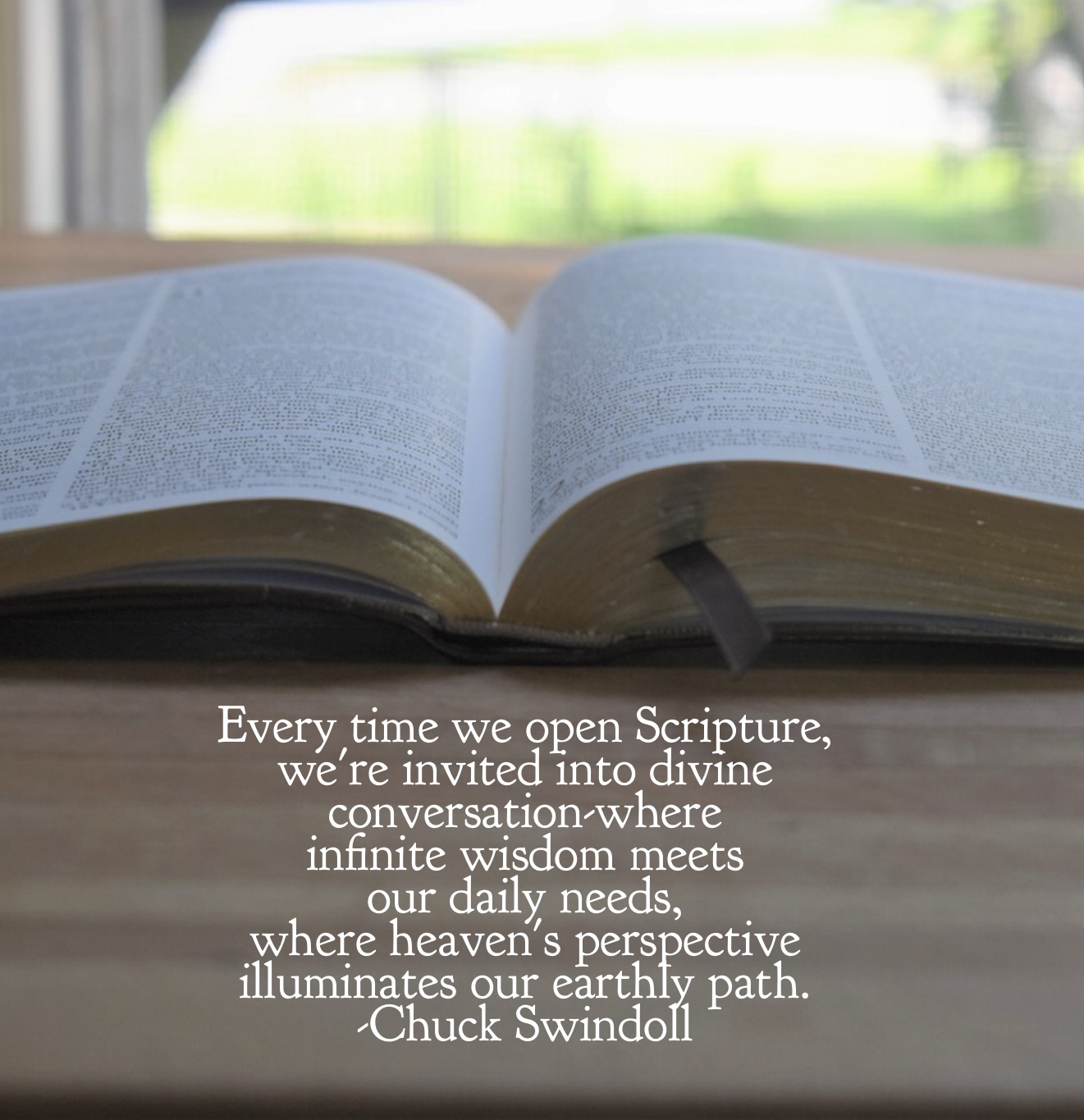
Chuck Swindoll quote

Every time we open Scripture, we’re invited into divine conversation–where infinite wisdom meets our daily needs, where heaven’s perspective illuminates our earthly path.
Chuck Swindoll

Laudable Linkage

Laudable Linkage

This is a busy time of year, but here are a few good reads you might find thought-provoking when you have a moment:

Uncomfortable Christmases, HT to Challies. I saw this last year after Christmas and saved it for this year. “But for some of us, going to a holiday gathering (or hosting one) can be fraught with spiritual tension when few (or none) share our Christian faith. And given numerous trends in our society, the tension may only get worse in the days ahead.”

Eleven Hindrances to Answered Prayer. HT to Challies.

Thinking About Bruce Willis and Jesus, HT to Challies. “We often talk as Christians about the suddenness of death. We talk to unbelievers about how important it is to not put off a decision for Jesus until later, because what if death comes calling when you don’t expect it. I wonder though have often we talk about or think about for ourselves, the suddenness of debilitation or disablement; how fast we can go from a fully functioning person, to our arms not working, our legs not working, our kidneys not working or even our mind not working.”

Keep This in Mind When There Is “Too Much to Do,” HT to Challies. This is written to pastors but has good advice for all.

Proverbs 31 Is Not Just for Women. Marli has an interesting perspective on this chapter that I’d not heard before.

How to Read and Remember, HT to Challies. “Someone recently asked me how to stay focused and retain what they read. It’s an important question, especially for anyone devoted to a life of profitable reading and learning.”

The Almighty Bean: When God’s Good Gift Becomes an Idol. “Maybe you own the t-shirt that says, ‘I need a little bit of coffee and a whole lot of Jesus.’ In truth, we just need Jesus—coffee optional.”

Wrap Up Some Stuff this Christmas, HT to Challies. “Our consumer-driven mentality is out of control, and we feel it everyday as more and more waste piles up around us. Sometimes a good answer is to slow down, cut back, and remove the unused things in our lives. But sometimes it’s not. Because you and I were created for a world full of things.”

More Than a Feeling: Be Ruled by Peace. “I’ve often fallen into the trap of thinking that peace is primarily a feeling. So when circumstances outside my control arise—my kids’ health situations, strained relationships, or some other crisis—peace feels elusive . . . drowned out by anxiety, sadness, anger, or overwhelm. This is why it’s important to understand peace as a reality that does not change when we encounter trials and suffering. Peace originates in the unchanging person of Jesus, and it never runs dry, regardless of what we’re facing or what our emotions might tell us. 

I sometimes think of changing the name of my “Laudable Linkage” posts, and one reason is that it seems weird to include links back to my own posts under such a title. But there are two that I think might be helpful this time of year:

Christmas Grief, Christmas Hope, Christmas Joy. Both of my parents and my grandmother all died in December, in different years. It seems every year I know of someone with a fresh loss during the holiday season. Even “old” grief can flare this time of year.

You Don’t Have to Choose a Word for the Year. Some do this rather than New Year’s resolutions and find great benefit in it. If it’s helpful, great. But it’s not a must. “What’s more vital than a word for the year is daily seeking God in His Word.”

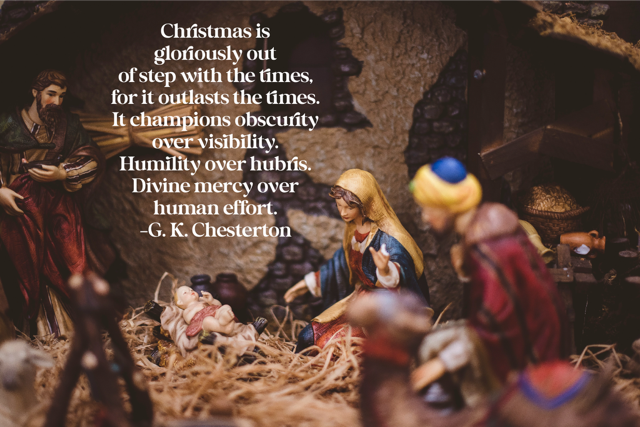
G. K. Chesterton Christmas quote

Christmas is gloriously out of step with the times, for it outlasts the times. It champions obscurity over visibility. Humility over hubris. Divine mercy over human effort.
–G. K. Chesterton

Laudable Linkage

Laudable Linkage

Comfort and Joy: How God Used the Loss of a Loved One to Save the Life of Another, HT to Challies. “Grief is painful, angry, messy, and real. But God does not abandon us in the midst of it. In fact, from soil soaked by tears, He can cultivate healing, goodness, and beauty—even if our broken hearts can’t see it right away.”

Christianity Is not Colonial: An Autobiographical Account, HT to Challies. “According to this ‘Christianity is colonial’ narrative, Christianity is the ‘white,’ ‘western’ religion which permitted all the above. Therefore, the Christian God is himself a racist colonialist who deserves, not to be worshiped, but to be denounced. This association of Christianity with colonialism is so out of step with reality as to be literally ridiculous.”

COVID’s Gift: The Gem We Should Now See We Were Missing. “If I asked you to make a list of the ten two-word phrases most common in the New Testament, the phrase ‘in Christ’ wouldn’t make it on most of our lists. Yet that phrase and its variants occur more times in the New Testament than the phrases ‘the cross,’ ‘eternal life,’ or even ‘Jesus Christ.'” The author posits that understanding our unity in Christ would reignite our love and understanding of the church. The best part of the article is under the heading “How are believers unified with Jesus?”

I’m Fine! “How are you today? No, I mean really, how are you today? I know you know the socially, western culturally correct response is that you are fine, however, that’s not what we’re about here, in this space.”

Purposes of Predictive Prophecy. “Certainly prophecy is intended to have a present impact on the believer’s faith and practice. No one should dispute that. But some posit that viewing eschatological prophecy as a detailed prediction of specific events short-circuits the ethical intention of such prophecy. I am positing that God tells us about the future because He actually wants us to know what is going to happen and expects us to believe that it is going to happen just as He says.”

We Need to Sing More Than Songs of Praise, HT to Challies. I agree, though I think singing does more than express emotion.

Sanctification and Sexual Purity: God’s Will for Your Life, HT to Challies. “There is a direct link between our holiness and our sexual purity. There’s a direct link between your body which is united to Christ and what you do with your body. And that my friends is not popular.”

Finally, I don’t know David and Ciara Dierking, but evidently many of my friends do, because I started seeing requests for prayer all over Facebook back in December when Ciara and her young son Colton became ill. Colton had COVID and strep, I believe, and two abscesses of infection in his neck. Once he had surgery to drain those, he was well on the road to recovery. Ciara had influenza B, group A strep, severe pneumonia, which sent her into toxic shock (sepsis). She nearly died. The medicine to treat the sepsis narrowed her blood vessels to the point that her extremities couldn’t get enough oxygen. She ended up having both arms and both legs amputated.

You can imagine how devastating that would be, especially for a young wife and mother. As I have prayed over and ached with this sweet family these last several months, there have been so many signs of God’s hand on them.

Ciara was rereading Nancy DeMoss Wolgemuth’s book, Choosing Gratitude, when all of this happened. As her family put excerpts from the book that Ciara had underlined on their Facebook page, somehow Nancy learned of it and asked if she could interview Ciara and David. That episode will air November 11 and 12 on the Revive Our Hearts app or website or podcast. But as part of that interview, ROH made this video. I encourage you to watch, be encouraged, and pray for this family. They’ve all overcome many challenges, but still have many more ahead. I’m going to leave this here in place of my usual Saturday morning graphic.

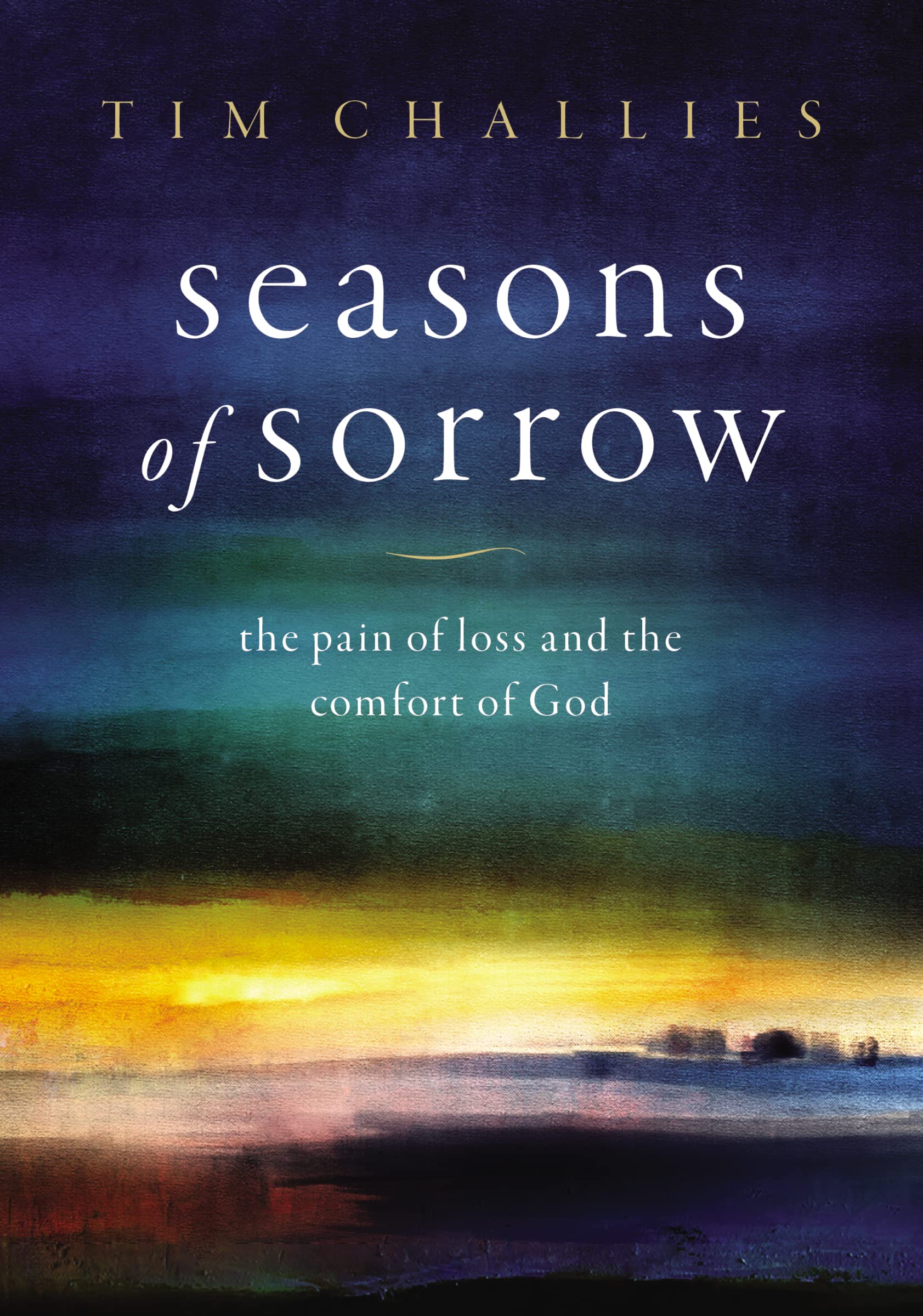
Seasons of Sorrow

One November day in 2020, Tim and Aileen Challies learned the stunning news that their 20-year-old son, Nick, had suddenly died. He had not been ill. There were no known congenital health issues. He was playing a game with his sister and their friends at college when he suddenly collapsed. Efforts to revive him failed.

Though grief never goes completely away, it is probably at its most intense the first year. Like many of us who write, Tim processed what he was thinking and feeling by writing. Some of what he wrote was published on his blog. But much was not. He gathered his writings from the year into a book titled Seasons of Sorrow: The Pain of Loss and the Comfort of God. The book is laid out across seasons, beginning with fall, when Nick died, through winter, spring, summer, and then fall again on the first anniversary of Nick’s passing.

Nick was a young man training for gospel ministry. This is not the first time I have wondered why would God take someone with so much potential to heaven instead of allowing them to do His work here. We don’t know all the answers. But we do know our times are in His hands. Anyone’s death, but especially that of one so young, reminds us that we’re not guaranteed a certain number of years. By all accounts, Nick used his time here well. May God give us grace to do with same, with a heart fixed on eternity.

Even though the book deals with the recent loss of an adult child, much of it can be applied to any loss. I found help and comfort in dealing with the seventeen year loss of my mom, who died seemingly (to us) too early at 68.

One of the things I appreciated most about Tim’s testimony was his desire to honor God in the midst of his grief. There is nothing wrong with grief and tears. Jesus wept with his friends at the loss of Lazarus, even while knowing He was about to raise him from the dead. We don’t go off on a season of grieving and then come back to faith in and peace with God. Tim demonstrates that we can trust Him through and in the midst of grief.

Tim wrestles honestly with what he knows of the goodness of God in circumstances that don’t seem good.

One aftermath of loss is fearing more loss.

I, whose son collapsed and died, cannot fall asleep in the evening until I have received assurance that both my daughters are still alive and cannot be content in the morning until I am sure both have made it through the night. Nick’s death has made us face mortality and human fragility in a whole new way. My children may as well be made of glass. I’m just so afraid that if Providence directed I lose one, it may direct that I lose another. If it has determined I face this sorrow, why not many more?

How, then, can I let go of such anxiety? How can I continue to live my life? The only antidote I know is this: deliberately submitting myself to the will of God, for comfort is closely related to submission. As long as I fight the will of God, as long as I battle God’s right to rule his world in his way, peace remains distant and furtive. But when I surrender, when I bow the knee, then peace flows like a river and attends my way. For when I do so, I remind myself that the will of God is inseparable from the character of God. I remind myself that the will of God is always good because God is always good. Hence I pray a prayer of faith, not fatalism: “Your will be done. Not as I will, but as you will”  (p. 76).

Another section that particularly spoke to me was when Tim found his longings for heaven mixed up with seeing Nick again as much, and sometimes more, than seeing Jesus. He confessed this to a friend, ending with the thought that he must sound like a pagan. The friend replied, “No, you sound like a grieving father” (p. 122).

And I’m content to leave it there. It was God who called me to himself and God who put a great love for himself in my heart. It was God who gave me my son, God who gave me such love for him, and God who took him away from me. The Lord knows I love the Lord, and the Lord knows I love my boy. I’ll leave it to him to sort out the details (p. 122).

Ecclesiastes 7:2 tells us, “It is better to go to the house of mourning than to go to the house of feasting, for this is the end of all mankind, and the living will lay it to heart.” God doesn’t condemn feasting and gladness: He incorporated such into Israel’s calendar year and tells us the joy of the Lord is our strength (Nehemiah 8:10). But we do tend to learn deeper lessons through mourning. I appreciate Tim’s sharing what he experienced and learned with us.

(I often link up with some of these bloggers.)

Laudable Linkage

IMG_0195

I’m waaaay behind on my blog reading. But I wanted to go ahead and share the ones concerning Christmas before it was all over.

We Need a Little Christmas! I love both meanings of this post by Lesley.

This Is Not How I Thought My Story Would Go, HT to Diane Heeney. Good applications drawn from Mary’s life.

We Wait in Darkness: Some Thoughts for Advent. “In Advent, we wait in the darkness. But we do not, I am convinced, wait hopelessly. For while we wait, we can tend the flame. The stories each of our homes are telling can be ones that lend flesh to truth, goodness, and beauty, so that the waiting we do can tend the flame of the Gospel flickering inside our hearts.”

Goodnight Till Then. Those of you who know Tim Challies know that his college-age son died suddenly and unexpectedly a few weeks ago. Also from Tim: When All Seems to Be Gain, Plan for Loss.

Do You Ever Wonder? Lessons Learned from Rebecca. Both Rebekah and Sarah manipulated events instead of trusting God’s promises. We all leave a string of failures in our wake, but thank God He redeems them.

Looking for Joy? Abide. “In addressing His disciples hours before His arrest, Jesus tells them over and over to abide, to remain, to dwell in Him. He knows that they’re worried about what life will look like without Him, so He gives them these instructions for a specific reason: “that [their] joy may be full” (John 15:11).”

On Benedictions, Part 1: He Who Is Able. “This passage doesn’t promise that we’ll never stumble into sin. But it does promise that God’s grace can enable us to persevere to the end—to stand before his throne still blameless, still washed by the blood of Christ, still cleansed from the sin in which we all too readily engaged.”

Assurance in an Age of Cancel Culture, HT to Challies. These days of being so easily “cancelled” when the culture at large doesn’t like what we say can make us fearful of speaking out. “This article is an outpouring of my inner war with ‘cancel culture’ and fear of man. These Biblical truths are weapons of warfare for me in the middle of my fight with ‘cancel culture.’”

Meatloaf Ministry. If you’ve ever been part of a church food ministry or any behind-the-scenes ministry, this will bless you.

Social Justice in Our Divided Age. Not everyone means the same thing by that term, which causes confusion and even hard feelings at times. I thought this was a good explanation.

Happy Saturday!

Laudable Linkage

IMG_0195

Here are some interesting reads discovered in the past couple of weeks:

It Is Never Right to Be Angry With God, HT to Challies.

What Our Stay-at-Home Mom taught us About Human Dignity, HT to Challies.

What to Do When Your Friend Loses a Baby.

When Mother’s Day Isn’t a Celebration.

Celebrating All Mothers by a Not-Yet Mother.

How to End Sibling Rivalry Like a Christian.

Unity About Modesty Among Differences of Opinion and Practical Considerations About Modesty, 3 and 4 in a series.

What’s Too Violent for Christian Readers?, a discussion with several authors. Pretty much agree with these points.

Animal Expressions, HT to Lisa. These are so cute! Especially the lamb and the baby gorilla with its mom.

And finally, some smiles, found on Pinterest:

I actually do that kind of thing sometimes….

Happy Saturday!

Save

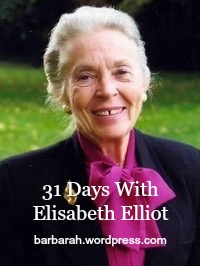
31 Days With Elisabeth Elliot: Nothing Is Lost If Offered to Christ

Elisabeth Elliot2This comes from the July/August 1987 edition of Elisabeth’s newsletter and is in Keep a Quiet Heart as well:

A pastor’s wife asked, “When one witnesses a work he has poured his life into ‘go up in flames’ (especially if he is not culpable), is it the work of Satan or the hand of God?”

Often it is the former, always it is under the control of the latter. In the biographies of the Bible we find men whose work for God seemed to be a flop at the time–Moses’ repeated efforts to persuade Pharaoh, Jeremiah’s pleas for repentance, the good king Josiah’s reforms, rewarded in the end by his being slain by a pagan king. Sin had plenty to do with the seeming failures, but God was then, as He is now, the “blessed controller of all things” (1 Timothy 6:15, PHILLIPS). He has granted to us human beings responsibility to make choices and to live with the consequences. This means that everybody suffers–sometimes for his or her own sins, sometimes for those of others.

There are paradoxes here which we cannot plumb. But we can always look at the experiences of our own lives in the light of the life of our Lord Jesus. How shall we learn to “abide” (stay put) in Christ, enter into the fellowship of His sufferings, let Him transform our own? There is only one way. It is by living each event, including having things “go up in flames,” as Christ lived: in the peace of the Father’s will. Did His earthly work appear to be a thundering success? He met with argument, unbelief, scorn in Pharisees and others. Crowds followed Him–not because they wanted His Truth, but because they liked handouts such as bread and fish and physical healing. His own disciples were “fools and slow of heart to believe.” (Why didn’t Jesus make them believe? For the reason given above.) These men who had lived intimately with Him, heard His teaching for three years, watched His life and miracles, still had little idea what He was talking about on the evening before His death. Judas betrayed Him, Peter denied Him. The rest of them went to sleep when He asked them to stay awake. In the end they all forsook Him and fled. Peter repented with tears and later saw clearly what had taken place. In his sermon to the Jews of Jerusalem (Acts 2:23, PHILLIPS) he said, “This man, who was put into your power by the predetermined plan and foreknowledge of God, you nailed up and murdered…. But God would not allow the bitter pains of death to touch him. He raised him to life again–and there was nothing by which death could hold such a man.”

There is nothing by which death can hold any of His faithful servants, either. Settle it, once and for all–YOU CAN NEVER LOSE WHAT YOU HAVE OFFERED TO CHRIST. It’s the man who tries to save himself (or his reputation or his work or his dreams of success or fulfillment) who loses. Jesus gave us His word that if we’d lose our lives for His sake, we’d find them.

I just learned recently, or was reminded, that all of Elisabeth’s language work that she had spent years on in Ecuador was lost down a mountainside. There was no retrieving it: there were no computer files with back-ups in those days. She knew whereof she spoke. We can trust that whatever we have done for God with a right heart is accepted by Him, even if we have “nothing to show for it.” Elisabeth says in A Lamp For My Feet:

Paul was a man who suffered the loss of everything, according to his own claim. Yet any loss he counted pure gain. The key to this transforming of earthly losses into heavenly gains is love. What do we love? If our hearts are set on people and possessions and position, the loss of those will indeed be irreparable. To the man or woman whose heart is set on Christ no loss on earth can be irreparable.

It may shock us for the moment. We may feel hurt, outraged, desolate, helpless. That is our humanity. But the Lord can show us the “long view,” the incalculable gain in spiritual and eternal terms, if we love Him above all. Everything that belongs to us belongs also to Him. Everything that belongs to Him belongs also to us. What, then, can we finally lose? If we lose not Christ Himself, we have finally lost nothing, for He is our treasure and He has our hearts.

See all the posts in this series here.