Review: Where We Belong

Where We Belong

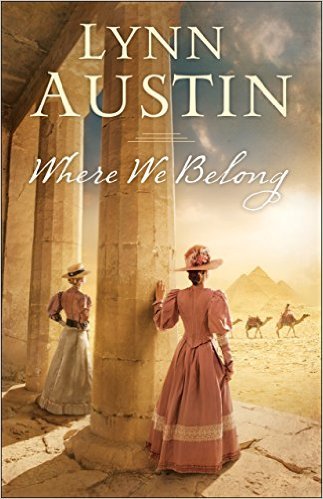
In Lynn Austin’s novel, Where We Belong, sisters Rebecca and Flora Hawes are traveling across the Sinai Desert on camels.

That’s particularly unusual for 1892. But neither sister is a conventional Victorian woman.

Rebecca was often bored in school as a child, thirsting for adventure. She convinced Flora to go with her to the train station and shipping line to amass information to persuade their father to take them on a trip overseas. He listened to their reasoning and planned a trip for the following summer. Rebecca found she had an affinity for languages, learning French and a little Italian for the trip. Later she added Greek so she could read Homer in his native tongue and Arabic for another trip.

She thought each journey would get the traveling and adventure bug out of her system. Instead, each journey made her want to travel more. Her father had always urged his daughters to find God’s purpose for their lives. But what could God do with a woman who loved travel, adventure, and learning and had enough wealth to finance any journey she wanted to undertake? The answer came in a surprising way.

Flora was a little more pliable and gracious than Rebecca. Flora didn’t usually initiate adventures, but she could be talked into going and always enjoyed them. She, too, struggled with assessing God’s plan for her life and almost let herself be molded into someone else’s plan for her. But then God’s leading became clear.

Each woman’s story is told in a series of flashbacks, always returning to their current desert trek. Their mother died shortly after Flora was born. They live through a meddling aspiring stepmother, the death of their father, and the Great Chicago Fire. A chance purchase of an ancient manuscript in Cairo turns out to be from an early copy of Scripture, fueling Rebecca’s desire to find more. With the recent publication of Darwin’s book and the tide of scientific discovery turning against the Bible’s truths. Rebecca feels that finding proof of such old copies of Scripture will help prove its validity and reliability. Along the way, she finds a much more personal reason for her quest.

The story is divided into five parts, each told from a different point of view: first Rebecca’s, then Flora’s, then Soren’s and Kate’s, two troubled young people that the sisters help, then back to Rebecca’s. At first Soren’s and Rebecca’s stories just seemed added on, but they did end up blending well with the overarching narrative.

Themes include the nature of Christianity, the Bible’s veracity and reliability, the responsibility of privilege, compassion for the less fortunate, being your own unique person, and finding your purpose in the world and the family of God.

I listened to the audiobook narrated by Mary Beth Light, speeding the rate up to 1.2 since the recording was a bit slow.

I saw that the novel was based on two real-life sisters, but the audiobook didn’t include the author’s notes, and my library didn’t have the book for me to look up that information. I didn’t find much information online except for a reference to twin sisters Agnes Smith Lewis and Margaret Dunlop Gibson, who also traveled, spoke many languages, and found one of the earliest copies of the gospels at Saint Catherine’s Monastery in Egypt. It looks like the novel included many details of the sisters lives but changed some, making them sisters rather than twins, describing different men from their real-life husbands, and detailing different charitable work than what’s listed.

I enjoyed the book and the trajectory of the characters’ lives.

Review: All My Secrets

All My Secrets by Lynn Austin

In Lynn Austin’s Gilded Age novel, All My Secrets, one of the wealthiest men in America has just died. The Stanhopes were contemporaries of New York’s elite families, like the Vanberbilts, Astors, and Van Burens.

Arthur Benton Stanhope III, known as A. B., was only forty-six when he passed. At the reading of his will, his mother, Junietta, wife Sylvia, and daughter Adelaide, or Addy, all found out that the original Arthur Stanhope had written his will in such a way that the Stanhope business and the bulk of the family money could only be passed down to the closest male heir. A small trust was left for Sylvia and Addy, but it was not as large as it might have been if the investments had the expected time to grow. But with a little economy, and perhaps the sale of the family yacht, they should manage fine.

Such economic measures, however, would send them toppling from the pinnacle of society they enjoyed. That was fine with Junietta. But Sylvia’s position and reputation as a hostess were her life. Sylvia decided the best thing they could do was find acceptable suitors to discreetly introduce Addy to in the hope that she might marry well before their financial state became too dire.

Addy didn’t like the idea of marrying a man for his money or feeling like a bargaining chip. Her mother assured her the choice was hers, and she wanted her to be happy. But Addy felt duty-bound to do everything in her power to keep the only home she had ever known in the family for her mother’s sake. Addy herself, didn’t want anything to change more than it had to.

Junietta thought their palatial home was a monstrosity. It had more rooms than they could ever possibly use. Addy had gotten lost in them as a child. The rooms they did inhabit were too large, their decorations overdone. The money expended on their balls and dinner parties could feed other families for weeks. Their contemporaries were gossipy rivals more than friends.

Junietta was more or less trapped in her marriage, but she wants Addy to know she has choices. Will Addy ever warm to the idea that the excessive wealth they are used to is wasteful, that there are better ways to live? Or would Addy write her grandmother off as eccentric? Junietta was going to have to reveal some of the secrets of her past that changed her own views. Would she have time to, before her erratic heart gave out?

I enjoyed this book a lot. I don’t see many novels set in this era, so it was fun to experience that time. Junietta’s secrets were revealed gradually in flashbacks, eventually prompting Sylvia to share secrets of her own. I enjoyed the characters and the natural way the faith element was woven in. The author makes sure to emphasize that being rich is not a sin in itself, and being poor is not inherently virtuous. But we’re all stewards of what we’ve been given.

But the book isn’t just about stewardship. It also involves loss, love, grief, life choices, forgiveness, and more.

In a fun coincidence, my oldest son visited the Marble House in RI with friends. It was built by William Vanderbilt for his wife, Alva, and started off the “summer cottage” fad among the elite (the “cottages” being 50+ rooms rather than what we think of as a cottage). The day after my son told us about his visit to this house, it came up in this book.

I enjoyed the audiobook, nicely read by Sarah Zimmerman. As usual, the audio version did not contain any of the author’s notes at the end, but I found some of that information in an interview with the author here.

I wished that the author had included an epilogue. The characters are left in such a way that we have a good idea what will happen to them, but I would have liked things to be a bit more wrapped up at the end. I just learned in the interview mentioned above that the author has written a novella with these characters that will come out at Christmas.