Laudable Linkage

Welcome to my latest round-up of noteworthy reads around the web:

Please Do and Don’t Assume Motives. This would solve so much. It doesn’t mean being naive.

Are You Becoming More or Less of an Encourager? HT to Challies. “The church must be an oasis for the true Christian! You must be such a great encouragement that you become a breath of fresh air for those who speak to you. Of course, we should confront sin and push people towards holiness, but when people talk to us they should feel like we care about them and, more importantly, their soul. Sadly, as life goes on and as time goes on, we can tend to become crankier and less thankful for our salvation, but the writer of Hebrews calls us to be different.”

We Don’t Need to Go Back to the Early Church, HT to Challies. I’ve heard off and on throughout my Christian life that we need to “do church” like the early church of the first century. But if you read the NT epistles, those churches were rife with problems that the NT writers had to correct.

How Can You Show Radical Hospitality as an Introvert? by Rosaria Butterfield, HT to Challies. “We need the people who are quietly listening and praying as other people are talking, discerning about things.”

Home Libraries Confer Long-term Benefits. “Home libraries are strongly linked to children’s academic achievement.”

Is Turning Off Your Notifications the Ultimate Productivity Hack? HT to Challies. Excess notifications are one of my biggest pet peeves, and I turned off most of them long ago. Especially anything that makes noise. Interesting note here that it takes “on average, 23 minutes and 15 seconds to get back to the task at hand after a distraction.”

And, finally, someone shared this on Facebook. Pretty cute.

Happy Saturday!

Book Review: Emma’s Gift

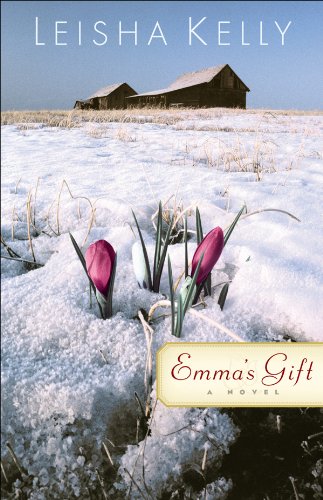
Emma's gift Emma’s Gift is the sequel to Julia’s Hope by Leisha Kelly. I think you could read and understand the second book without the first one, but you’d get much more out of the story with both of them. Plus, since Julia’s Hope will probably be one of my favorite books read this year, I encourage you to read it, too.

In Julia’s Hope, Julia and her husband, Samuel Wortham, and their two children lost everything during the Depression. They were hitchhiking east to get a job with Samuel’s cousin when they got word that the job fell through. Totally alone and with no hopes, they find shelter in an abandoned farmhouse. Then Julia gets the idea that perhaps the owner would let them stay in return for fixing up the place. They find the owner, Emma, who is an elderly amputee who can no longer live alone. She agrees to the arrangement, much to the consternation of some of her friends who think the Worthams are taking advantage of her. Before long the Worthams suggest that Emma come back to the farmhouse and stay with them, which she agrees to do, and they become something of an adopted family for each other.

Emma’s Gift picks up the story several months later. Emma was not in good health in the last book and knew her time was soon coming to an end. She passes away near the beginning of this story. It’s not unexpected, yet it’s still a blow to the family. But then their neighbor, a mother of ten children, passes away the same night, totally unexpectedly. The Worthams take in the children while the woman’s husband, George, deals with his grief. While glad to help, and, really, having no choice, an addition of ten children, one a newborn, weighs heavily. Helping the children through their grief while dealing with their own is a challenge.

Uncertainty also weighs on both families as their houses and land were owned by Emma. Emma had tried to give the Worthams the deed to the house they were in, but Samuel refused at the time. George has been unable to make any payments for months, if not years, and Emma wanted to forgive the debt. But now her affairs are in the hands of her nephew, so everyone has to wait to see whether he’ll abide by Emma’s wishes or take the property as his own.

Some of the townspeople bring food out and stay to help with the children, which helps Julia to feel that they are finally accepted. Some of the men help Samuel deal with George, who is on the verge of doing something stupid.

Even though the first part of the book is heavy with grief, please don’t let that deter you. The light does break through in the end, and it’s heartwarming to see the progression.

The point of view switches back and forth between Julia and Samuel. Two themes emerged for me: that everyone has something to give to help others no matter how much or little they have, and when you’re weighed down almost to the breaking point, God’s grace sufficient.

A few favorite quotes:

It made me feel good inside to love her right over top all the rough edges.

Kissing cheeks, passing plates, even listening to George pour out his woes one more time over a late cup of root coffee—it was all the work of God. Because people need each other. And sometimes we don’t realize how much we have to give until we’ve started giving it.

It doesn’t take away the pain of this world. But just knowing the outcome can stop the ache that comes in the middle of some lonely night, or can give you words to make a crying child smile again. God is faithful. Our shelter in the time of trouble. Our refuge in the time of storm. We don’t always know what he’s given us. When we’re deep in the hurt of some awful moment, we don’t always know what good things God has prepared for the days ahead. But we do know so much of himself has been given to our hands. To cherish. To rest in. And especially to share.

These two books are all I have, but there is another sequel, and then another three-book series with some of the same characters as well as a Christmas story. I’d like to get to the rest of them some day. In looking up Leisha Kelly after reading the last book, I was sad to discover that she and her teenage son had died in a car accident some years ago. But I am glad she left this legacy behind.

(Sharing with Carole’s Books You Loved, Semicolon‘s Saturday Review of Books, Literary Musing Monday)

What’s On Your Nightstand: September 2018

Nightstand82The folks at 5 Minutes For Books host What’s On Your Nightstand the last Tuesday of each month in which we can share about the books we have been reading and/or plan to read.

I checked my calendar yesterday morning, but I somehow got my weeks mixed up and thought I had another week before the Nightstand post! Instead, I am a day late. Oh, well…

Since last time I have completed:

The Guernsey Literary and Potato Peel Pie Society By Mary Ann Shaffer and Annie Barrows, reviewed here. Loved this! And the movie was wonderful, too, despite a few changes to the plot.

Julia’s Hope by Leisha Kelly, reviewed here. Loved this story about a family struggling during the Depression who ends up sharing a house with an elderly amputee.

Tea With Emma by Diane Moody, reviewed here. Something of a modern take on Jane Austen’s Emma. It was…okay.

Reclaim Your Life from IBS: A Scientifically Proven Plan for Relief without Restrictive Diets by Melissa G. Hunt, reviewed here. Both practical and helpful.

Helen Roseveare: On His Majesty’s Service by Irene Howat, reviewed here.

The Scars That Have Shaped Me: How God Meets Us in Suffering by Vaneetha Rendall Risner, reviewed here. Excellent. Deep. Convicting.

I’m currently reading:

Emma’s Gift by Leisha Kelly

The Lost Castle by Kristy Cambron

Rereading Women of the Word by Jen Wilkin

I’ve been using my normal audiobook time to listen to a series of lectures on Classics of British Literature by John Sutherland.

I’m also reading parts of The Elements of Style by William Strunk and E. B. White, but it’s more of a reference book than one to read straight through.

Up Next:

Reading the Bible for Life: Your Guide to Understanding and Living God’s Word by George Guthrie. Some of his blog posts have been very helpful to me, so I am looking forward to his book.

There’s a Reason They Call It GRANDparenting by Michele Howe, recommended by Michele Morin.

I am trying to decide whether my next audiobook with be Amazing Grace: William Wilberforce and the Heroic Campaign to End Slavery by Eric Metaxas or Alvin York: A New Biography of the Hero of the Argonne by Douglas V. Mastriano. I know a little of both men’s stories and would like to learn more.

I have all kinds of Christian fiction in my Kindle app and on my shelf, but I am not sure which one will be next.

I think that wraps up by reading activity for this month! Are you reading anything good?

Book Review: Tea With Emma

 Tea With Emma by Diane Moody is a story within a story.

The outer story has writer Lucy Alexander with writer’s block ever since her beloved aunt died. When Lucy’s father sends her the teacup collection that her aunt had willed to her, Lucy is reminded of their special times together and of the Jane Austen book her aunt had bought for her.

Then Lucy is inspired: she can write a series of stories based on each of the cups. The first one is loosely based on Jane Austen’s Emma.

Next comes the first story, Tea With Emma.

Two lifelong friends, Maddie and Lanie, are just returning from a trip to England. Maddie is inspired to open an English tea shop, and Lanie has agreed to help her. Their giggling and carrying on in the plane annoys the seatmate in front of them, an English professor. In a comedy or errors, the girls and the professor keep running into each other, with near-disastrous results.

When Maddie goes home to her grandmother in Texas, whom she has taken care of since the latter had a stroke, she lays out her plans for the tea room and gets her grandmother’s blessing. She soon discovers that the grumpy professor lives across the street. She tries to befriend him, but he rejects her efforts.

Inspired by Jane Austen’s Emma, but evidently missing what Emma had learned by the end, Maddie feels God’s mission for her life is to be a matchmaker. She encourages Lanie towards the contractor and away from an online computer geek. It does not go well.

Meanwhile the professor has to come to grips with the issues in his life which have made him so cranky.

My thoughts:

I thought the premise would make for a fun, touching story, but I just didn’t connect any of the characters, except maybe the grandmother and the computer guy. Maddie and Lanie seemed juvenile, Maddie seemed pushy, and the professor was just a grouch, at least until he got his heart right. And the transformation from irritation with Maddie to falling in love with her just seemed too quick and unrealistic. Of course, this is a novella, so things had to happen a little faster than they would have in a longer novel.

I enjoyed the theme of letting God have control and following His direction. Both Maddie and the professor became more likeable by the end of the story. I know Jane Austen’s Emma goes through a similar learning curve, but I always found Emma sophisticated and likeable even while I disliked her actions and motivations at the beginning.

Reviews on Amazon were mixed, with some people loving the story and others not, so it may just be a matter of personalities not appealing to everyone. It’s a sweet, clean story. So don’t let me discourage you from trying the book, especially as it’s free for the Kindle at the moment.  I’d love to hear what you thought of it.

(Sharing with Semicolon‘s Saturday Review of Books, Literary Musing Monday)


What’s On Your Nightstand: August 2018

Nightstand82The folks at 5 Minutes For Books host What’s On Your Nightstand the last Tuesday of each month in which we can share about the books we have been reading and/or plan to read.

As we near the end of another month, it’s time to recap what we’ve read.

Since last time I have completed:

The Hunchback of Notre Dame by Victor Hugo, reviewed here. Not my favorite classic or Hugo book, but I am glad to have read it. It kept me thinking for days afterward.

30 Days of Hope When Caring for Aging Parents  by Kathy Howard, reviewed here. Very good.

Full Assurance by Harry A. Ironside, reviewed here. Excellent study on what the Bible has to say about assurance of salvation.

The Pattern Artist by Nancy Moser, reviewed here. A maid from England accompanies her employers on a visit to America in 1911, then strikes out on her own. She lands a job in the sewing department of Macy’s and captures the attention of the Butterick Patterns salesman. Very good!

Back Home Again: Tales from the Grace Chapel Inn by Melody Carlson, reviewed here. Three sisters turn the old family home into a bed-and-breakfast, working through their own differences and town opposition. The first in a long series. Good.

Before We Were Yours by Lisa Wingate, reviewed here. Riveting historical fiction based on real circumstances concerning a woman who stole poor children and then placed them for adoption.

The Incorrigible Children of Ashton Place: Book VI: The Long-Lost Home by Maryrose Wood, reviewed here. A fun and satisfying wrap-up to this series.

Reshaping It All: Motivation for Physical and Spiritual Fitness by Candace Cameron Bure, reviewed here. Cameron’s journey from bulimia and excess weight to fitness, inside and out. Very good.

I’m currently reading:

The Guernsey Literary and Potato Peel Pie Society By Mary Ann Shaffer and Annie Barrows. Finally!

Helen Roseveare: On His Majesty’s Service by Irene Howat

Reclaim Your Life from IBS: A Scientifically Proven Plan for Relief without Restrictive Diets by Melissa G. Hunt

Up Next:

Christian Publishing 101 by Ann Byle

I’d like to reread, or at least look through again, Women of the Word by Jen Wilkin

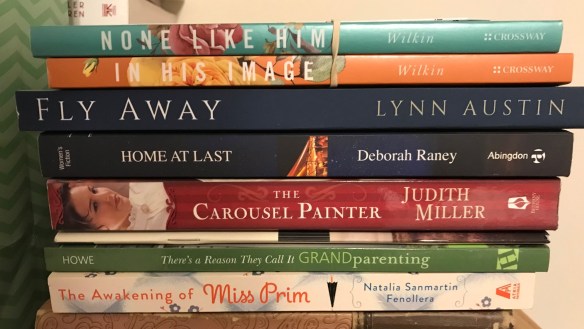
Something from this stack and my ever-increasing Kindle collection:

IMG_1115

Are you reading anything good now?

Book Review: Before We Were Yours

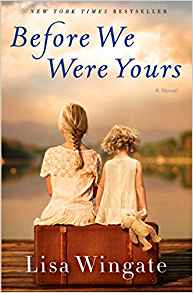
Truth is stranger than fiction, the saying goes. It is also more heartbreaking. One of the saddest and strangest situations in history is the story of Georgia Tann and the Tennessee Children’s Home Society she operated. Georgia would abduct poor children by various illegal means: outright kidnapping, taking children born to unwed mothers for “medical care” and then telling the mothers their babies died; tricking parents into signing their children over to the home, and others. Policemen, family court judges, a crime boss, and others were a part of Tann’s network. The children they obtained would be adopted out to unsuspecting couples or sometimes sold to high-profile, wealthy families. Records were often destroyed or falsified. Even though Tann thought the children would be better off in their new situations, ultimately her enterprise was a money-making scheme. Tann died while she and the home were investigated, but before she could be brought to justice.

Before we were yoursLisa Wingate sets her novel Before We Were Yours in these circumstances.

Avery Stafford is a senator’s daughter being groomed to take his place. On a trip with her father to a nursing home, a resident pauses before Avery, seems to recognize her, and calls her “Fern.” An aide hustles the woman away, chalking the incident up to dementia. But the woman made off with Avery’s heirloom bracelet, and when Avery goes back to the woman’s room to retrieve it, she sees a framed photograph of a woman who looks remarkably like Avery’s grandmother. Conversations with the resident, May, lead Avery to look into her grandmother’s journals. Every scrap of information uncovered produces more questions. Avery isn’t sure what she will ultimately find or what the consequences will be, but she feels compelled to know the truth. And the process causes Avery to question whether she is living a “role” in life set out for her by others.

May’s story is told in flashbacks. She was born Rill Foss, the oldest of five children who lived with their parents on a houseboat. When Rill’s mother goes into hard labor, the midwife insists that she be taken to the hospital. While Rill’s parents are gone, a policeman comes to pick up the children, saying he will take them to see their parents. Instead, he takes them to a woman waiting in a nearby car, who whisks them away to a children’s home.

Children in the home are neglected, not well fed, and abused. But when potential adoptive parents come, the children are dressed up and threatened to be on their best behavior. One by one Rill’s siblings disappear, but when she protests or tries to thwart their removal, she is punished and her remaining siblings threatened.

Even though May’s history is heart-rending, ultimately the book ends redemptively and hopefully.

Lisa’s scenes on the river are so real, I could almost see and smell and feel the surroundings. I ached with May through her story and the ultimate hard choice she had to make, and rejoiced at how things wrapped up for her. And I enjoyed Avery’s story as well.

A very well-written, excellent book.

(Sharing with Semicolon‘s Saturday Review of Books, Literary Musing Monday, Carole’s Books You Loved)

Book Review: Reshaping It All

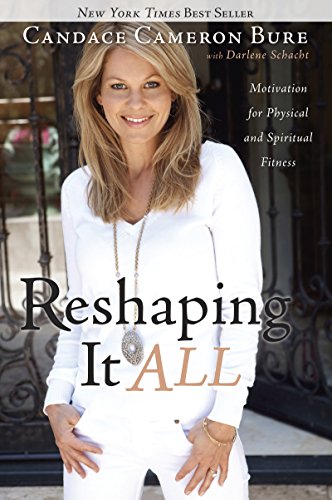
ReshapingSome of you may remember Candace Cameron Bure as oldest daughter D. J. Tanner in the TV series Full House several years ago. I have not really kept up with her career since then, but somehow I was aware that she’d had some eating issues, had lost weight, and was an outspoken Christian like her brother Kirk Cameron. So when her book, Reshaping It All: Motivation for Physical and Spiritual Fitness came up on a Kindle sale, I got it.

Although the book is not a full-fledged memoir, Candace gives glimpses of her growing-up years, family, time on Full House, marriage, and motherhood.

Her family seems remarkably grounded: even though Cameron and her brother were making all kinds of money, their father still made them work (at other jobs: he didn’t consider acting “work”) when they wanted something.

He could see that hard work was not only a prerequisite for success but that it was also a prerequisite for strong character. Struggling for the things we get teaches us the all-important lesson of self-disciple while it strengthens our body and spirit. It wasn’t enough for us to achieve a certain level of success in this world: our parents wanted us to reach our full potential as people who are strong in spirit and mind.

But Candace received mixed signals about food. He father provided “cardboard-tasting ‘health’ food” while her mother brought in doughnuts and such. Various other factors came into play, resulting in Cameron’s being about 25 pounds overweight and suffering from bulimia in her early twenties.

What I didn’t realize at the time is that my heart was longing for the things of this world. I ran to comfort food instead of running to God. I discovered my sin, but I hadn’t discovered that my heart was in the wrong place. I sought moral reformation instead of spiritual transformation. I had known who He was, but I still hadn’t grasped who I was in His sight.

She tells how she changed her approach to food and fitness. She didn’t follow a specific diet plan, and she believed everything was allowable in moderation, but she had a few principles she went by.

Transforming our bodies must begin by the renewing of our minds. Our bodies aren’t making these detrimental choices for us; they are simply animated by a mind that needs a mental makeover.

One such principle was HALT. “When you feel like reaching for food, ask yourself first if you are hungry, angry, lonely, or tired. If you’re hungry, then proceed, but it you are reaching for food in response to emotion, then halt your behavior immediately.”

And even though the book is primarily about her journey towards fitness, she applies some of the same principle to style, clutter, marriage, and other facets of life.

Candace became a Christian at age 12, and the life principles she espouses are based squarely on Scripture. She writes in a conversational, level-headed, encouraging, easy to read style.

Standing face-to-face with a mountain can be overwhelming, especially when your perspective is that of looking up from the bottom. But if we decide to take one step and then another, looking only at the ground set before us, we realize the potential we have.

The only negative for me was the fan letters. At the end of every chapter, Cameron includes a fan letter asking her a question related to the chapter before. That was fine, but each letter also contains a certain amount of fannish praise that I felt awkward reading.

This book was written back in 2011, before her co-hosting stint on The View and other pursuits. She has written a few more books since that time, too.

I enjoyed the book very much and took away a few nuggets to help me in my own journey.

(Sharing with Semicolon‘s Saturday Review of Books, Literary Musing Monday, Carole’s Books You Loved)
Laudable Linkage

IMG_0195

I’ve been mostly absent from the blog this week. It’s rare for me not to do a Friday’s Fave Five, even if I don’t post anything else. But it has been a busy week: card-making and present-shopping and wrapping for a baby shower and my oldest son’s upcoming birthday, house-cleaning for my son’s visit from out of state, buying tons of food for family get-togethers, etc, etc. It’s amazing what you can done when you’re not blogging! 🙂 I am not sure how much I will be online the next week. My oldest son is here, my husband is off, we’ll have more time with the whole family. But, in the past when I have thought I would not be posting much, I have been surprised. Our whole family likes our computer time, so we’ll see.

Meanwhile, I have collected in odd moments online the last week some thought-provoking, helpful reads I wanted to share with you.

Poor Interpretation Lets Us “Believe” the Bible While Denying What It Actually Say, HT to Challies. “Historically, theological liberals denied Scripture, and everyone knew where they stood. But today many so-called evangelicals affirm their belief in Scripture, while attributing meanings to biblical texts that in fact deny what Scripture really says. Hence they ‘believe every word of the Bible’ while actually embracing (and teaching) beliefs that utterly contradict it.”

Grace Comes With Refills.

Love Is Not a Feeling.

Praying the Words of Jesus for Your Teen.

Pants on Fire. The folly of the “I don’t know whether this is true or not; but I just wanted to get it out there” type of post.

Are We All “Harmless Torturers” Now? HT to Challies. “When we think of the savagery of social media, we often think of awful individual behavior…Harmless Torturers never go that far; we just like, retweet and add the occasional clever remark. But there are millions of us, and we’re all turning the dial.”

Why Getting Lost in a Book is So Good for You, HT to Linda.

Finally, you might be blessed by this video even if you don’t know Ron and Shelly Hamilton (of Majesty Music, aka Patch the Pirate and Sissy Seagull) and Shelly’s parents, Frank and Flora Jean Garlock. I had no idea the Garlocks were in this situation or that Ron had been diagnosed with dementia. This is not only an update of how they are doing, but a sweet testimony of a man caring for his wife.

Laudable Linkage

I have just a short list today, but I thought it best to go ahead and share it rather than have an overly lengthy one next time.

The Greatest Thing You Can Do With Your Life.

Know the Neighborhood, HT to True Woman. “Because many Christians have not ‘walked the streets’ of our Bibles, we are overly susceptible to the views of others, right or wrong. Like would-be travelers or gullible sightseers we take as fact the opinions of the ‘experts’ about the 66 cities we have rarely or never been to visit.”

Why Women Should Be Readers of Good Books, HT to Out of the Ordinary.

The “At Least” Among Us, HT to True Woman. “The thing about saying ‘At least’ to someone—particularly someone who’s confessing their own anger, fear, grief, or sadness at the circumstances of their life, is it negates their wrestle and it naturally elevates our own.”

Five Dangers of Reading Christian Biographies, HT to True Woman. You know I love Christian biographies, but there are some potential stumbling blocks in reading them.

And finally, HT to Laura, this fun real estate listing showed a guest using the various facilities on the property.

Happy Friday!

Back to the Classics Challenge Mid-year Check-in

Karen at Books and Chocolate hosts the Back to the Classics Challenge for reading classics at least 50 years old. She’s holding a mid-year check-in for the challenge – and a giveaway!

I enjoy this challenge because I was not exposed to many classics as I grew up, and this challenge inspires me to expand my horizons and explore books I might not otherwise read. I’m happy to report that I have read 11 of the 12 classics on my list, and I am now reading (or listening to) the 12th. Here’s what I’ve read so far:

My unfinished one is a classic that scares you (due to its length or it intimidates you in some way), and for that I chose The Hunchback of Notre Dame by Victor Hugo. I’m working on it now.

Karen allows for three children’s classics, and I am counting Where the Red Fern Grows, The Secret Garden, and Journey to the Center of the Earth for those. I’m not counting 20,000 Leagues Under the Sea because nothing I read about it indicated it was written for children.

I enjoyed all of these except Journey to the Center of the Earth, but I think my favorite is He Fell in Love With His Wife. Adam Bede would be a close second. Frankenstein was the biggest surprise.

Have you read any classics lately?