If Jesus Had Not Been Resurrected

If Jesus Had Not Been Resurrected

There’s an old Christmas song I’ve only heard a few times titled “If Jesus Had Not Come” by Albert C. Norton and Donald P. Hustad. The songwriters list several consequences we would face if Jesus never came to earth. Then the rousing chorus affirms:

But Jesus came! He came to earth,
And men beheld His manger birth!
The shepherds heard the angels sing,
The wise proclaimed Him Lord and King!
He died, He rose; and by His blood,
We too become the sons of God;
We preach the gospel in His name!
For Jesus came! Yes, Jesus came!

This Easter week, I’m thinking about what the consequences would be if Jesus had not been raised from the dead.

No resurrection for us. 1 Corinthians 15:20-23 says Jesus was the “firstfruits of those who have fallen asleep. For as by a man came death, by a man has come also the resurrection of the dead. For as in Adam all die, so also in Christ shall all be made alive. But each in his own order: Christ the firstfruits, then at his coming those who belong to Christ.” If He wasn’t raised from the dead, we won’t be, either. “If in Christ we have hope in this life only, we are of all people most to be pitied” (verse 19).

Futile faith. “If Christ has not been raised, then our preaching is in vain and your faith is in vain . . . And if Christ has not been raised, your faith is futile and you are still in your sins” (1 Corinthians 15:14, 17).

No meaning in life. Paul questions the worth of the dangers he endured for gospel’s sake if there is no resurrection. “If the dead are not raised, ‘Let us eat and drink, for tomorrow we die'” (1 Corinthians 15:30-32).

Death’s sting. Paul concludes his “resurrection chapter” with this: “For this perishable body must put on the imperishable, and this mortal body must put on immortality. When the perishable puts on the imperishable, and the mortal puts on immortality, then shall come to pass the saying that is written: ‘Death is swallowed up in victory.’ ‘O death, where is your victory? O death, where is your sting?'” (1 Corinthians 15:53-55). But if Jesus is not risen, death’s sting is still with us.

No hope. Peter begins his epistle by saying, “Blessed be the God and Father of our Lord Jesus Christ! According to his great mercy, he has caused us to be born again to a living hope through the resurrection of Jesus Christ from the dead” (1 Peter 1:3). But if there is no resurrection, we don’t have a living hope.

No inheritance. Peter speaks of an “inheritance that is imperishable, undefiled, and unfading, kept in heaven for you” which encourages us in our trials. But we’ll never receive that inheritance if there is no resurrection. (Ephesians 1 also speaks of our inheritance.)

No seeing loved ones again. When a loved one dies, or when facing our own death, one comfort is that we’ll see our loved ones again if they’ve believed on the Lord. Paul shares in 1 Thessalonians 4:13-18 that those who have already died will be reunited with those of us who are still alive when Jesus returns. Therefore we do “not grieve as others do who have no hope.” But without that hope, we’ll be swallowed up in grief.

No comfort. After sharing the expectation that we’ll see our loved ones again after death, Paul tells us to comfort (some versions say encourage) one another with these words. Likewise, Peter says we can rejoice in our sufferings when Jesus’ glory is revealed (1 Peter 4:12-14). But with no resurrection, there is no comfort.

No power. Paul prays that we may know “what is the immeasurable greatness of his power toward us who believe, according to the working of his great might that he worked in Christ when he raised him from the dead and seated him at his right hand in the heavenly places” (Ephesians 1:19-20). But with no resurrection, there is no resurrection power.

No intercession. Hebrews 7:25 says Jesus “is able to save to the uttermost those who draw near to God through him, since he always lives to make intercession for them.” I can’t imagine being without His prayers!

No wrongs set right. One of our comforts in a world where there are so many wrongs is that some day they will be set right. Paul preached that God “has fixed a day on which he will judge the world in righteousness by a man whom he has appointed; and of this he has given assurance to all by raising him from the dead” (Acts 17:31). But without the resurrection, those wrongs will never be righted.

No seeing Jesus. In this life, we love and believe in Jesus, though we do not see Him (1 Peter 1:8). We look forward to that “blessed hope, the appearing of the glory of our great God and Savior Jesus Christ, who gave himself for us to redeem us from all lawlessness and to purify for himself a people for his own possession” (Titus 2: 13-14). If he’s still buried, we won’t see Him.

No motivation. Paul concludes all he says about resurrection by encouraging, “Therefore, my beloved brothers, be steadfast, immovable, always abounding in the work of the Lord, knowing that in the Lord your labor is not in vain” (1 Corinthians 15:58). But without resurrection, our work would be largely in vain and we’d lose our impetus to keep going.

Facing God’s wrath. Paul writes of the Thessalonians who “wait for his Son from heaven, whom he raised from the dead, Jesus who delivers us from the wrath to come” (1 Thessalonians 1:10). But if Jesus was not raised from the dead, we’re not delivered.

How bleak and hopeless life would be if Jesus had not been raised from the dead.

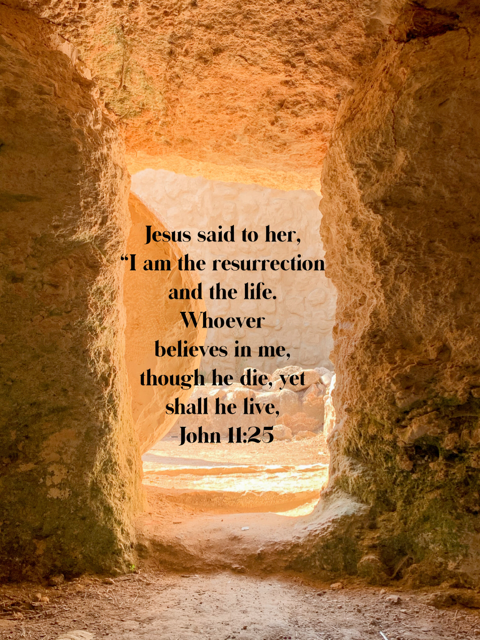
But, thank God, He has been raised! Not only that, He is the resurrection! He told Martha, “I am the resurrection and the life. Whoever believes in me, though he die, yet shall he live” (John 11:25).

I love how Krissy Nordhoff and Michel Neale expressed the joy of Jesus’ resurrection in The Mercy Tree (these are some middle verses and the chorus):

Hope went dark that violent dayThe whole earth quaked at love’s displayThree days silent in the groundThis body born for heaven’s crown.
 
And on that bright and glorious dayWhen heaven opened up the graveHe’s alive and risen indeedPraise Him for the Mercy Tree!
 
Death has died, love has wonHallelujah!, Hallelujah!Jesus Christ has overcomeHe has risen from the dead.

May we rejoice in all Jesus accomplished through His life, death, and resurrection! Hallelujah!
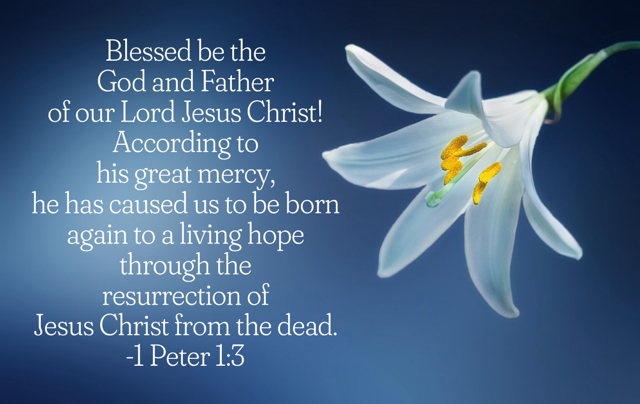
1 Peter 1:3

(I often link up with some of these bloggers.)

Laudable Linkage

Laudable Linkage

Here are some of the good reads found this week:

The Resurrection and the Rest of Your Life. “Encountering Jesus—walking with Him through both suffering and resurrection—changes you. When you trace His steps all the way to the cross and begin to grasp the weight of His love, when you witness His power over death and realize what He has already overcome—you don’t walk away the same.”

The Most Radical Thing You Can Bring to Easter Dinner, HT to Challies. “You look at the calendar and begin counting down the days to Easter—not with anticipation, but with angst. What should be a grateful celebration of the greatest event in history, Christ’s resurrection, is instead a time of stress as you think about getting together again with troublesome friends or family members.” Thankfully, none of the people we’re having for Easter is troublesome. But these reminders are good for any time of year.

The Dragon and the Rooster, HT to Challies. A father and daughter at odds and the power of forgiveness.

When Scripture Gets Stale, HT to Challies. “If you’re getting mired down in your reading, I want to give you some tips to help you refresh your mindset. If reading the Bible began to feel stale to me, here are five things I would do.”

When a Good Thing Turns Deadly, HT to Challies. Good and harmless things can become deadly if overindulged.

How to Publicly Thank God After a Work Win, HT to Redeeming Productivity. “Over the years, we’ve watched as the occasional actor or athlete directs thanks to God during an award show acceptance speech or after a big game. While most of us will never celebrate a win on national network television, gone are the days of a simple in-office announcement or a quiet dinner with family to celebrate a work promotion. Now, we update our LinkedIn profiles with a carefully crafted announcement that reaches beyond the intimate circles of our workplace or kitchen table. It’s wise to be discerning about how (and to whom) our gratitude is directed when we share good news.”

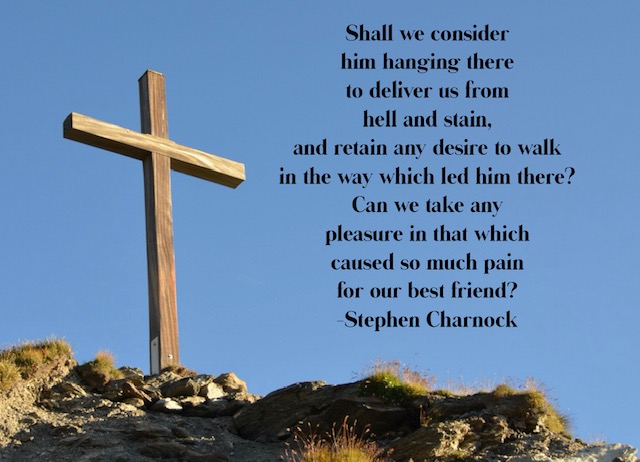
Shall we consider him hanging there to deliver us from hell and stain, and retain any desire to walk in the way which led him there? Can we take any pleasure in that which caused so much pain or our best friend? Stephen Charnock

Laudable Linkage

Laudable Linkage

Here’s another weekly round-up of good online reads.

Sacrifice Is the Beginning. “Maybe the giving up, the surrendering, is not the end at all. Maybe it is the very beginning of something new, something bigger, and more purposeful.”

Longing for More, HT to Challies. “On a soul level, whether in our highest or lowest moments, we know from our earliest memories that something critical is missing. And God shows us in all kinds of ways that He is that vital ingredient.”

Resurrection Sunday Hope for a Tuesday Afternoon. “While we can’t ride the Easter high every day of the year (the jelly bean supply just can’t keep up!), the hope of the resurrection never wanes. You can have hope, joy, and peace in the middle of your Tuesday doldrums or Thursday despair because Jesus is our risen Savior.”

Is the Lord’s Supper a Feast or a Funeral? HT to Challies. “When we approach the Lord’s Supper we should do so with an attitude marked primarily by joy, and not sorrow. We come singing and rejoicing, not mourning or weeping. Yet, how can this be if the thought of death pervades the very foundations of the sacrament? The answer lies in the gospel.”

Is the ‘Silent Treatment’ a Godly Approach to Conflict? HT to Challies. Though I agree with the writer that silence and withdrawal shouldn’t be used as punishment, some quiet time lets emotions cool down and helps us process what the conflict was all about and how to deal with it.

10 Reasons to Hate Hospitality and 10 ways to rethink it.

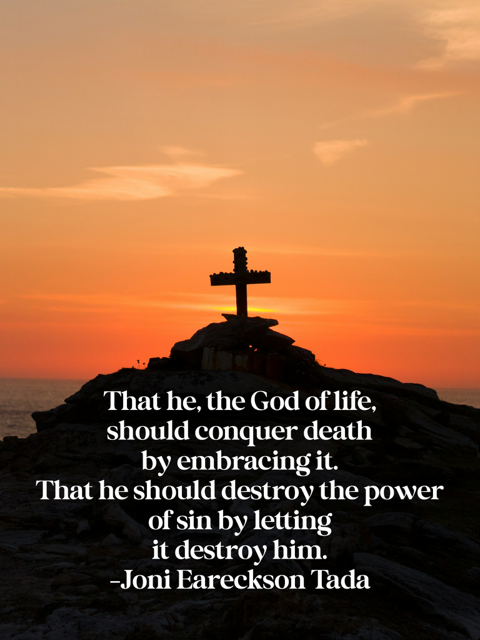
Jesus destroyed sin by letting it destroy him.

That he, the God of life, should conquer death by embracing it.
That he should destroy the power of sin by letting it destroy him.
Joni Eareckson Tada, When God Weeps

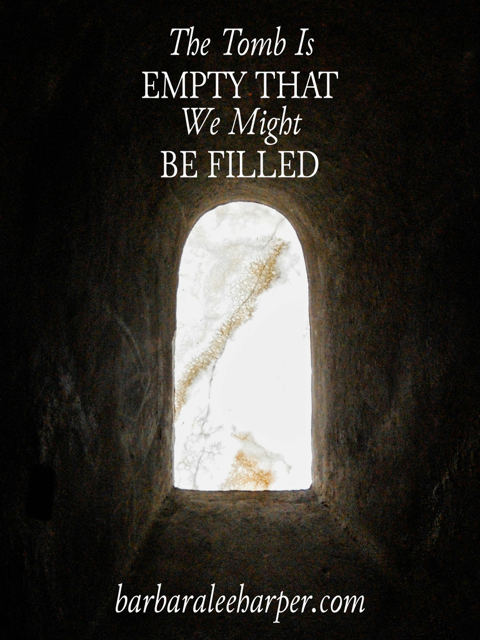
The Tomb Is Empty that We Might Be Filled

The tomb is empty that we might be filled.

Some people only think about Jesus at Christmas. Perhaps they are inspired by sweet paintings of a mother and child and promises of peace on earth and good will to men.

But Jesus is no longer in the manger.

He grew up to be a man, led a righteous life, kept all of God’s law in our place, and died on the cross for our sins. His death on the cross canceled our sin debt, demonstrated His love, reconciled us to God, took the punishment for our sins, made it possible for us to be saved, and more.

But Jesus is no longer on the cross.

Some of His last words were “It is finished.” He had done everything necessary to make it possible for people to be saved.

He was taken down from the cross and buried in a borrowed tomb.

But Jesus is no longer in the tomb.

When friends came to care for His body, instead they found an angelic messenger declaring, “He is not here; He is risen, just as He said.” “God raised him up, ending the pains of death, because it was not possible for him to be held by death” (Acts 2:24, CSB).

Jesus’ resurrection testifies that Jesus is the Son of God, validates His claims, removes death’s sting, gives hope in sorrow, show’s God’s power, and so much more.

Now Jesus is sitting at the right hand of the Father, praying for us, and preparing a place for us to be with Him. Yet He also dwells in our hearts through faith. “Christ in us” is “the hope of glory” (Colossians 1:27).

The manger, the cross, and the tomb are all empty—that we might be filled with His presence, pardon, power, and peace.

Emptied that Thou shouldest fill me,
A clean vessel in Thy hand;
With no pow’r but as Thou givest
Graciously with each command.

Witnessing Thy pow’r to save me,
Setting free from self and sin;
Thou who boughtest to possess me,
In Thy fullness, Lord, come in.

Mary E. Maxwell, “Channels Only”

“If you come to seek His face, not in the empty sepulchre, but in the living power of His presence, as indeed realizing that He has finished His glorious work, and is alive for evermore, then your hearts will be full of true Easter joy, and that joy will shed itself abroad in your homes. And let your joy not end with the hymns and the prayers and the communions in His house. Take with you the joy of Easter to the home, and make that home bright with more unselfish love, more hearty service; take it into your work, and do all in the name of the Lord Jesus; take it to your heart, and let that heart rise anew on Easter wings to a higher, a gladder, a fuller life; take it to the dear grave-side and say there the two words ‘Jesus lives!’ and find in them the secret of calm expectation, the hope of eternal reunion.” —John Ellerton

Jesus is the resurrection and the life. Whoever believes in Him will live though he dies.

This post was inspired by a short piece written by Terry Rayburn.

I often link up with some of these bloggers.

Why Is the Resurrection of Jesus Christ Important?

Why is the resurrection of Jesus Christ important

Easter Day! Time for new, springy clothes, a ham dinner, brightly colored eggs, and chocolate bunnies.

And the celebration of Jesus’ resurrection.

I’m not against those other things. I enjoy them all. But I do fear that the resurrection gets lost in the shuffle except for a special church service and hymns.

Even as Christians, sometimes we’re so used to the resurrection, we forget how special, how life-changing, how dynamic it is.

Or we might be comforted by the resurrection when a loved one dies, but we don’t think it affects everyday life much.

So I thought I’d spend some time thinking about just why the resurrection of Christ is important.

The resurrection of Christ proves His deity.

Set apart for the gospel of God, which he promised beforehand through his prophets in the holy Scriptures, concerning his Son, who was descended from David according to the flesh and was declared to be the Son of God in power according to the Spirit of holiness by his resurrection from the dead, Jesus Christ our Lord (Romans 1:1b-4).

He has fixed a day on which he will judge the world in righteousness by a man whom he has appointed; and of this he has given assurance to all by raising him from the dead (Acts 17:31).

The resurrection of Christ validated what He said. He foretold many times that He would rise after three days in the grave. Here are just a few:

From that time Jesus began to show his disciples that he must go to Jerusalem and suffer many things from the elders and chief priests and scribes, and be killed, and on the third day be raised (Matthew 16:21).

As they were gathering in Galilee, Jesus said to them, “The Son of Man is about to be delivered into the hands of men, and they will kill him, and he will be raised on the third day.” And they were greatly distressed (Matthew 17:22-23).

And as they were coming down the mountain, he charged them to tell no one what they had seen, until the Son of Man had risen from the dead (Mark 9:9).

The resurrection is part of the gospel. When Paul spoke of sharing the gospel, the resurrection was an integral part of it.

Now I would remind you, brothers, of the gospel I preached to you, which you received, in which you stand, and by which you are being saved, if you hold fast to the word I preached to you—unless you believed in vain.

For I delivered to you as of first importance what I also received: that Christ died for our sins in accordance with the Scriptures, that he was buried, that he was raised on the third day in accordance with the Scriptures (1 Corinthians 15:1-4).

That is why his faith was “counted to him as righteousness.” But the words “it was counted to him” were not written for his sake alone, but for ours also. It will be counted to us who believe in him who raised from the dead Jesus our Lord, who was delivered up for our trespasses and raised for our justification (Romans 4:22-25).

Without the resurrection, we’re still in our sins.

And if Christ has not been raised, your faith is futile and you are still in your sins. Then those also who have fallen asleep in Christ have perished. If in Christ we have hope in this life only, we are of all people most to be pitied (1 Corinthians 15:17-19).

I’ve heard some say to the unsaved, “If I’m wrong and you’re right, I’ve lost nothing. But if I’m right and you’re wrong, you’ve lost everything.” But that’s not what the Bible says. “If in Christ we have hope in this life only, we are of all people most to be pitied.”

Since Christ was raised, we know we will be, too.

But in fact Christ has been raised from the dead, the firstfruits of those who have fallen asleep. For as by a man came death, by a man has come also the resurrection of the dead. For as in Adam all die, so also in Christ shall all be made alive (1 Corinthians 15:20-22).

For the Lord himself will descend from heaven with a cry of command, with the voice of an archangel, and with the sound of the trumpet of God. And the dead in Christ will rise first. Then we who are alive, who are left, will be caught up together with them in the clouds to meet the Lord in the air, and so we will always be with the Lord. Therefore encourage one another with these words (1 Thessalonians 4:16-18).

Jesus said to her, “I am the resurrection and the life. Whoever believes in me, though he die, yet shall he live” (John11:25).

Since we will all be raised, we will see our loved ones again.

But we do not want you to be uninformed, brothers, about those who are asleep, that you may not grieve as others do who have no hope. For since we believe that Jesus died and rose again, even so, through Jesus, God will bring with him those who have fallen asleep (1 Thessalonians 4:13-14).

The resurrection removes death’s sting. Death is still grievous. It is still an enemy (1 Corinthians 15:26). But knowing that we’ll live again afterward and can meet God forgiven, cleansed, and accepted takes away death’s sting.

When the perishable puts on the imperishable, and the mortal puts on immortality, then shall come to pass the saying that is written:

“Death is swallowed up in victory.”
“O death, where is your victory?
    O death, where is your sting?”

The sting of death is sin, and the power of sin is the law. But thanks be to God, who gives us the victory through our Lord Jesus Christ (1 Corinthians 15: 54-57).

Because Jesus died and rose again, Satan is defeated.

In him also you were circumcised with a circumcision made without hands, by putting off the body of the flesh, by the circumcision of Christ, having been buried with him in baptism, in which you were also raised with him through faith in the powerful working of God, who raised him from the dead. And you, who were dead in your trespasses and the uncircumcision of your flesh, God made alive together with him, having forgiven us all our trespasses, by canceling the record of debt that stood against us with its legal demands. This he set aside, nailing it to the cross. He disarmed the rulers and authorities and put them to open shame, by triumphing over them in him (Romans 11-15).

Since therefore the children share in flesh and blood, he himself likewise partook of the same things, that through death he might destroy the one who has the power of death, that is, the devil, and deliver all those who through fear of death were subject to lifelong slavery (Hebrews 2:14-15).

The “rulers and authorities” mentioned in the last verse are thought to refer to Satan and his minions, the unseen “rulers of darkness.”

God’s power in the resurrection is the same power with which He works on our behalf.

That you may know . . . what is the immeasurable greatness of his power toward us who believe, according to the working of his great might that he worked in Christ when he raised him from the dead and seated him at his right hand in the heavenly places, far above all rule and authority and power and dominion, and above every name that is named, not only in this age but also in the one to come. And he put all things under his feet and gave him as head over all things to the church, which is his body, the fullness of him who fills all in all. (Ephesians 1:19-23).

Because of the resurrection, we can walk in newness of life.

We were buried therefore with him by baptism into death, in order that, just as Christ was raised from the dead by the glory of the Father, we too might walk in newness of life (Romans 6:4).

For the death he died he died to sin, once for all, but the life he lives he lives to God. So you also must consider yourselves dead to sin and alive to God in Christ Jesus. Let not sin therefore reign in your mortal body, to make you obey its passions. Do not present your members to sin as instruments for unrighteousness, but present yourselves to God as those who have been brought from death to life, and your members to God as instruments for righteousness. For sin will have no dominion over you, since you are not under law but under grace (Romans 6:10-14).

Jesus’ resurrection gives hope and meaning to our suffering.

So we do not lose heart. Though our outer self is wasting away, our inner self is being renewed day by day. For this light momentary affliction is preparing for us an eternal weight of glory beyond all comparison, as we look not to the things that are seen but to the things that are unseen. For the things that are seen are transient, but the things that are unseen are eternal. (2 Corinthians 4:16-18).

For I consider that the sufferings of this present time are not worth comparing with the glory that is to be revealed to us (Romans 8:18).

Because He died and rose again, we come to a throne of grace.

Since then we have a great high priest who has passed through the heavens, Jesus, the Son of God, let us hold fast our confession. For we do not have a high priest who is unable to sympathize with our weaknesses, but one who in every respect has been tempted as we are, yet without sin. Let us then with confidence draw near to the throne of grace, that we may receive mercy and find grace to help in time of need (Hebrews 4: 14-16).

Because Jesus rose again, He is interceding for us.

Who is to condemn? Christ Jesus is the one who died—more than that, who was raised—who is at the right hand of God, who indeed is interceding for us (Romans 8:34).

Because of the resurrection, we can be steadfast. After spending 57 verses talking about the resurrection in 1 Corinthians 15, Paul says, “Therefore”—because of all that he said in those 57 verses—

Therefore, my beloved brothers, be steadfast, immovable, always abounding in the work of the Lord, knowing that in the Lord your labor is not in vain (1 Corinthians 15:58).

In Isobel Kuhn’s Nests Above the Abyss, she says the Lisu “have no hope beyond the grave.” She had heard their wail “for the dead and my heart could hardly stand the hopelessness of their agony.” One five-year-old child screamed incessantly when his beloved neighbor died and he understood death for the first time. When he became a young man, he admitted, “after that awful introduction to the fact of death, he could not come upon a grave on the mountainside without getting cold all over.” This, Isobel says, is “a typical scene.” Another “cried so hard and so long he was ill for days” upon learning about death. Some who bury loved ones “sometimes weep themselves blind, and some lose their minds.” Some harden themselves by trying to forget their dead loved one.

That first five-year-old boy grew up to become an evangelist. One time he related his story, then told how he heard one of the missionaries speak on John 11:25, where Jesus said, “I am the resurrection and the life. Whoever believes in me, though he die, yet shall he live.”

“As she explained that verse, suddenly the truth of it broke in on my understanding, and the fact of eternal life, a life after death, a hope beyond the grave, shone before me. I was thrilled through and through; faith and acceptance of the Saviour were born right then in my soul. It was that verse on the resurrection that brought me to Christ; and I have a feeling that I am not the only Lisu to become a believer because of this truth. All of you who were led to become Christians by the resurrection doctrine, hold up your hands.” Ans all over the building hands shot into the air and the glowing joy on their faces told its own story (pp. 16-18).

May those of us who have heard of the resurrection all our lives be impressed anew with its truth, its hope, its victory. May we come to love and appreciate it now more than ever. May the resurrection impact us not just at Easter, but every day.

And may those who have not yet believed do so soon.

(I often link up with some of these bloggers.)