Review: My Beloved

My Beloved by Jan Karon

Jan Karon’s last book in her beloved Mitford series was published in 2017 and was supposed to be the end of the series. But she began to play around with an old short story idea, and eventually came up with My Beloved.

The premise of the story is that Father Tim, an Episcopal priest and the main character, has been told by his wife that all she wants for Christmas is a love letter. In a moment of inspiration, he bares his heart on paper. He also buys her a book of poetry, tucks the letter inside, and wraps them.

But then the letter and book go missing. After tracing his steps and racking his brain, he still can’t find them or come up with any ideas about where they could be. He tries a few times to write another, but just can’t get it to sound like the first one did.

Meanwhile, the letter and book get accidentally passed to various Mitford characters. Sometimes the result is comic, sometimes touching.

There are a few subplots running through the book. One involves Hope, owner of the Happy Endings book store, and the financial difficulties threatening the store. Former Mayor Esther Cunningham and her husband are aging and fussing with their “bossy” daughters over what they can and can’t do.

Dooley made an appearance in the first Mitford book as a “throwaway” boy who comes under Father Tim’s influence and, over the course of the series, eventually becomes his adopted son. Though the Mitford books are generally “cozy” reads, they don’t shy away from serious issues. Dooley’s mother had been an alcoholic who gave away some of her children for drink. Though she has become sober and even become a Christian, and all her children have been found, there are still underlying issues and pains blocking healing and relationships.

This book was structured a little differently, rotating the point of view with each chapter. I loved how the dialect instantly let us know which “voice” was speaking, even though the subject’s name was the name of the chapter.

Some of my favorite quotes:

Father Tim: “God’s love for his children wasn’t just for them to have and to hold, it was to freely, spontaneously give away—and to gratefully receive from others.”

Esther: “She was already surprised, thank you. Surprised by bein’ old as dirt; surprised by losin’ her scatter rugs; an’ surprised by goin’ from a mayor everybody voted for to an old woman whose car battery died months ago from sittin’ in th’ garage with a mouse nest under th’ hood.”

Cynthia: “Every saint has a past. Every sinner has a future.”

Esther: “A recliner was a drug, an’ she was overdosin’.”

Ray: “He would consider it a freebie for old people. I’m not goin’ there.” Esther: “Freebies for old people is exactly where I’m goin’.”

Esther: “At their age, surprises were not a good idea in th’ first place. You could keel over from a surprise.”

Helene: “With war raging around the world and suffering everywhere, how extraordinary, how beautiful this life could be. There were no words, really. No words.”

Father Tim: “There was only one person in the world who would really get what just happened. Thank God he was married to her.”

Father Tim: “Even now, that tribe is splitting apart, that one small wounded fragment is scattering in all directions, nursing their wounds, reluctant to give up anything so darkly familiar as their wounds, and headed to places from which they may not find their way back.”

Father Tim: “Why invite more pain into a family raised on pain? Because pain can serve as a passageway to joy. It’s that dark tunnel that goes through a mountain and dumps us out on the other side where the light is.”

I’ve seen reviews of Christian fiction that complain over the least mention of any religious content. So I have always marveled that these books so full of gospel truth have been so popular with the general public. Oh, I wouldn’t agree with every little point. But the great majority of these books are spot on.

Reading a Mitford book is like a visit back to one’s hometown. It was good to catch up with various characters and their situations.

Updated to add: Jan was interviewed on CBS This Morning recently:

Review: The Bitter End Birding Society

The Bitter End Birding Society

In Amanda Cox’s newest novel, The Bitter End Birding Society, Bitter End is a small town in eastern Tennessee with a variety of legends about how it got its name.

Ana Leigh Watkins, the most recent newcomer to Bitter End, plans to spend the summer helping her great aunt Cora sort through her belongings in preparation for selling her house and moving to a retirement community. In reality, Ana needs time away to recuperate from her year of teaching kindergarten. She’s regarded as a hero for confronting a school shooter who entered her classroom. But she remembers the fear in the young man’s eyes and feels she escalated a situation that could have been resolved peacefully. She can’t forgive herself for the young man’s fate and the trauma caused to her students. The praise she receives only weighs her down further.

Ana gets adopted by a stray dog. While taking him for a walk one day, she runs into a neighbor with a group of birdwatchers who invite her to join them. She learns her aunt is bitter enemies with the head of the bird-watching group. As Ana gently investigates further, she discovers a story over sixty years old of a moonshiner’s daughter, Viola, who falls in love with a preacher’s son. The tragedies that befell them are still having repercussions.

The narrative switches back and forth between Ana’s and Viola’s points of view.

I just discovered Amanda a few years ago and have read all of her books except a novella. I’ve loved every one. The stories are well-written and the characters are easy to identify and empathize with and root for. Their situations tug on the heartstrings, but gentle humor is laced throughout as well. Grace and redemption are underlying themes.

Some of the quotes that stood out to me:

I thought I could fit everything into tidy boxes and sort right from wrong. But now I see that sometimes a saint acts like a sinner. And sometimes a sinner acts like a saint.

Those lines can seem pretty blurry sometimes. One can look just like the other from the outside. I’d say that the difference comes down to the heart. A lost sheep wants to come home but can’t for some reason. Something is getting in their way. But a prodigal is running in the opposite direction on purpose. You can’t make someone come home if they don’t want to. 

It was a mystery how some trinkets and knickknacks were alive with meaning and memory while others were soulless souvenirs. 

Did he know that what he needed for his pain was healing, not an anesthetic? The numbness he felt was not a cure. Anesthesia was not the sort of thing a body could live on.

Healing was an ongoing journey without a fixed destination.

Sometimes things don’t come to a tidy conclusion. Words are left unsaid. Things are left undone. But this life is not the end. . . . . Our present circumstances, our perceived failures, they are not final.

I loved that the birding society visited the Seven Islands State Birding Park, which I have been to.

I listened to the audiobook read by Rachel Botchan, who had a distracting habit of taking a breath in odd places. But otherwise, I enjoyed her narration.

The audiobook does not include the author’s notes, but Amanda has linked to a few interviews she did about this book here, and I found another one here.

Review: By Way of the Moonlight

In By Way of the Moonlight by Elizabeth Musser, Allie Massey’s grandmother, known as Nana Dale, has just died. Nana Dale was an accomplished horsewoman, placing first in several shows and even riding in the Olympics. Their plan had always been that Allie would inherit the grounds, house, and enough money to open an equine therapy business on her grandmother’s property.

But the family learns at the reading of the will that Nana Dale sold the property to a development firm, evidently taken advantage of in her beginning dementia by an unscrupulous contractor.

Now Allie has a limited time to clear the house and have an estate sale before the house is imploded.

Allie is beyond upset. She can’t cope. She even breaks up with her fiance. Nana Dale had left a letter with cryptic instructions to find a cherrywood chest which will have more information. But no one in the family has seen such a chest.

In intermittent flashbacks, we learn of Dale’s life. She had loved horses from her earliest memories. But her father’s business crashed along with the economy during the Depression, and the horses had to be sold. Dale prayed long years that she might find Essie, her beloved filly.

Before the Depression, when her family boarded horses, Dale met a boy named Tommy with a horse named Infinity. The two became friends, even competing as a couple in some events.

The rest of Dale’s story takes us through Tommy’s bout with polio, mounted patrols along the coast during WWII called Sand Pounders, and a daring rescue of a sailor whose ship was torpedoed, which resulted in a major surprise.

In one interview, Elizabeth said part of the story was inspired by her mother’s property in Atlanta. In a series of short videos, Elizabeth takes readers through various areas of the house and grounds that were inspiration for the novel, which was fun to see. She said that there is pressure now, just like in the book, for owners of such properties to sell to developers who want to raze the buildings and put up new cluster houses.

The WWII and Sand Pounders sections of the book are not Elizabeth’s mother’s history. But when she happened upon information about the coastal mounted patrol, she wanted to include them in her book.

Elizabeth says later in her interview that in this book she wanted to “examine the thin line between fighting for what you believe in and developing an unhealthy obsession. Both women learn important lessons about pursuing dreams at all costs, which may cause them to sacrifice something or someone they love.”

I listened to the audiobook read by Susan Bennett. I thought Susan did a great job with the character voices, but the narration seemed too slow. Maybe she thought that was fitting for a Southern accent (the next audiobook I started is also read by Susan, but at a much more normal pace). Also, she had an annoying habit of turning one-syllable words into two syllables, especially at the end of sentences (not to be nitpicky, but after 14+ hours of listening, some things grate). The audiobook didn’t provide any back matter, so I am thankful Elizabeth included information and links to interviews here.

The story itself also seemed a little slow, especially the modern-day part. There’s almost no movement in plot in Allie’s story until near the end.

Nevertheless, overall, this was a good book. One of my favorite quotes, and themes, in the book is “When life gets hard to stand, kneel.”

Another: “Bitterness will rot out your soul. . . You may never get the answer on this side of life to the why. So it’s much better to ask the question, ‘Now that I’m in this place, Lord, what do you want me to do?'”

And “Life ain’t fair. It’s brutal sometimes. . . faith don’t stop the horrible things. But faith helps you walk through those things, whipped and angry and screaming on the inside. Lord don’t mind our screaming and raging. He done shown us how to do it in those psalms of his that King David wrote.”

Elizabeth is one of my favorite authors. Even though I like some of her other books better than this one, I did enjoy this one and can highly recommend it as well.

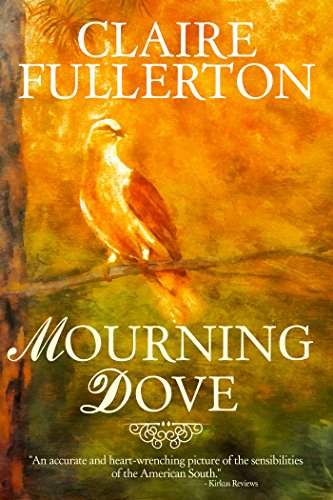
Mourning Dove

Millie Crossan is the narrator of Claire Fullerton’s Mourning Dove. When Millie was in her teens, her mother moved the family from Minnesota back to her native Memphis after her divorce.

Millie’s older brother and hero is Finley, eighteen months her senior. She looks up to him, follows him, feels secure in his care. “His presence was one part security blanket, one part safety net, and two parts old familiar coat conformed to fit my size after years of wear.”

They loved their father, who was much more involved with them than their mother. But he was an alcoholic who had trouble giving up his addiction. His death, as well as his addiction, had a profound influence on both children.

When the family arrived in Memphis, Millie’s mother, Posey, melted right back into her role. But Millie and Finley felt like outsiders until they got the hang of the culture of keeping up appearances at all costs.

Part of the novel is a coming-of-age story. Part of it is historical Southern fiction set in the seventies and eighties. Part of it is a nature-or-nurture question exploring how two close siblings can come to such different ends.

We learn early on that Finley is no longer with the family. As the story unfolds, we see his unraveling, leading to a tragic end.

I rarely have trouble “getting” the point of a book. But I did with this one. I searched for interviews with the author to try to gain a little more insight. She says here that the book started as a poem and then was transformed into narrative nonfiction before she turned it into a fictional saga. Since Claire, like Millie, moved from MN to Memphis and was raised by “the last of the great Southern belles,” I wonder if she had a “Finley” in her life. She shares in this interview what she wants readers to take away from the book, “That it’s not what we’re handed in life that matters, it’s how we handle the circumstances in which we find ourselves.”

This review helped me understand Finley a little more, especially this line: “When a child with intelligence and sensitivity is reared in an emotionally unstable household marred by tragedy, he may direct his intelligence toward destructive habits and pursuits.” Millie, by contrast (though she was not unintelligent or insensitive), keeps her feelings to herself. Her mother and her culture don’t encourage heartfelt openness. But Millie’s other relationships are somewhat stunted.

I was also a little confused because I had thought this was Christian fiction. But it’s not. Posey’s spirituality is only the socially acceptable kind, Millie has no use for God, and Finley goes the opposite direction, becoming a cult leader.

The ending left me a little flat at first, because it seemed there was nothing redemptive, nothing hopeful. Of course, in real life, tragedy doesn’t seem redemptive or hopeful at the time. And even if we can see ways God used it, after time has passed, it still hurts. But in books, usually there’s something to be gleaned from the events rather than just the fact that tragedy happened. I reread the beginning and the ending, and was caught by this sentence: “Every chord their father ever played in this room went out into the universe to ring forever, because music never dies, and they were born with it inside them.” A loved one’s influence lives on after them.

Have you read this novel? If so, I’d love to hear your thoughts.

Book Review: Chapel Springs Revival

In the Chapel Springs Revival novel by Ane Mulligan, best friends Claire Bennett and Patsy Kowalski meet with other friends weekly at Dees ‘n’ Doughs’ bakery in their small Georgia town. Most of the ladies are also entrepreneurs. As they discuss the diminishing tourist trade, the newest resident points out the shabby fronts of most of the main street businesses.

Claire, “with all the subtlety of a charging water buffalo,” makes it her mission to revitalize the town—or at least encourage all the business owners to spiff up their places and the town council to spring for repainting and flower baskets.

Patsy, for all the time she has known Claire, has helped helped rein her in and bail her out of trouble.

Both ladies are experiencing trouble in their marriages, which need revitalization more than the town does. They had married men who were also best friends, but now one is grouchy and the other is absent more often than not.

A series of “mishaps and miscommunication,” according to the Amazon description, gives the ladies sometimes comedic trouble. But the book isn’t all comedy. The characters learn and grow and have some touching moments.

This book wasn’t quite my cup of tea, so I don’t plan to read any more of the series. Claire never quite resonated with me. And one or more characters had a penchant for saying “Van Gogh’s ear!” when they were exasperated, which made no sense to me. But if you like I Love Lucy-type comedy with a Southern accent, you’d probably like this book.

A Southern Season: Stories from a Front Porch Swing

I picked up A Southern Season: Stories from a Front Porch Swing because I liked the title and concept. Plus, I had read several books by one of the authors, Eva Marie Everson, and heard her speak at a writer’s conference I attended virtually.

The book contains four novellas written by different authors. Each story takes place in the South in different seasons.

the first is Ice Melts in Spring by Linda W. Yezak. Since her husband’s drowning, Kerry Graham had avoided the coast. But now she has been requested by a reclusive author to come and catalog the items the author is donating to the museum Kerry works for. As the author lets down her guard and shares from her life, Kerry finds they have more in common than she knew.

In Lillie Beth by Eva Marie Everson, Lillie Beth was overjoyed not only to fall in love, but to escape her abusive home life. After she married David, Lillie Beth lives with David’s Granny while he goes to Viet Nam. But David doesn’t come home: he is killed in action.

Meanwhile, a Dr. Gillespie comes to town to help and then replace the town doctor. Dr. Gillespie’s wife had died, and he feels God has abandoned him. As the doctor helps Lillie when Granny is dying, he sees Lillie Beth’s simple faith and strength of character.

In Through an Autumn Window by Claire Fullerton, Cate returns to her Memphis hometown after her mother passes away. Her brother perpetuates their sibling rivalry until the two of them face a common enemy.

In A Magnolia Blooms in Winter by Ane Mulligan, Morgan James is living her dream as a Broadway actress. It was harder to break in than she thought. While waiting to hear whether she got her first leading part, her mother calls her home. The man leading the Christmas play has been injured. Since Morgan wrote the play, and her mother is responsible for the man’s accident, her mother asks Morgan to come help out. Morgan finds unexpected joy in directing the play and helping other young actors. When she reconnects with an old flame, she struggles with the thought of giving up what she thought was a God-given dream to act on Broadway. But could God have given her that dream for a specific purpose and season?

I enjoyed all these stories. Some were sad, some were funny. All were poignant and hopeful. The title fit well: this was a good book for summer evenings.

(Sharing with Carole’s Books You Loved)

The First Gardener

In The First Gardener by Denise Hildreth Jones, Tennessee governor Gray London and his wife, Mackenzie, struggled for ten years to have a child. Now little Maddie is about to start kindergarten and Gray will soon be seeking reelection.

Then tragedy strikes. The whole state mourns with the family. But Mackenzie doesn’t seem like she’ll ever emerge from her grief.

Jeremiah Williams has been the gardener of the governor’s mansion for over twenty-five years. Each governor’s family has become special to him. He’s not sure how yet, but perhaps God will use him to minister to Mackenzie’s heart.

The main plot of this book deals with grief: the family’s, plus those who try to help them bear it. You could say a secondary plot is finding and following God’s leading. A subplot centers Mackenzie’s eccentric mother and her group of friends, which lightens the heaviness of the story in places.

Overall, I thought the story was good. You can’t help but sympathize with Mackenzie and her tendency to withdraw into herself. I didn’t care as much for the antics of the grandmother and her friends. I really liked the character of Jeremiah. There’s a twist about him at the end that I wasn’t expecting, though a few clues were sprinkled about. I also enjoyed the Southern flavor of the story.

But the book was marred for me by several unnecessary references. For instance, early on, after the grandmother’s friends leave her house, she takes off her clothes “just because she can” and does whatever she does in the house in the nude. Secondly, one of the grandmother’s friends is well-endowed, and mention is made of her breasts a number of times. And then Gray and Mackenzie are trying undergoing fertility treatments to conceive another child, and when “baby-making time” is upon Mackenzie, she drops by her husband’s office to take advantage of it. None of these is explicit, but they are unnecessary and unwelcome. I don’t want to know when or how often a couple has sex, and I certainly don’t need pictures in my mind of a naked grandmother or her friend’s bustiness. I looked up my review of another of this author’s books from several years ago and noted mentions of nudity in it as well. Since this seems to be a penchant of hers, I’ll avoid her other books.

And that’s too bad, because otherwise she writes a good, heart-warming story.

Book Review: Jessie’s Hope

 In Jennifer Hallmark’s debut novel, Jessie’s Hope, Jessie is a young woman who lives with her grandparents. An accident that claimed her mother’s life left Jessie in a wheelchair since childhood. Jessie’s father abandoned the family.

Jessie is engaged to Matt and looks forward to their marriage. But she wrestles with several issues. Does Matt really love her, or does he just feel sorry for her? Though she longs to be independent, she worries that she won’t be able to be the wife Matt needs. And she wonders about her father and whether she should try to look him up.

Jessie’s grandfather, Homer, wants to provide Jessie with a beautiful wedding, but funds are limited. He goes to a ritzy wedding shop to see what can be done, but can feel their scorn towards a poor farmer in overalls who couldn’t possibly afford anything in their shop.

The course to a perfect wedding never did run smooth (apologies to Shakespeare), and a variety of problems crop up before the big day.

A secondary story line involves Angeline. She works at the ritzy wedding shop and had a crush on Matt, but he rebuffed her. She’s jealous of Jessie and feels Jessie views her as an enemy. But then they are thrown together in unexpected ways.

This is a sweet story with a number of underlying themes: the difficulty and necessity of forgiveness, the need to yield to God’s control instead of our own and to walk with Him by faith, the need to help others.

I love the strong sense of place Jennifer created. The contemporary Southern setting is distinct without being overly romanticized. The dialogue is just what I grew up with:

“What can I do you for?’

“If it tweren’t one thing, it was another.”

The cover is lovely and fits in well with the story.

My only quibble is that when Jessie us talking with another girl about becoming a Christian, the conversation revolves around accepting God as one’s Father. I think probably the author put it that way because both girls had father issues, and even though earthy fathers fail and forsake us, our heavenly Father never will. However, there are people who call on God as Father who do not trust Christ as Savior. Jesus and his death on the cross isn’t even mentioned in the conversation. Perhaps the author felt this character had been exposed to other aspects of the gospel in earlier encounters with Christianity. But I wish this had been a little more clear.

Otherwise, this is an excellent book. At the moment it’s on sale for the Kindle app for $3.99. You can learn more about Jennifer at Alabama Inspired Fiction.

(Sharing with Carole’s Books You Loved)

Book Review: Among the Fair Magnolias

magnolias Among the Fair Magnolias contains four different stories set in the Civil War-era South.

“A Heart So True” by Dorothy Love takes place in Pawley’s Island, SC. Abby Clayton’s father plans to run for governor and expects Abby to marry a distant cousin, Charles. But Abby’s previous encounters with Charles have turned her against him. Besides, she loves the country doctor. Will she end up marrying Charles out of duty, or will he show his true colors and convince her father Charles is not the man for her?

In “To Mend a Dream” by Tamera Alexander, Savannah Darby takes care of her sister and brother after the deaths of their parents and loss of their Nashville home. She works for a seamstress and suddenly finds herself tasked with sewing curtains for the new owners of her family’s home. This is an opportunity to find a box her father had told her he had hidden away on the property.  Bostonian Aidan Bedford had visited the area and bought the place after an unusual conversation with an enemy soldier whom he nicknamed Nashville. Aiden has brought his fiance to see the place and decorate it to her tastes, but the more time they spend together, the less sure he is of their engagement. But something about the seamstress working on their curtains intrigues him.

In “Love Beyond Limits” by Elizabeth Musser, the Civil War is over, the slaves are now working as freedmen and sharecroppers in Georgia, and Emily couldn’t be happier. She spends most of her time teaching former slaves how to read. Not everyone shares her joy, however: the Klan is dangerously active in the area. An old friend seeks Emily’s hand, but she can’t accept him because she loves another: one of the freedmen. But she can’t express her love because it would be dangerous for the man she loves. (This one had an unexpected double twist at the end!)

In “An Outlaw’s Heart” by Shelley Gray, Russell Stark has been on the run for years. He had defended his girlfriend, Nora, from an attack by his drunken father and killed him in the process. Both his mother and Nora told him to go, and he has spent most of his time with an outlaw gang. Now he’s come home to Fort Worth to find his mother seriously ill and his former girlfriend caring for her. Nora is still single but seeing another man, someone Russell thinks is hiding something. But will anybody believe an outlaw? And can he ever put his past behind him and move on?

Some of the characters in the stories were from other books by the authors, but I didn’t feel I was missing anything in the stories by not having read the previous books.

I got this book mainly because I love Elizabeth Musser’s writing. But I enjoyed all these stories, the lessons learned, and the journeys of faith for each one.

(Sharing with Carole’s Books You Loved)

Book Review: The Promise of Jesse Woods

jesse-woodsThe Promise of Jesse Woods by Chris Fabry opens with Matt Plumley in Chicago receiving a phone call from a voice from his past in West Virginia, sending him straight back there.

Matt had arrived in Dogwood, West Virginia from Pittsburgh when he was near 14 in the 1970s. His dad had grown up in Dogwood and was coming back to pastor the church there. Matt was not only the new kid, the new preacher’s kid at that, but he was also overweight, all of which worked against his making friends. But he did become friends with a couple of fellow outcasts, a boy of mixed race, Dickie Darrel Lee Hancock, and a girl named Jesse Woods from the wrong side of the tracks who took care of her sister because her father had left and her mother was ill.

As the three traipse around the countryside on their bikes, they get into various adventures and misadventures, revealing and keeping each other’s secrets. Matt’s eyes are opened to prejudice and mistreatment, to disappointment in his father, who goes along with Basil Blackwood, who runs everything in town, including the church, and to his first crush in Jesse.

The narration goes back and forth between the events of Matt’s childhood in 1972 and the events of 1984, when he returned. There is indication of something major that happened that caused a fallout between himself and Jesse, and though tidbits are uncovered along the way, the whole truth doesn’t come out until a big climax near the end. Even then it takes Matt a while longer to piece together the ramifications of that event to the present and to learn what he needs to learn, not only about the one promise Jesse didn’t keep, but also about himself.

Chris is a natural storyteller and weaves everything together nicely, though there was a bit too much detail about baseball for my tastes. There were also several mentions about what someone’s breath smelled like, which I thought odd in all but one instance. I would have been just a year or so older than Matt, so the parts about growing up in a small Southern town brought back many memories. There are moments of aching for children in Jesse’s situation. In one sense it’s a coming of age story – at least the 1972 scenes are. But in a larger sense it’s about Matt finally coming to terms with issues in his own life. A few times it’s pointed out to him that he’s concerned about rescuing others when maybe he’s the one who needs rescuing.

I thought the book was a smidgen too long and dragged in a couple of places, but overall it was an enjoyable read.

Genre: Christian fiction
My rating: 8 out of 10
Potential objectionable elements: There are a few “adolescent boy noticing a girl’s body” moments, though not explicit, and an attempted assault.
Recommendation: Yes.

(Sharing at Semicolon‘s Saturday Review of Books, Literary Musing Mondays, and Carol‘s Books You Loved)

Books you loved 4

Save

Save

Save

Save

Save