
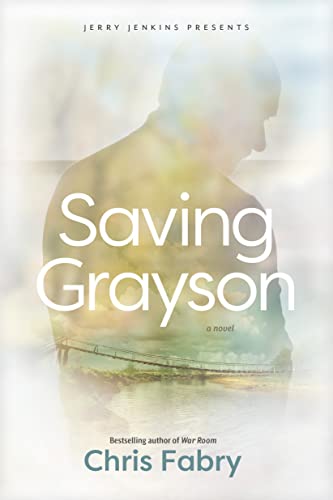
In the novel Saving Grayson by Chris Fabry, Grayson Hayes has early-onset Alzheimer’s. He knows his diagnosis and realizes his thinking ability and memories are slipping away. But there are some wrongs he would like to right while he can–even if he doesn’t remember exactly what they are.
He has a recurring dream about a woman in his home town. She’s on a bridge and someone is trying to push her off. Grayson feels his dream is a sign that he is supposed to go back to his home town in West Virginia and either save her from her fate, or find out what happened and who is responsible so justice can be satisfied.
Gray’s longsuffering wife, Lottie, has sworn never to go back to WV. And she can’t let Gray drive alone. But a young Black man named Josh volunteers to drive Grayson from AZ to WV.
As you might imagine, Josh and Grayson have several arguments and misadventures along the way.
Grayson isn’t a very nice person. At first we assume this is because of his condition and his frustration over things like his wife trying to sell his tools and pack up for a move. Grayson is paranoid, instantly thinking people are conspiring against him instead of assuming there is a reasonable explanation for whatever is happening. Lottie knows this is part of his disease but admits she is exhausted.
Yet when Grayson finally makes it to WV, nearly everyone he meets says, “I can’t believe you would come back here.” So we wonder if maybe his abrasiveness is not completely due to his disease after all.
Yet Grayson had an encounter with God late in life that changed him, and moments of clarity sometimes come through.
Chris Fabry skillfully weaves together threads of what it’s like to lose your memories and yourself, to love someone in this situation, the value of all life, the nature of forgiveness and receiving love, a little humor, and some suspense.
I’ll admit the first few chapters were not a cozy read–it was frustrating to read of Grayson’s misunderstandings and antics. Yet I am sure it’s many times more frustrating for all involved to actually deal with these issues.
But I am so glad I kept with the book. I loved the redemptive arc the story took. There was a nice “aha” moment when I realized who one character was (I don’t want to say more and spoil the surprise for other readers). The last chapter was a nail-biter.
Some of my favorite quotes from the book:
He had clear memories of the past, but others were fuzzy, like a photo taken from a car at a high rate of speed (p. 9. Kindle version).
How many of the mean people he’d met in his life were just scared of something, a monster they couldn’t see past? (p. 55).
Can God forgive what a man can’t remember? Can a man atone for the mistakes that haunt him when his memory is in ruins? If I could go back and relive a moment or an action, I don’t know where I’d go or what I’d do to make up for my failures (p. 215).
Let people love you. Don’t push them away. Allow God to love you through those he’s put in your life. Live knowing you are loved. You don’t earn that kind of love. You just receive it every day (p. 229).
Forgiveness is not never thinking of the bad things again. Forgiveness is choosing to move past them. Or maybe better put, allowing the past to move in next door (p. 240).
Chris has a Q&A about the book here. I got the Kindle version on sale last year and then the Audible version, read by Chris, a few weeks ago. It was nice to be able to switch back and forth between them.
I wasn’t sure what “Jerry Jenkins Presents” on the front cover referred to. That wasn’t explained inside the book. But this article shares that this book was one of three published by Focus on the Family and edited by Jenkins which deal with modern issues in a redemptive way.
Though this book would be helpful for friends and loved ones of people with dementia, I think it would be beneficial to anyone. The story itself is excellent and enjoyable. And many of us wrestle with feeling we have to earn people’s love–or God’s–instead of receiving it. Or we feel we have to atone for our sins, when Jesus is the only One who can do that.
 Stray Thoughts