Review: Van Gogh Has a Broken Heart

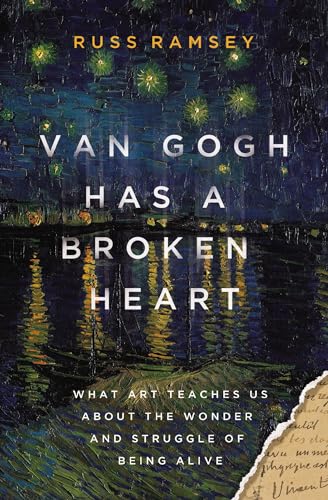
Van Gogh Has a Broken Heart

Van Gogh Has a Broken Heart: What Art Teaches Us About the Wonder and Struggle of Being Alive by Russ Ramsey is similar to his earlier book, Rembrandt Is In the Wind. Each draws observations from art and artists. This second book explores the theme of suffering and the beauty and grace that comes from it.

Art shows us back to ourselves, and the best art doesn’t flinch or look away. Rather, it acknowledges the complexity of struggles like poverty, weariness, and grief while defiantly holding forth beauty—reminding us that beauty is both scarce and everywhere we look (p. 4).

Beauty pulls us upward toward something that calls for some measure of discretion, something to be treated with dignity and care, something sacred. What does it pull us toward? The truth that we were made to exist in the presence of glory (p. 5).

All art comes from somewhere. It comes from someone who is in the process of living the one life they’ve been given. The more we can understand the specifics of their individual experience, the more we will understand why they created what they did and why the world has responded to it in the way we have (p. 12).

Ramsey says sad stories are universal, and they can provide fellowship in whatever we’re going through as well as empathy for others. They help us wrestle with the evil and brokenness in the world. “They remind us not just that this world can wound us, but that wounds can heal. They remind us to hope” (p. 10). They show us that beauty can come from brokenness.

That’s not to say all art comes through suffering. I think it was in my Music Appreciation class in college I heard a comparison of Beethoven and Haydn and how their lives shaped their music. Beethoven had a difficult father, health issues, and started experiencing hearing loss before he was thirty. Haydn had struggles, but by his thirties he had a steady job as the music director for a prince. A lot of his work is light, clever, even playful, while Beethoven’s is rich in emotional depth. 

There are ten chapters in Ramsey’s book. One tells the story of how the Mona Lisa was stolen and recovered, Pablo Picasso was a suspect, and the painting became a lot more famous after the theft. Another contrasts Rembrandt’s Simeon’s Song of Praise, which is very detailed and elaborate, painted early in his career, with Simeon in the Temple, painted late in his career and found after his death. They cover the same incident in the Bible, but the latter is simple and focuses on Simeon’s emotion. 

When I look at the old painter’s reimagining of the scene, to my eye he doesn’t seem to want to show us the spectacle of the temple when Simeon held Jesus, or what he can do with it as a painter. After a life filled with suffering and sorrow, he just seems to want to hold Jesus (p. 51).

Artemisia Gentileschi was a painter I’d never heard of. Ramsey describes the difficulty of a woman in this field as well as an artist working “for hire”–not painting scenes she loved for the pure pleasure of it, but taking commissions of what others wanted to see painted. He points out that “she’s not a girl-power feminism icon. She’s an icon in the sense that she’s an example of a woman who’s navigating a world that’s not built for her” (p. 66).  “We must be careful not to romanticize her work to make it fit our own cultural moment. It is one thing to draw conclusions about the impact of her art over time, and quite another to assign intent to her body of work that may not represent how she thought about it (p. 66). I wish people who try to bring modern-day sensibilities into other people’s history would realize “If we come to an artist like Artemisia with a narrative already in mind and insert her into it, we dishonor her actual experience” (p. 67).

Joseph Turner was another artist I didn’t know, whose style changed about halfway through his career. Ramsey discusses the possible reasons and implications.

The Hudson River School I had heard of but didn’t realize it was: a group of landscape painters who went into unexplored areas of what would become the United States to show immigrants to the area what beauty and grandeur was there. But the beauty was also untamed and could be dangerous. And the influx of new European plans for colonization would clash with the Native Americans already there whose philosophy about the land was vastly different.

Van Gogh’s infamous cutting off of his ear is told in the context of his trying and failing to establish an artist’s residence with Gauguin. They only lived in the same yellow house for sixty-three days, “two of the most productive month’s of each artist’s career, and two of the most turbulent” (p. 125).

Norman Rockwell’s work was “Dismissed by critics, who considered his paintings to be too idyllic and sentimental to be great art (p. 139). Rockwell agreed his work wasn’t “the highest form of art,” but said “I love to tell stories in pictures–the story is the first thing and the last thing” (p. 139). His work was influenced by the new technology of the four-color press. He became a well-loved fixture of the Saturday Evening Post until he started painting scenes from the Civil Rights movement like The Problem We All Live With and Murder in Mississippi, based on real events.

Edgar Degas is known for detailed paintings of ballerinas, like The Dance Foyer at the Opera in 1872. But macular degeneration slowly changed his work to the much less distinct Two Dancers Resting in 1910. I can’t fathom the difficulty and painfulness of trying to portray one’s vision when one’s vision is deteriorating. After discussing other artists with failing vision, Ramsey notes, “The art changes, but not necessarily in a negative way. Often when affliction and compulsion collide, something deeper, truer, and more lasting is born” (p. 166). He quotes modern artist Jimmy Abegg, who also has macular degeneration, as saying “The bad isn’t so bad when you recognize the goodness that will emerge from it, whatever trail that leads me down” (p. 166). Ramsey comments, “Affliction stirs us awake to things we might not have seen otherwise” (p. 166) and seeing “through new eyes” requires courage and humility.

Ramsey includes appendices on the symbolism often used in art and and famous art heists. One appendix is titled “I Don’t Like Donatello, and You Can Too.” Ramsey says we don’t have to like or “get” every artist, but, with “a posture of openness, willing to learn and grow” (p. 192), we can appreciate even what we don’t like.

A few other quotes that stood out to me:

What comes out of this life is his business, but what I do will never be what makes me who I am. Because this is so, when suffering comes, it doesn’t have the power to unravel God’s design. Instead, the suffering becomes part of the fabric (p. 155).

Our sorrows are ultimately hallowed by the One who enters fully into the painful stories of our own lives in order to show us that our suffering matters, while also becoming the place from which the Spirit enables us to become agents of God’s healing grace to those who find themselves lost and alone in their griefs (p. xi).

The goal of suffering well is to move us not only beyond the stick figures, but also from a place of pride to one of intimacy and familiarity with our Lord. It is to move us not from crude to eloquent, but from unfamiliar to intimate. This is why we practice spiritual disciplines (p. 50).

To truly love someone is to move beyond first impressions into the heart of things; it is to take on the sacred work of stewarding another’s joys and sorrow (p. 132).

Think about the physiology of growing old. If the Lord grants us many years, the way to eternal glory will include the dimming of our vision, the slowing of our bodies, the dulling of our minds, and the diminishing of our appetites. It’s a path that requires us to loosen our grip on this world, preparing us to leave it before we leave it. Is this not mercy? (p. 136).

I had missed the fact that there were discussion guides for each chapter in the back until I finished the book. I wish these had been included at the end of the corresponding chapters.

I don’t know if Ramsey has any future books like these planned. I hope so. There are multitudes more paintings and artists that could be discussed. If he does, I’d love to hear his thoughts on a couple of issues. One, how to think about pictures of deity in art and the second commandment about not making images. I wrestled with my own thoughts on this a few years ago. Two, the depiction of nudity in art. I personally would rather not see nudity in art or anywhere else. (There are a couple of paintings involving female nudity in this book).

As with Ramsey’s first book about art, I appreciated not only the information but the thoughtful and beautiful way the author weaves spiritual truth into the narrative. The result is poignant and meditative.
What I Learned from a Traumatic Illness

What I learned from a traumatic illness

September 1 will mark thirty years since I contracted transverse myelitis. TM is an auto-immune disorder in which a virus attacks the spine, triggering the body to attack not only the virus, but the myelin sheath around the nerves of the spine. An attack low on the spine might bring just a little numbness and tingling. But an attack high on the spine can result in quadriplegia, ventilator-dependency, and even death.

I was affected in the middle, in the thoracic region. My symptoms began with a vague feeling of numbness in my left hand, like I had slept on it wrong. Within three hours, my left arm was numb up to my shoulder as were both legs up to my lower torso. I couldn’t walk on my own. I was having trouble going to the bathroom.

I thought I was having a stroke. That’s the only thing I knew of that would cause parts of the body to suddenly go numb.

As it turns out, a number of ailments can cause sudden numbness. There was no one test to diagnose TM. Instead, tests were performed to rule out any other possible related illness. That took eight days in the hospital.

I was sent home with a few prescriptions and a plan for physical therapy.

Thankfully, I progressed from a wheelchair to a walker to a cane to walking unsteadily on my own over the course of a few months. My ability to walk has improved, but I still can’t run, jump, hop, or walk very well on uneven ground. Oddly, my balance is often affected the most when I am standing still with no support. This is due to TM’s effect on my proprioception. I’m usually fine if I can hold on to or lean against something stationery.

I am not as numb as I was, but I still don’t have full feeling in my left hand or lower legs. I have odd little nerve sensations–feeling like something is touching me when it isn’t, feeling a sudden hot sensation where there is no heat, etc. I can’t wear my wedding ring because it causes a pinging, funny-bone sensation in my hand.

But overall, I am thankful that I recovered to the point of being able to function as I needed to, to take care of my family, and to lead a relatively normal life.

I’ve been jotting down several things I have learned through this experience, and I thought I’d share them with you. I know many of you are going through physical trials or have in the past. Though our details might vary, I hope you’ll find camaraderie and encouragement here.

The unsteady trajectory of healing. It seems that often healing is a one step forward–two steps back process, feeling better one day and worse another. Often in the first couple of years after TM, I felt my symptoms were increasing to the same point they were in the beginning. Though TM is usually a one-time event, some people do have more than one attack. But repeated attacks are also signs of multiple sclerosis. So that specter was in view whenever I felt worse.

The hidden work of healing. Sometimes assessing healing is like watching paint dry. There doesn’t seem to be any progress day by day. But over time, healing gradually takes place unawares, until finally one day we can see definite progress from the previous week or month.

Riding the waves. When my husband and I were taking childbirth classes, our teacher invited a couple from her previous class to come in and share their childbirth experience. The new mom said something like this: during labor, when she wondered how many hours she was going to have to do this, she felt weary and defeated. But if she only concentrated on one contraction at a time, she was able to get through them better. She likened it to riding each wave of a surf as it came in.

That illustration has stayed with me all these years through many applications. When symptoms flared up or I had a bad day, I thought, I only have to deal with this day, this moment.

The value of rest. The first few months after TM, if I wanted to go anywhere, I would have to rest up the day of the event. Afterward, it wasn’t a matter of making myself rest: my body crashed and I couldn’t have done anything else anyway.

But I noticed I hardly ever had a cold or any other sickness during that time. I realized that maybe rest was nipping any other colds or viruses in the bud. When I began having heart rhythm issues, I couldn’t take decongestants any more. So rest and Tylenol and cough drops at the first sign of a cold became my go-to treatment. Most of the time, I got over them much faster than usual.

The need to strive. This sounds like a contradiction to the need for rest. It’s hard to balance sometimes. Usually we don’t know we’ve overdone it until it’s too late. But we don’t generally make much progress unless we stretch ourselves beyond what’s comfortable.

The value of an ordinary day. When I was in the hospital and recovering at home, one of the things I most wanted and missed was just an ordinary day like I’d had and hadn’t appreciated before.

The value of my work. As a homemaker, I can sometimes feel my work is not as important as other people’s. But when I couldn’t do my work and saw the extra pressure it put on everyone else to do what I always did, it helped me realize that I did have a helpful contribution to making family life go smoothly.

The value of help. People from church brought meals, cleaned bathrooms, babysat, prayed, sent cards, and let us know they cared. A group of men installed a handrail on the stairs and safety bars in the bathroom.

People often wonder what to do to help in a crisis. It varies according to the person and the situation. But I’d encourage praying about it and then doing what the Lord lays on your heart. For instance, one lady brought over a puzzle, and she and my oldest son sat and worked it at the kitchen table while we talked. We’d had to go back and forth to so many doctor’s visits, either taking the kids with us or to babysitters, and that quiet activity was a balm. Yet if someone had asked me what I needed, I never would have thought of a puzzle and quiet conversation.

The mental cost. This is something I didn’t realize until a few years ago. I was reading of a woman who had been in a horrific accident where she was hit by a bus, flying through the air until she landed on the street with multiple broken bones. On the one year anniversary of her accident, she wrote that she had healed physically, but still suffered triggers that affected her mentally and emotionally.

That statement was like a light bulb coming on in my mind.

For maybe a year or two after TM, I suffered from panic attacks. I didn’t tell anyone. This was in an era when many Christians were adamantly against psychiatry. We had seen a documentary about the dangers of Xanax. I was afraid of being shipped off to a psychiatrist and being put on psychotic drugs.

In fact, I was given Xanax while in the hospital, but no one ever explained why. I don’t remember that it had much of an effect. But I didn’t want to continue it.

So even as I healed physically and enjoyed time with my family and getting back to church, I didn’t realize that I was still shaken up mentally and emotionally. I think part of it is that the world no longer felt secure. We know that anything can happen any time–but when it does, life doesn’t seem safe any more.

In truth, this world was never meant to be our safe place. Our shelter and security comes from God. But it takes a while to remember that, or to apply it in new ways, when our lives are severely shaken.

Mental and emotional healing may take just as much of an up-and-down trajectory as physical healing and may leave us with limps, scars, or tender places.

Things evened out over time, but I wish I had talked to my neurologist or primary care doctor.about all this while it was going on. Thankfully, we understand mental issues better now than we did then.

Lessons from limitations. I’ve written about this before, but one of the biggest lessons was that even though I couldn’t do everything I had done before, that didn’t mean I couldn’t do anything. We all face limitations of some kind–physical, financial, relational, season of life, etc. Our limits don’t hinder our ministry: they just define it.

Happy stress is still stress. A nurse shared this with Mittu when Timothy was in the NICU for 10 1/2 weeks. It rang a bell with me, too. Even with events I am dearly looking forward to, I have to pace myself.

Faith during uncertainty. For the first couple of years after TM, I never knew what my symptoms and capabilities would be any given day. I felt bad when plans with the family had to be canceled, though they were understanding. I didn’t know how long symptoms would go on or what level of recovery I would eventually reach. I was used to getting medical problems fixed, either with medication or a procedure. Living with the unknown for so long was wearing, but it caused us to rely on God moment by moment and trust Him for the future.

The joy of finding others. We got our first family personal computer about six weeks after my diagnosis, and transverse myelitis was the first thing I looked up. I found an email subscriber list of TM patients and caregivers. No one else I knew outside of the medical community had ever heard of TM. To find people who knew what I was talking about, who could answer questions and compare notes, was a godsend.

Dealing with “what ifs.” We lived in a split-level house, and I couldn’t use the stairs at first. Would we need to move? I had three sons, the youngest just two years old. Would I be able to take care of them? We had just started our second year of home schooling. Would I be able to continue? About a third of TM patients don’t regain anything they lost at onset. What if I didn’t? Or what if it got worse? What if I developed MS? What if the doctors missed something? Living with uncertainty isn’t comfortable, but God’s Word assured me He was with me and cared for me. I didn’t know what the future held, but I could trust Him to meet my needs and lead us day by day.

It’s okay to have bad days, to cry, to lament. I used to think that in order to be a good testimony, I had to project “victory” and positivity all the time. That’s not only inauthentic, it’s unrelateable. In the psalms, we see people pouring out their confusion, questions, anguish, physical, mental, emotional, and spiritual pains. Eventually they remind themselves of what they know to be true about God’s character and ways, and they rest in Him even though the circumstances may not have changed.

The comfort of Scripture. Finding help and hope in the Bible was not new to me, but God’s Word helped me in special ways during this time. For example, the night before I was scheduled for an MRI, nearly every medical person who came into my hospital room asked me if I was claustrophobic. I didn’t know–I had never been in a position to feel claustrophobic before. I wanted to tell them that their questions were making me feel claustrophobic! I was told that they could give me something to calm my nerves, but it needed to be done a certain amount of time before the MRI. I opted not to take anything.

They stressed to me the importance of being still in the MRI machine. Before the MRI, the verses from my Daily Light on the Daily Path devotional were all about being still: “Sit still, my daughter” (Ruth 3:18); “Be still, and know that I am God” (Psalm 46:10); “Commune with your own heart upon your bed, and be still” (Psalm 4:4), and others. Those words kept running through my mind while I was in the MRI machine, and I remained calm. I even dozed off.

In the following months, other verses stood out to me. “The Lord strengthen him upon the bed of languishing: thou wilt make all his bed in his sickness” (Psalm 41:3); “In all their affliction he was afflicted, and the angel of his presence saved them: in his love and in his pity he redeemed them; and he bare them, and carried them all the days of old” (Isaiah 63:9); “And he said unto me, My grace is sufficient for thee: for my strength is made perfect in weakness. Most gladly therefore will I rather glory in my infirmities, that the power of Christ may rest upon me” (2 Corinthians 12:9), “Though he cause grief, he will have compassion according to the abundance of his steadfast love; for he does not afflict from his heart or grieve the children of men” (Lamentations 3:32-33), and so many others.

How about you? What has God taught you and how has He helped you in illness?

1 Peter 5:10

(I often link up with some of these bloggers.)

Laudable Linkage

Laudable Linkage

I found several noteworthy blog posts this week:

The Good We Cannot See, HT to Challies. “I wanted to see the purpose of the suffering; at least a small glimpse. I wanted to understand even a small piece of why God allowed it. I wanted to see the man that Ezra would become because of the pain he endured. I wanted to see a piece of redemption. I wanted to experience the tangible comfort of knowing that God intended the suffering for good with good defined by me. Therein lies the trouble.”

All the Books I’ll Never Read, HT to Linda. This resonated with me so much! “Not only will I never read all the books I wish I could, but I’ll never be all the things that I want to be, or do all the things that I want to do. When this realization first hit me, I have to confess I did not roll with it well.”

What We Miss When We Skip the Prophets. “The prophetic books of the Old Testament make up 250 of the Bible’s 1189 chapters. That’s about 21% of the Bible! And I think those books are sorely neglected.”

Big Heads or Big Hearts, HT to Knowable Word. “Truth and love ought not be thought of as if they are opposites — as if the pursuit of one will automatically detract from the pursuit of the other. Even in specific situations, we shouldn’t think that we need to decide between standing for the truth and loving. We can always do both!”

Beware Toxic Servant Leadership, HT to Challies. “Sometimes, what people mean by servant leadership is not leadership at all. If I only understand leadership as deferring to others and not stepping on people’s toes, then I’m at risk of ignoring what God has called me to do. We have become so allergic to authority that anytime someone expresses any authority at all we immediately recoil. This is not good.”

Why Does John Mention That He Outran Peter to Jesus’ Tomb? HT to Challies. I don’t remember if I ever wondered about this, but I appreciate this answer.

The 15-Minute Block, HT to Redeeming Productivity. “I am obsessed with this idea of the 15-minute block. Anything and everything becomes possible when you break it down into a manageable chunk.”

Should We Capitalize Divine Pronouns? I’ve been taught all my life that capitalizing pronouns referring to God was a sign of respect to Him. But lately I’ve found several sources saying that capitalizing divine pronouns is not necessary–partly because they are not capitalized in the original languages nor in many Bible translations. I’m glad Tim categorizes this as a conscience issue. Author and editor Lori Hatcher discusses the same question in To Capitalize or not to Capitalize: Exploring the Deity Pronoun Question.

Dead Man Talking. Bob Roberts is frequent camp speaker and the founder of Kids4Truth Clubs. We attended the same church for several years. Bob had cancer a few years ago, which went into remission. But now it’s back in his liver, and the prognosis is not good. While undergoing some experimental treatments as a last effort, Bob didn’t want to “waste” his cancer. So he began a podcast with five men who have been his friends for 30+ years to discuss what God is doing in his life. The one I linked to is the third, where he discusses the first half of his “bucket list.” The first one was more general; the second one discussed friendship and the impact of the group potentially losing one member. These are available wherever one listens to podcasts and on YouTube.

If I listened to the wretched talk of proud men, I might sometimes fancy sin was not so very sinful! But I cannot think little of sin, when I look at the cross of Christ. — J. C. Ryle

Laudable Linkage

Laudable Linkage

I found quite a few good reads this week:

Taking Our Stress to the Lord, HT to the Story Warren. “The world invites us into its fear and its solutions to that fear constantly. We live in a particularly tense and defensive time. Fried nervous systems and dialed up threat responses crowd our communities, near and far. Well-meaning tips about stress management often invite more stress with additional tasks to incorporate into our packed lives. And if we’re honest, unhelpful messages about stress are not exclusively external.”

We Can’t Fear Questions. “If you have the truth on your side, you don’t have to be afraid of questions. If you fear questions, people might wonder if you really have the truth on your side. If we want to successfully pass off our faith to the next generation, we can’t be afraid of their questions.”

To Go Forward, We Must Go Backward, HT to the Story Warren. “Other mediums require you to give your attention and, like books, paintings, songs, and even food, sometimes will point you to the transcendent. That’s what art does. But our phones are different. They’re black holes for attention. Social media, when it is primarily used to consume content instead of connecting with others, takes your attention and gives you nothing back.”

Prove Me, Try Me, Test Me, HT to Challies. “I don’t think I can do it. I don’t want to be proven, tried, and tested again. Not now; not tomorrow; not ever. Can we take a little break, God? How about a month? Can we take a month off from being proven, tried, and tested? Just a little vacation from trials? Can life just be easy for a little while?”

Quiet Invitations. A tip for engaging children in activities works for oneself as well.

What Does the Bible Mean When It Teaches Wives to Submit? HT to Challies. “Many people cringe at the teaching that wives are to submit to their husbands. A clear understanding of this teaching will lead us to marvel at the goodness of God’s plan for marriage and society.”

8 Marriage Pitfalls to Avoid Like the Plague. “We’re focusing on marriage’s irritating, foolish snares. When all is said and done, these pitfalls ultimately emerge as spiritual issues, because no one loves to fan the flames of inappropriate, subtly destructive behavior more than the enemy of our souls who most certainly hates any loving, loyal, compassionate commitment. On the table? Eight marriage bugaboos to be aware of. And if you’re not married, you’ll probably glean some helpful insights for other relationships.”

The Enormous Significance of Small Tasks. This is written in the context of parenting, but it’s true of teaching, caregiving, and so many other activities.

Walking with Those Who Weep, HT to Challies. “I have had the opportunity and privilege of walking with many through various forms of loss and trial. It was not until we lost our 18-year-old son, however, that I truly learned that there is a huge difference between knowing about grief and knowing grief. Walking through the death of our son revealed to me that I knew far less about what is actually helpful in supporting others than I thought.”

The Spiritual Problem of Being Overinformed, HT to Challies. “In a sense, ‘being informed’ is more of a liability than an asset in today’s world. The quality of digitally mediated information is simply too untrustworthy. What happens to us when we’re overinformed but underactivated? From my experience and observations, some common side effects occur.”

It Only Gets Better, HT to Challies. “Youth has many advantages, like strength and energy. Getting older has some drawbacks, but it has its perks too.”

Wings and a Prayer, HT to nikkipolani. A fascinating story of a Vietnamese pilot’s escape with 52 family members before the fall of Saigon.

J. C. Ryle quote

Pain that brings you closer to God will always be better
than comfort that keeps you away from Him.-
-J. C. Ryle

Laudable Linkage

Laudable Linkage

On Failure, HT to Challies. “Yes, we are going to keep failing at life, again and again. Failing people we love. Failing at things we love. Failing the God we love. But we have a path for dealing with failure. It takes faith, courage, and hope.”

When Your World Burns Down & How to Answer the Question of Pain and Suffering, HT to the Story Warren. “There are love stories that survive fire, and rise straight up from the ashes. This is a Love Story that begins more than 2 decades ago with a bundle of a baby boy …. our third son, named Levi, because the Farmer dared to believe it was a word from the Almighty: ‘And Levi got up, left everything and followed Him,’ (Luke 5:28), and the Farmer said that’s exactly the kind of man that we pray our boy will be.”

Prayer Requests from Jailed Children. “This message is scrawled on a prayer request card, sitting in front of me on my desk. Tears come to my eyes as I read it.”

What Is Your Name? “God requested a sacrificial offering instead of hospitality. And He showed Himself in the fire. He revealed the wonder of Himself in the sweet aroma of their sacrifice.”

Why Feeling Overwhelmed Can Be a Good Thing. “I feel as if I’m drowning in a tsunami of needs. Adult children who need help. Aging parents with health concerns. Personnel shortages at work. Ministry needs. Volunteer opportunities. I want to do good things for good people, but there just isn’t enough of me to go around. I’m overwhelmed. This realization, I’ve discovered, is the first step toward a solution.”

Death Is Not the Worst Thing that Can Happen to You, HT to Journey of Faith. “Contrary to what many Christians think, death is a big deal, and we shouldn’t take it lightly at all. But death isn’t the worst thing that can happen to us.”

What Haggai Taught Me About Priorities, HT to Knowable Word. “‘I can’t. I’m busy!’ These piercing words stopped me as they spilled out of my 2-year-old’s mouth. . . . Yet the reason I stopped wasn’t my son’s disobedience or misplaced priorities; it was because those words were an echo of my heart.”

Brain Fast Food: Living and Ministering in and Age of Casual Thinking. “One of the great advantages of the technological revolution is that we have unbelievable access to all kinds of great resources. One of the great disadvantages of the technological revolution is that intellectually speaking it conditions us to go after McDonald’s hamburgers rather than Ruth Chris steak.”

Stewarding Your Mind. “Doing productivity God’s way means viewing your entire life as a stewardship. Your time, talents, and treasure are all resources left to your care. And the sensible Christian will take care to do all that he or she can to make a good return on these things for the Master. Most believers understand this call to stewardship in areas like finances or even with the use of our time. But are you treating your mind like a stewardship?”

Chuck Swindoll quote

Every time we open Scripture, we’re invited into divine conversation–where infinite wisdom meets our daily needs, where heaven’s perspective illuminates our earthly path.
Chuck Swindoll

Why Doesn’t God Heal Everyone?

Why doesn't God heal everyone?

One of the greatest mysteries we grapple with is why God heals some people, but not others. A friend and I were discussing this recently. As usual, my thoughts continued long after our conversation, so I decided to share them here.

A few years ago, our pastor announced in June that he had liver and pancreatic cancer. He was gone before the end of summer. He was in his prime, pastoring a church with a love for his people that I have rarely seen matched. Two of his daughters got married that summer, and he was able to walk them both down the aisle. But he would have been a terrific grandfather in the coming years. He seemed to have so many years of usefulness left, it was puzzling that God took him home.

Another former pastor’s grandson underwent an excruciating battle with leukemia, which he eventually lost despite hundreds of people’s prayers.

Others experience disabilities for the rest of their lives, either from birth or from an accident or illness.

We can never know all of God’s reasons for what He allows. But here are a few:

We live in a fallen world affected by sin, so there will be illnesses and death until God redeems the earth. Christians aren’t exempt from these effects of the fall.

None of us is guaranteed a long life. We need to be ready for eternity.

God’s perspective. A seemingly early death is not a tragedy to God: it’s a head start on heaven as He welcomes His loved one home.

God enables us to minister to others through what we suffer. Joni Eareckson Tada has been paralyzed since a diving accident fifty-seven years ago. I don’t know of anyone who has done more to help the disabled community, bring awareness of what disabled people suffer, and glorify God in the midst of suffering. Those things probably would not have happened without her accident. When she speaks, we listen, because we know she has proven what she’s speaking about. She’s not mouthing empty platitudes or theories.

God’s strength is displayed through our weakness. Paul famously prayed three times for God to remove an affliction from him. But God answered, “My grace is sufficient for you, for my power is made perfect in weakness” (2 Corinthians 12:7-10).

Healing was not Jesus’ primary purpose. Jesus healed multitudes of people during His time on earth. He demonstrated compassion and power as He did so. But He said His purpose was to preach the gospel (Mark 2:32-39).

God’s glory displayed. When the disciples asked whether a man’s sins or those of his parents caused his blindness, Jesus said, “It was not that this man sinned, or his parents, but that the works of God might be displayed in him” John 9:1-7). Similarly, when Jesus received the news that Lazarus was sick, he said, “It is for the glory of God, so that the Son of God may be glorified through it” (John 11:1-4).

Jesus wasn’t grandstanding. He wanted to show people who He was so they could believe.

Since Jesus is glorified through healing, it’s even more puzzling that He would not heal everyone. But sometimes He is glorified more by displaying His grace through His people’s trials, as He did in Joni and Paul’s lives.

Suffering strengthens and develops us. The apostle Paul wrote, “We rejoice in our sufferings, knowing that suffering produces endurance, and endurance produces character, and character produces hope, and hope does not put us to shame, because God’s love has been poured into our hearts through the Holy Spirit who has been given to us.”

Trials keep us dependent upon the Lord. We always are dependent on God, but sometimes we forget. Sometimes we need His help in areas other people never think about, but that continual dependence is a good reminder that our strength comes from Him. Paul said his “thorn in the flesh” was given so that he might not become conceited over the revelations that had been given to him.

Suffering prepares us for glory. Paul wrote to the Corinthians, “So we do not lose heart. Though our outer self is wasting away, our inner self is being renewed day by day. For this light momentary affliction is preparing for us an eternal weight of glory beyond all comparison, as we look not to the things that are seen but to the things that are unseen. For the things that are seen are transient, but the things that are unseen are eternal.” Paul is not being dismissive when he calls our afflictions “light.” He’s saying that they’ll seem light compared to the glory to come.

Though all of these factors help at times, they don’t satisfy at other times. I’ve been ministered to by what Amy Carmichael wrote in Rose From Brier (emphasis mine):

But, though, indeed, we know that pain nobly born strengthens the soul, knits hearts together, leads to unselfish sacrifice (and we could not spare from our lives the Christ of the Cross), yet, when the raw nerve in our own flesh is touched, we know, with a knowledge that penetrates to a place which these words cannot reach, that our question is not answered. It is only pushed farther back, for why should that be the way of strength, and why need hearts be knit together by such sharp knitting needles, and who would not willingly choose relief rather than the pity of the pitiful?

…What, then, is the answer? I do not know. I believe that it is one of the secret things of the Lord, which will not be opened to us till we see Him who endured the Cross, see the scars in His hands and feet and side, see Him, our Beloved, face to face. I believe that in that revelation of love, which is far past our understanding now, we shall “understand even as all along we have been understood.”

And till then? What does a child do whose mother or father allows something to be done which it cannot understand? There is only one way of peace. It is the child’s way. The loving child trusts.

I believe that we who know our God, and have proved Him good past telling, will find rest there. The faith of the child rests on the character it knows. So may ours, so shall ours. Our Father does not explain, nor does He assure us as we long to be assured… But we know our Father. We know His character. Somehow, somewhere, the wrong must be put right; how we do not know, only we know that, because He is what He is, anything else is inconceivable. For the word sent to the man whose soul was among lions and who was soon to be done to death, unsuccored, though the Lord of Daniel was so near, is fathomless: “And blessed is he whosoever shall not be offended in me.”

There is only one place we can receive, not an answer to our questions, but peace — that place is Calvary. An hour at the foot of the Cross steadies the soul as nothing else can. “O Christ beloved, Thy Calvary stills all our questions.” Love that loves like that can be trusted about this.

Perhaps we wouldn’t be able to understand even if God did explain why He allows such severe pain and loss. But the more we know Him, the better we can trust Him. Like the psalmists, we can pour out our anguish to Him, then remind ourselves of His love and mercy and care for us.

Psalm 46:1

(I often link up with some of these bloggers.)

Laudable Linkage

Laudable Linkage

I went from just a few shared reads last week to a longer list today. I hope you’ll find something of interest here, along with some time to read.

That’s Just Your Interpretation,” HT to Challies. “This is a common response when discussing Scripture, isn’t it? ‘That’s just your interpretation!’ No matter how clearly the Bible speaks, this objection seems to persist. But is it true? Can we really understand the Bible? This question takes us to the heart of the Christian faith and invites us into a discussion about the clarity and authority of God’s Word.”

Ten Truths to Empower Your Prayer Life. “My introduction to prayer came at the age of seven. I was spending the weekend with my grandmother and had slept beside her, snuggled deep into the covers. As the early morning light filtered through the curtains of her bedroom window, the sound of her whispered prayer broke through the fog of my fading sleep. . . . In the years since then, I’ve learned much about this sacred privilege. Today, I’d like to share ten truths I’ve sought to apply in my own prayer life.”

The Greatest Show: Is Your Faith Performance? “The desire to have a godly reputation isn’t wrong, but the danger comes when our focus shifts from genuine transformation in Christ to carefully crafted perception. It’s a tale as old as time and worth pausing to ask: do you care more about appearing faithful, gracious, and surrendered to Christ than actually walking in an authentic relationship with Jesus?”

Be Faithful Over Little: A Different Vision for a Life That Counts, HT to Redeeming Productivity. “But God hasn’t purposed for most people to be world-shapers. The vast majority of our faithfulness and work for the Lord will be exercised in the small, often boring, and monotonous rhythms of life.”

Between Two Worlds: Suffering, Safety, and the Cross, HT to Andrew Le Peau. “The predominant institutional approach to suffering is often one of avoidance—from institutional marketing that equates flourishing with the absence of suffering to personal postures that treat suffering as an unwelcome and harmful interruption in one’s development. Institutions can lessen burdens but not eliminate suffering. No mentor, policy, program, or system can insulate students from grief, disappointment, or hardship. A culture increasingly focused on removing discomfort does not necessarily make people stronger; it often leaves them more anxious and unprepared for suffering when it inevitably comes.”

A Denier Redirected: Living Out the Greatness. This discussion about living in a godly way in an ungodly society dovetails with my own reading about Daniel and how he did so.

This Vice Is One of the Key Predictors of Divorce: Yet, It Is Oddly Understudied. It’s a vice running rampant in society these days.

Coming of Age. “You could tell me that no matter what a mother loves her children, but it takes a story to show me how painful that could be and what it means. Or maybe you tell me that it’s good for my children to suffer losses and failures; that they’ll learn how to pick themselves up if they only get to experience life’s challenges. I’d say it makes sense but it takes a story for me to understand the real value behind it. I could learn as I go and fumble blindly along the way, or I could walk in the shoes of many mothers who’ve gone ahead of me and have a story to tell me of how to become the mom of adults.”

What Did We Gain and Lose by Livestreaming? HT to Challies. “What began as a temporary necessity has become an expected staple of the church’s ministry. As people began returning to worship, committees and the session debated whether livestreaming should continue. If so, for how long, and for what purpose?”

C. S. Lewis quote

Obedience is the key to all doors: feelings come (or don’t come) and go as God pleases. We can’t produce them at will and mustn’t try.–C. S. Lewis

Laudable Linkage

Laudable Linkage

I hope you are warm and snug this cold winter morning (if you’re in the northern hemisphere–if it’s summer where you are, stay cool!) Here are some good reads found this week:

Reading the Bible to Meet God, HT to Challies. “In my book Help My Unbelief: Why Doubt is Not the Enemy of Faith I wrote about how important it is to read the Bible to meet God, to read it relationally and as sustenance for the soul. Often we simply read it for information, to follow a rule, or as an academic pursuit. Reading to meet God sounds like a great idea and the ideal for a Christian, but how do we actually do it”

Life Beyond the Spiritual Shallows. “There is a depth to God’s character that cannot be assessed with quick glances and fleeting thoughts. We will never become the kind of women who face the lion’s den without a deep understanding of God’s character. We will never know that depth if we cannot find ways to circumnavigate our brain’s wiring and study God’s Word for longer than eight second bursts.”

Preparing for the Storm, HT to Challies. “We don’t acknowledge the likelihood of impending trials, so we don’t prepare for them. It’s only after the trial has passed, when we’re left trying to pick up the shards of hope and put our lives back together, that we realize we need to stockpile emergency supplies for the next time Sorrow comes knocking at our door. Having lived through one storm, we realize we’ll need a reservoir for the next one.”

Why Pray for Protection When Suffering Keeps Coming? John Piper answers a difficult question from a listener about praying for protection when it seems pointless, when God let bad things happen in the past.

Are You Your Spouse’s Biggest Cheerleader? HT to Challies. “It works both ways. Wives need their husbands to encourage and affirm and cheer for them as well. In healthy, thriving marriages, husbands and wives are cheerleaders for one another. Smart husbands and smart wives know that the Bible is right on target when it says, ‘Death and life are in the power of the tongue’ (Proverbs 18:21). Spoken words can destroy or empower.”

Little People with Big Emotions: 5 Strategies for Emotionally Healthy Kids. This is excellent, something I wish I’d had when mine were young. “I wish I had been better equipped to help my kids when they experienced big emotions. How can we help our children manage their feelings without stuffing them down, prettying them up, or feeling like there’s no room for them?”

Four Reasons Acts 2:38-39 Does Not Imply Infant Baptism. “Though this passage mentions both children and baptism, Acts 2:38–39 leaves no room for infant baptism. Here are four reasons why.”

Sin and repentance

Sin brings brief pleasures and lasting sorrow.
Repentance brings brief pain and eternal joy.
Nancy DeMoss Wolgemuth

Laudable Linkage

Laudable Linkage

Here are some of the good reads found this week:

Why, My Soul, Are You Dejected? HT to the Story Warren. “Some people beat themselves up for feeling sad. Recently, an older Christian shared with me the many ways they do this. They said, ‘I know it’s bad, I should be happier if I have faith in God, right?’ They treated their sorrow with gut punches of shame. Some medicate it with distractions. Some do all they can to avoid it. Sadness surprises and embarrasses them. It shouldn’t.”

God Brings Us Bad to Give Us Best, HT to Challies. “When God lobs a hand grenade into life and rattles our faith to the core, we wonder how he’ll work the pieces of shrapnel together for our good. What does good mean, anyway?”

Why We Should Expect Witnesses to Disagree, HT to Knowable Word. “No two people are alike, so no two people experience an event in precisely the same way. If you’ve got three witnesses in a murder case, expect three slightly different versions of the event. Don’t panic, that’s normal. In fact, when three different witnesses tell me the exact same thing, I start to get suspicious.” J. Warner Wallace then applies this to the gospels and explains why variations between them don’t make them unreliable.

Helping Husbands After a Miscarriage, HT to Challies. This is part of a series from Biblical Counseling Coalition on reproductive loss.

Are You Scattering Bad Seed? “Every day good seeds are being sown into the lives of the people around us, the people we love and are called to serve. And every day we are tempted to plant thorns among them, to sow weeds among the wheat and tares among the crops.”

The Trouble with Competitiveness, , HT to Challies. “Competitiveness comes in many forms, which is part of its sneakiness. And because of its prevalence in our culture, we can easily deceive ourselves into thinking that it’s really not such a big deal. Author Jerry Bridges names competitiveness as one of our ‘respectable sins.’ And this respectable sin may seem fun for the moment, but it’s anything but harmless.”

The Procrastination Spiral. How procrastination becomes cyclic, discussion about whether or not it is a sin, and tips for breaking the cycle.

What Pastoral Productivity Can and Cannot Do For You, HT to Redeeming Productivity. Even though this article is aimed at pastors, I found the principles helpful as well. “Although the benefits of productivity can change your life and maybe your ministry, life in a fallen world means the benefits of productivity are limited. . . Although productivity can help you fulfill your purpose, productivity should not be your purpose.”

Spurgeon quote

When you think of what you are, and despair;
think also of what He is, and take heart.
–Charles H. Spurgeon

Laudable Linkage

Laudable Linkage

I haven’t been online as much as usual this week, but I have a short list of good reads discovered.

Count It All Joy: How to Grow and Mature in Trials. “I have a confession to make: Sometimes I revert to thinking like I’m in a fairytale. This one meets that one, and they live happily ever after. This happens and that happens and . . . they live happily ever after.”

Let’s Stop the Kid Jokes, HT to Challies. “While joking about kids may seem inconsequential in the moment, this sort of talk points to a larger cultural trend toward devaluing children by depicting them as burdensome and annoying. As Christians, we need to pause and reflect on how we speak about our children. Do our comments about parenting and our children’s struggles reflect Christ’s heart or the hot takes of our culture?”

The Measure of a Mom: How Women Combat Comparison. “Even in the local church, conflict flares unseen in the minds of mothers who allow their choices to become their identity. And with so many choices available, there are infinite ways for us to be divided.”

I Don’t Want to Be Taught! “While the rest of us are trying to white-knuckle a disciplined outward appearance, my youngest daughter’s disdain for being taught was in full display. It caused me to consider the state of my own heart, how often I might resent being shown my lack of wisdom and knowledge in matters more weighty than chess. Despite following Christ for most of my life, I find I am often still trying to go it alone, trying to prove I know the rules (or can make my own) and can safely play by them.”

How I Read Ten Books at Once. My own routine has some similarities, except I’m in five to seven books at any given time. I shared some of that several years ago in Finding Time to Read.

You Can’t Afford to Sit Out the 2024 Election. “There is no perfect party or candidate. But some support policies that do a better job of honoring biblical values. I pray for protection for those who do.” I don’t say much about politics here, but I believe we need to be good stewards of this right we’ve been given to have a voice in our elected officials.

Unbelief puts our circumstances between us and God, but faith puts God between us and our circumstances. F. B. Meyer

Unbelief puts our circumstances between us and God,
but faith puts God between us and our circumstances.
F. B. Meyer