Thanksgiving Is Not a Feeling

Thanksgiving is not a feeling

I often feel a little awkward when a group leader wants participants to share something we’re thankful for right off the bat. I hope she won’t call on me first so I have a little time to think.

In the midst of a heavy trial is another time it is hard to be thankful. The weight of what we’re going through overshadows thankful feelings.

Then other times, nothing bad is going on, but life just seems mundane, unexciting. If someone asks us what we’re thankful for at those times, we’d likely draw a blank.

These are all occasions when we might not feel thankful. But thanksgiving isn’t a feeling. It’s an action. And, ironically, giving thanks even when we don’t feel thankful often leads to feeling thankful.

It doesn’t usually take a lot of thought to find reasons to be thankful. And if you’re like me, once you get started, it’s hard to stop!

When going through a trial, I can be thankful that:

  • God is with me.
  • He promised to give me grace and help me.
  • He knows just how much to allow.
  • He loves me.
  • He is interested in my growth even if I am not.
  • He has a purpose in all He allows and works it for my good.

When life is mundane, I can be thankful that:

  • A respite is provided from busyness.
  • God is with me, even in the small moments.
  • When I do things as unto the Lord, they are important even if they are not big.
  • Quiet days provide time to listen to others.

When life is busy, I am thankful that:

  • God gives strength.
  • God quiets my racing heart.
  • God gives peace.
  • Rest is coming.

Any day, I can be thankful that:

  • God saved me.”Giving thanks unto the Father, which hath made us meet to be partakers of the inheritance of the saints in light: Who hath delivered us from the power of darkness, and hath translated us into the kingdom of his dear Son: In whom we have redemption through his blood, even the forgiveness of sins” (Colossians 1:12-14).
  • God comforts me. “For the LORD shall comfort Zion: he will comfort all her waste places; and he will make her wilderness like Eden, and her desert like the garden of the LORD; joy and gladness shall be found therein, thanksgiving, and the voice of melody” (Isaiah 51: 3).
  • God helps me. “The Lord is my strength and my shield; in him my heart trusts, and I am helped; my heart exults, and with my song I give thanks to him” (Psalm 28:7).
  • God loves me. “Let them thank the Lord for his steadfast love, for his wondrous works to the children of man!” (Psalm 107:8).
  • God forgives me. “I will give thanks to you, O Lord, for though you were angry with me, your anger turned away, that you might comfort me” (Isaiah 12:1).

We often look to our circumstances for reasons to be thankful. But we can be thankful for God Himself and His wonderful attributes:

  • Oh give thanks to the LORD, for he is good; for his steadfast love endures forever!” (I Chronicles 16:34; Ezra 3:11; Psalm 106:1; 107:1; 118:1, 29; 136).
  • Sing unto the LORD, O ye saints of his, and give thanks at the remembrance of his holiness” (Psalm 30:4).
  • Let us come before his presence with thanksgiving, and make a joyful noise unto him with psalms. For the LORD is a great God, and a great King above all gods” (Psalm 95:2-3).
  • I will give thanks to the Lord with my whole heart; I will recount all of your wonderful deeds” (Psalm 9:1).

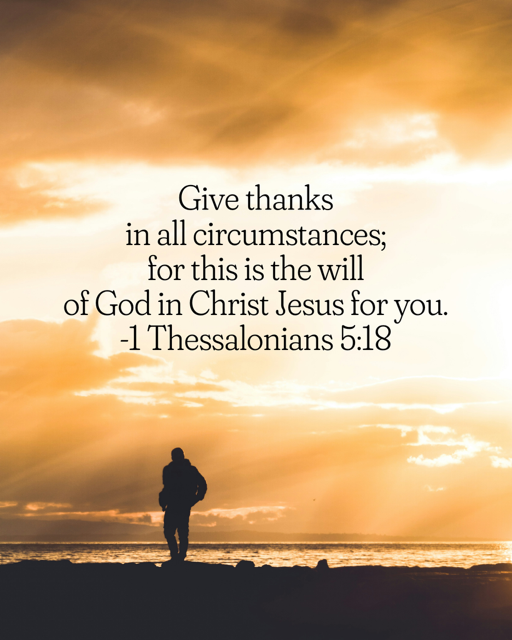
Among the many admonitions and encouragements to be thankful in the Bible is this, from 1 Thessalonians 5:18: “In everything give thanks; for this is the will of God in Christ Jesus for you” (NKJV). In everything–all circumstances, the ESV says–there is something for which we can be thankful.

Thanksgiving often spontaneously overflows when news is good or something happy occurs. But when we’re going through something hard, thanksgiving isn’t easy. The Bible says sometimes praise is a sacrifice. When we remind ourselves who our God is, what He has promised us, and how He loves us, we can find abundant reasons to thank Him.

1 Thessalonians 5:18

(I often link up with some of these bloggers.)
A Surprising Reason to Be Thankful

A Surprising Reason to Be Thankful

From our earliest years, we’re taught the good manners to thank someone when they give us something or do something for us. Thanking them shows we recognize and appreciate the kindness, consideration, time, trouble, and expense they’ve gone to.

How much more should we thank God for so many undeserved blessings? Thanksgiving praises Him and acknowledges that “Every good gift and every perfect gift is from above, coming down from the Father of lights, with whom there is no variation or shadow due to change” (James 1:7).

But recently I came across a surprising reason to be thankful.

Ezekiel 16 is an extended metaphor comparing God’s care of Jerusalem to the care of a man who found an abandoned baby girl, cared for her, fed her, and clothed her royally. When the baby grew up into a beautiful woman, the man loved her and wanted her to be his. In verse 14, God said, “And your renown went forth among the nations because of your beauty, for it was perfect through the splendor that I had bestowed on you.”

But instead of being thankful, Jerusalem “trusted in your beauty” and then became promiscuous with just about anyone she could find, taking God’s gifts and making idols, even sacrificing her children.

This passage reminds me of King Uzziah, who “was marvelously helped, till he was strong. But when he was strong, he grew proud, to his destruction. For he was unfaithful to the Lord his God” (2 Chronicles 26:15-16).

It’s a sad facet of our human nature that we can take God’s good gifts and use them for our own glory or gain.

We become prideful, forgetting anything good in us comes from Him. And then we turn from Him to false idols like the people in Romans 1:

For although they knew God, they did not honor him as God or give thanks to him, but they became futile in their thinking, and their foolish hearts were darkened. Claiming to be wise, they became fools, and exchanged the glory of the immortal God for images resembling mortal man and birds and animals and creeping things. Therefore God gave them up in the lusts of their hearts to impurity (Romans 1:22-24).

When we thank God for what we have, we remind ourselves that everything is a gift from Him. In 1 Corinthians 4:7, Paul reminds us, “What do you have that you did not receive? If then you received it, why do you boast as if you did not receive it?”

It’s not that God wants to lord it over us or browbeat us with the reminder that we should be thankful to Him. But He knows our hearts are “prone to wander,” as the old song says.

So thanking God not only gives Him proper praise, but it keeps our own souls healthy. We remind ourselves that everything we have comes from Him and is to be used for Him. We respond with humility, appreciation, and loving service.

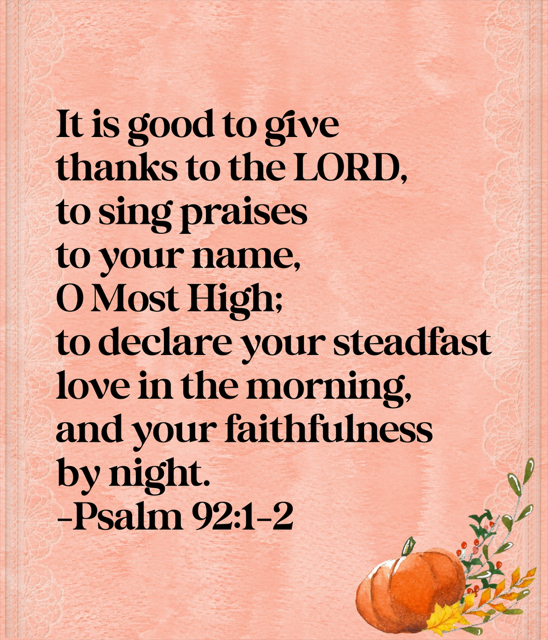
Psalm 92:1-2

(I often link up with some of these bloggers.)
Happy Thanksgiving!

Happy Thanksgiving

To give thanks is not the same as ‘feeling thankful.’
To give thanks in the midst of pain and problems is to take a step of faith based on the command of 1 Thessalonians 5:18: God tells us to give thanks in all circumstances
(not just those we can handle or feel on top of).
For what things can you give thanks, even while you’re hurting?

Joni Eareckson Tada,
A Thankful Heart in a World of Hurt

Though the world is full of trouble, and we have trials and problems,
God has given us much to be thankful for.
He is with those who believe on Him
and promises to give us everything we need.
He blesses us beyond measure.

Wishing you a wonderful Thanksgiving.

A Thanksgiving Lifestyle

A Thanksgiving Lifestyle

I was talking with a friend recently about how, with all God’s blessings and all we have to be thankful for, we should be overflowing with gratitude.

Instead, we often have to “make” ourselves stop and think about thankfulness.

Oh, sometimes we’re spontaneously inspired to praise God when we see a beautiful sunset, or when someone does something unexpected for us. We love that Thanksgiving gives us an opportunity to focus on our blessings. Some even post on blogs or social media something they are grateful for every day in November.

Those are all good practices.

But what about the rest of the year? How can we overcome the distraction of everyday cares and duties to be intentionally thankful?

Here are a few ideas:

Read the Bible regularly. Not only will we see multitudes of things to be thankful for, but we’ll see examples of how people thanked God. The admonition to “let the word of Christ dwell in you richly” in Colossians 3:16-17 is sandwiched between verses telling us to be thankful, suggesting a connection.

Some years ago I did a Thanksgiving Bible Study that turned out to be a big blessing. Just looking up a few verses with “thanks” or “thanksgiving” in a concordance will inspire us.

The psalmists talk about their problems, confusion, and pain, but the psalms are threaded through with hope and praise. The last several psalms especially focus on praising the Lord in just about every manner possible.

Psalm 145 is one of many that shares the two main categories of things we praise God for: who He is, and what He has done. The first seven verses say:

I will extol you, my God and King,
    and bless your name forever and ever.
Every day I will bless you
    and praise your name forever and ever.
Great is the Lord, and greatly to be praised,
    and his greatness is unsearchable.

One generation shall commend your works to another,
    and shall declare your mighty acts.
On the glorious splendor of your majesty,
    and on your wondrous works, I will meditate.
They shall speak of the might of your awesome deeds,
    and I will declare your greatness.
They shall pour forth the fame of your abundant goodness
    and shall sing aloud of your righteousness.

Pray. We can ask God to open our hearts to see the ways He has blessed us and help us not to just mention them rotely, but to be truly thankful. It helps, also, to turn psalms or thanksgiving passages into prayer.

Some incorporate a regular time for giving thanks in their prayer time. Some use the acronym A.C.T.S.:

A: Adoration, praise
C: Confession of sin
T: Thanksgiving
S: Supplication, or requests

Say thank you to God immediately.We’re taught from an early age to say thank you when someone gives to us or does for us. Why not do that with God in real time all through the day?

Thank you for this good parking space!

Thank you for helping me see that unadvertised markdown on pork chops at the store.

Thank you for helping that difficult conversation go well.

What beautiful tiny flowers by the sidewalk. Thank you for creating them and putting them here for me to see. What artistry You put even in a small gathering of blooms.

We don’t have to wait untll our official prayer time to mention these things. We’d likely forget most of them then. But we can keep up a running conversation with God all through the day.

Recall blessings as you fall asleep. I used to listen to music as I fell asleep. More recently, I set my audiobook timer. But as Bing Crosby crooned in the movie White Christmas, we can “Count your blessings instead of sheep.” I don’t know if the songwriter had the psalms in mind, but David wrote, “My soul will be satisfied as with fat and rich food, and my mouth will praise you with joyful lips, when I remember you upon my bed, and meditate on you in the watches of the night; for you have been my help, and in the shadow of your wings I will sing for joy” (Psalm 63:5-7).

Start a gratitude journal. Some like to keep a running record of what they are thankful for. This has two advantages. Writing them down helps reinforce them in our minds, and we’re blessed again when we later peruse our written records.

Recount your Ebenezers, In 1 Samuel 7, Samuel set up a stone to commemorate the Lord’s help, calling it an “Ebenezer,” which means “stone of help.” Some years ago I was encouraged to make a list of those special times in life when I especially saw God’s hand at work. As we tell stories of God’s faithfulness and blessings, we encourage ourselves and others.

Set times for thanksgiving. Some families make time on Thanksgiving Day for everyone to share something they are thankful about. Why not do this at intervals through the year?

Use music. Elisabeth Elliot wrote in On Asking God Why: “When I stumble out of bed in the morning, put on a robe, and go into my study, words do not spring spontaneously to my lips–other than words like, ‘Lord, here I am again to talk to you. It’s cold. I’m not feeling terribly spiritual….’ Who can go on and on like that morning after morning, and who can bear to listen to it day after day?”

She goes on to say that two things helped her. One was the book of psalms. She writes of David: “He found expression for praise far beyond my poor powers, so I use his and am lifted out of myself, up into heights of adoration, even though I’m still the same ordinary woman alone in the same little room.” The other help was hymns. She cites a few and writes, “By putting into words things on earth for which we thank him, we are training ourselves to be ever more aware of such things as we live our lives. It is easy otherwise to be oblivious of the thousand evidences of his care.”

Many hymns contain thanksgiving, but they also have phrases that could be turned into prayers of thanks.

Here are a couple of my favorites:

“Thanks to God for My Redeemer” sung by the Sacred Music Services‘ men’s chorus.

“My Heart is Filled with Thankfulness” (written by Keith Getty and Stuart Townend. I don’t know the folks in the video, but I like this version).

What about when we don’t really feel thankful?

Thanksgiving isn’t a feeling; it’s an action. We can give God thanks whether we feel thankful or not. Usually, once we do, the feelings come.

And usually, once we start looking for things to thank God for, it’s hard to stop.

How about you? Do any of these practices resonate with you? Do you have other ways to be intentionally thankful through the year?

Psalm 92:1-2

(I often link up with some of these bloggers.)
Benefits of Giving Thanks

Though our US holiday of Thanksgiving is over, giving thanks should continue. This year I saw some benefits to thanksgiving, some of which I don’t remember noticing before.

Thanksgiving reminds us what we’re supposed to be doing all year long. A man in our Sunday School class shared how the Lord delivered him from a life-threatening illness. Then he remarked, “I should be thanking and praising God every day, but I take this gift for granted.” We all do that, don’t we?

Thanksgiving reminds us where our gifts come from. We forget that even a good job, the availability of good food, clean water, warm beds, family, and so much more, are gifts from God. They could all be taken away in a moment.

Thanksgiving reminds us how God has led or provided for us in the past, through both good and bad times. As people shared testimonies in our midweek service, they tended to recall special moments in the past where God’s help was especially displayed. I call these “Ebenezer moments.” In 1 Samuel 7, after God delivered Israel from the Philistines, Samuel set up a memorial stone and called it Ebenezer, meaning “stone of help.” A few years ago, I was inspired to make a list of “Ebenezer” moments. Going over that list inspires love and praise to God for how He has worked in my life. “My soul will be satisfied as with fat and rich food, and my mouth will praise you with joyful lips, when I remember you upon my bed, and meditate on you in the watches of the night; for you have been my help, and in the shadow of your wings I will sing for joy. My soul clings to you; your right hand upholds me” (Psalm 63:5-8).

Thanksgiving needs to be intentional. Maybe some people are naturally geared towards gratefulness. But most of us notice the problems, irritations, and imperfections of life first. In Joy: A Godly Woman’s Adornment by Lydia Brownback, she says this: “If we are not looking for the good things, we may fail to see them when they come. That’s part of why thankfulness is so important. Offering thanks to God, no matter what is going on in our lives, is a way of acknowledging that he knows exactly what he is doing and that we can trust him” (p. 28, Kindle version).

Thanksgiving isn’t always a feeling. Another quote from Lydia’s book: “Sometimes thankfulness is a choice we make rather than a feeling we have” (p. 28).

Thanksgiving leads to more thanksgiving. Once you start looking for things to be thankful for, your list keeps growing. At the testimony service mentioned above, after everyone had a chance to share, people started saying, “His story reminds of the time God did this. . . “

Thanksgiving melts away our worries. When we remind ourselves of the ways God has helped and provided for us in the past, we’re encouraged to trust Him for the present and future.

Thanksgiving recalibrates our perspective. I can’t find the source now, but I recently read of a woman who was having an awful start to her day. On her way to work, she began deliberately looking for things to be thankful for. By the time she arrived, her mood and outlook had completely changed.

Thanksgiving shared with others increases opportunities to glorify God. As we heard each others’ stories at our testimony service, we thanked God not just for what He did for us, but also for what He did for others. “For it is all for your sake, so that as grace extends to more and more people it may increase thanksgiving, to the glory of God” (2 Corinthians 4:15).

Thanksgiving shared knits hearts together. Testimony services leave us not only with warm feelings towards God, but also towards each other.

So let thanksgiving continue! Let’s make it a point to look for God’s hand and thank Him as often as we can.

Have you found these or any other benefits to giving thanks?

(I often link up with some of these bloggers.)
Laudable Linkage

Here are a few of the thought-provoking reads found this week:

Peace That Passes All Understanding, HT to Challies. “Now what? I just tried one of the classic passages on anxiety and it didn’t work. A-ha, there is a clue. I was looking for a pill. I visited God-my-pharmacist and asked what to take for my anxiety. That’s not the way Scripture works. I should have noticed it when I reduced the passage to a formula.”

Trusting God Through Terminal Illness, HT to Challies. “I am very thankful that I have an eye-tracking device so that I can still use a computer and turn on the TV. When my voice gives up, I can use my eyes to slowly type a few phrases which my mechanical voice speaks out loud. It would be easy to look at me and feel that there was no purpose to my life, but that’s not what God says.”

To the Impetuous and Impulsive. “As people repent of their sins and profess their loyalty to him, he does not eradicate their personalities as if he created them wrong in the first place or as if there is nothing within them he can use or redeem. Rather, he channels their personality, he redirects it, masters it, perfects it. Though he does sanctify his people, he does not completely destroy and then recreate them in such a way that they are all the same.”

Four Practical Ways to Cultivate Personal Evangelism, HT to Challies. “Let’s be honest, evangelism can be intimidating. For most, it can induce certain anxiety that can be crippling. It is easy to leave this high call that every believer has to a select few – elders, extroverts, or “experts.” Where does this intimidation come from when it comes to evangelism?”

Can Christians Date Nonbelievers? HT to Challies. The author answers from passages other than the usual go-to verse on this issue.

Eleven Factors for Helpful Short Term Mission Trips from one who has been on both sides of such trips, HT to Challies.

Welcoming the World’s Oldest Babies, HT to Challies. “Three weeks ago—on Monday, October 31—Rachel Ridgeway gave birth to the oldest babies in the world. Nearly 30 years ago, Lydia Ann and Timothy Ronald were conceived in a fertility clinic. Hours later, they were frozen.”

Gray Hair Is a Crown of Glory, HT to Challies. “This age-group will never be the “target” group for church growth strategists. However, if you want a church that actually does the work of the church and gives back to you as a pastor and to the congregants on the whole – then pray for a group of elderly saints.”

How Jesus Cares for Caregivers, HT to Story Warren. “Caregiving is hard. Not only do we grieve the suffering of our loved one, but we also process our own losses. Caregiving requires us to lay down our preferences and plans and pick up the holy calling of meeting the needs of another.”

Chosen Isn’t So Special If You’re a Turkey, HT to Challies. “My kids used to say I should write a how-to-hide-the-turkey-recipe book. We ate a lot of turkey when we lived in Italy. Affordable and easily available, I disguised wings, thighs and breast, every possible way. But turkey, as often as it showed up at our house, didn’t come whole.” A fun story with a great application.

The quote above is from Joy: The Godly Woman’s Adornment by Lydia Brownback.

A Confession of Praise

A study Bible footnote unexpectedly intersected with thoughts about Thanksgiving.

I’m not a Hebrew scholar by any means. But the ESV Study Bible noted that the Hebrew word todah could be translated as “make confession” or “give thanks or praise,” depending on the context. The footnote goes on to say, “Some overlap of these meanings is not surprising because rightful confession is itself a kind of worship of God” (p. 820).

We don’t usually connect confession of sin with worship and praise, but the one does lead to the other, doesn’t it? Once we’ve confessed sin to the Lord and rested in His grace and forgiveness, we overflow with joy and thankfulness.

“Blessed is the one whose transgression is forgiven, whose sin is covered. Blessed is the man against whom the Lord counts no iniquity, and in whose spirit there is no deceit” (Psalm 32:1-2).

But I began to wonder at another connection.

I was taught that confession of sin means saying the same thing God says about it. In other words, we don’t downplay our sin. We’re honest about it. We don’t say, “Oh, I just told a little fib.” No, to adequately confess sin, we have to call it what it is and own up to it: “I lied.”

So I wonder if giving thanks or praise carries that same connotation. When we praise God, we’re agreeing with what He says about Himself. It’s not that He needs the affirmation, but we need to recognize Him for who He is. And when we do, we can’t help but praise Him. And the more we behold Him, the more our cares and concerns melt away, because we remind ourselves He is more than able to handle any need we have.

Confessing also seems to carry the connotation of personal experience. I might share or rejoice in what God has done in someone else’s life. But if I am confessing, whether it’s sin or praise, I’m sharing what God has done in my life.

In Psalm 95:2, todah is the word translated thanksgiving: “Let us come into his presence with thanksgiving; let us make a joyful noise to him with songs of praise!”

Many of the psalms combine confession of sin, thankfulness for God’s grace, amazement at His greatness, and confession of His people’s personal experience of His provision, protection.

Psalm 145 is a beautiful example of this. Part of it says:

One generation shall commend your works to another,
    and shall declare your mighty acts.
On the glorious splendor of your majesty,
    and on your wondrous works, I will meditate.
They shall speak of the might of your awesome deeds,
    and I will declare your greatness.
They shall pour forth the fame of your abundant goodness
    and shall sing aloud of your righteousness.

The Lord is gracious and merciful,
    slow to anger and abounding in steadfast love.
The Lord is good to all,
    and his mercy is over all that he has made.

10 All your works shall give thanks to you, O Lord,
    and all your saints shall bless you!
11 They shall speak of the glory of your kingdom
    and tell of your power,
12 to make known to the children of man your mighty deeds,
    and the glorious splendor of your kingdom.
13 Your kingdom is an everlasting kingdom,
    and your dominion endures throughout all generations.

Psalm 65 does as well:

Praise is due to you, O God, in Zion,
    and to you shall vows be performed.
O you who hear prayer,
    to you shall all flesh come.
When iniquities prevail against me,
    you atone for our transgressions.
Blessed is the one you choose and bring near,
    to dwell in your courts!
We shall be satisfied with the goodness of your house,
    the holiness of your temple!

These thoughts brought to mind Ron and Shelly Hamilton’s song, “Worthy of Praise”:

My heart overflows with praise to the Lord
I will lift up my voice to the King
He brought me out of the pit of despair
And taught my heart to sing


Worthy of all my praise
You are worthy of all my praise
I bow at Your throne
And I worship You alone
Lord You are worthy
Worthy of praise

I wish you all a wonderful Thanksgiving filled with food, family, and praise for Him who is worthy.

(I often link up with some of these bloggers.)
Laudable Linkage

Here are some of the articles that resonated with me this week:

Love Is a Skill, HT to Challies. “Anyone who has tried very hard to love other people well will know that love doesn’t always feel very natural. A lot of times it feels more like hard work.”

The Problem with Reading the Bible Verse-by-Verse, HT to Knowable Word. The verses divisions, subheadings, footnotes, charts, etc., in most of our Bibles “break up the text into little chunks (often arbitrarily), and we do not naturally read in little chunks, we read in big chunks. You read ordinary books section by section, not word by word, but all the footnotes and verse numbers condition us to read the Bible verse by verse.” Those tools are good for study later, “but the first and most important rule for interpreting and appropriating any biblical book is to actually read the book.”

Dig Deeper, HT to Challies. “Think of the scriptures like a fancy layered dessert — maybe a cake or parfait. There are several layers, and each offers new delights. If you don’t dig down into all the layers, you’re missing out.”

A Call for Endurance and Faith, HT to Challies. “We are not without encouragement in times like these, and sometimes the call for endurance comes in ways that seem strange to the contemporary churchgoer who has enjoyed religious freedom all their lives.”

What Does God Want of Me? HT to Challies. “But what I do remember are the three questions that came out of this difficulty, questions that my husband raised in the midst of this trial to help provide us with direction and guidance. These questions have stayed with me ever since, and have given me clarity and lessened my burden in a wide variety of situations: problems with children or other family members, issues in my marriage, dilemmas in church, personal trials, and more.”

Is Your Way Really God’s Way? ‘While the Bible is heavy on function (what we are to do) it is light on form (how we are to do it).” This article helps discern between form and function and the errors of insisting on our form of doing things.

Protecting Your Teenagers Online, HT to Proclaim and Defend. “We have a pool in our backyard. We also have young children. What steps do we take to protect them? 1. A fence; 2. Swim lessons; 3. Supervision.” Kristopher Schaal then applies these three levels of protection to internet usage.

Cultivating Attention: The Challenge of Reading Great Literature, HT to Linda. “As a literary critic, writer, and professor, I have the great privilege of working with literature every day, and helping others to encounter the beauty of great stories as well. Evangelization and discipleship through beauty is vitally important for our modern culture, for God is perfect Beauty as well as perfect Goodness and Truth. Stories, poetry, and all the arts can help us both to grow in our own faith and to share that faith with others in a compelling way . . . But it’s not easy. Many readers find themselves discouraged, encountering a gap between their desire to engage with great tales and the rather more difficult reality of the experience.”

Why the World Needs Readers (Like You), HT to Linda. “I’ll be honest. It’s in my own self-interest to say that reading is important. I am the author of a book blog, after all. But I believe—passionately—that reading is more than your average pastime. Much more. Here’s why I think that readers, people like you and me, are critical to preserving civilization—and helping it flourish.”

How an Introvert Does Thanksgiving, HT to Linda. “As a large and diverse group, we introverts love our families and the holidays no more or less than anyone else. So the fear and loathing with which we sometimes face this season is not an intro-aversion to the whole concept of family or holidays. It’s more the specifics of the experience that exhaust us; many of us are right now anticipating Thanksgiving with equal parts of delight and anxiety. Yes, pie. But also forced togetherness, lots of chitchat, and old family scripts replaying again and again. It’s a tradeoff. So, before the holidays flatten you like a runaway truck, perhaps take a minute to sort through their delights and the stresses to sketch out some strategies for Thanksgiving so you can enjoy more of the former and less of the latter.”

I Could Never Get Grandma’s Dressing Quite Right—Until She Was Gone, HT to Linda. “Back then I hadn’t yet learned that the most important thing about cooking for other people is the joy your food can bring them. . . .that on Thanksgiving, it’s a waste of time to roast a whole entire pumpkin for pie (the canned stuff is superior anyway!), and that investing in six great dishes is far better than churning out 12 I’m too exhausted to actually eat, and that turkey tastes approximately the same no matter what you do to it.”

thankful heart

A Perfectly Ordinary Thanksgiving

I was working through a couple of blog post ideas, trying to decide which to use. Then I remembered this was Thanksgiving week.

“Hmm,” I thought. “I should probably say something about Thanksgiving.”

But what could I say that I hadn’t already said? What new angle or twist could I come up with?

Then I thought—does Thanksgiving really need an angle? Can’t we just—be thankful?

But what if we’re not feeling so thankful?

Well, thanksgiving isn’t a feeling. It’s an action, an act of the will. And once we start giving thanks, it’s not long before we feel thankful.

If you’re not feeling so grateful this week, maybe you could read some psalms, like 100 or 103 or 107 or 145.

Or you could sing or read some hymns, like “Great Is Thy Faithfulness” or “Come Thou Fount of Every Blessing.”

Or you could recount your Ebenezers, those times in your life you especially saw God’s hand at work.

Or you could make a list of simple blessings: a beautiful sunset, a warm home, friends and family, food to eat, and so on.

Though we should be thankful every day, Thanksgiving is a good reminder that we do have a lot to be thankful for. I’ve found that once I get started looking for things to be thankful for, it’s hard to stop.

It’s fine to create a Thanksgiving feast (we will) or try some new ideas to spur thankfulness (we have) or set out Pinterest-worthy decorations or or try some Thanksgiving-ish crafts (done those, too).

It’s also fine to eat out or use paper plates or grill hamburgers or make sandwiches.

But simply giving thanks to the Giver of all good things often gets lost in the shuffle of everything else. Whatever else we do, may giving thanks to Him be our main focus.

Here’s both a hymn and a thankful list! It’s beautifully sung by the Sacred Music Services‘ men’s chorus.

I wish all of you a wonderful Thanksgiving Day, someone to share it with, something good to eat, some time to rest, and some time to “give thanks to the Lord, for he is good, for his steadfast love endures forever!” (Psalm 107:1).

(I often link up with some of these bloggers.)

Laudable Linkage

Here’s are some good reads found this week. Perhaps some might be of interest to you.

How to Pray for Your Child’s Salvation. “Every Christian parent knows this longing for their children. Most would even confess that our children coming to saving faith is, in fact, the greatest desire we have for our children. Yet, we cannot force this faith. We labor for it, we teach to it, we encourage it, and above all, we can pray for it.”

The Antidote to #MomGuilt. “Why are mothers the most guilt-ridden creatures on the planet? I’m not completely sure, but I think the pressure of daily sustaining tiny people’s lives may have something to do with it. The acknowledgment that we’re messing up seems the worst thing we could say about ourselves in light of the weightiness of our soul-shaping, life-preserving occupation. We know that our actions or inactions could set a course for another human that is marked by pain or sorrow or self-loathing or failure, and what if it lasts longer than a lifetime and into eternal torment?”

In Defense of Something Close to Venting, HT to Challies. “Speaking honestly and openly seems both necessary and precarious. So then, how are we to share our stronger thoughts and feelings? Is venting legitimate, constructive, healthy, and faithful? In short, is it ok to “vent?” Scripture offers a nuanced response. It gives permission, admonishes caution, and provides direction.”

An Invitation, HT to Challies. “But for those of you who find yourself playing with words, turning over sentences, creating mounting paragraphs, carrying index cards in your pocket or on the dashboard or atop your nightstand, texting yourself meaningful phrases or ideas, your mind brimming with childhood memories and stories which spark a seeing of the hand of God in the minutiae, I beckon you to write. Our world needs more Christ-following writers willing to swirl truth with beauty.”

Resisting the Pull of Materialism. “Black Friday is coming soon, and I admit: I enjoy it. I’m a proud bargain shopper, and the deals this time of year are irresistible. In fact, the sales have already begun, and they are tempting me to buy, buy and buy some more. But this year, I want to be intentional about resisting the pull of materialism.”

Inter-Generational Church, HT to Challies. “I have come to think it largely a net loss that we segregate ministries based on age, and I am not referring to children’s ministries. . . . Certainly, there is value in likeminded people in similar situations encouraging one another along. The potential comradery is undoubtedly high when I meet with another dad who is going through the same things as me. But on the other side we far too often miss the invaluable outside perspectives, like what my older friend told me.”

Turning the Dials at Thanksgiving, HT to The Story Warren. “It’s Thanksgiving and I’m in the kitchen turning dials, trying so hard to get everything just right. If only I spoke of solely the oven dial—but who can forget the relational dials, the conversational dials, the quick repentance dials, and even the simple act of dialing the number just to extend the invitation. At the holidays it seems there are far too many complex layered dials to turn and crank and adjust just so. It can be downright exhausting.”

May your Thanksgiving preparations go better than this, HT to Linda.

This is a beautiful rendition of “O the Deep, Deep Love of Jesus,” HT to The Story Warren.

Happy Saturday!