Review: The Women of Oak Ridge

Women of Oak Ridge

When we first moved to the Knoxville area, we attended church in Oak Ridge. I saw signs about the “secret city” and wondered what they were referring to. I learned that Oak Ridge sprang up quickly and secretly during WWII as part of the Manhattan Project plans to build an atomic bomb. The Oak Ridge plants processed uranium. No one except top officials knew the purpose of the plants. Secrecy was strictly enforced. The employees only knew that their work was supposed to help the war effort. Oak Ridge was a restricted city complete with dormitories, trailers, grocery stores, tennis courts on which dances were held, even a movie theater.

Michelle Shocklee set her novel, The Women of Oak Ridge, in two different timelines. In 1944, young Maebelle Willett is recruited to work in the K-25 plant of Oak Ridge as an errand girl. The building is so big that bicycles are supplied for people like Mae to get around the plant. She took the job mainly for the salary: her father is a Kentucky coal miner suffering from black lung. She can help the family much more here than she could in KY. She enjoys her work, her young roommate, Sissy, and the social opportunities with friends and the young men on site.

Mae is suspicious of the man Sissy is dating. There’s just something off about him. The employees are not supposed to talk about their work, but this man shares disturbing details. When Sissy doesn’t return to their room after a date, Mae is sure Sissy’s boyfriend, Clive, had something to do with her disappearance. Her search to prove her suspicions leads to more trouble and then disaster.

In 1979, Mae’s niece, Laurel, lives in Boston and is working on her doctorate in psychology. When she learns about Oak Ridge’s part in the Manhattan Project, she think a study of the effects of long-term secrecy and the employees’ mixed feelings over finding out they were working on such a massively destructive weapon would be a good subject for her dissertation. She travels to Oak Ridge to spend the summer with her Aunt Mae, interviewing her and other former OR employees and doing research.

Mae welcomes Laurel but is close-lipped about her own wartime experience. Mae feels the past is best left there. Laurel nudges her gently, but when she sees how upset Mae gets over the subject, she backs off. Mae does give her the name of some friends who worked at the site to interview.

Laurel’s research of old Oak Ridge newspapers at the library leads her to a small notice placed by Mae asking for information about Sissy. Laurel tries to find out more without disturbing Mae. Will the results bring healing for Mae . . . or untold trouble?

I was fascinated when I first heard the history of Oak Ridge years ago, partly due to the thought of a whole secret city springing up out of nowhere, and partly in wonder over the hundreds of people who would move out of state to take a job they knew nothing about. I don’t think either occurrence would happen these days. Several years ago I read The Girls of Atomic City by Denise Kiernan, a factual account of Oak Ridge’s history. Michelle’s book lines up with the details in Denise’s–in fact, I wondered of she might have used it as a resource. It was fun to see the experience of a young new employee there fleshed out and to hear street names and places I recognized.

Parts of the book had me on the edge of my seat and looking for extra opportunities to listen to my audiobook of it. I loved the spiritual counsel Mae’s friend gives her about the freedom from guilt and sin that Jesus offers.

The only thing that bothered me about the plot was that young Mae seemed awfully naive–maybe a little clueless. She’s supposed to be naive: she’s young and has never been away from her small town before. But I got frustrated that her attempts and responses made things so much worse than they could have been. I can’t say more without giving away too many details.

However, we all have gotten into some level trouble at times from mistakes we’ve made. What a blessing and relief God’s grace is.

I listened to audiobook nicely narrated by Caroline Hewitt. The point of view switches back and forth between Mae’s early timeline in the 1940s and Laurel’s in 1979, but I didn’t find it difficult to follow along.

This is the first book of Michelle’s that I have read, and I am eager to check out more of her work.

Review: The Collector of Burned Books

Collector of Burned Books

The Collector of Burned Books by Roseanna M. White takes place in Paris during WWII, opening with the Nazi takeover of the city.

Corinne Bastien is a professor at the Sorbonne, but looks more like a student. Secretly, she oversees the Library of Burned Books, a collection of books that have been banned by the Nazis. She encodes some of them with war news and send them out to some of her students, who send encoded messages back. The others Jewish authors who worked with the library fled before the Nazis arrived.

Now, however, Goebbels has sent a “library protector,” Christian Bauer, to take over all the libraries in Paris. Christian is not sure how he got the position. He’s a professor, not a soldier. With his record of speaking out against the Nazis, he’s surprised he hasn’t been arrested. All he can figure is that his friend in the police force, who was absorbed into the Gestapo, has adjusted his records.

He and his friend, Erik, had many discussions about the best way to combat the madness surrounding them–whether to fight against it overtly, only to be arrested, or to battle quietly from within while seeming to go along. They decide on the latter course. Christian knows many of the French Jewish authors personally. Perhaps he can mitigate the damage done to them and their works. At the very least, he can insist on civility among the soldiers assigned to him.

Christian arrives at Corinne’s flat with a list of books checked out by her mother from the Library of Burned Books. He only wants then returned. Corinne plays dumb. Her mother is out of the country and is not very organized–she doesn’t know where the books could be.

As Christian visits repeatedly to search for the books, they discover they have much in common. Corinne still regards him as an enemy, but she realizes he is not like the others.

Eventually, some surprising twists lead them to the truth about each other. And then a shocking betrayal threatens everything they’ve worked for.

Another part of the story involves hiding a boy with birth defects whom the German authorities wanted to have euthanized.

Some of my favorite quotes from the book:

These students had it all wrong—backward. Books didn’t burn. Books ignited. They lit the burning in others. Not with paper and match. With ideas. But then, that was their very argument (p. 1, Kindle version).

The only way to defeat a bully was to win him over. The only way to truly defend what you believe is to make your enemy believe it too (p. 4).

The words we hear, the words we read, the words we sing along to on the radio and study in the papers with our morning coffee, become our thoughts. I think our thoughts become our beliefs. And I think our beliefs become our actions. That is why Goebbels sent us here, Kraus. Because words form the foundation of society. Ideas create culture. Control them, and you can control . . . everything (p. 76).

He would tell you to think, next time, before you blindly chase your ideology. He would ask you to think, not just to feel. To ask, always, if you could be wrong. To listen, always listen, to the other points of view. Because the moment we stop granting someone the right to disagree, Kraus, this is what happens. Do you understand me? This is what turns men into tyrants. This is what leads to fear and death (p. 265).

God could well have said no. Today, he’d extended his mercy. His grace. But as too many in Germany had already learned, sometimes he didn’t intervene. Sometimes he let the monsters come. Sometimes good people, good Christians, good Jews were dragged off in the night, no matter the prayers they cried. He’d promised to be with his people through persecutions—not to prevent them (p. 304).

Read novels, because they will put you in someone else’s skin. Read poetry, because it will give wings to your soul. Read science, because it will show you what’s possible. Read politics, because it will teach you how strongly people care about how their fellow men are treated, wherever they stand on what the best way is. . . . Read things you hate and things you love and things you never thought you’d understand. And never, never accept the excuse that you’re not strong enough to handle it if you read something that offends you. You are. You’re strong enough to be offended and then try to understand why. You’re strong enough to grant that someone can be different and still be worthy of dignity. And if you aren’t? . . . Then read more, until you are (pp. 315-316).

Roseanna is a master storyteller who creates wonderful characters and intricately interwoven plots. I enjoyed both of these characters immensely.

I also enjoyed Roseanna’s notes at the end of the book, where she shares what’s historically accurate and what’s made up. There really was a Library of Burned Books. There really was an anti-Nazi professor who was given a special assignment, though not the one detailed in the book.

There were even some fun surprises, like a character from Roseanna’s Shadows Over England series showing up. This was the first series of Roseanna’s I read, and I loved them. Though there were clues, I didn’t recognize him until his real last name was revealed and he shared a bit of his history. There was a tie-in with another previous character from Yesterday’s Tides, but I didn’t remember him or his situation at all.

The faith element is Catholic, which would have been accurate for the setting and characters. There was mention of some practices I couldn’t agree with–a priest forgiving sins, the need for penance, praying to Mary and saints, the supposed healing power of the Eucharist. But the overall tenor of the characters’ hope in God was touching and inspiring.

I listened to the audiobook, superbly read by Lisa Flanagan. This time, the audiobook did include the author’s notes, which I appreciated. But I also had a Kindle version for reference.

Roseanna mention in her notes that one character will be getting his own story in another book. I don’t know if it will be a sequel, exactly, but I look forward to it.

Review: The Librarian of Saint-Malo

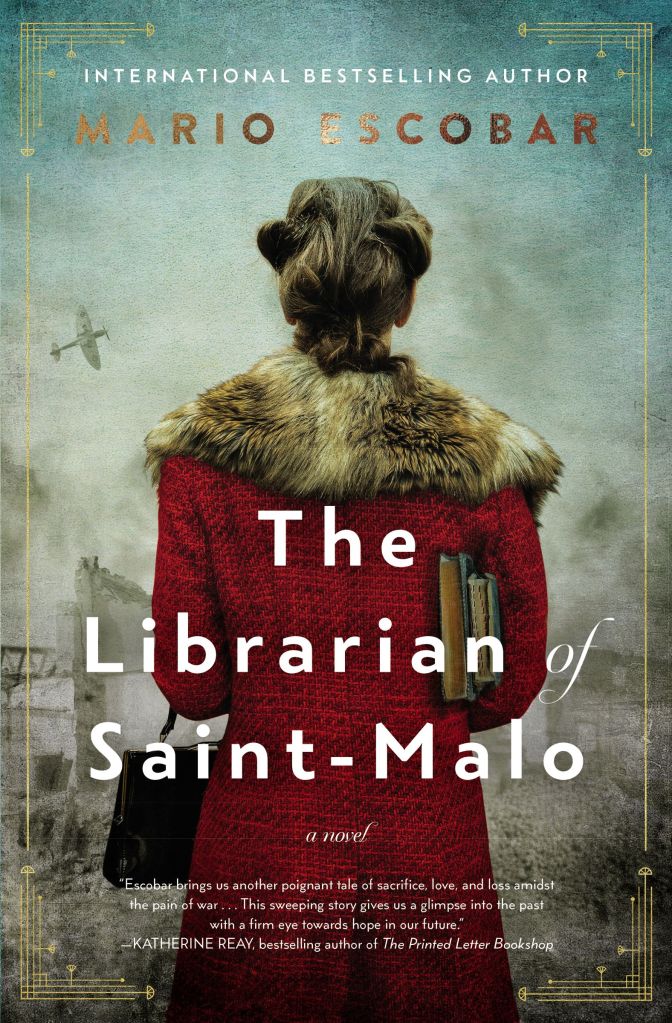
The Librarian of Saint-Malo

In the novel, The Librarian of Saint-Malo, by Mario Escobar, World War II broke out on the day Jocelyn and Antoine married. She developed tuberculosis on their honeymoon and struggled with her health for a long time.

Jocelyn worked as a librarian’s assistant in Saint-Milo, France, a port city that was once a haven for privateers. Antoine was eventually called for military service. When the Nazis invaded France, Jocelyn and her friend, bookstore owner Denis, hid some of the most valuable and important books away before the Nazis could either destroy or steal them.

A Nazi officer took over one of the bedrooms in Jocelyn’s apartment. The officer in charge of going through the books at the library was kinder and did not search as thoroughly as he could have for forbidden or valuable books.

The longer the Nazis occupied the area, the worse things got: food shortages, restrictions, people being herded and sent to concentrations camps–including Denis.

When the tide turned and the Nazis saw they were beginning to lose the war, they refused to surrender or retreat from Saint-Malo in an effort hold off Allied forces from getting further inland. So the city was besieged by American bombs to try to drive out the Nazis, leaving it nearly totally destroyed.

The book is written as a series of letters from Jocelyn to an author she admires so that he might tell her story. But most of the chapters weren’t really written as letters. When Jocelyn addresses the author at intervals, it seems she does so almost as a reminder to the reader that she’s writing letters.

Escobar writes in his author notes that this book was inspired by a visit he took to Saint-Malo as well as an account of a love story someone shared with him. He shares what circumstances and characters were based on real people.He writes that he “wanted to show the suffering of the common people during the German occupation of France and home in on the terrible persecution that the occupation unleashed on culture and books in particular” (p. ix).

I’ve read a number of WWII novels, mainly because that seems to be the most popular era for historical fiction. Usually this genre details some of the awful things people went through during that time but also highlights the bravery and humanity of the characters and leaves one feeling inspired and hopeful.

But this book fell flat for me, especially the ending. I never really connected with Jocelyn. The fact that this book was translated from another language and written by someone from another culture may have contributed to some of the thinking and conversations seeming a little unnatural to me.

Plus the author had characters, mainly Jocelyn, making sweeping generalizations. At one point she comes to see the wife of the marshal’s daughter because she’s been told letters from her husband have been sent there. She remarks, “I thought about how the rich and powerful never lose a war; they can adapt to any circumstance, as if pain and suffering were never meant for them (p. 46)–as if no one rich or powerful ever suffers. In another place, she says, “Heroism is just selfishness” (p. 46). She writes to her author-correspondent, “Being a writer means feeling things at a deeper level than everyone else and knowing how to communicate those depths, helping readers to see reality in a way they never have before” (p. 112). I agree with the second half of the sentence, but not the first. She tells an officer, “You fail to understand women, Lt. Bauman. We are not moved by ideals—that is a banal game ever played by men. We’re driven by something much deeper that really makes the world turn: affections” (p. 116). That doesn’t make sense to me at all.

And then there’s a vulgar expression that I thought was more modern uttered by the Marshall.

I had thought this was a Christian fiction novel, but it doesn’t seem to be. “Fate” is mentioned several times.

One good thing from the book was learning about Saint-Malo, which I had never heard of before. Somehow it was rebuilt after all the destruction and is now a resort town.

Plus there were a few quotes I loved. A couple of my favorites:

My hope is that someday, when humanity regains its sanity, people will know that the only way to be saved from barbarianism is by love: loving books, loving people, and, though you may call me crazy, loving our enemies. There’s no doubt that love is the most revolutionary choice and, therefore, the most persecuted and reviled (p. 2).

Literature is a weapon against evil (p. 124).

Since Escobar is a new author to me, I looked up several reviews of this book when I saw it on sale. Opinions were mixed. Some, like me, felt the book fell short in some ways; others loved it.

(Sharing with Bookish Bliss Quarterly Link-Up)

Review: Mrs. Tim Carries On

Mrs. Tim Carries On by D. E. Stevenson

Mrs. Tim Carries On is a sequel to Mrs. Tim of the Regiment. Like the first book, this is written in a diary format and based on author D. E. Stevenson’s own experiences.

Major Tim left for France during early 1940, leaving Mrs. Tim—Hester—home in a small English village with their daughter, Betty. Their son, Bryan, is away at preparatory school but comes home on holidays.

Hester writes that she decided to use her diary as an escape from war news and not mention it unless it affects her directly. So, at first she writes of old friends mentioned in the first book, amusing anecdotes of Betty, squabbles among servants, and such. She heads up the “Comfort Depot,” which involves collecting things for the soldiers and setting them out for the men to choose from.

The only mention of the war in the first part of the book has to do with shortages and an increasing number of Polish soldiers who have escaped from Hitler’s advances there. The community seems to receive them generously. Some of them can speak English or French, so they can usually find someone to communicate with.

The daughter of a friend, Pinkie, comes to stay with Hester indefinitely. Pinkie was a little girl the last time she was seen, but now is a beautiful seventeen-year-old, and several of the men fall in love with her. But she sees them only as friends.

Things turn a little somber in Part 3 when several more countries have fallen to Hitler and Hester has not heard from Tim for several months. Then in Part 4, she visits her brother in London and experiences bombs dropping in the streets and constant airplanes buzzing overhead.

There’s one odd new character, a Miss Brown Winters, who thinks she has lived several other lifetimes, mainly in ancient Egypt. Hester doesn’t believe her but finds her “interesting.”

Once again, there’s not much of an overall plot arc–the story is more just reflecting everyday life during that time.

Some of my favorite quotes:

[I] repair to the kitchen in a cheerful frame of mind. Cheerful feelings are soon dissipated. The kitchen is extremely warm, but the moral atmosphere is at zero. Mrs. Fraser, my large and terrifying cook, is waiting for me with a grim smile. I enquire in trembling tones whether anything has gone wrong. Mrs. Fraser replies that that depends. Having long and bitter experience of domestic catastrophes I am prepared for the worst (p. 5, Kindle version).

Her eyes are full of tears and I realise that she must be comforted, so I proceed to explain my own particular method of “carrying on”. None of us could bear the war if we allowed ourselves to brood upon the wickedness of it and the misery it has entailed, so the only thing to do is not to allow oneself to think about it seriously, but just to skitter about on the surface of life like a water beetle. In this way one can carry on and do one’s bit and remain moderately cheerful (p. 12).

“All war is awful,” says Guthrie. “It’s a wrong and horrible thing, war is, but we don’t need to worry about the rights and wrongs of war. We tried our best for peace. We tried for peace to the absolute limit of honour . . . but you can’t have peace when a pack of ravening wolves gets loose” (p. 37).

A day like this is a gift from God—or so it seems to me—and it seems all the more precious when it comes at the end of a long dark dreary winter (p. 52).

The daffodils have come in and are blowing like the bugles of Spring in the flower-shop window (p. 58).

I have the feeling that everyone in the world is asleep—but I know that it is not so. All over Europe there are people—men and women—keeping watch. There are aeroplanes, laden with death, speeding across the sky; there are sailors on the lookout; there are thousands of women like me who cannot sleep because their hearts are torn with anxiety . . . all over Europe the shadow of suffering lies. I sit and think about it, and in some strange way it is a relief to give way to misery. It does nobody any harm, for there is nobody to see. Just for a few moments I can take off the mask of cheerfulness. Just for a few moments I can allow myself to think (pp. 113-114).

I sit down on the window seat and prepare to listen, for if there is one thing I enjoy more than another it is a heart-to-heart talk with my son (p. 140).

[On visiting her childhood home] The dressing-table mirror is spotted with damp, and I am not sorry to see its degeneration, for it was never a kindly friend. It was like the friend who is in the habit of saying, “I feel it is my duty to tell you . . .” and it did its duty well. It was always candid about spots or blemishes or untidy hair. I glance into it as I pass to the window and find that its nature is not ameliorated by the passing years (pp. 215-216).

There’s a lovely poem called “Dunkirk 1940” which Stevenson shows as coming from one of the men. It’s too long to include (but I found a copy here). It tells of the Israelites’ miracle of the Red Sea parting, and the men at Dunkirk wishing for a similar miracle, to escape on dry land. But God provided a different miracle for them: “A double miracle to set us free –
Lion-hearted men, calm sea,” and hundreds of boats of all sizes.

I enjoyed this book much more than the first one. I can’t put my finger on why. Maybe because the characters were familiar to me, or maybe because the story had more touching moments mixed in with the lighter fare..

Review: The Winter Rose

The Winter Rose by Melanie Dobson is a dual-timeline novel.

Grace Tonquin is an American Quaker woman living in Vichy France during WWII. She had left behind the lifestyle of her actress mother, Ruby. Now she works with a network of others to help Jewish children escape France over the Pyrénées mountains into Spain. Grace has been told by Roland, her friend and leader, this must be her last group. Previously she had gotten the children to those who would take them over the mountains; now she must go with them. It was no longer safe for her to remain in France.

One boy, Louis, ends up having to remain behind in hiding with Helene, a woman who worked with Grace. Grace takes the remaining eleven children through various dangers until they finally arrive in Spain.

Most of the children are sent to live with relatives. Grace takes two of the children, siblings Elias and Marguerite, home with her to Oregon. She and Roland marry, and they raise the children as their own.

In 2003, Addie Hoult comes to Tonquin Lake in OR to look for any remnants of the Tonquin family. Her mentor and father-figure, Charlie Tonquin, is desperately ill and needs a transplant preferably from someone related. Charlie has always steadfastly refused to share anything about his family or his past. But Addie is determined to try to find his relatives, hopefully even his long lost sister.

I had seen films about people who helped Jewish children escape over the mountains. However, those movies ended with the children getting safely over, where it was assumed they lived happy and stable lives afterward. This book deals with the aftermath some of them faced. Even getting to safety, many of them couldn’t help but be traumatized by having to leave their homes and families, travel in difficult conditions, and witness things children should not have to see.

Some of the quotes I liked best:

She didn’t understand, nor would she ever, why God didn’t rescue everyone in this life, but it was her job, her grandfather had often reminded her, to be faithful in caring for those God gave to her (p. 37, Kindle version).

No one wants to hold you against your will. We want you to master your will so you can be in control of yourself (p. 189).

Living, I think, defies the loss. Loving well defies it, too (p. 301).

I enjoyed Melanie’s notes at the end where she told some of the history the novel was based on as well as what was fictional. She included some of that information on her website here.

When I’ve shared Melanie’s books before, some have wondered if she was related to or connected with the Dobsons of Focus on the Family. The “About the Author” page at the back of the book says, in part, “Melanie is the previous corporate publicity manager at Focus on the Family, owner of the publicity firm Dobson Media Group, and a former adjunct professor at George Fox University.” Since her husband’s last name is Dobson and she worked at Focus, I assume he is related somehow–unless the same last name is just a coincidence.

Overall, I thought this was a good book. I got a little lost in some places, unusual for Melanie’s books. But I appreciated getting to know “the rest of the story,” as Paul Harvey wold have said, behind some of the displaced children of WWII and the people who helped them. However, they aren’t the only ones in the story dealing with past wounds and needing to heal from their experiences. That seems to be the common theme among many of the characters.

Review and Giveaway: Chasing Shadows

Chasing Shadows by Lynn Austin

In Chasing Shadows, a novel by Lynn Austin, people of the Netherlands thought they would be safe during WW2 because their country was neutral. But the Nazis invaded and took over anyway.

Lena de Vries is a farmer’s wife with a son and two daughters. She loves her life, though she has frequent arguments with her daughter, Ans.

Ans doesn’t care for farm life and doesn’t embrace her family’s faith. When she has an opportunity to move to Leiden, she takes it. She’s offered a job as a companion to a woman named Eloise with “melancholia”–her symptoms sound like what we would call bipolar disorder today. Eloise is depressed by her losses during WW1. When the Nazis invade, she’s in danger of sinking further. Ans starts helping in small, but ever-increasing ways with the Resistance. When Eloise finds ways she can help, too, she’s energized.

Ans had begun dating a Dutch policeman, Erik. The Nazis took over the police force, but Erik thought the best way to cope was just to get along with them. But they increasingly require more and more, and he and Ans differ about where they should draw the line.

Jewess Miriam Jacobs fled Germany with her father, who procured a teaching position in Leiden. They planned to send for Miriam’s mother later. But when the Nazis came, there was nowhere to escape. The coastline and borders were monitored. Some Jews who had escaped to other countries were turned away. One by one, the Nazis followed the same procedures as they had in Germany: limiting Jewish activity, requiring yellow stars on their clothing, eliminating their positions. When word came that Jews were being deported to settlement camps, Miriam and her father know they have to hide.

Meanwhile, Lena has to learn to let go—first of Ans when she leaves, then her husband Pieter when he trains for fighting, then her teenage son when the Nazis scoop up young men to build trenches and such. She and her husband hide both Jews and Dutch police who went underground rather than work for the Nazis. Though their food supply continues to dwindle, Lena can’t turn away the hungry that come to her farm.

I loved that this book didn’t cover just one thread–the Jewish persecution or the dangers of being in the Resistance or strains on the homefront—but dealt with facets of all of them. It was fully orbed, covering how the war affected and caused suffering for everyone. For instance, when the queen, in exile, orders railroad workers to strike, deportations of the Jews cease and Nazi supplies are stopped–but so are everyone else’s. There was widespread starving, especially in cities. People who had homes chopped up furniture to burn to keep warm, and animals of any kind (including cats and horses) weren’t safe from being caught and eaten.

Plus the three main characters are at different stages in life and at different levels in their faith. And each has to make nearly impossible choices.

I was so attached to these characters that I was sad to let them go when the story was over.

As it happens, I somehow ended up with two copies of this book. I think I bought it on sale but maybe forgot I had already received it for my birthday. Then the audiobook (nicely read by Stina Nielsen) came up free in the Audible “Plus” catalog, and I figured I’d get to it sooner via audio. But I still liked having the print books to refer to certain passages and read the book’s back material.

So I’d like to offer these two paperback books to a couple of my readers. I’m sorry I’ll have to restrict the giveaway to continental US addresses due to postage prices. If you’d like to enter a drawing for a copy of this book, leave a comment on this post. I’ll count all the comments on this post as entries unless you tell me you’d rather not be in the drawing. I’ll draw two names one week from today and contact the winners via email. If I can’t reach you or don’t hear back from you within a couple of days after that, I’ll draw another name.

I wish I could give you all a copy!

The giveaway is closed. Congratulations to Kitty and Sarah!