Review: The British Booksellers

The British Booksellers by Kristy Cambron

The British Booksellers by Kristy Cambron shifts back and forth from WWI to WWII.

Amos Darby and Charlotte Terrington are secret childhood friends with a love for books. But that’s all they can ever be. Amos is a tenant farmer’s son, and Charlotte is an earl’s daughter. Though Charlotte loves Amos, her parents arrange her marriage with Will Holt, the future Earl of Harcourt.

Amos goes off to WWI and comes back scarred. He opens a book shop on Bailey Lane in Coventry, England, but becomes something of a recluse.

Charlotte, now widowed Lady Harcourt, has opened a bookshop as well across the lane with her daughter, Eden. The booksellers have been rivals and enemies for over twenty years, though Eden has tried to negotiate a peace between them.

When an American lawyer, Jacob Cole, shows up with alarming news for Charlotte and Eden, they fight back to keep their estate, even though it is becoming ever harder to maintain.

But when WWII begins and German bombers fly across Coventry, Amos, Charlotte, Eden, and Jacob have to work together to help each other and their neighbors survive.

The Coventry Blitz is referred to as the Forgotten Blitz. The London Blitz received so much attention, Coventry was overlooked in the press. Kristy Cambron says in her author’s notes that some officials suppressed news of the devastation of Coventry so as not to damage morale.

The story includes four Land Girls, part of the Women’s Land Army in Britain who helped out at various farms and homes across the nation. I had read of these women in other books, so it was neat to see their roles fleshed out a bit more.

The historical story was quite interesting, but Charlotte and Amos’ story was so touching.

With characters who have a common love for books and who become rival booksellers, the importance of books comes up often. One of my favorite quotes about this aspect:

Books are an escape that beckons the reader from the heavy burdens of this world.’ Isn’t that what you told me once? They can challenge as well as comfort. Entertain and educate. Even save us in ways we’d never expect. You’ve used the words art, oxygen, and life all to describe them. Anyone who can see such value in these pages ought to also see that they could take him away from a future he doesn’t want. If anything, that is what Dickens wrote for his characters. Isn’t that what you wish for yourself?

I listened to the audiobook, beautifully read by Barrie Kreinik. Happily, this time the audiobook did contain author’s notes about the historical aspects of the book. There weren’t any notes about what inspired the personal stories, though.

With going back and forth between timelines, it was a little hard to keep up sometimes with where we were in the story. It’s not as easy with an audiobook to flip back to the beginning of the chapter to check the dates. Plus 1914 and 1940 sound alike. But it didn’t take too long to get oriented.

Overall, I loved the book and the characters and felt for them.

Review: Yours Is the Night

Yours Is the Night by Amanda Dykes

In Yours Is the Night by Amanda Dykes, Matthew Petticrew grows up with his sister on a racetrack in New York in the early 1900s until the father who never claimed them sent them away. Matthew’s sister, Celia, was sent to nursing school, Matthew to be a groom at the stables of Harvard University.

When Matthew travels with some Harvard boys to Plattsburg Training Camp to deliver horses, a chance meeting with his childhood hero, Jasper Truett, one of Theodore Roosevelt’s Rough Riders, changes his life.

Matthew and three acquaintances are sent to the Argonne forest for more wood to reinforce the trenches.

One of the men, George Piccadilly, is a Brit whose parents had sent him to Harvard to get a divinity degree to avoid having to fight in the first World War. However, through a series of events, he ends up at Plattsburg Training Camp . He has no use for religion but somehow ends up a chaplain. His joviality and Matthew’s seriousness don’t seem like they would mix, but George sticks close to Matthew because he looks like he would know how to survive. Plus George thinks he can lighten Matthew up a bit.

The last acquaintance is Henry Mueller, a bookish young man who was recruited as a fresh-faced, boy-next-door to write for the newspaper about the war under the pen name Hank Jones.

As they gather wood, they hear a woman singing. George dubs her the Angel of Argonne. And then one night they meet her in person at the freshly dug grave of her grandfather.

Mireilles, called Mira, grew up with her father and grandfather in the Argonne. When the war came crashing into their quiet lives, Mira’s father went to fight. Now her grandfather is gone, too.

The men feel they can’t leave her alone in her forest home so near the front lines. But they don’t want to send her out alone, either. They obtain permission to accompany her to her nearest relative’s house.

The journey will change each of them.

It took me longer to get into this book than Amanda’s previous book, Whose Waves These Are. The point of view shifts back and forth between Matthew, George, Hank, Jasper, and Mira. It took a little while to get them all sorted out. Plus there was a lot of bickering between George, whose character I didn’t really like at first, and the other two younger men. It was understandable, even funny at times. But not my favorite.

But at some point, everything clicked into place. The last few chapters were just beautiful. I loved the ending. Right after finishing, I went back and reread the first few chapters, understanding them better.

The prologue and epilogue tell of the choice of a casket for the Tomb of the Unknown Soldier. In the author’s notes, Amanda tells of visiting the tomb on the centennial anniversary year and how much the symbolism meant to her. She writes that she did not mean to fictionalize the unknown soldier, but “His anonymity allows him to represent the countless ones who never came home. . . . I hope that only respect, gratitude, and a fierce guarding of the real soldier’s true story—untouched by this imagined one—is found in these pages.”

Some of the other quotes I liked:

That burning justice is a gift. . . . But you be sure and save it for where it’s needed. Some battles aren’t battles after all (p. 23, Kindle app).

I understood the way words can shape hearts. Evade the creation of mobs and fear, and instill a home-front army of citizens armed with hope (p. 65).

The sky rumbled like only the earth should, and the earth bled like only people should, and people—people lived and died like nobody, ever, should (p. 151).

War happens. We help. It’s what we do. Not one of us can fix this whole mess, but maybe we can help this one moment (p. 151).

Men of few words, I was realizing, said much with their silence over here (p. 174).

“The matches . . . they are hope.” They are hope. The three words socked the air from me. Bringers of hope . . . creators of light from dark, when struck on hard places (p. 178).

It’s not mine to change what has happened . . . I cannot. It is mine to walk through what will come (p. 181).

There are none who can undo the past. But there is one who will carry the pain of it. He knows too well the sting of injustice. No, more than that. The blood of it. But with it, He bears the scars of his own injustice with the same hands that carry me now (p. 182).

Her brother was a thoughtful speaker, one who weighed his words and chose few of them to speak, ones that seemed always to carry so much in their depths. His sister seemed to do just the opposite—speak her words, then catch them and consider them, then say more words to explain. As if she were swimming in them, and happily so (p. 195).

What if what we believe to be our shortcomings, our oddities, are actually purposeful quirks that suit us for the moments we were made for? (p. 257).

Though I loved Whose Waves These Are more, I came to enjoy this book quite a lot as well. I’m a fan of Amanda’s writing and eager to read more of her books.

Review: Far Side of the Sea

In Far Side of the Sea by Kate Breslin, Lieutenant Colin Mabry had been on the front in WWI. After recovering from a serious accident and the loss of his hand, he’s assigned to MI8, decoding messages sent by carrier pigeon. He’s troubled by the sounds of battle he hears across the channel as well as any loud, sudden noises.

One day he finds a carrier message to himself from a woman he thought dead, Jewel Reyer. She had taken him in, at great risk and cost to herself, when he was injured in France. He had promised to return for her. But then he had his accident and recovery, and afterward heard her entire village had been attacked with no survivors.

He obtains permission to travel to France. He is stunned to find that the message was sent not by Jewel, but by her half-sister Johanna, who works with doves for the French Army Intelligence. Johanna found Jewel’s diary, where she mentioned Colin. Johanna has reason to think her sister is alive and in the custody of a German agent who had been in charge of her village. Johanna wants Colin to help her find Jewel.

Colin is angry at the deception and wary of Johanna. But if there is a chance Jewel is alive and needs his help, he must look for her. He owes her that. Plus, the two were just beginning to develop feelings for each other, and he must know if she still feels the same way.

So he sets aside his anger at Johanna, and they travel to Jewel’s last known location with more questions than answers.

But they find themselves in danger, not knowing whom to trust.

This is the first book I’ve ever read by Kate Breslin, and it definitely reeled me in after the first few chapters. Johanna has several secrets she has not shared with Colin, and bits of her story and background are revealed through the book, as well as her reasons for not sharing all. It takes a while to decide whether she is trustworthy and someone we should be pulling for.

Then they meet an array of iffy characters and situations and face multiple twists and turns.

The story also deals with Colin and Johanna’s inner issues as well. Colin not only suffers from what we now know as PTSD, but he’s lost confidence in himself. Johanna had a checkered upbringing and struggled to find a place to belong or believe that there was a God who was interested in her.

I didn’t know at first that this book was a sequel to another, Not By Sight. Far Side of the Sea read well on its own, but I might like to go back and read the first book some time if I catch it on sale.

I enjoyed the author’s notes at the end, where she tells more about carrier pigeons used in war and what details and people were real or made up.

I’d had the Kindle version of this book for a while, but recently saw the audiobook was among Audible’s free titles. It was nice to switch back and forth between reading or listening, depending on my circumstances.

As I said, this was the first of Kare Breslin’s books I’ve read, but it won’t be the last.

Review: Ladies of the Lake

In Cathy Gohlke’s novel, Ladies of the Lake, Addie MacNeill is orphaned at age twelve. Her older half-brother sells the family home in Prince Edward Island and ships Addie off to a Lakeside Ladies’ Academy in Connecticut.

Some of the older girls pick on Addie for her newness and different ways. But she surprises herself by finding three dear friends: Dot, Susannah, and Ruth. Eventually they dub themselves the “ladies of the lake” and plan to meet together regularly once they’ve graduated.

When Lucy Laude Montgomery publishes Anne of Green Gables, set in Addie’s beloved PEI, Addie writes to her. The two begin a regular correspondence, and Montgomery encourages Addie in her own writing endeavors.

But trouble stirs when Addie and Dot fall in love with the same young man, Stephen. Over time as he favors one over the other, jealousy and deceit escalate between the girls and ruins their friendship.

WWI is brewing, and Ruth lost her brother in the Lusitania bombing, so she’s prejudiced against Germans. Stephen Meyer and his brother, Jonas, are as American as they come. But their parents still have a heavy German accent. Soon the rest of the community joins in persecuting and ostracizing the Meyers.

Addie is called to Halifax to help her sister-in-law through the end of her pregnancy and delivery. While there, the colliding of two ships sparks the Halifax Explosion, which killed and injured thousands and destroyed homes and buildings. Addie lost her brother and his family and was deeply burned and scarred. Believing that Steven had chosen Dot, Addie decides to change her name to Rosaline Murray and make a new start.

Seventeen years later, Rosaline’s daughter, Bernadette, is about to graduate from Lakeside Ladies’ Academy and dearly wants her mother to come. Rosaline is sensitive about traveling outside of Halifax with her scars. But worse than that, she doesn’t want to face Dot, who is now the headmistress of the Academy.

Dot herself has struggled with secrets for seventeen years now. Believing Addie died in the explosion, Dot has no way to make things right. But when Bernadette starts reminding her of Addie, Dot wonders if Addie could possibly be alive. Could she ever face her again?

Rosaline and Dot resist the things they need to do the most: face each other and confess their wrongdoings and apologize. Their inner torment threatens to hurt themselves and those they love.

I enjoyed this story so much. I loved the characters and how the plot unfolded. The correspondence with Montgomery was a fun element. I had never heard of the devastating Halifax explosion. I loved how the author told it from the standpoint of those affected.

I listened to the audiobook which, sadly, did not contain the author’s end notes. I would have loved to learn more about what inspired the author.

Cathy Gohlke has written another winner that I can highly recommend.

Review: Yesterday’s Tides

Yesterday's Tides novel by Roseanna M. White

Roseanna M. White’s novel, Yesterday’s Tides, has two related story lines taking place in 1914 and 1942 on Ocracoke Island in North Carolina’s Outer Banks.

In 1914, Louisa Adair helps her mother and “Grann” run an inn. She’d like to go to teacher’s college, but there isn’t enough money. Plus, she’s needed at home.

Though Louisa has blue eyes, her skin coloring is darker than most people’s. Her mother will not tell her anything about her deceased father except that he was a good man. A few people are prejudiced against her, thinking she must be of mixed race.

When two college-age cousins, one from Maryland and one from England, come to the inn for the summer, Louisa has no idea how her life will change as a result. Louisa has no plans to fall in love: she keeps a polite reserve with the inn’s male guests. But she and Remington Culbreth, from England, find themselves in each other’s company often. Just after they do fall in love, WWI breaks out and Remington is called to service at home. Will their relationship survive not only the war, but the differences in their families and lifestyles?

In 1942, Evie Farrow now runs the inn with her grandmother. One day while taking some baked goods to the neighbors, a loud explosion is heard in the distant waters. While Evie’s Coast Guard friends prepare to investigate and help, Evie heads home to pray. When a badly burned Englishman washes up near the inn, somehow Evie knows not to report him. He says he is military, but he’s not in uniform. What mutterings she hears as he goes in and out of consciousness alert her to the fact that he is an intelligence officer. But what would an English spy be doing in Ocracoke?

When he wakes up, she learns his name is Sterling Bertrand and he is tracking a German operative. But it will take weeks for his wounds to heal. Meanwhile, he wonders just how far he can trust Evie, who seems to have secrets of her own.

I’ve read many dual timeline novels, and usually there are enough differences between the two timelines to keep from getting confused. I had a little harder time with this one, since both stories took place at an inn in Ocracoke and involved a visiting Englishman. I think I would have had an easier time with reading rather than listening. I didn’t catch some of the names that were the same in both timelines, so I kept getting surprised at the connections. I don’t think that would have happened if I were reading instead of listening.

As it happened, partway through the audiobook I discovered that I did have a Kindle copy! So I went back and forth between reading and listening.

One delight with this book was running into some characters from Roseanna’s previous books. I won’t say which ones, as that might give away parts of the plot. You don’t have to have read those books to understand this one, but it was a fun surprise to see those characters again. Evidently Remington was in an earlier book as well, but, though I remember the story and situation, I don’t remember him.

I’m sorry to say I was not thrilled with the audiobook narrator. Some of her accents seemed a little off to me. Plus she had an odd cadence, her inflection going up when it didn’t need to.

There are so many layers to this novel, and so much more to it than there appears to be at first. I loved the stories, and after finishing the book, I just wanted to sit with the characters a bit more before saying goodbye to them and starting another story.

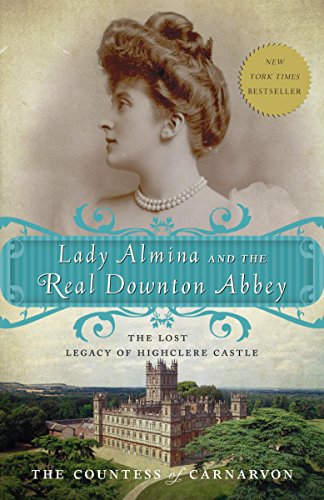
Lady Almina and the Real Downton Abbey

You don’t have to be a fan of Downton Abbey to enjoy Lady Almina and the Real Downton Abbey: The Lost Legacy of Highclere Castle. If you enjoy British manor houses and history, especially the Edwardian era, you’ll like the book whether you’ve seen the series or not. But if you are a Downton Abbey aficionado, you’ll probably enjoy some of the behind-the-scenes information about the setting for the series.

The fictional Downton Abbey is set in a real castle called Highclere, home to the current eighth Earl of Carnarvon and his wife, the author of this book, the Countess of Carnarvon.

An able historian, the Countess draws from diaries, letters, and other information to tell of one of her predecessors, Lady Almina, who married the fifth Earl of Carnavon in 1895.

Almina was the illegitimate daughter of Alfred de Rothschild, a wealthy banker. Though she had been presented at court, “she had not been invited to the highly exclusive, carefully policed social occasions that followed. Almina’s paternity was the subject of a great deal of rumour, and no amount of fine clothes or immaculate manners could gain her access to the salons of the grand ladies who quietly ruled Society. So Almina had not attended all the crucial balls of her debut season, occasions that were designed to allow a young lady to attract the attentions of an eligible gentleman” (p. 4). But somehow she drew the attention of George Edward Stanhope Molyneux Herbert. Apparently her beauty and large dowry overcame the circumstances of her birth. But from all accounts, Almina and George were fortunate to have a genuine marriage where they truly loved each other.

One of Almina’s main functions was to plan and host dinners and gatherings, even for the Prince of Wales, her husband’s friend. She was a master of organization and a charming hostess.

Unlike many women, she traveled with her husband, a man of many and varying interests.

But life changed during WWI. Almina had found a knack for nursing during one of her husband’s illnesses. During the war, she converted part of the castle into a hospital. She wanted the soldiers to feel like guests at a country estate. She knew they needed respite for the mind and soul as well as the body. But she wasn’t just a distant financier: she donned a nurse’s uniform, made rounds with the doctor every morning, and helped in various ways, even bathing gangrenous feet.

After the war, when travel could resume again, Almina and George traveled to Egypt. George had been to Egypt many times, because of his love for travel and the area, but also for his heath. The damp winters of England were unhealthy for him, so he often spent winters in Egypt. He had financed several excavations over the years without finding much for his efforts. He was going to give up, but then his partner in the work, Howard Carter, wanted to go one more time. George agreed, and this time, to their amazement, they found the tomb of Tutankhamun (not a spoiler as this is mentioned early in the book).

Between these major events, the book tells various details about George and Almina’s family, upstairs vs. downstairs life, the progression of the war and its aftermath, details around the Earl’s discovery of King Tut’s tomb, and Almina’s long-term legacy.

Almina grasped early on “that she was only one part of a machine that would long survive her. Part of her initial task on arrival was to understand the history and community that she was becoming a part of” (p. 15). “Everyone at Highclere, whether they worked above or below stairs, on the farm or in the kitchen, had a role to fulfil, and Almina was no different,” (p. 11).

In shows and films about this era, we often see lords of the manor not doing much besides hosting lavish dinner parties and going hunting. But, in fact, they had a lot of responsibility. Before the war, the Earl had an idea where things were going, and took a large sum of money out of the bank. “Considering that he was morally responsible for the welfare of the entire household, as well as the tenants, he refused the offer [of selling some of his land to the government] and set about adding to his flocks and herds. He also bought one and a half tons of cheese and an immense amount of tea. . . Once he had deposited the gold in his bank in Newbury, he was in a position to provide 243 men women and children with all essentials for at least three months” (pp. 125-126).

The current countess adds in the epilogue that even now, “The challenge for Highclere is to ensure that the Castle and its estate businesses remain strong enough to preserve their rich heritage. It is the same need to balance business and conservation that confronted Almina” (p. 292). “It was the economic fallout of the Second World War, combined with new tax structures, that made it impossible to maintain the opulence of previous generations at Highclere Castle,” (p. 301). When Almina’s son became the sixth earl, he had a reduced staff. WWII took a further toll on the whole country in many ways. The current earl and countess live at the castle part of the time and in a cottage at other times. They offer the house for various gatherings and other purposes (like settings for films) not only as a means of upkeep, but to preserve the house’s legacy.

The countess says in the prologue this book “is not a history, although it is set against the exuberance of the Edwardian period, the sombre gravity of the Great War and the early years of recovery after the conflict. It is neither a biography nor a work of fiction, but places characters in historical settings, as identified from letters, diaries, visitor books and household accounts written at the time.”

It took me a little while to get into this book. The first part was largely informational. But by the time the book got to the war and the castle becoming a hospital, my attention was more engaged. Overall, I really enjoyed it.

I got the Kindle version of this book a while back during a sale, but got the audiobook recently during another sale. Wanda McCaddon is a wonderful narrator for the book: I had previously heard her narration of several other classics.

There is a sequel to this book which I don’t have yet but would like to read some day: Lady Catherine, the Earl, and the Real Downton Abbey. Lady Catherine was Almina’s daughter-in-law, an American who was not an heiress and wasn’t raised in anything like the society she married into. Her husband inherited the estate at a fairly young age, so they were both thrust into big responsibilities sooner than expected. Then they had to manage during WWII and the subsequent changes to the country and their lives.

If you’re interested in the castle, the countess has an Instagram account for it here: https://www.instagram.com/highclere_castle/. She shares some of the hidden nooks and crannies as well as the gatherings they currently host and other interesting details.

This book could fit in the Celebrity category of the the Nonfiction Reader Challenge. George and Almina were celebrities in their day, Downton Abbey has brought a new celebrity to the castle, and the current The Earl and Countess are celebrities now.


Last Christmas in Paris

Last Christmas in Paris: A Novel of World War I by Hazel Gaynor and Heather Webb opens with the beginning of WWI. Two friends from childhood, Will Elliott and Thomas Harding, head out for France to fight, enthusiastically expecting the war to be over by Christmas. Then they plan to meet Will’s sister, Evie, and her friend, Alice, in Paris for Christmas to celebrate.

But of course the war drags on much longer than the few months til Christmas.

Evie writes Will and Thomas with all the support and hope she can send. Will is not much of a writer, so Evie gets most of her news about him from Tom.

Over time, enthusiasm and naiveté wanes and the realities of war weigh them all down. Tom gets more discouraged by what he has seen and has to do.

Tom also faces pressure from his father’s illness and business troubles. His father owns and operates the London Daily Times and always planned for Tom to follow in his footsteps. Tom’s interests fall more into a literary and scholarly vein, and he has no interest in the newspaper, which causes tension with his father. But when his father falls ill, Tom is consulted. He can’t do much from France, so he asks his cousin, John, to step in. There has been some longstanding feud between Tom’s and John’s families, but Tom never knew what it was all about, and he has to hope John will keep the paper’s best interests in mind.

Evie, meanwhile, chafes at home. She wants to do something to help, but her mother insists that for girls in her class, the only acceptable activity is aiding her mother with her charities and looking for a suitable husband. But Evie branches out from her protective gilded cage. Though she puts herself at risk, she also grows through her efforts.

The book opens with an aged and ill Thomas planning to go to Paris for Christmas in 1968 to read one last letter from Evie. Most of the book is made up of letters, mostly between Tom and Evie, but also with Will, Alice, their parents, and Tom’s contacts at his father’s business. At different places throughout the novel, the scene switches back to Tom and his current situation and reflections over his life.

This book was not in my Christmas reading plans, not even on my radar until Becky mentioned it. It sounded interesting, and I needed a new audiobook, so I got it. Epistolary novels are not my favorite style of writing, but I have enjoyed some.

I am so glad I listened to this book. I enjoy historical fiction, and not as many books are written about the first world war. I like how this one shared details of everyday life in England as well as on the front.

But mostly I enjoyed the growth of Evie and Tom’s characters and their relationship with each other. From lighthearted banter to lifting each other up from the deepest discouragement, from heartbreak to hope, from misunderstanding to shared poetry, they get to know one another better than they ever had before but almost miss each other in the end.

Though there is some mention of God and prayer, this is a secular book. It has maybe three bad words, but is remarkably clean.

The audiobook is excellently done, with different narrators for the different characters.

This is a beautiful book, and I am so glad I listened to it.

Book Review: A Portrait of Loyalty

A Portrait of Loyalty is the third in Roseanna M. White’s Codebreakers series which takes place during WWI.

Lily Blackwell inherited her mother’s artistic eye, but her medium is photography rather than paint. Skilled in retouching as well as taking pictures, Lily’s father recruits her into the government’s propaganda department. But they keep her involvement a secret from Lily’s mother, who doesn’t approve of art being used that way.

Zivon Marin’s outspokenness against Lenin led to his fiance’s murder and his having to flee Russia. He had been second in command in Russia’s cryptography department and now offers his services to England. Though England accepts his offer, not everyone in the department is sure they can trust him—especially when compromising pictures begin mysteriously showing up.

When Zivon and Lily meet, neither can be completely forthcoming. So how can they ever truly know and trust each other?

And as WWI seems to be winding to a close, another threat looms: the Spanish flu, known at first as the three-day fever.

A few favorite quotes:

The world may still look dark, but if photography had taught her anything, it was that there was always more light to be found. Sometimes you just needed to change your lens. And sometimes you need a flash. Neither ever changed what was really there… but it showed it in a new way.

We must be still – not our hands and feet, but our minds. And know that He is God. That He has not changed. That the same Lord who loved us when all is well loves us still when all is lost. His promises are as true today as they were yesterday. He has been enough to see people through the worst since the dawn of time. We must trust that His love is enough to see us through now.

She had a feeling he was like a matryoshka doll too–a placid exterior that hid layers of secrets and mysteries. And she couldn’t help but wonder what lay beneath this carefully crafted shell.

Once again, Roseanna has woven together an intriguing story with a lot of depth and layers. The only problem with listening to the audiobook raher than reading is that the audiobook doesn’t include the author’s end notes explaining where she got her inspiration and what parts of the story were based on true happenings.

Although I think any of the books in the series could be read alone, I really enjoyed reading/listening to them straight through. The Codebreakers series continues the timeline and some of the characters of the Shadows Over England series.

Shadows Over England:

Book 1: A Name Unknown
Book 2: A Song Unheard
Book 3: An Hour Unspent

Codebreakers series:

Book 1: The Number of Love
Book 2: On the Wings of Devotion
Book 3: A Portrait of Loyalty

(Sharing with Carole’s Books You Loved, Booknificent Thursday)

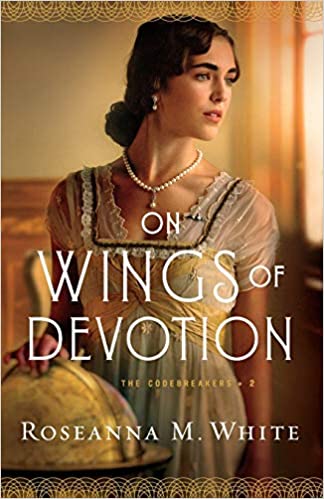
Book Review: On the Wings of Devotion

In Roseanna M. White’s novel, On Wings of Devotion, Phillip Camden’s nickname is “Black Heart.” He earned it when his squadron went down in flames and he was thought to be the cause due to a loud argument and threat to one of his men. A friend pulled some strings to get Phillip out of prison and into Room 40, where the codebreakers worked during WWI. But his surliness and bitterness keep everyone at bay.

Arabelle Denler is a nurse and an heiress. She’s warm and kind, but not considered attractive. Since her father had been absent most of her childhood, all she ever wanted was a family. When a lifelong friend suggested a marriage of convenience so her money could help preserve his family home, she readily agreed. But then her fiance fell in love with someone else.

Phillip puts himself forth as Arabelle’s protector from the stream of men seeking her hand—and her money—now that she’s free. As they come to know each other, Arabelle sees beyond the surface of Phillip’s brusque exterior. He sees the goodness and kindness of her heart.

But an old acquaintance seeks Phillip out. He knows she’s up to no good. But he doesn’t realize that she’s setting him up as part of a larger target.

This book is the second of the Codebreaker series, which is a continuation of the Shadows over England series. I enjoyed seeing a few characters from the previous books pop up. But I enjoyed Phillip’s and Arabelle’s stories even more. All the threads of the story—the characters, the spiritual and mental journeys, the intrigue—kept me listening to the audiobook every chance I got, especially the last fourth or so of the book.

A couple of quotes:

This war was destroying her entire generation. Those it hadn’t wiped out entirely it was trying to take apart piece by piece. And what could she do?

We can be sure it will be painful. Cutting out what stands between us and God always is. But we can also trust that in the giving, we’ll gain something far more precious.

The audiobook was wonderfully read by Susan Lyons. The only negative about the audiobook is that it doesn’t include the author’s notes at the end, where she tells how she came to write the story, what historical details she drew on, etc.

Each book I read from Roseanna is my favorite. Until I read the next.

(Sharing with Booknificent Thursday, Carole’s Books You Loved)

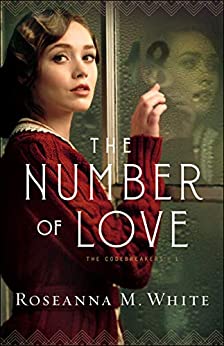
Book Review: The Number of Love

Margot De Wilde thinks in numbers. Numerals line up differently in her head when all is well or something is off. Her father developed a system of cryptography before WWI with young Margot as his main pupil. After his death, Margot and her mother were rescued from Belgium (in A Song Unheard) to be with her brother, famous violinist Lucas De Wilde, in London. Though a teenager, Margot is recruited to work in the admiralty’s secret Room 40 deciphering Germany’s coded messages.

Margot had one good friend back in Belgium, but she’s not interested in the silly things most girls are. She’s content to be alone, but when she notices Dot, another young woman at the admiralty seemingly on the outskirts of society, they strike up a satisfying friendship.

Dot thinks her brother, Drake, is in the Navy. Their grandfather in Spain thinks Drake is a student. Neither suspects Drake actually works undercover.

Drake finds Margot fascinating and loves her sarcastic sense of humor. But Margot has no time for or interest in romance.

Then Margot suffers a tragic loss that turns her well-ordered world upside-down. Not only do the numbers in her mind stop, but God seems silent.

And Drake returns from Spain wounded with an enemy who may pursue him all the way to London.

The Number of Love is the first in Roseanna M. White’s Codebreakers series, which follows the Shadows Over England series. A few of the characters carry over. This novel is every bit as captivating as the first three. It may be my favorite of Roseanna’s so far.

A couple of quotes from the book:

Faith isn’t just feeling. We have to know He’s still there, unchanged, even when we can’t feel Him. When the grief’s too loud to let us hear His voice.

There were never any guarantees. Even being sure God wanted him to do this didn’t mean he’d come home safely. Sometimes God’s will meant bullets searing flesh. Death coming too soon. Sometimes God’s will was to let man taste the consequences of his folly and his hatred and his supposed self-sufficiency. Sometimes God let people die. Let His children break. And then pieced them back together into something new. Something that He could use for His glory instead of theirs

I enjoyed the suspense provided by the intrigue and mystery concerning Drake’s pursuer and the historical detail. At the end of the book, Roseanna differentiates between the actual historical facts she used and the details she made up.There was an actual Room 40 of codebreakers during WWI that few knew about.

I love that Margot is an imperfect heroine. Even though she’s smart, she’s also young and a bit immature. And she can come across as a little arrogant sometimes. But her experiences help mature and humble her and teach her to rely not on her abilities or systems, but on God.

I’m so glad Roseanna continued this series. I look forward to the next book!

(See also: Why Read Christian Fiction)

(Sharing with Booknificent Thursday, Carole’s Books You Loved)