Review: The Island Bookshop

The Island Bookshop

In The Island Bookshop by Roseanna M. White, Kennedy Marshall has a career she loves in the Library of Congress. But when her sister back in North Carolina’s Outer Banks has a serious fall from a ladder, Kennedy travels to help care for her sister and run their grandmother’s island bookshop.

Kennedy hasn’t been home in a while. She loves the island, her sister, and the bookshop. But she’s avoiding Wes Armstrong. They’ve been friends since childhood, but Kennedy had deeper feelings. Then Wes married her friend Britta. Though Britta passed away, Kennedy knew too many of her secrets–secrets she can’t bear that Wes should know.

Wes’s family has built a successful business on the island, but a development group has offered to purchase the business. The money would help, but the business has been Wes’s life. He struggles with knowing what he should do.

When Kennedy’s sister’s recovery takes longer than expected, Kennedy faces some difficult decisions.

When a question comes up about a different name on the lease of the bookshop than Kennedy’s grandmother, Kennedy searches for information among county records and old boxes in the attic. She finds a number of editions of The Secret Garden in various languages as well as some old letters with surprising news.

Interspersed between the modern-day chapters are scenes from Kennedy’s great-grandmother’s life. Ana is pregnant when she comes to the US during WWII from Dalmatia in Croatia, which at that time was part of Italy. Her husband, Marko, had come earlier to get a job and find a home. But he doesn’t come to meet her when she arrives. Italian-looking immigrants were viewed suspiciously at that time, and Ana doesn’t receive much help or direction. Finally a sea captain gives her a bit of information which leads her to the wife of the man who hired Marko for his fishing boat. The wife graciously takes Ana in, though she has to deal with anti-Italian sentiment from some of the neighbors.

But her friend’s daughter is enamored with Ana. They both love books, and Ana shares her favorite, The Secret Garden.

Then tragedy strikes. Ana doesn’t know what she will do in a new country with a newborn daughter.

I enjoyed both the modern-day and the historical stories. I hadn’t realized Croatia had been part of Italy. At the time, most people in the US weren’t interested in the difference–Italy was Italy and was ruled by Mussolini, so Italians were suspect. It was hard enough to adjust to a new country without that added layer.

I don’t usually read seasonally except at Christmas. But it was fun to read a “beachy” story at the end of the summer.

Themes of faith, forgiveness, and second chances are woven well through both narratives. Roseanna is one of my favorite authors, and this book is a lovely addition to her body of work.

Review: Code Name Edelweiss

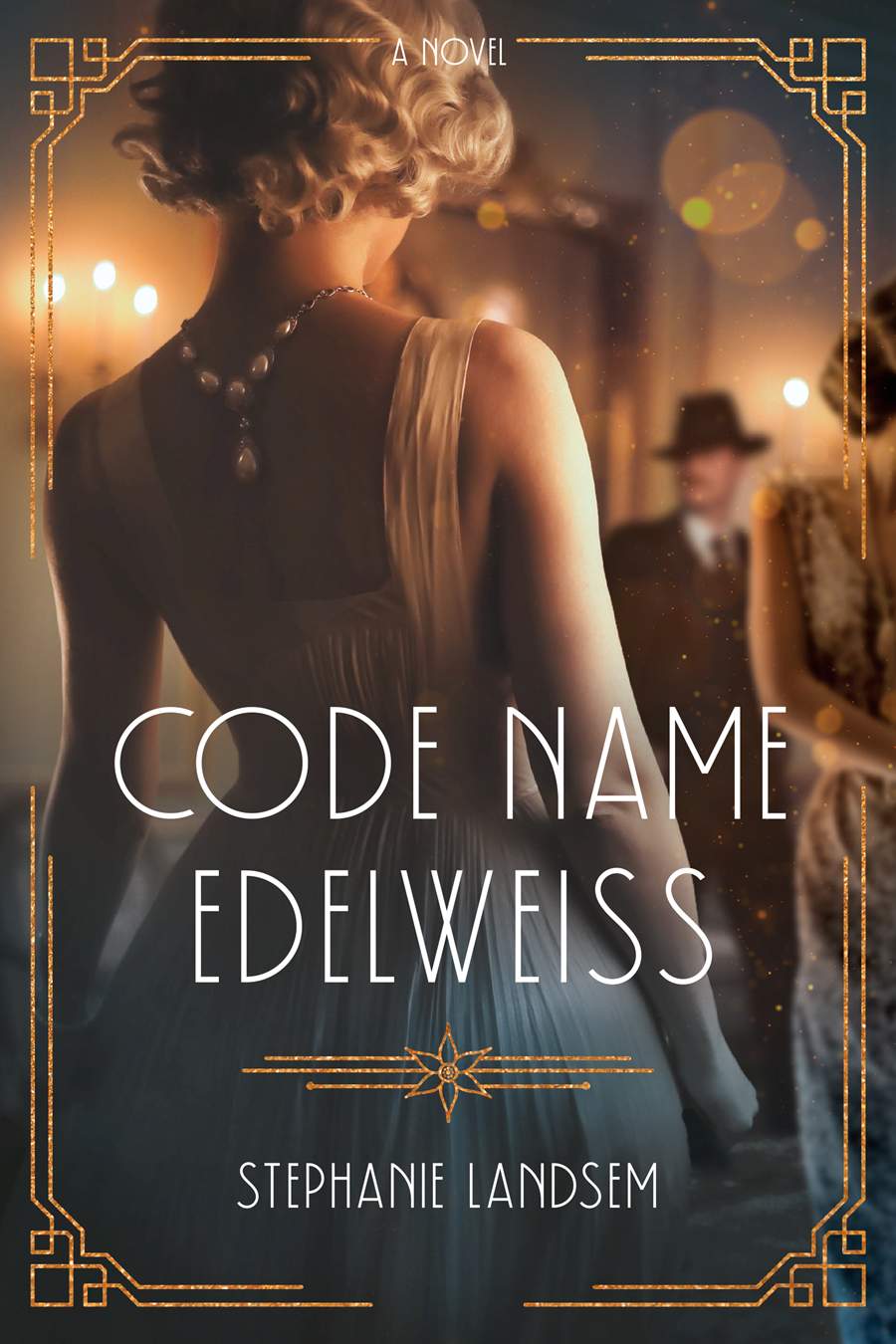
Code Name Edelweiss

Code Name Edelweiss by Stephanie Landsem is a novel based on a true story.

In 1933, Hitler’s rise to power in Germany causes concern for many. But Liesl Weiss doesn’t have time to pay much attention to him. Her husband is missing, and the police assume he just abandoned his family. Liesl is the sole provider for her two children as well as her mother and brother. When Liesl is suddenly fired from her secretarial job at MGM, she desperately looks for another position.

She interviews with a Jewish lawyer named Leon Lewis and learns that what he needs is a spy. An organization called Friends of New Germany appears to help German Americans, especially veterans. But Lewis thinks the leaders are up to something nefarious. He wants Liesl to work as a secretary for group, keep her eyes and ears open, and report back to him.

At first, Liesl thinks Lewis’ fears are unfounded. Her bosses seem very nice. Some of their documents could be taken the wrong way, but aren’t blatant.

As time goes on, however, the group’s stance becomes clearer. Yet there’s not enough concrete evidence to report them. Lewis meets with officials in Washington, but they think he is overreacting. Everyone’s focus is on the Communists, not the Nazis.

Lewis has another operative in the group, known only as Thirteen. He and Liesl don’t know the other’s identity. As he works his way up in the group, he becomes more alarmed. He knows they are up to something, but he can’t find clear details.

Finally Liesl’s and Thirteen’s paths converge. They take more risks to get the information they need, but put themselves in danger to do so. When they finally learn the group’s plans, will they be too late to stop them?

The last several chapters kept me on the edge of my seat.

I think Liesl was like a lot of Americans at the time–preoccupied with her own problems, disbelieving anything bad was going on, then thinking there was nothing she could do anyway. But slowly, she comes to realize that she has to intervene. Lewis shares a quote with her: “If not me, who? If not now, when?”

Then as she rises in the Friends of New Germany organization, she has to deal with misunderstandings from her mother, friends, . . . and her Jewish neighbors.

Some of the other quotes that stood out to me:

I loved my country, but also I loved my German heritage. Would I be forced to choose between the two? (p. 64, Kindle version).

He thought maybe he had it figured, the question that had hounded him since Monterey, the one about why God allowed evil like Winterhalder and the Nazis. Why he didn’t stop them. He guessed that God did stop them—but not with fire and brimstone or smiting like Wilhelm would have done. No, he used people—good people like Leon Lewis, not-so-good people like himself. Gave them what they needed to work with and let them at it. Wilhelm would sure prefer the fire and brimstone, but maybe that’s why God was God . . . and he wasn’t (p. 348).

Adolf Hitler and his religion of anti-Semitism was not a Jewish problem. It was my problem. And if good people did nothing, the evil around us would continue to grow and flourish (p. 90).

The faith element is more subtle here. At first Liesl’s relationship with God is strained: she can’t understand why He would allow her husband to leave. She’s burdened with the pressures of providing for her family and feeling like she is not giving her children the time they need. Thirteen is not particularly spiritual at first. He says at one point that most people weren’t born bad, but were made that way–which is not true, Scripturally, but which shows where his thinking is at the time. But both of them gradually come to stronger faith and dependence on God. 

I enjoyed the author’s historical notes. Leon Lewis was a real person who employed a spy network, helped prosecute American Nazis, and prevented assignations and sabotage. The Nazis really were more active here than many realized. The author includes a quote from Hitler saying the Nazis would cause confusion in America and undermine people’s faith in their government, and then the Nazis would help German Americans rise to power (she doesn’t cite the source). One of their goals was to take over the movie studios and use them for their own purposes. Organizations like the Friends of New Germany were real as well. 

The author says her goal “is not to document a historical event but to write a compelling story about how a character reacts to this event, how it affects her life, and how she is changed by what she encounters. One of my favorite quotes about fiction is this: A story doesn’t have to be true to tell the truth. This is what I hope you gain from [the characters’] story: the truth about courage, conviction, and love that both encompasses and transcends the historical record.”

I think she succeeded.

(Sharing with Bookish Bliss)


Review: The Painted Castle

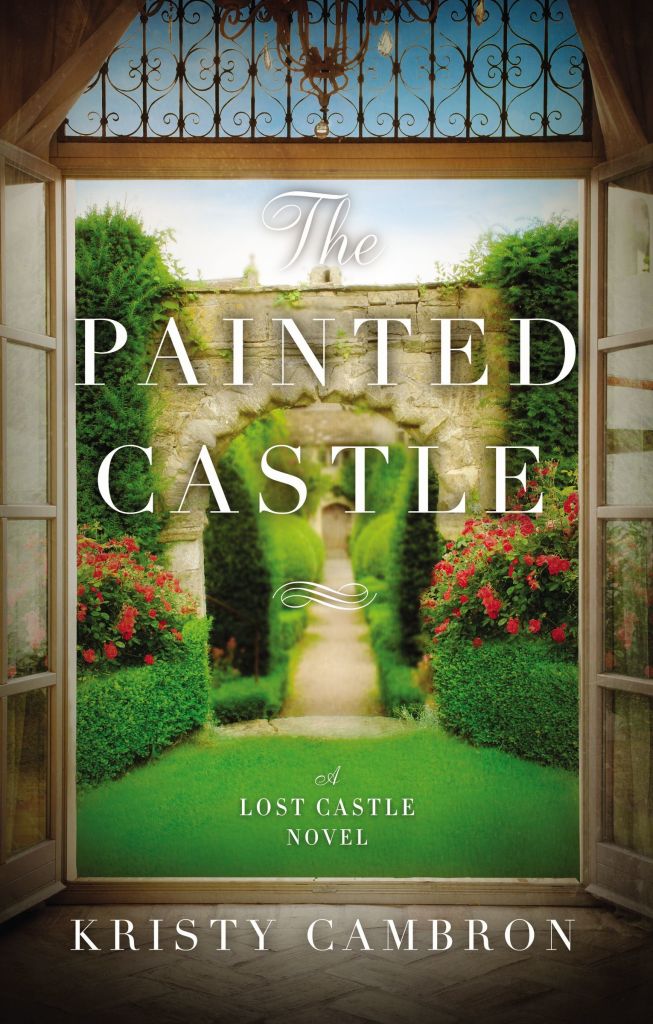
The Painted Castle by Kristy Cambron

The Painted Castle is the third in Kristy Cambron’s Lost Castle series, the first two being The Lost Castle and Castle on the Rise.

In modern-day Dublin, Keira Foley is the sister of the two main characters in the previous books. She is an art historian but lost her job, and her fiance broke up with her. She’s working in her brother’s pub for now, until she’s asked to authenticate a portrait of Queen Victoria painted by Franz Xaver Winterhalter. It was discovered in an old manor home whose owner just wants to sort through and sell everything. But Keira doesn’t know if she can trust the man asking: a rumored American art thief. She decides to go with him, and uncovers more questions than answers.

In 1833 England, Elizabeth Meade is shattered when her beloved father is killed. He left her and her mother in dire financial straits, which her mother tries to hide from society. Elizabeth’s only goal in life to to find the man who killed her father and take revenge. Her favorite pastime, painting, is not approved by her mother, but brings Elizabeth joy. When Elizabeth is grown, her mother arranges her marriage to a Viscount Huxley, and Elizabeth is startled to learn he is the very man she thinks murdered her father.

During WWII, Amelia Woods turned the estate into a haven for refugee children after her beloved Arthur died. But now she’s ordered by the English military to house a group of American pilots. Amelia does her best in a difficult situation, trying to shelter the children from the war as much as she can and manage amidst rationing. She and the American captain bond over the books in her husband’s library.

A main character in each timeline is recovering from some kind of loss. Many of the characters learn that though our path isn’t always what we’d planned, we can trust God through it.

Partway through the book, I began to wonder if Winterhalter was a real artist. He was! And the portrait of Victoria was real as well, commissioned by her for her husband’s birthday. It was unconventional for the time, showing Victoria with her hair down and a bit more shoulder uncovered than usual. Albert loved it, but felt it was too intimate for public display, and hung it in his study.

Much historical fiction these days is written with two timelines. Kristy is the only writer I’ve known to weave together three, and though she does it well, I hope this does not become a trend. 🙂 She does a good job keeping us from getting confused by naming the date and location at the beginning of each chapter and orienting us quickly with pertinent details.

I enjoyed the settings and stories as well as the way details were unfolded throughout the book. Each of the characters seemed relatable.

A couple of favorite quotes:

Books are a completely personal kind of journey. On the first page, they ask us not only to be willing but to be moved, changed, persuaded, even made new by the time we reach the end. Everyone’s walk-through is different (p. 104).

Parham Hill seemed to own the strange combination of both peace and pain. Beauty and bitterness. A lavishness surrounded by a coldness . . . They were strange bedfellows to find hidden in the shadow of Framlingham Castle and its quaint little country hamlet (p. 131).

In her author’s notes, Kristy shares that her father was an American pilot in WWII who flew in the very area she wrote about here. And she shares other bits and pieces that inspired her plots.

There are also some interesting bits in the book about H. A. Rey and his wife, Margret. He was born in Germany, and he and his wife were Jews living in France. They escaped on bicycles not long before Paris fell, taking their manuscript of Curious George with them, which became an instant success when they got it published.

Though it’s been a while since I read the previous two books, I felt the last chapter pulled everything together very well and was a fitting conclusion.

(Sharing with Bookish Bliss Quarterly Link-Up)

Review: When We Were Young and Brave

When We Were Young and Brave

The day after Japan attacked Pearl Harbor, the Japanese invaded the Chefoo school for missionary children in what is now known as Yantai in northern China. They allowed the school to operate and keep to its schedule, though they rationed food and policed activities. Almost a year later, the Japanese took over the school buildings completely and sent the staff and students to an abandoned missionary outpost known as Temple Hill, keeping them under Japanese guard. In September 1943, the staff and student were transported to an interment camp known as Weihsien with 1,500 other people from various walks of life. They remained Weihsien until it was liberated by Americans in 1945.

Hudson Taylor, founder of the China Inland Mission, had founded the Chefoo school in 1881 for the children of CIM missionaries. A few children of other Europeans also attended the school.

I had read of the Chefoo school and its capture in various missionary biographies and in David Michell’s memoir of his time as a Chefoo student in A Boy’s War. So I was interested to learn that Hazel Gaynor wrote a fictional account of the school’s interment in When We Were Young and Brave.

Gaynor’s characters are fictional. She focuses mainly on a ten-year-old girl named Nancy, nicknamed Plum, and and two of her friends as well as one teacher, Elspeth Kent and her friend. The chapters switch back and forth between the point of view of Nancy and Elspeth, so we get both the adult’s and child’s view of events. One of Nancy’s friends, Joan, aka Mouse, gets one chapter late in the book.

The story begins with the everyday workings of the school with the Japanese occupying the surrounding area. The Chefoo school was fairly self-sufficient, so they didn’t fear the Japanese, though they disliked the tension of having them nearby.

Everything changed, however, when Japan declared war on Great Britain. Now everyone at Chefoo school was the enemy.

Thankfully, many students were away for Christmas break at the time of the Japanese occupation. Those at the school over the holidays were unable to be with their parents due to lack of safety to travel.

As the years wore on, the strain became harder to bear with lack of proper food and the increasing fear of the Japanese guards.

The school staff tried to keep everyone’s spirits up by maintaining classes and Girl Guides (similar to Girl Scouts in the USA). But they all faced various hardships.

The book opens and closes with the adult Nancy, thirty years after liberation, reflecting on her experiences.

The book is well-written. The characters are relatable and well-developed. As a reader, I felt the weight of what they were going through.

A few quotes stood out to me:

Our war wasn’t one of battles and bombs. Ours was a war of everyday struggles, of hope versus despair, of courage against fear, strength over frailty (p. 198).

In the most peculiar circumstances imaginable, their interment had insured that they were capable beyond their years (p. 243).

War and interment are part of their lives now, part of their story, part of who they are. . . . I actually think life is meant to have its share of difficultly and struggle. That’s when we find out who we really are, what we’re really made of, not when everything’s going along all jolly and straightforward and terribly nice. We come alive in the dramatic bits, don’t we; in moments that make us gasp and cry (p. 285).

But a few factors marred my enjoyment of the book.

First, Gaynor often refers to the children as “privileged.” Since most of them were missionary children, this was not a posh, expensive boarding school for the higher classes. There was probably some sense in which the children were more privileged than some of the Chinese nationals, who had been fighting Japan for a while already. But it wasn’t necessary to infuse the same sensibilities as one would have for a standard elite British boarding school.

Secondly, the school was established as a Christian school. According to David Michell, the school still provided “a truly Christian education for body, mind, and spirit” when he was there. But there is little mention of Christianity in Gaynor’s book. When Elspeth only took two books with her when they left Chefoo, she chose her Girl Guide Handbook and the Buddhist scriptures a Chinese servant had given her, not a Bible. She mentions struggling all her life to believe in God and says a budding sunflower gave her “more strength and hope that any prayer ever had” (p. 118). The teachers’ encouragement is the British stiff upper lip, “Keep calm and carry on” variety rather than anything of a spiritual nature.

Then, Elspeth feels that the children’s parents put their mission above their children by sending them away to school. That was not usually the case. Though teaching at home predates institutional learning, home schooling was not the industry then that it is now. Parents might have been able to teach their children at home on the mission field for their early years, but likely would not have had the material to do so as they got older. Plus, the children would not have had the credentials to go to college. Thankfully, these days, many mission boards work with parents to teach their children at home.

Additionally, some of the missionaries worked in remote areas with very few other Christians. Isobel Kuhn wrote that the tribe they worked with didn’t worship idols: they worshiped demons. When her son got old enough that she couldn’t keep him at her side all day, she feared what he would be exposed to as he interacted with people on the village. For many parents, sending their children away to school was for their protection.

Gaynor wrote that she drew from some of the internees’ own accounts at Weihsien Paintings and the Chefoo School Archives in London as well as other books. But all her characters were invented (except Olympic runner Eric Liddell, who was a missionary to China, and was interred at the camp. He died there of a brain tumor). Her characters and their interactions largely came from imagining what her own children might do in this situation, what she would have felt like as a parent at the time, and her grandmother’s war-time experiences. So I struggled a bit with not knowing was was real in the book and what came from the author’s imagination.

At some point, I set aside what I knew of the school and just read the book for what it was: a fictionalized account of people enduring and overcoming great, sustained hardships. I enjoyed it much more after that. But it spurred me to get David Michell’s book to reacquaint myself with the real story.


Review: The British Booksellers

The British Booksellers by Kristy Cambron

The British Booksellers by Kristy Cambron shifts back and forth from WWI to WWII.

Amos Darby and Charlotte Terrington are secret childhood friends with a love for books. But that’s all they can ever be. Amos is a tenant farmer’s son, and Charlotte is an earl’s daughter. Though Charlotte loves Amos, her parents arrange her marriage with Will Holt, the future Earl of Harcourt.

Amos goes off to WWI and comes back scarred. He opens a book shop on Bailey Lane in Coventry, England, but becomes something of a recluse.

Charlotte, now widowed Lady Harcourt, has opened a bookshop as well across the lane with her daughter, Eden. The booksellers have been rivals and enemies for over twenty years, though Eden has tried to negotiate a peace between them.

When an American lawyer, Jacob Cole, shows up with alarming news for Charlotte and Eden, they fight back to keep their estate, even though it is becoming ever harder to maintain.

But when WWII begins and German bombers fly across Coventry, Amos, Charlotte, Eden, and Jacob have to work together to help each other and their neighbors survive.

The Coventry Blitz is referred to as the Forgotten Blitz. The London Blitz received so much attention, Coventry was overlooked in the press. Kristy Cambron says in her author’s notes that some officials suppressed news of the devastation of Coventry so as not to damage morale.

The story includes four Land Girls, part of the Women’s Land Army in Britain who helped out at various farms and homes across the nation. I had read of these women in other books, so it was neat to see their roles fleshed out a bit more.

The historical story was quite interesting, but Charlotte and Amos’ story was so touching.

With characters who have a common love for books and who become rival booksellers, the importance of books comes up often. One of my favorite quotes about this aspect:

Books are an escape that beckons the reader from the heavy burdens of this world.’ Isn’t that what you told me once? They can challenge as well as comfort. Entertain and educate. Even save us in ways we’d never expect. You’ve used the words art, oxygen, and life all to describe them. Anyone who can see such value in these pages ought to also see that they could take him away from a future he doesn’t want. If anything, that is what Dickens wrote for his characters. Isn’t that what you wish for yourself?

I listened to the audiobook, beautifully read by Barrie Kreinik. Happily, this time the audiobook did contain author’s notes about the historical aspects of the book. There weren’t any notes about what inspired the personal stories, though.

With going back and forth between timelines, it was a little hard to keep up sometimes with where we were in the story. It’s not as easy with an audiobook to flip back to the beginning of the chapter to check the dates. Plus 1914 and 1940 sound alike. But it didn’t take too long to get oriented.

Overall, I loved the book and the characters and felt for them.

Review: Whose Waves These Are

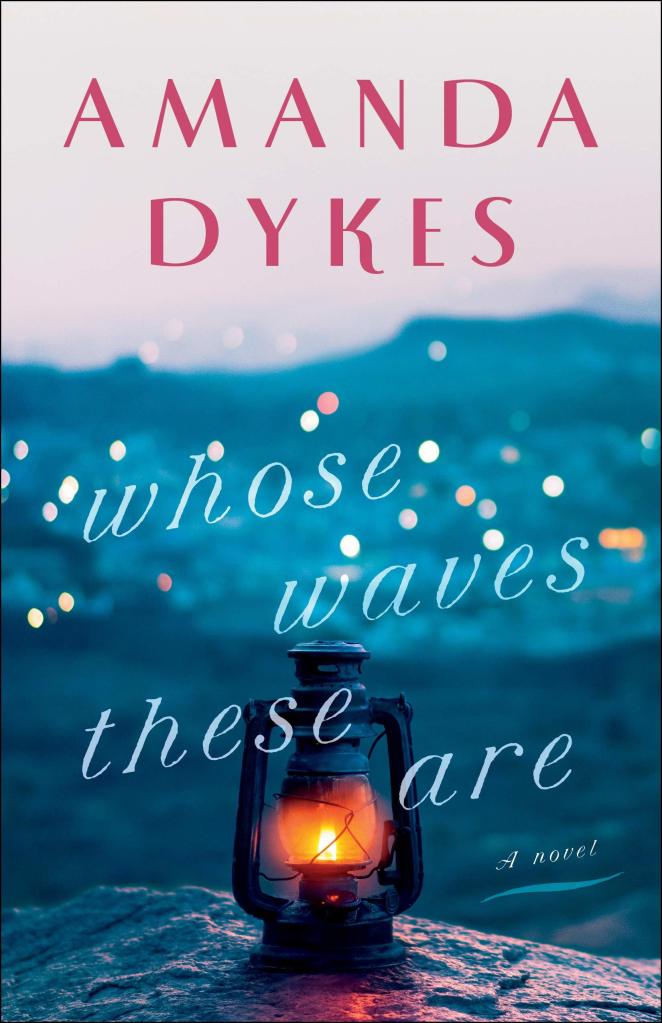
Whose Waves These Are by Amanda Dykes

Whose Waves These Are by Amanda Dykes begins in September, 1944. Identical twin brothers in a small Maine village, Ansel-by-the -Sea, have just turned eighteen. Enlistment in military service has been closed “to protect the home-front work force,” but the draft is in effect. A letter arrives from the President ordering one of the twins to report for duty. Robert Bliss assumes, hopes, the letter is for him. He’s single, ready to go. His brother, Roy, is married to Jenny–the girl Robert has loved for years but didn’t speak up for soon enough. Roy and Jenny have just discovered they’re going to be parents.

But, no. The letter is for Roy.

Robert proposes that he could go in Roy’s place. They’ve stood in for each other many times. But Roy argues that it’s his turn to help save others.

Then we’re whisked to Chicago in 2001, where Annie Bliss crunches numbers. She was an anthropology major, but her first assignment to help a small village ended in disaster. In her current job, at least she can’t hurt anybody.

Then she receives news that her “Grandbob” back in Ansel-by-the-Sea is in grave condition in the hospital.

Annie speeds back to Maine, where she had visited as a child when her parents’ deployments overlapped and they left her with Bob. There she is known as “Bob’s Annie.”

While Bob is unconscious, Annie gets reacquainted with the people she knew. There’s one newcomer since she lived there, a quiet, brooding postman and EMT named Jeremiah Fletcher, or Fletch. Annie discovers boxes of rocks in a closet in Bob’s house. Jeremiah shows her even more in the boathouse. Bob has left her a key, but no word about what it belongs to. As Annie asks around town, people either don’t know or aren’t sharing what Bob was up to.

The point of view switches back and forth between these two time frames. The older one unfolds what happened with the brothers during the war and the years afterward. As one grieves the loss of the other, he writes the only poem of his life asking for rocks to represent people lost during the war. He plans to build something to represent hope and healing. But another tragedy halts his efforts.

The twenty-first century timeline shares Annie’s story and shows her discovering the pieces of her history that she had not known.

I loved this book. I just wanted to sit and hug it after finishing it. It left me wishing I could visit Ansel-by-the-Sea, if it were a real place and these people lived there. I love books with a strong sense of place, whose stories could not have taken place anywhere else.

I loved the characters. I loved the way the author unfolded and wove together everyone’s stories.

I also loved many of the author’s turns of phrases. A few:

A wake is a ripple left after a departure (p. 41).

He said it was time to be part of the unbreaking, of the making of something. He told me there was a Carpenter who was going to build me right up, too (p. 75).

She looks at Bob lying there, face mapped in wrinkles carved from compassion (p. 79).

She’s used to city life, rich in its own way, with an energy and bustle from the lives there, but where eye contact is a safety issue and a good neighbor is your insurance company’s tagline (p. 87).

Annie tries for small talk. Which, as she’d learned, could sometimes lead to large talk. Which made the small talk bearable (p. 131).

Don’t get stuck in the dark . . . There’s a whole lotta light . . . Go there instead (p. 171).

Saluting—a stance of the fiercest heartache schooled into firmest respect (p. 173).

The song she offered up was all the more beauitful in its wavering and brokenness. Courageous, and offering. The laying out of her broken heart before her God (p. 188).

Words begin to light up, pour right through, like someone turned on a faucet and he’s just trying to catch them. They’re not his, really, he’s just the one scratching them out (p. 188).

He slaps courage back into himself and goes to church (p. 202).

I choose to believe there is some shred of light left in him. A light I pray he fights for (p. 238).

His thoughts are becoming more like an ongoing conversation with heaven, these days—usually more questions than anything else. And this was a big one. What now? (p. 249).

He looks like someone who’s been cut loose to drift and hasn’t found shore (p. 252).

Not healed . . . but held. Like the pieces of him have been gathered right up, and that is enough for now. The rest will follow (p. 275).

The strength of the storm does not change whose waves these are. There is One mightier still (p. 348).

I was motivated to read this book because I had seen high praise for it. That praise was well-deserved. I’ll be looking up more of Amanda Dykes’ books to read.

Review: By Way of the Moonlight

In By Way of the Moonlight by Elizabeth Musser, Allie Massey’s grandmother, known as Nana Dale, has just died. Nana Dale was an accomplished horsewoman, placing first in several shows and even riding in the Olympics. Their plan had always been that Allie would inherit the grounds, house, and enough money to open an equine therapy business on her grandmother’s property.

But the family learns at the reading of the will that Nana Dale sold the property to a development firm, evidently taken advantage of in her beginning dementia by an unscrupulous contractor.

Now Allie has a limited time to clear the house and have an estate sale before the house is imploded.

Allie is beyond upset. She can’t cope. She even breaks up with her fiance. Nana Dale had left a letter with cryptic instructions to find a cherrywood chest which will have more information. But no one in the family has seen such a chest.

In intermittent flashbacks, we learn of Dale’s life. She had loved horses from her earliest memories. But her father’s business crashed along with the economy during the Depression, and the horses had to be sold. Dale prayed long years that she might find Essie, her beloved filly.

Before the Depression, when her family boarded horses, Dale met a boy named Tommy with a horse named Infinity. The two became friends, even competing as a couple in some events.

The rest of Dale’s story takes us through Tommy’s bout with polio, mounted patrols along the coast during WWII called Sand Pounders, and a daring rescue of a sailor whose ship was torpedoed, which resulted in a major surprise.

In one interview, Elizabeth said part of the story was inspired by her mother’s property in Atlanta. In a series of short videos, Elizabeth takes readers through various areas of the house and grounds that were inspiration for the novel, which was fun to see. She said that there is pressure now, just like in the book, for owners of such properties to sell to developers who want to raze the buildings and put up new cluster houses.

The WWII and Sand Pounders sections of the book are not Elizabeth’s mother’s history. But when she happened upon information about the coastal mounted patrol, she wanted to include them in her book.

Elizabeth says later in her interview that in this book she wanted to “examine the thin line between fighting for what you believe in and developing an unhealthy obsession. Both women learn important lessons about pursuing dreams at all costs, which may cause them to sacrifice something or someone they love.”

I listened to the audiobook read by Susan Bennett. I thought Susan did a great job with the character voices, but the narration seemed too slow. Maybe she thought that was fitting for a Southern accent (the next audiobook I started is also read by Susan, but at a much more normal pace). Also, she had an annoying habit of turning one-syllable words into two syllables, especially at the end of sentences (not to be nitpicky, but after 14+ hours of listening, some things grate). The audiobook didn’t provide any back matter, so I am thankful Elizabeth included information and links to interviews here.

The story itself also seemed a little slow, especially the modern-day part. There’s almost no movement in plot in Allie’s story until near the end.

Nevertheless, overall, this was a good book. One of my favorite quotes, and themes, in the book is “When life gets hard to stand, kneel.”

Another: “Bitterness will rot out your soul. . . You may never get the answer on this side of life to the why. So it’s much better to ask the question, ‘Now that I’m in this place, Lord, what do you want me to do?'”

And “Life ain’t fair. It’s brutal sometimes. . . faith don’t stop the horrible things. But faith helps you walk through those things, whipped and angry and screaming on the inside. Lord don’t mind our screaming and raging. He done shown us how to do it in those psalms of his that King David wrote.”

Elizabeth is one of my favorite authors. Even though I like some of her other books better than this one, I did enjoy this one and can highly recommend it as well.

Review: Secrets She Kept

Secrets She Kept by Cathy Gohlke

In Secrets She Kept by Cathy Gohlke, Hannah Stirling’s mother has just passed away. More than mourning her mother, she mourns the loss of what could have been. Hannah’s mother had been distant from Hannah and her father for as long as she could remember.

Going through her parents’ home for some clue about her mother’s past turns out to be fruitless. When she sees the lawyer to finalize her mother’s affairs, Hannah is surprised to be given a key to a safe deposit box that Hannah had never known about. But all she finds there is her parents’ wedding certificate, her father’s military discharge papers, and a few empty envelopes with German addresses and stamps on them.

The paperwork, however, lets her know a shocking surprise: the man she called Daddy all her life could not have been her real father.

The point of view switches to thirty years earlier in Germany, when Hannah’s mother, Lieselotte Sommer, was a teenager just before Kristallnacht. Her mother lay dying, her brother was a whole-hearted member of the Hitler Youth, and her father was a rising member of the Nazi party. Lieselotte had loved her brother’s friend, Lukas Kirchmann, for as long as she could remember. She helps him and his family help Jews with food, false papers, and anything else they can. She longs for the day they can marry.

But Lieselotte’s father puts pressure on her to marry a Nazi officer and raise Aryan children for the Fuhrer. Her father has been distracted, but she never guessed the depths he would go to to further his own ends.

Switching back to Hannah again, her lawyer researches the German addresses on the envelopes in her mother’s safe deposit box. He discovers that she has a grandfather she never knew about. Her mother, Lieselotte, had said she was from Austria and her family all died in the war.

Hannah travels to Germany to meet her grandfather, to try to find out more about her mother, and to discover who her father was. At first she enjoys the connection with her grandfather. But her research uncovers horrifying family secrets.

This book was riveting. I listened to the audiobook, free at the time from Audible’s Plus Catalog, and eventually began looking for extra time to listen more. All the characters, including side characters, are well-developed and the plot. There’s so much more I’d love to say, but I don’t want to spoil anything for potential readers. So I’ll just say it’s a really good book and highly recommended.

Review: Yesterday’s Tides

Yesterday's Tides novel by Roseanna M. White

Roseanna M. White’s novel, Yesterday’s Tides, has two related story lines taking place in 1914 and 1942 on Ocracoke Island in North Carolina’s Outer Banks.

In 1914, Louisa Adair helps her mother and “Grann” run an inn. She’d like to go to teacher’s college, but there isn’t enough money. Plus, she’s needed at home.

Though Louisa has blue eyes, her skin coloring is darker than most people’s. Her mother will not tell her anything about her deceased father except that he was a good man. A few people are prejudiced against her, thinking she must be of mixed race.

When two college-age cousins, one from Maryland and one from England, come to the inn for the summer, Louisa has no idea how her life will change as a result. Louisa has no plans to fall in love: she keeps a polite reserve with the inn’s male guests. But she and Remington Culbreth, from England, find themselves in each other’s company often. Just after they do fall in love, WWI breaks out and Remington is called to service at home. Will their relationship survive not only the war, but the differences in their families and lifestyles?

In 1942, Evie Farrow now runs the inn with her grandmother. One day while taking some baked goods to the neighbors, a loud explosion is heard in the distant waters. While Evie’s Coast Guard friends prepare to investigate and help, Evie heads home to pray. When a badly burned Englishman washes up near the inn, somehow Evie knows not to report him. He says he is military, but he’s not in uniform. What mutterings she hears as he goes in and out of consciousness alert her to the fact that he is an intelligence officer. But what would an English spy be doing in Ocracoke?

When he wakes up, she learns his name is Sterling Bertrand and he is tracking a German operative. But it will take weeks for his wounds to heal. Meanwhile, he wonders just how far he can trust Evie, who seems to have secrets of her own.

I’ve read many dual timeline novels, and usually there are enough differences between the two timelines to keep from getting confused. I had a little harder time with this one, since both stories took place at an inn in Ocracoke and involved a visiting Englishman. I think I would have had an easier time with reading rather than listening. I didn’t catch some of the names that were the same in both timelines, so I kept getting surprised at the connections. I don’t think that would have happened if I were reading instead of listening.

As it happened, partway through the audiobook I discovered that I did have a Kindle copy! So I went back and forth between reading and listening.

One delight with this book was running into some characters from Roseanna’s previous books. I won’t say which ones, as that might give away parts of the plot. You don’t have to have read those books to understand this one, but it was a fun surprise to see those characters again. Evidently Remington was in an earlier book as well, but, though I remember the story and situation, I don’t remember him.

I’m sorry to say I was not thrilled with the audiobook narrator. Some of her accents seemed a little off to me. Plus she had an odd cadence, her inflection going up when it didn’t need to.

There are so many layers to this novel, and so much more to it than there appears to be at first. I loved the stories, and after finishing the book, I just wanted to sit with the characters a bit more before saying goodbye to them and starting another story.

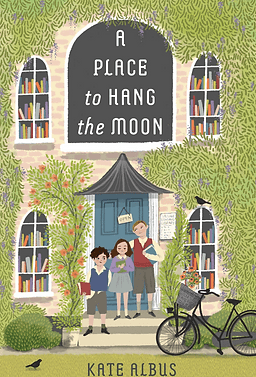
A Place to Hang the Moon

In A Place to Hang the Moon by Kate Albus, William, 12, Edmund, 11, and Anna, 9, live in 1940 England. Their parents died when William was 5. “The grandmother” had charge of them since, but she sent them off to boarding school and was cold and aloof when they were home.

Now the grandmother has died as well. The family solicitor, Mr. Engersoll, explains that the children have been left a lot of money, but no one has been named as their guardian. Apparently there is no one to ask. The children plead to stay with the family’s housekeeper, Mrs. Collins, but she’s too old to take them in.

Mr. Engersoll suggests that the children join evacuees being sent to the country. Perhaps the foster parents they find might take them in permanently. The children are advised not to tell anyone that they are alone in the world or that their family has money, so they don’t get taken advantage of.

The children agree with what Mrs. Collins calls “the preposterous plan,” as there seems to be no other option.

The children are billeted together first with one family, then another. I don’t want to spoil the story by telling what went on in those places, but neither is suitable.

The children spend many afternoons in the town library. Books have always been their friends, and the warmth and quietness of the library provide a refuge. The kind interest of the librarian, Mrs. Muller, makes the place even more welcome.

It’s not long, however, before they discern Mrs. Muller is something of an outcast. She’s married to a German man who has disappeared.

The children wish they could stay with Mrs. Muller, despite her husband’s possible Nazi leanings.

This story starts out like a classic fairy tale, with children alone in the world having to overcome various difficulties. I had thought it was a young adult book, but Amazon recommends it for grades 4-7.

I don’t often read secular books for this age group, but the Story Warren and Hope both spoke well of this story, piquing my interest. I agree with C. S. Lewis that a good children’s book can be enjoyed by adults as well. When the title came up temporarily free from Audible. I gave it a try.

I’m so glad I did. I loved this book. The story is well-told and the characters are beautifully drawn. Descriptions of both warm and cozy and difficult scenes make you feel you are experiencing them along with the children. References to beloved classic children’s books are scattered throughout. Polly Lee’s British accent enhanced the audiobook. I didn’t want the book to end.

Some of my favorite quotes:

The first words of a new book are so delicious—like the first taste of a cookie fresh from the oven and not yet properly cooled.

The librarian took this all in, standing by the fire and observing the children for a while, letting the silence be. Somehow, it didn’t feel awkward, the way silences often do. Perhaps librarians are more used to quiet than most.

William, Edmund, and Anna knew, somewhere deep in the place where we know things that we cannot say aloud, that they had never lived in the sort of home one reads about in stories – one of warmth and affection and certainty in the knowledge that someone believes you hung the moon.

Edmund took in the boy’s mended jacket, the eyes underlined in shadows, the skin above his upper lip chapped raw from a dripping nose gone unattended, and saw the sort of hunger whose endlessness digs a pit in a person. Being eleven, Edmund wouldn’t have put it quite in those words, but he recognized it nonetheless.

While she wasn’t sure of the precise definition of the word “bibliophile,” Anna was certain it meant something that she wanted to be.

The stealing of sweets, after all, is an act committed only by those with unspeakably black souls.

The smell of the cookies filled the children with a warmth that can only come from the magnificent alchemy of butter and sugar.

Truth be told, Anna was rather giving away the ending, but sometimes one cannot help oneself.

Anna thought of offering up a hearty platter of I told you so, but she didn’t. Why foul perfection with such a sharp thing as bitterness?

This is a lovely book. Not fluffy bunny and serene landscape lovely, but a wonderful tale beautifully told.