It’s time for the next-to-the-last edition of Melli‘s ABC photo challenge! Most of you know the drill by now, but in case there is anyone new, Melli challenged us to find letters of the alphabet in the things around us. We’re not to make the letter out of anything or take a picture of the letter itself in a sign: we’re supposed to find it “as is” in nature or in an object where you wouldn’t normally look for a letter. We’ve been taking two at a time, and this week we’ve been looking for W and X.
For weeks the only W I could find was in the structure over a street. You can see Vs and Xs there as well, but I am using it for W.
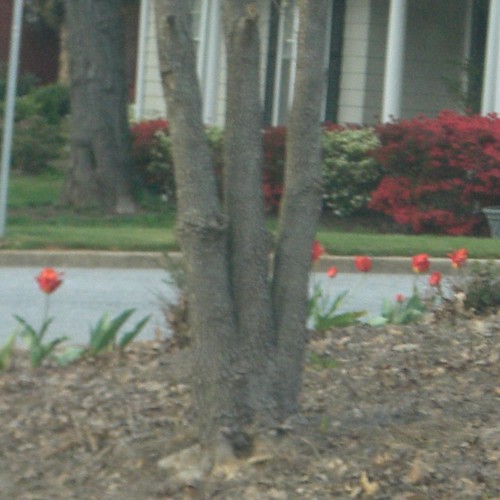
But then on the way to dinner at the mall tonight, Jeremy pointed out a W tree:
And at the mall I noticed the “bark” on this fake palm tree looked like Ws. It’s not the clearest picture — it was taken with Jer’s cell phone.
I found Xs in a multitude of places. The first ones were these little camp tables:
The fencing that this morning glory was climbing last summer:
Another fence in someone’s neighborhood:
In the road:
On the door and window of this little house:
This one I happened to remember from my archives when I saw a real red barn today. Years ago I was on a committee to redecorate the toddler nursery at church, and we chose a barnyard theme. This is the door, with Jeremy demonstrating how it works. He’s about 5 there. He’s in most of the pictures I took of the project with his arms spread in a “Ta-da!” pose. It was cute.
And here is the wall:
I didn’t paint the mural — my good friend Valorie who is VERY talented did. But I did help stencil the little animal border on the other walls. That was a fun project.
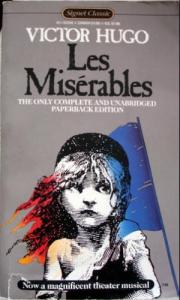
I’ve read a couple of different abridged versions of Les Miserables by Victor Hugo and made it my goal to read the unabridged version.
A brief synopsis for those who might be unfamiliar with the story: Les Miserables at its most basic is the story of Jean Valjean. He lived with his sister and her family in extreme poverty in France after the French Revolution. In one act of desperation he broke a window and stole a loaf of bread. His sentence was lengthened by multiple escape attempts until he was finally released 19 years later. His hardness and bitterness increased by the response he got when he was required to show his papers at each new town he visited, resulting in lower pay and refusal of the townspeople to rent him a room or serve him a meal because he was an ex-convict. An act of grace by a bishop resulted eventually in transforming him.
When he traveled into a new town, his help in saving someone’s life and the confusion and excitement around the event resulted in the town officials’ forgetting to ask him for his papers. He was hired on in a factory and devised a way to improve the factory’s production, leading to his promotion, eventually to the head of the factory, and further still to his being elected the mayor. He was known as a quiet but kind and and benevolent man, using much of his wealth to aid those in need.
Thus it would seem his life was set on a new course of usefulness and happiness, except…except…
Except for Javert, a former prison guard who became the new police inspector in Valjean’s town, who thinks he recognizes the mayor as an ex-convict who has broken his parole.
Intersecting Valjean’s story is that of Fantine, a young, naive girl who gave herself to a man who only wanted to use her as a diversion one summer, leaving her with child, Cosette. In that day a single woman with a child was a scandal, so Fantine found an innkeeper and his wife whom she paid to keep her child while she went to another town to look for work. She ended up in Valjean’s factory, where she was fired after it was discovered that she had a child. In the meantime, the innkeeper, Thenardier, made up stories about Cosette needing more clothes, needing medicine, becoming very ill, all in an effort to extort money from Fantine. Fantine, worried and desperate, sold her teeth, her hair, and eventually her body (which is handled discreetly, without explicitness, in the book and was viewed by Hugo as a form of slavery). She became gravely ill from neglect of her own care, and an altercation in the street brought her to the attention of Valjean. When he heard her story, he felt responsible for her situation since she was dismissed from his factory, and he paid her her care and promised to take care of her daughter. The Thenardiers resented Valjean’s rescue of Cosette and the subsequent loss of income.
The rest of the book details the pursuit of Valjean by Javert, and, at times, Thenardier, his care of Cosette, her growth into a young woman, her falling in love with Marius, much to the dismay of Valjean, who has never loved anyone else and is afraid of losing Cossette.
That is the basic plot, but there are so many more layers, subplots, and characters in Les Miserables. There are discussions of poverty, politics, French history. One of the major themes is the righteousness of the law, as represented by Javert, versus the righteousness of grace, represented by Valjean. While not a Christian book in itself (it portrays the innate goodness of man, whereas Scripture portrays the innate sinfulness of man, and it includes some strange philosophies, and its politics are much more socialistic than I am comfortable with), it does portray Christian themes of redemption, forgiveness, sacrifice, and selflessness, and Valjean does depend on God for salvation and strength.
I have mentioned here before that I had read a couple of different abridged versions and had wanted to read this unbridged version for a long time. Though normally I am a book purist, wanting a book to remain as untouched as possible, I can see now why this book is abridged. The sheer 1,463 page length of the book is not so much the problem as the frequent asides. It is rather like rush hour traffic in some places — very slow going interspersed by brief interludes of acceleration. It’s like a mini-series interrupted at the climactic moments by a documentary. Valjean’s escape with Cosette to a convent leads to a discussion of the history of convents in general, this convent in particular, whether convents are right or wrong. An incident at the end of the battle of Waterloo which has repercussions for two characters later in the book is preceded by a 57-page description and discussion of Waterloo. A student revolt at the barricades leads to a discussion of the differences between an insurrection and a riot and which, in the author’s opinion, is right and wrong. Valjean’s escape from the barricades with a wounded Marius through the sewers involves a detailed description of the history of sewers and the author’s suggestions for how they could be made better (and I never knew there were so many different synonyms for sewage). Hugo must have been an intensely curious man as well as a thinker and a philosopher, but the asides do get tiresome. Though at times I found myself interested in them in spite of myself, particularly the battle of Waterloo section, a few times I was tempted to skip through them, reminding myself that I wanted to read the unabridged version, not skim through it.
And I am glad that I read it. It did give me a fuller understanding of the story, and I particularly enjoyed learning more of Fantine’s early story than other versions included and more of Javert’s mental struggle that led to his actions at the end of his life.
There are moments of sheer beauty in the book, moments of identification with the very human struggle, such as Valjean’s dilemma when he learns another man has been arrested under his name. One of the most poignant moments iss when he returns home after Cossette’s wedding and pulls out the little clothes he had bought for her when he first rescued her, and weeps into them. One of my favorite sections is when Thenardier seeks to implicate Valjean to Marius, unwittingly clearing his name instead.
And for all of Hugo’s wordiness, there are moments of clever, succinct, descriptive phrasing: “For dowry, she had gold and pearls; but the gold was on her head and the pearls were in her mouth.” “A torn conscience leads to an unraveled life.” “There is a way of falling into error while on the road of truth. He had a sort of willful implicit faith that swallowed everything whole.” “Skepticism, that dry rot of the intellect.” “He suffered the strange pangs of a conscience suddenly operated on for a cataract’.” “This man…was…still bleeding from the lacerations of his destiny.”
Just a word about the musical based on the novel: it was through the musical that I first discovered this story. I was in the library video section one day, saw a video of the tenth anniversary production of the musical, and decided I’d check it out just to see what it was all about, having heard the title for years but knowing little of the story. I was absolutely enthralled. The music is gorgeous and the story so touching. But for the information of those whose standards are as conservative as mine or more so, there is a smattering of four-letter words, and the section dealing with Fantine’s prostitution is much more explicit than the book is. Unfortunately, though I’d love to see a stage production, I could not in good conscience because of that section. As it is we skip the “Lovely Ladies” song on the video and CD. I was delighted to discover, though, that the musical does go back to the original for many things, using even some exact lines from the book. It’s fairly faithful to the book except for the section mentioned, and the fact that Eponine and Marius’s relationship is not as it was in the book, and the scene of Valjean praying over Marius before the battle of the barricade and regarding him as a son was not on the book: at that point, even after rescuing Marius, Valjean hates him for the threat he is to taking Cosette away and is only caring for him for her happiness, though he does come to love him as a son much later. Plus Valjean doesn’t fight Javert after Fantine’s death before rescuing Cosette: he is arrested and escapes again later.
I’ll leave you with a couple of scenes from the musical. The first is the confrontation between Valjean and J avert after Fantine dies.
The second takes place after Valjean learns another man has been arrested in his name, and he struggles within himself as to what to do about it. The number 24601, which is mentioned in both songs, was Valjean’s number in prison.
I’ve mentioned that for our ladies’ luncheon this year, instead of a speaker giving a devotional, we’re having a lady do a dramatic presentation ofEvidence Not Seen by Darlene Deibler Rose, an autobiographical book about her confinement in a Japanese prison camp while serving as a missionary to the Philippines during WWII. I read it years ago: it’s a tremendous book. So I was excited to hear that this lady did this presentation.
In determining the theme and theme verse for the luncheon, I’ve been dipping in and rereading parts of the book. You can’t read much of it without the theme of faith becoming prominent. What I don’t want to happen, though, is for people to walk away from the presentation thinking, “Wow, how inspirational. She had such great faith. I could never do what she did, but what a great story.” I don’t think she would have wanted people to magnify her, or even her faith. In her acknowledgments, she wrote,
“More than ten years ago I began to write the story of my experiences during World War II for Bruce and Brian, my sons. I wished them to know, if ever difficult circumstances came into their lives, that their mother’s God is still alive and very well, and His arm has never lost its ancient power.”
She would want God, the object of her faith magnified, not the size of her own faith.
That reminded me of the time the disciples asked the Lord Jesus to increase their faith. He didn’t give them a three point formula for increasing faith. He responded in Luke 17: 6: “If ye had faith as a grain of mustard seed, ye might say unto this sycamine tree, Be thou plucked up by the root, and be thou planted in the sea; and it should obey you.” You have probably heard it said that the mustard seed is one of the smallest seeds. He seems to be saying, “It’s not the size of your faith that matters: just exercise what you have.”
Another passage that has been coming to mind in connection with Darlene’s story is from I Peter 1:
6 Wherein ye greatly rejoice, though now for a season, if need be, ye are in heaviness through manifold temptations:
7 That the trial of your faith, being much more precious than of gold that perisheth, though it be tried with fire, might be found unto praise and honour and glory at the appearing of Jesus Christ:
8 Whom having not seen, ye love; in whom, though now ye see him not, yet believing, ye rejoice with joy unspeakable and full of glory…
One idea for a theme for the luncheon was “Golden Faith” — a faith tried, purified, and precious.
It seems that what is more important to the Lord is not the size of our faith, but its purity, from the above verses, and it’s simplicity, from Mark 10:
14 But when Jesus saw it [that they were turning away the children], he was much displeased, and said unto them, Suffer the little children to come unto me, and forbid them not: for of such is the kingdom of God.
15 Verily I say unto you, Whosoever shall not receive the kingdom of God as a little child, he shall not enter therein.
16 And he took them up in his arms, put his hands upon them, and blessed them.
And, of course, it’s not just the character of faith: it is primarily the object of our faith: not some nebulous or mysterious idea of “the universe” (you hear people say things like that these days: “The universe has a purpose,” etc.) God wants us to have faith in Him.
Hebrews 11:6: “But without faith it is impossible to please him: for he that cometh to God must believe that he is, and that he is a rewarder of them that diligently seek him.”
John 14:6: “Jesus saith unto him, I am the way, the truth, and the life: no man cometh unto the Father, but by me.”
Now…I just need to figure out a way to distill these thoughts into something more concise.
We found out early this morning that one of the dear saints at our church passed away. She was a good friend, one of the first people here to invite us over. She had myriad physical problems but never had a self-pitying attitude. She volunteered long past the age that people retire to their rocking chairs.
There are always such strange mixed feelings when a believer dies. There is joy that she is without pain any more and in the Lord’s presence. Yet there is the feeling of loss, the missing of her presence, the renewal of loss each time you think about calling her only to remember she is gone.
It’s funny how the Bible says life here is but a vapor, yet we’re so surprised when it actually does end. She had been seriously ill so many times and bounced back, we just kept expecting that to be the pattern even though she was growing feebler.
Not long after hearing the news, the hymn “Jerusalem the Golden” came to mind, one of my favorites. The Bible doesn’t tell us very much about heaven. Elisabeth Elliot says that’s because, if we knew how wonderful it was, we would never get anything done here for thinking about it.
Jerusalem the golden,
with milk and honey blest,
beneath thy contemplation
sink heart and voice oppressed:
I know not, oh, I know not,
what joys await us there;
what radiancy of glory,
what bliss beyond compare!
They stand, those halls of Zion,
all jubilant with song,
and bright with many an angel,
and all the martyr throng:
the Prince is ever in them,
the daylight is serene;
the pastures of the blessèd
are decked in glorious sheen.
There is the throne of David;
and there, from care released,
the shout of them that triumph,
the song of them that feast;
and they who with their Leader
have conquered in the fight,
for ever and for ever
are clad in robes of white.
Oh, sweet and blessèd country,
the home of God’s elect!
Oh, sweet and blessèd country,
that eager hearts expect!
Jesus, in mercy bring us
to that dear land of rest,
who art, with God the Father,
and the Spirit, ever blest.
By Bernard of Cluny, 1145; translated by John Mason Neale, 1851, 1859
I have on a CD somewhere a beautiful men’s choral version of it that I was hoping to find online, but couldn’t. I found this version with the organ — not my favorite instrument, generally, but this is nice. And then I found this — I don’t know these folks and the words are a little hard to hear, but at least you can get an idea what this lovely hymn sounds like.
Jesus said unto her, I am the resurrection, and the life: he that believeth in me, though he were dead, yet shall he live. John 11:25.
I have two springtime poems today. One by Robert Frost is one of my favorites — I think I have posted it every April.
Spring
The sun was warm but the wind was chill.
You know how it is with an April day
When the sun is out and the wind is still,
You’re one month on in the middle of May.
But if you so much as dare to speak,
A cloud comes over the sunlit arch,
A wind comes off a frozen peak,
And you’re two months back in the middle of March.
– Robert Frost
This second one is fairly new to me though it is an old hymn by John Wesley drawing parallels between springtime in the land and our need for spring-like renewal in our hearts.
Waiting For Spring
Though cloudy skies, and northern blasts,
Retard the gentle spring awhile;
The sun will conqu’ror prove at last,
And nature wear a vernal smile.
The promise, which from age to age,
Has brought the changing seasons round;
Again shall calm the winter’s rage,
Perfume the air, and paint the ground.
The virtue of that first command,
I know still does, and will prevail;
That while the earth itself shall stand,
The spring and summer shall not fail.
Such changes are for us decreed;
Believers have their winters too;
But spring shall certainly succeed,
And all their former life renew.
Winter and spring have each their use,
And each, in turn, his people know;
One kills the weeds their hearts produce,
The other makes their graces grow.
Though like dead trees awhile they seem,
Yet having life within their root,
The welcome spring’s reviving beam
Draws forth their blossoms, leaves, and fruit.
But if the tree indeed be dead,
It feels no change, though spring return,
Its leafless naked, barren head,
Proclaims it only fit to burn.
Dear LORD, afford our souls a spring,
Thou know’st our winter has been long;
Shine forth, and warm our hearts to sing,
And thy rich grace shall be our song.
-John Newton, 1779, from Olney Hymns, vol. 2, hymn 31
Today is an extremely busy day, so it might be awhile before I catch up with some of my blog friends today, but I’ll be by eventually.
Happy Friday!
(The top graphic is from Microsoft Clipart, the bottom one from Graphic Garden.)
I saw that National Library week is coming up in April [12-18], and that led to some questions. How often do you use your public library and how do you use it? Has the coffeehouse/bookstore replaced the library? Did you go to the library as a child? Do you have any particular memories of the library? Do you like sleek, modern, active libraries or the older, darker, quiet, cozy libraries?
Thanks for using my question!
I remember the thrill of getting my very own library card in elementary school. I don’t remember going to the library other than through school. When my children were small I wanted them to have that “thrill,” too. We went to the library from the days they were toddlers, took out heaps of books that they then wanted me to read to them the rest of the day. I loved it. They got library cards when they were old enough to clearly print their names. We went to some of the special programs (meeting Mr. McFeely at one. Mr. Rogers’ Neighborhood was their main childhood program, so that was fun). We participated in every summer reading program.
They loved to be read to when they were younger, and my oldest loved to read for himself, but the younger two left off reading for pleasure. That makes me so sad — I think they’d enjoy it if they tried it again, but they both say they’re not a “reading kind of guy.” 😦 But, consequently, somewhere along the way we gradually stopped going to the library.
I worked in the university library while in college. I enjoyed studying there, particularly since I had access to a couple of quiet spots away from the crowd, but it was too busy then to wander around looking at books for pleasure. I do remember when I was being trained for the reference room that I was pretty scared of the responsibility of helping students find resources they needed (in the day before the Internet), but I also discovered the library had a wealth of resources that were probably unknown to most people. In my senior year they began building the new library, so it’s not recognizable to me any more.
I don’t go to the library much these days unless I am looking for a classic or trying out a new author. I read mostly Christian fiction, and most libraries aren’t current in that genre except for the best sellers, like the Left Behind and Mitford series.
There is something cozy about the older, darker libraries. If I were going to the library to sit down and read, I would prefer the old-fashioned kind. The sleek modern ones were a little intimidating to me at first — they just seemed so busy and bright and scattered. But I have gotten more used to them now and I love the efficiency of them. They still don’t seem very inviting to me, though. They seemed designed more to get your business done and get out.
My oldest likes to go to the coffeehouse bookstores. To him that’s a pleasant evening out. I haven’t really gone to them to sit down and read — I guess I am still not used to being able to take coffee over to a chair and pick out a book to read there. I’d be expecting someone to tell me food and drink aren’t allowed where they could be spilled on the merchandise (do they have a “you spill, you buy” policy, I wonder?), and I keep expecting someone to tap me on the shoulder and tell me if I am going to read the book, I need to go ahead and buy it. Usually when I go I know what I want, and I get it and leave. But if I wanted to check a book or author I was unsure of, I’d welcome the opportunity to sit down and read a little more extensively before deciding to buy the book. In that case I probably would check the library first.
I’ve just realized that I’ve lost that pleasurable strolling through aisles of books and discovering treasures. I remember finding books I really enjoyed just by looking around within a certain category. I should probably try that again — after I get my to-be-read stack whittled down.
There is another special memory the library holds for me: that’s where I met my husband. ♥
I saw at Linda’s 2nd Cup of Coffee that Rachel at In His Hands is having a picture carnival called O Baby, asking people to post pictures of themselves as babies and little ones.
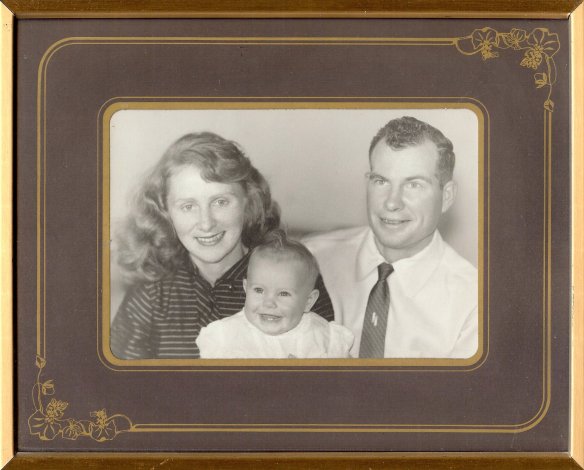
This is one of the earliest I have. I was maybe 6 months old there, with my mom and dad. In all of my “posed” baby pictures my hair is combed like that — must have been the style for babies then?
They both had all that curl and my hair is straight as a board.
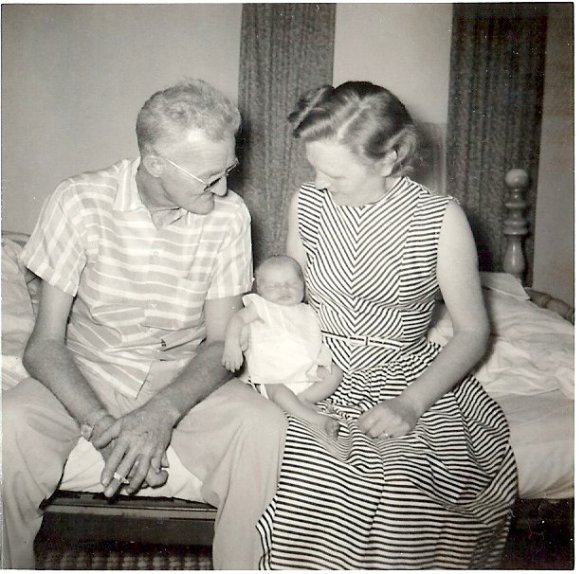
Actually, here is an even earlier one with my grandparents. I wonder why I didn’t inherit their skinny genes?
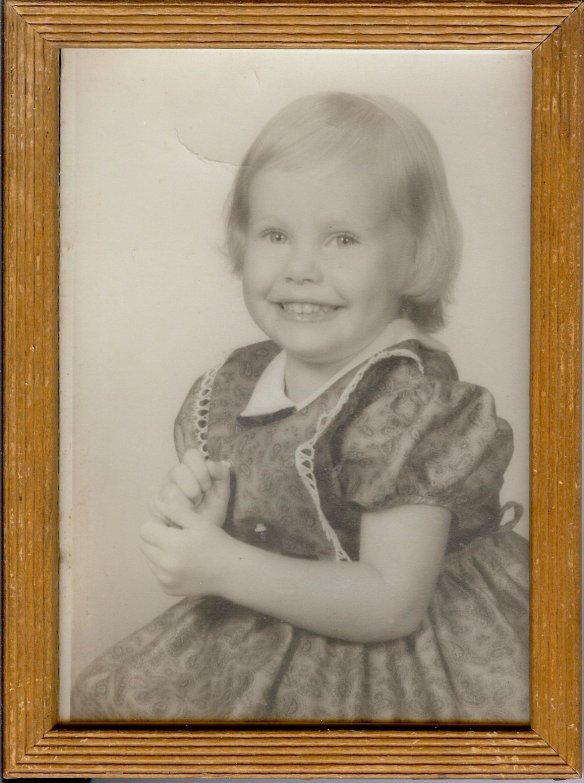
In this one I am about three. I’m told they couldn’t get me to smile for the picture til they gave me some pennies.
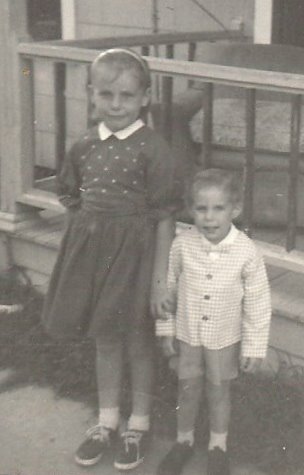
I’m with my little brother here one Easter. I must’ve been about 5 or 6 or so, and he would have been 1 or 2.
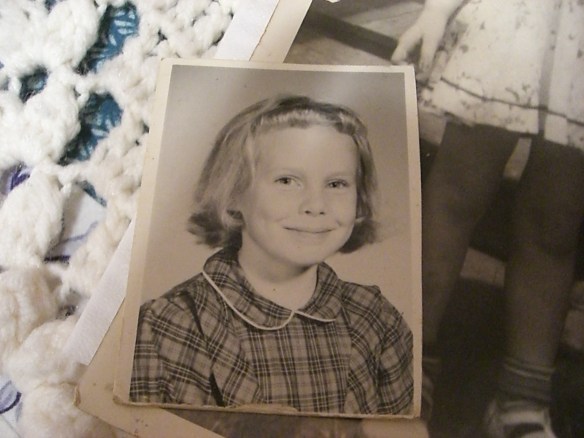
This is one of my favorites from 4th or 5th grade.
That was all before color was invented. 🙂 This one from 6th grade is, I think, the first colored photo I have of myself. I had to sleep in rollers and Dippetty Doo to get even that little bit of wave!
You can join in the fun or see others’ photos from childhood at In His Hands.














 Stray Thoughts