Friday’s Fave Five

FFF daisies

Welcome to Friday’s Fave Five, hosted by Susanne at Living to Tell the Story, in which we can share five of our favorite things from the last week,  wonderful exercise in looking for and appreciating the good things God blesses us with. Click on the button to learn more, then go to Susanne’s to read others’ faves and link up your own.

Here are some highlights of the past week – I think many of them are “repeats,” but it’s good to be thankful for blessings every time they happen, not just the first time: 🙂

1. A three day weekend.

2. A cookout with the family including grilled hamburgers and chocolate pie.

3. A leaky toilet fixed, and a hard-working husband willing to tackle it. He had Jesse work with him this time – figured it was one of those life skills he needed to have. I’m thankful, too, that we have more than one bathroom so it wasn’t much of a problem to have one out of commission for a day.

4. God’s help reaching a goal. I’ve been working on the church’s ladies newsletter and hoped to get it finished yesterday so all I had to do today was proofread it one last time before getting it printed (as opposed to racing against the clock Friday afternoon to get it done), and, thank the Lord, that happened.

5. Good visits with Jim’s mom. Since she is not speaking much any more, and when she does try I often can’t hear or understand her, it makes visiting a little harder. Sometimes she nods or shakes her head, but sometimes you just don’t know how much she is getting. Two days ago she actually laughed at something I said and then teased Jim back a little bit, and yesterday when I asked her if she’d had a good lunch, she asked me, “Did YOU have a good lunch?” Then she was able to speak quietly, but still out loud, for the rest of the visit.

Happy Friday!

Book Review: Introverts in the Church

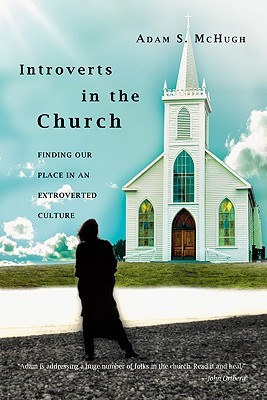
IntrovertsI came across Introverts in the Church: Finding Our Place in an Extroverted Culture by Adam S. McHugh around the same time that I came across Quiet: The Power of Introverts in a World That Can’t Stop Talking by Susan Cain (linked to my review). Susan’s book was somewhat clinical and historical, and I thought Adam’s would be a nice complement to hers, with spiritual applications.

It was and wasn’t. Some parts of the book were extremely helpful, but some of it totally turned me off.

One of the main characteristics of introverts is that they’re energized by solitude. They’re not hermits, not all are shy, they do like socializing to a degree, but it drains them, whereas extroverts are energized by socializing. They also process things differently. Extroverts process by talking with others: they can speak and think at the same time, though sometimes they are more prone than introverts to speak before thinking (e.g., Peter). Introverts process things internally and take longer to do so, so sometimes they miss speaking up because they’re still trying to figure out what to say. Extroverts can handle a lot of stimulation: introverts, only so much. Introverts also “prefer depth over breadth” (p. 41). That doesn’t mean that extroverts have no depth: it just means that introverts may have only a few very close friends rather than a great number of casual friends, generally hate small talk, prefer to fully explore a few interests rather than experiencing a smattering of interests.

McHugh starts off by making the case that church life seems to be set up more for extroverts than introverts (see the post on his blog, The Top Five Things Introverts Dread About Church, one of my all-time favorite posts ever). He cites a survey indicating more people than not thought Jesus was an extrovert (though McHugh lists several qualities of both the introvert and extrovert from what we see of Jesus’s life and suggests that Jesus was the perfect balance between the two), examples of equating spirituality with sociability, of a church atmosphere resembling a “nonalcoholic cocktail party” where “there is a chatty, mingling informality…where words flow like wine” (p. 21) rather than quietness and reverence.

Introverts tend to process things slowly, so they might lag behind in conversation and therefore be uncomfortable. They prefer having more involved, meaningful conversation with one or two people rather than glad-handing everyone they see. They “can faithfully sit in the back pew of worship services, rarely talking to anyone and still feel a genuine connection to the community (p. 93). They probably prefer quieter forms of church worship and wouldn’t mind some intervals of silence in order to think and process.

McHugh emphasizes that neither approach is right or wrong, and most of us have some mixture of introvert and extrovert in us, though most of us are usually stronger one way than the other. He asserts that, just like there are a variety of spiritual gifts withing the church that are supposed to interact to make up the body, so the church needs different personality types, partly so that we can minister to different personality types. There are valuable ways introverts can minister that may not look just like the way extroverts do, and that’s ok. An introvert doesn’t have to change his personality to “fit in” God’s kingdom, though McHugh acknowledges that we all need to be stretched out of our comfort zones sometimes.

He cites various ways introverts can be misunderstood or can feel they don’t fit in. He tells of a few people whose pastors thought that fostering community meant having a lot of church activities and groups, and one was thought less than spiritual if one did not attend all or most of these, yet the introverts found them exhausting.  Introverts may be thought standoffish. I admit I have seen some of this. Recently a pastor who is usually very gracious equated being “quiet and bashful” with being “self-absorbed,” and the solution seemed to be to stop being quiet and bashful rather than to find ways a quiet and bashful person can minister (although, as I said above, we do need to extend ourselves past our comfort zones sometimes, but anyone can be self-absorbed, introvert or extrovert). Those kinds of things hurt, yet I can’t say I carry the sense of woundedness McHugh seems to, but he does have a chapter on “Finding Healing” for those who do.

He does have some admonitions for introverts that I found helpful:

“It is natural for introverts to distance themselves from others to do the necessary work of internal processing, but too often we use that as an excuse for avoiding others, even when we have the social energy to engage” (p. 52).

We are “susceptible to an unhealthy degree of self-preoccupation” and “become mired in our inner worlds, to the exclusion of relationships and actions that would bring …healing and joy” (p. 59).

“Our inner reflections can become excessive to the point of inaction. Introversion should never be an excuse for laziness or sin. Understanding our introversion is not the end of our self-discovery and growth; it is a beginning point for learning to love God and others” (p. 59).

“The love that is the ultimate goal of the Christian life cannot be restricted to inner stirrings, but it must be expressed in self-sacrificial action. Healing will come en route. We stretch as we take risks and move beyond our comfort zones” (p. 59)

“We bless the body of Christ when we express our gifts within community and when we love at personal costs to ourselves” (p. 60).

“When we use our introversion as an excuse for not loving people sacrificially, we are not acting as introverts formed in the image of God. We who follow a crucified Messiah know that love will sometimes compel us to willingly choose things that make us uncomfortable, to surrender our rights for the blessing of others. We worship a God ‘who by the power at work within us is able to accomplish abundantly far more than all we can ask or imagine’ [Ephesians 3:20]. We must be always be open to the sovereign God who can shake us to our cores, who gives us the strength to transcend our humanness and to do things we never thought possible” (p. 63).

“Even when our resources are at their lowest point, even when we have nothing to offer, we work out of a power that can take our scant reserves and overwhelm people with a mercy that heals both body and soul” (p. 65)

“Sometimes we play the ‘introvert card’ in order to avoid taking a risk or doing something uncomfortable” (p. 136).

“Introverts may need to keep struggling through greeting times at church, because we need the constant reminder that the Christian life is never lived in isolation” (p. 193).

“God may call some people into a work for which they are not perfectly suited, for His greater glory” (p. 138).

“When Moses objected to God at the burning bush, saying that he was a clumsy speaker, God did not disagree with him…The power of the Holy Spirit gives us the ability to do things we couldn’t do otherwise” (p. 138).

But while we need to extend ourselves, there are things churches can do to minister to introverts and enable them to connect and minister. He doesn’t suggest that churches should “coddle” introverts or “create yet another target audience” (p. 193), but one of the main things churches can do is to recognize that there are different ways to energize, lead, worship, experience community. He spends much of the book discussing these factors.They can stop “communicating to introverts that their ways of living and relating and worshiping are inferior or unfaithful” (p. 193) and realize that though we hold to the same “paramount, indispensable values” (p. 23), we may have different ways of expressing them. “The truly healthy church is a combination of introverted and extroverted qualities that fluidly move together. Only in that partnership can we capture both the depth and breadth of God’s mission” (p. 30).

Someone I read thought he focused too much on leadership rather than lay people, but I didn’t think so personally: there are two chapters specifically on leadership, and many of his examples involve pastors, but I found much I could glean and apply to myself even within those chapters.

I found the majority of the book very helpful, but I had major problems with the chapter on “Introverted Spirituality” and some of the chapter on “Introverts in Church”. He recommends several Eastern practices that “move beyond the senses” (p. 70) and mystical and Catholic practices that I would be uncomfortable with. I do agree that “words and tangible images are signs pointing to God, but they are not God Himself” (p. 71), and that God said, “as the heavens are higher than the earth, so are my ways higher than your ways, and my thoughts than your thoughts” (Isaiah 55:9), but I very strongly disagree that “words have a way of trying to control Him” (p. 71) or that we need to seek Him beyond words, especially the very words that He breathed out for us to have until we see Him again. A former pastor used to call the Bible “divinely brief” – of all the infinite number of things God could have said and conveyed to us, this is what He wanted us to know and think about and learn from. In the chapter on “Introverts in the Church,” he opens the chapter with a quote from Neil Postman that “If an audience is not immersed in an aura of mystery and symbolic otherworldliness, then it is unlikely that it can still call forth the state of mind required for a nontrivial religious experience” (p. 187). Though there are times when we can be humbled and amazed by God’s “otherworldliness” and transcendence, and though there are mysteries in the Bible and about God Himself that we can never fully fathom, I don’t think worship is “mystical.” A speaker I used to hear in college called worship “worth-ship” – ascribing to God and acknowledging His worth, His majesty, glory, holiness, and His abundant other qualities – which we learn of through His Word, not “beyond our senses.” Peter, James, and John had one of the most amazing spiritual experiences ever when they saw Christ transfigured before their very eyes, yet when Peter referred to it, he went on to say we have a “more sure word of prophecy” in the Scripture than even that experience. I am also wary of a prayer form that involves “silence to quiet the mind and focus on a sacred word or phrase. Apophatic prayer tries to rid the mind of all images and forms so as to be open to encounter directly the Mysterious One. It is the desire of the meditator to listen to God rather than talk to God” (p. 71). I have read suggestions that the focusing on a single word or phrase while meditating may be an occultish practice. I don’t know about that, but I do know that Biblical meditation is not an emptying of the mind but rather a using the mind, mulling or thinking over. Right when I was in the midst of this book, I was at home from church sick one day and listened to a sermon by Jim Berg on “Let the Word of Christ Dwell in You Richly” from Colossians 3:16. He defined meditation as “peering intently with purpose” involving concentration, purpose, and focus on a particular passage. I’m not saying that every single practice McHugh mentions is wrong (though there are some I am more uncomfortable with than others) or that Christians might not be able to use some of them in beneficial ways, but I am very wary of extra-Biblical practices, and strongly disagree that introverts need to seek this kind of spirituality. Besides all of that, I am just more practically minded. When he was writing of a specific form he likes to use in prayer, my thought was, “Well, ok, if that helps you. But some of us just like to talk to God in prayer.” Admittedly sometimes my thoughts get scattered in prayer, and when they do I go back to what we call the Lord’s prayer (not to say it in a rote way, but to use it phrase by phrase as a jumping-off point) or the Psalms or one of the New Testament prayers like Colossians 1:9-14 or Philippians 1:9-11.

So…as I said at the beginning, much of the book was extremely helpful, but some of it raised some red flags for me.

(This will also be linked to Semicolon‘s Saturday Review of Books.)

The Hidden Art of Homemaking: Gardens and Gardening

It’s Week 6 of  The Hidden Art of Homemaking Book Club hosted by Cindy at Ordo Amoris where we’re discussing Edith Schaeffer’s book, The Hidden Art of Homemaking a chapter at a time.

Chapter 6 discusses “Gardens and Gardening,” and Edith applies some of the same principles as in other chapters, that people don’t necessarily need to become experts, get a degree, start a farm, etc., to participate and benefit by doing a little gardening, but they can start small, as she did with what we would call now container gardening, or with a small space of land. She lists many of the benefits of gardening (exercise, contributing to rather than taking from the environment, the pleasure and anticipation of planting something and watching it grow, etc.) and a few of the many Biblical allusions to planting.

And while I understand and agree with all of that, I have to confess, I am no gardener. My husband had a garden for a few years, but it was a battle royal to keep bugs from destroying it, and at certain times of the year it was more pressure that relaxation to keep up with it. I have not been able to spend more than a very few minutes on my knees since TM, even with a pad, so I am not keen to go start a garden myself. I have thought of starting some squash growing in a container or two, since often what I find in the store is so sad-looking, and have also thought of growing some herbs. I’d have to figure out better ways of battling the bugs – I cringe at spraying pesticides over something I am going to eat.

I do a little better with ornamental plants. Somehow both at our former house and this one, rose bushes have flourished despite me, not because of me. I think some of my first plants were hanging baskets, just the basic petunias, impatiens, and begonias. Last year I tried verbena for the first time, and this year some blue lobelia and pink Gerber daisies. At our last home there was a purple hydrangea bush that I just loved and wanted one here: the one I planted last year is putting forth buds (I can’t remember what color I bought, though. 🙂 Either pink or blue, as they didn’t have purple, but I think the color of the bloom primarily depends on the soil, anyway. I’m excited to see how they turn out). I do want to plant some bulbs some time for early spring blooms.

With this chapter, as well, as the others, if we have little or no experience at all in the given topic, we can start out small, learn as we go, and expand. I do enjoy walking around the plant sections at stores and seeing what kinds of things are there and wondering how I can incorporate them.

I do love how flowers can brighten up the area. We had none right next to this house, and I’ve enjoyed planting some since we’ve been here (oddly, the previous owner planted daffodils and a few other things behind the shed and in an area of the back yard that can’t be seen from the windows. Haven’t figured that out yet.)

Barbara's Cell phone pics 191

Patio flowers

This one came with this variety of plants all together: all I had to do was transplant it into this container. It has filled out nicely.

Planter

One of the spiritual parallels I’ve learned most with the small experiences I’ve had with plants is that of John 15:2b: “every branch that beareth fruit, he purgeth it, that it may bring forth more fruit.” The few that I have worked with need to be cut back sometimes. If they’re just let go, they may continue to grow to an extent but will look scraggly and sick or may even stop growing altogether. Cutting back – pruning or “deadheading” the spent flowers and even sometimes cutting back what looks like perfectly good growth – makes the plant, full, lush, bushy, healthy, ad produces many more flowers. This is one of the most comforting truths concerning suffering and loss: we may not know why God took a certain person or thing or closed a certain door, and there are many Biblical reasons for suffering, but one is this: we will grow spiritually in ways we would not have without that “pruning.”

More discussion on this chapter can be found here.

What’s On Your Nightstand: May 2013

What's On Your NightstandThe folks at 5 Minutes For Books host What’s On Your Nightstand? the fourth Tuesday of each month in which we can share about the books we have been reading and/or plan to read.

May has seemed like an awfully long month! Here’s what has been passing over my nightstand since last time:

Completed:

The New American Standard Bible. No, not the whole Bible in a month. I like reading the Bible through, for various reasons, but on my own timetable as I feel led rather than in a year. I don’t remember when I started this time around, but I just finished reading through the NASB.

With the Word by Warren Wiersbe, again, not just since last month. I used it as my companion through the Bible this last time: it contains a few paragraphs of commentary on every chapter in the Bible. I have not reviewed it, but I quoted from it extensively when I was hosting The Week in Words.

Betrayal by Robin Lee Hatcher, second in the Where the Heart Lives series, reviewed here.

His Ways, Your Walk, focusing on Bible passages written specifically to women, newly published by my friend Lou Ann Keiser, reviewed here.

Comforts From Romans: Celebrating the Gospel One Day at a Time by Elyse Fitzpatrick, reviewed here. Mixed emotions on this one.

The Freedom of Self-Forgetfulness by Tim Keller, more of a booklet, really, at 46 pages. Very good.

My Heart Christ’s Home by Robert Boyd Munger, another small booklet, also good.

Introverts in the Church: Finding Our Place in an Extroverted Culture by Adam S. McHugh. Just finished it Sunday, hope to have a review up in the next day or two. Review is up here. Mixed emotions with this one, too.

Pride and Prejudice by Jane Austen, audiobook. I enjoyed it much more than I did my first time reading the book a few years ago.

Shepherds Abiding, Jan Karon, audiobook.

Currently Reading:

Island of the Blue Dolphins, by Scott O’Dell, selected by Amy at Hope is the Word for Carrie’s Reading to Know Book Club for May. First I forgot about this, then the library didn’t have it, so I’ll be pushing to get this one done.

Bonhoeffer: Pastor, Martyr, Prophet, Spy by Eric Metaxas.

The Hidden Art of Homemaking by Edith Schaeffer along with Cindy at Ordo Amoris who is hosting a read-along book club.

The Greatest Thing in the World by Henry Drummond, a closer look at I Corinthians 13.

Those who know me well know that’s an awful lot of non-fiction for me! I’m aching to get back to stories!

Coming up next:

The English Standard Version of the Bible. I probably won’t mention this month to month.

Through Gates of Splendor, by Elizabeth Elliot, a missionary classic, for Carrie’s Reading to Know Book Club for June, selected by myself.

The Merchant’s Daughter by Melanie Dickerson.

The Duet by Robert Elmer.

Light From Heaven by Jan Karon, last of the Mitford series, via audiobook.

What are you reading?

Memorial Day

A brief history of memorial Day is here. Originally it was called Decoration Day, and people honored their loved ones who had died during battle by decorating their graves. According to Wikipedia, “By the 20th century, Memorial Day had been extended to honor all Americans who have died while in the military service.” while Veteran’s Day is designed to honor all veterans past and present who served.

None of my loved ones died while in battle, but I don’t think it is out of keeping with this day to remember those who fought and died since that time. I wrote about the veterans in my family once here.

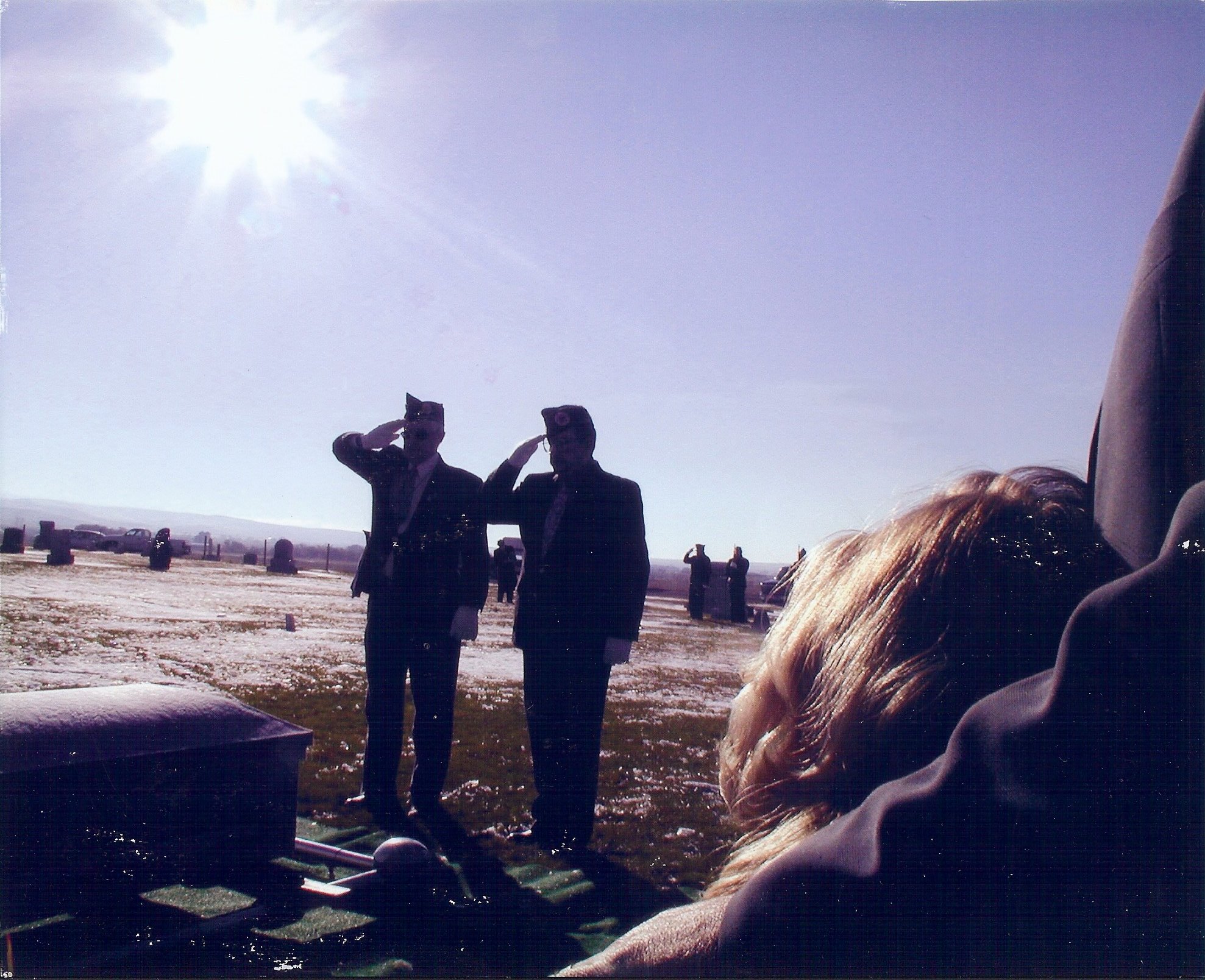
This is from my father-in-law’s funeral. I’ve always thought it was particularly poignant to see these two old veterans paying their respects:

Memorial Day

Lead Me Back

For all who need to come back home —
“I have blotted out, as a thick cloud, thy transgressions,
and, as a cloud, thy sins:
return unto me; for I have redeemed thee.”
Isaiah 44:22
Lead Me Back
Lead me back to my home, I have wandered far away.
I’ve been gone for far too long. Will You welcome me today?

Is it possible You can hear me after the way I turned from You?
Is it possible that You’re near me, that You never went away,
And You’ll lead me back today?

The life I spent, the days I lost, I have lived them all in vain.
Now I hold nothing to show but a heart that is full of pain.

Lord, I know that You will hear me although I turned away from You.
Lord, I see that You were near me, and You never went away,
And You call me back today.

Lead me back to my home, I have wandered far away.
I’ve been gone for far too long. Will You welcome me today?

Now I come to You today.

~ Words and music by Pepper Choplin

As sung by the Steve Pettit Evangelistic Team on their CD, Creator Of It All.

Laudable Linkage

I don’t know if this will matter to anyone but me, but I used to label my Laudable Linkage posts with all the different topics covered. The only problem with that was when I went to look through a particular category, there would be a lot of “Links” posts, and it was hard to find and skim through my own posts. I didn’t want a reader searching through the categories to face the same thing, so I created a separate Laudable Linkage category for these types of posts and I’m in the process of changing the tags on the old ones.

On to my collection of interesting reads from the last couple of weeks:

Tim Bosna and Evil’s Smile. The last paragraph is a helpful perspective when unthinkable and insensible evil happens.

Where Was God?

Forgive Us These Faults.

5 Things Every Christian Should Know. Or remind ourselves of.

Aiming at Heaven.

Why Going to Church on Sunday Is an Act of War.

To Ron and Shelly Hamilton’s Church on the death of their son. Good advice when a church member is grieving.

5 Ways We Grow.

The Difference Between Original Autographs and Original Texts of Scripture.

4 Ways to Be Like Nana Lois from II Timothy 1:5

10 Ways to Encourage a Missionary, HT to Kim.

Why Christian Writers Should Keep Writing, HT to Laura.

An Invitation to Old-fashioned Blogging, sharing our simple stories, before “branding” became a part of blogging, HT to Susanne.

A delicate subject matter – toilets in Japan from missionary friend Kim. I find these things fascinating. Note the last one with the sink on top of the toilet, so the water from washing your hands goes to fill the tank. One thing I’ve never understood about bidets – I’ve never used one, but you know how with a air hand dryer, your hands never get completely dry….? Seems like that would be a problem with bidet dryers as well.  I’m glad they have alternate western-style toilets in airports there! Even in the US, I’m always glad to get back to my very own bathroom. 🙂

Enough of that – here’s a fun way to make a bear-faced pancake:

This cat must be thinking, “Make. It. Stop.”

Have a great weekend!

Friday’s Fave Five

FFF daisies

Welcome to Friday’s Fave Five, hosted by Susanne at Living to Tell the Story, in which we can share five of our favorite things from the last week,  wonderful exercise in looking for and appreciating the good things God blesses us with. Click on the button to learn more, then go to Susanne’s to read others’ faves and link up your own.

Here are some highlights of the past week:

1. A good report from the eye doctor for my husband three weeks after his surgery for retinal detachment. Everything is still very blurry, which is discouraging, but we’re assured that is normal and it takes time for the nerves involved to heal.

2. Better weather than predicted. We’ve had thunderstorms forecasted for much of the week, but have only had a little rain here and there.

3. Good news from OK. My daughter-in-law’s mother as well as family friends live in the area affected by the tornado, and though some in their church lost homes, everyone is safe physically. Our hearts go out to all of those experiencing loss and grief.

4. My first shower here – baby shower, that is. There are been bridal and baby showers at church since we moved here, but for various reasons I haven’t gone until last night. For some reason I have been “cocooning” at home more since we’ve moved, but it’s good to get out and mingle every now and then. I enjoyed it, particularly getting to know a couple of ladies a bit better.

5. An improvised casserole that turned out well. Wednesday nights we have to eat earlier due to prayer meeting, and usually I just fix something really simple, like grilled cheese sandwiches. But this day, all day long I couldn’t decide what to make. I ended up tossing together some leftovers and some new ingredients, and we liked it! I couldn’t tell you the proportions, but it had chicken, cream of chicken soup, sour cream, rice, bacon, corn, and onion.

Happy Friday!

Book Review: His Ways, Your Walk

HWYWHis Ways, Your Walk by my friend Lou Ann Keiser focuses on Bible passages written specifically to women. It grew out of Lou Ann’s long experience as a missionary wife, counseling many women and seeing the types of problems and struggles that regularly arise, and out of her years of Bible reading and study.

It covers a lot of ground for 244 pages: how to become born again, how to know God’s will for one’s life, singleness, romance, marriage, motherhood, women in the church, spiritual gifts, dress, entertainment, dealing with emotions, abuse – and that’s not even half the topics discussed. There are “application” questions after major sections, to process and apply what one has read. It is very practical, straightforward, balanced, chock full of Biblical wisdom, and laced with humor.

One of my favorite aspects of the book is that most of the time, when Lou Ann is discussing a passage, she includes the whole passage right there in the book rather than just a reference (though sometimes references are listed for further study).

One of my favorite quotes is in the chapter on dress: “We shouldn’t call attention to ourselves by looking tacky any more than we should call attention to ourselves by wearing too much bling. We need to find balance” (p. 152). Another, in a section on the husband’s headship over his wife, quotes I Corinthians 11:3 (“But I would have you know, that the head of every man is Christ; and the head of the woman is the man; and the head of Christ is God”), and then observes, “Is it negative to have a head? Obviously not, since Christ has one! Here, we have a glimpse of God’s order of authority. God the Father is in a position over Christ. Is God the father more important or better than Christ? No. They are equal; both are God! But Christ was obedient to His heavenly Father” (p. 72).

This book is good not only for personal study, but it would be good to share with daughters, a Sunday School class, or in a mentoring situation.

This book also represents a few firsts for me: this is the first (and only, so far) book I was asked to read and critique before publication, the first book in which I was listed in the acknowledgments, and the first book in which I am actually quoted. Thanks, Lou Ann!

You can read more of Lou Ann’s writings at her blog, In the Way.

(This will also be linked to Semicolon‘s Saturday Review of Books.)

The Hidden Art of Homemaking, Chapter 5: Interior Decoration

It’s Week 5 of  The Hidden Art of Homemaking Book Club hosted by Cindy at Ordo Amoris where we’re discussing Edith Schaeffer’s book, The Hidden Art of Homemaking a chapter at a time.

Chapter 5 is about Interior Decoration, and I have to say I think this might be the chapter I feel most at home in so far, because Edith talks about decorating one’s living space, whether a “dream home” or a boarding house room, not with the latest decorating fads for a magazine-worthy decor, but with originality and personality. She says our “spot” should not only express something of ourselves to visitors but should also be a place that is satisfying and feels “at home” to us. She advises the reader not to wait for certain funds or the ideal home (some of my frustrations along those lines are here) or even for marriage, but to start right where we are with personal touches to our space, and as she has said in previous chapters, ideas beget ideas, creativity begets more creativity.

She shares some personal examples that may be beyond the scope of what many of us can or want to do, but they’re good for sparking ideas. Some are time-honored traditions, like making quilts or rugs from scraps, or restoring old furniture rather than buying new. We did some of this when we were first married, transforming a storage barrel used in college into a side table with a long tablecloth over it. Once when the kids wanted a tree house, and new lumber was prohibitively expensive, my husband found some used wooden palettes and took the boards apart, sanded them down and made a great tree house. That was one of the things I hated leaving behind when we moved.

After last week’s chapter about drawing and sketching, I began to wonder why she didn’t include crafts or home arts, like embroidery, quilting, etc., but she mentions them here.

There is nothing inherently wrong with buying new furniture and decorations, and we’ve done a good bit of that as well, but the goal should be to make it homey and express one’s own tastes and personality.

We do need to keep in mind the other people with whom we live. I don’t believe in stripping the place bare when young children are in the house, but that’s probably not the time for antique vases. I have decidedly feminine tastes in decorating, but living with all males, I’ve tried to have the family room, at least, more neutral. My husband has said that if he lived alone he probably wouldn’t think to decorate, but he does appreciate the homeyness decorations add. He usually leaves the decorating choices up to me, but we do major furniture shopping together and consult on paint colors, etc.

We need to keep in mind, too, that “this world is not our [ultimate] home,” that we’re to lay up treasures in heaven rather than earth, that here on earth moth doth corrupt and thieves can break through and steal, and we’re not to set out hearts too much on “things.” And sometimes “we are to be willing to sacrifice in the area of material things as well as in all other areas, to put first the things of God, to put first His use of our time, or money, and our talents” (p. 79). I was reminded of that just yesterday morning with this post about a time of loss. Isobel Kuhn tells of a time early in her marriage when they were ministering to a poor  tribe whose manners were decidedly different from her own. She was pleased with her nesting and her newlywed “things,” but then one of the women blew her nose into her hands and then wiped them on the new couch, and a mother held her baby away from her while the baby urinated on the new rug. Those things weren’t done to express hostility toward Isobel – it’s just the way things were done there. She had to struggle to not let her precious “things” take precedence in her heart over the needs of the people she was working with, and she learned to be very practical with her possessions. The Goforths lost everything four different times in their lives. After the last time, “when, in the privacy of their own room, the ‘weaker vessel’ broke down and wept bitter, rebellious tears, Goforth sought to comfort her by saying, ‘My dear, after all, they’re only things and the Word says, ‘Take joyfully the spoiling of your goods!’ Cheer up, we’ll get along somehow.’” He wasn’t being calloused: he had a generally faith-filled, buoyant spirit, while his wife had…one rather more like my own. We need to hold all of God’s material gifts to us loosely, remembering they are ultimately His and He has promised to supply all we need.

But even within those parameters, He often allows for some expression of personality and creativity in our living spaces.

I shared a tour of my house here, but I thought I might share just a couple of those expressions of personality here.

This one has a story behind it:

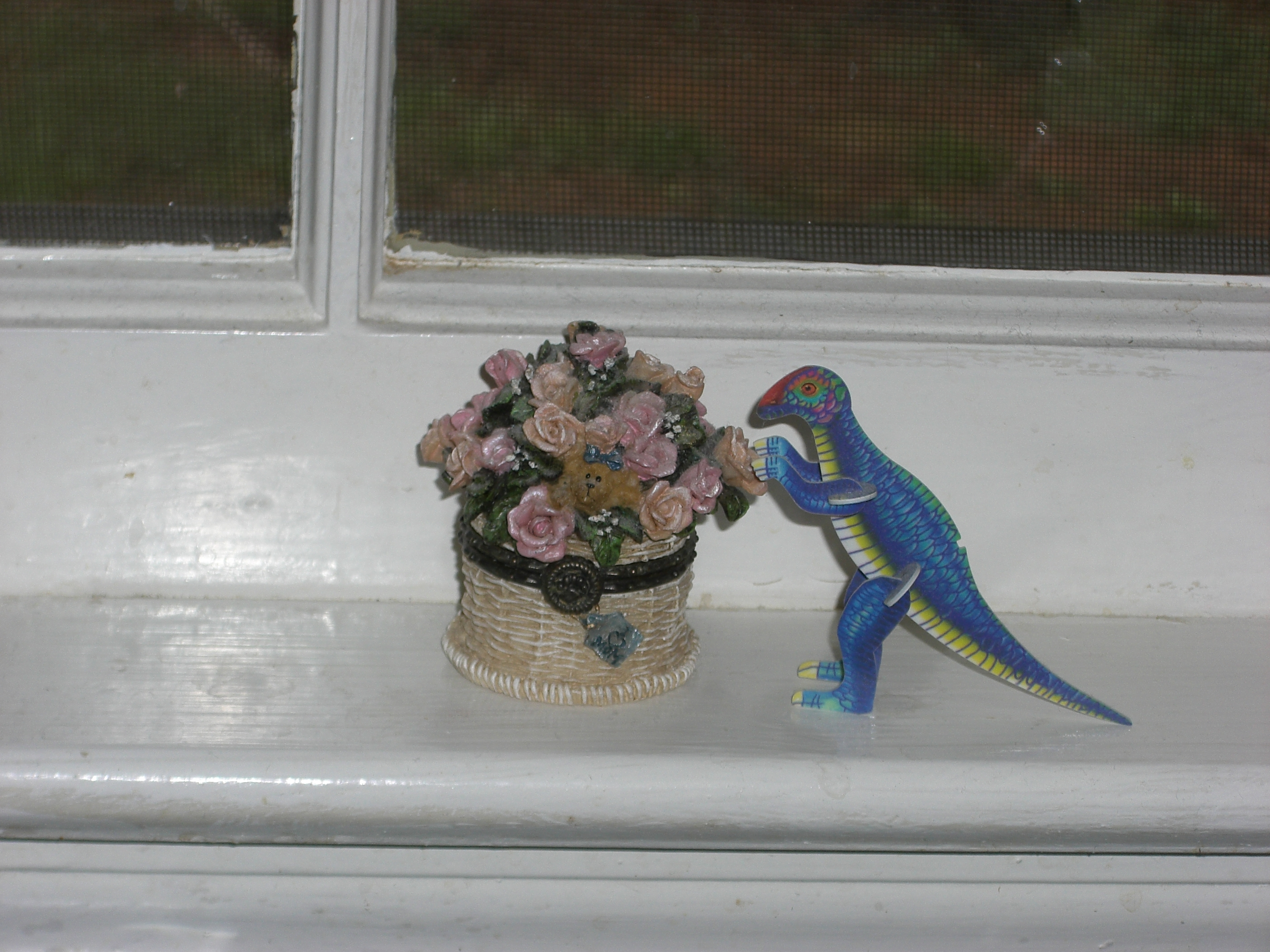
CIMG0034

I collected Boyd’s Bears figurines for a while, and this is a small figurine of a flower basket with a teeny little bear hiding in it. I kept it on the windowsill above the kitchen sink for a while. One day I found this little dinosaur next to it, put there by one of the boys when they were younger. I don’t know if the dinosaur was supposed to be after the flowers or the bear. 🙂 Or maybe the boys were just adding to the decorations. But I’ve always loved this as a picture of living with boys, and now I keep these together in a little curio cabinet.

Of course, living with boys, sometimes the “decorating” gets a little out of hand…

Life with boys

I mentioned Boyd’s Bear figurines – I posted some of my collection here. I just love their little faces and the details of them. There is only room for so many, though, before they become just a blur of too many to keep track of, but I tried to get my collection to reflect my interests – there is one holding the music to an Irish folks song, one reading a book, a couple cooking, several “Mom” and “couple” ones. Most were given to me by my husband or Mom.

Another of my favorites is a needlepoint piece I did when expecting my first son. My youngest still had it up in his room until his twelfth birthday, when we took it down so he wouldn’t get teased about it. That was kind of sad – an official turning from little boyhood.

Needlework bears

You can’t really tell from the picture, but there are different types of stitching in different places and the little cookies are raised rather than flat.

CIMG0557

This is one I am hanging on to. I don’t know if I will hand it off to a grandchild (if any of their parents want it) or keep it for a playroom here.

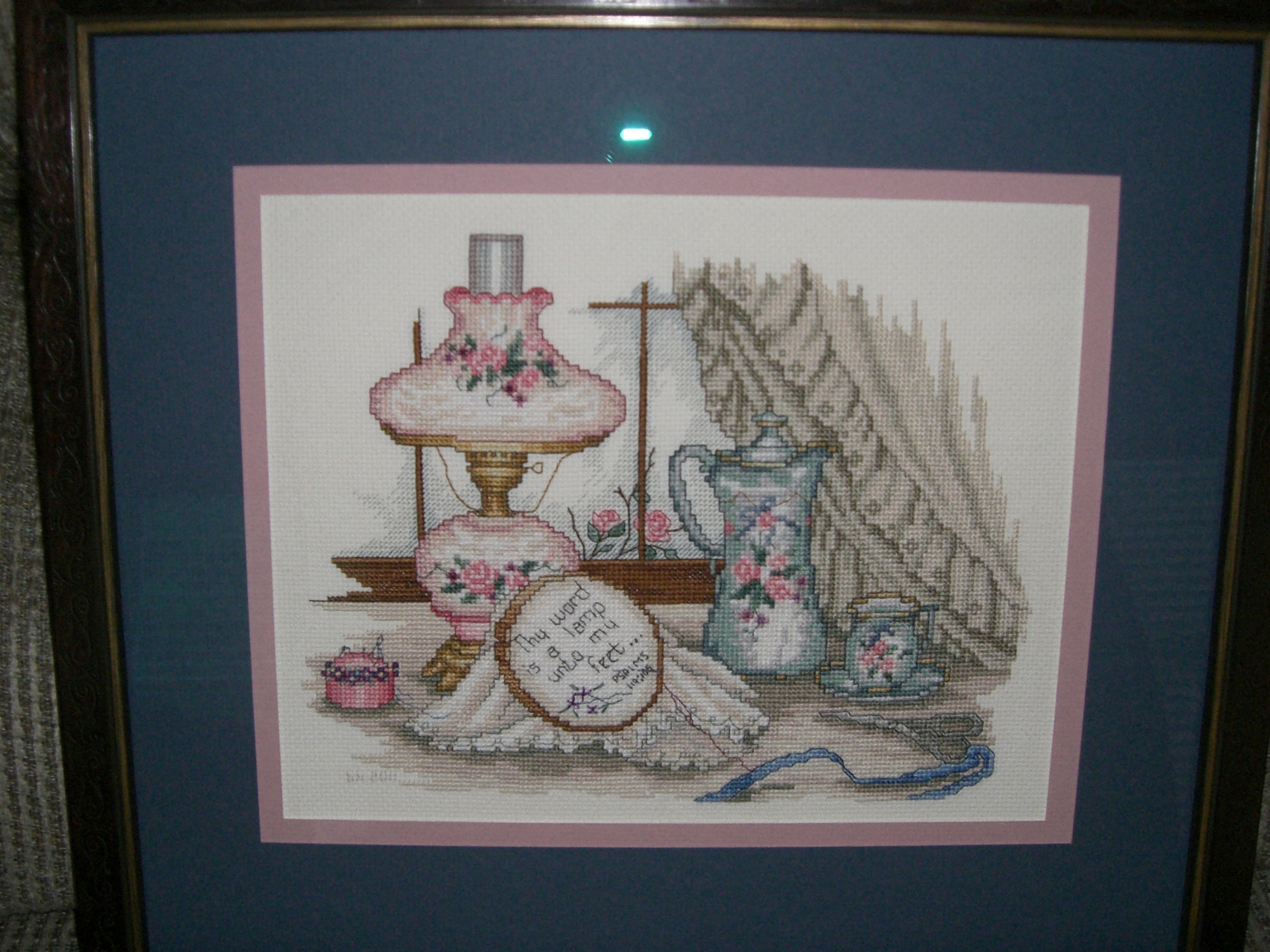
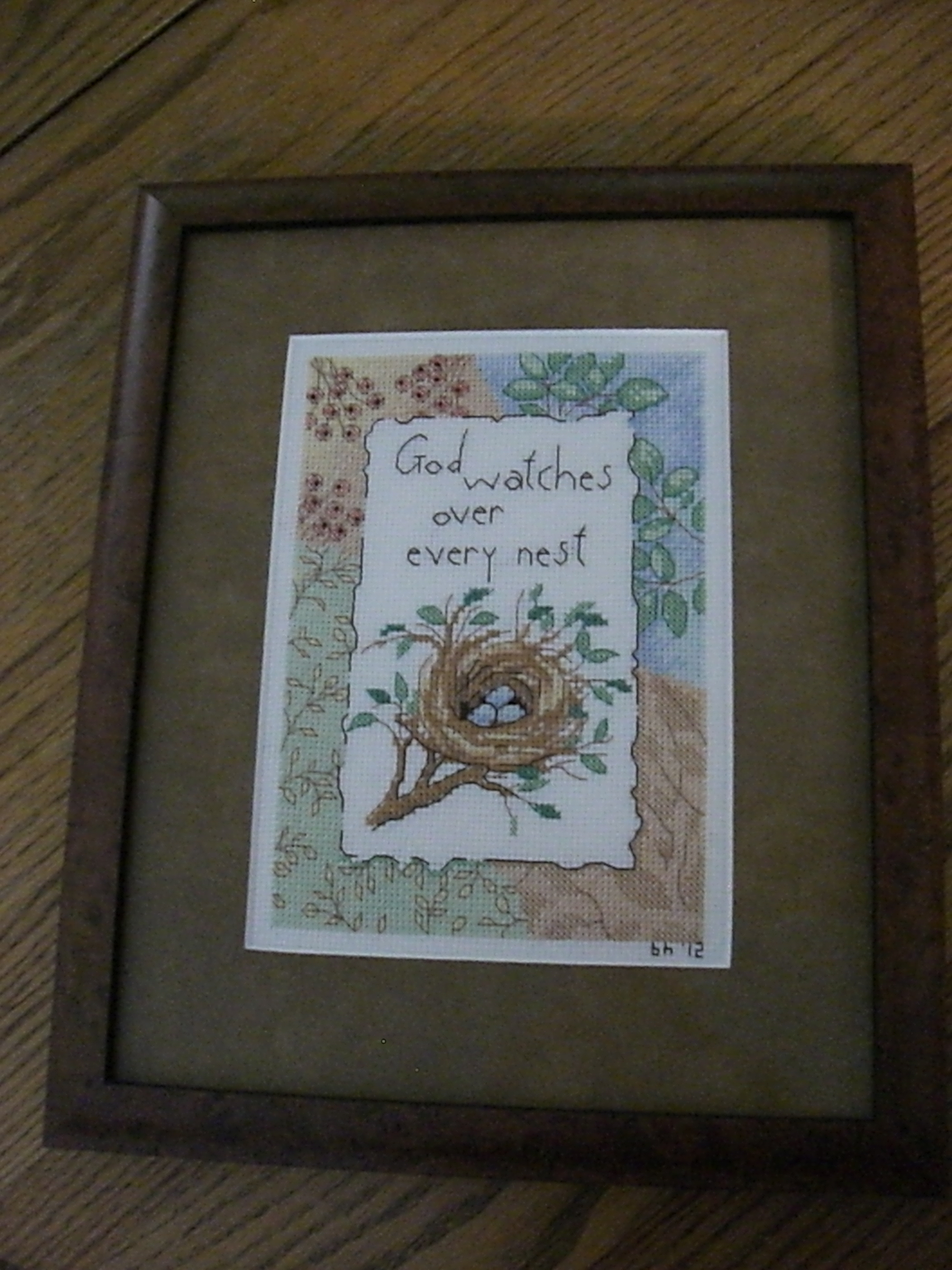
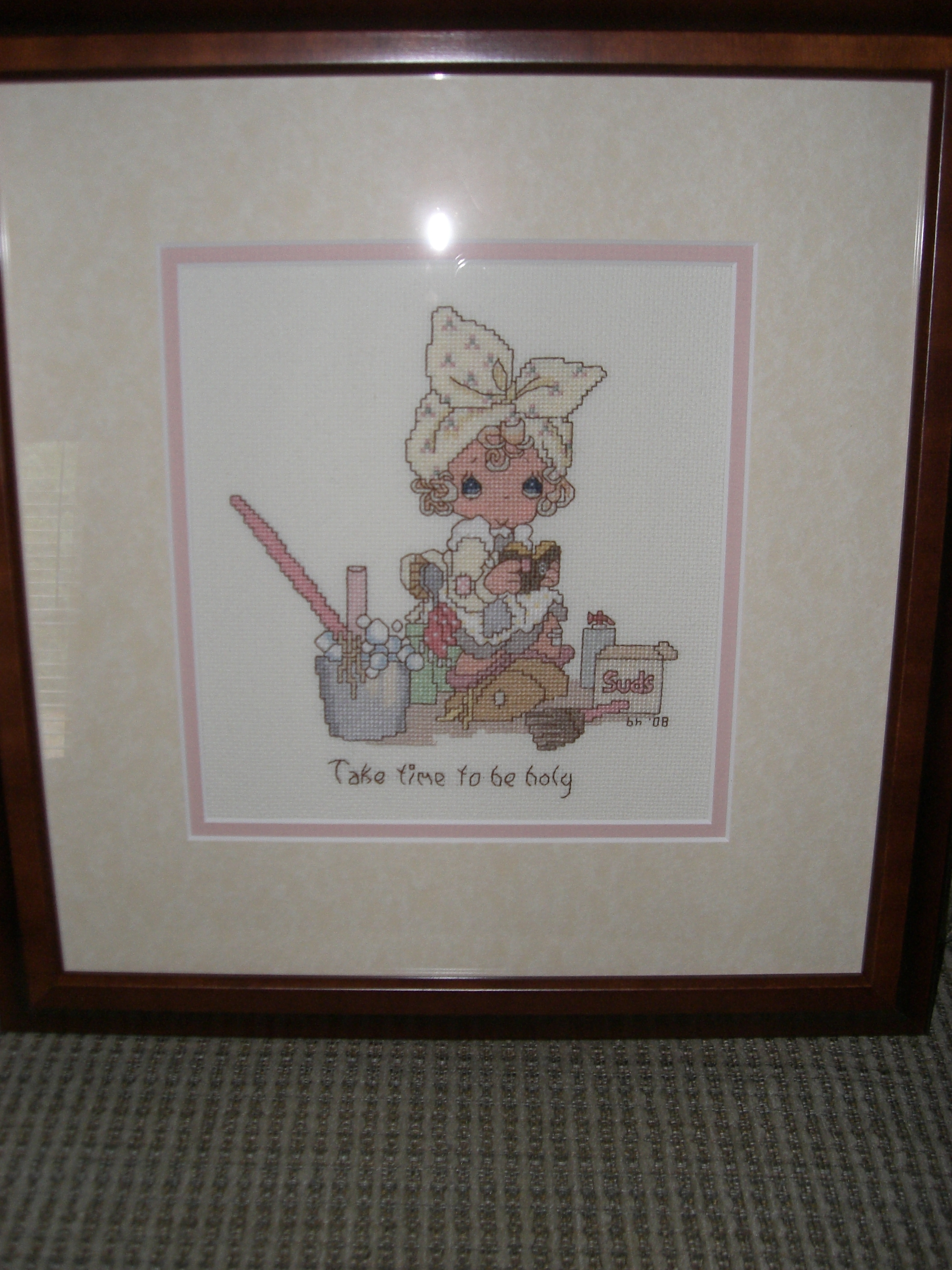
A few years ago I realized that I had done a lot of cross stitch through the years that I had given away for gifts, but didn’t have much that I had done for my own home. I wanted to do a few pieces both to express my own personality and maybe to hand down to progeny. Of course, my tastes are more feminine, as I said, and having all boys, I don’t know if they’d be interested in any of these just because their mom made them, and daughters-in-law will have their own tastes. I hope when I am gone that they will keep some things like this for grandchildren – I often wish I had something personal from my grandparents. But at any rate, these are a couple of my favorites:

Our only investment in “real art” was a set of prints by Paula Vaughan, a gift to me from my husband, who knew how much I liked them. But I have also framed cards and pages from calendars.

I did have one class in Home Furnishings in college, where we learned a bit about elements of art and principles of design, but I am far, far from expert in it. I never did get to go on and take the next class, Interior Decorating, which I would have loved, I think. Sometimes I watch decorating shows and “get” what the designers are saying, sometimes I have no idea. 🙂 I don’t always agree with what they do, but I sometimes enjoy listening to their reasons. But though some of these principles and elements are helpful (i.e., wondering why something looks “wrong” with the end table next to the couch and then realizing that it’s because the lamp there is way too small in proportion to the rest of the furniture), overall what’s most important is what Edith stresses: making a place homey, comfortable, and an expression of your own creativity and personality.

More discussion on this chapter is here.

This post will be also linked to Women Living Well.