Book Review: Bonhoeffer: Pastor, Martyr, Prophet, Spy

bonhoefferDietrich Bonhoeffer is one of those names I’ve heard for years but never really knew anything about, so when Bonhoeffer: Pastor, Martyr, Prophet, Spy by Eric Metaxas came up for sale at a good price on both Audible.com and Amazon’s Kindle store, it looked like a good time to learn more about him. (The Kindle price has gone back up but at this writing the audiobook at Audible is just $3.99.  The narrative parts were easy to listen to, but the philosophical parts were harder for me to grasp just by listening, so I was glad to have the Kindle version with which to read and ponder more slowly.)

I finished this book back in the fall, but noted so many places in it that even beginning a review by looking back at those notes was daunting. The book itself is some 600+ pages. So I finally decided that I wouldn’t summarize the book or his life except to say that he was a German Lutheran minister who helped to found what was called the Confessing Church, who opposed Hitler to the point of participating in the conspiracy to assassinate him, who was executed because of his part in that plot, and whose theology has been argued about ever since. You can find many further summations online (Wikipedia’s article on Bonhoeffer is a nice one). I’m just going to share some of my own impressions and things I liked and didn’t like.

I was intrigued by the family discussions he grew up with. His mother was a Christian, but his father, Karl, was not, yet his father “respected his wife’s tutelage of the children in this and lent his tacit approval of it” and attended the family religious activities, though the family did not attend church. Karl Bonhoeffer was a psychiatrist and “taught his children to speak only when they had something to say. He did not tolerate sloppiness of expression any more than he tolerated self-pity or selfishness or boastful pride.” He also wanted his children to keep their emotions under control, feeling that “Emotionalism, like sloppy communication, was thought to be self-indulgent.” He had a strong dislike of cliches and didn’t allow his children to use them, which puzzled me at first until I understood that he wanted his children to think for themselves rather than just parroting catch-phrases. These all worked together to cause his children to be razor-sharp thinkers.

Some followed their mother, some their father. When Dietrich announced at age 14 that he was going to be a theologian, his lawyer brother questioned his choice and called the church a “‘poor, feeble, boring, petty bourgeois institution.’ ‘In that case,’ said Dietrich, ‘I shall have to reform it.'”

I liked that spirit about him, which led him to start the Confessing Church when the German Christians began to let themselves be Hitler’s puppets. He wasn’t one to sit back and grouse about issues when he could take action. On the other hand, that spirit is probably part of what led him into the conspiracy against Hitler.

I can understand the problems with Hitler’s regime and atrocities and the feeling that this could not be allowed to continue. I can condone a staging a coup to take him down. I can appreciate the difficulties in doing so because Hitler’s popularity with the public was at a high by the time his generals knew what was going on behind the scenes and knew that something must be done. They tried to limit him before WWII began and failed, and by that time any movement against him would have been at the peril of their own lives. I wrestle with whether an assassination attempt was the right response. With some of the conflicts in the world in my lifetime, I’ve often wondered whether taking out the one guy at the head of the trouble would be a better recourse that having multitudes die in a war, and I have always been glad that I wasn’t the one who had to make such decisions. So I can appreciate the moral wrestlings people of conscience would have had in that day, yet I still have trouble with a professing Christian pastor conspiring to have a leader killed, especially in light of the kind of political leadership Paul was under when he wrote in his epistles about what a Christian’s stance should be under it: he didn’t say anything about attacking those in charge or taking them out. Even though Bonhoeffer wasn’t the one pulling the trigger or planting bombs personally, he said that to aid as he did he’d have to be willing for such. “If necessary, he would be willing to kill Hitler…Bonhoeffer had to be clear that he was not assisting in the fulfillment of a deed he was unwilling to do” (p. 388, Kindle version).

I can’t really regard him as a martyr: he was persecuted for his faith, in being cut off from preaching, teaching, and writing, but he was executed for his part in the conspiracy against Hitler, not for his faith (unless you believe, as Metaxas evidently does, that his faith was what drove him to be a part of that plot).

I do appreciate his integrity in realizing that any action of this kind he took had to be his action alone and not something he could lead the church into. I also appreciated his testimony of unfailing kindness while imprisoned.

I am confused about his theology: some statements he made in the book I liked and agreed with, like the difference between cheap grace and costly grace, but some had me scratching my head. Evidently I am not the only one, because in a few articles I have read since finishing the book, there are some who argue over whether he was conservative or liberal and what his views were on various important doctrines. I was confused, too, at how he could discern problems with wrong theology yet still align himself churches that taught wrong theology.

I really disagreed with him here:

Bonhoeffer knew that to live in fear of “guilt” was itself sinful. God wanted His beloved children to operate out of freedom and joy and to do what was right and good, not out of fear of making a mistake. To live in fear and guilt was to be “religious” in the pejorative sense that [he] often talked and preached about. He knew that to act freely could mean inadvertently doing wrong and incurring guilt. In fact, he felt that living this way meant that it was impossible to avoid incurring guilt, but if one was wished to live responsibly and fully, one would be willing to do so (p. 424-425K).

Only the man whose final standard is not his reason, his principles, his conscience, his freedom, or his virtue, but who is ready to sacrifice all this when he is called to obedient and responsible action in faith and in exclusive allegiance to God – the responsible man, who tries to make his whole life and answer to the question and call of God (pp. 445-446K).

God…demands responsible action in a bold venture of faith and…promises forgiveness and consolation to the man who becomes a sinner in that venture…one must sacrifice oneself utterly to God’s purposes, even to the point of possibly making moral mistakes (p. 446).

I do agree Christians should operate out of love for God rather than a neurotic fear of misstepping, but I don’t thing “freedom in Christ” precludes walking circumspectly or working out our salvation with fear and trembling. I don’t honestly think Bonhoeffer would say that, either, but there is a balance there and statements like these seem to lean too far one way. I can understand being willing to sacrifice reputation (as Mary, Jesus’s mother did), but I don’t see that God calls us to sacrifice virtue, when He is the one who has called us to virtue, and to sacrifice oneself to Him to the point of making moral mistakes seems incongruous.

I enjoyed the historical aspects of the book, particularly  about how Hitler came to power. I had always wondered how such a man could have been elected to leadership or not deposed at some point. I don’t know where I was during some of my history lessons, but I didn’t know (or had forgotten) that Germany was quite unhappy with their lot after WWI, and part of what brought Hitler to glory was his reclaiming some of the territory Germany had lost. Then he staged certain events or recast them to the public to make it look like he had no choice but to take certain actions. It was also fascinating how he somehow escaped so many assassination attempts on his life.

I was perturbed by some aspects of Metaxas’s writing. He seemed to assume the reader knew certain aspects of Bonhoeffer’s life already and would refer to them way beforehand, plus he would mention someone and say something like “In 20 years he will be the person who does such and such.” I know a biography is a different genre than a novel or story, but some story-telling techniques can make it more interesting (and not ruin the suspense by spilling the beans too soon). He seemed to feel as if Bonhoeffer could do not wrong except that he sometimes “spoke hyperbolically, for effect, and sometimes it backfired” (p. 364K). He also got a little carried away sometimes with sentences like, “Behold, that unpredictable magus, Adolph Hitler, would now with a flourish produce from his hindquarters a withered olive branch and wave it before the goggling world” (p. 356K) and, commenting on Hitler’s atrocious table manners, “the famously vegetarian Reichsfuhrer indecorously bolted his meatless mush.”

Some of the articles I found online that discussed Bonhoeffer or disagreed with much of what Metaxas wrote are:

Hijacking Bonhoeffer.
Metaxas’s Counterfeit Bonhoeffer: An Evangelical Critique.
Bonhoeffer: Approaching His Life and Work (a second article titled Bonhoeffer and the Scriptures is underneath the end notes of the first article).
So Many Different Dietrich Bonhoeffers.

I don’t feel so bad about my confusion of where Bonhoeffer stands if even the experts don’t agree on it. 🙂 But there are enough quotes of his dismissing certain core doctrines that I wouldn’t call him an evangelical (in Hijacking Bonhoeffer, the author makes the argument that Mataxas painted Bonhoeffer as much more conservative than he was to make him more appealing to conservatives, therefore “highjacking” him from the liberals who claim him as their own.)

So…I’m glad to have read the book, particularly for the historical aspect but also to get something of a window into who Bonhoeffer was, though the window itself may not have been the clearest, according to these other sources.

(This will also be linked to Semicolon‘s Saturday Review of Books.)

Sanctity of Life

I didn’t realize until earlier today that it is Sanctity of Human Life Sunday, but I didn’t want to let the day end without saying something about it.

As a Christian I believe God is the author of life, and He says he knew us even in the womb.

“Before I formed you in the womb I knew you, And before you were born I consecrated you; I have appointed you a prophet to the nations.” Jeremiah 1:5

For you formed my inward parts;
    you knitted me together in my mother’s womb.
 I praise you, for I am fearfully and wonderfully made.
Wonderful are your works;
    my soul knows it very well.
My frame was not hidden from you,
when I was being made in secret,
    intricately woven in the depths of the earth.
Your eyes saw my unformed substance;
in your book were written, every one of them,
    the days that were formed for me,
    when as yet there was none of them.
Psalm 139:13-16

This column, On abortion, it’s best to err on the side of life, makes the point that if there is any chance at all that the unborn fetus is a real human life, then it is best to treat it as such.

I saw this going around Facebook:

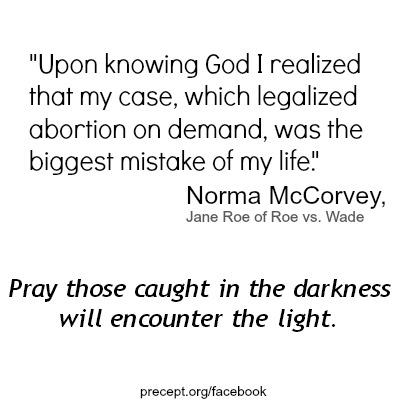
Roe mistake

“Each day, 2,150 women wake up in America believing abortion is the only realistic solution to an unplanned pregnancy” (care-net.org).
God brought Norma out of darkness and into His marvelous light.
Many women are still sitting in the darkness;
will you help them see the light of the world?

We win by showing love, compassion, and mercy to one frightened woman at a time.”

Laudable Linkage

Here are a few good reads from the last week:

When Your Calling Frightens You.

The Distinct, Positive Impact of a Good Dad.

The Mother I Meant To Be.

I Signed Up For This. Accepting the difficulties of motherhood, by God’s grace.

The Dark-Tinted, Truth-Filled Reading List We Owe Our Kids.

Russian Mother Takes Magical Pictures of of Her Kids and Animals. Some of the most gorgeous photos I’ve seen.

And if you’ve ever wondered what would happen if you threw boiling water into freezing air:

And here’s one way to walk a dog:

I didn’t watch the whole thing – it’s about the same for the first couple of minutes.

Hope you gave a great Saturday!

Friday’s Fave Five

FFF birds on a wire

Welcome to Friday’s Fave Five, hosted by Susanne at Living to Tell the Story, in which we can share five of our favorite things from the last week, a wonderful exercise in looking for and appreciating the good things God blesses us with. Click on the button to learn more, then go to Susanne’s to read others’ faves and link up your own.

This has been a fairly balanced week between getting some things done yet not feeling pressured and overburdened to get things done. Here are some of the highlights of the week:

1. Good weather. Not only did we not get predicted bad weather this week, but we actually had sunshine! Or at least more than we’ve had in a while. Does my heart good.

2. Rest. I wasn’t feeling well Sunday – nothing major, but it was enough that I needed to stay home from church. We’re not legalistic about Sunday activities, but I do try to keep it a day of rest as much as possible by not doing anything around the house that doesn’t absolutely have to be done, so I felt free to just rest, doze, and read off and on all day rather than feeling like I needed to be up doing something, and it was so refreshing.

3. A decorating dilemma solved. I had some more formal, elegant candle holders, wedding gifts from dear friends, on the mantel in the family room, along with some birdhouses, which are a bit more casual. I didn’t feel the candle holders “fit” there, but I didn’t want to move them until I had something to replace them, and I wasn’t sure where to put them. Our living room is a bit dressier, but much smaller than in our previous house, so there was no place for them there. I went out to Hobby Lobby this week and found this neat little piece:

photo(3)

It was on sale half-price, but even then was a bit more than I wanted to spend…but I had a gift card for HL from Christmas, so I let it be my Christmas present. 🙂 It fits in nicely with the rest, I think:

photo(5)

Next decorating project: replacing the plaque over the mantel. Love it (and I do have another place in mind for it), but it’s out of proportion to everything else. I do have some ideas – just have to decide which one to use.

The candle holders found a home on top of my desk:

photo(6)

I probably should put candles in them, huh? 🙂 The little angel figurine, by the way, was originally in a dish garden arrangement that my mom had sent to me for Valentine’s Day in college ages ago, and the little wooden house on the mantel was made by Jim’s dad.

4. Getting just a bit of sorting and organizing done: just the basket on my desk and the most-used drawer of my desk, but it felt good to get them in order.

5. Another problem solved: finding a way to turn my mother-in-law’s nightgowns into hospital-type gowns. Easier to dress and undress her, and more comfortable, too.

Overall a good week! I hope yours was, too.

Book Reviewed: Unglued

UngluedUnglued by Lysa TerKeurst was one of those books I heard good things about, got when it was either free or on sale for the Kindle app, and then let sit there for months. I’m not sure what prompted me to read it now, but I am glad I did.

The subtitle is Making Wise Choices in the Midst of Raw Emotions. Most of us have had experiences with out-of-control emotions, both externally from others or internally within ourselves. Some of us are “exploders” who lash out at others in some way, and some of us are “stuffers” who seethe inside, or some combination of the two.

Emotions in themselves aren’t wrong: God gave them to us for various reasons. But just like with the rest of His gifts, we can use them in wrong ways.

Lysa starts with the idea of making “imperfect progress.” Sometimes we beat ourselves up over missteps and failures, but we need to remember it’s okay to take baby steps and to get up and start over as many times as needed, as long as we’re moving forward.

A big part of diffusing our emotions is taking control of the thoughts that feed them. “We won’t develop new responses until we develop new thoughts. That’s why renewing our minds with new thoughts is crucial. New thoughts come from new perspectives” (p. 22K – the K means Kindle version. I’m not sure if the page numbers are the same in the book itself). “Scripture also teaches that we can accept or refuse thoughts. Instead of being held hostage by old thought patterns, we can actually capture our thoughts and allow the power of Christ’s truth to change them: We demolish arguments and every pretension that sets itself up against the knowledge of God” (p. 23K).

The other biggest factor in getting our emotions under control is spending time in God’s Word, and Lysa shares many applicable Scriptures.

Here are some other helpful quotes:

“I can face things that are out of my control and not act out of control” (p. 23).

“Could I trust God and believe He is working out something good even from things that seem no good? You see, if I know there is a potential good hidden within each chaotic situation, I can loosen my grip on control” (p. 24K).

“We can’t always fix our circumstances, but we can fix our minds on God” (p. 28K).

“Instead of condemning myself with statements like, I’m such a mess, I could say, Let God chisel. Let Him work on my hard places so I can leave the dark places of being stuck and come into the light of who He designed me to be” (p. 37K).

“I choose to view this circumstance as a call to action, not a call to beat myself up mentally” (p. 40K).

“In processing unglued reactions, soul integrity if the heart of what we’re after. Soul integrity is honesty that’s godly. It brings the passion of the exploder and the peacemaking of the stuffer under the authority of Jesus where honesty and godliness embrace and balance each other” (p. 52K).

“I stuff to protect myself by keeping conflict at bay. But if I’m stuffing and not being honest about my true feelings, that self-protection quickly turns into selfishness, and the unresolved conflict gives birth to bitterness” (p. 56K).

“Choosing a gentle reply doesn’t mean you’re weak; it actually means you possess a rare and godly strength” (p. 69K).

“Feelings are indicators, not dictators. They can indicate there is a situation I need to deal with, but they shouldn’t dictate how I react. I have a choice” (p. 72K).

“We must spend time with God, letting His truths become part of who we are and how we live. That’s what it means to have an internal experience with Him. Only then will we develop holy restraint” (p. 75).

“I acknowledge that I can only control myself. I can’t control how another person acts or reacts. Therefore, I shift my focus from trying to fix the other person and the situation to allowing God to reveal some tender truths to me…My job isn’t to fix the difficult people in my life or enable them to continue disrespectful or abusive behaviors. My job is to be obedient to God in the way I act and respond to those people” (p. 88K).

“I stuff as a false way to keep the peace. True peacekeeping isn’t about stopping the emotion. Remember, emotions move inward or outward – whether we want them to or not. True peacekeeping is about properly processing the emotions before they get stuffed and rot into something horribly toxic” (p. 91).

“Is my desire in this conflict to prove that I am right, or is my desire to improve the relationship?” (p. 92K).

“Instead of reacting out of anger, I pause and let the Holy Spirit redirect my first impulses. Then I tackle the issues – not the person” (p. 93).

“It is through God’s ‘great and precious promises’ (2 Peter 1:3-8) that I can participate in the divine nature. A nature very different from my own. I may not be gentle by nature, but I can be gentle by obedience. If – and only if – I equip myself with predetermined Biblical procedures that I can rely on when I start to feel the great unglued coming on” (pp. 104-105K).

“I started thinking that maybe I needed my own set of default procedures for when selfishness, pride, impatience, anger, or bitterness rear their ugly heads. Because in the moment I feel them, I feel justified in feeling them and find them hard to battle. But God’s promises – His truths and examples from Scripture – are powerful enough to redirect me to the divine nature I’m meant to have. Having a predetermined plan from Him will help me stay calmer when I start to feel unglued. More godly. More in line with Scripture” (p. 107K).

That’s probably way too many quotes – and that’s not even all I marked. But I hope some of them spoke to you as they spoke to me.

This is the first book by Lysa Terkeurst I’ve read, though I have two more on hand. I enjoyed her style, and I gleaned much from this one (I even went skimmed back through it after I finished to remind myself of some of the main points).

There were places where I didn’t agree with something she said, but I instead of going into them here, I’ll refer you to this review for more detail. Reading it has made me rethink this book.

(This will also be linked to Semicolon‘s Saturday Review of Books.)
Book Review: Unspoken by Dee Henderson

UnspokenI’ve mentioned before my history of reading Dee Henderson novels. Her latest is Unspoken, which involves a survivor of one of the most famous kidnappings in Chicago. Charlotte Graham was kidnapped at sixteen and found four years later but has never said a word about it to the police or much of anyone else in the eighteen years since. She has a new life and profession and tries to keep a low profile.

But her grandfather, who is evidently wealthier than most of the population, has died and wanted her to manage his estate, part of which is a massive amount of valuable old coins. That brings her to Bryce Bishop, a dealer in coins who has his own respectable family business in Chicago. Bryce had been bored and prayed for God to shake up his life a bit, and Charlotte’s coins, the way she offered them for sale, and the woman herself have certainly answered that prayer.

Charlotte has decided she is single for life, so at first she is uninterested in anything but a business relationship with Bryce. The time they spend together leads to a friendship and interest on Bryce’s part. It’s a while before she feels free enough to disclose anything about her past, and she does so in stages. She describes herself as “at best a messed-up Christian” because she can’t reconcile how God could love her and yet let this happen to her, and how He would have forgiven her kidnappers if they had repented.

As Bryce and Charlotte work through their issues, a well-known investigative reporter decides it is time to write a book about the case. Not only will the book open old wounds for Charlotte, but it opens the door for danger as well. There is a reason she hasn’t said anything to the police about her abduction, and this reporter’s book could not only jeopardize her privacy but also the safety of her loved ones.

Paul and Ann Falcon from Full Disclosure are characters in this book as well, as friends of Bryce. You don’t have to have read that book to understand this one, but it was fun to “see” them again.

As always, Dee had done a wonderful job with the story, the suspense, the characters, and the spiritual issues in a natural way. I can always count on her books to pull me right in and keep me interested all the way through. This one did get a little boggy in places with all the detail about coins: I understand some detail was needed to be authentic, but I could have used less in places. But overall I loved it!

(This will also be linked to Semicolon‘s Saturday Review of Books.)

How to Turn a Nightgown Into a Hospital Gown

As many of you know, we care for my mother-in-law in our home, and one problem area in caring for someone who is almost immobile and now somewhat contracted is dressing them.

First we used hospital-type gowns: you can Google “hospital gowns” and find several places online to buy them. But the aide who cares for her during the week prefers using knit shirts because the hospital gowns’ length and extra fabric would get in the way while changing or positioning her or would get bunched up around under her. At first I didn’t like having her just in a shirt and Depends, but then she is in bed most of the time and covered up: even when we have her in her wheelchair for a couple of hours a day, she’s covered with a throw blanket, and we have enough to keep her warm. We use the longer hospital gowns if we take her out to the doctor or something, but just a shirt for everyday at home in bed.

As my mother-in-law got more contracted, it became harder to get a knit shirt on her arms and over her head. She keeps one arm pretty close to her body and it takes many encouragements to relax it before we can move it even to put deodorant on or put a sleeve over it, so we went back to hospital gowns. I did cut off the length of one and hemmed it up so it wouldn’t get so bunchy. They are much easier to get off and on, but they’re all short-sleeved (the only ones I found online with long sleeves opened in the front, which wouldn’t work for my m-i-l), and with cooler weather we wanted something with long sleeves. I was just about to look up patterns and see about making our own gowns when it occurred to me that I could take an existing gown and turn it into a hospital gown by cutting the back open and placing a Velcro patch at the top. I was concerned that the fabric taken up by finishing the edges and overlapping to use Velcro might make the gown too tight through the shoulders, so the first one was an experiment. Thankfully, most gowns are roomy enough that that wasn’t a problem (I had also thought of doing this with one of her knit shirts, but I think that would make a shirt too small).

Even though this is a pretty straightforward, self-explanatory procedure, since this is a blog and all, we must have pictures. 🙂

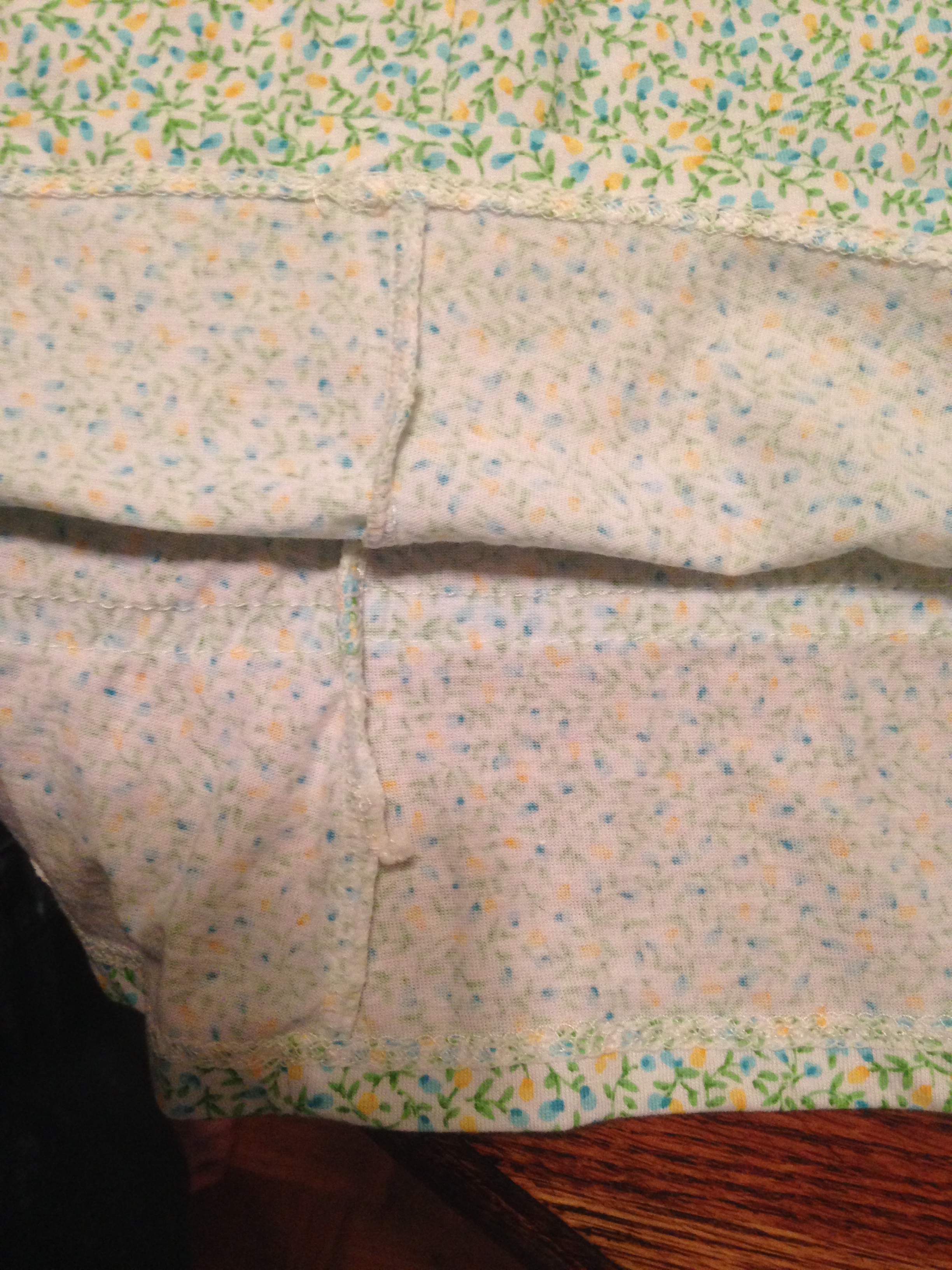
First I laid the gown on the table and lined up the side seams and shoulders so I could be sure I was cutting straight up the back:

Barbara's Cell phone pics 373

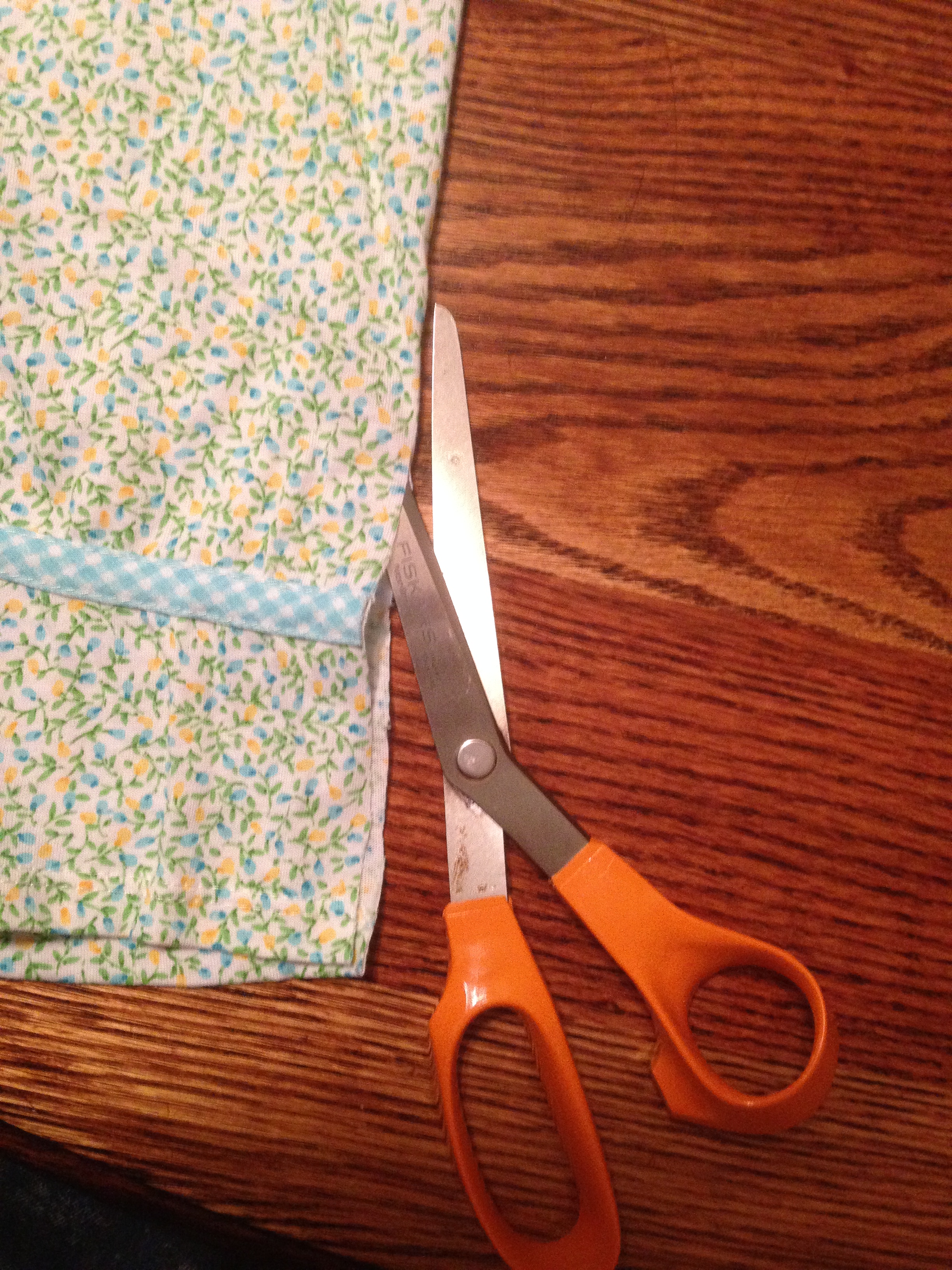
One I had it straightened out and laying flat, I cut up the center of the back:

Barbara's Cell phone pics 374

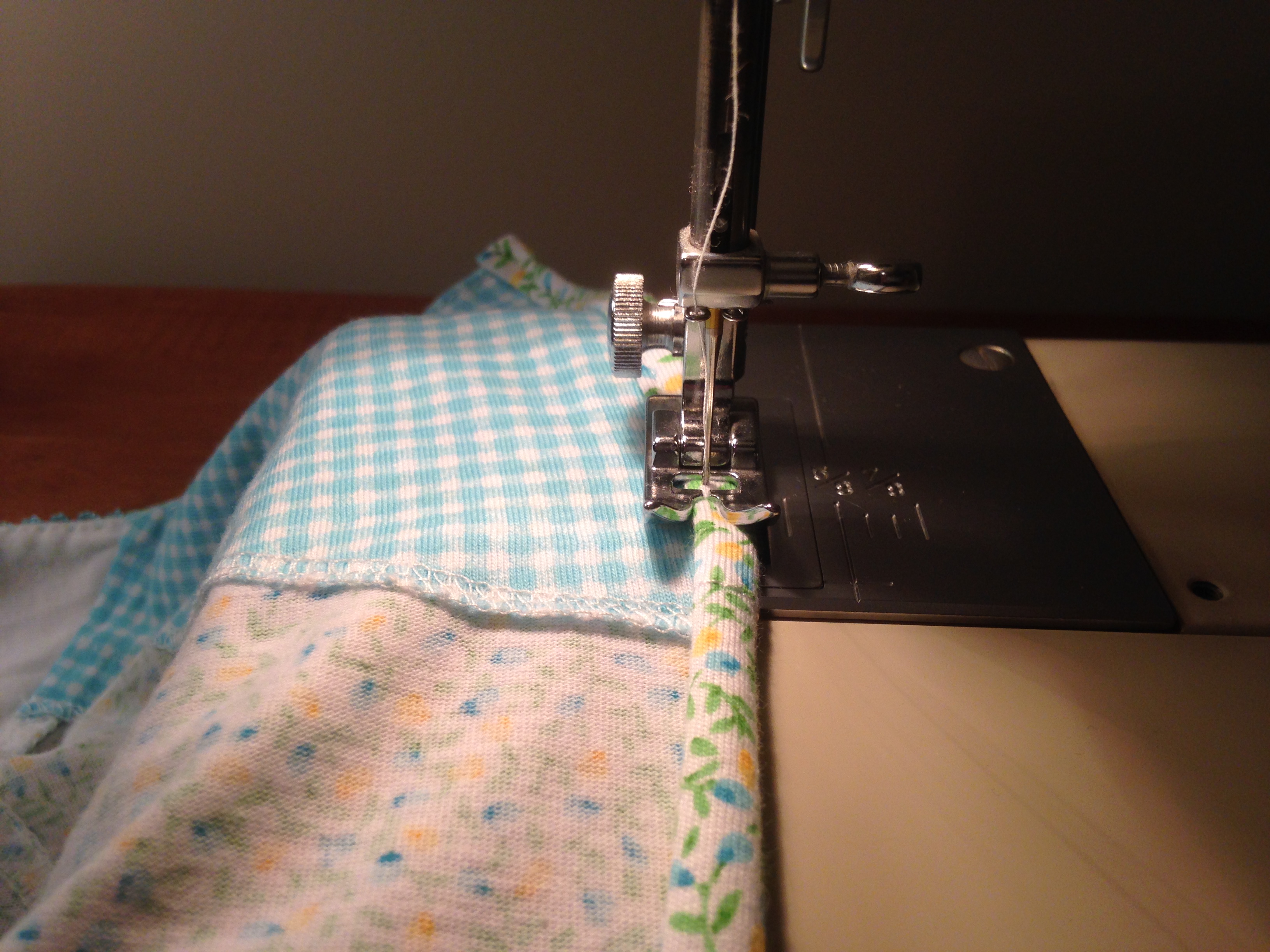
Then I turned under the raw edges just enough to stitch them down (with the knit fabric it pretty much curls into place, but I’d say I turned it under about 1/8 or 1/4 of an inch and then under again. The smaller you can make this, the less you’ll lose of the gown.

Barbara's Cell phone pics 375

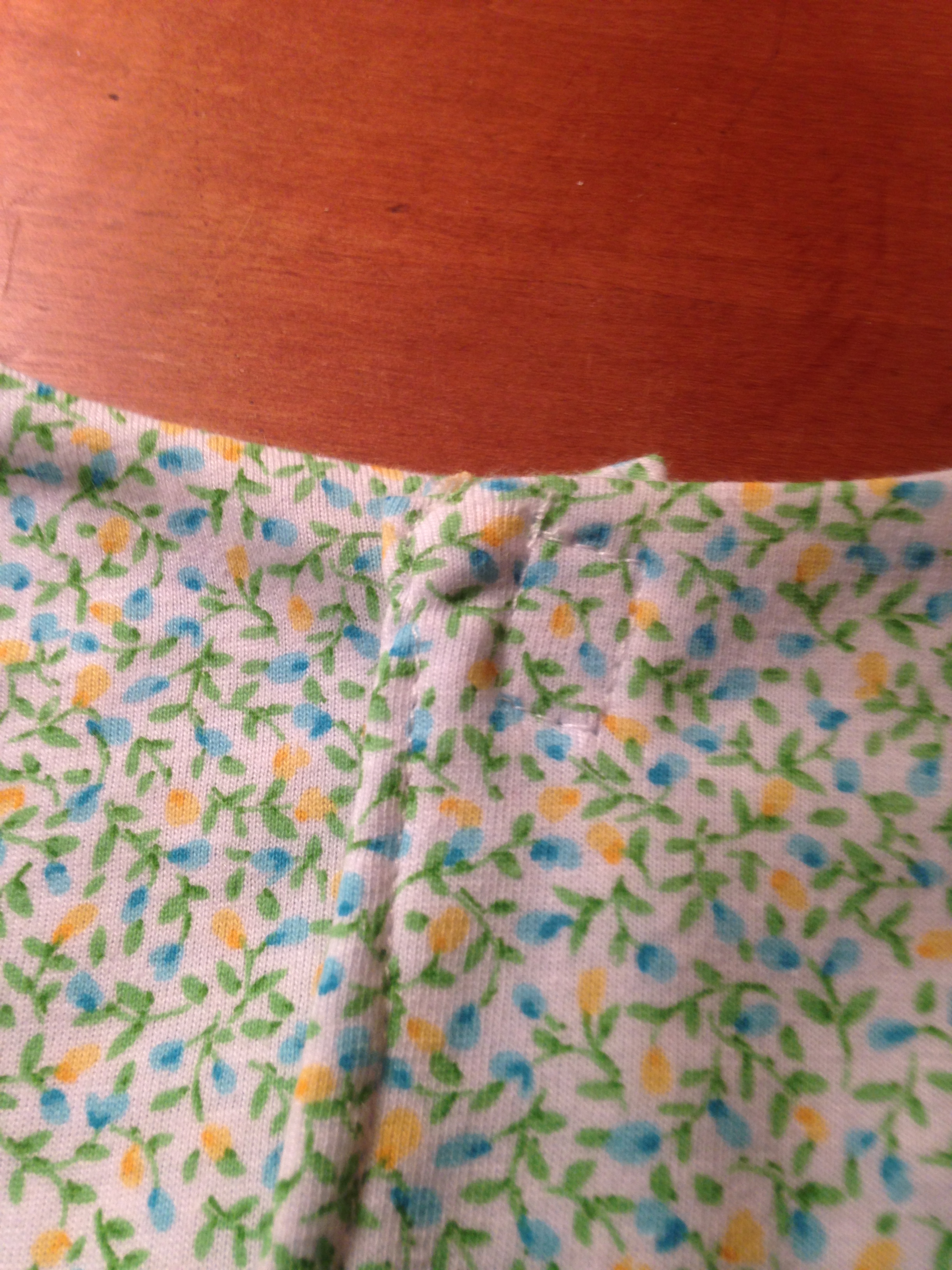
Then I sewed a Velcro patch on the right side of the fabric on one side of the gown, and the wrong side of the fabric on the other side (sounds more complicated to explain than it actually is, but basically you want to be able to place one side over the other).

Barbara's Cell phone pics 377

Barbara's Cell phone pics 379

(Please excuse my not-so-straight sewing there. 😳 )

Important note here: do not use stick-on Velcro! The adhesive doesn’t stick well enough on fabric to stay on through opening and closing the gown. I knew that and thought I’d use it anyway to hold the Velcro in place while I sewed it, but the adhesive glopped up my sewing machine needle with goo. Using the sew-on kind is not hard at all.

My mother-in-law’s caregiver and I were really pleased with the results. Not only is it easier to get on her and warmer, but the fabric is softer and more pliable that a regular hospital gown. For now I’ve left it its original length, but if it gets as bunchy and in-the-way as the other hospital gowns, I can cut the length off – probably not as short as a shirt, but shorter than gown-length.

If you have a serger or some way of finishing the edges without turning them under, and you want to make ties for the top instead of using Velcro, you could do this without losing the inch or so in the back. The Velcro, to me, is easier to use than tying ties. I wouldn’t use a hook and eye closure if the person using the gown is fairly immobile, because you have to watch their skin constantly for any breakage or chafing (which could quickly develop into a bedsore), and I’d be afraid a hook and eye would be more prone to that.

There you have it! I’ve redone a couple of her gowns now, and since it worked so well, I’ll be doing a few more in the coming days.

I’m linking up with “Works For Me Wednesday,” where you can find an abundance of helpful hints each week at We Are THAT family on Wednesdays.

TBR Challenge

I appreciated my friend Lisa‘s comment on my post about book challenges last week about the struggle with balance between wanting to be intentional in reading yet not wanting to feel hemmed in. I struggle with that, too. There are some books I’d never get around to reading without some of these challenges and lists, but I don’t want to have so many lists that I’m feeling overly pressured. I know sometimes God has directed me to a book I needed right at the moment that wasn’t on my radar, and I want to leave room for that and for the just-for-fun books (because I read both to learn and to relax.)

2014tbrbuttonI’ve been pondering for a few days what to list for the 2014 TBR Pile Challenge hosted by Roof Beam Reader. The challenge is to read 12 books in a year that have been on your shelves unread with a publication date before 2013. I chafe a little bit at that because I have books on my shelves published last year that I want to get to, and books I just got for Christmas that have pre-2013 publication dates but are new to me. But I do understand the need for guidelines of some kind, or else this would be just a general reading list. So I am trying to keep within the spirit of the post and choose books that I’ve had on my shelves or in my Kindle app for a while now. I came up with a list of 25, and that’s not including a box of books in my closet that I had forgotten about. 😳 So from those I’m narrowing it down to this list of 12, with two allowable alternate titles in case I decide against any of the others during the year (as per instructions, as I finish each book and review it, I’m adding the link to that review to the titles below):

1. Made to CraveSatisfying Your Deepest Desire with God, Not Food by Lisa TerKeurst (pub. 2010). Proverbs 31 Ministries is hosting a study of this book beginning Jan. 19, so I’ll be joining in that. (Finished March 1, 2014)

2. Crowded to Christ by L. E. Maxwell (pub. 1952), recommended by a former pastor. (Finished April 7)

3. Ida Scudder: Healing Bodies, Touching Hearts by Janet and Geoff Benge (pub. 2012). I had read a biography of hers (though not this one) some 25-30 years ago and wanted to refresh myself on her story. (Finished Feb. 3)

4. The House Is Quiet, Now What? by Janice Hanna and Kathleen Y’Barbo (pub. 2009). The subtitle is Rediscovering Life and Adventure As a Empty Nester. My nest isn’t totally empty yet, and I don’t see a shortage of things to do for a long time to come, but figured this would be helpful with perspective. One sentence I saw while flipping through it really spoke to me (about the “sandwich generation”), so I am looking forward to this. I had thought Lisa recommended this one, but maybe that was a different book. (Finished March 10)

5. How to Read Slowly by James W. Sire (pub. 1978). Even with making notes and marking with sticky tabs. I have a hard time feeling like I’ve really grasped everything I need to from nonfiction, so I am hoping this will help in that regard. (Finished July 20)

6. How to Be a Writer by Barbara Baig (pub. 2010). I like to read a book about writing every now and then to keep those embers stirred.

7. Walking From East to West: God in the Shadows by Ravi Zacharias (pub. 2009), because Sherry recommended it to me and because I like hearing how people came to the Lord, among other reasons. (Finished March 16)

8. The Great Divorce by C. S. Lewis (pub. 1946). I’ve read Narnia, the Space Trilogy, and Mere Christianity and now want to read some other Lewis books. (Finished May 6)

9. Loving the Church by John Crotts (pub. 2010), sent to me by Carrie a long time ago. 😳 (Finished June 17)

10. The Book of Three by Alexander Lloyd (pub. 2006), first book in the Prydain Chronicles, recommended by Janet. (Finished June 30)

11. Wednesdays Were Pretty Normal: A Boy, Cancer, and God by Michael Kelley (pub 2012). (Finished May 21)

12. Why We Are Not Emergent: By Two Guys Who Should Be by Kevin DeYoung and Ted Kluck (pub. 2008), partly because I have never heard anybody adequately explain what the emergent movement is, and I’ve heard this is a good critique. (Finished October 15)

Alternates: Girl in the Gatehouse by Julie Klassen (Finished Aug. 31) and Just Jane: A Novel of Jane Austen’s Life by Nancy Moser (Finished Aug. 4). (My wrap-up post for this challenge is here: https://barbarah.wordpress.com/2014/12/15/reading-challenge-wrap-up/)

You notice how many of these are nonfiction. That’s probably why they have been languishing on my shelves. 😳 I gravitate to fiction and biographies: I like nonfiction when I read it, but I usually have to “make” myself read it. So this list will be a challenge in more ways than one!

As per Roof Beam Reader’s instructions, when I finish and review each book, I’ll make its title above into a link to the review.

Nonfiction Challenge hosted at The Introverted ReaderLisa mentioned on her reading challenges post this morning a Nonfiction Reading Challenge which I hadn’t seen but given all the nonfiction  have listed here, I figured I may as well join up. 🙂

The Challenge:  Read any non-fiction book(s), adult or young adult. That’s it. You can choose anything. Memoirs? Yes. History? Yes. Travel? Yes. You get the idea? Absolutely anything that is classified as non-fiction counts for this challenge.

I always like levels in my challenges, so here are mine:

Dilettante–Read 1-5 non-fiction books

Explorer–Read 6-10

Seeker–Read 11-15

Master–Read 16-20

This challenge will last from January 1 to December 31, 2014. You can sign up anytime throughout the year.

With the books listed about plus a couple of others I want to read this year, I am aiming for the Seeker level.

Do you have books that have been on your “To Be Read” shelves for a while? Maybe you’ll consider joining in with challenge with us, and we can encourage each other along the way.

Laudable Linkage

Here are a few interesting reads found this week:

Head Knowledge = Good. Heart Knowledge = Good. We need both.

Reading the Bible Like Jesus: Matt. 22:31 and Reading the Bible Like Jesus: Luke 24. I would just caution, with the first one, that though we do need to read the Bible as written directly to us, we need to remember that not every instruction or promise is for us to follow. Some things were given specifically to Israel or to an individual. But, yes, even that is written to us for a purpose.

Don’t Pray in Circles!

Coming Home: When Missionaries Come Off the Field. Ways to be helpful rather than hurtful.

Rescued. Beautiful.

How Do Birds Keep Warm in Winter? HT to FFF friend Kathie (who always has gorgeous photos!) I thought our resident cardinals were just getting fat, and though they do eat more to stay warm, they also fluff layers of air amidst their wings as insulation. Very interesting article.

Saw this at Bobbi‘s. Very sweet. I don’t know if falling makes you stronger, as it says at the end, but I do hope I’ve taught my kids that falling isn’t the end. This is a good reminder, too, that though Olympic athletes are talented, they also have years of hard word leading up to their feats.

Have a good weekend!

Friday’s Fave Five

FFF birds on a wire

Welcome to Friday’s Fave Five, hosted by Susanne at Living to Tell the Story, in which we can share five of our favorite things from the last week, a wonderful exercise in looking for and appreciating the good things God blesses us with. Click on the button to learn more, then go to Susanne’s to read others’ faves and link up your own.

Brrr! It was 1 degree F on Monday and didn’t get above the mid-teens all day, and this was after rain and snow, so it was pretty icy out. I haven’t been that cold in a very long time. 45 degrees today (Thursday) felt almost balmy! Here are some favorite parts of the week.

1. Not losing power. Sometimes a favorite is something that didn’t happen that you were afraid might! According to the local news, about 500 or so homes did. I felt so bad for them and prayed it would be restored quickly.

2. No broken pipes here: our church did have one, but because they were taking precautions it was minor.

3. Not running out of supplies. Somehow I was not as prepared for the weather this time as I usually am, and I’ve found that makes a great deal of difference in how I feel about the weather! We were running low on a couple of things before I felt comfortable enough to venture out, but didn’t run out completely, thankfully.

4. Warmer weather, relatively, later in the week. Supposed to be in the 60s by the weekend!

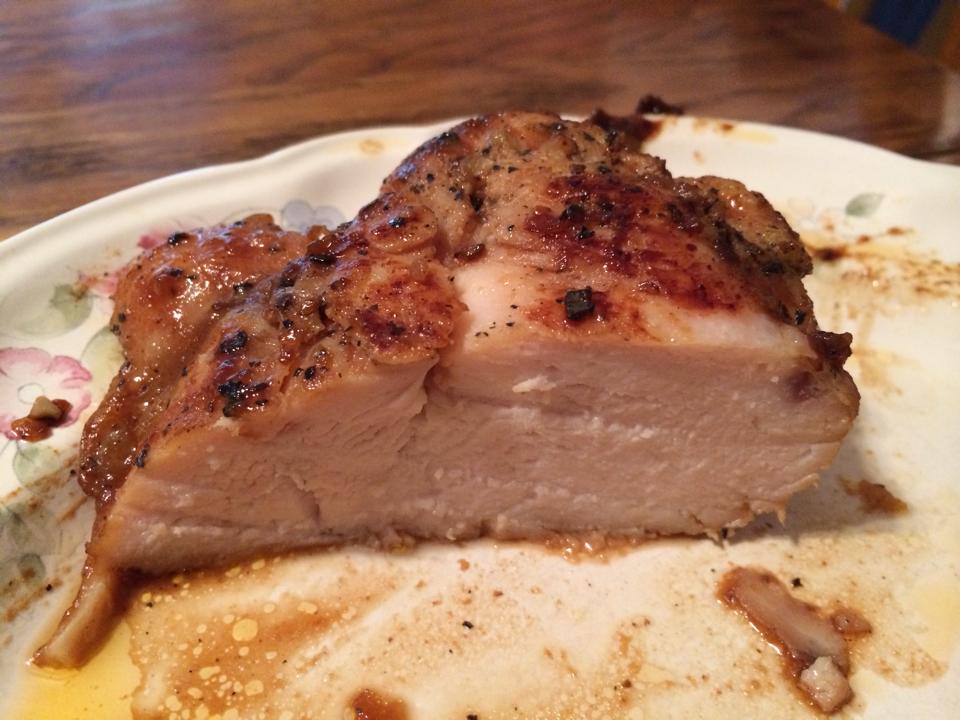
5. Sous-vide chicken. I mentioned last week that my son made a sous vide cooking apparatus for my husband for Christmas, and this is his third and so far best experiment with it. He made three kinds of chicken: teriyaki, barbecue, and a marinade he had found at the store (it is nice with this system that one can make different flavors without their mixing together with each other). The chicken breasts were so thick that he never could have grilled them without burning the outside before getting the inside done. They were so moist and good.

sous vide chicken

1513231_10153712344160637_786420415_n

BTW, when I mentioned sous vide last time, someone commented on the cost of the cooker. Jim said new they’re about $500, but Jeremy had found a link with instructions to make a sous-vide cooker for about $40 and put one together for his dad. When they were first discussing it, I thought, “OK, so, what’s the big deal?” But now I am a definite fan!

Bonuses: Safety on super-icy roads was a blessing, as was my mother-in-law’s aide being able to come in spite of the weather, and throw blankets, coffee, and good books have helped make the cold days a good bit cozier.

Happy Friday!