31 Days With Elisabeth Elliot

For the past two years I have participated in 31 Days, a blog challenge wherein a blogger can choose a topic to write about every day in October. Last year I shared 31 Days of Inspirational Biography, and the year before 31 Days of Missionary Stories. I enjoyed them very much, but they did take up a great deal of time, even though many of them were pre-written for a ladies’ newsletter. I wasn’t sure if I would participate this year or not, but as I pondered what topic I would write about if I did do it, the only thing that came to mind (until today) was to share quotes from Elisabeth Elliot. She has probably had the most profound influence on my life of anyone I have known or read, in the areas of walking with and serving the Lord in general as well as being a Christian woman, wife, and mother. She was a true Titus 2 woman to me though I never knew her personally. I appreciate the way she didn’t pull any punches, so to speak, about what it costs to follow the Lord, but she always pointed us back to His love, wisdom, care, and sufficiency. She just passed away this past June, and I believe it’s imperative that her voice continues to live on and share with women for generations to come.

Elisabeth Elliot2I wondered if someone else might choose her writings for a topic this month, but finally decided it doesn’t matter. If someone else does, we will probably share different things and with a different audience, and even if we overlap, that’s okay.

If you’d like to learn more about 31 Days and see what the different categories are, you can go here. There is a Facebook group for participants here and a Pinterest group here. I’m excited to see some of the topics already! I enjoyed some good reading there last year.

If you’d like to read this series, you can either subscribe to my blog (see a couple of different ways to do so on the sidebar) or bookmark this post. I’ll share a list with a link to each post from the month here.

Day 1: Limitations.
Day 2: Irritants as God’s Messengers.
Day 3: Thy list be done.
Day 4: The Rupture of Self.
Day 5: Enjoying the 80%
Day 6: How to Do the Job You Don’t Really Want To Do.
Day 7: Writing By Faith.
Day 8: Treading Alone.
Day 9: Can God Use Our Imperfections?
Day 10: Background of the phrase “Do the Next Thing
Day 11: Nothing Is Lost If Offered to Christ.
Day 12: A Quiet Heart.
Day 13: On Asking God Why.
Day 14: A Devious Repentance.
Day 15: God’s Help For God’s Assignment.
Day 16: Learning the Father’s Love (and letting go of self in light of it)
Day 17: Transformation.
Day 18: Forgiveness.
Day 19: Ordinary work (meditations from the life of Mary)
Day 20: No Further Than Natural Things.
Day 21: What Fits Us For Service.
Day 22: Loneliness.
Day 23: The World Must Be Shown.
Day 24: A Call to Older Women.
Day 25: The Face of Jesus.
Day 26: Freedom and Discipline.
Day 27: Spending Time Alone With God.
Day 28: The Hand That Hurts and the Hand That Heals.
Day 29: The Key to Supernatural Power.
Day 30: Short quotes.
Day 31: Book List and Memorial Video.

Book Review: The Screwtape Letters

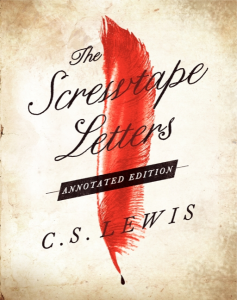
ScrewtapeThe idea for what would become The Screwtape Letters first came to C. S. Lewis in 1940, and, when they were completed, they first appeared one at a time in a weekly Anglican publication called The Guardian. The public response prompted publishers to make it into a book as soon as possible. It was first published in England in 1942 and in the USA shortly thereafter.

Lewis thought it might be both “entertaining and useful” to write a series of letters from an older devil to a younger apprentice in his work of tempting and tripping up a new “patient.” The type of approach, presenting “a negative point of view to lift up the positive,” was unusual for Lewis, but he felt it “would give a fresh, even comical perspective on the subject and might attract readers who might not normally think about such things.” Why a comical approach for such a serious subject, one that ended up being very difficult and unpleasant for Lewis to write about?” Partly to “[lure] the ordinary reader into a serious self-knowledge under pretense of being a kind of joke”* (McCusker’s preface) and because “humor involves a sense of proportion and a power of seeing yourself from the outside” (Lewis’s 1961 preface).

In his preface to the original edition, Lewis notes that “There are two equal and opposite errors into which our race can fall about the devils. One is to disbelieve in their existence. The other is to believe, and to feel an excessive and unhealthy interest in them. They themselves are equally pleased by both errors and hail a materialist or a magician with the same delight.” In the same preface he “[advises the reader] to remember that the devil is a liar. Not everything that Screwtape says should be assumed to be true even from his own angle.” He writes in the preface to the 1961 edition that “Satan, the leader or dictator of the devils, is the opposite, not of God, but of Michael,” an archangel, and “God has no opposite.”

At first it is a little hard to get used to the reverse thinking of the letters: Screwtape refers to God as “the Enemy,” to the devil as “Our Father Below,” to his position in the “Lowerachy” of hell, etc. It takes frequent mental adjustments throughout the book, and I can see at least partly how it could seem so oppressive for Lewis to try to express what a devil’s thoughts might be.

Screwtape’s nephew, Wormwood, is his apprentice and correspondent, and Wormwood, seems to want to come at the patient with a full-fledged attack and arguments. Screwtape counsels him that argument is not the answer, because by arguing, “you awake the patient’s reason, and once it is awake, who can foresee the result?” (Letter 1). Likewise, Wormwood wants to be able to “report spectacular wickedness. But do remember, the only thing that matters is the extent to which you separate the man from the Enemy. It does not matter how small the sins are provided their cumulative effect is to edge the man away from the Light and out into the Nothing…Indeed the safest road to Hell is the gradual one—the gentle slope, soft underfoot, without sudden turnings, without milestones, without signposts” (Letter 12). Thus, distracting someone on the verge of a spiritual crisis with thoughts about lunch proves quite effective.

When Wormwood’s patient becomes a Christian, Screwtape threatens “the usual penalties” but admits there is still plenty they can do, such as to “work hard, then, on the disappointment or anticlimax” that occurs a few weeks after his conversion, for “If once they get through this initial dryness successfully, they become much less dependent on emotion and therefore much harder to tempt.” Wormwood can also point out the flaws in the patient’s church and fellow churchmen, “[keeping] out of his mind the question ‘If I, being what I am, can consider that I am in some sense a Christian, why should the vices of those people in the next pew prove that their religion is mere hypocrisy and convention?'” (Letter 2).  He offers a few more suggestions, among them:

Whenever they are attending to the Enemy Himself we are defeated, but there are ways of preventing them from doing so. The simplest is to turn their gaze away from Him toward themselves. Keep them watching their own minds and trying to produce feelings there by the action of their own wills. (Letter 4).

[The Enemy] wants men to be concerned with what they do; our business is to keep them thinking about what will happen to them (Letter 5).

Provided that meetings, pamphlets, policies, movements, causes, and crusades, matter more to him than prayers and sacraments and charity, he is ours–and the more “religious” (on those terms) the more securely ours. I could show you a pretty cageful down here (Letter 7).

Never forget that when we are dealing with any pleasure in its healthy and normal and satisfying form, we are, in a sense, on the Enemy’s ground. I know we have won many a soul through pleasure. All the same, it is His invention, not ours. He made the pleasures: all our research so far has not enabled us to produce one. All we can do is to encourage the human to take the pleasure which our Enemy has produced, at times, or in ways, or in degrees, which He has forbidden. Hence we always try to work away from the natural condition of any pleasure to that in which it is least natural, least redolent of its Maker, and least pleasurable. An ever increasing craving for an ever diminishing pleasure is the formula (Letter 9).

A moderated religion is as good for us as no religion at all–and more amusing (Letter 9).

But flippancy is the best of all. In the first place it is very economical…If prolonged, the habit of Flippancy builds up around a man the finest armour plating against the Enemy that I know, and it is quite free from the dangers inherent in the other sources of laughter. It is a thousand miles away from joy; it deadens, instead of sharpening, the intellect; and it excites no affection between those who practise it (Letter 11).

Your patient has become humble; have you drawn his attention to the fact? (Letter 14).

Tortured fear and stupid confidence are both desirable states of mind (Letter 15).

The search for a “suitable” church makes the man a critic where the Enemy wants him to be a pupil (Letter 16).

Now you will have noticed that nothing throws him into a passion so easily as to find a tract of time which he reckoned on having at his own disposal unexpectedly taken from him…They anger him because he regards his time as his own and feels that it is being stolen. You must therefore zealously guard in his mind the curious assumption ‘My time is my own.’ (Letter 21) (Ouch! This one hit particularly home for me.)

That’s probably more than enough, but there is so much more. When the patient does begin to feel as if he has done something wrong, Screwtape advises trying to help him avoid “the explicit repentance of a definite, fully recognized, sin,” but rather to encourage a “vague, though uneasy feeling that he hasn’t been doing very well” (Letter 12). If the patient gets to the place of proclaiming “No more lavish promises of perpetual virtue…not even the expectation of an endowment of ‘grace’ for life, but only a hope for the daily and hourly pittance to meet the daily and hourly temptation! This is very bad” Letter 14).

The particular edition I read also included “Screwtape Proposes a Toast,” originally an article in the Saturday Evening Post in 1959. It’s written as Screwtape giving an after-dinner speech in hell at the annual dinner for new graduates of the Tempter’s Training College for Young Devils. Though it contains some general advice from Screwtape, a great deal of it involves politics and education and “devilish” tends on those fronts.

Lewis said in his preface to the 1961 edition that “Some have paid me an undeserved compliment by supposing that my Letters were the ripe fruit of many years’ study in moral and ascetic theology. They forgot that there is an equally reliable, though less creditable, way of learning how temptation works. ‘My heart’—I need no other’s—’showeth me the wickedness of the ungodly.’ ” Thus this isn’t an exhaustive study of every way we can be tempted. I was a little surprised at a few obvious things he didn’t cover (like trying to keep people away from Bible reading). Maybe he felt those were obvious enough that they didn’t need to be dealt with. He doesn’t really discuss spiritual warfare, either, or show how a “patient” can resist temptation except in a few passing observations. His main purpose was to show how Satan can so easily get us off course, sometimes by the merest step away from the way God intended things.

I won’t give away what ultimately happens to the patient or Wormwood, but I did enjoy this peek into the devices of the devil. As I said when I introduced this book for Carrie‘s Reading to Know Classics Book Club for this month, II Corinthians 2:11 was a motivating factor in reading this book: “Lest Satan should get an advantage of us: for we are not ignorant of his devices.”

There were a few little places where I didn’t agree with Lewis, most notably a mention of Limbo in Screwtape’s toast, a place for “creatures suitable neither for Heaven nor for Hell.” McCusker quotes a letter from Lewis in which he describes it as a place for the “virtuous unbeliever,” where it’s pleasant except for a “faint melancholy because you’ll all know that you missed the bus.” I don’t know where he got such an idea (it’s noted he explored it further in The Pilgrim’s Regress, which I have not read), but it is not a Biblical concept. McCusker also has a note from a chapter in Letters to Malcolm on a sentence where Screwtape mentions a “final cleansing” before death for humans that Lewis also believed in Purgatory, not as a Catholic doctrine so much as just a need for a final cleansing from whatever sin we were stained with when we get to heaven. I thought that was odd as well. When we repent and believe on Christ, all our sins, past, present, and future, are forgiven, and we’re seen through the righteousness of Christ, not our own. But otherwise, I thought he showed amazing insight and a great deal of cleverness in writing about such concepts in such a way.

The particular version I read was the e-book The Screwtape Letters: Annotated Edition by C. S. Lewis with preface and annotations by Paul McCusker. I found it on a great sale a few months before reading it. His preface and annotations were very helpful: the annotations included definitions of obscure words and explanations of some unfamiliar references as well as cross-references to some of Lewis’s other writings that expand on concepts mentioned here. Sometimes I wrestled with whether to chase down the references or just read the story, but most times it was rewarding to get that additional insight. I was grateful McCusker included both the preface to the original version and the 1961 version here as well.

Carrie will have a wrap-up post for discussion of this book tomorrow. If you’ve read it with her book club, you can link up your post there. I am looking forward to seeing what others thought of this book. It was my first time to read it, but I can tell it’s going to be one I come back to often.

By the way, Carrie shared in her review a clip of a play made from this book. I agree with her that it works better as a book than a play!
_________________________________
*It is difficult to put page numbers for quotes from an e-book, because they might vary on different devices or with different size fonts, so I just put what section or letter the reference is from.

Reading to Know - Book Club

(This review will also be linked to Semicolon‘s Saturday Review of Books.)

Middle Child and Other Syndromes

My middle son like to tease about having “Middle Child Syndrome.” Recently he shared this:

Middle child

It’s true that there is such a thing as Middle Child Syndrome, with middle children feeling often overlooked between the oldest, who did everything first, and the youngest, who is new and cute and takes the focus off the middle one. But, really, each position has its problems and could have its own syndrome. I have always loved Erma Bombeck’s piece to each of her children and why she loved each one “best.”

The oldest is the guinea pig. Usually parents are most cautious with their firstborn because everything is new to them and they’re not sure what to do. That cautiousness usually rubs off on the child. Or, more rarely, I think, first-time parents are too sure of what to do and then have to find out the hard way that they’re not always right. Perhaps being surrounded by adults also usually makes him a little more serious and introvertish. He might have the biggest shock to his system when the next baby comes, compared to other children, because everything was his and only his before – his parents’ attention, every toy, piece of clothing, etc. Now it all has to be shared with a newcomer. The oldest also has a built-in set of responsibilities. He usually has to help mom and dad in various ways when another baby comes, has to watch them at times, has full-blown baby-sitting responsibilities when he’s older. Because the parents are usually just getting started and then having more children, money is tighter, so there may be fewer opportunities available. When the kids as a group get in trouble, he’s often held to a higher standard because he’s older and should have “known better.”

Middle children can indeed feel like they’ll never stand out because they’ll never be the first to walk, talk, etc. But their parents are usually a little more relaxed with them: the firstborn didn’t die from their mistakes, and they’ve learned that some of the things they worried about were not that big a deal after all. That in turn helps the child to be a little more relaxed. Middle children are usually more sociable and make friends more easily because they’ve been around other people near their age since birth. Middle children are said to be peacemakers: I didn’t see that in my own middle child growing up (or in my siblings, either), at least not with his brothers, but I do see it in him as an adult. Middle children have the advantage of seeing what’s involved when the oldest starts school, tries out for a sports team, starts piano lessons, etc., and that may work hand in hand with their more easygoing nature to make them less afraid to try new things.

Youngest children are accused of getting away with everything. If that is true because the parents are getting tired, distracted, and lax in their discipline, that is a definite problem. But often it just looks that way because the parents are even more relaxed, have more of a handle on what works and what doesn’t, what is concerning and what isn’t, etc. The youngest is usually even more sociable and makes friends easily, again, perhaps because he has always grown up with other people around. Youngest children may feel like they are never taken seriously, like their family will always see them as the baby. They may feel “picked on” by their older siblings. They may have unfinished baby books and the fewest baby pictures because the parents were busy with a growing family. They may get tired of hand-me-downs (or they may look forward to them: mine was delighted when his older brother game him a bunch of toys he had grown out of). The financial situation of the family can go two ways: if the older children have moved out on their own, there may be more money and therefore more stability and opportunities for the youngest. However, if older children are in college, etc., and the family has to care for grandparents, time and resources might be tighter for the youngest. I’ve felt bad for my youngest that he doesn’t remember a lot of the family trips and activities we participated in as a family because he was so young, and now, with his older brothers moved out and Great-Grandma moved in, there is not an opportunity for a family vacation in the sense of all of us going somewhere together. In his mind we “never” took a family vacation. But we have taken individual days to do fun things together in recent years. The parents of youngest children may be transitioning to empty-nest mindset while he is still there: my husband is the youngest of four, and when he was a teen-ager, he was often out for school or youth group functions or work during dinner time. His parents had gotten into the habit of eating dinner in front of the TV, and when he came home, they were distracted. He told me when we were first married that it meant a lot that I stopped and greeted him when he got home. The youngest also has parents who are older – which is better in some ways for their wisdom and life experience, but perhaps they might not be up for more physical pursuits. Siblings may be harder on them. They’re often not quite as sensitive as oldest kids because they’ve had to take a lot of flack from siblings as they grew up. I don’t mean not sensitive in a bad way, but in that they don’t get “crushed” when other kids say and do stupid things because they’re used to a certain amount of that from their own siblings. Youngest kids can feel loneliness as older siblings leave the nest – he may feel the most upheaval from the family constantly changing.

This isn’t an exhaustive list of birth order traits – there have been whole books and many articles written about them. These are just some thoughts that came to mind from my family’s experience. There are exceptions, of course, to every list of traits: in the articles I have read, no one list fits everyone in my family in its entirety (either my siblings or my own children).

The main thing I wanted to consider, though, is that God uses everything, even our place in our families and the good and bad parts of that experience, to shape us and to make us the kinds of vessels He wants us to be. Sometimes it’s even the very thing we most thought unfair or most felt we lacked that helps us focus on handling things differently with our own children. I am the oldest of six, and there were times I hated having to be “the responsible one.” Once when my mom called me her “built-in babysitter,” I wanted to stomp my foot and say, “I am NOT a baby-sitter! I am a daughter!” But I wasn’t allowed to do things like that. 🙂 As an adult, though, I am glad that sense of responsibility was forged into my character. Sure, I was overcautious and fairly tense, but God paired me with someone who is the youngest of four and much more relaxed. I didn’t even realize that about myself until after we had been married for a while, so I wouldn’t have thought to look for someone to offset that trait in me. I am thankful God did that for me. 🙂 And a cautious outlook is not entirely a bad thing, unless it’s paralyzing. Every trait has its good and bad sides. My more cautious nature has held me back sometimes but it has kept me out of trouble other times.

In the article The Secret Powers of Middle Children, the authors point out that “They achieve because of the way they’re being brought up. They develop strategies and skills that stand them in good stead as adults.” I didn’t agree with everything in the article, and not all of the traits mentioned are ones I have seen in my own child. But it was an interesting overview of middle children. Some of the very traits that middle (and oldest or youngest as well) children most disliked growing up go into making them the adults they become.

My own middle son was the first to spend an entire summer away from home, the first to travel to another country, the first to marry and have a child. I don’t know if any of those were done specifically in order to be the first at something or if they just happened that way – I think the latter. But I think it is an illustration that we don’t have to be bound by our birth order.

I chafed a bit at the article’s suggestion that middle children are “neglected” by parents. It may actually help them that they are not under the microscopic focus of parents like the oldest was. Personally, I was glad that I had some alone time with each child. My oldest was almost three when his brother was born, so I had those three years with him. Then when he went to school, I had a lot of alone time with my middle child until his younger brother was born when he was six. Then when my middle child went to school, I had a lot of alone time with the youngest. But I think even in families with more children than that or closer together than that, they strive to have some personal alone time with each one.

I also resented a bit the article’s assertion that “Middles have lower self-esteem than other birth orders because of their lack of uniqueness and attention at home.” We always felt that each child was unique and enjoyed finding the personality traits of each one, and, as I said above, strove to make sure each one had attention.

Another factor here, though, is that every parent will make mistakes, have blind spots, overlook or miss cues, etc. Even when parents strive to be the best, most attentive parents they can, they’re only human, and sinners as well.

But whatever our place in the order of our families, the type of families we have, the amount of parenting we did or didn’t have, and any other trait that went into our growing up – God uses all of it to develop in us traits we need. He can make up for any lack and pitfalls and help us to balance out in the areas we need to.

Laudable Linkage

Here are a few interesting reads discovered in the last week or so:

33 Verses for Battling Fear and Anxiety.

The Presence of Greatness. “What the world calls damaged, deficient, broken, Jesus names beloved, beautiful, redeemed. What the world would throw away as useless, He honors and exalts, making the least into teachers of compassion, possessors of radiant faith, living parables of His truth. What the world considers great, isn’t. Not in the eternal scheme of things.”

Not Just For Kids — Adults Need It Too {Scripture Memory}. Lisa is starting a 31-day series on Tools to Memorize a Bible Chapter

Blood Moons and Biblical Discernment.

Winning the Heart of Your Wife.

5 Ways to Read a Blog Post Without Getting Your Jimmies Rustled.

Some Thoughts on the Reading of Books.

3 Steps to Publication…Guaranteed! is the title, but this is actually about good and bad ways to begin a novel.

Our Sunday School teacher showed us this last Sunday – a video of the true scale of the solar system. Pretty cool!

Short list this time, since it has only been a week since the last one, but hopefully a little easier to navigate.

Happy Saturday!

Friday’s Fave Five

FFF tamara'sIt’s Friday, time to look back over the blessings of the week with Susanne at Living to Tell the Story and other friends.

This has been…not a bad week but not the best. I’ve had a couple of days that I described to my husband as being busy all day but having nothing to show for it – though I guess clean clothes are something after all. 🙂 But still, there are always blessings to count, and if we sometimes have to think or look for them a little harder, the exercise is all the more beneficial. Here are some highlights since last week:

1. Jesse’s birthday. It was actually last week but we celebrated Saturday when everyone’s time off coordinated. Always fun to get the family together and celebrate someone’s special day.

0164f00e651ecb6698ba6f0b1cc26ff739e8e7b163

2. Timothy is very interested in bags of tissue and packages now. 🙂

01fcaa529c582fb1b58800a827cdfd3bfc836083c8

3. Lemon cake with lemon glaze. Normally I don’t feel it is really dessert if it is not chocolate. 🙂 But Jesse has asked for lemon cake the last few birthdays, and I have come to look forward to it. Every now and then something lemon with just the right degree of tartness hits the spot. It’s just a cake mix (Duncan Hines Lemon Supreme) and the glaze is made of 2 cups powdered sugar mixed with 3-4 tablespoons lemon juice.

4. My husband’s sous vide chicken, which I know I have mentioned before, but it is always good. 🙂 He made some for Sunday dinner with the equipment Jeremy had put together for him, and we had enough left over for Sunday evening snacking and then stir fry Monday night.

5. A few fall decorations. I need to send Jesse up into the attic tomorrow for the rest, but I got a couple of things set out. Funny how I wasn’t really ready for fall until I did that. 🙂 They do help set an atmosphere.

Bonus: cool mornings. It’s still warm in the afternoons but the mornings are not only lusciously cool, but also a portent of more coolness to come.

Happy Friday!

Knowing God, Chapters 11 and 12: God’s Word and His Love

Knowing GodWe’re continuing to read Knowing God by J. I. Packer along with Tim Challies’ Reading Classics Together Series. This week we are in chapters 11 and 12.

I believe chapter 11, Thy Word Is Truth, is one of the most important in the book, not because God’s Word is more important that His love or grace or the rest of His attributes we’ll be looking at, but because without His Word we wouldn’t know about the rest. At least, not as much. God’s Word is His revelation to us: as one pastor put it, it is divinely brief. It doesn’t tell us everything that ever happened or everything God is thinking or doing, but it does tell us what He most wants us to know about Himself and how He wants us to live.

God speaks to us through three different means in the Bible: law or instruction, promises, and testimony: “information give by God about Himself and people–their respective acts, purposes, nature, and prospects” (p. 110).

Though God is a great king, it is not his wish to live at a distance from his subjects, Rather the reverse: He made us with the intention that he and we might walk together forever in a love relationship. But such a relationship can only exist when the parties involved know something of each other…we can know nothing about Him [God] unless He tells us. Here, therefore, is a further reason why God speaks to us: not only to move us to do what He wants, but to enable us to know Him so that we may love Him. Therefore God sends His word to us in the character of both information and invitation. It comes to woo us as well as to instruct us; it not merely puts us in the picture of what God has done and is doing, but also calls us into personal communication with the loving Lord Himself (p. 110).

But the claim of the word of God upon us does not depend merely upon our relationship to him as creatures and subjects. We are to believe and obey it, not only because he tells us to, but also, and primarily, because it is a true word. Its author is “the God of truth” (Psalm 31:5; Isaiah 65:16), “abundant in … truth” (Exodus 34:6 KJV); his “truth reacheth unto the clouds” (Psalm 108:4 KJV; compare 57:10) – that is, it is universal and limitless. Therefore his “word is truth” (John 17:17). “All your words are true” (2 Samuel 7:28 RSV).

Truth in the Bible is a quality of persons primarily, and of propositions only secondarily. It means stability, reliability, firmness, trustworthiness, the quality of a person who is entirely self-consistent, sincere, realistic, undeceived. God is such a person: truth, in this sense, is his nature, and he has not got it in him to be anything else. That is why he cannot lie (Titus 1:2; Numbers 23:19; 1 Samuel 15:29; Hebrews 6:18). That is why his words to us are true, and cannot be other than true. They are the index of reality: they show us things as they really are, and as they will be for us in the future according to whether we heed God’s words to us or not (p. 113).

Chapter 12 discusses the wonderful truth of the love of God. Packer notes that a lot of false ideas have sprouted about what it means that “God is love” (1 John 4:5, 16), and we have to look at what God’s love is as revealed in His Word.

When Paul says, “ the love of God is shed abroad in our hearts by the Holy Ghost which is given unto us” (Rom 5:5 KJV), he means not love for God as Augustine thought, but knowledge of God’s love for us…Three points in Paul’s words deserve comment. First, notice the verb shed abroad. It means literally poured (or dumped) out. It is the word used of the “outpouring” of the Spirit himself in Acts 2:17-18, 33; 10:45; Titus 3:6. It suggests a free flow and a large quantity—in fact, an inundation. Hence the rendering of the NEB, “God’s love had flooded out inmost heart.” Paul is not talking of faint and fitful impressions, but of deep and overwhelming ones. Then, second, notice the tense verb. It is in the perfect, which implies a settled state consequent upon a completed action. The thought is that knowledge of the love of God, having flooded our hearts, fills them now, just as a valley once flooded remains full of water. Paul assumes that all his readers, like himself, will be living in the enjoyment of a strong and abiding sense of God’s love for them. Third, notice that the instilling of this knowledge is described as part of the regular ministry of the Spirit to those who receive him—to all, that is, who are born again, all who are true believers. One could wish that this aspect of his ministry was prized more highly than it is at the present time. With a perversity as pathetic as it is impoverishing, we have become preoccupied today with the extraordinary, sporadic, non-universal ministries of the Spirit to the neglect of the ordinary, general ones. Thus, we show a great deal more interest in the gifts of healing and tongues—gifts of which, as Paul pointed out, not all Christians are meant to partake anyway (1Cor. 12:28-30)—than in the Spirit’s ordinary work of giving peace, joy, hope and love, through shedding abroad in our hearts of knowledge of the love of God (p. 118).

God’s love does not contradict His holiness and justice:

“The God who is love is first and foremost light, and sentimental ideas of His love as an indulgent, benevolent softness, divorced from moral standards and concerns, must therefore be ruled out from the start. God’s love is a holy love. God…is not a God who is indifferent to moral distinctions, but a God who loves righteousness and hates iniquity, a God whose ideal for His children is that they should “be perfect…as your heavenly Father is perfect” (Mt. 5:48) (p. 122).

This goes along with much of what C. S. Lewis said in The Problem of Pain.

Packer describes or defines God’s love as follows: “God’s love is an exercise of his goodness toward individual sinners whereby, having identified himself with their welfare, he has given his Son to be their Savior, and now brings them to know and enjoy him in a covenant relation” (p. 123), then he expands in each phrase individually, a wonderful section in which to meditate on how great and full His love is.

One of the things I like best about reading a book together with others is that they bring out different emphases or even bring out points I missed. See Lisa’s post about God’s love and Tim’s about the Holy Spirit’s ministry of shedding God’s love abroad in our hearts for different perspectives of these chapters. I’m only able to keep up with these two with an occasional glance at the Facebook group for this project, but it’s enlightening to see what others got out of the same reading.

Book Review: The Problem of Pain

Problem of PainIn The Problem of Pain, C. S. Lewis sets out truths and speculations about why a wise, loving, kind, and omnipotent God would allow so much evil, suffering and pain in the world. It’s a question that troubles believers and unbelievers alike and one which was a major hindrance to Lewis’s own conversion.

Chapter 1, “Introductory,” traces three threads through human philosophy and development that lead to religion: an awe or dread of unseen beings, which Lewis calls the Numinous; a sense of some kind of morality; and the connection between the Numinous and morality. The Numinous is either “a mere twist in the human mind…or else it is a direct experience of the really supernatural, to which the name Revelation might properly be given” (p. 10). In Christianity there is one more thread: the historical event of the death and resurrection of Christ. Either Christ was “a raving lunatic of an unusually abominable type, or else He was, and is, precisely what He said. There is no middle way” (p. 13).

To ask whether the universe as we see it looks more like the work of a wise and good Creator or the work of chance, indifference, or malevolence, is to omit from the outset all the relevant factors in the religious problem. Christianity is not the conclusion of a philosophical debate on the origins of the universe: it is a catastrophic historical event following on the long spiritual preparation of humanity which I have described. It is not a system into which we have to fit the awkward fact of pain: it is itself one of the awkward facts which have to be fitted into any system we make. In a sense, it creates, rather than solves, the problem of pain, for pain would be no problem unless, side by side with our daily experience of this painful world, we had received what we think a good assurance that ultimate reality is righteous and loving (p. 14).

Mankind tends to think that “If God were good, He would wish to make His creatures perfectly happy, and if God were almighty He would be able to do what He wished. But the creatures are not happy. Therefore God lacks either goodness, or power, or both” (p. 16). Lewis spends the next couple of chapters talking about God’s omnipotence and goodness. Some pain is inherent in nature: fire warms when used rightly but burns when one gets too close to it. Some pain arises when individual beings assert their own wills which then clash with each other. God in His omnipotence could have made it impossible for people to sin against each other, but He made man with a free will and the ability to choose his actions.

You may attribute miracles to Him, but not nonsense. This is no limit to His power. If you choose to say ‘God can give a creature free will and at the same time withhold free will from it’, you have not succeeded in saying anything about God: meaningless combinations of words do not suddenly acquire meaning simply because we prefix to them the two other words ‘God can’. It remains true that all things are possible with God: the intrinsic impossibilities are not things but nonentities. It is no more possible for God than for the weakest of His creatures to carry out both of two mutually exclusive alternatives; not because His power meets an obstacle, but because nonsense remains nonsense even when we talk it about God (p. 18).

But “if the universe must, from the outset, admit the possibility of suffering, then” wouldn’t “absolute goodness…have left the universe uncreated”? Lewis “warn[s] the reader that I shall not attempt to prove that to create was better than not to create: I am aware of no human scales in which such a portentous question can be weighed” (p. 27). But he goes on to offer some thoughts about “how, perceiving a suffering world, and being assured, on quite different grounds, that God is good, we are to conceive that goodness and that suffering without contradiction” (p. 27).

What we mean by goodness is not always what true goodness actually is:

By the goodness of God we mean nowadays almost exclusively His lovingness; and in this we may be right. And by Love, in this context, most of us mean kindness – the desire to see others than the self happy; not happy in this way or in that, but just happy. What would really satisfy us would be a God who said of anything we happened to like doing, ‘What does it matter so long as they are contented?’ We want, in fact, not so much a Father in Heaven as a grandfather in heaven – a senile benevolence who, as they say, ‘liked to see young people enjoying themselves’, and whose plan for the universe was simply that it might be truly said at the end of each day, ‘a good time was had by all’. Not many people, I admit, would formulate a theology in precisely those terms: but a conception not very different lurks at the back of many minds. I do not claim to be an exception: I should very much like to live in a universe which was governed on such lines. But since it is abundantly clear that I don’t, and since I have reason to believe, nevertheless, that God is Love, I conclude that my conception of love needs correction (pp. 31-32).

Even humans don’t want friends and loved ones to continue in a course that makes them happy but is hurtful or destructive to themselves and others, so we can understand that Divine love, so much above ours, will need to correct, halt, or discipline individuals and attempt to bring them to repentance, which will involve some degree of pain.

“We are, not metaphorically but in very truth, a Divine work of art, something that God is making, and therefore something with which He will not be satisfied until it has a certain character.” As an artist erases and reworks a drawing until it becomes as perfect as possible, “One can imagine a sentient picture, after being rubbed and scraped and recommenced for the tenth time, wishing that it were only a thumbnail sketch whose making was over in a minute. In the same way, it is natural for us to wish that God had designed for us a less glorious and less arduous destiny; but then we are wishing not for more love but for less” (pp. 34-35).

Similarly, when a man has a dog, “man interferes with the dog and makes it more lovable than it was in mere nature. In it’s state of nature it has a smell, and habit’s, which frustrate man’s love: he washes it, house-trains it, teaches it not to steal, and is so enabled to love it completely. To the puppy the whole proceeding would seem, if it were a theologian, to cast grave doubts on the ‘goodness’ of man: but the full-grown and full-trained dog, larger, healthier, and longer-lived than the wild dog, and admitted, as it were by Grace, to a whole world of affections, loyalties, interests, and comforts entirely beyond it’s animal destiny, would have no such doubts” (p. 36). Man cares for animals he loves: he “does not house-train the earwig or give baths to centipedes. We may wish, indeed, that we were of so little account to God that He left us alone to follow our natural impulses – that He would give over trying to train us into something so unlike our natural selves: but once again, we are asking not for more love, but for less” (p. 36).

The parent-child analogy is a closer one to spiritual truth than man and art or man and dog, but no loving father says, “I love my son but don’t care how great a blackguard he is provided he has a good time” (p. 37).

When we want to be something other than the thing God wants us to be, we must be wanting what, in fact, will not make us happy. Those Divine demands which sound to our natural ears most like those of a despot and least like those of a lover, in fact marshal us where we should want to go if we knew what we wanted. He demands our worship, our obedience, our prostration. Do we suppose that they can do Him any good, or fear, like the chorus in Milton, that human irreverence can bring about ‘His glory’s diminution’? A man can no more diminish God’s glory by refusing to worship Him than a lunatic can put out the sun by scribbling the word ‘darkness’ on the walls of his cell. But God wills our good, and our good is to love Him (with that responsive love proper to creatures) and to love Him we must know Him: and if we know Him, we shall in fact fall on our faces (p. 46).

Lewis then goes on to explain why mankind needs such alteration in the first place. He asserts this is necessary because in his time there was not so much a sense of sin as people would have had in the times when the Bible was written, against which the gospel appeared as very good news indeed. He gives various reasons for that to show that “Christianity now has to preach the diagnosis – in itself very bad news – before it can win a hearing for the cure” (p. 48) and then goes on to show how pervasive and deceptive sin is in our hearts.

It’s when he discusses how man became sinful in the first place in his chapter on the fall of man that I have my first serious problems. He regards the first few books of the Bible (at least, maybe more of it) as mythic. He believes in the evolutionary view of man’s development and as such believes that the “first man” could not have sinned as Adam did because he would not have had the intelligence, self-awareness, or conscience to, since he was what we commonly think of as a prehistoric cave man. At some point in man’s continued evolution, mankind as whole sinned against God by somehow preferring its own way rather than His, of somehow rejecting His reign, and thus the rest of human race was born in sin. He rejects the idea that we are responsible or accountable for or being punished for Adam’s sin. He has problems coming to terms with the statement that “as in Adam all die, even so in Christ shall all be made alive” (1 Corinthians 15:22). Now, I don’t believe that believing in evolution disqualifies a man from salvation or heaven, but I think taking a great deal of the Bible as mythic is not only wrong, but creates new problems. It makes more sense to me that since Adam sinned and was corrupted, every ancestor of his was also corrupted, and thus we are all born sinners, than to try to imagine that the sin of a group of people somehow plunged the entire human race ever after into sin. I think it is quite dangerous to take plain statements of Scripture as mythic and symbolic. I have X marks (which I sometimes put next to statements I disagree with in a book) and question marks all through this chapter and can’t take the time or space here to delineate them all. I do understand that Lewis was speaking from the intellectual viewpoint of his day. He’s not afraid to contradict prevailing viewpoints with Scriptural truth where he see it clearly, but I assume he must not have heard a convincing argument in regard to creation and a literal interpretation of Genesis. He comes out at the right place in the end: “that man, as a species, spoiled himself, and that good, to us in our present state, must therefore mean primarily a remedial or corrective good” (p. 85), but the way he gets there is convoluted.

The next two chapters on human pain are the best, in my opinion. Lewis proposes that about four-fifths of the pain in the world arises from our own sinfulness, our bent as people created with choice and free will to use that will to sin against others.

“We are not merely imperfect creatures who must be improved: we are, as Newman said, rebels who must lay down our arms” (p. 88).

But there are other kinds of pain that do not come directly from other people’s sins against us.

The first answer, then, to the question why our cure should be painful, is that to render back the will which we have so long claimed for our own, is in itself, wherever and however it is done, a grievous pain… to surrender a self-will inflamed and swollen with years of usurpation is a kind of death (p. 89).

Hence the necessity to die daily: however often we think we have broken the rebellious self we shall still find it alive. That this process cannot be without pain is sufficiently witnessed by the very history of the word ‘Mortification’ (p. 89).

The human spirit will not even begin to try to surrender self-will as long as all seems to be well with it (p. 90).

If the first and lowest operation of pain shatters the illusion that all is well, the second shatters the illusion that what we have, whether good or bad in itself, is our own and enough for us. Everyone has noticed how hard it is to turn our thoughts to God when everything is going well with us. We ‘have all we want’ is a terrible saying when ‘all’ does not include God. We find God an interruption. As St Augustine says somewhere, ‘God wants to give us something, but cannot, because our hands are full – there’s nowhere for Him to put it.’ Or as a friend of mine said, ‘We regard God as an airman regards his parachute; it’s there for emergencies but he hopes he’ll never have to use it.’ Now God, who has made us, knows what we are and that our happiness lies in Him. Yet we will not seek it in Him as long as He leaves us any other resort where it can even plausibly be looked for. While what we call ‘our own life’ remains agreeable we will not surrender it to Him. What then can God do in our interests but make ‘our own life’ less agreeable to us, and take away the plausible source of false happiness? It is just here, where God’s providence seems at first to be most cruel, that the Divine humility, the stooping down of the Highest, most deserves praise (p. 94).

God, who made these deserving people, may really be right when He thinks that their modest prosperity and the happiness of their children are not enough to make them blessed: that all this must fall from them in the end, and that if they have not learned to know Him they will be wretched. And therefore He troubles them, warning them in advance of an insufficiency that one day they will have to discover. The life to themselves and their families stands between them and the recognition of their need; He makes that life less sweet to them. I call this a Divine humility because it is a poor thing to strike our colours to God when the ship is going down under us; a poor thing to come to Him as a last resort, to offer up ‘our own’ when it is no longer worth keeping. If God were proud He would hardly have us on such terms: but He is not proud, He stoops to conquer, He will have us even though we have shown that we prefer everything else to Him, and come to Him because there is ‘nothing better’ now to be had. The same humility is shown by all those Divine appeals to our fears which trouble high-minded readers of Scripture. It is hardly complimentary to God that we should choose Him as an alternative to Hell: yet even this He accepts. The creature’s illusion of self-sufficiency must, for the creature’s sake, be shattered; and by trouble or fear of trouble on earth, by crude fear of the eternal flames, God shatters it ‘unmindful of His glory’s diminution’ (pp 95-96).

Sometimes pain also serves as a reminder that this world is not all there is and isn’t meant to satisfy: when something painful happens – illness, bad news, etc. – “At first I am overwhelmed, and all my little happinesses look like broken toys. Then, slowly and reluctantly, bit by bit, I try to bring myself into the frame of mind that I should be in at all times. I remind myself that all these toys were never intended to possess my heart, that my true good is in another world and my only real treasure is Christ” (pp. 106-107). “Our Father refreshes us on the journey with some pleasant inns, but will not encourage us to mistake them for home” (p. 116).

And though he doesn’t mention Romans 5:3-5 (“And not only so, but we glory in tribulations also: knowing that tribulation worketh patience; And patience, experience; and experience, hope: And hope maketh not ashamed; because the love of God is shed abroad in our hearts by the Holy Ghost which is given unto us”), he does discuss the principle that suffering develops these things in us.

Lewis said near the beginning that he was writing merely to explain the problem of pain, not to necessarily tell how to deal with it. Yet he does say, “If pain sometimes shatters the creature’s false self-sufficiency, yet in supreme ‘Trial’ or ‘Sacrifice’ it teaches him the self-sufficiency which really ought to be his – the ‘strength, which, if Heaven gave it, may be called his own’: for then, in the absence of all merely natural motives and supports, he acts in that strength, and that alone, which God confers upon him through his subjected will. Human will becomes truly creative and truly our own when it is wholly God’s, and this is one of the many senses in which he that loses his soul shall find it.”

He discusses the moral objection to hell in another chapter and makes several good points. I’ll just share this one:

In the long run the answer to all those who object to the doctrine of hell, is itself a question: ‘What are you asking God to do?’ To wipe out their past sins and, at all costs, to give them a fresh start, smoothing every difficulty and offering every miraculous help? But He has done so, on Calvary. To forgive them? They will not be forgiven. To leave them alone? Alas, I am afraid that is what He does (p. 130).

Lewis has a chapter on animal pain, which he confesses is primarily speculation since the Bible says nothing about what animals feel and they can’t tell us. But here is another place where his evolutionary thought comes in and contradicts clear Biblical truth. He says earlier generations felt that suffering of animals and all creation came about as a result of Adam’s fall. We get that from a few places, among them that Genesis 3:17-19, where God said told Adam: “cursed is the ground for thy sake; in sorrow shalt thou eat of it all the days of thy life; Thorns also and thistles shall it bring forth to thee; and thou shalt eat the herb of the field; In the sweat of thy face shalt thou eat bread, till thou return unto the ground; for out of it wast thou taken: for dust thou art, and unto dust shalt thou return.” So apparently before this time there were no thorns and thistles and it wasn’t hard work to get something to eat. Then in the millennial kingdom, when Christ rules the earth, it is prophesied in Isaiah 11 that in that time:

The wolf also shall dwell with the lamb, and the leopard shall lie down with the kid; and the calf and the young lion and the fatling together; and a little child shall lead them.

And the cow and the bear shall feed; their young ones shall lie down together: and the lion shall eat straw like the ox.

And the sucking child shall play on the hole of the asp, and the weaned child shall put his hand on the cockatrice’ den.

They shall not hurt nor destroy in all my holy mountain: for the earth shall be full of the knowledge of the Lord, as the waters cover the sea.

So we assume from this that the harmful behaviors which shall no longer be were a part of the original fall and not part of animal’s original creation, since they are set right here. But Lewis says this “is now impossible, for we have good reason to believe that animals existed long before man. Carnivorousness, with all that it entails, is older than humanity (p. 137). I have an X by that statement as well as a few others in this chapter.

Even more alarming to me is his thought that “it might be argued that when He emptied Himself of His glory He also humbled Himself to share, as man, the current superstitions of His time. And I certainly think that Christ, in the flesh, was not omniscient – if only because a human brain could not, presumably, be the vehicle of omniscient consciousness, and to say that Our Lord’s thinking was not really conditioned by the size and shape of His brain might be to deny the real incarnation and become a Docetist. Thus, if Our Lord had committed Himself to any scientific or historical statement which we knew to be untrue, this would not disturb my faith in His deity” (p. 137). It would disturb mine, and I don’t believe for a moment that Christ believed “superstitions of His time”! There were multiple incidences of His displaying omniscience even while in human form. I just discussed this recently in a chapter from J. I. Packer’s book Knowing God in this post.

Lewis closes with a short chapter on pain which is mostly speculative but does include the theme present in The Last Battle in the Narnia series, that it’s the place we’ve been longing for our whole lives.

If you’ve read this far, you deserve a pat on the back. I am sorry this is so long, but when I write about a book, I want to convey not only a glimpse of what it is about to those reading, but I want to record the salient points as well as my own thoughts and impressions to remind myself of in the future.

I was a bit frustrated that Lewis didn’t go into more of the Biblical reasons for suffering, but then I reminded myself that it wasn’t his purpose to write such a treatise: he was merely wanting to address the problem of pain from a philosophical viewpoint couched mostly in Scripture. I remember reading somewhere which I can’t trace now that someone who read this book then approached Lewis about making the talks which eventually became Mere Christianity.

There are a lot of really good nuggets in this book. But there are enough questionable things that this would not be my first choice to recommend to someone on this topic. That would be When God Weeps by Joni Eareckson Tada and Steve Estes. But I would still recommend this with caution about some of the problem areas.

(This review will also be linked to Semicolon‘s Saturday Review of Books.)

What’s On Your Nightstand: September 2015

What's On Your NightstandThe folks at 5 Minutes For Books host What’s On Your Nightstand? the fourth Tuesday of each month in which we can share about the books we have been reading and/or plan to read.

I don’t know where this month has gone. Well, there is still a week of it left, so I guess I don’t have to lament its passing already. 🙂 But the fourth Tuesday is the day set aside for talking about what we’re reading. (Update: Or not….looks like the site has switched the Nightstand posts to next week. I don’t know if this is a permanent change to the last rather than fourth Tuesday of the month (which I would prefer) or if it just happened that way this time. But I am leaving this up since it has already been posted).

Since last time I have completed:

Everyday Grace: Infusing All Your Relationships With the Love of Jesus by Jessica Thompson, reviewed here. Very helpful.

Through Waters Deep by Sarah Sundin, reviewed here. Enjoyed it quite a lot!

Quo Vadis: A Narrative of the Time of Nero by Henryk Sienkiewicz, reviewed here. Epic.

The Problem of Pain by C. S. Lewis. Just finished it over the weekend: hope to review it in the next day or two. Honestly, this is my least favorite Lewis book so far, which is not what I had expected to say about it. Reviewed here.

I’m currently reading:

Knowing God by J. I. Packer along with Tim Challies’ Reading Classics Together Series. I’ve been sharing impressions of a couple of chapters at a time here. I can see why it is considered a classic.

The Screwtape Letters by C.S. Lewis for Carrie‘s Reading to Know Classics Book Club for this month. Should finish this soon.

The Girls of Atomic City: The Untold Story of the Women Who Helped Win World War II by Denise Kiernan, a true story set nearby during WWII. Pretty interesting!

Things We Once Held Dear by Ann Tatlock. Haven’t made much progress with this – I think I have had too many books going at the same time.

To Whisper Her Name by Tamera Alexander, my first by this author. Just started the audiobook.

Next Up:

Child of Mine by Beverly Lewis

Unlimited by David Bunn

I Dared to Call Him Father: The Miraculous Story of a Muslim Woman’s Encounter with God by Bilquis Sheikh

The Dead Secret by Wilkie Collins, the last of my classics challenge books.

In addition I have finished my TBR Challenge, am almost finished with my Back to the Classics Challenge, and shared some bookish questions.

What’s on your reading plate…er, nightstand these days?

Book Review: Quo Vadis

Quo VadisWhen I posted my reading plans for the year, a friend suggested that Henryk Sienkiewicz’s With Fire and Sword: An Historical Novel of Poland and Russia would fill the Forgotten, Long, or Translated classic categories of the Back to the Classics Challenge. I was looking over descriptions and reviews of the book and decided to look into for next year’s challenge, but noticed along the way that Sienkiewicz had also written Quo Vadis: A Narrative of the Time of Nero. That’s a title I have heard of for years but never read, and I was looking to replace the classic I had originally chosen for a translated one, so I started listening to this via audiobook. Then I got the free Kindle version to reread or look more closely into various sections.

The Latin phrase quo vadis means “Where are you going?” and is usually connected with a legend that says Peter was fleeing from Roman persecution when, outside the city, he saw Jesus with His cross coming into the city. When Peter asked where He was going, Jesus supposedly replied, “I am going to Rome to be crucified again.” I had thought perhaps the title might be a metaphor for the various characters, especially Marcus Vinicius, and it may be, but the author includes the legend as a scene near the end of the book as well.

Vinicius is a Roman tribune who falls in love with a beautiful young woman who is the ward of a general. Her name is Callina, though she goes by Ligea throughout most of the book because her people were known as Ligeans. They were conquered by Rome, and technically she is a hostage. Somehow she came to the house of Aulus Plautius and his wife, Pomponia Graecina, but she has become like a daughter to them. Marcus’s attraction at first is primarily lustful: she’s beautiful and he desires her, so his uncle, the influential Petronius, suggests that, since she is a hostage, they can have Caesar take her from her home, bring her to the palace, and then give her to Marcus. Marcus doesn’t understand why this does not go over well with Ligea (duh), but while at the palace where they participate in a feast which turns into a drunken orgy, Marcus realizes that one of the things he loves about Ligea is that she’s not like other women, and to either take her by force or subject her to such an atmosphere would not only violate her personally but would change everything he loves about her.

At one time Ligea drew a fish in the sand, but Marcus did not know it had any special meaning. Ligea escapes the palace with her servant and the help of a number of other Christians. In trying to find her, Marcus learns that the fish is symbolic of Christianity. He and Petronius are surprised that Ligea is a Christian, as there are a number of odd rumors going around about Christians, such as that they poison wells and fountains, worship an ass’s head, murder babies, and “give themselves up to dissoluteness.” But since Ligea and the one or two other professing Christians they know are not like that, then the rumors, they reason, must be wrong. Marcus doesn’t care, as he is willing to set up an altar to Christ and add Him to the other gods he worships, if he can only find Ligea and make her his.

Marcus does find the Christian community, and as he spends time with them, he realizes that being a Christian is not just a side religion for them, but rather affects everything they do. Furthermore, it is an obstacle between himself and Ligea, because, though he senses she loves him, she could not be his mistress, because it would violate her religion, and she could not marry him because he is not a believer. Thus he is in an agony.

The context of their story plays out in the backdrop of the Roman civilization of the time. Though many covet the favor of Nero’s court, it’s an uncertain place to be, as Nero’s favor can change on a whim or the merest displeasure. When Marcus reminds Petronius that he is “playing with death” by his verbal jousts, Petronius replies that “That is my arena, and the feeling that I am the best gladiator in it amuses me.” The excess, frivolity, self-gratification, depravity, and cruelty of the Romans, particularly the patrician class, is contrasted with the poverty, simplicity, sincerity, and goodness of the Christians. Many of the major characters come to their own fork in the road and have to decide which way they are going.

And all at once he saw before him a precipice, as it were without bottom. He was a patrician, a military tribune, a powerful man; but above every power of that world to which he belonged was a madman whose will and malignity it was impossible to foresee. Only such people as the Christians might cease to reckon with Nero or fear him, people for whom this whole world, with its separations and sufferings, was as nothing; people for whom death itself was as nothing. All others had to tremble before him. The terrors of the time in which they lived showed themselves to Vinicius in all their monstrous extent. He could not return Lygia to Aulus and Pomponia, then, through fear that the monster would remember her, and turn on her his anger; for the very same reason, if he should take her as wife, he might expose her, himself, and Aulus. A moment of ill-humor was enough to ruin all. Vinicius felt, for the first time in life, that either the world must change and be transformed, or life would become impossible altogether. He understood also this, which a moment before had been dark to him, that in such times only Christians could be happy.

The author has Nero and Peter coming face to face at one point, which probably did not really happen, but of the meeting he says:

For a while those two men looked at each other. It occurred to no one in that brilliant retinue, and to no one in that immense throng, that at that moment two powers of the earth were looking at each other, one of which would vanish quickly as a bloody dream, and the other, dressed in simple garments, would seize in eternal possession the world and the city.

Even Petronius, though not at all tempted by the Christian religion, acknowledges “that a society resting on superior force, on cruelty of which even barbarians had no conception, on crimes and mad profligacy, could not endure. Rome ruled the world, but was also its ulcer.”

There is a definite Catholic flavor to much of the Christianity in the book, perhaps most noticeable when the author has Peter saying that God will build His capital in Rome rather than Jerusalem (not something the Bible ever intimates) and calls Peter the “vice-regent” of Christ. But there is also a surprising amount of truth in a lot of the characters’ grappling with what Christianity would mean to them. The author portrays many of the Romans as not really believing in the gods, much less loving them, though they felt compelled to placate them with offerings for good measure. But the Christians had “found a God whom they could love, they had found that which the society of the time could not give any one –happiness and love.”

“What kind of God is this, what kind of religion is this, and what kind of people are these?” All that he had just heard could not find place in his head simply. For him all was an unheard-of medley of ideas. He felt that if he wished, for example, to follow that teaching, he would have to place on a burning pile all his thoughts, habits, and character, his whole nature up to that moment, burn them into ashes, and then fill himself with a life altogether different, and an entirely new soul.

Since the book was written in 1895 and translated in 1896, of course it reads like an older work – more telling than showing, a little dragged out in places. Peter and Paul are highly idealized. I had to smile at a description of Marcus’s handsomeness remarking about his “brows joining above the nose.” Perhaps a unibrow was considered handsome then. 🙂 But the descriptive passages of the famous Roman fire and the persecutions in the arena were quite well done. Of course, given the setting, we know that someone among the main characters will end up in the arena, but it didn’t happen in any of the ways I had thought it might, and there is quite a bit of intrigue about whether that person can be saved before their time in the arena comes.

The author is said to have done quite extensive research before starting this book, and he weaves historical details in fairly seamlessly. I am not well versed in that segment of history, so I am not sure how much is factual and how much is fictional except that he did include some actual historical figures, though of course their conversations are fictional.

I have to commend him, too, that some of the scenes portraying the profligacy of the people left one feeling disgusted and sick at their actions without the descriptions getting too gratuitous. I wish modern authors would take a note from this. He does include a few details I would prefer to have been left out (too many mentions of “heaving bosoms”), but considering what could have been said about what was going on, particularly at Nero’s feast, he showed much restraint. I’ve often said “less is more” with these kinds of details, and this book illustrates that.

The book left me with several thoughts to ponder, among them: the cost of following Christ, something we don’t take into account in our day in many places in the world; the thought that whatever persecution or disfavor we think Christians are facing now, we really haven’t seen anything yet in most places; the testimony of the Christians that belied the rumors about them (“For so is the will of God, that with well doing ye may put to silence the ignorance of foolish men” – I Peter 2:15); the thought in an above quote, that in such times only Christians could be truly happy, for this world is not the end for them.

I listened to the audiobook narrated by Frederick Davidson, and honestly, it was hard to follow at first. That’s one reason I got the Kindle version as well. I am not sure if it was due to the opening of the book itself or the narrator’s voice. He did some characters very well, particularly Petronius, Chilo (a wily investigator employed by Marcus), and Nero, but other times he spoke in a monotone. Once I got well into the book and invested in the characters, however, the less his narration bothered me.

There are a number of film versions, notable a 1951 film starring Deborah Kerr and Robert Taylor, that I would like to see but haven’t yet. It would be interesting to see how they condense the 22 hours of the book to the 2 hours or so of a movie. I was very surprised it was not on Netflix.

Though it was not a flawless book, overall it was a good read and I enjoyed it.

(This review will also be linked to Semicolon‘s Saturday Review of Books.)

Laudable Linkage

It has again been a little while since I have been able to share good reading I’ve found on the web. I try to do them about every other week so there’s not such a long list, but life doesn’t always work out that way. But here they are, and maybe you’ll find something of interest among them:

The First Cut Is the Deepest: Self-Harmers in the Church.

When We Are the Ones Who Persecute.

Back to School: Helping Kids Stay in the Word.

The Best Day of the Week. “Lord’s Day worship isn’t a burden to endure, but a joyful offering from God to receive. Christians don’t put aside their earthly cares each week to earn God’s favor, but to enjoy worshiping the God whose favor has already been granted in Jesus Christ. It is a true delight to forego even the best worldly endeavors for the day, without feeling any sense of guilt for being lazy or uncaring, to revel in the heavenly things of God which are the truest and greatest treasure for any Christian (Matthew 6:19-21).”

Dear Moms: You Do More Than You Know.

Your Children Are Your Neighbor. This is excellent. There is one difference in that parents are authorities over their children and supposed to correct them, while they are not with neighbors, but even still, authority can be handled with grace and not authoritarianism.

Five Boys’ Reaction to One Being Bullied.

5 Ways to Ruin a Perfectly Good Dating Relationship.

An Open Letter to Ann Coulter about the use of the word “retard”. We need to scourge that noun from our vocabulary.

How Making Time For Books Made Me Fell Less Busy, HT to Challies

Easy Tips to Add Text to Photos.

Here are a few about writing:

Why I Write.

How to Evoke Powerful Images in Your Reader’s Mind.

How to Write a Devotional: The Definitive Guide.

Saw this going around Facebook:

Open Bible

And this is adorable and made me laugh: a little baby fakes out her dad when he tries to cut her fingernails:

Happy Saturday!