Literary Christmas Reading Challenge

A Literary Christmas: 2017 Reading Challenge // inthebookcase.blogspot.com

Tarissa at In the Bookcase is hosting a Literary Christmas Reading Challenge, and, since I like to read Christmasy books in December, I decided to join in! More information on the challenge is here.

I have read or am planning to read the following (the ones I have already read and reviewed are linked back to my reviews):

Sarah’s Song by Karen Kingsbury
Silver Bells by Deborah Raney
Keeping Christmas by Dan Walsh
I’ll Be Home For Christmas, four novellas in one.
The Great Christmas Bowl by Susan May Warren
Gospel Meditations for Christmas by Chris Anderson, Joe Tyrpak, and Michael Barrett

That will probably be more than enough, but I have a few others on hand or in my Kindle app if needed. 🙂

Book Review: Silver Bells

Silver BellsSilver Bells by Deborah Raney opens in small-town Bristol, Kansas in August 1971. Michelle Penn has had to leave college after two years because her parents can’t afford to send both her and her brother, and they hope that having her brother in college will keep him out of Viet Nam. Michelle has found a job as the city reporter in Bristol’s small newspaper. She meets the sports reporter at the desk next to hers, and after she makes a comment about the boss’s son, she’s chagrined to learn that’s him. “First day on the job and she was toast. Burned-to-a-crisp toast.” Thankfully, the boss’s son, Rob, thinks the whole thing is funny.

He shows her the ropes and takes her along for a breaking case, which involves a domestic disturbance. While he’s snapping pictures, she’s supposed to be getting details, but compassion for the battered wife and daughter stop her in her tracks. She talks Rob into using the least graphic of the photos and goes back later to see if she can help the woman.

Later she humanizes the paper a bit by putting a fun, good-feeling photo on the front cover. At first the editor is not pleased that the cover photo did not involve politics or sports, but the response is so positive that he grudgingly assigns her the cover photo from now on. But he does warn her that he has a policy against employees dating.

Unfortunately, Michelle has already taken a liking to Rob, and he is attracted to her as well. They’re thrown together often to cover stories, but Rob’s father once again warns Michelle away from Rob and threatens her with losing her job. Rob wonders if it’s time to get out from under his father’s thumb so he can live his own life the way he wants to.

My thoughts:

This was a sweet, funny, touching, clean romance. I loved the banter between Rob and Michelle. The faith element was woven in naturally as the characters learned to seek and then to trust God with their situation. The 1970s were the era of my teens, and I enjoyed the touches particular to the times that Deborah incorporated. This era is not often written about, so it was refreshing from that aspect as well. The plot ends at Christmastime, making it a perfect Christmas read.

(Sharing with Semicolon‘s Saturday Review of Books, Literary Musing Monday, and Carole’s Books You Loved)

“Managing” Christmas

We look forward to many enjoyable Christmas activities and traditions. But when we add them to an already-packed schedule, stress rises. We can feel frantic and pressured rather than enjoying the season. Who has time for a quiet moment to ponder the meaning of it all?

Though I am not an organizational expert, here are a few tips I’ve found helpful:

Start early. Some people shop all year for Christmas. That doesn’t work for everyone – they might not have the storage space, or desires might change over the year. It’s been a big help to me to buy Christmas cards fairly soon after they first come out, usually in November before Thanksgiving. I can find a good selection at a discount store then, whereas later they’ll be picked-over. The last few years, we’ve asked for everyone’s “wish lists” by Thanksgiving week, and by taking advantage of online sales that week, we’ve gotten the bulk of our Christmas shopping done then.

Evaluate traditions. Composer Gustav Mahler said, “Tradition is not the worship of ashes, but the preservation of fire.” Traditions are lovely ways to enhance a season and create family memories, but sometimes they become a burden rather than a blessing. I recently read of a family whose mom/grandmother had passed away. The first Christmas afterward, someone made the special dish that she had always made for Christmas dinner. But then they realized that none of them really liked it, and there were other, better ways to remember their loved one.

Involve the whole family. We always decorate the house for Christmas together as a family. My husband and I divide up the shopping. The kids help clean the house.

You don’t have to go to everything. School programs and recitals, special things going on in town, get-togethers with various groups all add to the fun but also the time constraints. Unless you like being out a lot, choose the most meaningful things for your family and forget the rest. Or rotate what you attend from year to year.

Some activities can be scheduled outside of December. Some people do their annual Christmas family newsletter around Thanksgiving or just after New Year’s rather than at Christmastime. We had one Sunday School class that scheduled its class party in January rather than December, both to relieve everyone’s December calendars and the church facility usage, and give us something to look forward to in January.

Put off what can be put off. In addition to what was mentioned in the last point, December is not usually the time for massive organizational or home projects. I also try not to schedule doctor’s or dentist’s appointments in December unless it can’t be helped. By the way, you might be thinking of getting appointments or procedures in before the end of the year if you’ve already met your deductible so that you’ll pay less. Check with your insurance about when their year starts and ends. We just found out a few months ago that our insurance company counts our year not from January to December, but from December through the following November, so December expenses count for the new year, not the current one.

Take shortcuts. It’s ok to buy pre-made cookie dough or even bakery or restaurant items rather than making everything from scratch for every activity or gathering. I store my mini Christmas trees (some maybe 10 inches tall, some about 2 feet) with the decorations on in their own containers, so when I put them up, all I have to do is fluff them out a little and put back on any decorations that fell off rather than decorating each from scratch each year. (If you have extremely fragile ornaments, that might not work).

Acknowledge changes in circumstances and seasons. A friend grieved one year because she was in the hospital with a kidney infection Christmas Eve and Christmas Day. She felt she was “ruining” Christmas for her family. Since nothing could be done about the circumstances, it would have been a good time to teach her kids to adapt. Maybe families could turn such times into something fun for the kids in some way (maybe Dad bringing doughnuts for Christmas breakfast in the hospital room, opening stockings there and saving the big presents for later, etc.). Another friend’s husband was in prison over several Christmases, another was homeless one Christmas. Some people get stranded in airports or can’t make planned trips due to bad weather. Though these things are sad and frustrating, they can’t be helped. It’s best to make the best of it in some way. And it’s funny how those “different” Christmases are the ones that we sometimes remember the most. On the other hand, some Christmases are filled with grief, and it’s ok not to be into the ‘frothy” aspects of the season. Also, as the family grows, or decreases when kids move out, the different things you do as a family might change. We used to get Christmas presents for all the siblings, then their spouses. But our giving decreased as families grew. Empty nesters might not do all the decorating they did when kids and grandkids were home for the holidays.

Find ways to focus on the meaning of the season. There are Advent Bible reading plans online that incorporate OT passages prophesying the Messiah’s birth as well the familiar NT passages about Christ’s birth and other applicable NT passages. I’ve been blessed by focusing on one Christmas devotional book in December. Some I’ve read are (linked to my reviews):

Come, Thou Long Expected Jesus: Experiencing the Peace and Promise of Christmas compiled by Nancy Guthrie, containing sermon excerpts or essays from as far back as Augustine and as current as Tim Keller.

Let Every Heart Prepare Him Room: Daily Family Devotions for Advent by Nancy Guthrie is geared for family usage, but I enjoyed reading it by myself as well.

The Women of Christmas: Experience the Season Afresh with Elizabeth, Mary, and Anna by Liz Curtis Higgs.

From Heaven: A 28-Day Advent Devotional by A. W. Tozer

I’m currently reading a new one, Gospel Meditations for Christmas by Chris Anderson, Joe Tyrpak, and Michael Barrett. I’m only a third of the way into it, but it’s good so far. I have enjoyed others in the Gospel Meditations series that I’ve read.

Don’t expect perfection. I wrote about our idea of a “perfect Christmas” a few years ago and compared it to the first Christmas. Traveling while heavily pregnant and giving birth in a stable would not rate as a perfect Christmas to most of us.  But that’s the Christmas setting of our nostalgic carols. More importantly, that Christmas the resulted in the Savior of the world being born. The point of Christmas celebrations is to remember and celebrate that birth, so if every bow isn’t straight or every cookie isn’t baked and decorated just right, it’s not the end of the world.

How about you? What ways have you found to get the extras done at Christmas and still have time for reflection?

“Christmas is so much more than a holiday. So much more than buying and wrapping and cooking and eating and trimming with tinsel and mailing out cards. It’s a season for reflection, for preparation, for renewal.” ~Liz Curtis Higgs, The Women of Christmas 

(Sharing with Inspire Me Monday, Literary Musing Monday, Glimpses, Tell His Story, Coffee for Your Heart, Porch Stories, Faith on Fire)

Book Review: The Bronze Bow

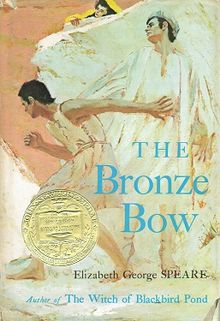
Bronze bowThe Bronze Bow by Elizabeth George Speare takes place during the time Christ lived in Israel. Daniel bar Jamin is a young Jewish man fueled by one passion: vengeance against the hated Romans. They had crucified his father and uncle when Daniel was eight, his mother died of grief, and his sister, who saw the bodies on the crosses when she was three, was so traumatized that she became excessively fearful and has never left the house since. Daniel’s grandmother took the children in, but she was so poor that she had to sell Daniel to a blacksmith as an apprentice. Daniel’s master was so cruel that Daniel escaped to the hills, where he was taken in by a band of outlaw freedom fighters.


One day Daniel, now a young man, spies another young man and his sister exploring the hills and realizes he uses to know the other young man, Joel. Though it’s not wise or safe, Daniel feels compelled to speak to them. They get reacquainted and wonder whether the freedom fighter’s leader, Rosh, could possibly be the deliverer, the Messiah they wait for. Joel wants to join Rosh’s band, so Rosh tells him to go back to town and wait, and he’ll send him word when it’s time.

Eventually Daniel’s friend, Simon the Zealot, sends word to Daniel that his grandmother is dying. As his sister, Leah’s, only living relative, Daniel feels compelled to go back and care for her, though Rosh calls him “soft.” Simon offers Daniel his blacksmith’s shop since Simon is following Jesus and not using it. Daniel finds that most people in the village, though they don’t like Roman rule, aren’t willing to fight against it. Though homesick for the free air and space of the hills, Daniel recruits Joel and other boys to a band to train to help Rosh when the time comes.

As Daniel hears of Jesus from Simon and Joel, goes to listen to his teaching, and witnesses healings, he can’t help but wonder about him and ponder his words. He wishes Jesus would team up with Rosh. But eventually he realizes Jesus’s deliverance is not so much from Roman oppression, his message is not about revenge, hatred, and war: in fact, he tells people to love their enemies. That Daniel cannot acquiesce to, so he goes his own way, which eventually leads to disaster and despair. Will Daniels’s hate destroy everything dear to him, or will his hitting rock bottom finally allow him to look up?

“Daniel,” he said. “I would have you follow me.”

“Master!….I will fight for you to the end!.”

“My loyal friend,” he said, “I would ask something much harder than that. Would you love for me to the end?”
___

It is the hate that is the enemy. Not men. Hate does not die with killing. It only springs up a hundredfold. The only thing stronger than hate is love.

My thoughts:

I came across this book while searching for an award-winning classic for the Back to the Classics challenge, and this won the Newberry medal. I was resistant to reading it, both because I figured it would be predictable and I am wary of fictionalized Bible-related stories. I chose another classic but had to lay it aside due to bad language and couldn’t find anything else, so I came back to The Bronze Bow. And I was pleasantly surprised! Though one event happened like I thought it might, the rest of the story didn’t pan out like I thought it would at all, and I was drawn in to Daniel’s story and angst. I listened to the audiobook nicely narrated by Peter Bradbury, but also checked out the hard copy from the library to go over certain passages more in depth.

I wouldn’t take my theology from this book. There are conversations and incidents involving Jesus that may not represent Him or His message entirely accurately, and the redemption described seems more about overcoming hate than personal salvation from sin (though of course overcoming hate with love is certainly a part of salvation).  But it does give an excellent feel to the times, especially to what being under a Jew under Roman occupation was like, and shows the cultural customs naturally without being didactic. The characters were well-drawn and the story drew me right in.

One thing that stood out was the sense of anticipation of waiting for the Messiah, the Deliverer, even though some people missed the point of what He was coming to deliver them from. It was interesting reading this during the Christmas season, when we commemorate the anticipation of His coming the first time, and renews in me that sense of anticipation of His coming again.

(Sharing with Literary Musing Monday and Carole’s Books You Loved)

Laudable Linkage


IMG_0195

Here’s my latest round-up of thought-provoking, noteworthy reads discovered in the last few weeks.

Bibles are not talismans. It’s all about the words.

The Importance of Margins.

What Would Jesus Do About Transgender? HT to Challies.

13 Things a Pastor Should Never Say to a Congregation, HT to Challies. Yes.

7 Hard Truths About Retirement, HT to Challies.

Ban the bike! How cities made a huge mistake in promoting cycling, HT to Challies.

If you like writing about imagination, children’s literature, and families, you might be interested in writing for Story Warren: they’re looking for new contributors.

Finally, I was looking for this yesterday in talking about my young grandson’s imagination. I couldn’t find it then but found it later in the afternoon.

Happy Saturday!

Friday’s Fave Five

christmas FFFIt’s Friday, time to look back over the blessings of the week with Susanne at Living to Tell the Story and other friends.

We’re really feeling the winter cold this week, but thankfully no snow yet! Here are some highlights from the last week:

1. A new Christmas tree. I saw a mini white Christmas tree with pink and blue ornaments at a store and just loved it. Unfortunately that store didn’t have any more of that tree or ornaments, but after looking around I found what I wanted. I decided to put it in my bedroom – I have never had anything Christmasy in my bedroom, and I have gotten a ridiculous amount of pleasure from this. Ironically, I have been asking myself if there are ways we should simplify or cut back on our decorating, and here I go adding more. 🙂 One tip for others with mini trees: I have some in other rooms, too, and I store them individually in a container with the decorations still on. When we get them out again, all I have to do is fluff them up a little and put back on a few ornaments that might have fallen off rather than decorating the whole thing again. So that helps.

IMG_0524

2. Alexa. I wasn’t a big fan at first, but my husband enjoys having it, and he doesn’t buy any gadget without searching for deals on it. But what I especially love is that he programmed it to turn the Christmas lights on and off on our tree and outside just by speaking to it. 🙂 The one switch for the tree was in a hard-to-reach place, and the one for the outside lights is outside, and I always hated having to go out in the cold and dark night to turn them off. So having those switches programmed in is nice!

3. Surprise help with the dishes. I usually clean up the kitchen after dinner while my husband feeds his mom. One night I had gotten the dishwasher loaded but still had to hand wash the pots and pans and the blending equipment to puree his mom’s food. I had to step away for a bit, and when I came back, he had returned from feeding his mom and cleaned up her dishes plus everything else I hadn’t finished. A nice surprise! And I think I’ve mentioned before that he always does the Sunday morning breakfast dishes. I just don’t have time to tend to them – unless I want to get up even earlier – and it’s so nice not to have them still sitting in the sink when we get home.

4. Being almost finished with Christmas shopping and wrapping.

5. Timothy’s imagination. He was playing a fishing game with his dad on the couch, and the carpet was transformed into “freezing cold” water which he occasionally jumped into and even swam in. He had us all laughing without trying in the least to be funny.

Happy Friday!

Book Review: What Is a Healthy Church?

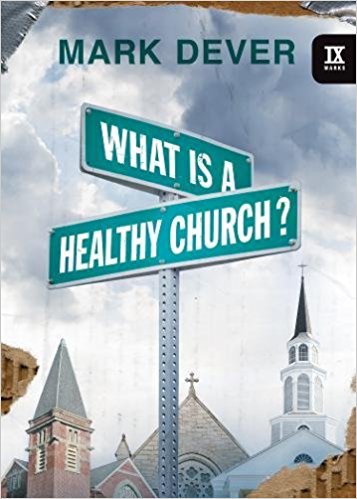
Healthy ChurchMark Dever opens What Is a Healthy Church? by pointing out that much of what we look for in a church is determined by our own particular culture: the type of music, pastor, preaching, etc., that we’re used to. He encourages readers to consider Biblical marks of a healthy church. Why does he address a book like this to Christians in general rather than church leaders? Because, he points out, most of the NT epistles, which contain much instruction about church as well as personal life, were written to congregations, not just pastors.

Then he explains briefly what a Christian is, what the church is and isn’t, what the church is for, and why Christians need a church. Ultimately the church “is called to display the character and glory of God to all the universe, testifying in word and action to his great wisdom and work of salvation” (p. 48).

The church finds its life as it listens to the Word of God. It finds its purpose as it lives out and displays the Word of God. The church’s job is to listen and then to echo…The primary challenge churches face today is not figuring out how to be “relevant” or “strategic” or “sensitive” or even “deliberate.” It’s figuring out how to be faithful–how to listen, to trust and obey (pp. 55-56).

He then discusses one by one what he considers nine marks of a healthy church, dividing them into three essential marks (expositional preaching, Biblical theology, Biblical understanding of the Good News) and six important ones (Biblical understanding of conversion, evangelism, membership, church discipline, discipleship and growth, and church leadership).

You and I cannot demonstrate love or joy or peace or patience or kindness sitting all by ourselves on an island. No, we demonstrate it when the people we have committed to loving give us good reasons not to love them, but we do anyway (p. 29).

If a healthy church is a congregation that increasingly displays the character of God as his character has been revealed in his Word, the most obvious place to begin building a healthy church is to call Christians to listen to God’s Word. God’s Word is the source of all life and health. It’s what feeds, develops, and preserves a church’s understanding of the gospel itself (p. 63).

Martin Luther found that carefully attending to God’s Word began a Reformation. We, too, must commit to seeing that our churches are always being reformed by the Word of God (p. 67).

Sometimes, it’s tempting to present some of the very real benefits of the gospel as the gospel itself. And these benefits tend to be things that non-Christians naturally want, like joy, peace, happiness, fulfillment, self-esteem, or love. Yet presenting them as the gospel is presenting a partial truth. And, as J. I. Packer says, “A half truth masquerading as the whole truth becomes a complete untruth.”

Fundamentally, we don’t need just joy or peace or purpose. We need God, himself. Since we are condemned sinners, then, we need his forgiveness above all else. We need spiritual life. When we present the gospel less radically, we simply ask for false conversions and increasingly meaningless church membership lists, both of which make the evangelization of the world around us more difficult (p. 77).

My thoughts:

I don’t think I have ever read anything by Dever before and was only vaguely aware of his organization, 9Marks. This book seems to be a compact version of what he has written more extensively elsewhere. We received it in a gift bag from a church we visited. Generally I agree with what’s here with a couple of exceptions, one relatively minor.

1) In the chapter on preaching he makes the statement “Has not every step of growth in grace occurred when we heard from God in ways we hadn’t heard from him before?” (p. 66). For me, significant growth in grace has occurred sometimes from being reminded of something I already knew from God’s Word that I needed to return to or refocus on.

2) I think he’s too dismissive of differences in preference of music styles in churches. He seems to consider it almost a non-issue.

Remembering that the church is a people should help us recognize what’s important and what’s not important. I know I need the help. For example, I have a temptation to let something like the style of music dictate how I feel about a church. After all, the style of music a church uses is one of the first things we will notice about any church, and we tend to respond to music at a very emotional level. Music makes us feel a certain way. Yet what does it say about my love for Christ and for Christ’s people if I decide to leave a church because of the style of its music? Or if, when pastoring a church, I marginalize a majority of my congregation because I think the style of music needs to be updated? At the very least, we could say that I’ve forgotten that the church, fundamentally, is a people and not a place (p. 35).

If it were just a matter of preferences, that would be true. What I think he might not understand is that some people consider certain types of music not just not preferable, but wrong. We’ve heard teaching for years about what’s wrong with certain types of music. On the other hand, the Bible doesn’t say anything about particular music styles, and I think some of that specific teaching went far beyond what the Bible has to say about music. But I don’t think that means “anything goes.” So we’re trying to sort out what’s coming from conscience or conditioning, but I don’t think we can ignore conscience or conditioning, either. Music makes up a significant part of a church service, so, while it’s not “the” main issue, or even part of the “nine marks,” it is still an issue.

Aside from those, I thought this was a good overview of what a healthy church should be. I also appreciated his encouragement to both pastor and people to be patient if a church isn’t “there” yet and his reminder that growth takes time. Once when we were getting ready to move to another state, our dear pastor at the time advised us to look not just at where a church is, but where it’s heading, and I think that dovetails nicely with the instruction in this book. No church will be perfect, but we should look for one with a good foundation and growth in these ways.

(Sharing with Semicolon‘s Saturday Review of Books, Literary Musing Monday)

Book Review: Sarah’s Song

Sarah's SongSarah’s Song is the third in Karen Kingsbury’s Red Glove series, but can easily be read without having read the first two.

In this story, Sarah Lindeman lives in a retirement home while fighting a losing battle with heart failure. Every Christmas she brings out twelve old yellowed envelopes with ornaments with a single word on each and places one on the tree each day. The words unfold the story of her return to the Lord and her love story with dear husband, Sam, a story involving sin, rebellion, grace, and restoration.

This Christmas, one of Sarah’s nurses, Beth, takes an interest in hearing the story unfold day by day. Sarah senses that Beth has deep needs that the details of her own story can minister to. But will Beth hear it? And will Sarah live long enough to tell it?

A couple of sentences made me wince a bit, like “All of life was a dance, the steps measured out to the music of the days” and especially gloves that “smelled of old love and days gone by.” And though the plot line is somewhat predictable, it’s a sweet, touching story and I enjoyed it.

(Sharing with Semicolon‘s Saturday Review of Books, Literary Musing Monday, and Carole’s Books You Loved)

Christmas Book Giveaway

I have a few gently-used Christmas books I read last year that I’d like to give away to anyone who wants them. I’ll list them and link back to my reviews of them. If you’re interested in any, let me know in the comments. If you’re interested in more than one, let me know which you’d like first, second, and so on. If no one else wants the book you named – it’s yours! If multiple people want one book, I’ll use random.org to draw someone’s name. I’ll draw names a week from today, Tuesday, Dec. 12. That should get them to you with plenty of time left in the month for some cozy Christmas reading. I’m afraid due to shipping costs I’ll have to restrict this to contiguous USA addresses only.

father-christmas

2. Where Treetops Glisten, three novellas set during the WWII era, by Tricia Goyer, Cara Putman, and Sarah Sundin.

Where-Treetops-Glisten

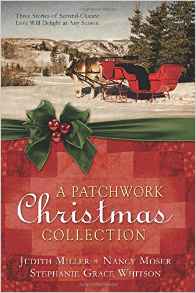
3. A Patchwork Christmas Collection by Judith Miller, Nancy Moser, and Stephanie Grace Whitson, three novellas from the Victorian era.

patchwork-christmas

There you go!
____________

Update: The giveaway is closed. the winners are:

Father Christmas: Kathie
Treetops Glisten: Dianna
Patchwork Christmas: Brenda

Congratulations! I’ll be emailing you in just a moment to get your addresses.

My Sin Is Not Someone Else’s Fault

When I have to confess something to the Lord or apologize to someone else, I tend to want to explain the reasons I did what I did, as if that somehow justifies my wrong response.

The very first people committing the very first sin did the same thing.

One day I was totally arrested by this thought:

My sin is not someone else’s fault.

Wait – aren’t they responsible for what they did? Don’t other people sometimes deliberately try to get us to sin?

Sure. And they’re answerable for their own actions.

But what does God tell His children?

No temptation has overtaken you that is not common to man. God is faithful, and he will not let you be tempted beyond your ability, but with the temptation he will also provide the way of escape, that you may be able to endure it. (1 Corinthians 10:13, ESV)

When we give account of ourselves to God, we won’t be able to point the finger at anyone else.

I used to take refuge in the King James version of 1 Corinthians 13:5, especially in that word easily in the phrase “love…is not easily provoked.” And then a trusted pastor told us that the word “easily” isn’t in the original text. If you look up the Strong’s numbers for this verse, which link to the Greek or Hebrew words and their translations – there is no link for “easily.” Many other translations leave it out.

So I can’t use that as an excuse: “I tried to resist, you know, and did for a while, but really, it was just too much. Anyone would have reacted that way at that point.”

No, God has promised “a way of escape” in each temptation. Too often I am looking for a reason to give in rather than a way to get out of temptation.

We all fall and fail every day. What are we to do?

1. Accept responsibility. Acknowledge what we did wrong and own up to it. (And if I can interject this here, we also need to teach our children to do this. Yes, we understand that they act out when they’re tired, hungry, etc., and we attend to those issues first. But when they do something deliberately wrong, we need to avoid making excuses for them and teach them to own up to what they did.)

2. Confess it to the Lord.

If we confess our sins, he is faithful and just to forgive us our sins and to cleanse us from all unrighteousness. 1 John 1:9

Whoever conceals his transgressions will not prosper, but he who confesses and forsakes them will obtain mercy.  Proverbs 28:13, ESV

I’ve been told that to “confess” means “to say the same thing as.” In other words, call it what the Bible says it is. I didn’t tell a little fib: I lied. I wasn’t just a little out of sorts: I was selfish and irritable and unkind.

3. Rest in His promise of forgiveness.

4. Confess it to anyone else involved. A trusted former pastor once said that the circle of confession needs to be as wide as the circle of the sin. If I spoke harshly to someone in private, I need to go back to that person, apologize, and ask their forgiveness. If someone embezzles funds, well, that’s a much wider circle.

5. Make restitution if necessary. If something was stolen or property was destroyed or damaged, we’re responsible to to return, replace, or pay for it. If someone’s reputation was damaged, we do what we can to acknowledge our own blame and clear the other person.

6. Mortify (kill) the sin. I admit this is a concept I struggle with, because if you “kill” something, then you don’t expect to have trouble with it the very next day – or hour. But Romans 8:13 says, “For if you live according to the flesh you will die, but if by the Spirit you put to death the deeds of the body, you will live.” (ESV; the KJV uses the word “mortify”). A helpful explanation is here, but an idea that helps me don’t give it life support. Do all you can to undermine it, to weaken it, rather than to give it any impetus. “But put on the Lord Jesus Christ, and make no provision for the flesh, to gratify its desires” (Romans 13;14, ESV).

7. Seek victory. Pray and seek God’s Word for His help in overcoming sin. Perhaps memorize applicable Scriptures or copy them and put them on a card in a prominent place as a reminder.

8. Plan ahead when possible. The young man in Proverbs 7 who got taken in by  the wrong kind of woman was where he should not have been in in the first place (v. 7-9). We might need to avoid certain places. If we’re going into a situation where there might be trouble, we can make a plan of action: for instance, if I have a tendency for gluttony and a lack or control around food, before the company Christmas party I can plan exactly how much I’ll allow myself, perhaps eat a little beforehand so I am not hungry, seek to talk to people instead of prowling around the refreshments.

9. Look for the way of escape that God’s Word promises. So often when we’re thinking about doing something that, deep down, we know we shouldn’t, a “still, small voice” will be trying to talk sense to us and talk us out of it all the time we’re trying to justify it. We need to ask the Lord to help us, but we also need to take action and flee.

10. Yield to God. Give Him “the right of way.”

Neither yield ye your members as instruments of unrighteousness unto sin: but yield yourselves unto God, as those that are alive from the dead, and your members as instruments of righteousness unto God (Romans 6:13).

11. Follow the right way. The same verse that talks about “fleeing youthful lusts” goes on to tell us to “pursue righteousness, faith, love, and peace” (2 Timothy 2:22). We need to concentrate as much or more on doing as on don’ting. Erwin Lutzer said in How to Say No to a Stubborn Habit that if someone tells you not to think of the number 8, all of a sudden that’s all you can think about. The best way to deal with a wrong thought is to replace it with another thought. We tend to follow what we focus on.

12. Behold Him.

But we all, with open face beholding as in a glass the glory of the Lord, are changed into the same image from glory to glory, even as by the Spirit of the Lord. II Corinthians 3:18

For we do not have a high priest who is unable to sympathize with our weaknesses, but one who in every respect has been tempted as we are, yet without sin. Hebrews 4:15

Our sanctification as well as our salvation rests on the finished work of Christ. We don’t become any more or less saved or more or less loved when we sin. But sin keeps our relationship from the full fellowship we would otherwise enjoy, hinders our testimony, dishonors the Lord, and so many other things. God expects for His children to grow in Him. So when we do sin, we need to confess it and rest in the love of a Father who is more than ready to forgive.

The Lord is merciful and gracious, slow to anger and abounding in steadfast love. Psalm 103:8

*I’ve been addressing people who are already born again and have become children of God. Forgiveness of sin and grace to overcome it is only possible when we have that relationship with God. If you’ve never believed on Christ as savior, please read more here.

(Sharing with Inspire Me Monday, Glimpses, Literary Musing Monday, Tell His Story, Woman to Woman Word-filled Wednesday, Coffee for Your Heart, Porch Stories, Faith on Fire)