
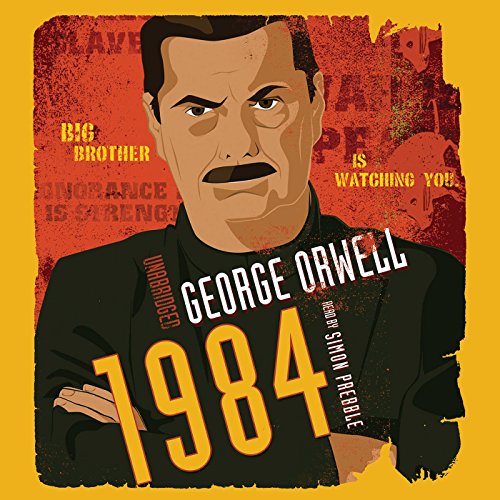
George Orwell’s 1984 depicts a futuristic totalitarian state. An oligarchy known as “the Party,” headed by an unseen Big Brother, rules Oceania, one of three superpowers. Telescreens broadcast only what the Party allows, but they also observe people at work and home. Thought Police come for anyone whose words, actions, or even expressions step outside of party policy. Those who do not comply become nonpersons and are “vaporized”: all trace of them disappears and they are never referred to again.
Winston Smith is a member of the party, but he hates it. He remembers fragments of what life was like before the revolution, when the Party took over. He also works for the Ministry of Truth, which, ironically, rewrites and “corrects” news to line up with current Party position. He wonders that no one else seems to see the absurdity in the contradictory reports coming from the party. But he doesn’t dare try to talk to anyone about it.
In an atmosphere like this, everyone is suspect. When one woman seems to have her eye on Winston, he fears she is looking for some reason to report him. But, to his surprise, she gets a secret message to him that she loves him. Through much subterfuge, they arrange to meet, and then embark on an illicit relationship.
Sadly, however, another relationship turns out to be false.
1984 is based on the totalitarianism of Stalinist Russia but also warns against the dangers of totalitarianism in any context. Wikipedia points out many of the corresponding details.
The novel brought many new terms into the mainstream: Big Brother and the phrase “Big Brother is Watching You,” Thought Police, Doublespeak.
I thought I had read this back in high school. Maybe I did. But some of the frank sexual content makes me surprised that the book would have been required reading by teenagers, especially that many years ago. Yet the sexuality is not titillating. It’s not exactly clinical, either. It’s there to show that the Party control reached even into bedrooms: sexual relations were illegal even between married people except for purposes of bringing forth children as their duty to the Party. The novel reveals later the purpose for suppression of sexual desire was to channel all passion to the Party.
What drew me to 1984 at this time was coming across a quote from the book: “Who controls the past controls the future. Who controls the present controls the past.” That struck a chord with me because we see traces of it even now in revisionist history and “fake news.”
1984 has one of the most interesting opening lines: “It was a bright cold day in April, and the clocks were striking thirteen.” A few other quotes:
If you want a picture of the future, imagine a boot stamping on a human face—for ever.
Being in a minority, even in a minority of one, did not make you mad. There was truth and there was untruth, and if you clung to the truth even against the whole world, you were not mad.
For, after all, how do we know that two and two make four? Or that the force of gravity works? Or that the past is unchangeable? If both the past and the external world exist only in the mind, and if the mind itself is controllable – what then?
Nothing was your own except the few cubic centimetres inside your skull.
Every record has been destroyed or falsified, every book rewritten, every picture has been repainted, every statue and street building has been renamed, every date has been altered. And the process is continuing day by day and minute by minute. History has stopped. Nothing exists except an endless present in which the Party is always right.
One does not establish a dictatorship in order to safeguard a revolution; one makes the revolution in order to establish the dictatorship.
We know that no one ever seizes power with the intention of relinquishing it.
In the past the Middle had made revolutions under the banner of equality, and
then had established a fresh tyranny as soon as the old one was overthrown.
Don’t you see that the whole aim of Newspeak is to narrow the range of thought? In the end we shall make thoughtcrime literally impossible, because there will be no words in which to express it.
The heresy of heresies was common sense.
If you can feel that staying human is worth while, even when it can’t have any result whatever, you’ve beaten them.
1984 is not a pleasant read. It’s depressing in places. It’s deeply disturbing, but in a way that provokes thought. Hopefully it’s a warning to every generation who reads it.
I listened to the audiobook nicely read by Simon Prebble.This book will fulfill the genre classic requirement for the Back to the Classics Reading Challenge.





 Stray Thoughts