A Very Bookish Christmas is a collection of Christmas novellas which each have a tie-in to a classic book.
Gingerbread Treasures by Rebekah Jones is based on The Sign of Four, a Sherlock Holmes story by Arthur Conan Doyle. Emily Willis contacts her uncle’s friend to investigate a weird situation. Every December 12 of the last few years, she has received a gingerbread man with a key and instructions not to eat the cookie. On the fifth year, someone stole all four cookies plus her dog. Then she received an email “from a friend” requesting a meeting and saying she could bring two friends, but no police.
Molly and Anna by Sarah Holman is based on Pollyanna by Eleanor H. Porter. Molly and Anna Garcia’s parents have both died, and they are being flown from their small mission to their aunt’s house. Molly tries to play the “glad game” like her favorite book heroine, Pollyanna. But it’s hard, especially when her aunt doesn’t want her to talk about her father or speak in Spanish, as she’s used to.
Sylvie of Amber Apartments by J. Grace Pennington is based on Anne of Green Gables by L. M. Montgomery. Sylvie is so into Anne of Green Gables that she includes on her Christmas list a dress with puffed sleeves like Anne craved. Sylvie’s imagination is more active than her mom thinks is practical. But when she slights her longtime friend for a new girl that reminds her of Diana in the book, perhaps her book world has intruded too much on real life.
Sincerely, Jem by Kate Willis is based on Daddy Long-Legs by Jean Webster. Jessie is an introverted book-lover who feels uncomfortable at parties. She brings along her inspiration book to write down observations, character sketches, etc. When a friend suggests a pen pal, Jessie likes the idea. She uses the pen name Jem and enjoys getting to know her correspondent without having to make awkward small talk. And she learns that part of friendship is extending herself.
I’m quite familiar with Anne, but it had been a long time since I had read the Holmes books, and I had never read the other two (though I’d seen the movie version of Pollyanna ages ago). Perhaps because I wasn’t as familiar with these classics, I didn’t enjoy this book quite as much as I did the Thanksgiving version. Plus the first story seemed to contain a lot of unnecessary repetition.The Thanksgiving book was also the second written, so I think perhaps the writers had garnered a bit more experience.
That’s not to say I didn’t enjoy the book—I did, very much, especially the last three stories. I don’t know if the authors have any more collaborations up their sleeves (A Very Bookish Valentine’s Day, perhaps? Lots of possibilities there!). But if they do, I’m sure I’ll read them.
Though we love Christmas time, its busyness stresses us out. Calendars are full anyway, and then we add gatherings, programs, extra shopping and food preparation, wrapping, decorating, and various traditions.
Alexandra Kuykendall tried an “experiment in relishing the season,” as her subtitle says. Instead of an idealistic or nostalgic or “perfect” Christmas, she wanted to create a realistic Christmas that didn’t leave her exhausted and frustrated when it was over. She lets us in on the experiment in her book, Loving My Actual Christmas. Though she includes ideas and tips, “it’s more for your spirit to absorb the message of the holiday among the lights and gifts.”
She chose the four weeks and themes of advent to guide her. She wanted not just to “do better” organizationally, but to implement, foster, and be guided by hope, love, joy and peace.
Because hope, peace, joy, and love are certainly words I want to associate with this time of year. Rather than overspending, overeating, undersleeping, and underrejoicing, I want to notice the goodness God has offered in the here and now. In this year. This Christmas. Regardless of the circumstances. Because I don’t want to resent this actual Christmas, I want to love it.
For each week of Advent, she wrote down her approach, the Scriptures she read, a daily recording of what happened that week, a summary of what she learned, a list of what practices she’ll continue, and questions for reflection.
One of the first things she did was consult with her family about their desires. Expectation can make the holiday sweet and exciting but also set oneself up for a letdown. So they discussed the different programs, traditions, etc., to see what was most important to everyone and what, if anything, could be left out for sanity’s sake.
Here are some of the quotes I highlighted:
Circumstances may not be what we want, but we can step over the “whens” and “if onlys” to notice God’s gifts right in our midst.
“And heaven and nature sing.” Because he rules the world, all of his creation rejoices. That’s it. It doesn’t say heaven and nature sing when the Christmas card is beautiful and perfectly photoshopped, but because he rules the world. That’s it then. Joy does really come back to Jesus.
My people don’t need the perfect Christmas, but a present mother, daughter, wife, friend.
Christmas isn’t a race that ends on the 25th with recovery after, but a true season of relishing.
Jesus didn’t come to earth in order that we might overspend every December and have terrible arguments about the holiday bills. He came that we might have life. Let’s figure out what we can afford and live within those parameters.
You don’t want to end the party season depleted by executing the details, but energized by the relationships that are strengthened by a shared time together.
There are no awards shows for Christmas party throwing. No prizes for “Best Able to Pull It Off Alone.” Ask guests to bring food or help with decorations, invitations, setting up, or cleaning up.
There was one place that made me wince a bit. In discussing the circumstances of the first Christmas and Mary’s quiet pondering mentioned in Luke 2:19, the author writes, “Here Mary has just given birth to God . . .” I know what she meant. Jesus was (is) God in flesh. He didn’t originate in this birth: He existed eternally. And He is part of the Godhead, along with the Father and Spirit. The author would agree with all this, so she’s not saying God had His beginning here. She’s just pointing out the wonder of a young woman giving birth to the Messiah in such a setting. But the way it was phrased was a little uncomfortable to me.
Most of us have to do some mental adjusting about the holidays by the time we’ve had many Christmases as adults. We have to continually reminds ourselves what the season is actually supposed to be about and adjust our perspective. I found the author’s thoughts and tips very practical and helpful.
Christmas lights are my favorite holiday decorations. Just when the landscape becomes bare and dreary and the nights are longest, cheery lights go up inside and outside. I miss them when we take them down at the end of the month.
I don’t know if I did a good job teaching my children the symbolism behind many of our Christmas customs. But the symbolism behind Christmas lights is a favorite.
God began creation by saying “Let there be light”. But He soon saw His world engulfed in darkness when sin came in. Nevertheless, He promised light would shine again.
“I am the LORD; I have called you in righteousness; I will take you by the hand and keep you; I will give you as a covenant for the people, a light for the nations, to open the eyes that are blind, to bring out the prisoners from the dungeon, from the prison those who sit in darkness (Isaiah 42:6-7).
“But for you who fear my name, the sun of righteousness shall rise with healing in its wings. You shall go out leaping like calves from the stall” (Malachi 4:2).
The Isaiah passage that foretells of the child born, the son given who will take David’s throne, rule in righteousness, whose “name shall be called Wonderful Counselor, Mighty God, Everlasting Father, Prince of Peace” begins with “The people who walked in darkness have seen a great light; those who dwelt in a land of deep darkness, on them has light shone” (Isaiah 9:2).
Scripture points repeatedly to Jesus as the light.
Jesus said, “ “I am the light of the world. Whoever follows me will not walk in darkness, but will have the light of life.” (John 8:12).
In him was life, and the life was the light of men. The light shines in the darkness, and the darkness has not overcome it (John 1:4-5).
When we believe on the Lord, His light shines through us:
At one time you were darkness, but now you are light in the Lord. Walk as children of light (for the fruit of light is found in all that is good and right and true), and try to discern what is pleasing to the Lord. Take no part in the unfruitful works of darkness, but instead expose them. For it is shameful even to speak of the things that they do in secret. But when anything is exposed by the light, it becomes visible, for anything that becomes visible is light (Ephesians 5:8-14a).
The NKJV renders that last phrase “But all things that are exposed are made manifest by the light, for whatever makes manifest is light.”
This is the message we have heard from him and proclaim to you, that God is light, and in him is no darkness at all.If we say we have fellowship with him while we walk in darkness, we lie and do not practice the truth.But if we walk in the light, as he is in the light, we have fellowship with one another, and the blood of Jesus his Son cleanses us from all sin (1 John 1: 5-7).
Someday, for God’s children, “night will be no more. They will need no light of lamp or sun, for the Lord God will be their light, and they will reign forever and ever” (Revelation 22:5). How desperately we need to choose light now, because those who don’t will be “thrown into the outer darkness. In that place there will be weeping and gnashing of teeth” (Matthew 8:12).
For now, though we have the light, we live in a dark world.
Who among you fears the Lord and obeys the voice of his servant? Let him who walks in darknessand has no light trust in the name of the Lord and rely on his God (Isaiah 50:10).
Thank you so much for your kind comments yesterday and your prayers while I was in the hospital. I’m back at home now and feeling well. I have follow-up appointments with my primary care doctor and cardiologist soon.
I’m probably going to have to have a second ablation. I can’t tell you how much I hate the thought of going through that again. But I also hate having afib and going to the ER. We’ve known people that were much improved after the second one. So, we’ll see what the doctors say.
Meanwhile, I’m going to mainly relax the rest of the weekend.
Hi folks. I’m in the hospital again with atrial fibrillation. I’d appreciate your prayers that my heart would covert to the right rhythm and for wisdom in how to proceed afterward. I don’t have a Friday’s Fave Five post together at this point – maybe later. Thank you!
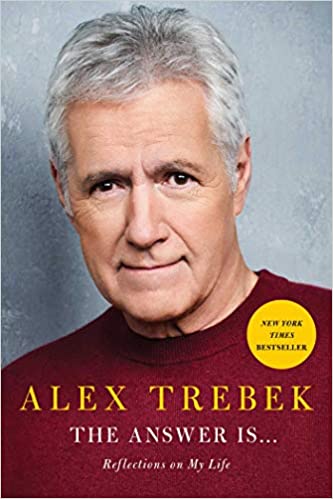
Even if you’ve never watched the game show Jeopardy!, you are likely familiar with the program and its host, Alex Trebek. He had never planned to write about his life, though he had been urged to several times. But after his pancreatic cancer diagnosis, he received such an outpouring of love and support, he thought perhaps he should share with his supporters “a little more about the person they have been cheering on”. He also said in one interview that he noticed chemo patients didn’t have much to do while receiving treatment, so he thought he’d provide “a little light reading.” And he also thought that someone would probably write about him at some point, so he wanted to have his say first . (As it happened, the biography Who Is Alex Trebek? by Lisa Rogak was released the same day as Alex’s autobiography. Because of that, I suspect her book might not have been authorized.)
The title of Alex’s book is the phrase he spoke when revealing clues on Jeopardy!: The Answer Is… (by the way, I didn’t realize the exclamation mark was part of the show’s name until reading this book). The chapter titles are formatted like the questions and answers from the show: “The answer is . . .Neckties” or “Who is . . .The Great Gildersleeve?”
Alex’s subtitle, Reflections on My Life, aptly describes the book. Most of the chapters aren’t long and don’t go into great detail. He shares some memories from his family, growing-up years in Canada, his beginnings in show business, and various memories from his 36-year run as Jeopardy! host. He philosophizes a little about different topics..
I’ve watched the show occasionally for decades (I even remember the original Jeopardy! with Art Fleming), but my husband and I have watched regularly the last few years.So I enjoyed reading about the show, especially the chapters on Ken Jennings’ and James Holzhauer’s, historic runs as Jeopardy champions. I’m glad they included a picture of the “script sheet” Alex uses as he hosts (I had thought the clues and answers must come up on a computer screen at his podium, but they are printed out). I liked that photos are scattered throughout the book rather than just on a few glossy pages in the middle.
I enjoyed learning more about Alex personally as well. He insisted that he be called the host of the show rather than the star. He feels viewers see him “not so much as a showbiz personality but as an uncle” (p. 221). He has always come across as someone who doesn’t take himself very seriously.
I was surprised to find a lot of swear words in the book. Alex said he started cursing deliberately because he “needed a vice.” He felt held back from “becoming one of the guys” in his early career because “people can be suspicious of someone who’s so chaste.” Later he felt that cursing “didn’t help me become one of the guys. It just made me look like a jerk. My bad” (p. 93).
I’m always interested in people’s encounters with spiritual truth. Though Alex was raised Catholic, he says he believes “we are all part of the Great Soul—what some call God. We are God and God is us. We are one with our maker. How do I know this? It’s not that I know it. It’s that I feel it.” However, he says that, facing the end of his life, “I’ve been thinking more and more about that old line they used to use in the military: ‘No one’s an atheist in a foxhole.’ If ever there was an opportunity to believe in God—a god—this might be a good one. Trebek, now that you’re on the verge. What have you got to lose?” (p. 284). I hope he had an opportunity to hear, understand, and truly consider the gospel before his passing.
Except for the swearing, this was a nice overview and a bit of insight into the man so many of us knew and loved.
I enjoy participating in the the Back to the Classics challenge hosted by Karen at Books and Chocolate. I wasn’t exposed to many classics growing up, and I’ve determined to educate myself with several of them. The categories help me expand my reading horizons. The titles link back to my reviews. I included the publication dates to verify that the books are 50 years old, as required:
1. 19th Century Classic: Hard Times by Charles Dickens (1854) 2. 20th Century Classic: My Antonia by Willa Cather (1918) 3.Classic by a Woman Author: Eight Cousins by Louisa My Alcott (1875) 4. Classic in Translation (originally written in something other than your native language): Phantom of the Opera by Gaston Leroux (1910) 5. Classic by a Person of Color: Wynema: A Child of the Forest (1891) 6. A Genre Classic:1984 by George Orwell (1949) 7. Classic with a Person’s Name in the Title: The Merry Adventures of Robin Hood by Howard Pyle (1883) 8. Classic with a Place in the Title: Lark Rise (1939), Candleford Green (1943), and Over to Candleford (1941), the Lark Rise to Candleford trilogy by Flora Thompson 9. Classic with Nature in the Title: Rose in Bloom by Louisa May Alcott (1876) 10. Classic About a Family (multiple members of the same family as principal characters): Amberwell (1955) and Summerhills by D. E. Stevenson (1956) 11. Abandoned Classic (one you started but never finished). Billy Budd by Herman Melville (1924) 12: Classic Adaptation (Any classic that’s been adapted as a movie or TV series): Doctor Thorne by Anthony Trollope (1858)
Anthony Trollope, D. E. Stevenson, and Willa Cather were all new-to-me authors whose other works I look forward to exploring.
We’re allowed up to three children’s books: mine were Eight Cousins, Rose in Bloom, and Robin Hood.
Karen has a points system where the number of categories we complete gives us a corresponding number of entries in a prize drawing she holds. I don’t get extra points for reading more than one book in a couple of the categories—I did so just because I wanted to keep reading a series. Karen likes for us to calculate our number of entries. For completing all twelve categories, I get three entries.
If you are interested in participating next year, the rules, categories, and sign up post are here at the Back to the Classics 2021 post. Thanks to Karen for hosting! I enjoyed it very much.
Routines can help us establish good habits. Half the battle in establishing a regular quiet time or devotional time is staking out a workable, regular time and place. Some days—and some seasons of life—upend our schedules, and all we can do is watch for any available minutes. But we usually do better when we plan to work Bible reading into our day.
But a routine can become—routine. A rut, even.
How can we keep our Bible reading from becoming routine—or dig it out of the rut if it’s already there?
Pray. Ask God to remind us of the treasure His Word is. Sometimes I pray Psalm 119:18 just before starting my Bible reading: “Open my eyes, that I may behold wondrous things out of your law.” Or Psalm 119:25: “My soul clings to the dust; Revive me according to Your word” (NKJV).
Don’t expect high excitement every time. A Thanksgiving feast is wonderful and memorable. But the monthly tuna casserole and everyday peanut butter sandwiches nourish us as well. Some devotional times leave us overflowing with joy or conviction or inspiration. Most quiet times don’t end that way, yet the Word feeds us every time we partake of it.
Remember the purpose of time in the Word: not just to get through a certain number of chapters or a certain amount of time, but to meet with the Lord and get to know Him better.
Change your plan. If you usually read the Bible through in a year, maybe switch to a two-year plan or a five-year plan—or a 90-day plan. Or a biographical plan or a chronological plan. Bible Gateway lists 18 different plans. Near the end of the year you’ll see a number of posts and articles about ways to read the Bible in the New Year (though you don’t have to wait til then to start).
Change your style. We benefit from both reading and studying the Bible, but most of us are inclined one way or the other. If you usually read large chunks for an overview, perhaps study a particular book in more detail. If you like to camp out in one passage for days, maybe get the bigger picture by reading several chapters or a whole book at one sitting.
Add aids. I’ve only had a study Bible the last few years. The background information and notes help so much in comprehending more of the passage. One year I used Warren Wiersbe’s With the Word as a companion. This year I am using his “Be” commentaries.
Have a Bible reading project. Once I read through the gospels looking particularly for claims Jesus made about Himself. I put a “C” in the margin beside every verse of Jesus’ claims and then put them all together. Doing so provided a valuable resource plus woke me up from falling into familiar patterns from familiar passages. I’d love to read through the Bible noting every reference to God as Creator and what the passage shares about Him (His greatness, His power, etc.) I’d love to do the same thing with every passage where God promises to be with someone. Mardi Collier started reading the Psalms, jotting down every truth about God that she came across. As she came to a new truth, she’d write it across the top of a notebook page, and then list verses underneath as she found them. Some of the page titles focused on what kind of Person God is: My God is holy, My God is good, etc. Others shared God’s actions: My God hears me, My God is in control, and so on. Her study ended up covering the whole Bible and eventually became a book, What Do I Know About My God?
Ask different questions. When I first started reading the Bible on my own, I was instructed to look for a command to follow, a warning to heed, a promise to claim. I underlined them in different colors as I found them. Later I heard of asking the old journalism questions of a passage: who, what, when, where, why, and how. Those are great questions, but If you’ve asked them several times, chances are you already know the answers. Maybe ask, instead or along with those, what does this passage show me about God? Or, how does this person change over the course of his story? For example, the first few times I read Genesis, I missed the transition of Judah from Genesis 37-50. Now, reading in Exodus, I am noticing Moses’ change from arguing with God that he couldn’t fulfill His calling in Exodus 3 and 4 to becoming a great leader over the rest of the book. The changes in people in the Bible come about as God works in them and enables them through the circumstances He puts them in. That can inspire us that He is doing th same in our lives.
Try a different translation. I used the KJV for some 25 years. When I read the NASB and ESV, I saw passages with new eyes. I prefer to stay with the translations that are as close to word-for-word as possible rather than paraphrases. But sometimes I look up the paraphrases as commentaries.
Remove the references. Before we could cut and paste from the Internet, one of our former Sunday School teachers suggested that we type out some of the epistles as the actual letters they are without the verse numbers and headings. The chapter and verse numbers weren’t in the original text, but they do help us find and discuss passages. Sometimes, however, they are not well placed. One sentence can be broken up into several verses. So sometimes reading without the verse numbers can help us not to fragment the verse. Now you can buy Bibles printed without chapter and verse numbers.
Stop and think. Paul tells Timothy in 2 Timothy 2:7: “Think over what I say, for the Lord will give you understanding in everything.” It’s easy to sail through a familiar passage. In the narrative portions, we see how everything turned out just a few pages later. Remember the people in those situations—David hiding in caves from Saul, Joseph in prison, Daniel facing the lion’s den, etc.—didn’t know how everything would turn out. If we put ourselves in their situations the passage opens up to us more.
Make notes. I stopped journaling during my quiet time when I found I was spending more time writing than reading. But recently I’ve gone back to just writing a few notes both to reinforce what I just read or to remind myself later. My notes are usually just a short summary, but thinking about how I’d describe the passage helps me not gloss over it. Some people like to draw charts and diagrams and arrows and circles to engage the Scriptures more.
Don’t compartmentalize. Often we read for so many chapters or minutes and then pray, or vice versa. But we don’t have to separate prayer and reading. If we’re in a section of praise, we can stop and praise God. If a passage convicts us about something we’re doing wrong, we can stop and confess it to God right then.
How about you? What ways have you found to avoid or get out of a Bible reading rut?
Here are some great reads found this week, the first few Christmas-related.
Christmas Is for Dark Times, HT to Challies. “For many, 2020 has been a dark year – physically, emotionally, mentally, financially. People have lost their loved ones, their jobs, their security and their health. Does this mean Christmas should be cancelled? No. The real Christmas happens in the darkness.”
A Simple Strategy for Meditating in God’s Word, HT to Challies. “God speaks to you directly through His Word. He directs your heart as you read it and meditate on it. Here is a simple strategy that can help you to feed on God’s Word directly.”
The Biggest Threat Faced by the Church, HT to Challies. “What is the biggest threat faced by the church today? Many in the U.S. seem to think the answer is government tyranny. Tyranny is always a danger, but tyranny is not the biggest threat faced by the church in the U.S. or any other nation.”
All Moms Need to Do Is Remain, HT to the Story Warren. “But moms already have so much work to do, and our relationship with God is often put on the backburner. Well-meaning friends, family, and podcast hosts may tell you that it’s okay, busy moms just don’t have time to meet with God. People think they are letting you off the hook, but it makes remaining with God seem impossible (or at least improbable).”
Are Masks a Conscience Issue? HT to Challies. “I’m not qualified to offer a defining medical word on masks, but I want to offer some thoughts on the implications for Christians who refuse to wear a mask because they say it violates their conscience.”
And finally, a fun look at different kinds of Christmas shoppers, HT to Steve Laube:
On Fridays I like to pause for a few moments with Susanne and friends to reflect on some of the blessings of the week.
Well, most of us are officially in the Christmas season now. Here are some favorites from the first week in December
1. Christmas tree shopping and decorating. We got our tree Saturday. We still do it the old-fashioned way and buy a live one from a lot. Jason and Mittu and Timothy come along to help choose the tree and then decorate it at our house. Jesse got decorations from the attic. Mittu made soup and sandwich for lunch. It’s always fun to hear the kids exclaim over the ornaments as they put them on the tree. And I love how Timothy plunges right in. I love how everyone takes part, and we get it all done in a few hours.
It hadn’t seemed like it was time for Christmas yet. But once we got everything decorated and started playing Christmas music, the Christmas spirit definitely arrived.
2. Christmas music. I enjoy listening to Christian music in the kitchen and other times, but there is something special about Christmas music.
3. Productive days. I made a little shift in my order of doing things, and it has made a big difference.
4. Enough leftovers for meals. With just three of us home, I still pretty much cook like I always have, and we use the leftovers for lunches. Somehow we ended up with a stuffed refrigerator, not even counting Thanksgiving fare. I didn’t think we’d conquer it all at lunchtime, and I had enough of two main dishes to use for dinner two nights. It was nice having a couple of evenings of just warming up food and adding a new side.
Jim’s mom asked me once, years ago, if my family minded leftovers. I told her it depended on what was left over. Thankfully, everyone was ok with what we had, though we were glad to see some of it finished off.
5. Sweaters, heaters, throw blankets, and fingerless gloves have all helped keep me warm during the cold snap we’ve had this week. We even had our first snowfall—the kind I love: big fat fluffy flakes that don’t accumulate on the roads and only stay around for a day.







 Stray Thoughts