

One of my least favorite parts of winter is the barrenness of the landscape. Besides a few fir trees, nothing is growing and everything looks dead and gray.
The plants and trees aren’t dead, of course. They’re just dormant, suspending their usual growth process for their protection. Life is still inside the plants and their roots, ready to spring forth when conditions are ripe again.
I think our souls sometimes go through periods of dormancy, too. We all have ups and downs, times when we “feel” more fervent and spiritual than others. We know we don’t rely on feelings, but they can sure make things easier or harder.
Grief can look like dormancy. Just like a broken leg needs time to heal, a broken heart does as well. Much of a grieving person’s energy goes towards healing. They’re still very much alive, spiritually and otherwise. Some say that their deepest periods of growth have come during their most sorrowful times. But they may not look or act like their normal selves and may not appear to be as fruitful as they usually are.
King David’s life seems to me to display dormancy after his great sin with Bathsheba and his unthinkable plot to have her husband killed. The first part of his life had gone well as he followed God closely. He wasn’t perfect, but he was “a man after God’s own heart.”
But after these sins, David tried to cover his tracks for several months. Then God’s prophet confronted him, and David broke down. He confessed his sin and repented.
Yet even forgiven sin has consequences. David’s household was in turmoil for years afterward. One son raped his half-sister. Another son killed the first and tried to take over David’s kingdom.
And David said nothing to rebuke his sons. Did he feel he had no right in light of his failures? Did he feel the events in his family were part of his punishment? It would have been better to be honest with them about his sin, to warn them about the dangers of temptation and the necessity to nip it in the bud, to point out that he didn’t “get away with it,” as perhaps they hoped to do, but he was under God’s chastening hand.
In fact, David is pretty quiet from the time of his sin until his return to the kingdom after Absalom’s rebellion. But he doesn’t seem fully himself again until 1 Kings, as he helps Solomon get ready to build the temple.
In today’s cancel culture, David’s career would be over and his esteem among his people would have been lost.
But God wasn’t done with David. David’s spiritual life wasn’t dead: just read Psalm 51, written after his repentance. According to this site, Psalms 32, 86, and 122 were also written after this time.
John Newton captured this idea of reviving in spring in a couple of poems. One, written in April of 1776, begins “Pleasing spring is here again” and goes on to capture evidences of spring. The next few stanzas say:
What a change has taken place!
Emblem of the spring of grace;
How the soul, in winter, mourns
Till the Lord, the Sun, returns;
Till the Spirit’s gentle rain,
Bids the heart revive again;
Then the stone is turned to flesh,
And each grace springs forth afresh.
Lord, afford a spring to me!
Let me feel like what I see;
Ah! my winter has been long,
Chilled my hopes, and stopped my song!
Winter threatened to destroy
Faith and love, and every joy;
If thy life was in the root,
Still I could not yield thee fruit.
Speak, and by thy gracious voice
Make my drooping soul rejoice;
O beloved Saviour, haste,
Tell me all the storms are past:
On thy garden deign to smile,
Raise the plants, enrich the soil;
Soon thy presence will restore
Life to what seemed dead before.
In the last stanza, Newton longs for his eternal home where winter will be no more.
In “Waiting for Spring,” written a couple of years later in March of 1778, Newton revisits this idea. In the first three stanzas, he talks about the change of seasons as part of God’s decree. Then he writes:
Such changes are for us decreed;
Believers have their winters too;
But spring shall certainly succeed,
And all their former life renew.
Winter and spring have each their use,
And each, in turn, his people know;
One kills the weeds their hearts produce,
The other makes their graces grow.
Though like dead trees awhile they seem,
Yet having life within their root,
The welcome spring’s reviving beam
Draws forth their blossoms, leaves, and fruit.
Then he prays in the last stanza:
Dear Lord, afford our souls a spring,
Thou know’st our winter has been long;
Shine forth, and warm our hearts to sing,
And thy rich grace shall be our song.
It’s one thing when circumstances or sorrows cause us to draw in and heal, or God’s chastening weighs us down for a while. It’s another thing if we’re dormant because we’ve neglected God’s means of growth.
Like plants, we need light.
There are many who say, “Who will show us some good? Lift up the light of your face upon us, O LORD!” (Psalm 4:6)
The Lord bless you and keep you;
the Lord make his face to shine upon you and be gracious to you;
the Lord lift up his countenance upon you and give you peace (Numbers 6:24-26).
The unfolding of your words gives light; it imparts understanding to the simple. (Psalm 119:130).
Again Jesus spoke to them, saying, “I am the light of the world. Whoever follows me will not walk in darkness, but will have the light of life” (John 8:12).
We need water.
Christ loved the church and gave himself up for her, that he might sanctify her, having cleansed her by the washing of water with the word (Ephesians 5:25-26).
Jesus stood up and cried out, “If anyone thirsts, let him come to me and drink. (John 7:37).
And we need nourishment.
I have treasured the words of his mouth more than my portion of food (Job 23:12).
Your words were found, and I ate them, and your words became to me a joy and the delight of my heart, for I am called by your name, O LORD, God of hosts. (Jeremiah 15:16).
Jesus said to them, “I am the bread of life; whoever comes to me shall not hunger, and whoever believes in me shall never thirst.” (John 6:35).
Whether your soul is feeling sluggish and sleepy or in full bloom, or in-between, will you turn to His light and let it warm you? Will you take in His water and let it soak down deep in your soul? Will you partake of His nourishment to strengthen your roots and bring forth fruit in your life?
After two days he will revive us; on the third day he will raise us up, that we may live before him.
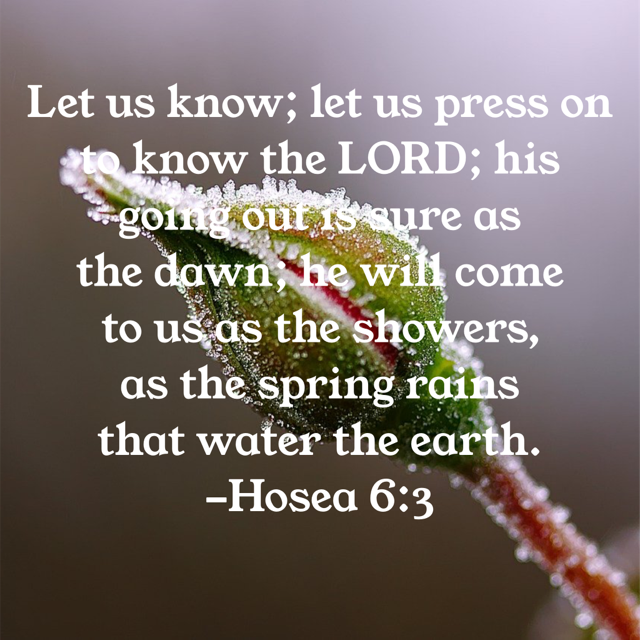
Let us know; let us press on to know the Lord; his going out is sure as the dawn; he will come to us as the showers, as the spring rains that water the earth (Hosea 6:2-3).
(I often link up with some of these bloggers.)



 Stray Thoughts