Review: Across the Ages

Across the Ages

Across the Ages is the fourth in Gabrielle Meyer’s novels about time crossers: people who live in more than one timeline until their twenty-first birthdays, at which time they can choose which of their timelines to stay in and which to forfeit.

In all the previous books, the time crosser had a parent to tell them what was going on and share the rules. In this book, Caroline’s mother left her as a baby with her grandfather in South Carolina in 1727 and then fled, never to be heard from since.

Caroline goes to sleep in South Caroline and wakes up in Minnesota in 1927, where she is the dutiful daughter of a famous pastor. The next night, she goes to sleep in MN and wakes up in SC on a plantation with her grandfather, without having lost a day in-between.

When Caroline tried to tell either family about her strange existence as a child, they scolded her for making up stories. Her grandmother from her 1727 life had been burned at the stake as a witch. All Caroline can figure is that she’s under a curse from that grandmother.

When her grandfather in 1727 plans to force her into an arranged marriage with a man she doesn’t love, she decides to try to find her mother to get some answers. Caroline dresses as a boy and finds work on a ship to Nassau, the last known location of her mother. Everything goes well—until her boat is captured by pirates.

In 1927, Caroline’s brothers don’t live up to her father’s standards. One is a crooked cop, the other a crooked businessman. She tries to keep her brothers’ activities secret so as not to harm her father’s reputation. But she admits that living under public scrutiny is wearing. Her own search for answers leads her to places her parents wouldn’t want her to go.

Gabrielle Meyer keeps finding ways for new takes on this unique concept. This is the first book where the main character isn’t related to the main characters in the previous books. But I realized further in that there was a connection in this book with some of the side characters from the third book, For a Lifetime.

I listened to the audiobook, nicely read by Rachel Botchan, who has narrated all the books in this series. Thankfully, the audiobook included the author’s historical notes.We meet Ernest Hemingway and Charles Lindbergh as characters in this book, and several others are based on real people. Caroline’s preacher father is based on Billy Sunday, which I had guessed due to his having been a professional baseball player. However, I had not known that Sunday’s sons did not share his faith and dabbled in the things he preached against, like Caroline’s brothers did.

Some readers would want to know that there is mention of adultery and brothels with the corrupt brothers, but nothing explicit is shown.

Part of the history also included in this novel was the O’Connor agreement in St. Paul, MN, whereby criminals could stay in the city without being bothered as long as they checked in with the police, paid bribes, and did not commit crimes while there.

But besides the fascinating historical detail, I enjoyed Caroline’s personal journey, though it was painful for her in parts. She struggles to discern what true belief in God is, rather than just performing outwardly to her parents’ expectations. And she finds that she is not cursed, but blessed.

Although this book could be read alone, I’d recommend the whole series.

Is God Only Your Emergency Contact?

Is God Only Your Emergency Contact?

I’ve sometimes heard people say, “If God will only answer this one prayer, I promise I’ll never bother Him again.”

That statement strikes me as sad, because it reveals such a misunderstanding of the nature of God.

God wants us to “bother” Him. He’s delighted to answer the prayers of His children (though He may not answer them in quite the way they had in mind because He knows what is best for them).

God doesn’t want to be only our heavenly 911 operator who will fine us if we call without an emergency. He wants to walk in fellowship with us every moment.

God is also our:

Father. “See what great love the Father has lavished on us, that we should be called children of God!” (1 John 3:1). When we believe on the Lord Jesus Christ as our Savior, we become God’s children. Fathers instruct, guide, and discipline their children, but they also love to listen to them.

Savior. “And there is no other god besides me, a righteous God and a Savior; there is none besides me. Turn to me and be saved, all the ends of the earth! For I am God, and there is no other” (Isaiah 45:21b-22). He doesn’t want to just get us out of the occasional bind. He wants to take care of the biggest problem we have–a rebellious sin nature that wants to do our will instead of His–and transform us into His likeness.

Righteousness. “In his days Judah will be saved, and Israel will dwell securely. And this is the name by which he will be called: ‘The LORD is our righteousness” (Jeremiah 23:6). “He shall say, ‘Surely in the LORD I have righteousness and strength'” (Isaiah 45:24, NKJV). We’re not righteous on our own. We need “the righteousness of God through faith in Jesus Christ for all who believe” (Romans 3:22).

King. “God my King is from of old, working salvation in the midst of the earth” Psalm 74:12). He is the king of all other kings, the ultimate good and just authority.

Shepherd. “The Lord is my shepherd; I shall not want. He makes me lie down in green pastures. He leads me beside still waters. He restores my soul. He leads me in paths of righteousness for his name’s sake” (Psalm 23:1-3). He leads, feeds, guides, and protects us.

Strength. “The Lord is my strength and my shield; in him my heart trusts, and I am helped; my heart exults, and with my song I give thanks to him. The Lord is the strength of his people; he is the saving refuge of his anointed” (Psalm 28:7-8). We’re weak and powerless on our own, but He upholds us with His strength.

Refuge. “The Lord is my rock and my fortress and my deliverer, my God, my rock, in whom I take refuge, my shield, and the horn of my salvation, my stronghold” (Psalm 18:2). He is firm, dependable, sheltering.

Help. “God is our refuge and strength, always ready to help in times of trouble” (Psalm 46:1). And not only in times of trouble: “Behold, God is my helper; the Lord is the upholder of my life” Psalm 54:4).

High Tower. “The LORD is my rock, and my fortress, and my deliverer; my God, my strength, in whom I will trust; my buckler, and the horn of my salvation, and my high tower” (Psalm 18:2, KJV). A high tower has two advantages: it’s hard for enemies to fight against it, and it gives access to the bigger picture.

Song. “The LORD is my strength and my song; he has become my salvation” (Psalm 118:14). He doesn’t just call us to bear life; He is our song.

Joy. “Then I will go to the altar of God, to God my exceeding joy, and I will praise you with the lyre, O God, my God” (Psalm 43:4). People think the Christian life is flat and joyless. They couldn’t be more wrong! “You make known to me the path of life; in your presence there is fullness of joy; at your right hand are pleasures forevermore” (Psalm 16:11).

Peace. “Then Gideon built an altar there to the LORD and called it, The LORD Is Peace” (Judges 6:24). “For to us a child is born, to us a son is given; and the government shall be upon his shoulder, and his name shall be called Wonderful Counselor, Mighty God, Everlasting Father, Prince of Peace” (Isaiah 9:6). We find peace only in Him.

God. “O God, you are my God; earnestly I seek you; my soul thirsts for you; my flesh faints for you, as in a dry and weary land where there is no water” (Psalm 63:1). He is all-powerful, all-knowing, everywhere present at all times, yet He is my God. He doesn’t want to save us and then leave us until we get to heaven. He wants a relationship with us! He intimately knows all our needs and is the only One who can meet them. He cares about every detail of our lives.

Many of these aspects of God in the Old Testament are also found in Jesus in the New Testament, because Jesus “is the radiance of the glory of God and the exact imprint of his nature, and he upholds the universe by the word of his power” (Hebrews 1:3).

Probably much more could be said, but this is enough to inspire us not to regard God as a distant entity, but as a loving Father. We don’t have to worry about coming to God too often or with too many needs. He wants us to draw close, to depend on Him for everything. He’s not just there for emergencies. He’s there for every moment.

If you don’t know Him in this personal way, as your God, I invite you to read more here: How to Know God.

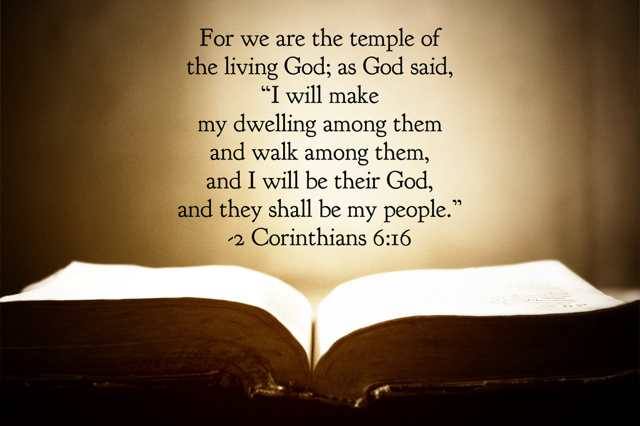
2 Corinthians 6:16

(I often link up with some of these bloggers.)