Evaluating Evangelistic Phrases. “Sadly, much of what is called evangelism today lacks gospel clarity. Repentance and faith are often missing or muddied in many of our evangelistic endeavors. Over the years, a number of popular phrases, terms, and shorthand expressions have either watered down or replaced the Biblical response to the gospel.”
What Is the Gospel? HT to the above article. “What exactly do Christians mean when they talk about the ‘gospel of Jesus Christ’?” I especially like the definition of repentance: “To repent of our sins means to turn away from our rebellion against God. Repentance doesn’t mean we’ll bring an immediate end to our sinning. It does mean, though, that we’ll never again live at peace with our sins.”
How Valuable to Me Is My Bible Today? “What would it feel like today not to own a Bible? What if I knew hardly anyone who did? What would I be willing to do to have one for myself?” Written by our beloved former pastor.
The Paradox of Parenting and How to Trust God More, HT to Challies. “From the moment our babies leave the safety and protection of the womb, we are literally and figuratively pushing them out. They can’t stay in the nest forever, and this brings us joy and sorrow. Isn’t this the paradox of parenting? The more we want to hold on to them, the more time reveals we have to keep letting them go, little by little.”
A Common Face, HT to Challies. “One of the best things my church’s women’s ministry does is to have someone share their testimony at our events. I am often stunned at what I hear from the ordinary women around me – women who quietly go about their everyday lives while harboring beautiful, compelling stories of God’s mercy. Why do we pander and scramble to hear the famous, successful and beautiful people speak, when God’s glory is just waiting to be displayed by the sisters and brothers around us?”
Sending Love, HT to Challies. “Sending Christ-like love means moving from the busy lane of one’s own life to enter the path of another, just as Jesus did when God sent Him to earth. It’s a selfless kind of love, not one from which the giver seeks to gain. And when such love is given, it brings blessed relief, casts hope over despair, and offers a glimpse of Christ.”
A Message for Young Women. “Somewhere out there in the great, wide world, someone is praying for you. She probably doesn’t know you and you probably don’t know her. You may not meet one another for many more years. But she’s praying for you nonetheless and has been for a very long time. She is the mother of a son.”
Incredible performance. An annual meeting of high school choirs in KY led to a wonderful tradition.
I enjoy listening to parts of Stephen Davey’s sermons on the radio while my oatmeal is bubbling. I’m thankful he puts the transcripts online so I can catch the rest. He had a series of messages about David that I particularly loved. This section from last Tuesday (Feb 8) struck me:
And as we’ve already learned, being a man or woman after God’s own heart doesn’t mean you’re sinless. David was guilty of great sin against God and others.
Why could David be called a man after God’s own heart? Was it because David was perfect? No; it was because God was David’s priority.
Being a man or woman or a young person who pursues after the heart of God doesn’t have anything to do with your perfection – it has everything to do with your priority.
And that is exactly the priority that David wants to ring in Solomon’s ears for the rest of his life.
That’s what I want to ring in my children’s hearts as well. I think I put this verse somewhere in their graduation paraphernalia for each of them: “And you, Solomon my son, know the God of your father and serve him with a whole heart and with a willing mind, for the Lord searches all hearts and understands every plan and thought. If you seek him, he will be found by you, but if you forsake him, he will cast you off forever” (1 Chronicles 28:9).
The days keep steadily passing by, whether seeming fast or slow, despite how much I do or don’t get done in them. Susanne atLiving to Tell the Story invites us to pause a moment and recount the blessings of the week lest we forget them. So here are a few of mine:
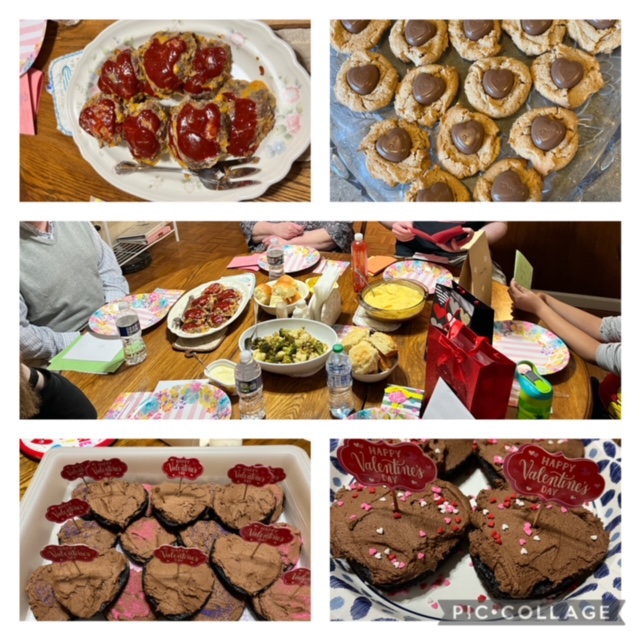
1. Valentine’s Day is always a highlight at our house with “meat hearts’ (mini meat loaves made in heart shapes) as the main course and heart-shaped cupcakes and peanut butter cookies with chocolate heart centers for dessert.
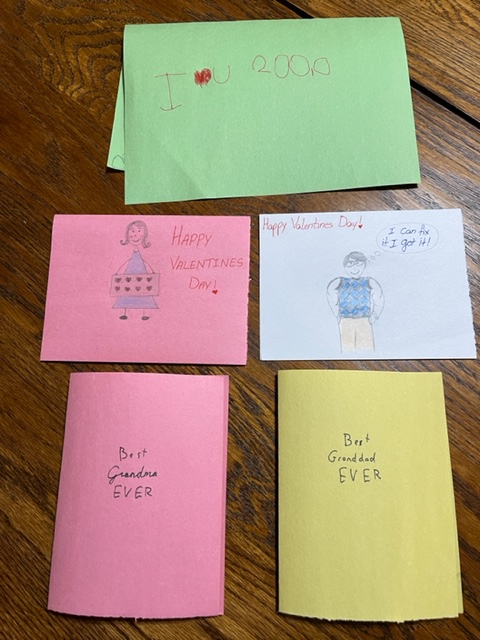
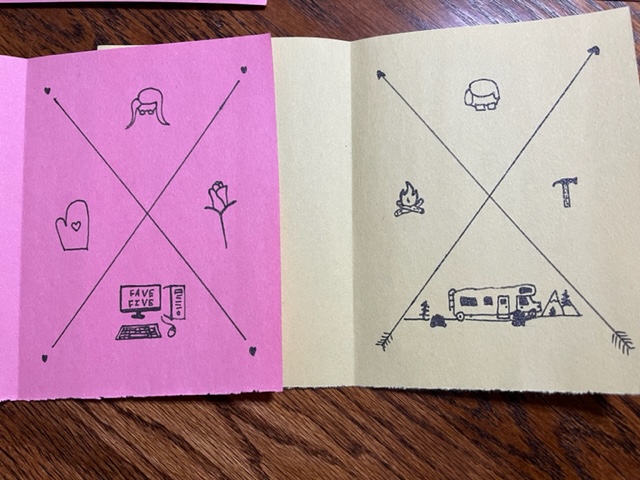
I make Valentines for the family, which I usually share in my end–of-month post. This year Jason and Mittu and Timothy made Valentines, too! I love them.
Did you notice that Friday’s Fave Five made it in my card? 🙂
2. Saturday at Jason and Mittu’s. Jason had a leak in his downstairs ceiling, and Jim went over Friday night and Saturday to help fix the leak and patch the ceiling. They invited me over for lunch Saturday, and I hung out with Mittu and Timothy while the guys worked. We painted, colored, and watched YouTube videos of Ryan’s World science experiments—Mittu and I may have dozed during the latter. 🙂
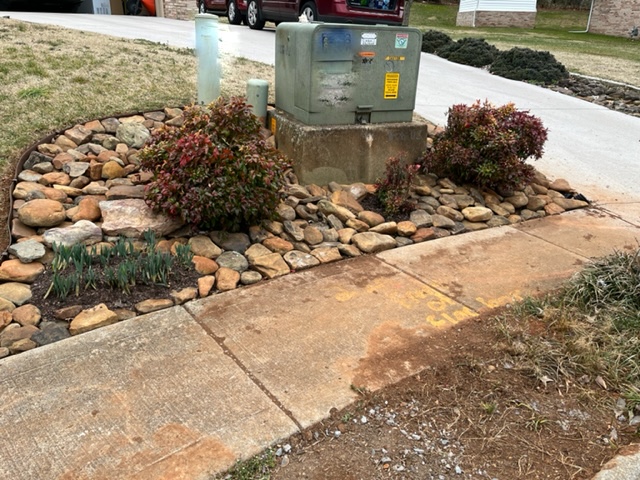
3. Landscaping. You might remember that our utility company had to replace the lines in our neighborhood that go to this big ugly box in our yard. To do that, they had to tear out the landscaping we had there. Jim took a day off last Friday, and it was warm enough that he could work on this area. He dug up some bushes from the back yard along with a few daffodils, which for some reason a previous owner planted behind the shed, of all places. If those daffodils survive the transplant ok, we might put the others in the space between the sidewalk and street. Or we might just plant new ones—Jim said they were hard to dig up. The rocks were a part of the previous landscaping, and the utility people had left them piled up on the edge of the curb. Jim said the hardest part of this was bending over to pick up rocks and then bending over again to replace them.
At some point, he’ll put a removable fence in front of the big box itself, so they can get to it if needed.
You can still see some of their writing on the sidewalk. Hopefully it and the dirt stains will wear off someday!
4. Good timing. I placed an online order at the grocery store for a 4 p.m. pickup. But in the process of creating the order, that time period closed. The next available time was 5, which is when I am usually starting to make dinner. But I had dinner in the crockpot that day, so I figured that time would work out. Then the store called and said the order was ready at 3:30. Then my husband texted and asked if I had any prescriptions ready at the drug store: he was going to swing by there on his way home from a meeting. I didn’t, I said, but I did have a grocery order ready across the street from the drug store if he had time it deal with it. Thankfully he did, so that worked out well all around.
5. A good CAT scan report. Nine years ago this coming Sunday, Jim had surgery to remove a cancerous kidney. He didn’t have to have chemo or radiation because we were told they weren’t effective for kidney cancer. He had a CAT scan this week which showed everything was fine, no signs of cancer. We are immensely thankful. We were told this kind of cancer doesn’t usually spread–but they couldn’t say it never would. And if it did come from the original cancer, chemo and radiation still wouldn’t work on it, even if it ended up somewhere else in the body. So a clean CAT scan is a relief in many ways.
Bonus 1: One of my sisters sent the rest of us and my brother packages this week, and I got mine Thursday! I can’t show what it is yet, though, until the others get theirs.
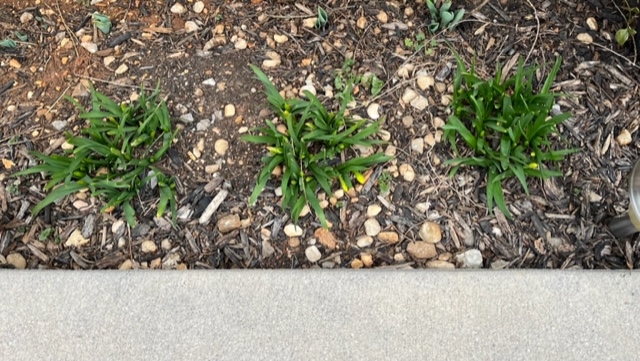
Bonus 2: Signs of spring! Besides the daffodils mentioned above, these mini ones are coming up in the flower bed by the front door. The mini tulips are starting to sprout behind them.
Framley Parsonage is the fourth of Anthony Trollope’s Barsetshire Chronicles.
The story opens with Mark Robarts, boyhood friend of Ludovic Lufton. Lady Lufton, Ludovic’s mother, thinks Mark would make a fine vicar. So she pays for his training, gives him the living connected with Framley, and even finds a wife for him.
Mark is grateful for Lady Lufton’s graciousness to him, but he wants his own way occasionally. The one area he steps outside of Lady Lufton’s preference is in his friendships. He feels that to move up in the world, he needs to seek our relationships with some from higher society, introduced to him by Ludovic. Lady Lufton feels that these associates are not of high moral character, beside their being opposite from her politically. Nevertheless, Mark feels, and convinces his wife, that he needs to move in the circles of the elites.
It’s not long before Mark gets into trouble. He realizes that these people do not have the same values he has. But then he gets himself entangled in a mess when a Mr. Sowerby urges him to sign a bill for him (essentially to cosign a loan). Mark knows he doesn’t have the money to pay the bill if it should come to him, and he knows Sowerby has an awful reputation for running up debts. Yet Mark lets himself get talked into signing the bill.
Another plot line involves Mark’s sister, Lucy. When their father dies, Mark and his wife, Fanny, take Lucy into their home. Ludovic tries to draw out the quiet young women and soon becomes attracted to her. But his mother has another bride in mind for him—the statuesque beauty, Griselda Grantly, daughter of the archdeacon. Ludovic accommodates his mother by dancing with Griselda, but he finds her cold.
As these two plot lines develop and intersect, a few subplots wind in and out as well: a political falling out, a severe parson “proud of his poverty” whose family needs help that he won’t accept, two mothers trying to one-up each other in the choice of their daughters’ suitors, and even a visit from Dr. Thorne, the main character from the previous book in the Barsetshire Chronicles which bears his name.
It took me a little while to get into this story. I was not much interested in the political aspect and got irritated by Mark’s lack of backbone. But when his circumstances began to catch up with him and affect him, I began to sympathize with him more. Lucy was my favorite character, and I loved her story. The book has a heart-warming ending, with even Lady Lufton seeming more human and less severe.
Trollope continues to have his narrator speak as one of the community, though he never inserts himself into any of the scenes. The narrator also often breaks the “fourth wall” to speak directly to the reader.
Some of my favorite quotes:
It includes two populous villages, abounding in brickmakers, a race of men very troublesome to a zealous parson who won’t let men go rollicking to the devil without interference (p. 93).
I know it will be said of Lord Lufton himself that, putting aside his peerage and broad acres, and handsome, sonsy face, he was not worth a girl’s care and love. That will be said because people think that heroes in books should be so much better than heroes got up for the world’s common wear and tear. I may as well confess that of absolute, true heroism there was only a moderate admixture in Lord Lufton’s composition; but what would the world come to if none but absolute true heroes were to be thought worthy of women’s love? What would the men do? and what—oh! what would become of the women? (p. 136).
She confessed to herself that Griselda’s chance of a first-rate establishment would be better if she were a little more impulsive. A man does not wish to marry a statue, let the statue be ever so statuesque (p. 164).
She was so glad she knew it, that she might comfort him. And she did comfort him, making the weight seem lighter and lighter on his shoulders as he talked of it. And such weights do thus become lighter. A burden that will crush a single pair of shoulders will, when equally divided—when shared by two, each of whom is willing to take the heavier part—become light as a feather. Is not that sharing of the mind’s burdens one of the chief purposes for which a man wants a wife? For there is no folly so great as keeping one’s sorrows hidden (p. 218).
To endure with her lord all her lord’s troubles was easy to her; it was the work to which she had pledged herself. But to have thought that her lord had troubles not communicated to her,—that would have been to her the one thing not to be borne (p. 218)
So he went his way . . . thinking as he went which was most unreasonable in her wretchedness, his friend Lady Arabella or his friend Lady Scatcherd. The former was always complaining of an existing husband who never refused her any moderate request; and the other passed her days in murmuring at the loss of a dead husband, who in his life had ever been to her imperious and harsh, and had sometimes been cruel and unjust. (p. 254).
Wounds cannot be cured as easily as they may be inflicted (p. 271).
At the time of this writing, the Kindle edition of this book was free and the Audiobook was included as part of my Audible subscription. I mostly listened to the audiobook wonderfully read by Simon Vance, but I read a few parts in the Kindle edition.
Before I became a Christian, God’s law showed me I needed a Savior. I had fallen far short of God’s requirements. But my sins also made me afraid to face Him. It was God’s love that melted me and drew me.
God loved us before we knew Him: “For God so loved the world, that he gave his only Son, that whoever believes in him should not perish but have eternal life” (John 3:16). While we were yet sinners, Romans 5:8 says, Christ died for us. He didn’t wait until we had our act together to show love to us or to die for us. Hosea 11:4 says God drew His own with “cords of kindness, with the bands of love.” “In love you have delivered my life from the pit of destruction, for you have cast all my sins behind your back” (Isaiah 38:17). When the man we know as the “rich young ruler” came to Jesus, naively claiming he had kept all the commandments, “Jesus, looking at him, loved him” (Mark 10:21). Then Jesus, in love, pointed out to the young man his main flaw. The young man walked away sorrowing, unwilling to give up his idol. But my hope is that he eventually did come to faith in Christ.
Does God still love me when I fail? After I became a Christian, when I failed yet again, when I allowed something back in my life that I had sworn I was done with, I was afraid to face Him. I feared punishment like sudden lightning. I dreaded profoundly disappointing Him.
Yet He loved me still. I had to learn that the love that saved me would also keep me and that sanctification (growing more Christlike) was a lifelong endeavor.
The Lord is merciful and gracious, slow to anger and abounding in steadfast love. He will not always chide, nor will he keep his anger forever. He does not deal with us according to our sins, nor repay us according to our iniquities. For as high as the heavens are above the earth, so great is his steadfast love toward those who fear him; as far as the east is from the west, so far does he remove our transgressions from us. As a father shows compassion to his children, so the Lord shows compassion to those who fear him. For he knows our frame; he remembers that we are dust (Psalm 103:8-14).
Does this catastrophe mean God doesn’t love me? When various trials and testings came into my life, I wondered what I had done wrong to merit them. I did not yet know that God has many reasons for suffering, that He allows them to do work in our lives that can’t be accomplished in other ways. As Joni Eareckson Tada so often says, “God permits what He hates to accomplish what He loves.”
Does God really want the best for me? Sometimes I’d hear people say that God works everything out for our good and His glory (probably based on Romans 8:28). Occasionally I would think, “His glory, yes. But our good?” Scripture shows over and over again God going to extreme measures to show His love for His wayward people. Even though it might not feel like it in the moment, yes, He works everything together for our good.
Maybe this too-frequent tendency to forget or doubt God’s love is one reason why Paul prayed this for the Ephesians:
“. . . that Christ may dwell in your hearts through faith—that you, being rooted and grounded in love,may have strength to comprehend with all the saints what is the breadth and length and height and depth,and to know the love of Christ that surpasses knowledge, that you may be filled with all the fullness of God” (Ephesians 3:17-19), emphasis mine).
Paul follows up this stunning prayer with the statement that God is “able to do far more abundantly than all that we ask or think, according to the power at work within us” (verse 20). We tend to pull this verse out when we have Really Big Prayer Requests to reassure ourselves that God is able to answer them. But Paul applied it to his prayer in verses 14-19.
“To know the love of Christ that surpasses knowledge.” How can we know something that surpasses knowledge, that is beyond knowing fully?
One commentary at the bottom of the Bible Hub page on this verse says it partly means that we “may always go on from faith to faith, from knowledge to knowledge, and yet find new depths still to be fathomed.” Another says, “As the breeze fills the sails and bears forward the ship, so the love of Christ fills the soul and moves it in the direction of God’s will. But in its fullness it passeth knowledge; it is infinite, not to be grasped by mortal man, and therefore always presenting new fields to be explored, new depths to be fathomed.”
God’s goodness (another subject for another time) and God’s love are the two guardrail truths that keep me steady when things happen that I can’t understand. God will always do right, and His love for us is unshakeable.
Who shall separate us from the love of Christ? Shall tribulation, or distress, or persecution, or famine, or nakedness, or danger, or sword?As it is written, “For your sake we are being killed all the day long; we are regarded as sheep to be slaughtered.” No, in all these things we are more than conquerors through him who loved us.For I am sure that neither death nor life, nor angels nor rulers, nor things present nor things to come, nor powers,nor height nor depth, nor anything else in all creation, will be able to separate us from the love of God in Christ Jesus our Lord (Romans 8:35-39).
When we become fully assured of God’s love, we can rest in Him and quiet our fears.
The LORD your God is in your midst, a mighty one who will save; he will rejoice over you with gladness; he will quiet you by his love; he will exult over you with loud singing (Zephaniah 3:17).
In addition to these verses, hymns grounded in Biblical truth are rich reminders and assurances of God’s love. Here are a few of my favorites, with a sample stanza or two of each:
From “Jesus, I Am Resting, resting” by Jean Sophia Pigott:
Oh, how great Thy loving kindness, Vaster, broader than the sea: Oh, how marvelous Thy goodness, Lavished all on me! Yes, I rest in Thee, Beloved, Know what wealth of grace is Thine, Know Thy certainty of promise, And have made it mine.
Simply trusting Thee, Lord Jesus, I behold Thee as Thou art, And Thy love, so pure, so changeless, Satisfies my heart, Satisfies its deepest longings, Meets, supplies its every need, Compasseth me round with blessings, Thine is love indeed.
Loved with everlasting love, Led by grace that love to know; Gracious Spirit from above, Thou hast taught me it is so! Oh, this full and perfect peace! Oh, this transport all divine! In a love which cannot cease, I am His, and He is mine; In a love which cannot cease, I am His, and He is mine.
O Love that will not let me go, I rest my weary soul in thee. I give thee back the life I owe, that in thine ocean depths its flow may richer, fuller be.
The love of God is greater far Than tongue or pen can ever tell. It goes beyond the highest star And reaches to the lowest hell. The guilty pair, bowed down with care, God gave His Son to win; His erring child He reconciled And pardoned from his sin.
Could we with ink the ocean fill, And were the skies of parchment made; Were every stalk on earth a quill, And every man a scribe by trade; To write the love of God above Would drain the ocean dry; Nor could the scroll contain the whole, Though stretched from sky to sky.
On the mount of crucifixion fountains opened deep and wide; through the floodgates of God’s mercy flowed a vast and gracious tide. Grace and love, like mighty rivers, poured incessant from above, and heav’n’s peace and perfect justice kissed a guilty world in love.
Once again, I’m behind on my blog-reading due to a busy week. But here are a few noteworthy reads:
A Special Valentine Invitation: Will You Be Mine? “Many of us have experienced both highs and lows when it comes to love and special valentine invitations.But the most lavish, epic, and monumental Valentine’s Day to ever take place in history, celebrates the best kind of love—God’s extravagant love.”
All This Wasted Worry, HT to Challies. “A few months ago, I was about to begin onto one of my nighttime worry rituals. There was a flight the next day, and I pictured myself gripping the armrest tightly throughout the flight like I always do—as though holding the armrest with all my might somehow keeps the plane in the air. And I laughed because there isn’t anything as ludicrous as believing that one’s white-knuckled grip on a piece of plastic in economy seating has anything to do with keeping an airplane in the sky.”
The Education of Whoopi Goldberg and Race in Christian Culture. “Whoopi Goldberg was suspended two weeks from The View for stating on air that the holocaust was not about race. . . Personally, I am not sure she should have been suspended. What she said was ignorant and insensitive, but such statements do foster discussion, education, and eventually enlightenment. If we constantly penalize one another for saying stupid things, we will eventually stop talking with one another altogether.”
How Did the Apostle Paul Stand for His Rights? “As we’ve discussed religious liberty in recent months, several people said something along these lines to me, ‘Didn’t Paul stand up for his rights when the Romans threatened him?’ This is a fair question since Paul did use his Roman citizenship on two occasions when interacting with representatives of the government. Let’s look at both incidents and think about how Paul went about this.”
Do you remember Irene Ryan, who played “Granny” on The Beverly Hillbillies? It’s hard not to think of her as perpetually Granny, because that’s the only way we ever saw her. I’m not sure why, but a couple of videos of her were in my YouTube suggestions. This was from one of her early films. The other was a pre-Granny episode of Password against fellow actor Bob Crane of Hogan’s Heroes. I also just recently learned that she was only five years older than co-star Buddy Ebsen, who played her son-on-law, Jed.
Wow, we’re almost halfway through February already. Time passes so quickly, it’s good to pause now and then to appreciate our blessings. Susanne atLiving to Tell the Story invites us to do just that.
Some of my favorite parts of the last week:
1. Thoughtful treats. When my youngest son, Jesse, was home, he enjoyed Lunchables as a snack. When he had one that included two Oreo cookies, he usually gave me one. Then my husband, Jim started doing the same thing. Though Jesse has his own place now, we still keep a few Lunchables on hand. I came to my desk one day this week to see that Jim had left his Oreos for me. 🙂
2. Repotting plants has been on my to-do list for a very long time, and I was happy to get to them this week. These had all been on my kitchen windowsill and needed room to grow.
We couldn’t get the little cactus-looking one out of its container. The little pebbles on top were glued together as one unit. I had thought this was a real plant, but maybe it’s a fake.
3. Catching up with friends. One friend and I had been trying to get together for lunch since before Christmas. We had to keep canceling due to illness or other things coming up. We finally met at Red Lobster one day this week. Then, I dropped something off at the home of my friend who recently had a baby, thinking I would only be there for a couple of minutes. I was hoping to talk with her, but wanted didn’t want to keep her too long. But we got to visit for a while. I enjoyed talking and laughing with both these friends.
4. Going out to dinner. My husband and I get take-out probably more than we ever have in our lives—with just the two of us at home, it’s not so expensive to do. And I love not cooking. 🙂 One night this week we decided to actually go to Cracker Barrel. That was nice in itself, since it’s not my husband’s favorite place. But as we discussed options, he said this was ok.
Though I’m a homebody and haven’t actually been too bothered by being home during the pandemic, these outings reminded me that I am not entirely ready to be a hermit. 🙂 It is fun to get out sometimes.
5. A long overdue haircut. In-between running errands and seeing friends, I was able to slip into the salon where I usually go. My regular hairdresser wasn’t there, but the lady who cut my hair did a good job. It’s nice not to feel unkempt.
And that’s a small window into my week. How has yours been?
In Malissa Chapin’s debut novel, The Road Home, Cadence Audley has started a new life with a new name—for the second time. Her past has dogged her steps, but she’s determined to lead a quiet, peaceful life in Deercrest, Wisconsin. She’s found a good job as a barista with a great boss. Antique stores in the area fulfill her taste for vintage purchases.
On one such shopping trip, Cadence finds an old recipe box filled with hand-written recipes. Her coworker Googles the name written inside the box and found that the owner had lived in town. Thinking to return a valued heirloom, Cadence finds Fredonia, the middle-aged daughter of the recipe box owner. Fredonia had donated the recipe box in the first place and is not thrilled to see it again—or Cadence, for that matter. But, upon learning that Cadence likes antiques, Fredonia invites the younger woman to drive with her to Kentucky to help clean out her mother’s home.
Fredonia’s offer comes just in time, because Cadence’s past has caught up with her—again.
This is a split-time novel. The second timeline belongs to Ida Beale Evans, owner of the recipe box. She had been a banker’s daughter in Indiana when she married her sweetheart, Bud, and moved with him to his new pastorate in Kentucky. Though she enjoys life as a country preacher’s wife, she has one sorrow. Suddenly one night, her deepest desire is unexpectedly fulfilled—but to keep it will call for a lifetime of secrecy.
Though Ida is a Christian and Cadence is not, both women struggle with trusting that the truth will set them free. The truth seems like it will destroy them. But Cadence has come to the end of her road. Can she escape and start over yet again? Or must she face her past and its consequences, even though doing so means losing everything she holds dear? Can she trust the young preacher who tells her, “Your sin caused problems everywhere, but God is bigger than this. He’s big enough to help you live a new life” (Location 3415, Kindle version).
I enjoyed following the journey of both women and the truths they learned. I also enjoyed the sense of place in the book, especially the Kentucky sections. There was a nice mix of both funny and poignant moments in the story. Sprinkled throughout the book are recipes from Ida Beale’s box. It was fun to learn on Malissa’s blog what inspired the pink Cadillac road trip in the book and to peruse her Pinterest board for the people and items that inspired or contributed to the story.
As of this writing, the Kindle edition is $2.99, but a paperback version is also available.
People who write about writing tell us to avoid cliches. I read one article that advised tucking a few cliches into dialogue, if you’re writing fiction, so the conversations sound normal and familiar. Generally, though, cliches are considered trite and unoriginal. There’s nothing modern readers and publishers like so much as an original idea or a twist on an old one.
While I agree with all of the above, one day it dawned on me that the problem with cliches are not the phrases themselves. The problem is us. Most of the definitions and articles I looked up said that a phrase became a cliche through overuse. Why was the phrase overused? Because it aptly or creatively expressed something people identified with. But people heard it so much, they got tired of it. Then the phrase lost its luster, if not its meaning. The phrase still meant what it always did, but we don’t hear it the same any more. We gloss over it or even get irritated by it.
Most of us use cliches thoughtlessly out of habit—thus the admonition to watch for and eliminate them from our writing and speech. But some cliches are used to stop a conversation, according to Wikipedia. For instance, if you’re telling someone your troubles, and they respond, “That’s just the way the cookie crumbles” or “Into each life some rain must fall” (though the latter is from a poem), they’re not really interested in hearing you.
It’s possible to let truth become cliche spiritually as well, isn’t it?
In the church I attended in my teens and college years, we sang “Victory in Jesus” quite a lot. In another church my husband and I attended several years ago, a frequent congregational song was “Til the Storm Passes By.” In another place, it seemed like I heard “Be Thou My Vision” almost every week. For a while, I almost cringed when I heard these songs announced or heard their opening notes.
But was there anything wrong with the songs? No, they are all wonderful expressions of Biblical truth. The fact that they seemed overused was a problem in my own heart.
What about Romans 8:28: “And we know that for those who love God all things work together for good, for those who are called according to his purpose.” Granted, sometimes people use this verse like a band-aid on cancer. They mean well, but they want to “fix” the problem instead of weeping with those who weep, and then the verse becomes a conversation-stopper. But does the frequency with which we hear this verse null its meaning and effectiveness? It shouldn’t.
If someone quotes or refers to Psalm 23, should I glibly think, “Shepherd, sheep, got it,” and move on?
When Israel complained about eating manna, honestly, I can identify with them. But God faulted them for grumbling and murmuring. They forgot the miracle of God’s provision in the wilderness—a wilderness they were wandering in due to their own sin and failure.
In Malachi, Israel was offering to the Lord animals that wouldn’t even be fit for a governor (1:8), much less for a sacrifice for God. Then the people complained, “What a weariness this is” (1:13).
It’s good to be familiar with God’s Word. Throughout the Bible, God expects us to know Scripture enough to be able to think about it in our everyday lives. So if some parts of the Bible seem trite or overly familiar to us, the solution is not to scale back on our Bible reading.
What can we do then?
We can pray with the psalmist, “Open my eyes, that I may behold wondrous things out of your law” (Psalm 119:18). We can remember the incredible privilege it is that the Creator of the universe wants to speak to us. “How precious to me are your thoughts, O God! How vast is the sum of them!” (Psalm 139:17). If God’s Word isn’t feeling so precious and wondrous lately, we can ask God to help us see it that way.
We can pray for revival. “Will you not revive us again, that your people may rejoice in you?” (Psalm 85:6). “My soul clings to the dust; give me life according to your word!” (Psalm 119:25. Other translations say “quicken,” “revive, “preserve.”) Three times in Psalm 80, the writer asks God to “Turn us again, O God, and cause thy face to shine; and we shall be saved.”
We can ask God to search our hearts and lead us to repentance if need be. “For thus says the One who is high and lifted up, who inhabits eternity, whose name is Holy: ‘I dwell in the high and holy place, and also with him who is of a contrite and lowly spirit, to revive the spirit of the lowly, and to revive the heart of the contrite'” (Isaiah 57:15).
We can ask God to restore our delight in Him and His Word.
Delight yourself in the Lord, and he will give you the desires of your heart (Psalm 37:4).
I delight to do your will, O my God; your law is within my heart (Psalm 40:8).
Great are the works of the Lord, studied by all who delight in them (Psalm 111:2).
Blessed is the man who walks not in the counsel of the wicked, nor stands in the way of sinners, nor sits in the seat of scoffers; but his delight is in the law of the Lord, and on his law he meditates day and night.
We can return to our first love. “But I have this against you, that you have abandoned the love you had at first.Remember therefore from where you have fallen; repent, and do the works you did at first” (Revelation 2:4-5). Maybe thinking back through our testimony, God’s dealings with us when we first knew Him, revisiting our “Ebenezers,” those times we saw evidence of God’s working in our lives, will stir up that first love.
Practically, maybe interrupting our regular scheduled Bible reading plan to read through some psalms or passages that have held special meaning for us in the past might help. So might reading the Bible in a different translation than you’re used to. Slowing down to focus on the words, maybe reading them out loud, can keep us from racing through a passage. A college professor years ago advised looking up the definitions of all the words in a verse, especially if the verse was familiar.
There was a young man in my youth group years ago who, whenever he was asked to pray, asked that we’d learn something new from the Bible that day. We’ll continually be learning new things from the Bible; we’ll never exhaust it in this life. But sometimes we need reminders of what we’ve heard and learned before. “Therefore I intend always to remind you of these qualities, though you know them and are established in the truth that you have. I think it right, as long as I am in this body, to stir you up by way of reminder, since I know that the putting off of my body will be soon, as our Lord Jesus Christ made clear to me. And I will make every effort so that after my departure you may be able at any time to recall these things” (2 Peter 1:12-15).
John Newton wrote a lovely hymn called “Waiting for Spring.” First he talks about God’s promise that the seasons will continue, so we have the assurance that “Winter and spring have each their use” and winter will give way to spring. He says, “Believers have their winters too.” “Though like dead trees awhile they seem,” the spiritual life God placed in them will cause them to bloom again. He closes with this prayer:
Dear LORD, afford our souls a spring, Thou know’st our winter has been long; Shine forth, and warm our hearts to sing, And thy rich grace shall be our song.
May God shine in and warm our hearts and renew our love for Him and His Word.
Every Need Is Not a Call. “As we try to discern the often blurry lines between good, better, and best, we should prayerfully consider our passions, priorities, and providential circumstances. When we walk in dependence upon Christ, we can learn to respond to needs faithfully rather than frantically.”
Losses of a Prayerless Christian, HT to Challies. “Though God is sovereign over all things, He ordains the means of prayer. There are some things He will not do unless we pray, though He always does all He purposes (Psalm 135:6). The mystery does not change this truth: You do not have because you do not ask (James 4:2).”
Never Underestimate the Value of Ordinary, Brief, Christian Conversations, HT to Challies. It’s so true that we minister to each other in small, brief conversations and not just in official sermons or lessons. I can still remember comments made in passing decades ago that directed my thinking in certain areas. it’s so important to be in God’s Word and filled with His Spirit so He can use us in those ways.
Is There Such a Thing as Bad Missions? HT to Challies. “Good motives do not overcome bad methodology. Make sure your missionaries know what they are speaking into before they speak.”
Defending Without Becoming Defensive, HT to Challies. “There is a difference between winning an argument and winning a person. Of course, it’s easy to forget this in the middle of a tense conversation. Emotions are powerful when the stakes are high.”
A Little Poetry Improves Life: How Verse Awakens Wonder, HT to The Story Warren. “I ask the class, ‘How do you know that God intends for you to understand and enjoy poetry?’ . . . It is gratifying to see how quickly someone comes up with the correct answer. That answer is that approximately one-third of the Bible comes to us in poetic form.” Leland Ryken dispels misconceptions and shares tips for getting more out of poetry, especially Biblical poetry.
‘Redeeming Love’ Irredeemably Exploits Actors and Viewers. HT to Challies. “Debates among Christians about the presence of nudity and sex in media are certainly not new. But it’s an important topic to continually reengage and thoughtfully consider—especially as the boundaries of sexual content on screen continue to be pushed. The release of a ‘sexy’ faith-based film like Redeeming Love offers a chance to revisit this discussion, albeit from a new vantage point.”
What Happens When a Believer Dies? HT to Challies. “Every person reading this article is dying. Perhaps you have reason to believe that death will come very soon. You may be troubled, feeling uncertain, or unready to leave. Make sure of your relationship with Jesus Christ. Be certain that you’re trusting Him alone to save you—not anyone or anything else, and certainly not any good works you’ve done. And then allow yourself to get excited about what’s on the other side of death’s door.”
I don’t often read The Babylon Bee and I don’t know any of these people, but the caption about one-line summaries of classic novels caught my eye. This woman’s father had multiple sclerosis, and in the last years of his life couldn’t do much but read. He set out to read as many classic novels as he could and then wrote these summaries of them. Some are pretty funny, like Dracula by Bram Stoker: “Vampire advantage—immortality; disadvantage—limited liquid diet.” Commenters try their hand at one-line summaries, too.
Welcome to the first FFF of a new month. Susanne atLiving to Tell the Story invites us to look back over the week and name five of the best things from it. It’s a good practice in counting our blessings before they pass by, forgotten.
Here, then, are a few of my favorite parts of the last week:
1. A fixed dishwasher. I’ve mentioned my husband’s ongoing attempts to repair our dishwasher. He had one last thing to try before giving up. Thankfully, he was successful. We’ve run the dishwasher a few times now with no leaks.
2. Dinner at Jason and Mittu‘s, which we hadn’t done since Christmas time due to Covid at their house. Thankfully, everyone is well again. We enjoyed grilled hamburgers with several sides and rousing games of Uno and Dutch Blitz.
3. A negative Covid test. I’d had very mild symptoms for a few days, but decided to use a home Covid test before the visit with the kids mentioned above and before Jim had to travel (his first flight since the pandemic started). Thankfully, the test was negative.
4. Two organizing projects done. The first one involved the kitchen pantry and one cabinet and drawer. I had three specific goals: I wanted to get either the air fryer or instant pot (or both!) off the countertop, to get some newly accumulated baking supplies together in one location, and to take the cookie cutters and pumpkin-carving equipment, which are only used once a year or so, out of prime space in the big kitchen drawer. I was able to do all of those except the instant pot. Plus I got rid of some things and rearranged what remained in better ways. I even found a couple of things I had forgotten I had (like Valentine cupcake decorations—good timing!
Then, I had two under-bed storage boxes in our bedroom closet–because they wouldn’t fit under out bed. I had some gift-wrapping supplies in them, but was consolidating all that stuff somewhere else. The under-bed storage units did fit under the bed in the guest room, and I’ll use them for some supplies from the shed that I want to bring in. The extra space in the closet provided a better place for my husband’s shoes and an extra shelf on his side. Then I dusted everything I could reach in there—amazing how much dust gets into a closet.
5. The Olympic games. I don’t pay attention to sports generally, but I do like the Olympics. I watched some of the figure skating qualifications last night and look forward to the opening ceremony tonight.














 Stray Thoughts