Unknown's avatar

About Barbara Harper

https://barbarah.wordpress.com

Real Life Devotions

I’m sure you’ve seen Facebook or Instagram photos of ideal quiet times with the Lord. A beach at sunrise. A sunny deck and a glass of lemonade. A comfy chair, throw blanket, and steaming mug of coffee. A reading plan tidily checked off.

I admit I like having a plan and a routine. And there’s nothing wrong with those kinds of inspirational photos. It’s lovely when the setting comes together beautifully with devotional time. Maybe those pictures document the settings specifically  because they are so rare.

But I think sometimes we set ourselves up for failure because we don’t reach that ideal. When we struggle to stay awake, when we can’t find a quiet minute in the day, when the kids clamor for attention any time we sit down, when we hit the ground running with meetings all day and our attention span is shredded at night … what then? We often give up on our quiet time because it won’t look like we think it shoud.

But Bible reading isn’t just a nice thing to do when we can fit it in, when we can do all the things we think a quiet time requires. It’s vital to our walk with God. It’s our spiritual nourishment. We have our flesh and an enemy of our souls to fight against.

I’ve written before about finding time for Bible reading, so I won’t go into all that here. I just want to encourage you that real life devotions won’t always look ideal. God can speak to my heart in my comfy chair with a half hour set aside. But He can also speak through His Word (and has) when I am tired, rushed, ill, nursing a baby, traveling, or only have a few scattered minutes through the day.

With that in mind, I started a hashtag on Instragram and Twitter for #reallifedevotions. The idea was to show what real Bible reading time “in the trenches” was like.

Here’s my usual spot:

I used to be the comfy couch and throw blanket person, but then I too easily dozed off. So I moved here. My desk is cluttered, my inbox is stuffed, there’s a sprinkling of dust. My drawer is hanging open for easy access to pens, pencils, and sticky tabs. I do believe in dusting and straightening. 🙂 But if I waited to get everything else done before I read my Bible, well, I’d never get to it.

This is my second real life devotions photo:

I used to journal quite a bit, but then it seemed like I was spending more time writing my thoughts rather than reading God’s. For years I didn’t write anything. I guess some of my blog posts are processing what I have read. But lately I’ve started almost a bullet journal, just jotting down a summary, sometimes just a sentence. Sometimes I’ll write more if I need to process something. I look back at what I have written at the end of my quite time for that day, but rarely after that. (DL stands for Daily Light on the Daily Path, a devotional book I first discovered in missionary biographies and have read for years.)

With my mix of printing and cursive, I don’t know if others could even read my notes. (My handwriting has never been good, and trying to take notes in college lecture classes made it worse.) But they’re not meant for others to read. These aren’t the literary quality of The Journals of Jim Elliot or David Brainerd’s diary.

Nor are my journal entries decorative. I love to see what artistic people do with their devotional jottings, like Karla Dornacher. They can probably whip up beautiful art in journals or Bible margins in no time. I know for many, this is a way to meditate on God’s Word. But for me, trying to be artistic would be a distraction, a frustration, and one more thing to do. Their way works for them; my way works for me.

All of that to say, don’t feel like you have to have a beautiful, artistic, calligraphic journal with a pretty cover to jot down notes from your Bible reading time. You don’t even have to write anything down at all. If you do, great!  If it’s lovely, wonderful! But if it’s merely functional, a way to remember or think through what you’ve read, that’s fine, no matter what it looks like.

This third photo is staged because this has not been my practice. It’s in memory of a neighbor from decades ago who had three little stairstep children in a row, all under the age of five. Her washing machine was in her kitchen, and she left her Bible on top of it to get a few minutes reading in as she could.
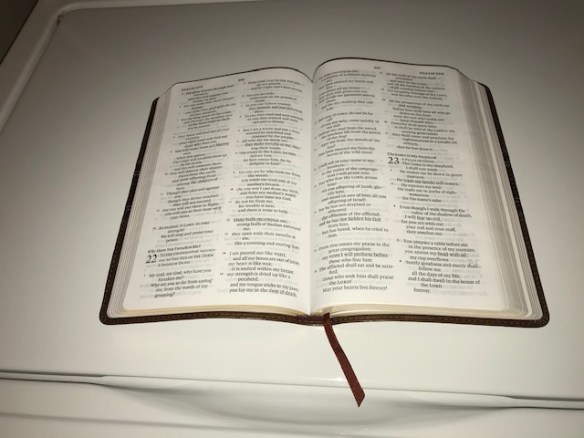
As I wrote in Encouragement for Mothers of Small Children, the time when my children were little was the most challenging to try to carve out any quiet time, much less to read the Bible in a coherent manner. Yet I suffered spiritually when I didn’t read. It’s important to both read and study the Bible, but some seasons, it’s hard to do either. When I truly only had a few moments, God met with me and fed my soul in that time.

Moses met with God on a mountain. Daniel met with God in captivity. David met with God in pasture while shepherding, in a cave while hiding from enemies, and in a palace. Jonah met with God in the belly of a whale. We can meet with God any time, anywhere.

How about you? What does your real life devotional time look like? How has it changed through the different seasons of life? What was your most unusual devotional setting?

(Sharing with Purposeful Faith, Tell His Story, InstaEncouragement, Anchored Abode,
Recharge Wednesday, Worth Beyond Rubies, Let’s Have Coffee, Heart Encouragement,
Faith on Fire, Grace and Truth, Inspire Me Monday, Global Blogging, Senior Salon,
Hearth and Home)


How do you know if God is displeased with you?

How to know if God is displeased with youAs I skimmed through Twitter recently, I saw a tweet from someone I didn’t know who asked, “How do you know if God is displeased with you?”

I didn’t have time to read all 60+ responses, but I scrolled through several. I was astonished to see that no one appealed to the Bible or prayer.

One mentioned a sinking feeling in the pit of their stomach. Another cited a vague uneasiness. One said that everything going wrong in life was a sure sign of God’s displeasure. But those can all be caused by any number of things.

God uses our consciences to convict us sometimes, but conscience has to be trained. Some people have no conscience about cannibalism or genocide. Others’ consciences trouble them over every little thing.

So how do you know if God is displeased with you?

Ask Him. “Search me, O God, and know my heart! Try me and know my thoughts! And see if there be any grievous way in me, and lead me in the way everlasting!” (Psalm 139:23-24).

Read His Word. There He tells us what’s right and wrong. Of course, we have to be careful to read in context, consider who is saying what to whom, and interpret it with some common sense principles.

Paul says, “Yet if it had not been for the law, I would not have known sin. For I would not have known what it is to covet if the law had not said, “You shall not covet” (Romans 7:7b). The Bible gives us the ten commandments (Exodus 20), a list of things God hates (Proverbs 6:16-19), lists of things to put off and put on (Ephesians 4:17-32), the difference between the works of the flesh and the fruit of the Spirit (Galatians 5:16-26), as well as other instructions.

The Bible doesn’t just tell us what not to do: it also tells us what we should be doing. So we could also displease God by failing to do good in some area.

The more we read the Bible and grow in the Lord, the more we grow in our understanding. For instance, we might read early on that we shouldn’t steal. That seems pretty straightforward: don’t take anything that belongs to someone else. Then later we realize that if we goof off on the job, we’re stealing from our boss the work he has paid us for. Then even later we come across Ephesians 4:28: “Let the thief no longer steal, but rather let him labor, doing honest work with his own hands, so that he may have something to share with anyone in need.” We realize that not stealing isn’t an end in itself: we need to replace theft with honest work not only to provide for ourselves, but to help others.

Besides general right and wrong, the Bible shares some specific things that God is pleased with:

Faith. “And without faith it is impossible to please him, for whoever would draw near to God must believe that he exists and that he rewards those who seek him” Hebrews 11:6).

Fear (reverence): “The Lord takes pleasure in those who fear him, in those who hope in his steadfast love” (Psalm 147:11).

Spiritual sacrifices: “Through him then let us continually offer up a sacrifice of praise to God, that is, the fruit of lips that acknowledge his name. Do not neglect to do good and to share what you have, for such sacrifices are pleasing to God” (Hebrews 13:15-16).

Obedience: “Has the Lord as great delight in burnt offerings and sacrifices, as in obeying the voice of the Lord? Behold, to obey is better than sacrifice, and to listen than the fat of rams” (1 Samuel 15:22). Wait a minute—I just mentioned sacrifices were pleasing to God, and now I am saying they are not? The sacrifices in this verse were part of the OT system of worship. Too often people fell into religious ritual without their hearts being in it (we still do that, though our rituals are different). God was saying through Samuel that it doesn’t do any good to perform religious rites without obeying Him. That’s the height of hypocrisy.  But the spiritual sacrifices that please God, mentioned above in Hebrews, were ministry to others at cost to ourselves from a heart of love and worship of God.

Jesus: “This is my beloved Son, with whom I am well pleased; listen to him” (Matthew 17:5). “And he who sent me is with me. He has not left me alone, for I always do the things that are pleasing to him” (John 8:29). Jesus is more than just an example, but God does want us to listen to Him and live like Him. “Therefore be imitators of God, as beloved children. And walk in love, as Christ loved us and gave himself up for us, a fragrant offering and sacrifice to God” (Ephesians 5:1-2).

One problem with trying to please God is that we can’t in our flesh.

For those who live according to the flesh set their minds on the things of the flesh, but those who live according to the Spirit set their minds on the things of the Spirit. For to set the mind on the flesh is death, but to set the mind on the Spirit is life and peace. For the mind that is set on the flesh is hostile to God, for it does not submit to God’s law; indeed, it cannot. Those who are in the flesh cannot please God (Romans 8:5-8).

That’s dire. What’s the remedy?

You, however, are not in the flesh but in the Spirit, if in fact the Spirit of God dwells in you. Anyone who does not have the Spirit of Christ does not belong to him. But if Christ is in you, although the body is dead because of sin, the Spirit is life because of righteousness. If the Spirit of him who raised Jesus from the dead dwells in you, he who raised Christ Jesus from the dead will also give life to your mortal bodies through his Spirit who dwells in you (Romans 8:9-11).

How does that happen? When we believe on Jesus Christ as Lord and Savior and turn from our sin and trusting in ourselves or anything else, Jesus and the Holy Spirit live within us. Jesus lived a perfect life of righteousness, which we could never do. He took our sins on Himself on the cross, so that when we repent and believe on Him, He puts His righteousness on our account.  We could never be good enough on our own to please God. Even if we could from this moment forward, we have a past of not pleasing God. The only way He can be completely pleased with us is through Christ.

We can be saved in a moment. But then it takes a lifetime to grow in grace and Christlikeness. One former pastor used to say that “work out your own salvation with fear and trembling” (Philippians 2:12) meant not to work for salvation, but to work it out like a math problem: take all those lofty truths and principles and work them into your everyday life.

But we do stumble and fail. When we believe in Christ, God becomes our Father.

As a father shows compassion to his children, so the Lord shows compassion to those who fear him. For he knows our frame; he remembers that we are dust” (Psalm 103:13-14).

Over and over in the Bible, God is described as longsuffering, slow to anger, merciful, ready to forgive, ready to help. If our heart is with Him and our desire is to walk with Him and do His will, we don’t need to walk around with a vague feeling of spiritual uneasiness. As a loving Father, He will show us right from wrong, forgive us when we fail, and enable us to live for Him.

But some walk in blatant disregard of the Bible yet think God is well-pleased with them. Or they think they know who God is and what the Bible says, but they’re misinformed. We shouldn’t be presumptuous. How we need to read His Word, come to Him with a humble spirit, and seek His grace to live for Him.

Early in my Christian walk, I probably had more of that vague uneasiness that something was wrong spiritually. A former pastor used to say that when we come to God and ask Him to search our hearts, then we wait and deal with whatever He brings to mind. He likened it to opening a box, dealing with what’s there, opening another box, until there are no more boxes—nothing else that God brings to mind. I still do that sometimes. But now, after 45 years of reading His Word and walking with Him, usually conviction is immediate. Often, right after I do or think something wrong, God will remind me of what His Word says about what I just did or thought. Then I try to immediately ask His forgiveness. But it’s still good to ask Him to search our hearts in case we’re overlooking something.

Sometimes it takes a while to sort through whether we’re feeling false guilt over a man-made principle that goes beyond the Bible. But the more we read His Word and walk with Him, the more familiar we’ll be with what pleases and displeases Him.

 Now may the God of peace who brought again from the dead our Lord Jesus, the great shepherd of the sheep, by the blood of the eternal covenant, equip you with everything good that you may do his will, working in us that which is pleasing in his sight, through Jesus Christ, to whom be glory forever and ever. Amen (Hebrews 13:20-21).

(Sharing with Inspire Me Monday, Global Blogging, Senior Salon, Hearth and Soul,
Purposeful Faith, Tell His Story, InstaEncouragement, Anchored Abode,
Recharge Wednesday, Worth Beyond Rubies, Share a Link Wednesday,
Let’s Have Coffee, Heart Encouragement, Faith on Fire,
Grace and Truth,
Blogger Voices Network)


Friday’s Fave Five

It’s Friday, time to look back over the blessings of the week
with Susanne at Living to Tell the Story and other friends.

This has been another of those weeks—not bad, but pretty similar to the last several. We enjoyed another distanced visit with my son’s family in the back yard on a very pleasant evening. We’re continuing to find the supplies we need. We were especially thankful to find our favorite TP! 🙂

Here are some other things I am thankful for:

1. Losing five lbs. was a surprise, especially since I have been craving homemade baked goods. The only thing different is that we haven’t been getting takeout food.

2. Benadryl Cream. Somehow I got a couple of super-itchy bug bites on the back of my thigh. Cortisone cream wasn’t helping, but then I remembered I had some Benadryl cream in my purse. That worked much better.

3. Culling the closet. There were a few items I needed to get rid of, so I finally took the time to sort through my closet and pull out things I didn’t use or need any more. I need to check with the thrift store to see if they are accepting donations, but it feels good to have the closet less cluttered.

4. The end of a hard week for a couple of sons. One was asked to work overtime, specifically an hour earlier than usual all this week. Another had been working from home, but Mother’s Day is one of their busiest times, and they were shorthanded.  So he had to go in and work 12-hour (or more) days all this week, last weekend, and I think even some of the week before. This is Timothy’s Daddy, so it’s been hard for the whole family. I’m hoping things go back to normal for them next week.

5. Moms. Speaking of Mother’s Day, I’ve been thinking of the moms in my life. My own, of course, my mother-in-law, my grandmother, a dear lady in my church who I counted as my spiritual mom. Sadly, they are all gone. But I am thankful for their memories and their continuing influence in my life. A lot of women along the way have mothered by speaking an encouraging “word in due season” right when I most needed it. And now a new generation of moms like my daughter-in-law, my friend Rebekah, and others, have been encouraging me and teaching me new things. I hope I can be a blessing to them, too.

I hope you have a special time remembering your mom this weekend.

Book Review: Over to Candleford

Over to CandlefordOver to Candleford is the second book in Flora Thompson’s semi-autobiographical Lark Rise to Candleford Trilogy.

Candleford is a bigger town about eight miles away from the village of Lark Rise where Laura’s family lives. For years, Laura heard offhand plans about maybe going over to Candleford one day. Then finally it happens.

Laura’s father hires a cart, and the whole family drives over to visit relatives. Laura and her brother Edmund are fascinated by the new things they see. They are a bit intimidated by their relatives, though. Both families they visit are more well-to-do than Laura’s. The first has so much excess that Laura doesn’t feel comfortable. The second family is less ostentatious and more thoughtful and kind, and Laura feels more at home.

Later, Laura’s mother asks if Laura and Edmund think they could walk to Candleford by themselves. I can’t fathom sending children that young (nine and eleven) on an eight mile walk alone. But they make it.

This starts Laura on several visits to Candleford. One of my favorite parts is when she discovers a pile of old books in the attic and then discovers her uncle loves to read as much as she does.

Every afternoon when her cousins could be persuaded to go out or do what they wanted to do without her, she would tap at the door of her uncle’s workshop and hear the familiar challenge, ‘Who goes there?’ and reply, ‘Bookworms, Limited,’ and, receiving the password, go in and sit by the open window looking out on the garden and river and read while her uncle worked.

Laura’s family might seem a little rough to modern readers. They are not unkind, but they don’t coddle their children. “Her mother was kind and sensible and loved her children dearly, but she did not believe in showing too much tenderness towards them or in ‘giving herself away’ to the world at large.” When a neighbor tells Laura, “Never you mind, my poppet. Good looks ain’t everything, and you can’t help it if you did happen to be behind the door when they were being given out,” her mother tells her later, “You’re all right. Always keep yourself clean and neat and try to have a pleasant, good-tempered expression, and you’ll pass in a crowd.”

Laura starts to feel less valued than the new babies, until her mother finally treasures the bond they share in remembering early days and people that the youngest can’t.

When Laura turns thirteen, that’s about the time girls in the village found work outside the home to help support the family. But Laura is unsuited for many of the lines of work open to her and feels like a failure. Then an unexpected opportunity arises.

There is a little more plot to this book than Lark Rise, the first one. But there’s still a lot of description and short vignettes of people and customs.

I enjoyed the opening of new horizons to Laura in visiting a bigger town and unfamiliar people. I also liked her arc from a girl into a teenager.

Thompson also shares the changes that occurred during her lifetime.

They were still much as their forefathers had been; but change was creeping in, if slowly. A weekly newspaper came into every house, either by purchase or borrowing, and although these were still written by educated men for the educated, and our hamlet intellects had sometimes to reach up a little for their ideas, ideas were slowly percolating.

I smiled at this about bicycles:

But, although it was not yet realized, the revolution in transport had begun. The first high ‘penny-farthing’ bicycles were already on the roads, darting and swerving like swallows heralding the summer of the buses and cars and motor cycles which were soon to transform country life. But how fast those new bicycles travelled and how dangerous they looked! Pedestrians backed almost into the hedges when they met one of them, for was there not almost every week in the Sunday newspaper the story of some one being knocked down and killed by a bicycle, and letters from readers saying cyclists ought not to be allowed to use the roads, which, as everybody knew, were provided for people to walk on or to drive on behind horses. ‘Bicyclists ought to have roads to themselves, like railway trains’ was the general opinion.

Yet it was thrilling to see a man hurtling through space on one high wheel, with another tiny wheel wobbling helplessly behind. You wondered how they managed to keep their balance. No wonder they wore an anxious air. ‘Bicyclist’s face’, the expression was called, and the newspapers foretold a hunchbacked and tortured-faced future generation as a result of the pastime.

There’s always resistance to any progress, and then it becomes normal.

As a homebody myself, I appreciated this:

To the women, home was home in a special sense, for nine-tenths of their lives were spent indoors. There they washed and cooked and cleaned and mended for their teeming families; there they enjoyed their precious half-hour’s peace with a cup of tea before the fire in the afternoon, and there they bore their troubles as best they could and cherished their few joys. At times when things did not press too heavily upon them they found pleasure in re-arranging their few poor articles of furniture, in re-papering the walls and making quilts and cushions of scraps of old cloth to adorn their dwelling and add to its comfort, and few were so poor that they had not some treasure to exhibit, some article that had been in the family since ‘I dunno when’, or had been bought at a sale of furniture at such-and-such a great house, or had been given them when in service.

This was a sweet story, and I look forward to the next one, Candleford Green.

(Sharing with Booknificent Thursday, Carole’s Books You Loved)

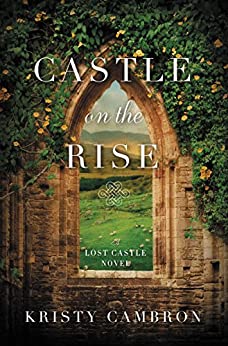
Book Review: Castle on the Rise

Castle on the Rise by Kristy Cambron Castle on the Rise is the sequel to The Lost Castle novel by Kristy Cambron. I think they could be read as standalones. But I’d recommend reading both.

Laine Forrester travels to France to be the matron of honor at her best friend’s wedding. The castle setting and the events leading up to the wedding make it seem like something out of a fairy tale.

But a couple of events bring the fairy tale crashing into real life problems. For one, the groom’s estranged brother from Ireland, Cormac, shows up just before the wedding to ask him to come back to the Foley home for an urgent need.

Laine’s friend asks her to come along. Laine hasn’t told her of her own crisis and crossroads. Now doesn’t seem like the time. But the invitation is a perfect excuse to get away for a while with her adopted daughter, Cassie.

The Foleys have been bequeathed a castle from a customer’s will. They didn’t know her well and can’t figure out why she willed them a castle. Cormac’s father, Jack, just wants to call an auction house and sell everything. But Cormac feels he needs to find out what’s behind the gift. Laine’s father was an antique dealer, so she helps Cormac evaluate which items are of value.

This novel weaves together stories from three timelines, all revolving around the castle. One takes place in the 1790s during an uprising between the Irish and English. Maeve’s family owns the castle, but her father is immobilized in grief over the loss of his wife and son. So she has to take the reins. One of her first tasks is to deal with a wounded enemy.

Another strand of the story takes place during the 1916 Easter Rising. Issy’s family now lives in the manor house, but her brother goes against her father’s wishes to join the rebels. Issy feels compelled to join him, and her budding interest in photography helps document events.

As Laine and Cormac investigate, they discover more of the castle’s surprising past. They each take steps to overcome their own past wounds to be open to new possibilities.

I knew, of course, that the Irish had fought against English control at intervals. But I didn’t know many of the details. I enjoyed learning some Irish history through this book. But I also enjoyed the stories in each timeline and the obstacles each character had to overcome.

And often, whenever I cam to a stopping place, music from the Irish Tenors sprang to mind for the next little bit. 🙂

A few quotes:

[Sean] was of a sort to look far down a path—he always said, to see the good that could come of something God was crafting behind the scenes, one had to keep an eye out for it. And Issy needed that view at present because she failed to see it (p. 50).

The talk of luxuries went far deeper than a gift of fruit. Maeve knew that. Theirs were the longstanding divides between the rich and poor, Protestant and Catholic, Anglo and Irish, even oppressed and free—for hundreds of years. They’d bled into the very earth beneath their boots, and it was tasked to her to either uphold or endeavor to change attitudes around them (p. 162).

Writers are the caretakers o’ history, Byrne. We document the livin’ and dyin’ of the human cause. But our pen, however noble, however well-intended, will always bleed the color of our convictions (p. 181).

I also enjoyed Kristy’s notes at the end concerning what led to her writing the novel, her research trip to Ireland, and the true historical details she included.

All in all, this is another great book by Kristy with three stories in one.

(Sharing with Booknificent Thursday, Carole’s Books You Loved)

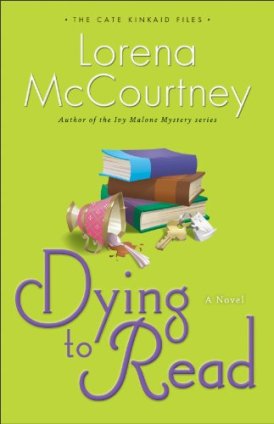
Book Review: Dying to Read

In Lorena McCourtney’s novel, Dying to Read, Cate Kinkaid is nearly 30 and at a crossroad. She’s helping out her private investigator uncle until another job opens up. Her first assignment is simply to verify that a particular woman lived at a certain address. But things get complicated when Cate finds a disgruntled book club and a dead body rather than the woman she’s looking for.

Then Cate’s uncle falls off a ladder and needs hip surgery, so she’s on her own. She decides the least she can do is try to get more information about the woman she was originally looking for. But, though she has no PI training, something about the dead woman’s case and the book club nags at her. Before long she finds herself deep in suspects and danger.

I don’t read many mysteries. I got this on a Kindle sale because of the title and the book club aspect. It took me a little while to get into the book, but I was engaged before too long. Cait is a little quirky. I wouldn’t call the writing funny, exactly, but there are some witty moments. But it’s not exactly a comedy: there are several twists and turns and some dangerous moments. The author did a good job presenting several plausible suspects while keeping the real murderer a surprise until nearly the end.

This book is the first in a trilogy. If you like clean, cozy mysteries with a Christian main character, I think you’d like this book.

(Sharing with Carole’s Books You Loved, Booknificent Thursday)

Come, let us return to the Lord

IMG_2191?ver2God pictures His relationship to His wayward people in the prophet Hosea’s relationship to his adulterous wife, Gomer. Gomer didn’t just drift away, nor was she seduced unaware. Chapter 2:5-7 says she pursued other lovers. She had children by men other than her husband. She thought they would give her “my bread and my water, my wool and my flax, my oil and my drink” (2:5).

However, God declared, “she did not know that it was I who gave her the grain, the wine, and the oil, and who lavished on her silver and gold, which they used for Baal” (2:8). She not only didn’t acknowledge God, didn’t even thank Him for His gifts, but she used His gifts to worship a false god.

Later God likened Israel as a child whom He loved and taught to walk, yet “they did not know that I healed them” (11:3).

The Bible says God “richly provides us with everything to enjoy.” (1 Timothy 6:17). “He makes his sun rise on the evil and on the good, and sends rain on the just and on the unjust” (Matthew 5:45). “The God who made the world and everything in it, being Lord of heaven and earth, does not live in temples made by man, nor is he served by human hands, as though he needed anything, since he himself gives to all mankind life and breath and everything…In him we live and move and have our being” Acts 17:24-28).

God gives us everything we have, even our very breath. Do we acknowledge Him? Thank Him? Or use His gifts in wrong pursuits?

Warren Wiersbe says, “The essence of idolatry is enjoying the gifts but not honoring the Giver” (Be Amazed (Minor Prophets): Restoring an Attitude of Wonder and Worship).

Romans tells us:

For his invisible attributes, namely, his eternal power and divine nature, have been clearly perceived, ever since the creation of the world, in the things that have been made. So they are without excuse. For although they knew God, they did not honor him as God or give thanks to him, but they became futile in their thinking, and their foolish hearts were darkened (Romans 1:20-21).

The chapter goes on to say that since people persisted in living without acknowledging God,

  • “Therefore God gave them up in the lusts of their hearts to impurity” (1:24).
  • “For this reason God gave them up to dishonorable passions” (1:26).
  • “Since they did not see fit to acknowledge God, God gave them up to a debased mind to do what ought not to be done” (1:28).

Wiersbe says, “One of the greatest judgments God can inflict on any people is to let them have their own way.”

Fortunately, God doesn’t give people up easily. Further in the Acts passage that we looked at earlier, Paul says God  “made from one man every nation of mankind to live on all the face of the earth, having determined allotted periods and the boundaries of their dwelling place, that they should seek God, and perhaps feel their way toward him and find him. Yet he is actually not far from each one of us” (Acts 17:26-27).

Back in Hosea, God disciplines His people and then shares these “I will” promises:

  • I will allure her, and bring her into the wilderness, and speak tenderly to her” (2:14).
  • I will give her her vineyards and make the Valley of Achor a door of hope” (2:15).
  • For I will remove the names of the Baals from her mouth, and they shall be remembered by name no more” (2:17).
  • I will make for them a covenant on that day” (2:18a)
  • I will abolish the bow, the sword, and war from the land, and I will make you lie down in safety” (2:18b).
  • I will betroth you to me forever. I will betroth you to me in righteousness and in justice, in steadfast love and in mercy. I will betroth you to me in faithfulness. And you shall know the Lord” (2:19-20).
  • I will answer” (2:21).
  • I will sow her for myself in the land” (2:22).
  • I will have mercy” (2:23).

God draws us with “cords of kindness, with the bands of love” (Hosea 11:4). He seeks out the lost sheep.

From Wiersbe’s book one more time:

The key word is return (Hos. 3: 5), a word that’s used twenty-two times in Hosea’s prophecy. When Israel repents and returns to the Lord, then the Lord will return to bless Israel (2:7–8). God has returned to His place and left Israel to herself (5:15) until she seeks Him and says, “Come, and let us return to the Lord” (6:1 NKJV).

Sometimes the return we need to make is a simple confession of loss of focus, lack of acknowledgement, thankfulness, or love. Sometimes it’s a full-blown 180-degree change of direction.

That’s the essence of repentance: turning from our way to God’s way (for more on repentance, see here). That happens at salvation, but it also needs to happen throughout our Christian walk. As we learn more of His will and Word, we continually adjust ourselves to them as we walk with Him.

May we return to His gracious love quickly and wholeheartedly.

(Sharing with Inspire Me Monday, Global Blogging, Senior Salon, Hearth and Soul,
Purposeful Faith, Tell His Story, InstaEncouragement, Anchored Abode,
Recharge Wednesday, Worth Beyond Rubies, Share a Link Wednesday,
Let’s Have Coffee, Instant Encouragement, Grace and Truth,
Faith on Fire, Blogger Voices Network)

Laudable Linkage

A collection of good reading onlineHere are some great reads collected in the last couple of weeks.

Women Wielding the Word.Such a good post by Sue on maintaining a habit of meeting with God in His Word. “I figure if I can’t give God five minutes anytime on any given day, I’m not taking Him and our relationship seriously.” ” We don’t worship the habit – that’s a rope on our necks instead of an anchor to our souls. God’s not interested in my checking off boxes in His name. I don’t worship the habit, but habits help me worship.

More and More, HT to Challies. I think many of us can identify with Glenna’s discouragement at not being more Christlike. “I’m beginning to think that when we’re most discouraged by our sin, God is working something good. The more we see it, the more He helps us to fight it.”

One Way to Build Your Trust Muscles, HT to Maree. “But if you’re looking for ways to strengthen your trust muscles for the days ahead, now might be a good time for you to start gathering up some stones from your past too.”

The Two Paths Out of Trials, HT to Challies.

The Right Response to the Old Testament Law. “Some struggle to understand how these laws reflect divine love and noble character. But this should not be surprising since we live at such a vast distance from that culture. If we want to see how the laws are just and fair and good, we need to study not only the laws, but also the context in which they were given”

Thankful for God’s Good Gift of Government. Our church has read through Ezekiel and Daniel in the past months, and one truth that comes through those books loud and clear is that God works behind, in, and through governments. That doesn’t mean they are always right. But he does call us to obey and honor them unless they contradict His commands.

5 common triggers for highly sensitive people, and 5 antidotes to help them survive social distancing by Anne Bogel, HT to Linda. This fits me to a “T” and was a good reminder. And a reassurance that I’m not the only one.

On Christians Spreading Corona Conspiracies: Gullibility is not a Spiritual Gift, HT to Linda. “God has not called us to be easily fooled. Gullibility is not a Christian virtue.” “Spreading unproven speculation is bearing false witness.”

How to Talk to Your Kids About the Tragedies of COVID-19, HT to the Story Warren.

The Worst Rebrand in the History of Orange Juice, HT to Challies. “Don’t let beautiful design distract from what’s important: Communicating the right information to your customer at the right time.” Yes! I hate when products undergo a major rebranding that’s artsy but doesn’t tell me what I need to know at first glance.

Of Stuck-ness and Sustaining Books. I loved this—partly because Pooh was a beloved character at our house, partly because of the scene Disney left out, and the comfort of “sustaining books” and kindness.

Mincaye Is Now With Jesus. Many of you are familiar with Jim Elliot, Nate Saint, and the other missionaries who were speared to death by the tribe they were trying to reach in Ecuador in 1956. Their story has been dear to me since I first read Through Gates of Splendor in college, and I have read much about the men and the families since that time. Mincaye was one of the killers of the men who later came to the Lord and became a grandfather figure to Steve Saint’s kids. Mincaye just passed away this week. Steve Saint’s tribute to him is here.

Finally, I loved this attempt at a professional video with a toddler “helping,” especially the end. The comments are fun, too. I am not sure if the video will show up in Feedly or emails: if not, you might need to click through to see it.

Happy Saturday!

Friday’s Fave Five

It’s Friday, time to look back over the blessings of the week
with Susanne at Living to Tell the Story and other friends.

The first day of May! Turning the calendar to a new page is one of life’s little pleasures for me. But this month, especially, I look forward with hope for safe first steps in returning to normalcy.

Meanwhile, here are some highlights of the last week:

1. Working through a to-do list around the house not only got things done, but felt good.

2. Zoom Bible study. Our ladies only get together for Bible study about once every six weeks. We had our first attempt to do so via Zoom on Saturday, and everything went well. My husband always set things up for our church meeting, and I had thought he would be nearby in case I needed any help for this. But he was working on a project outside. It wasn’t hard at all to figure out, though. Our leader’s Internet cut out near the end, but one lady called her and put her on speaker so she could finish out the session with us.

3. A refurbished basketball goal. I’m not sure why we hung on to the basketball goal that my kids had. The rim was oval instead of round after being laid down for so long. The bottom, which is supposed to be filled with water to provide enough weight to keep the goal upright, had sprung a leak a long time ago. It has been out behind our shed for years. But my husband decided to fix it up for Timothy. He used a car jack to fix the rim, painted the whole thing, and bought a new net and balls. He filled the base with sand instead of water, so it shouldn’t leak as easily. It looks really nice now, and Timothy and his family came over to try it out last weekend.

4. Chocolate chip butterscotch brownies. Mmmm. I’m not sure why they’re called butterscotch. They don’t taste like butterscotch. But they taste good. 🙂 I only make half a batch for just the three of us.

Butterscotch brownies5. A great movie. I just finished a delightful movie over several mornings of stationary bike riding that left me smiley and teary at the same time: This Beautiful Fantastic. Thanks to Laura for recommending it.

Bonus: quick return of power when it went off during a storm, Face Time calls.

What’s something good from your week?

End-of-April Reflections

what happened in AprilWell, April has been quite the month, hasn’t it? I’m sure it’s been different for all of us than any other time in our lifetimes.

We were sad to have to cancel our oldest son’s visit here and our usual get-togethers. But we were thankful to see videos of our grandson’s Easter egg hunting and Easter basket unpacking, and then we did a three-way FaceTime with all the family for his birthday. We’ve had a few socially distanced visits with everyone but our oldest, so we’re not as deprived as some. It’s all still not the same as normal, but it could be worse.

Like many of you, I’m caught between knowing we need to reopen businesses and fearing another wave of outbreaks when we do. Our state just released a three-phase plan starting tomorrow. I hope it goes well. My husband and I will probably keep doing what we’re doing and hang back for a bit since we’re in at-risk groups.

So many people have talked about having extra time. I don’t know where mine has gone, but it doesn’t feel like I’ve had any extra on my hands! I have listened to some free writing-related webinars, but other than that and making face masks for the family, I haven’t gotten much extra done.

One of the nicest things about April has been seeing nature come back to life with the lawns greening and flowers and trees blooming.

Family

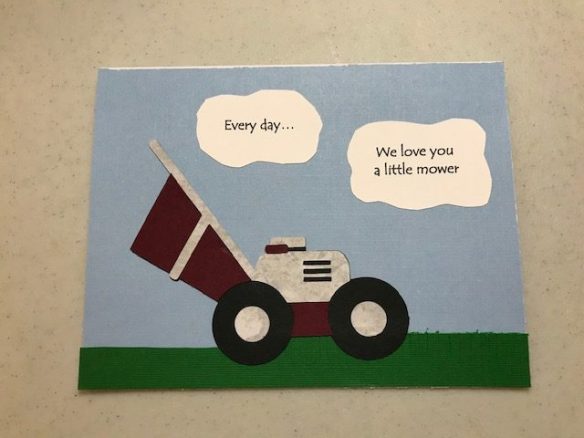
This birthday for my grandson was supposed to involve a big camp-out. That didn’t happen, but my husband set up his tent in the back yard for a few days. My son and grandson came over and got to explore it. It’s big enough that they were more than six feet from each other inside. We sat in lawn chairs while Timothy “mowed” the grass for us with his toy lawn mower. 🙂

Timothyisms

He learned a knock-knock joke this month:

T- Knock knock
Who’s there?
T- Europe
Europe, who?
T- I’m not a poo!

🙂 He tried to voice-text it to me, but I didn’t get it til his mom wrote it out in a text.

Creating

The only card I made this month was for Timothy’s birthday. I started to incorporate camping since that was the theme for the rest of his birthday. But I had seen variations on this mowing idea on Pinterest and wanted to use it. One of Timothy’s favorite things is when Granddad comes over to mow, and Timothy has turned so many items into imaginary push and riding lawn mowers. So when I saw this idea, I knew I would do it for him some time.

Watching

My husband and I watched an interesting PBS production called The Windemere Children, about Jewish children and young people who were rescued from Nazi prison camps after WWII and taken to an estate in England. Most were orphans, though they had to wait a bit to learn their family members’ fates. Some had only known life in the camps and a “survive any way you can” mentality. The first time baskets of bread were served, they grabbed handfuls and hid them in their rooms. The director said, “Let them. Let them see that here is plenty.” They were taught the English languages and customs and just given time to acclimate before either being adopted or starting to work. That was such a wise thing to do. The program was moving, as was this article about one of the men who was a teen then. The article also contains a photo of the actors with the men they portrayed.

And though it wasn’t planned, we happened to watch a different movie with a variation on the same theme titled Resistance. It’s the story of famous mime Marcel Marceau and his work with the French Resistance, especially in getting Jewish children out of France during the war. It was very good. Unfortunately, there was one brief bedroom scene. For those who like to fast-forward through such, as we do, it comes right after a girl steps out of a shower (she’s not the problem; she’s covered). (Updated to add: the scene is not explicit, no nudity is shown. But I still wish it had not been there. And, of course, this being wartime film, there are a few violent scenes.)

I was trying to find season six and seven of When Calls the Heart to watch while using my exercise bike, but it only seems to be available to rent. So I’ll have to wait on that. Then I saw there was a spinoff called When Hope Calls that was free, but when I looked it up on Amazon Prime, it said it could only be viewed with a Hallmark subscription. I hate when Amazon lists things that you can only get by subscribing elsewhere.

Do you have any recommendations of good clean movies or series on Netflix or Amazon Prime?

Reading

This month I’ve completed (links go back to my reviews):

I’ve collected most of Wiersbe’s “Be” commentaries as they have gone on sale for a dollar or two for the Kindle. But I kept forgetting about them. Finally I remembered to pull them out in conjunction with our church’s Bible reading plan.

I’m currently reading:

  • Over to Candleford by Flora Thompson, the second in the Lark Rise trilogy (audiobook)
  • Castle on the Rise by Kristy Cambron
  • Dying to Read by Lorena McCourtney
  • Breaking Anxiety’s Grip: How to Reclaim the Peace God Promises by Dr. Michelle Bengston

Blogging

Besides the Friday’s Fave Fives, book reviews, and occasional Saturday Laudable Linkages, my Monday posts have been applicable not just to the current pandemic, but to living with trials in general:

I also shared some of my favorite songs about Jesus’ death for us and songs to celebrate the resurrection.

Writing

Not much this month except for a devotional and guest post I’m going to send to sites that accept such. I’ve been listening to podcasts and webinars about writing, as I mentioned. Now I just need to get to it.

With April, it seems we’ve turned a corner into full-fledged spring. I love the weather in April and May before the heat of summer starts. I know this May will be a let-down for many with graduations and the usual end-of-school activities canceled. Perhaps our Mother’s Day will have to be as subdued as our Easter was. But we can count our blessings that we’re alive and well. This year will be one we’ll remember just because it was different.

How was your April?

(Sharing with Grace and Truth, Faith on Fire, Inspire Me Monday, Global Blogging,
Senior Salon, Hearth and Soul, Purposeful Faith, Tell His Story,
InstaEncouragement, Worth Beyond Rubies, Let’s Have Coffee)