Unknown's avatar

About Barbara Harper

https://barbarah.wordpress.com

Friday’s Fave Five

It’s Friday, time to look back over the blessings of the week with Susanne at Living to Tell the Story and other friends.

Spring continues its back-and-forth entrance. We got back down in the 20s a night or two, but the days have been pleasant. Next week’s temperatures look nice as well, though some rain is on the way. Meanwhile, here are some highlights of the last week.

1. Finding two special recipes. It would take too long and be too boring to anyone besides myself to go into where and how I found them. But I discovered a recipe of my grandmother’s for Chess Pie that I had wanted. I don’t know how useful it will be, though, as it starts with “3/4 stick oleo or the whole stick.” I wonder how you decide which to use? πŸ™‚ It was in her own handwriting, making it doubly special. The other was for a French Silk Pie from a lady I think of as my second mom. I am also unsure of using it because it requires eggs, yet is uncooked. I think back in the day they might not have had to worry about salmonella and such from raw eggs. But I am glad to have both of these.

2. A new-to-us exercise bike. My dear husband has been keeping an eye out for one for several weeks and just found a good one on Saturday.Β  I’ve put it to good use a few times already. I love that it’s quiet and I can exercise at home without traipsing off to the gym. And, since I’ve been using it first thing in the morning, it gets me wide awake for my quiet time in God’s Word, which comes next.

3. Finally getting my cabinet-dusting and organizing project done – as well as cleaning out the door shelves and drawers of the refrigerator. I followed my friend Diannaβ€˜s example and just did a few sections at a time. My main goal was cleaning crumbs and dust and finding a a place for a couple of items. But I did also weed out a few things to throw or give away. And I reacquainted myself with what I have in some of those darker or harder-to-reach corners. A bonus with this one: rest after work!

4. A couple of easy returns. I hate returning things to stores. I usually try to get my husband to take care of that task. πŸ™‚ I had a pretty negative experience years ago trying to return something, so part of me braces myself for the sales clerk to argue with me. But even though I thought one store in particular might have some resistance to one return, they politely returned my money with no questions asked.

5. Devotional bullet journal. I’ve shared before that I used to journal along with my Bible reading, but dropped it because I was spending more time writing than reading. But lately I’ve been thinking about just jotting a few lines from the different sources I read, so I finally started. It’s hard not to try to outline or list everything, but I wanted to keep it simple and just highlight the main point or thought. That helps cement it in my mind, plus it helps me read with purpose rather than just going through a routine. I’ve only been at it a few times so far, but I am enjoying it.

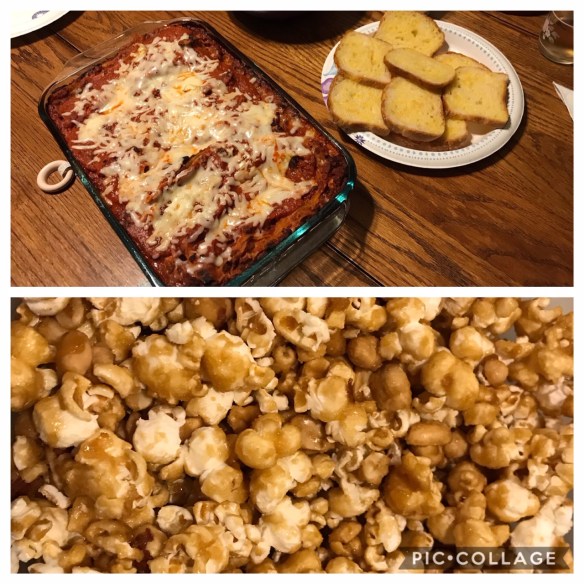
Bonus: Pizza and movie night with the family.

Happy Friday!

Book Review: How Green Was My Valley

How Green Was My Valley by Richard Llewellyn is the story of a family in a Welsh mining village in the 1800s. The story begins with the narrator, Huw (pronounced like Hugh), looking back over his time in the valley just as he is getting ready to leave it as an older man.

Huw remembers his somewhat idyllic childhood. Most of the men in the valley worked in the coal mines. They’d come home en masse covered with coal dust, take a bath, and enjoy a fine meal prepared by their wives. Saturdays were special: payday. Every wife would dress in her second-best and bring a chair outside her door. Her husband would put his pay for the week in her lap. After a bath and a good dinner, then they’d go shopping.

Huw was the youngest son. Most of his brothers worked in the mines and contributed to the family coffers, so they were well-off, comparatively, and able to help others when times were hard. Huw was in an accident after which he could not walk for five years. Even after he could walk, his legs were spindly. Huw was educated by a village woman until she had taught him all she could. Then she prepared him for the national school. There he was a target, both because he was so slight and because he was the new kid. When he came home beat up, his father taught him how to defend himself.

Fighting was a big part of life then. People fought over slights, over speaking to a man’s daughter without asking his permission first, over just about any real or perceived infraction.

Huw’s memories trace the progression of his family, his own coming to manhood, Mr. Gruffydd (Griffith), the town minister, troubles and triumphs in town and at school. Trouble with the mines affected most of the families, and arguments flew back and forth about the best way to handle them. Some, including some of Huw’s brothers, were for unions, some for striking. And the slag heap, made up of waste from the mines, continually grew into a bigger blight on the landscape, eventually choking off life from the river and the land.

I’m not one to see symbolism behind every element in literature, but the slag heap is such a presence through the book that it must symbolize something. I’m not sure exactly what, though. Man’s progression, which so often ends upΒ  harming his environment? Man’s inherent corruption, which affects everything he touches? Maybe a bit of both.

Llewellyn is a beautiful writer, with a musical lilt to much of his prose. I listened to the audiobook wonderfully narrated by Ralph Cosham, and enjoyed hearing the lyricism of the book that way. I also checked a print copy from the library and enjoyed rereading a few passages.

There is beauitful to watch a mountain sleeping, and other mountains in the other valleys rising up like bits of blue velvet to make you feel you could cut a piece and wear it for a coat, to dance in above the fat clouds.

O, there is lovely to feel a book, a good book, firm in the hand, for its fatness holds rich promise, and you are hot inside to think of good hours to come.

There is good a cup of tea is when you are feeling low. Thin, and plenty of milk, and brown sugar in the crystal, in a big cup so that when your mouth is used to the heat you can drink instead of sipping. Every part of you inside you that seems to have gone to sleep comes lively again. A good friend of mine is a cup of tea, indeed.

I knew she was laughing, but she looked as though she were crying, with golden tears unsteady in her eyes, and her eyes gone lovely blue to call for pity, big, and round, like a little girl wanting to be carried, and turning down her mouth, only a little not to be ugly, and a tremble in the chin, and with hair almost the colour of a new penny about her face and hanging down three feet, with stray ones shining like the strings of a harp across her eyes and down her cheeks.

There is a wholeness about a woman, of shape, and sound, and colour, and taste, and smell, a quietness that is her, that you will want to hold tightly to you, all, every little bit, without words, in peace, with jealousy for the things that escape the clumsiness of your arms. So you feel, when you love.

Men lose their birthrights for a mess of pottage only if they stop using the gifts given them by God for their betterment. By prayer. That is the first and greatest gift. Use the gift of prayer. Ask for strength of mind, and a clear vision. Then sense. Use your sense. …Think long and well. By prayer and good thought you will conquer all enemies.

Never mind what you feel. Think. Watch. Think again. And then one step at a time to put things right. As a mason puts one block at a time. To build solid and good. So with thought. Think. Build one thought at a time. Think solid. Then act.
____
Well,” my father said to her, and looked at her.

β€œWell,” my mother said to him, and looked at him.

In that quietness they were speaking their own language, with their eyes, with the way they stood, with what they put into the air about them, each knowing what the other was saying, and having strength one from the other, for they had been learning through forty years of being together, and their minds were one.”

When Huw was sent to take some things to a neighbor having a baby, he thought doctors brought babies in their bags. The daughter of the woman having the baby told him otherwise and brought him to a window to watch to prove her point. Traumatized, he went home, and eventually his parents found out. He thought he was going to get in trouble, but his father just said:

Listen to me. Forget all you saw. Leave it. Take your mind from it. It had nothing to do with you. But use it for experience. Now you know what hurt it brings to women when men come into the world. Remember, and make it up to your Mama and to all women. . . And another thing let it do . . . There is no room for pride in any man. There is no room for unkindness. There is no room for wit at the expense of others. All men are born the same, and equal. As you saw to-day, so come the Captains and the Kings and the Tinkers and the Tailors. Let the memory direct your dealings with men and women. And be sure to take good care of Mama.

Another interesting comment about women came when he and one sister had to do all the dishes for their large family, and he commented, “A man will never know a woman until he knows her work.”

One of the funniest parts was when the village school teacher came to the house to drill Huw before his examination for the English school. She gave him a math problem about how long it would take to fill up a bathtub with so many gallons going in and two holes letting so much out the bottom. Huw’s mother, a smart woman in her own right but not much on “book learning,” can’t get over the silliness of someone pouring water into a tub with holes. Then when they move on to decimals, she wants to know who came up with that idea and who says what that little dot is supposed to do.

One somewhat disturbing part was when a small girl was “ravaged,” and the men of the village sought him out and took his punishment into their own hands.

“To hand her murderer over to the police will give him an extra day to live, which your daughter was denied,” said Mr. Gruffydd. “He shall be fed and housed until the day he meets the rope, but your daughter will lie beneath the dead wreaths long before then, and the rope gives a good quick and clean, without blood, without pain, without torture of the soul and body. Is justice done, then, with a rope about the neck of a man, and his victim, a child of seven years, torn and twisted, long in her grave?”

“No,” said the crowd.

“Shall we burn him?” asked Mr. Gruffydd. “But if we do, he will die a death of honour, for martyrs died in the flame. What then?”

“Give him to me,” said Cynlais Pritchard.

“Is that your common decision?” Mr. Gruffydd asked the crowd.

“Yes,” they all shouted back.

“Take him,” said Mr. Gruffydd, “and as we do with him, so shall we do with the next, if next there is. And remember, if you bury him, however deep, you pollute innocent ground. Burden not the earth with such.”

Though the people were God-fearing, sadly, Huw saw Christ as only a man.

There is a smattering of “damns,” “hells,” and such. There is one description of teenage fondling and another of a sexual encounter that are written metaphorically, but still more graphically than I am comfortable with.

Though much of the book has a nostalgic feel, to me it ended up sad. Nearly everyone has passed on and the slag heap is about to crush what’s left. Huw muses:

But you have gone now, all of you that were so beautiful when you were quick with life. Yet not gone, for you are still a living truth inside my mind. So how are you dead, my brothers and sisters, and all of you, when you live with me as surely as I live with myself.

Llewellyn was of Welsh decent and portrayed this as something of his own history. After his death, it was discovered that he had not been in Wales until well after the book was published. He knew people from Welsh mining families and drew from their conversations.

The 1941 film version with Roddy McDowall and Maureen O’Hara remains popular even today. I saw it years ago but I remember little from it. I’d like to watch it again some time.

Book Review: The Fashion Designer

Fashion designerΒ The Fashion Designer by Nancy Moser is a sequel to her book The Pattern Artist. I think the second book could be understood alone, but I encourage reading both of them.

In The Pattern Artist, which I read and reviewed last year, Annie Wood was a housemaid in England in 1911. She hoped her skill in sewing and designing would move her up to a lady’s handmaid. But the handmaids took credit for her work. Deciding there was no future for her in the Summerfield’s house, she decided on a trip to the US to strike out to pursue her own version of the American dream. She started out in the sewing department of Macy’s, then was hired on as a pattern artist for Butterick.

In the beginning of this new book, The Fashion Designer, Annie and a few friends from Butterick had quit their jobs to start a new company designing practical patterns for the everyday woman. But the lady who had enthusiastically promised to fund their endeavors inexplicably has a change of heart: she wants the women to design for her elite, upper crust friends and wants them to create patterns for a fashion show. At first Annie and her friends comply, but then bow out because their investor’s vision no longer matches their own.

After several discussions with her husband and the other women, they decide to try to open a store with dresses that people can buy off the rack but also have altered to fit if need be. They pool their resources to get started while they look for funding to continue. But all the financial avenues that seem promising end up closing.

Meanwhile, someone from Annie’s past at the manor house in England shows up seeking her own fresh start. Maude, one of Annie’s coworkers and partners, faces struggles in her relationships. She had vowed never to marry, for her own private reasons, but she meets someone who makes her wish she could change her mind. And a difference of opinion with Annie’s husband’s father puts a rift not only in their relationship, but between his parents as well.

Once again Nancy shared at the back of the book how some of her research informed the story and included facts and photos from the era. I especially enjoyed how she tied in Lane Bryant’s true story to intersect with Annie’s fictional one.

I enjoyed following along with Annie and Sean as they struggled to trust God for His wisdom and provision for the plans that they felt had come from Him.

(Sharing with Carole’s Books You Loved, Literary Musing Monday, Booknificent)

Giving of ourselves in ministry to others

So often when we want to minister to someone, we think we need to start a program or do some thing. And often we do. James warns against wishing someone well without taking the steps to meet their physical needs. Programs can be a good way to organize ministry efforts efficiently.

But programs without heart, without a personal touch, can be just a going through the motions. God is the One who touches and changes hearts. He doesn’t “need” us, but He often chooses to minister to others through His people. Paul said, “I will most gladly spend and be spent for your souls” (2 Corinthians 12:15, ESV). He speaks of being “poured out as a drink offering on the sacrifice and service of your faith (Philippians 2:17). He didn’t just run through a program. He gave of himself.

I visited my mother-in-law almost every weekday during her five-plus years in various care facilities. I often felt more “useful” if I could do something – straighten her room a bit, bring her some mail, change her hearing aid battery, etc. – rather than get caught in the same conversational loops repeatedly. What she needed most, and what was hardest to give, was just one-on-one time and attention.

Some years ago our ladies’ group wanted to do something for the elderly ladies in our congregation. We decided to make little gift bags and then divide them up among us to deliver to the older ladies’ homes. Though they enjoyed the gifts, what they loved most were the visits. Some dear folks in one church would make little gifts or cards for my mother-in-law when she lived in our home, but they would send them home with us or someone who lived near us because we lived a distance from the church. Though we appreciated that they thought of her, a ten-minute personal visit would have been so much more effective. Even if she didn’t know the person, even if she forgot within the next hour that anyone had been there, for those few minutes she would have known that someone was interested enough in her to come and see her.

I’ve read blog posts directed to pastors about what to do when visiting members of their church who are ill. Some of the instructions urge having an agenda of talking, sharing Scripture, and praying. Those are all fine. It does help to have some idea of what to share so your mind doesn’t go blank. But from the times I have been seriously ill, I can tell you that working through an order of service or script was not what most ministered to my heart. What did minister to me was the personal looking in the eyes, empathizing, listening.

Even in our families, we often have wonderful talks while driving, cooking, etc. But sometimes we need to put everything aside and just look each other in the eye and listen.

Jesus often ministered to crowds. But then He would take a moment for a personal encounter with one person. Once He was stopped by one lady while on his way to minister to a father’s dying girl. But He had time for all of them, even though it might not have seemed that way to the father, Jairus, at first. Once He stopped a whole crowd in response to a blind beggar.

The simplicity which is in Christ is rarely found among us. In its stead are programs, methods, organizations and a world of nervous activities which occupy time and attention but can never satisfy the longing of the heart. ~ A. W. Tozer, The Pursuit of God

It’s easy to get overwhelmed with everything we need to do and with all the needs we need to meet. We can easily feel depleted. But we seek His filling, His strength and grace, not our own. And we minister to the person given to us in each moment, without worrying about everyone and everything else. We trust Him for His guidance and provision as we share Him with others. When we’re filled with Him, we bring a sense of Him to others.

Programs, gifts, etc., are all fine in their place. I’ve been ministered to via each of those means. But we mustn’t forget to give of ourselves.

He giveth more grace when the burdens grow greater,
He sendeth more strength when the labors increase;
To added affliction He addeth His mercy;
To multiplied trials, His multiplied peace.

When we have exhausted our store of endurance,
When our strength has failed ere the day is half done,
When we reach the end of our hoarded resources,
Our Father’s full giving is only begun.

Fear not that thy need shall exceed His provision,
Our God ever yearns His resources to share;
Lean hard on the arm everlasting, availing;
The Father both thee and thy load will upbear.

His love has no limit; His grace has no measure.
His pow’r has no boundary known unto men;
For out of His infinite riches in Jesus,
He giveth, and giveth, and giveth again!

Annie Johnson Flint

(Sharing with Inspire Me Monday, Literary Musing Monday, Tell His Story, Let’s Have Coffee, Wise Woman, Woman to Woman Word-filled Wednesday, Faith on Fire, Grace and Truth)

End-of-March musings

IMG_1424

March is a month of contrasts. The worst of winter and best of spring. Daffodils pushing through brown grass. Rain and sunshine.

Our days have contrasted as well — a couple of very busy weeks followed by laid-back ones.

Writing

I started off the very first March weekend with my second writer’s conference. Though I enjoyed and learned from the first one, I gleaned so much more from this one. The keynote speaker, Karissa Culbreath, had some excellent sessions. I benefited from great workshops and meetings and an immensely helpful and encouraging critique of my partial manuscript submission. And! I won a prize in a devotional writing contest and an opportunity for a chapter of mine to be included in an anthology. Exciting! And encouraging that there has been improvement in the last year.

I am sorry to say I have not accomplished much on the writing front since then. Distracted by other things, I guess. I did incorporate the suggestions made by the person who critiqued my manuscript at the writer’s conference, and I keep a running list of notes about things to add or adjust. I think the difficulty is that now I need to go back and shape up each chapter, and the first one needs the most work. In some ways that’s harder than just getting my thoughts out in the first place. But I will get back to it as soon as possible!

Family

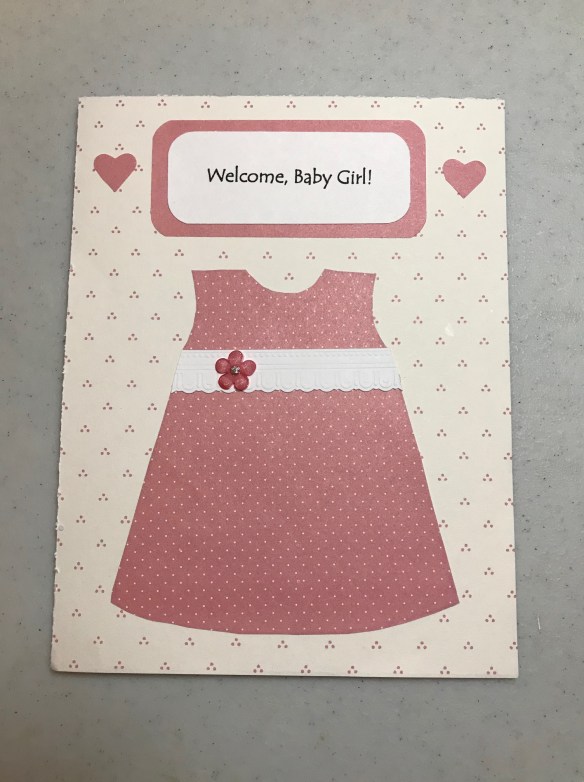
The very next week after the conference, we celebrated my dear husband’s birthday and I had a follow-up appointment six months from my physical (with good results, thankfully). This is the only card I hand-made this month.

IMG_1393

We also celebrated with my middle son his one billionth second of life. πŸ™‚

My favorite Timothyism of the month: Evidently when we get up from a sitting position, we often remark that we “must be getting old.” So one evening as I got up from the dining chair and groaned a little, my four-year-old grandson said, “Are you old now?” Getting there! Much too quickly!

Around the house

After the scheduled events settled down, the activity around the house picked up. The weekend I was away, Jim took up the carpet that was in our bathroom and replaced it with new flooring.

IMG_1439

Much improved! Now the search is on for wall paint and bath mats. The first sample paint we tried was too blue and we’ve yet to try another one. I found some pink and grey striped bath mats, but they looked a little too busy – plus they had all kinds of strings hanging from them after washing them. I think I need mostly solid-colored ones.

Jim’s also been busy transforming the room his mom lived in for the last five years back into his office. We’d had some of her equipment (Hoyer lift, Broda chair) on sale on Facebook and Craig’s list, hoping to recoup some expenses plus get them to someone who needed them. But we didn’t have any takers. Jim has a colleague who was helping some friends, a husband taking care of his wife, and Jim offered to give the equipment to them. At least he had the satisfaction of knowing it was a help to someone.

He took some things off walls, patched and painted holes and dents, and rearranged a few things. He has a way to hook up his computer to her TV, so he has an extra screen. He mounted the TV on the wall to give his desk (an old table) more surface space. My son and daughter-in-law had a photo blown up and printed on wood that my oldest son had taken of the Snake River Canyon when we were in Idaho and given it to Jim on his birthday. They had Romans 8:18 printed in the corner, a verse that was special to us when Jim’s mom passed away. He was able to get that up on his office wall.

I couldn’t get a picture without the shadow of my arms in it – it looks much better in person!

The room is starting to look a lot more like his own space now. I’m so happy for him to have it. Not just because I don’t have to listen to one-sided business conversations any more. πŸ™‚ But he really didn’t have his own spot to work, spread things out and leave them, etc., and now he does.

I don’t usually go on a cleaning frenzy just because of a date on the calendar. But recently I’ve noticed that our kitchen cabinets were in sad shape: dusty inside and out. Plus I needed to create some space for our small blenders (one an immersion blender and the other a “Magic Bullet” type, though not that brand). We had used them several times a day to puree Jim’s mom’s food, and washed them by hand and left them in the dish drainer for the next time. Since we’re not using them so often any more, I needed to find a spot inside for them. I followed my friend Dianna‘s example and just did a section at a time. I started with the easy ones – the cabinets that were already organized but just needed everything taken out and the shelves dusted. Now they’re all done except the biggest two that are going to need the most work. Though my goal was cleaning and rearranging, I have found a few things to get rid of.

Exercise

I’ve been struggling (again) with exercise. I benefit from the gym but hate the traveling time and the time involved changing into special clothes and back – as well as the time it takes just to exercise. But I can tell such a difference in my stamina when I am exercising regularly. So the past week or two I’ve been using some walking DVDs I have at home. Jim has been looking for a used exercise bike – the thing I use most at the gym – and just found one over the weekend. I’ve already put it to use and plan to keep at it!.

Reading

I’ve enjoyed a lot of good reading this month! I’ve finished the following and have linked back to my reviews:

Laura Ingall’s Wilder’s Fairy Poems, compiled by Stephen Hines

The Laura Ingalls Wilder Songbook compiled and edited by Eugenia Garson. Music and a little background of the songs mentioned in the Little House books.

Becoming Mrs. Lewis: The Improbable Love Story of Joy Davidman and C. S. Lewis by Patti Callahan, a fiction based-on-fact account of C. S. Lewis’s wife.

Steal Away Home: Charles Spurgeon and Thomas Johnson, Unlikely Friends on the Passage to Freedom by Matt Carter and Aaron Ivey, another fictional book based on the true friendship of C. H. Spurgeon and a freed slave, Thomas Johnson.

Saving Amelie by Cathy Gohlke, a novel about the daughter of an American genetic scientist who hides and saves the deaf daughter of a friend. Excellent! My first book by Gohlke, but not my last.

Love Is Not a Special Way of Feeling, a reprint of Charles G. Finney’s Attributes of Love by another name. Difficult to read, and I disagreed with several points, but did glean a few helpful thoughts.

She Makes It Look Easy by Marybeth Whalen, about a “perfect” friend who is not really so perfect after all.

The Wednesday Letters by Jason F. Wright, a novel about a family’s discovery, after their parents’ deaths, that the father had written a letter to his wife ever Wednesday of their 39 years together.

I’ve just finished but have not yet reviewed The Fashion Designer by Nancy Moser and How Green Was My Valley by Richard Llewellyn.

I’m currently reading Booked: Literature in the Soul of Me by Karen Swallow Prior, How to Understand and Apply the New Testament by Andrew Naselli, The Pickwick Papers by Charles Dickens, and I’ll Watch the Moon by Ann Tatlock.

Around the blog

Besides the book reviews and weekly Friday’s Fave Fives, I’ve shared:

And that wraps up another month!

(Shannan invites us to share our end-of-month round-up posts, what we’re into, what’s keeping us sane. Also sharing with Literary Musing Monday, Woman to Woman Word-filled Wednesday, Quick Lit)

Laudable Linkage

Here are a few interesting reads found on the web lately:

Next in the Sexual Revolution: Children. HT to Proclaim and Defend. “They claim children are sexual beings too and who are we to deny a consenting child that right?” Scary and appalling.

Matthew 18 is Not Instructive for Book Reviews, But Much of the New Testament Is, HT to Challies. β€œβ€˜Did you contact the author privately before you posted the review?’ . . . The question invokes the well-known, but oft-misunderstood, church discipline passage in Matthew 18:15-20.”

The Miracle That Can Happen When You’re Tired. “They were tired. They were overworked. They were hungry. Which just so happens to be the perfect time for God to display His power.”

Who Says Social Media Can’t Make You Wise? HT to True Woman. “Ten years of social media has shown me the wisdom of being slow to speak, how comparison kills joy, how in-person friendship knows no substitute. But it has also taught me the sweetness of the well-timed word of encouragement, of shared celebrations and shared losses. Used wisely, a virtual platform can actually minister. For those indwelt by the Spirit, wisdom can be unearthed from even such common soil as social media.”

14 Stunning Illustrations That Perfectly Capture the Introverts Love of Books, HT to Linda

The $8,000 Mistake All Bloggers Should Beware. I forget where I saw this one. “Copyright laws have created and enabled an industry of predatory lawyers – also known as copyright trolls. These attorneys take advantage of photographers and artists who make their images available online, as well as the bloggers who don’t know any better and post the wrong content to their sites.” Apparently they don’t have to warn you first and give you a chance to take it down. We all know (or should) that just because a photo is on the Internet doesn’t mean we can use it. But apparently some of the instances we thought were ok, like a link back to the original site, don’t justify the use of the photo.

You’re Using a Cutting Board Incorrectly, HT to Challies. I never knew! But it makes sense!

And, finally, someone on Facebook posted this video of a baby trying chocolate milk for the first time. Adorable!

Happy Saturday!

Friday’s Fave Five

It’s Friday, time to look back over the blessings of the week with Susanne at Living to Tell the Story and other friends.

Here are a few of my favorite things from the last week:

1. Jason’s one-billionth second. Somehow my son Jason had determined a while back that his one-billionth second of life would occur this week. So Mittu, his wife, cooked up a little surprise celebration and asked us over for it. Fun!

My grandson had not known we were coming, and he was out with his dad in the front yard riding his tricycle as we approached the house. As soon as he realized it was us, he started pumping his arms up and down, then started tapping my door after we parked, and gave me a hug as soon as I got out of the car. There’s nothing like being so warmly greeted by a sweet little boy.

2. Good news. My oldest son is looking to buy his first home, and we’ve enjoyed reports that the process is coming along. Especially good was that his credit number was better than when he first looked at it – turns out if you have a dispute over a charge on your credit card, that card isn’t listed in your credit report. Thankfully, on the second check, his number was back up there where it should be.

3. An insulated drink holder. I recently discovered this. My soft drinks tend to lose their coldness too soon. I don’t like to use ice, because it dilutes them. This helps!

4. More out-of-the-ordinary tasks accomplished. I don’t spring clean per se, but lately I’ve noticed my kitchen cabinets looking dusty inside and out. Last Saturday I cleaned the outside of all of them. I’m taking the insides a bit at a time and have gotten most of the upper cabinets done. It’s a nice feeling to be getting that done.

5. Fluffy pillows. I *love* how my pillows feel just after I’ve washed and dried them.

Happy Friday!

Book Review: The Wednesday Letters

Jack and Laurel Cooper were married for 39 years. The last few years they’ ran a bed-and-breakfast in VA. Jack had been battling cancer and knew his time was short. Laurel had heart issues they were both unaware of. At the end of the first chapter, Jack and Laurel died in each other’s arms.

The Coopers had three adult children. Matthew, the oldest, is a tightly wound businessman. Samantha, the only daughter, is a police officer who originally wanted to be an actress. Malcolm, the youngest, is a bit of a wild card, living in South America and writing a book at the time of his parents’ deaths.

As the three converge at their parents’ place and start going through papers, they discover a collection of letters. They had never known that their father wrote a letter to their mother every Wednesday of their marriage. Some are fun (especially one about a chance meeting with Elvis). Some recall daily or major events, some are silly, some are poignant. Some reveal deep and painful secrets that are of particular consequence to Malcolm. Can he forgive as his parents forgave?
___

I first saw this book advertised in the Victoria Trading Company catalog and thought it sounded interesting. Because it was in that catalog, I thought it would be from the Victorian era. Instead, it’s set in 1988. I don’t often take chances with modern secular fiction, unless I have heard favorable reviews from someone I trust, because it usually contains bad language or explicit scenes. But I decided to go ahead with this book. And I was pleasantly surprised. There were no objectionable elements, and the story was well-written and touching with an undercurrent of faith.

I did not know until after I finished the book and was looking for more information that the author is a Mormon. I have serious disagreements with much Mormon doctrine, but I didn’t pick up on anything of that nature in the story.

Book Review: She Makes It Look Easy

In the novel She Makes It Look Easy by Marybeth Whalen, Ariel Baxter is a stay-at-home mom and photographer. Her photography side business has taken off to such a degree that she and her husband can afford a nice new home in a neighborhood she has dreamed of living in for years. Though Ariel has her gifts, her life and home are disorganized and chaotic.

Through my lens I watched the dynamic of friendship play out among Heather and her friends: the familiarity laced with timidity, the chance to open up paired with the fear of being exposed, the awkward dance of really knowing another person. . . somehow the girls always found a way to come back together, to find what made them stick and hold on to that. I envied their natural rapport, the ease that can only come with time together. How ironic, I thought as I focused and clicked, that these girls already had what I couldn’t seem to find.

Ariel’s neighbor, Justine is one of those women who has it all together. She’s pretty, fit, perfectly made up for a pool party, her daughters wear matching outfits. She’s organized – she even has an organizing notebook! And she’s creative and speaks to her church’s ladies’ group.

Ariel is delighted that Justine deigns to befriend her and help her start organizing and exercising. As they spend more time together, Ariel is sometimes frustrated that Justine calls the shots in what they do. But she doesn’t want to jeopardize the friendship, so she goes along. She even acquiesces when Justine steers her away from another neighbor, Erica, whom Ariel actually likes.

As events unfold, we see that Justine’ life is not as perfect as everyone else thinks. She may be organized, but her happiness, marriage, and spiritual life are facades.

We had been living in denial for months, fooling ourselves into thinking that we were safe if we stayed inside the bubble of our affluent neighborhood, not realizing that’s the problem with bubbles: They shimmer and shine, but they burst easily.

I think we all have a little bit of Eve in us. She had perfection and everything she could ever want and still she reached for more.

I fell asleep praying for the strength to do what was right and for God to guard me from situations that could land me in the same situation Justine had gotten herself into. I was learning we all need protection from ourselves.

The not-so-subtle theme of the book is that no one is perfect and we shouldn’t put people up on pedestals. No matter how great everything looks on the outside, we all have our issues. While I think this is an important point, and we get into a lot of trouble comparing ourselves to each other, I felt the author took the theme and characters to extremes. I don’t think she’s saying that organized, put-together people are bad and disorganized people with messy lives are on the right track, but it almost looks that way in the book.

Another theme is the contrast between healthy and toxic friendships. Justine is the suburban equivalent of the “queen bee” at school whose favor almost everyone seeks and who decides who is “in” and “out.” Ariel’s just glad to be “in” at first and she’s entirely too trusting. Slowly and painfully her eyes are opened to the truth.

Motivations are another key factor. Justine seems to be primarily motivated by finding “happiness,” even if it takes her on a path that she knows is wrong. Her organization, ministries, and everything else were not for God and His glory or to benefit her family and others. They were her personal search for significance.

Some readers would want to know that a couple of characters engage in adultery, but there are no explicit scenes.

Overall, this story uncovers important truths to consider in our friendships, motivations, our evaluation of ourselves, and our walk with the Lord.

(Sharing with Carole’s Books You Loved)

The humility of wisdom

When’s the last time you heard anyone say they needed wisdom? About the only time I hear anyone mention wisdom is in regard to a particular situation. “I need wisdom about this job decision.” I’m praying for wisdom for dealing with Johnny’s continued disobedience.”

But when is the last time we thought about our need for wisdom just to live our everyday lives for God’s honor and glory? We often pray that He will guide us, provide for us, forgive us. But do we pray for wisdom? Do we value wisdom as the Bible does?

Or do we plunge ahead with our day and our plans, thinking we know everything we need to and can make our own choices?

Our church has been reading through Proverbs together the last few weeks. If you’re familiar at all with Proverbs, you know it is all about wisdom. I don’t think there is a chapter that doesn’t mention it. And since we’ve been camped out there, the need for and value of wisdom have been emphasized repeatedly and in varying ways.

A full-scale study of wisdom would take more space than a blog post allows. But what struck me most during this reading is the humility of wisdom.

It takes humility to understand that we need wisdom, that to go our own way often leads us astray.

Trust in the Lord with all your heart, and do not lean on your own understanding. In all your ways acknowledge him, and he will make straight your paths. Proverbs 3:5-6

There is a way that seems right to a man, but its end is the way to death.
Β Proverbs 14:12

The fear of the Lord is the beginning of wisdom, and the knowledge of the Holy One is insight. Proverbs 9:10

It takes humility to search for wisdom, to acknowledged that I don’t have it, and no matter how much I have, I need more.

My son, if you receive my words and treasure up my commandments with you, making your ear attentive to wisdom and inclining your heart to understanding;Β  yes, if you call out for insight and raise your voice for understanding, if you seek it like silver and search for it as for hidden treasures, then you will understand the fear of the Lord and find the knowledge of God. Proverbs 2:1-5

It takes humility to receive and instruction, and even more to receive rebuke. I was familiar with one or two verses about it being wise to receive reproof,Β  but I’ve noted 19 so far! Here are a few:

Like a gold ring or an ornament of gold is a wise reprover to a listening ear. Proverbs 25:12

The ear that listens to life-giving reproof will dwell among the wise.
Whoever ignores instruction despises himself, but he who listens to reproof gains intelligence.
The fear of the Lord is instruction in wisdom, and humility comes before honor. Proverbs 15:31-33

By insolence comes nothing but strife, but with those who take advice is wisdom.
Β Proverbs 13:10

If someone tries to correct us, is our first response, “I better take heed: I might gain some wisdom from this?” No, our first response is anger with thoughts of “Who do you think you are?” and “Don’t judge me!” But the Bible says the wise person listens and learns. By contrast, “A scoffer does not listen to rebuke” (Proverbs 13:1) and “He who hates reproof is stupid” (Proverbs 12:1).

It’s scary to think of the personal consequences of rejecting reproof: it’s even more scary to realize that my lack of listening to instruction can negatively affect others. “Whoever heeds instruction is on the path to life, but he who rejects reproof leads others astray” (Proverbs 10:17).

I wonder if this lack of realization of our need for wisdom is behind our subtle ageism, even in the church. Once when visiting a new church, someone was showing us where the various classes were, and as we passed one door, our guide said, “Oh, you don’t want that one. That’s where the older folks are.” One younger lady told me she didn’t come to our ladies’ meetings because she thought only older ladies attended – even though at that time most of the attendees were just in their forties. Instead of deeming older people as worthy of our time and drawing on their wisdom, we label them out of touch, too slow, not “with it.” Proverbs honors older saints and the value of listening to authorities.

Of course, the need for wisdom runs throughout the Bible, not just Proverbs. One notable passage says:

For I want you to know how great a struggle I have for you and for those at Laodicea and for all who have not seen me face to face, that their hearts may be encouraged, being knit together in love, to reach all the riches of full assurance of understanding and the knowledge of God’s mystery, which is Christ, in whom are hidden all the treasures of wisdom and knowledge. I say this in order that no one may delude you with plausible arguments. Colossians 2:1-4.

May we continually seek Him and His wisdom through His Word.

IMG_1422

(Sharing with Inspire Me Monday, Literary Musing Monday, Tell His Story, Let’s Have Coffee, Porch Stories, Wise Woman, Faith on Fire, Grace and Truth. Links do not imply complete endorsement)