Unknown's avatar

About Barbara Harper

https://barbarah.wordpress.com

When People Say Thoughtless Things

When people say thoughtless things

In the twenty-some years I’ve read blogs, I’ve come across several posts about what not to say to people in certain situations. I found these articles helpful and eye-opening.

For instance, many single people really don’t like being asked why they aren’t married or dating anyone. They may be wondering the same thing. They may be hurting and lonely. Or they may be postponing dating in their current season of life.

Likewise, it’s not usually wise to ask a young married couple when they are going to have children. They may be trying. They may have had miscarriages. They may want to but can’t afford to yet.

It’s never wise to ask any woman when she is due unless you know she is pregnant. In my young married years, loose dresses with no belts or waistlines were fashionable, leading to many mistaken conclusions.

When my husband and I were dating in college, we returned from summer and Christmas breaks to friends asking if we were engaged yet. I was spending much thought and time in prayer trying to discern if that was God’s will for us. I felt uncomfortably pressured by all the questions and expectations.

Sometimes we’re not trying to be hurtful, but we’re just thoughtless in our speech. Years ago, friends with the last name of Fox had their first child. When I saw them at church I smilingly quipped the verse about “little foxes spoiling the vine.” The husband looked at me wearily and said, “Everyone says that.” I instantly realized what a thoughtless, inane, and even unkind statement that was, and later was convicted that it was a horrible misuse of Scripture.

Many of these questions are plainly none of our business. Some cause pain even if we mean them as a lighthearted inquiry. Ephesians 4:29 reminds us, “Let no corrupting talk come out of your mouths, but only such as is good for building up, as fits the occasion, that it may give grace to those who hear.” We need to be careful, thoughtful, prayerful, and edifying in what we say.

Yet, not everyone will see articles like the ones mentioned. Someone will inevitably say something that rubs us the wrong way. What then?

Avoid sarcastic comebacks. It can be tempting to strike back. But most times, people don’t realize they’ve said something hurtful. Sending back a zinger will only escalate the incident.

Give the benefit of the doubt. Most people truly do mean well. If they are trying to say hurtful things on purpose–then we need to have a different kind of conversation with them.

Appreciate their interest. At least they are interested in our lives and they’re not ignoring us.

Educate if needed. If they’ve never been in our situation, of course they are not going to understand. A friend whose child had life-threatening allergies has often had to shed light on common misconceptions and weather all kinds of misinformed comments about allergies.

Realize sometimes we’re the problem. Sometimes something is meant well but we take it the wrong way.

View the opposite end of the spectrum. Sometimes, people are so afraid of saying the wrong thing that they say nothing. We can foster that by too much complaining about the wrong things that have been said.

Give them grace, the same grace we would want people to extend to us if we said the wrong thing…because we likely will at some point. In fact, we probably have at some time without realizing it.

Confront or overlook. If someone has been truly hurtful, we may need to talk to them privately about why their comment caused pain and try to resolve the issue. (Matthew 18:15: “If your brother sins against you, go and tell him his fault, between you and him alone. If he listens to you, you have gained your brother”).

Or we may decide just to overlook the comment (I Peter 4:8: “Above all, keep loving one another earnestly, since love covers a multitude of sins”; Proverbs 10:12: “Hatred stirs up strife, but love covers all offenses”).

Whether we confront or overlook, we need to deal with it one way or the other and let it go. We shouldn’t hold it against them, carry a grudge, let it fester, become bitter, or avoid them afterward.

We need to forgive on the basis of the great wrongs we have been forgiven, not on the basis of whether or not they “deserve” it (See Matthew 18:20-35). We didn’t deserve God’s forgiveness, and He has forgiven us so much more than anything anyone has done or said to us. (Matthew 6:14-15: “For if you forgive others their trespasses, your heavenly Father will also forgive you, but if you do not forgive others their trespasses, neither will your Father forgive your trespasses”).

We need to exercise patience and forbearance. (Colossians 3:12-13: “Put on then, as God’s chosen ones, holy and beloved, compassionate hearts, kindness, humility, meekness, and patience, bearing with one another and, if one has a complaint against another, forgiving each other; as the Lord has forgiven you, so you also must forgive”; Ephesians 4:1-3: “I therefore, a prisoner for the Lord, urge you to walk in a manner worthy of the calling to which you have been called, with all humility and gentleness, with patience, bearing with one another in love, eager to maintain the unity of the Spirit in the bond of peace”).

We need to be filled with and manifest the fruit of the Holy Spirit: (Galatians 5:22-23: “But the fruit of the Spirit is love, joy, peace, patience, kindness, goodness, faithfulness, gentleness, self-control; against such things there is no law”).

It’s not that we can never discuss the sensitive topics like those mentioned at the beginning of this post. But we need to think before we speak and consider whether what we’re about to say is wise or helpful. We need to take into account the timing, setting, and our relationship with the person. We need to ascertain if we’d do better to be quiet or talk about another topic.

Whether we’re the speakers or the receivers, we need to walk closely with the Lord, seek His guidance, and “give grace to those who hear.” (Ephesians 4:29).

Ephesians 4:29

(Revised from the archives)

(I often link up with some of these bloggers.)

Laudable Linkage

Laudable Linkage

I’m happy to share some thought-provoking reads found this week:

No Confidence? No Problem! “I used to think it was important to project confidence when it comes to parenting, and I wanted everyone to think that I had everything under control at all times. But the deeper I have gotten into this lifelong job, the more I have realized how complicated and special each little soul in my care is, and I have learned that there are very few one-size-fits-all philosophies of motherhood. Each child and each phase is its own adventure, with its own set of variables, and I have learned that I need God’s help with each and every bit of it.”

Is ChatGPT Forming Your Faith? “ChatGPT and similar tools have made it easier than ever to locate and interpret Bible verses, to receive guidance on challenging topics, and to get answers to questions we’d normally hesitate to ask out loud. Is that a bad thing? Are the alarms unwarranted? As I’ve talked to friends about their ChatGPT usage and paid more attention to my own, it’s clear that using the latest AI to find answers for our spiritual lives involves a degree of danger that would be foolish to ignore.”

The Devil Hates Context. Use It, HT to Knowable Word. “You can see why the devil left out Psalm 91’s context. Verse 13 preaches his demise. It reveals Christ’s victory over him. I’m sure the devil hates context. So, in our spiritual warfare, in wielding the sword of the Spirit, use the whole weapon—the whole canon—context and all.”

Is Tribalism Bad? HT to Proclaim and Defend. “Why can’t individuals assess the values and ideas held by themselves and others, then socially associate with respect to those shared values? An us-versus-them social landscape emerges for every possible topical issue in our free society because we occupy an idea-versus-idea environment. Rather than shriek about the human impulse to join a tribe, it’s more productive to explain which tribes are worthy of members — and doing so is necessarily a form of intertribal competition. Alternative strategies end up with the self-defeating claim: Join me in the fight against tribalism.”

What Does the Bible Say God Can’t Do? “In the back of my mind I thought I remembered hearing that there were only 2 (or was it 3?) things that God cannot do. I did a quick search online to refresh my memory. Well, I was surprised to find that everyone had a different opinion on how many things God can’t do!”

Ordinary Faithfulness: A Life That Says Come and See. “Life right now is normal. For some reason the thought of this being ‘all there is’ can feel almost startling. But when I take a step back to assess this dread, the Lord uses His Word to whisper a quiet question into my heart. What’s wrong with a life filled with ordinary faithfulness?

The Foibles and Fallibility of Christian Leaders, HT to Challies. “Encourage your leaders, pray for them, help them serve Christ as they serve you, overlook some things just as they overlook the faults you have, confront them with love when necessary if you are prayerful and spiritually-minded and aware of your own sins, follow them as they follow Christ, but don’t idolize them. Encouragement is different than that.”

John C. Broger quote

Learning how to love your neighbor requires a willingness to draw on the strength of Jesus Christ as you die to self and live for Him.–John C. Broger

Friday’s Fave Five

Friday's Fave Five

On Fridays, some of us pause the busyness to think back through the ways God has blessed us this week. Please feel free to join in with Susanne and friends at Living to Tell the Story.

1. Birdbath and fountain. One of my Mother’s Day gifts was a birdbath and solar fountain. Jim was able to set them up this week.

Birdbath

I wanted one that was resin (plastic) rather than metal so it hopefully won’t get too hot. I don’t know if the birds will be interested in the fountain, but we figure it might help algae not develop. So far the birds haven’t shown any interest in it. But I hope they will soon!

2. A celebration of life service for a man in our church. It might sound odd to list this as a favorite–we grieve with the family, especially his wife. But I always enjoy hearing the overview of a person’s life as well as testimonies of his faithfulness and character. His brother spoke, and their testimonies were intertwined. I hadn’t heard them before and marveled at how God worked to bring them to Himself.

3. Impromptu lunch with Jason, Mittu, and Timothy on Saturday at Kern’s Food Hall. Jim and Mittu got Indian food; Jason got a burger and fries; Timothy and I got pizza.

4. Church-wide lunch Sunday. It was nice to have lunch taken care of and visit with people while eating. They had chili along with chips, vegetables, and cheese. The kids were manning the serving tables, and Timothy’s job was to keep the chip bowls refilled. 🙂

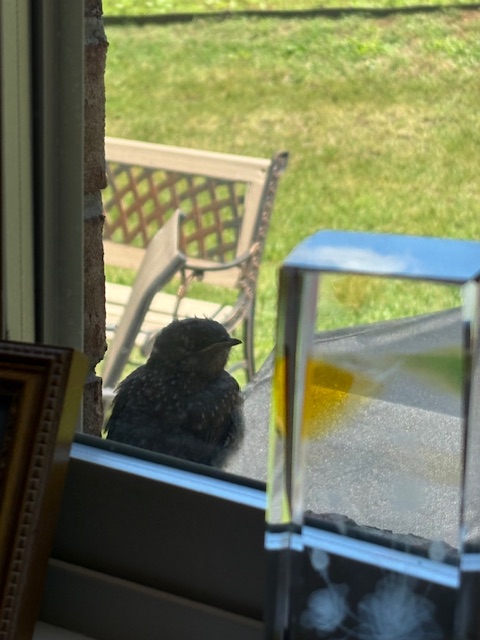
5. Bird visitors. As I went to the sink yesterday, I saw a little bird perched on the windowsill.

Bird

He was there quite a while–maybe an hour or more. Finally, his mom or dad brought him something to eat. Jim got this photo:

Birds

We think the baby either fell or was blown out of the nest a little too early or was trying to fly and got waylaid by the wind. It was fun to watch them while they were so close by.

And that wraps up another week! How was yours?

Testing

Testing

For most of my husband’s professional career, he worked as a lab technician and then a lab manager, first in the textile industry, then in plastics.

Part of lab work involved troubleshooting problems as they came up. But when the company developed new products, they had to be tested.

In automotive textiles, for instance, fibers and fabrics need to maintain their color despite being hit with bright sunlight for years. So the lab had a weatherometer to simulate so many days of sunshine to see how soon the fibers would fade.

Other tests involved metameric properties: looking the same color in different lights. Automobile manufacturers wanted a car’s color to look the same in sunlight, under the showroom’s fluorescent lights, and in the homeowner’s garage with incandescent lighting. There was a brief exception to this for a time when some cars were deliberately painted to look like they changed colors as they passed. But even then, I believe the interior colors remained the same.

Fibers were also tested for tensile strength: their ability to be stretched or pulled without breaking.

Sometimes were tests were diagnostic. The technicians needed to know the properties of the fibers to discover their weaknesses in order to strengthen them or improve them.

God might test people for the same purposes. He knows our weaknesses and whether we will pass or fail our tests. But often we don’t know until we fail. Like Peter before Jesus was arrested, we feel confident in our devotion to Him. We’re even warned to watch and pray, and, like Peter, fall asleep instead. And then when the temptation comes, we fall on our faces and weep bitterly.

But when we fail a test, God doesn’t reject us or pull us off the assembly line. He uses the failure to make us aware of our need for dependence on Him. If we respond in the right way, we draw even closer to Him because we realize how much we need Him.

However, some tests don’t expose weaknesses: they reveal strengths. Manufacturers like to advertise that their products have passed tests. College entrance exams show that a student is ready to handle the challenges of university learning. Military, police, and firemen all have to pass rigorous tests to prove they can handle their jobs.

When God pointed out to Satan that Job was a righteous, godly man, God knew how Job would respond. Though knocked to the dust in sorrow and coming to some wrong conclusions, Job’s faith never faltered. Even when he questioned God, he was still expressing trust in him. His example of facing intense suffering has encouraged Christian for centuries.

Likewise, Joseph endured the cruelty of his brothers, being sold into slavery, falsely accused, and forgotten, with a grace few of us could manage. His conclusion that God meant for good what his brothers meant for evil has helped many Christians come to the same understanding and to trust God even when life seems unfair and doesn’t make sense.

Sometimes our tests are not just for us. When we see how others weather their tests, we’re encouraged that surviving and thriving are possible. That’s why we listen when someone like Joni Eareckson Tada speaks. She’s been through the fire and found God faithful and good.

Being a good testimony through our tests doesn’t mean putting up a smiling front or keeping a stiff upper lip. The psalmists poured out their confusion, frustration, and fears to God. It helps to read that others have wrestled with the same questions and feelings we do. That’s part of their testimony as well as the resolutions they come to.

If fibers were sentient, they might consider the tensile test was torture. But the technician isn’t being cruel. He doesn’t want to destroy the fiber. He doesn’t want it to fail. He has every hope that it will pass the test so that it can perform the function for which it was created.

God does not test us in a clinical or dispassionate way. He has our best interests at heart. He wants us to grow and develop in the best way we can. Like a parent, coach, or teacher, He stretches our endurance so we may grow stronger and more dependent on Him. He wants to show others, through us, that His grace is sufficient.

The Bible encourages us to endure testing joyfully:

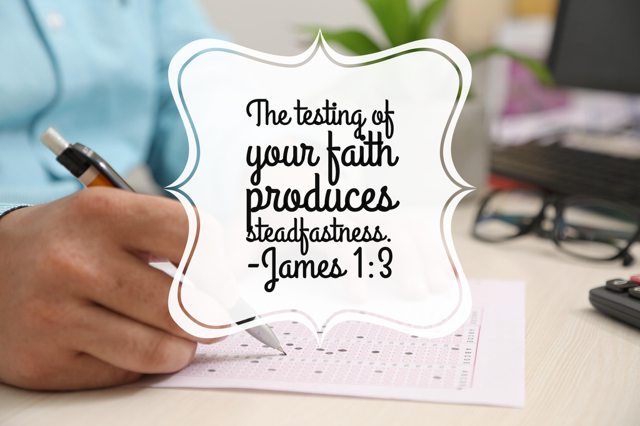
Count it all joy, my brothers, when you meet trials of various kinds, for you know that the testing of your faith produces steadfastness. And let steadfastness have its full effect, that you may be perfect and complete, lacking in nothing (James 1:2-4).

In this you rejoice, though now for a little while, if necessary, you have been grieved by various trials, so that the tested genuineness of your faith—more precious than gold that perishes though it is tested by fire—may be found to result in praise and glory and honor at the revelation of Jesus Christ (1 Peter 1:6-7).

We rejoice in our sufferings, knowing that suffering produces endurance, and endurance produces character, and character produces hope, and hope does not put us to shame, because God’s love has been poured into our hearts through the Holy Spirit who has been given to us (Romans 5:3-5).

And when the tests are over:

And after you have suffered a little while, the God of all grace, who has called you to his eternal glory in Christ, will himself restore, confirm, strengthen, and establish you (1 Peter 5:10).

Blessed is the man who remains steadfast under trial, for when he has stood the test he will receive the crown of life, which God has promised to those who love him (James 1:12). 

Will our faith remain vibrant, or fade under pressures and trials?

Will our colors remain true, or change with circumstances?

Will we endure without breaking?

Not in our own strength. But I can do all things through him who strengthens me” (Philippians 4:13).

May God give us grace to endure testing for His glory.

James 1:3

(I often link up with some of these bloggers.)

Laudable Linkage

Laudable Linkage

I have quite a long list of links that piqued my interest to share this week. I hope you’ll find some useful reading here.

Occasionally I like to repeat the reminder that links don’t imply 100% endorsement of everything on a site.

What Does Trouble Do? “To live is to experience trouble. There is no path through this life that does not lead through at least some kind of difficulty, sorrow, or trial—and often through a cornucopia of them. This being the case, we rightly wonder: What does trouble do? Though we may not see an answer in the immediate circumstances of our lives, we can begin to put one together as we look at the lives of other believers.”

On Mother’s Day, Rinse and Repeat with Truth. This is one of my favorites from Michele–good not just for moms and not just on Mother’s Day. “As mothers, as women, as grace-dependent creatures, we rely on the cleansing properties of God’s Word as it removes the gunk, as it scrubs away the Slime that the culture leaves in our thoughts and our habits. And since we are constantly swimming in lies, we constantly need the truth before our eyes, in our ears, and in our minds to counteract the Slime.”

Tell the Truth About Children, HT to Challies. I’ve been considering writing a post about the worth of children. This author does an admirable job. “Perhaps we zealously undertake the rescue mission of motherhood while our hearts still cling to the names the world reserves for children: Chaos. Burdens. Busyness. Craziness. But God bestows on them different names: Heritage. Power. Blessings. Gifts. Our children do not need to ‘grow up’ to earn given titles. Rather, mothers’ hearts need to hear afresh God’s words about children.”

When Prayer Starts With Panic, HT to Challies. “Notice what Paul actually says. He does not say, ‘don’t feel anxious and then pray,’ but rather, ‘in everything, by prayer and supplication… let your requests be made known.’ It’s a call to bring our panic into conversation with God, while it’s still happening. And he even includes thanksgiving, not as a command to pretend, but as a practice to remind ourselves that God’s character remains steady—even when everything else feels fragile.”

When Christ Is En Vogue, Christians Beware, HT to Challies. “I want to have the perspective of Paul, that ‘whether in pretense or in truth, Christ is proclaimed, and in that I rejoice. Yes, and I will rejoice’ (Phil 1:18). But with this widespread cultural acceptance comes a level of danger. I want to give three warnings about the dangers of Christian popularity.”

Sharpen Your Sword for Victory in Spiritual Battles. “Sometimes we use fleshly methods to deal with spiritual matters, like lashing out when people mistreat us. Situations never end well when we utilize worldly ways. But when we use the Sword of the Spirit—which is the Word of God—we invite the Lord to intervene in our circumstances, and the outcome is different. Do you know how to sharpen your sword? It’s crucial we understand how to skillfully use and maintain the Sword of the Spirit.”

Wounded Intercession: Turning Pain Into Prayer. HT to The Story Warren. “What we see in these examples is something deeper than mere forgiveness. It’s wounded intercession: taking the wounds inflicted on us by others and turning the pain into prayer.”

On Silence During Chaos. This post is the fifth in a series by Dan Olinger about caution with how we express ourselves over political issues or news in public forums.

17 Gospel Encouragements to Overcome Barriers to Biblical Hospitality. “Hospitality is a beautiful calling, but sometimes the reality of our lives looks very different from the picture we have in our minds. We might feel like our circumstances create barriers to offering the kind of welcome we long to extend. What if biblical hospitality is simply about welcoming others as Christ has welcomed us? Many barriers to hospitality can be overcome by embracing the gospel and looking to Jesus as our example.”

How Moms Can Care for Women Experiencing Infertility, HT to Challies. “The weight of infertility is heavy, and those experiencing it need all kinds of women in the body of Christ to help carry their burden (Gal. 6:2). If you’re a mother who hasn’t experienced infertility, you can still minister to women navigating it. There are no magical words to say, but in my experience, some attitudes and actions can be a soothing salve to a wounded heart.”

Why Boys No Books? Though the topic of this post is why boys don’t read, I was especially interested in a discussion there about an essay C. S. Lewis wrote on chivalry. He says men are mostly divided into the warrior/jock type (which he calls “stern”) or the nerd/artist type (which he calls “meek”). But every now and then comes a man who is a blending of the two, which he calls a “knight,” which this author says is “A Davidic kind of man with gentle hands that can deftly strum a harp, or chop off Goliath’s head.” He then discusses how reading can help point boys to this ideal.

More Than Skin Deep, HT to Linda. “We’re urged to focus our finite energy on fixing our external appearance, as though that will bring us some sort of deep and lasting life satisfaction. Unfortunately, spending too much precious life energy on the externals is … exhausting. And although I enjoy feeling reasonably put together as occasion warrants, I really don’t want to spend my remaining lifetime on a fruitless quest to look like the me of thirty years ago.”

Job’s Friends Versus Bob’s Friends. I mentioned a few weeks ago this podcast called Dead Man Talking by Bob Roberts, someone from one of our former churches. He has stage 4 liver cancer and wanted not to “waste” it, so he and four friends from college days meet to discuss various facets of what he is learning and going through. Someone suggested the subject of Job’s friends compared to Bob’s as a joke, but a valuable discussion grew from there. I linked to the YouTube version, but the podcast is also on Spotify and Apple podcasts.

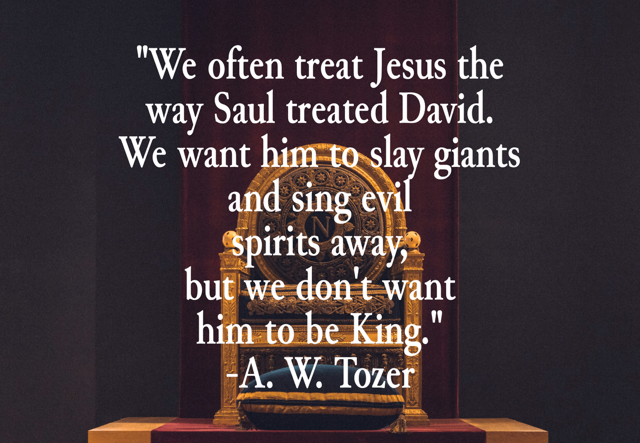
“We often treat Jesus the way Saul treated David. We want him to slay giants and sing evil spirits away, but we don’t want him to be King.” – A.W. Tozer

Friday’s Fave Five

Friday's Fave Five

Well, it’s been a week! It’s good to pause amidst the busyness and reflect on the blessings God sprinkles throughout our days. We share some of those blessings each week with Susanne and friends at Living to Tell the Story.

1. Safety in a medium earthquake. Saturday morning around 9, I was sitting at my desk when I heard a rumbling sound. As I tried to figure out what it was, the house started shaking and I heard a loud crack somewhere. Then everything went still, though the rumble took a while to fade out. Immediately, Facebook and other neighborhood forums were filled with posts asking, “Was that an earthquake?” It was! A 4.1 magnitude centered about 30 miles from us. I looked up some information afterward and found that damage doesn’t usually occur until an earthquake is 5.5 and above. And I hope I am never in one stronger than this one! It was very disconcerting, but I am glad no major damage was reported.

2. Mother’s Day breakfast. Saturday night, Jason and Timothy brought over a breakfast Mittu had made for us to warm up for Sunday Mother’s Day breakfast: quiche, potatoes, mangoes, and banana bread. It was good! And I was able to sleep a little longer since all I had to do was warm things up.

Mother's Day breakfast

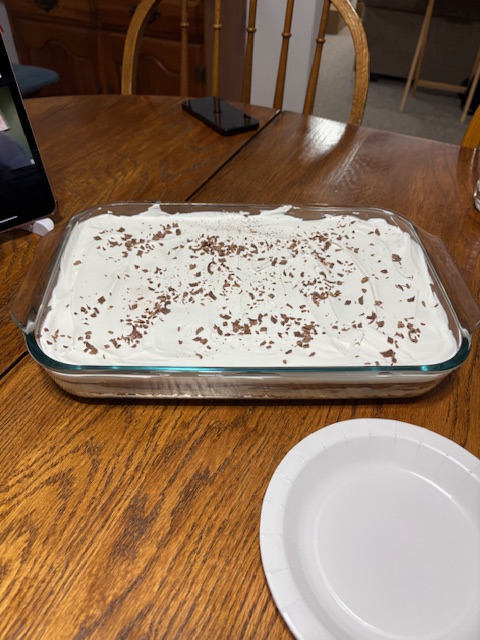
3. Mother’s Day. My family always goes above and beyond to make Mother’s Day special. Jim grilled burgers and turkey sausage. Mittu made what I call Four-Layer Dessert (like this recipe except we make a graham cracker crust), but she calls Chocolate Lasagna. It’s good by any name!

Mother's Day feast
Chocolate dessert

I received cards and flowers and treats and thoughtful gifts.

Mother's Day flowers and cards

And a Crumbl cookie. 🙂

Crumbl cookie

4. Dishwasher duty. I think Jim and the boys took care of the dishes Sunday, though Mittu may have as well (I remember hearing Jim ask, “Why is Mittu working? 🙂 ). But Monday morning, when I got up, Jim was unloading the packed dishwasher and dish drainer as well.

5. Phone call with a friend recuperating from an accident a few weeks ago. It was good to hear her voice and learn directly how she was doing.

I hope you had a great week!

Review: Crimson Roses

Crimson Roses

In Grace Livingston Hill’s novel, Crimson Roses, Marion Warren has been taking care of her ill father for five years. They had always planned that she would go to normal college and become a teacher, until his accident.

Now he has passed away. They had discussed that she would have the house and her brother the life insurance money. But a will can’t be found. So her brother, Tom, feels the best thing to do is sell the house and buy a farm in Vermont (which his wife strongly wants to do). They plan that Marion will always have a home with them, where she can help with the housecleaning and teach their children (basically, act as unpaid live-in help).

Marion’s practical mother, who died years before, always called her husband a visionary, not necessarily meaning it as a compliment. Marion takes after her father, while Tom is more like their mother. Marion mildly protests that she doesn’t want to live on a farm in Vermont, she wants to stay in the city, go to school, attend lectures and concerts and such. Tom says these are “foolish notions,” and she’s too old to go to school now anyway. Tom and his wife, Jennie, think that Marion is just being grumpy and will come around by the time they leave.

As Marion considers her options, she truly feels it’s best for her to stay in the city. Since Tom and Jenny won’t listen, Marion finds a job and small apartment on her own. She plans not to take any of her father’s assets so they will be able to buy their farm.

When they find out her plans, there is a big blow-up. Jennie (who gets my nomination for worst sister-in-law ever) feels Marion is being selfish. Tom finally concedes that the only way Marion will learn is to let her have her way. In time, when she realizes she can’t make it on her own, she’ll come to the farm with them.

But Marion thrives in her new situation. She’s been out of circulation for several years while caring for her father, and some of her coworkers help her update her look and clothes. Marion draws a line at some of their suggestions, though, not wanting to look like a “flapper.”

Marion’s intense loneliness almost sends her to Vermont. But she hears of a local weekly symphony concert series. If she manages her money carefully, she can afford it.

On the night of the second concert, Marion finds a beauitful crimson rose on her seat. Thinking the rose has been placed there by mistake, she tries to find who it belongs to. But no one claims it. She decides to take it home and enjoy it.

But the next week, a crimson rose is again at her seat. And the next week, and so on throughout the concert series.

Later in the book, when a young man shows interest in Marion, some “mean girls” in the church think Marion’s station is beneath his and act unkindly toward her (fueled by the interest in one of the girls in the young man).

This book was published in 1928, and, of course, is very old-fashioned in style and content. It’s a clean, sweet story–maybe a smidgen too sweet, but just a smidgen. Some of the 20s slang is amusing.

Marion seems a little naive for a twenty-three year old young woman. But that might have been the case in those times. Plus she had been mostly at home for five years.

The theme of the story might be that faithfulness wins out in the end. Through all her tribulations, though Marion struggles, she remains humble and sweet and tries to do the right thing.

I listened to the audiobook nicely read by Anne Hancock. Though the audiobook was released in 2024, the narrator’s style and accent matched the setting in the book.

(Sharing with Bookish Bliss)

Joys and Sorrows of Mother’s Day

The Joys and Sorrows of Mother's Day

Mother’s Day is fraught with mixed emotions.

It’s good to honor mothers. The Bible does. One of the ten commandments tells us to honor our parents. Motherhood has taken a beating by society over the last several years. Moms carry a heavy load, often unseen and unappreciated. They need all the encouragement and support they can get.

But Mother’s Day is profoundly sad for others.

Some grieve the death of their children, or their estranged children or wayward children.

Some have mothers who are still here physically but far away mentally or emotionally, mothers who rarely, if ever, showed love, mothers who abandoned them, mothers who have died. For those who feel abandoned or unloved by parents, may you truly know “When my father and my mother forsake me, then the LORD will take me up” (Psalm 27:10).

Some would love to be mothers, yet God has not granted that request. Mother’s Day only adds to their pain. I appreciate Wendy Alsup’s thought that “God uses both the presence and the absence of children in the lives of His daughters as a primary tool of conforming us to Christ.”

Some moms grieve that their families don’t acknowledge this day at all, and they feel more taken for granted than ever. Erin has some good advice for managing expectations.

Some downplay the day. They would rather have their family appreciate them year-round, not just on a certain designated day. And, true, it doesn’t make sense to disrespect someone every other day and then buy them flowers and a card on Mother’s Day. But I always look at special days in the same vein as Thanksgiving. Yes, we’re supposed to be thankful every day, but Thanksgiving reminds us of all we have to be thankful for. Jesus’ resurrection impacts our lives every day, but it receives special focus at Easter. So Mother’s Day, Valentine’s Day, or someone’s birthday are just opportunities to tell someone you love that you appreciate them.

For many, all the talk of ideal mothers on Mother’s Day makes them feel their failures all the more. They feel like “perfect mother,” or even “good mother,” are titles they can never aspire to. God took our faults and foibles into account when He made us mothers. He knows we’re made of dust. We confess our sins to Him and lean on Him moment by moment for grace and help and strength to mother as He wants us to. “Let us then with confidence draw near to the throne of grace, that we may receive mercy and find grace to help in time of need” (Hebrews 4:16).

My mother and all of my older mother figures are gone now. I try to honor their memories. I am thankful for so many women who were examples to me and made me a better woman, wife, and mother. I hope I can encourage others as these ladies did me.

For those whose families show their love this day, and for those who have a mother to celebrate today, I wish you joy.

For those who sorrow, I pray for the peace that passes understanding. May His merciful kindness be for your comfort, according to His word unto you (Psalm 119:76).

Proverbs 31:25

(Revised from the archives.)

(I often link up with some of these bloggers.)

Laudable Linkage

Laudable Linkage

I found quite a few thought-provoking reads this week:

How Do I Leave My Sin at the Foot of the Cross? “Whatever it is, even when you’ve consciously given it to Jesus, you wake up the next morning and it’s back. Or it reappears because you gave in to temptation during moments of stress or exhaustion, even though you thought you’d fully surrendered the struggle to the Lord. What then? When you feel caught somewhere between the guilt that clings to you and the truth of Scripture, what does it actually mean to leave a sin struggle at the foot of the cross?”

If You Never Become a Mother: Truths to Anchor Your Hope. “They have learned to rest in truth––the kind that gently offers them a reminder that their value is not tied to motherhood nor do their lives lack meaning, beauty, or purpose. They’re merely grounded in a different kind of fullness.”

William Carey and the Power of a Second Chance. “Sometimes, life does require a ‘do-over.’ A second chance at a project, person, or path in life. Again, these can be frustrating, humiliating, and discouraging, but necessary. William Carey found himself in such a situation.”

Graduate, Step Up to More than the Podium. “When I graduated, I had to rethink what graduation means. I’d come to see it as a finish line, but I needed to see it as a launching pad. The graduate (whether from kindergarten or college) is stepping up from one level of formation, education, and aptitude to another. You may be graduating with a diploma or degree in engineering or nursing, but when you step up to the podium, you shouldn’t neglect to move forward in your Christian walk as well.”

She Forgot Our Names, But Not the Rock of Ages, HT to Challies. “My grandmom’s story taught me about the power of music for remembering and reproducing truth. The songs that Grandmom learned as a barefoot girl in a little mountain church stayed with her – for eight decades. They stayed with her when almost everything else was being forgotten.”

The Woman Who Saved Capitol Hill Baptist Church, HT to Challies. “She did not need a formal leadership role in the church to know that every member has the responsibility to protect a church’s life and doctrine. A sign of a church’s health is not simply how well the church’s leaders know their Bibles but how well the members do.”

The One Life Dream That Makes a Girl Blush, HT to Challies. “But the souls that move in bodies in and around my home? They are a legacy and an investment that I do not ever regret giving it all for. When I’m weary and feeling empty, when my life goals feel lifetimes away and my body isn’t the one I hoped I’d have, I can promise you that I wouldn’t give them up for a thousand trips around the world, a perfect waistline, or a name linked to fame.”

Reading Widely and Well. “The lack of reading and ensuing limited vocabularies lead to a limited ability to interpret rightly and wrestle well with ambiguity. I find students more likely to categorize an author immediately as friend or foe. They quickly determine whether they are supposed to blindly agree with, or set themselves in opposition to, a given text, often as a result of the author’s known or assumed political or religious persuasion. This approach doesn’t require close reading skills; it just requires quick judgment.”

You Don’t Need AI. You Can Just Tell Your Kids Stories. HT to Challies. “In my experience, the biggest challenge to telling bedtime stories is the difficulty of making up a plot and dialogue and characters. This is where A.I. is offering to save you time and effort. Don’t buy it. You can do this.”

Elisabeth Elliot quote about mothers

The process of shaping the child, shapes also the mother herself. Reverence for her sacred burden calls her to all that is pure and good, that she may teach primarily by her own humble, daily example. Elisabeth Elliot

Friday’s Fave Fives

Friday's Fave Five

It’s been a busy, up-and-down kind of week. It’s easy to get stuck in doldrums over the “down” parts, so it helps to remind ourselves of the good parts–which we do every Friday with Susanne and friends at Living to Tell the Story.

1. Ladies’ Luncheon at church. We had a couple of sessions before and after with the theme of telling our stories of God’s work in our lives.

2. A mistake is often not good, but this time it was. We got a weird email, supposedly from our insurance company. But we brushed it off as a scam attempt. The next day we got an email from them thanking us for our conversation that day, with an attachment of an insurance policy. We began to be concerned about identity theft. After some research and phone calls, we discovered the agent had used the wrong email.

3. Valet parking and finding our way. I had an appointment at UT Medical Center this week, which is a huge, confusing complex. Jim offered to drive me and drop me off at the right building while he parked. But we discovered they had valet parking for only $2 more than the parking garage charge would be. Then we had to go in one building to get to another building and felt a bit like rats in a maze, but we found our way in and out without any problems. I’m quite directionally challenged, so I appreciated that Jim drove and then went with me to find the right place.

4. Spring flowers. Jim was looking around the garden section of Home Depot and found some plants marked down. He decided to get several for the planters around the house, thinking that if I didn’t like any of them, he could plant them somewhere else. But I liked them all!

5. Real ID appointment set up. I was concerned that I might not get an appointment before my driver’s license expired–the web site said most appointments are made 90 days out. But, thankfully, I was able to set it in time. I dug up all the appropriate paperwork, so all I have to do with it now is wait for the appointment.

How was your week?