Unknown's avatar

About Barbara Harper

https://barbarah.wordpress.com

God’s Correction Is a Blessing

God's Correction is a blessing.

I recently saw a meme which said that our relationship with God is not about Him pointing out our sin, but about exchanging our hearts with Jesus.

I had to think about that a while.

I’m not sure what the writer meant by exchanging hearts with Jesus. Maybe she was alluding to Ezekiel 36:26, where God says He will remove our heart of stone and give us a heart of flesh.

But what particularly struck me was the downplaying, even the rejection, of the need for God to point out our sin. The thought reminded me of a song that was popular when I was a kid. The singer prays at night during a lonely time. She doesn’t want God to correct, challenge, or chasten her. She just wants Him to listen.

Our relationship with God is more than dealing with sin, of course. But dealing with sin is certainly part of it. Even the allusion to needing a new heart is an indication that all is not right with ours.

No one enjoys having their wrongdoings pointed out. Yet God pointing out our sin is not a negative aspect of our relationship with Him. It’s a blessing. It’s sin that comes between us, hinders our prayers, and clouds our fellowship. When God convicts us of sin, it’s a sign of His love and an opportunity to confess to Him and be forgiven. Proverbs 28:13 says, “Whoever conceals his transgressions will not prosper, but he who confesses and forsakes them will obtain mercy.”

We might think of it a little like this. Suppose a young boy who is old enough to know better kicks a ball around in the house and breaks a window, hits his little sister, skips school, and is found smoking with his friends—and then asks his parents for the latest video game. Most parents would say, “We have some other things to talk about first.”

The parents correct the child not just because he’s not living up to their standards or embarrassing them in front of the neighbors, but for his own good. A child who is never corrected by his parents will never learn to say no to himself or rein himself in. He’ll most likely have trouble in school, in his job, and in relationships because he’s never been taught to do anything but have his own way.

We don’t like to be shown that we’re doing something wrong. Everyone having their own “truth” these days makes it even harder to pin down an authoritative right and wrong.

But what about when we are wrong?

If you’re going the wrong direction, wouldn’t you want someone to tell you before you go too far out of your way?

If you are training to be an accountant, wouldn’t you want to work out the mistakes in your calculations so you don’t cost yourself or your client great sums of money?

If you’re a brain surgeon, wouldn’t you want the best training and practice so you’re not a hazard to your patients?

Correction is a fact of everyday life. We’re in a constant state of growth. Learning better ways to do things and treat people involves examining our thoughts, motives, speech, and actions, ferreting out what’s bad, and learning improved ways to think, feel, speak, and act.

The need for correction is even more vital spiritually.

Sin is what originally separates us from God. Isaiah 59:2: “Your iniquities have made a separation between you and your God, and your sins have hidden his face from you so that he does not hear.”

Jesus died on the cross to take care of our sin. 1 John 3:5: “You know that he appeared in order to take away sins, and in him there is no sin.” Galatians 2:21b: “If righteousness were through the law, then Christ died for no purpose.”

Well, you might say, I am a believer. The Bible says “There is therefore now no condemnation for those who are in Christ Jesus (Romans 8:1). So I don’t have to worry about sin any more.

No, that’s not true. I John 1:6-10 says—to Christians—

 If we say we have fellowship with him while we walk in darkness, we lie and do not practice the truth. But if we walk in the light, as he is in the light, we have fellowship with one another, and the blood of Jesus his Son cleanses us from all sin. If we say we have no sin, we deceive ourselves, and the truth is not in us. If we confess our sins, he is faithful and just to forgive us our sins and to cleanse us from all unrighteousness. If we say we have not sinned, we make him a liar, and his word is not in us.

Our sins are forgiven and we’re not under condemnation. But we still have an old nature. After we’re saved, we fight against sin because we have a new nature that wants to please our Father. As we grow in Him, He convicts us of things that are wrong so we might confess them and put them aside. Sin doesn’t sever our relationship, but it does affect it.

Usually after several years of being a Christian, we’ll be convicted about things we never thought of when we were first saved. That’s a blessing: if God dealt with everything in our lives at once, we’d be overwhelmed. As parents, the things we deal with our children at age fifteen will be different, and likely more advanced, than what we dealt with at age five.

Being convicted of our sin does more than prompt us to confess and forsake the sin. It also humbles us and reminds us how much we need to be in God’s Word and to rely on Him for our daily walk.

A. W. Tozer said, “We must allow the Word of God to correct us the same way we allow it to encourage us.” “All Scripture is breathed out by God and profitable for teaching, for reproof, for correction, and for training in righteousness, that the man of God may be complete, equipped for every good work’ (2 Timothy 3:16-17). Multitudes of verses in proverbs tell us that wise people receive corrections, but fools don’t listen.

Like the psalmist, we need to regularly invite God to “Search me, O God, and know my heart! Try me and know my thoughts! And see if there be any grievous way in me, and lead me in the way everlasting” (Psalm 139:23-24). “Examine me, O LORD, and prove me; Try my mind and my heart” (Psalm 26:2). Paul tells us to examine ourselves before taking communion.

God “disciplines us for our good, that we may share his holiness. For the moment all discipline seems painful rather than pleasant, but later it yields the peaceful fruit of righteousness to those who have been trained by it” (Hebrews 12:10b-11).

We don’t approach a stern judge who is ready to bang his gavel. We come to one who sympathizes with us in grace. “Since then we have a great high priest who has passed through the heavens, Jesus, the Son of God, let us hold fast our confession. For we do not have a high priest who is unable to sympathize with our weaknesses, but one who in every respect has been tempted as we are, yet without sin. Let us then with confidence draw near to the throne of grace, that we may receive mercy and find grace to help in time of need” (Hebrews 4:14-16).

So don’t search the Bible or pray only for assurance and affirmation. Let God’s Word and Spirit do their sanctifying work of searching you and correcting you. The process may not be pleasant, but His cleansing ultimately brings great peace and joy.

(I often link up with some of these bloggers.)

Laudable Linkage

Here are a handful of thought-provoking reads found this week:

A Life-Giving Brain Cancer, HT to Challies. “In July of 2022, I was diagnosed with a tumour in the left frontal lobe of my brain; what doctors termed the eloquent, dominant brain. … Six months later, I am glad to have completed active treatment, and excited for a second future. In fact, I’ve never been happier or felt more blessed than I do right now, and I’m eager to share with you why.”

Is It God’s Will to Always Heal Us? “Instead of assuming God wants us healthy, we need to realize that He may accomplish higher purposes through our sickness rather than our health.”

Not at Odds: Revival and Routine Faithfulness. “A true revival therefore will never diminish the necessity of routine faithfulness. Sadly, many Christians unintentionally pit revival fruitfulness against ordinary faithfulness. We celebrate one and downplay the other. Revival and routine, however, are not mutually exclusive. We should pursue and value both.”

Revival and Bad Theology, HT to Challies. “I would expect revival to be a bit of a mess because it will be a place under tremendous spiritual warfare. If God is moving, so is the enemy, but this is not my point. My point is that I would never expect a place where revival or reformation is breaking out to have all their theology perfect. Theological maturity comes in time through the study of the Scripture.”

Rethinking the Value of Potential. “I’ve noticed that a common pro-life talking point needs reforming. Often we’ll hear Christians say things like, ‘We probably aborted the person who would have found the cure for cancer’ or ‘You don’t know–you could be aborting the next great world leader’ or ‘the next great artist/musician/preacher.’ You get the point. Theologically, there are a couple of issues with this type of talk, but I’m going to focus in on what these statements say about the value of life.”

The Lost Art of Handing Out Gospel Tracts, HT to Challies. “I still get scared. It’s still awkward almost every time. And yet, I continue to feel compelled, even privileged, to do this uncomfortable, scary work of handing out tracts. If you’ve been terrified to share the gospel or have hesitated to use tracts to do so, here are a few reasons that may cause you to reconsider.”

Friday’s Fave Five

We’ve had quite a warm week in the high 70s. I even had to turn on the air conditioner yesterday. We’re supposed to get down in the 30s again next week, but I’ll enjoy a respite from winter cold while I have it.

In the ups and downs of life, it’s helpful to stop and think about the good things God has graced us with each week. Otherwise, our blessings can fly by hardly noticed.

I like to pause each Friday with Susanne and friends at Living to Tell the Story to do just that: acknowledge and thank God for the highlights of the week.

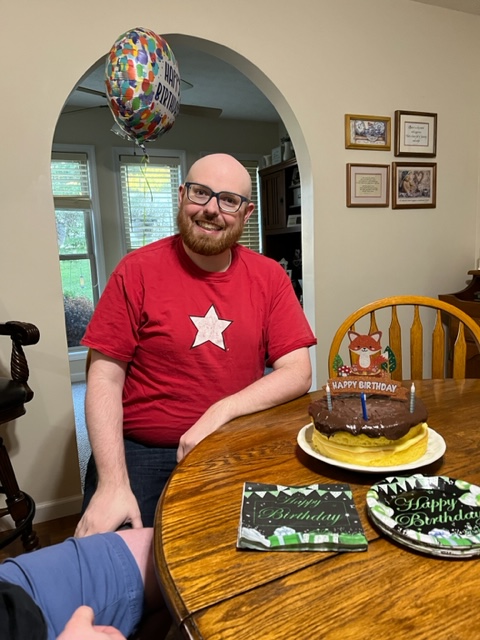
1. My daughter-in-law’s birthday. We enjoyed celebrating her arrival in the world and in our family.

Jason made that gorgeous chocolate cheesecake for Mittu’s birthday!

2. Kidney Day. Jason and Mittu realized this week was the tenth anniversary of my husband’s surgery for kidney cancer (made easy to remember since his surgery was on Mittu’s birthday that year). They decided to surprise him with a “Kidney Day” celebration. Mittu made this adorable kidney-shaped cake as well as chicken tostadas. Jim showed his urologist a picture of the cake, and he got a kick out of it.

3. An all-clear confirmation. Jim had his annual visit with his urologist this week, and his scans and tests confirmed that he is still cancer-free. The type of kidney cancer he had doesn’t usually spread, but it can: thus the need for yearly checks. It’s always a relief to get the results of that visit. The doctor said they don’t usually follow up on it any more after 10 years, since it’s even less likely to spread after that time.

4. Breakfast biscuits. Jim had to go out early one morning for lab work while fasting and brought us some Chick-Fil-A biscuits when he came back.

5. Daffodils have started springing up!

Is there some blessing, large or small, you can give thanks for this week?

Do you have trouble commenting on my site?

A couple of long-time blog friends have been unable to comment on my blog, even though we’ve commented on each other’s sites for years. That made me wonder if others are having trouble commenting as well.

I do hear from some of you regularly. (Thank you!) So some comments are getting through. But there should not be any problem commenting at all.

If you can’t leave a comment here, would you email me and let me know? And it would be a big help if you could tell me exactly what kind of error message comes up when you try to comment. Any details you can give me will help when I take this to WordPress support.

There is a link in my sidebar under my picture that says “Feel free to email me.” Click on that phrase, and you should be taken to your email server. If that doesn’t work, I’ll expand my email here so bots don’t pick it up. Just take out the words in parentheses and write it like a normal email address: barbarah06 (at) gmail (dot) com.

I’ve had difficulty myself commenting on some WordPress blogs that make me log in every time I comment now. I get a message saying I need to log in because I am using an new email address, even though I have commented on these sites for years with the same email address and web site. So maybe WordPress has some kind of glitch.

But I’d like to let WordPress know exactly what’s going on with commenting problems here so they can look into it.

Thanks for your help!

Tips for Finding a New Church Home

I wrote a couple of weeks ago about ways churches could help visitors to find out more about their church. I thought it only fair to look at the other side of the coin: how can new visitors to a church help their visit to go well?

We have many options to watch churches online. But we miss so much if we just observe from afar rather than taking the time to participate with others of like faith. Yes, all Christians belong to the church as a whole. But it’s in our individual congregations where we serve, learn, grow, build each other up, practice the “one anothers” in the Bible.

It’s disconcerting to look for a new church home. On one hand, we don’t want to flounder around for long. On the other, we want to take time to make the best decision. Meanwhile, we feel adrift until we find the place where we feel we belong and can serve.

These are some factors that have helped us when visiting churches.

1. Pray for God’s wisdom and direction, not just before your search, but all during it.

2. Decide what’s most important to you. Obviously, you want to find a church that preaches truth from the Bible. But as I mentioned in the previous post, it’s possible in cities like ours to find hundreds of churches with the same statement of faith, the same core beliefs that we ascribe to. So sometimes we end up weighing secondary issues, like:

Traditional vs. contemporary style of service and music
“King James Only” or other Bible versions
Casual or formal
Expositional or topical preaching
Continuationist or cessationist (referring to certain gifts of the Holy Spirit)
Reformed or not
Age-segregated or family-integrated
Songleader and choir or worship team
Premillennial, post-millennial, amillennial (referring to “end times”)

We can acknowledge that no one’s salvation is dependent on their views of these secondary issues, and Christians have freedom of conscience in some of these areas to choose what they think best. But if you feel strongly one way, you’re going to be uncomfortable in a church that practices another way.

And then there are issues like programs for the various family members, preferences for a large or small church, etc. But I would encourage folks not to be too rigid about programs and church size. We were hesitant about our last church because it had fewer than 25 people, and we didn’t want to be in a church that small. But we loved the church and the people, and it had a real family feeling to it. There are advantages to large and small churches–neither is right or wrong. If you’ve been used to one, maybe give the other a try. And personally, I am less interested in programs than I used to be.

3. Research. Asking people you know for church recommendations is often a good place to start. But it’s vital to research churches on your own as well.

Thankfully, these days most churches have at least basic websites where you can find a statement of faith. Most church sites will tell you a little more about themselves (though, after you’ve looked at several, they all begin to sound alike. One of my pleas in the previous post was for church websites to tell what’s distinctive about the church as much as possible). Many church web sites will have audio or video recording from previous services, which helps you know what the worship and preaching styles of the church are. We also like to look at information about the pastoral staff. Where a pastor has gone to school or what organizations he has served with will shed light on where he is coming from.

Many churches have a Facebook page. Some will have more information there than on their web site.

Sometimes we’ve looked up the pastor’s Facebook profile if we don’t find much information on the church’s website or Facebook page.

Doing as much research as possible ahead of time will help you narrow down your church choices and hopefully avoid unpleasant surprises.

4. Arrive early for your first visit. We try to leave early for our first time at a church for several reasons: we don’t know what traffic will be like; we like to find out where to go and where bathrooms are; we want to allow time to chat if people stop to introduce themselves.

5. Be friendly. Many church members fail in greeting first-time visitors. But we can make it easier by being approachable, friendly, open-faced, even introducing ourselves first. If we scowl or avoid eye contact or arrive late and leave as soon as possible, we’re not giving people a chance to welcome us.

6. Go to a smaller service. Usually we just go to the main service for our first visit to a church. If all goes well, then we’ll go to Sunday School or a midweek prayer meeting. Those meetings are often where people are more open and friendly—I don’t know if it’s because the group is smaller, or they regard visitors to those services as less likely to be just passing through.

7. Go more than once. Unless something glaring comes up in our first visit, we go to a church we are considering at least twice, and usually much more often.

8. Don’t judge; give grace. At the church we belonged to when we were first married, we had a visitor once who griped about several things. While we were glad to have problems pointed out so we could correct them, it was dismaying that this man had so many complaints, and that he voiced them his first time there.

Sometimes things might be a little off during your visit—that’s one reason we try to go more than once. Sometimes the sound system will have problems one morning or someone will flub the announcements or misspeak. There might be dust and debris on the bathroom floors; maybe a cleaning crew member was sick or missed their rotation. Any number of things can go wrong–or at least not as well as hoped.

9. Jot down questions as they arise. We don’t usually fill out a visitor’s card. If we visit a couple of times and decide to move on, we don’t want to keep receiving letters or phone calls from a church.

But if we attend over several weeks, questions might come up about the pastor’s or church’s stand on particular issues. Sometimes we ask about those when chatting with the pastor after a service. Sometimes my husband will call the pastor during the week. Usually if we’re seriously considering membership, we’ll meet with the pastor or invite him and his family for dinner. We’ve found most pastors to be very open to questions.

10. There is no perfect church. A church is made up of imperfect people, so of course it’s not going to be perfect. We know that on one level, yet it’s easy to go from church to church without finding one that’s “just right.” With so many churches close by, it’s easy to think the ideal one with all the features we want might be the next one. And if family members disagree about what features they want, the decision is even harder.

The church my husband grew up in was the only Baptist church in an area dominated by a different sect. The church members just had to learn to get along and set aside their differences, because there was nowhere else to go. That’s not a bad scenario.

Lastly, don’t be like Mr. Bean. 🙂 I don’t know how everyone around him kept a straight face.

You want to look for a place where you can serve, not just a place where you can receive benefit. But for us, looking for specific ways to serve (beyond greeting, praying for people, showing kindness, pitching in, etc.) comes later as we see the needs and see where we best fit.

Eventually, God will lead us to the local church we can call home and settle into.

What has helped you as you have looked for a new church home?

(I often link up with some of these bloggers.)

Laudable Linkage

These reads caught my eye and provided food for thought this week.

The Faith Crisis of Francis Schaeffer, HT to Challies. “Those who have been affected by the work of Francis Schaeffer may not know of his own struggle with depression due to a crisis of faith, what some have called ‘the hayloft experience.’ It occurred in 1951, not long after relocating his family to Switzerland, and lasted over three months. It proved to be the most influential crisis in his life. During that time, he put into question the major doctrines of the Christian faith and his own adhesion to them.”

Create the Right Conditions for Spiritual Growth: Trust the Recipe. “Faithfully meeting with God, holding to the written Word, and holding myself before it has looked different in every season of my life. There is no secret formula and no “perfect” method. The point is to make it happen.”

Is Revival Happening Now? “In the past week, reports have surfaced about a similar move of God in our day on college campuses. Something began to happen during a chapel service at Asbury College in Wilmore, Kentucky, that has now lasted for days. Reports of what many are calling a revival or an awakening have spread.”

Do the Synoptic Gospels Portray Jesus as God? Rethinking Jesus Walking on the Water, HT to Challies. “It does not follow that the Synoptic Gospels somehow deny Jesus is God, or portray Jesus as merely and only human. Instead, I think it is more accurate to say that the Synoptics present Jesus as God in ways that are less overt than John, but are nevertheless clear about his identity as the God of Israel.”

What Love Looks Like. “In my younger years I would have missed it. I would have lamented that he didn’t give me all the flowery words I wanted to hear, even though those flowery words don’t actually get the dishwasher emptied and filled again. I think sometimes we are just too hard and strict about what we will accept as love from our spouses.”

Is Every Occasion and Occasion for Mom Guilt? HT to Challies. “What do you do in the face of such an insidious experience—one that creeps in so subtly and imposes itself upon everyday moments? I’ve found that these moments need to be slowed down so we can discern what is at work in our hearts. To do this, we need to rely upon the One who knows us, searches us, perceives our thoughts, and is familiar with all of our ways (Ps 139:1–2).”

And another about mom guilt: Not Enough of Me to Go Around, HT to Challies. “She stands before me with eager eyes, just wanting her mommy to do one simple thing. Hand extended, she displays the hair tie. But I can’t help her. Not right now. And so I have begun to teach my sweet ones a new saying: ‘My mommy loves me. She will help me when she can.’ A simple truth, but not an easy one.”

Friday’s Fave Five

Another Friday has sped its way here, altogether too quickly. I’m pausing with Susanne and friends at Living to Tell the Story to remember the blessings of the week.

1. A microphone and a cable. Lately at Zoom meetings, I’ll get a notice that my microphone isn’t working–even though it did when I tested it and worked fine for the first half of the meeting. My oldest son got me an external microphone that plugs into the USB port of my laptop, and that worked fine. Then the room where I like to do Zoom calls and where my Cricut machine is located is far from our modem, and Internet connection is spotty there. My husband got a cable that allows Internet to function better.

2. A pre-Valentine date. We make Valentine’s Day a family day. But this year my husband suggested the two of us go out to eat the night before Valentine’s Day. We figured the restaurants would not be busy, since so many people go out on Valentine’s. We were wrong. 🙂 We went to a new-ish Texas Road House and had a longer wait than expected. But the food was really good. Jim had ribs and I had herb-encrusted chicken.

Then, a local high school soccer team was having a fundraiser inside the restaurant with a table full of sweets. We got a couple of cake pops from them for dessert.

We frequently get take-out and stream a movie. And since my husband works from home, we eat lunch together most days. But usually if we go to a restaurant, it’s with all the family. We hadn’t gone out to eat with just the two of us in a long time. It’s funny how much I looked forward to it, even to dressing up just a bit to go out. We may have to do that more often. 🙂

3. Valentine’s Day with the family. As we usually do, I made “meat hearts” (heart-shaped mini meat loaves), cheesy potatoes, and heart-shaped chocolate cupcakes. Mittu made a great salad and rolls. I made cards for everyone, and Timothy made cards for Jim and me. Jim brought flowers and my favorite milk chocolate Lindt Lindor truffles as well as lavender roses for Mittu. Jason and Mittu and Timothy brought candy for me and honey roasted peanuts for Jim. I found a themed tablecloth with Valentine mazes, word searches, tic-tac-toe grids, and pictures to color. All in all, a fun night.

Though I loved all the thoughtful gifts and fun things, to me the biggest demonstration of love was finding my husband later that night scrubbing the encrusted baking pans that I had left to soak because I was too tired to deal with them after everyone left.

4. An adjusted schedule. For the past few weeks, I’ve gotten everything for my blog’s weekend posts done by Friday so I am free for family things or other projects on Saturday. That has worked really well.

5. Getting phone calls over with. I don’t know why, but I hate to make business or medical phone calls. I had let some needed calls accumulate, so I sat down Thursday afternoon and plowed through them. Of course, one requires hearing back from the office I called before I can move on to the next step. But at least for the moment, I have called everyone I needed to. And that feels good.

What’s something good from your week?

Unveiling the Past

In Kim Vogel Sawyer’s novel, Unveiling the Past, Megan DeFord and Sean Eagle are married cold case detectives. They are working on a case about the death of two young brothers when their captain interrupts them. A friend of the captain’s wants to investigate her father’s disappearance from several years before. The missing father was accused of embezzling from his bank, though there was no evidence to suggest he did. But his sudden disappearance lent credence to the idea that he did steal the money. His daughter, Sheila, wants to find out what happened, and she wants a woman detective. Since Meghan is the only woman in the office, the captain wants her to take the case.

Sean, however, feels strongly about the case they are on. He could give it to one of the other detective teams, but he has been personally involved with the family and feels he would be letting them down to drop the case now.

Reluctantly, Sean and Meghan decide to work with another detective team so Sean can finish his case while Meghan works on the one from the captain. Unfortunately, that leaves Sean working with Tom Farber, the most cantankerous detective on site.

On a personal level, Sean longs to start a family. But Meghan’s highly dysfunctional mother and absentee father make her uncertain of her own maternal capacities.

In fact, Meghan’s lack of a father in her life makes her sympathize with Sheila. Meghan’s mother had finally given her the name of her father a few years ago. Maybe it’s time to look him up.

This book is the sequel to Bringing Maggie Home, one of my top books of last year. Each book could be read on its own, but I would recommend both of them.

The title of the book reflects many layers of unveiling, both in the two main characters, the people they are investigating, Meghan’s parents, and Farber.

I mentioned in my review of the first book that I like Christian fiction that shows Christian people doing normal Christian things. Two characters in the book are new Christians. Meghan, in particular, wrestles with discerning between her own desires and God’s will.

Overall, I enjoyed this book quite a lot.

I listened to the audiobook, nicely read by Barbara McCulloh.

Love Does Not Eliminate Hard Things

Imagine your best family friend and mentor was a skilled physician. If someone in your family got seriously ill, your doctor friend would be the first person you’d call. And though your friend had other responsibilities, you’d expect him to come as soon as he could.

Mary and Martha must have felt that way when Lazarus was sick. Jesus was not a doctor, but He was a healer. He was their friend. They knew He was the Messiah, though they didn’t understand fully how His role would work itself out. But they had every reason to expect that Jesus would come to them right away.

But He didn’t.

Now Jesus loved Martha and her sister and Lazarus. So, when he heard that Lazarus was ill, he stayed two days longer in the place where he was” (John 11:5-6).

Knowing that Lazarus was ill, and the family wanted Him to come, Jesus delayed. He didn’t wait an hour or a day. He waited two days.

What struck me in my recent reading of this familiar passage was the little word “so.” The passage doesn’t say, “Jesus loved them, but he stayed.”

It doesn’t say, “In spite of the fact that Jesus loved them, He delayed.”

Instead, “He loved them. So He waited.”

He waited because he loved them.

If you’re not familiar with the story, Lazarus dies before Jesus comes. By the time Jesus arrives, Lazarus has been in the tomb four days. Mary and Martha are crushed and greet Jesus with, “Lord, if you had been here, my brother would not have died.”

But the story doesn’t end there. Jesus raises Lazarus from the dead.

Why didn’t He come before Lazarus died and save everyone the heartache by healing him?

Jesus told the disciples, “Lazarus has died, and for your sake I am glad that I was not there, so that you may believe.”

Jesus told Martha, “Did I not tell you that if you believed you would see the glory of God?

Just before He raised Lazarus, He prayed, “Father, I thank you that you have heard me. I knew that you always hear me, but I said this on account of the people standing around, that they may believe that you sent me.”

He wanted them to know who He was and believe in Him. The disciples and Mary and Martha knew, but He wanted to manifest Himself to them in deeper ways. The crowd was a mixture of people, many of whom did not know Him yet.

Jesus had healed a girl not long after she died and a young man at his funeral. But someone could have said, “Maybe they weren’t really dead in the first place. Maybe He just revived them.”

But Lazarus had been buried for four days. When Jesus told men to roll away the stone in front of the tomb, Martha objected because of the odor that would arise from his corpse. There’s no question that Lazarus was actually dead.

Jesus could have performed a miracle to heal Lazarus beforehand. But He performed a greater miracle by raising him from the dead, that His friends might be strengthened in their faith and that others might believe.

Jesus’ raising of Lazarus was a precursor not only of Jesus’ future resurrection, but of that of all believers. How many people through the ages have been comforted by what Jesus told Martha: “I am the resurrection and the life. Whoever believes in me, though he die, yet shall he live, and everyone who lives and believes in me shall never die.”

Jesus showed His love in other ways as well.

He came to Mary and Martha though His life was in danger. When Jesus told the disciples He was going to Judea, they reminded Him the Jews there wanted to stone Him. When He insisted, Thomas was so sure of danger that he said, “Let us also go, that we may die with him.”

Jesus was “deeply moved” and wept, even though He was about to raise Lazarus. “He had to be made like his brothers in every respect, so that he might become a merciful and faithful high priest in the service of God” (Hebrews 2:17).

We often want to remove all the hard places from the lives of those we love. As parents especially, we want to make things as easy as possible for our children. And that’s not a wrong desire. But it’s often through the hard things that we grow in our faith and in our character. “Suffering produces endurance, and endurance produces character, and character produces hope, and hope does not put us to shame, because God’s love has been poured into our hearts through the Holy Spirit who has been given to us” (Romans 5:3-5). That doesn’t mean we go too far the opposite direction and heap hard things on them. We need God’s wisdom and balance.

God doesn’t take away all the hard parts of life. He uses them to deepen our knowledge of Himself, strengthen our faith, to mature us, to comfort us that we may comfort others.

“Though he cause grief, he will have compassion according to the abundance of his steadfast love; for he does not afflict from his heart or grieve the children of men” (Lamentations 3:32-33).

(I often link up with some of these bloggers.)