Unknown's avatar

About Barbara Harper

https://barbarah.wordpress.com

The More We Know Him, the More We Trust Him

It’s natural—or should be—for Christians to go to the Bible for our spiritual needs. God has promised to meet our needs. His Word gives us hope, assurance, comfort, guidance, and so much more.

But if we’re not careful, we can approach Bible reading with an “all about me” attitude. What’s in it for me, how does it relate to me, how does it make me feel.

Instead, the Bible is all about God. God wants to meet our needs, but more than that, He wants us to know Him. He told Jeremiah of the exiles He was punishing, “I will give them a heart to know that I am the Lord, and they shall be my people and I will be their God, for they shall return to me with their whole heart” (Jeremiah 24:7). Throughout the Bible we see His longing for a people to know Him.

Eternal life begins with coming to know God. Jesus said, “And this is eternal life, that they know you, the only true God, and Jesus Christ whom you have sent” (John 17:3). But when Paul said “that I may know him” in Philippians 3:10, he already knew Him as Lord and Savior. Yet he longed to know God more. Peter tells us to “grow in grace, and in the knowledge of our Lord and Savior, Jesus Christ” (2 Peter 3:18).

My husband and I met and started dating in college in SC. But in May, he went home to Idaho, and I went home to TX for the long summer until we saw each other again the next fall. I’m sure I spent much of those summers apart gazing at the photos I had of him. But to get to know him better, I heard his words during the few phone calls we could afford and read them in his letters.

2 Corinthians 3:18 says, “And we all, with unveiled face, beholding the glory of the Lord, are being transformed into the same image from one degree of glory to another.” We can’t behold an accurate physical image of God in a painting or photograph. But we behold Him in His Word.

And in His Word, we find that He is good, loving, kind, merciful, righteous, powerful, wise, always present. We see His declarations about Himself. We read what the prophets of old said about Him. We see His actions in dealing with people throughout the Bible.

When we see our capable God, we’re assured He can handle anything, and anxiety melts away. When we see Him as the God of all comfort, our sorrow or pain is eased. When we see His ability to provide abundantly, over and above our need, we trust Him. When we see His calm and control, our fretfulness dissipates as we rest in Him.

The more we get to know Him, the more secure we are in His love, the more confidence we have in His wisdom, character, and provision.

And as we get to know Him, we trust Him more. We trust His promises in individual Bible verses, but more than that, we trust His character and His ability to take care of every need we have. We move beyond just getting our needs met and we find the ways He wants us to show His love and truth to others.

We don’t get to know Him just to get our needs met. But in getting to know Him, our needs are met.

So as we come to His Word, let us look for Him on every page. Let’s know and trust and love Him more and more each day.

In Thy truth Thou dost direct me
by Thy Spirit through Thy Word;
and Thy grace my need is meeting
as I trust in Thee, my Lord.
Of Thy fullness Thou art pouring
Thy great love and pow’r on me
without measure, full and boundless,
drawing out my heart to Thee.

From “Here Is Love” by William Rees

(I often link up with some of these bloggers.)

Laudable Linkage

With family here this week, I haven’t been at the computer as much as usual. But here are a few good reads I discovered.

The Appropriate Blessing. “We are each sons and daughters of God, our Father. We are each unique and different from one another. Our personalities, quirks, talents, and purposes are as varied as the colored crayons in a 64 Crayola box of crayons.”

Our Understanding of Earth and Our Assumptions of Heaven. “Jesus told us to be like little children, not like great celebrities. He didn’t tell us to be famous, but to be faithful, not to revel in the applause of men but to long for the affirmation of God. Our responsibility is to exercise the gifts and embrace the duties God has given us, no matter what they are, no matter how public, no matter how visible.”

Healthy Distrust of Self. “Paul was not self-focused; he didn’t spend his days beating himself up mentally for his failures and shortcomings. But he did have a healthy distrust of his own inclinations, and he saw to it that the circumstantial doors to those inclinations were kept closed.”

Don’t Let “Discernment” Give Doctrine a Bad Name, HT to Challies. “I get frustrated sometimes by the lack of discernment I see from people who fly the ‘discernment’ banner. Isn’t the whole point of discernment to be able to discern truth from error? To see clearly what is good and right as opposed to what is bad and wrong?”

Steps of Assurance Counseling. “Just like the check engine light on my truck might be caused by any number of issues, doubts as to one’s salvation may be caused by any number of spiritual issues. Because of that, it is very important when counseling someone who is struggling with assurance to properly diagnose the problem.”

Home Library Management: Weed Out the M.U.S.T.Y. Titles, HT to the Story Warren. “Deacquisition. Um, yes…this is also known as ‘culling’ or ‘weeding.’ A painful subject for booklovers, but it is true that some books outlive their usefulness to you. The purpose of weeding is to cultivate the quality of your collection.” Megan shares an acronym to help make those decisions.

Friday’s Fave Five

Susanne at Living to Tell the Story hosts this opportunity to pause and appreciate the good things of the week. It really helps to pause and reflect a bit before the week floats away into memory.

It’s hard to believe we’re at the end of September. It was a busy month for us–maybe that’s why it seemed to go by even more quickly than usual.

Here are some of the blessings of the last week.

1. Extended family visit. My step-father, two sisters, and nephew from TX flew in to spend a few days. We all drove to SC to spend a day with two more sisters, my niece, and great niece there. It was the first time in three years all five sisters were together. We only wished my brother and his wife in CT could’ve come and made it a full family reunion. I had hoped the TX family might see a bit of fall color here, because they don’t have that in TX. There wasn’t a lot here yet, but we saw a bit driving through the mountains to SC. The weather was great the whole week except for a bit of rain and fog on the way back from SC. I wrote more about the visit in my end-of-month post yesterday and shared some pictures. We had such a good time and miss them already.

2. A completed extended to-do list. I tend to want to do a full-scale spring cleaning before anyone comes to visit, but I’ve learned the hard way that, 1) I never get everything done I want to, and 2) I wear myself out if I try. I made a master cleaning list I keep in the computer and added to it this time. For the first time ever, I got every “cleaning for company” item crossed off! That doesn’t mean everything that could have been done was–there’s always more to do. But the most essential things were. A very few items got crossed off without being completed since I determined they weren’t needed. But that’s a legitimate way to deal with them, right? 🙂

3. Pumpkins Spice Mini Donuts. I’m not big into pumpkin-flavored everything, but I really like getting these once a year.

4. Great American Cookie Company. I’m not at the mall often (probably a good thing), but I love this company’s peanut butter cookies when I’m there. I got some both at a mall in SC and then here in TN this week.

5. Cooler weather seems to have settled in for the season, and I love it.

How are things in your neck of the woods?

September Reflections

Wow, this month has sped by. It’s hard to fathom that September is almost over.

We celebrated Labor Day with traditional grilled burgers and a much-appreciated long weekend. The next weekend, my son, daughter-in-law, and grandson made dinner for us for Grandparent’s Day and brought over flowers and a colored picture from Timothy. We attended the state fair for the first time in years. Mid-September, we celebrated my youngest son’s birthday.

My daughter-in-law made the cute lemon blueberry cake.

Then my family from TX (two sisters, my step-father, and nephew) came to visit for a few days, and just left Wednesday morning. One day we all drove to SC to see family there (two sisters, my niece and great niece). It had been three years since we had all see each other. We missed my brother and sister-in-law in CT. We got this picture of all five sisters, with my brother and s-i-l’s picture on the phone:

And this one of all five of us with my step-dad:

This was the whole group after dinner in SC, minus Jesse, who couldn’t come that day:

It was so good to catch up with each other, more than can be done on FB and through texts and messages. We laughed (and ate!) so much! Timothy got to meet his second cousin for the first time. We took the kids to a park one afternoon and visited the mall in TX. We played lots of games. Most of all I enjoyed just talking with everyone.

Creating

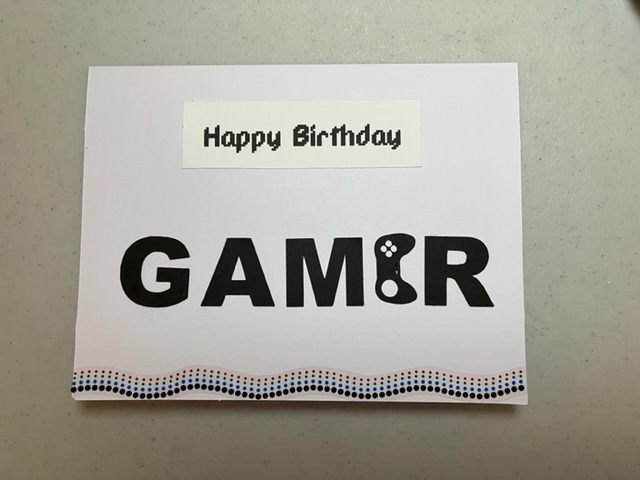
I just made one card this month, for Jesse’s birthday. You can tell his interests by the card and the shirt he wore in the first picture. 🙂

“Gamer” was done on the Cricut, “Happy Birthday” on the computer, and the border at the bottom was a sticker.

Watching

We’re enjoying our regular shows being back on with the fall season. We’re trying out the new version of Quantam Leap, but the jury is still out—we’ve only see one episode so far. We like the College Bowl, where college quiz teams compete against each other, hosted by Peyton and Cooper Manning.

I have not found anyone who likes the new Rings of Power, based on Tolkien’s writings. But we really like it. That may be because we’re not familiar with Tolkien’s work outside LOTR and The Hobbit. I hear this program is basically writing their own stories. But the feel of it is very Tolkien-ish to me. The main thing that would ruin it is if they bring modern-day sensibilities into it, especially “woke-ness.” So far that hasn’t happened. The one thing I don’t like is that they’ve made the main character, a younger version of Galadriel, arrogant and angry and sullen. But she’s fighting a battle no one else sees the need for so far, so maybe she’ll mellow out over time.

We also watched an old movie called Desert Rats starring Richard Burton. It’s based on a true story abut a little-known battle in Tobruk during WWII.

Reading

Since last time, I have finished (titles link to my reviews):

  • The Lost Heiress by Roseanna M. White, first in the Ladies of the Manor series. A young woman in Edwardian England finds she is the missing daughter of an earl. She doesn’t realize she is carrying a hidden treasure that an enemy will try to get first by flattery and romantic insinuation, and then, when that doesn’t work, by force. Excellent.
  • The Reluctant Duchess by Roseanna M. White, the second book in the Ladies on the Manor series. England’s most eligible bachelor rescues a Scottish young woman from an abusive father and even more abusive fiance by marrying her and taking her to England. But she struggles fitting in to her new role as a duchess, and their relationship does not go smoothly at first. Then there’s that pesky hidden treasure from the first book that bad guys are still after
  • A Lady Unrivaled by Roseanna M. White, third and final book in the Ladies of the Manor series. Lady Ella Myerston is sweet and cheerful. She wants to help protect her brother’s family and their friends from the danger that has haunted all three books. But everyone else want to shelter and protect her. She feels she’s not being taken seriously, but she’s determined to do what she can. Lord Cayton is a changed man from the cad he used to be, but not everyone trusts him. The two become an unlikely pair to bring the series to a close.
  • Jesus Led Me All the Way by Margaret Stringer, an autobiography of her 40 years as a missionary in what was then Irian Jaya among former headhunters and cannibals.
  • Essentialism: The Disciplined Pursuit of Less by Greg McKeown. From the back book cover: “Essentialism isn’t about getting more done in less time. It’s about getting only the right things done. Only once we discern what is absolutely essential and eliminate everything else can we make our highest possible contribution towards the things that truly matter.”

I’m currently reading:

Blogging

Besides Friday Fave Fives, Saturday Laudable Linkage, and book reviews, I’ve posted these since last time:

  • Passive or Pursuing? Is the fruit of the Holy Spirit something we passively receive or something we actively pursue? Both.
  • Daily Light on the Daily Path. I’ve been using this devotional book, made up entirely of Scripture, for about 30 years. A friend had never heard of it, so I thought I’d share about it.
  • When You Have to Say No. We have more opportunities than we can handle these days. I shared some ideas for discerning when to say no.
  • What Is God’s Highest Calling? Sometimes we hear that motherhood or full-time professional ministry is God’s highest calling. But that’s not what the Bible says. What is, then?
  • When Spiritual Routines Get Boring. Routines are helpful in many ways. But prayer and Bible reading on autopilot aren’t spiritually healthy. Here are some ways to alleviate our frail human tendency to lapse into thoughtless routine when spending time with God.

Writing

I was asked to participate in a critique group which meets every other week via Zoom. We take turns presenting our work for the others to edit and make suggestions about. It’s been so helpful, no matter whose work we’re critiquing. I’ve started implementing some of the suggestions.

I enjoyed all the activities of September, but I am looking forward to a quiet October. So far, the only things I have scheduled are lunch with a friend and a couple of medical appointments. We usually carve pumpkins sometime during the month as well.

How was your September? Are you looking forward to anything in October?

A Lady Unrivaled

In A Lady Unrivaled by Roseanna M. White, Lady Ella Myerston is quick to laugh and always sees the bright side of life. But danger has come to her brother and sister-in-law and their friends. Ella is determined to help, even as the others want to shelter her and keep her from danger.

Lord Cayton, the cousin of one of the Myerston’s friends, had been a cad in his youth. He had led one woman on but then married another for her fortune. Then his wife died in childbirth, leaving him with a beloved baby daughter, Addie. Regret over his past and a desire to do the best for his daughter lead him to Bible study with his cousin, Lord Stafford. Cayton becomes a changed man, but he has trouble convincing everyone except Stafford. And he doesn’t trust himself, doesn’t feel he deserves another chance at love after breaking the hearts of two women.

Now some past associates have come back to lure him into their scheme–the very scheme that threatens Ella’s family, and now her.

The merry Lady Ella and the moody Lord Cayton become unlikely allies in the effort to remove this threat once and for all. They are surprised both by unsuspected betrayals and unforeseen friendships.

In a secondary plot line, Kira Belova is a “kept woman,” a Russian ballerina who became the mistress of a wealthy mogul, Andrei Varennikov. She feels secure, until Andrei announces his plans to marry a princess. He sends Kira to England in disguise as a maid to get information about some missing diamonds. She and her mistress end up guests in Cayton’s home. Kira begins to question her life and choices and must decide whom to trust and whom to help.

This book is the third and last of the Ladies of the Manor series. The author deftly combines suspense, intrigue, humor, faith, and sweetness. This book was a satisfying end to the series and a reminder that we all need to receive and extend grace.

When Spiritual Routines Get Boring

I watched, amused, as my husband prepared to go to work. He checked to make sure he had his wallet, keys, backpack, and water, then he kissed me goodbye.

But then he remembered something else he needed, or something else he needed to do, before he left. He’d run through his checklist again—keys, wallet, backpack, water, wife—and remember something else he needed to get. He went through this process three times, ending each time with kissing me goodbye.

I suppose I could have gotten upset that he forgot he had already kissed me goodbye several times, that kissing me was part of the routine. Or I could have reveled in getting four kisses instead of one.

But I was amused because I have similar routines.

Some routines arise to help us remember what’s vital. When I get out of the car, I stop to check for my phone, purse, glasses and keys, saying each one aloud. This routine grew out of having locked one or more of these items in the car in the past (all of them one time when one of my then-young children closed the car door before I was ready).

I also have a checklist before I leave the house to make sure I have those same items and have turned off the oven and burners (because I have accidentally left one on for hours, though thankfully not while I was gone) and have locked all the doors (because I have come home to a forgotten unlocked door).

Routines also help us get into the right mindset. Michael Phelps had an elaborate routine before races to prepare both his mind and body. A basketball player preparing for a free throw will usually dribble the ball a few times before aiming for the hoop.

Routines also save us time and brain power by not having to think through everyday decisions. We follow more or less the same schedule with eating breakfast, brushing teeth, showering, dressing. Routines can help us avoid distractions and give more time to creative thought.

But operating on automatic pilot gets us into trouble. I don’t know how many times I’ve missed a turn while driving because I was following my usual path instead of remembering I was going somewhere different that day. Or I’ve gotten to the end of my shower and forgotten if I washed my hair.

When I read articles about establishing a regular quiet time of Bible reading and prayer, I find many authors encourage setting up a routine. If we plan a quiet time at the same time and place with the same tools every day, soon it becomes regular and we don’t have to stop and think about whether, when, or where we’re going to have devotions.

Well and good.

But I’m sure you’ve had the same experience I have of running through your quiet time as a routine and then forgetting what you read five minutes later. Or looking at the same prayer list with a bit of dismay at praying for the same things over again.

I like to start my prayer time with what we call “the Lord’s prayer” and expand from there. But when I look at those same words every morning, sometimes I am in danger of running through them thoughtlessly.

How can we help our spiritual practices not to become so routine that we move through them on autopilot?

Remember who we are interacting with. Warren Wiersbe said in With the Word “The end result of all Bible study is worship.” He meant Bible study isn’t an end in itself: it should lead us to worship of the God in its pages. But it helps to start Bible reading with worship as well, to rejoice in the fact that the God of the universe wants to talk with and hear from me. The Bible says His thoughts are precious to us, highly valuable (Psalm 119:72). Stopping to think about who He is and what a treasure His Word is helps get me in the right mind set. Sometimes I do that with thought and prayer, other times by reading or quietly singing a hymn or reading a psalm or two.

Pray. Sometimes I just stop in the middle of what I am doing and ask God to clear the cobwebs and wake me up spiritually. Sometimes I’ll read through parts of Psalm 119, which is mostly prayer, like verse 24″ “Your testimonies are my delight; they are my counselors,” or 25: “My soul clings to the dust; give me life according to your word!” Verses 36-37 are good, too: “Incline my heart to your testimonies, and not to selfish gain! Turn my eyes from looking at worthless things; and give me life in your ways.”

Change up the routine. It helps sometimes to change the order in which we do things or the translation or study method we’re using. Maybe go out on the patio or somewhere else in the house instead of our usual spot. I mentioned starting with the Lord’s prayer. But some years ago I made a list of other biblical prayers like Colossians 1:9-12 and Philippians 1:9-11, and I’ll use one of those instead.

Find study aids. If boredom comes from not understanding what we’re reading, a study Bible or simple commentary will help.

Examine our hearts. I think boredom in spiritual routines is often the result of familiarity or fatigue. But if we always feel bored when we read the Bible or pray, something deeper might be wrong. Maybe we’ve gotten our focus off the Lord or we’re harboring some sin. We need to ask Him to examine our hearts and show us anything that displeases Him. The Israelites were in worse trouble than they realized when they complained of weariness in the spiritual routines of their day.

Do it anyway. We shouldn’t let the feeling of boredom and routine stop us. Often, once we get going, we find something special in the day’s reading. One former pastor said one of his best times of prayer occurred when he started out confessing to the Lord that he didn’t feel like praying. Sometimes at the end of my quiet time, I’ve prayed, “God, you know I didn’t feel these things as fully as I have at other times. But you know I mean them.” Feelings help, but we do right whether feelings are there or not.

If over-familiarity with the Bible is a problem, these reasons to keep reading it might help.

God understands our human frailty. “For he knows our frame; he remembers that we are dust” (Psalm 103:14). He’s not looking for a stellar “performance” in our time with Him. He invites us to “with confidence draw near to the throne of grace, that we may receive mercy and find grace to help in time of need” (Hebrews 4:16).

Do you have any other tips for alleviating boredom when reading the Bible or praying?

(I often link up with some of these bloggers.)

Laudable Linkage

Here are some of the posts that resonated with me this week:

Did You Know You Might Be Someone’s Blessing in Disguise? “I don’t remember that nurse’s name, but God does. She never knew how her warmth, genuineness, and kindness blessed us that day. But God does.”

Counseling Your Child About Salvation. When my kids were young, I was greatly concerned with how to know they were ready to be saved rather than just praying a prayer to please parents or fit in. This article has some wise advice.

Something to Eat, HT to Challies. “Too often, when someone first believes in Jesus – especially someone famous – we rush to push them on stage, or sign a book deal, asking them to tell their stories while they still have an empty stomach. They have been raised to new life, but they still need something to eat.”

Judge Not, HT to Challies. “Matthew 7:1 is one of the most needed and one of the most abused statements in the Bible. . . .Yet just because people can misuse a verse does not give us a reason to throw out that verse. The fact is that Matthew 7:1 is a necessary corrective that many Christians need to hear. If we can first clear away the false claims, we will be in a position to let Matthew 7:1 shape us as Jesus intended.”

The American Dream Couldn’t Save My Marriage, HT to Challies. “I am grateful to this country which granted me asylum and opened the door for my permanent residence status. I received many opportunities through which I was able to continue my education, find a better job, and travel freely without fear. When I purchased my first home, I felt I had accomplished the American dream. This and lots of other things ended up going right for me before I had to realize how wrong I had been.”

On Losing Consciousness in Public, HT to Challies. Though I don’t have Seth Lewis’ health problems, my own have frustrated me due to their seeming waste of time and hindrance of doing the things I need and want to do. “My body betrayed me and flipped the power switch without my permission. When something like that happens, I am forced to remember two realities: that I am not in control, and that I am not as strong as I think I am.” But instead of being distressed by those truths, I can trust “there’s no need for despair over weakness because God is still in control and still strong enough to keep his promises for his children.”

What to Remember When God Feels Distant. “Often, it is in seasons of struggle and weariness that we find God’s peace to be most sustaining, His comfort most reassuring, His presence most stabilizing. Maybe we have to come to the end of ourselves to realize He truly is the only Source of everything we need?”

When Church Leadership Goes Wrong. “But it is my conviction, and Honeysett’s, that the majority of leaders who eventually go wrong set out with good desires and noble motives. Their good intentions were not enough to protect them from eventually abusing their power and misusing their authority. Some of them may have even behaved in abusive ways without knowing they were doing so. Yet ‘lack of intention doesn’t remove culpability. The heart is deceitful, and we are never fully aware of our own motives.'”

Being Senior. “In any other context but aging, the word senior is very positive.”

Friday’s Fave Five

Susanne at Living to Tell the Story hosts this opportunity to pause and appreciate the good things of the week. I’ve found this weekly break to be so helpful and encouraging. Here are a few of this week’s blessings:

1. Jesse’s birthday. I always love our kids’ special days, though they’re starting to make me feel old. I joked on Facebook, “How can my youngest be 29 when I’m only 39 1/2?” 😉

2. Queen Elizabeth’s funeral service. I didn’t get to watch it as it happened, but someone had told me they watched on YouTube where there was no commentary, just a recording of the service. The music was glorious and the message so clearly pointed to Christ.

3. The first day of fall. I’ve said often that I love the in-between seasons of fall and spring, where the weather is a nice change but not at the extremes of hot or cold. And both have such beautiful color. The leaves are just starting to turn. I have family from TX coming in this week, and though full fall color won’t be out for a few weeks yet, I’m glad they’ll see a bit of it.

4. A productive week. With my family coming, I got a few projects done around the house and have started a more intense cleaning than my usual weekly tasks. I’ve learned from past experience not to get so into getting things done that I am exhausted when they get here. So I am aiming to get the major things done, then we’ll see about the rest. I can’t say I enjoy the act of cleaning, but I do enjoy the results.

5. Weeding out items to give away. I keep a large box in the pantry to toss things in that I don’t want or need any more. When that gets full, I usually add to it some other items. With family coming, I wanted to get that stuff out of the way. I’ve got a few boxes stacked up to be taken to the thrift store. It feels good to create some space and get these things some place more useful.

Have a great weekend!

Essentialism: The Disciplined Pursuit of Less

Normally I wouldn’t have looked twice at a book like Essentialism: The Disciplined Pursuit of Less by Greg McKeown. I’ve read a number of books on time management, achieving goals, etc., so I wasn’t looking for one more.

But I listened to an interview with the author as part of one writer’s group’s attempts to draw in new members. And though I decided not to join the writer’s group, I appreciated much that Greg had to say.

These days, we’re all beset by having more opportunities and responsibilities than we can keep up with. Plus other people can pile their agendas on to us. We spend much of our time “busy but not productive.”

The way of the Essentialist means living by design, not by default. Instead of making choices reactively, the Essentialist deliberately distinguishes the vital few from the trivial many, eliminates the nonessentials, and then removes obstacles so the essential things have clear, smooth passage. In other words, Essentialism is a disciplined, systematic approach for determining where our highest point of contribution lies, then making execution of those things almost effortless (p. 7).

Lest that sound cold and heartless, one of our essentials is our loved ones. One of the catalysts to McKeown’s journey towards essentialism was when he was pressured to be at a meeting with a client just hours after his daughter was born. He was told the client would respect him for his sacrifice of being there. But the client didn’t, and the meeting in the end turned out to be pretty worthless.

Trade-offs are going to happen as we learn we can’t do everything. It’s better to decide ahead of time what’s really most important and spend our energy there, even when that means saying no to other things, even good things.

Part 1 of McKeown’s book focuses on essence: to do what’s essential, we first have to figure out what’s essential according to our goals and values. We have to determine what’s non-negotiable and what’s a trade-off.

Part 2 is Explore: the “perks of being unavailable,” the necessity of sleep and even play.

Part 3 is Eliminate: to say yes to some things, we have to say no to others. Part 3 explores principles and methods for eliminating the nonessential.

Part 4 is Execute: protecting our essential goals by implementing buffer zones, starting small and celebrating small wins, the helpfulness of routines to eliminate unnecessary decisions, flow and focus.

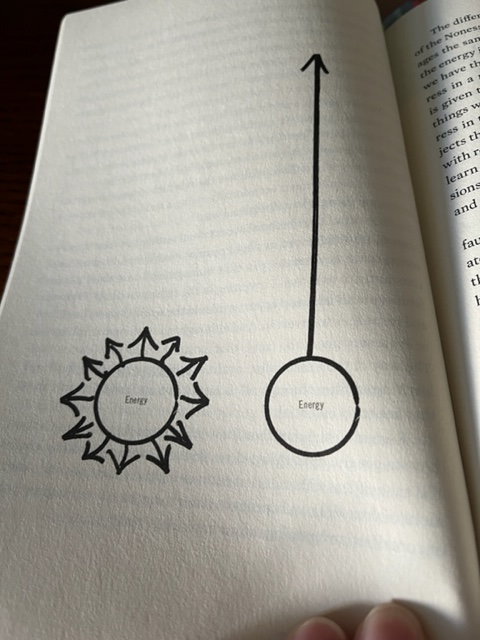
Sprinkled throughout the book are simple but very effective illustrations. This one, for example, shows “the unfulfilling experience of making a millimeter of progress in a million directions” vs. “investing in fewer things” to “have the satisfying experience of making significant progress in the things that matter most” (pp. 6-7).

Here are a few of the other quotes that stood out to me:

For capable people who are already working hard, are there limits to the value of hard work? Is there a point at which doing more does not produce more? Is there a point at which doing less (but thinking more) will actually produce better outcomes? (p. 42).

We need to be as strategic with ourselves as we are with our careers and our businesses. We need to pace ourselves, nurture ourselves, and give ourselves fuel to explore, thrive, and perform (p. 94).

An essential intent, on the other hand, is both inspirational and concrete, both meaningful and measurable. Done right, an essential intent is one decision that settles one thousand later decisions. It’s like deciding you’re going to become a doctor instead of a lawyer. One strategic choice eliminates a universe of other options and maps a course for the next five, ten, or even twenty years of your life. Once the big decision is made, all subsequent decisions come into better focus (p. 126).

The way of the Essentialist isn’t just about success; it’s about living a life of meaning and purpose. When we look back on our careers and our lives, would we rather see a long laundry list of “accomplishments” that don’t really matter or just a few major accomplishments that have real meaning and significance? (p. 230).

McKeown includes multiple examples from businesses and institutions. Just about the time I wished he brought some of his illustrations and principles down to a person level, he did.

One problem that he didn’t discuss, though, is when you can’t say no to obligations that seem meaningless. He says several times that saying no to the unnecessary meeting or obligation actually garners respect instead of resentment. But that’s not always the case. And you can’t always say no if your boss requires something that you think is a waste of time.

And you have to be careful that your time-savers don’t become an imposition on someone else. For instance, he mentions someone who skipped a regular hour-long meeting at work to get his own work done, then got a ten-minute summary from a coworker, thus saving himself forty minutes. But he doesn’t note that this guy was putting an unnecessary drain on his coworker’s time. If I had been the coworker, I would have been tempted to say, “If you want to know what happens at the meetings, you need to be there. I have too much to do to recap them for you every week.”

But those instances are minor. Most of what the author had to say was very good.

This isn’t a Christian book, and the author recommends a wide range of resources that I wouldn’t always agree with.

But overall, McKeown gave me much to chew on.

The Reluctant Duchess

The Reluctant Duchess is the second in Roseanna M. White’s Ladies of the Manor series.

Brice Myerston, the duke of Nottingham, was a side character in the series’ first book, The Lost Heiress. He was one of England’s most sought-after eligible bachelors, which he handled by being a notorious flirt to fend off serious advances from young ladies and their mothers. But he also had a close walk with God and uncanny sense of the right thing to do.

He finds himself in a knotty dilemma, though. His family has made their annual visit to Scotland to visit his mother’s family home not long after the death of his father. There, the Scottish laird, who has no use for Englishmen and has avoided the Myerstons all this time, asks the family to dinner. While there, the earl of Lochaber tries to set a trap for Brice to wed the earl’s daughter, Rowena. Brice steadfastly refuses at first. But then he realizes this is no title-seeking or money-grubbing ploy. Rowena is in serious trouble. Brice feels the Lord’s direction to protect her, and the only way to do that seems to be to marry her and take her back to England.

Rowena’s father has become harsh and distant since the death of her mother. Her fiance, Malcolm Kinnaird, seemed loving and kind at first. But his true colors came out when he forced himself on Rowena and became as controlling and as harsh as her father. Rowena hates that her father has set a trap for Brice, but she accepts his offer as the only way to escape.

But Rowena trembles at the thought of being a duchess in English society. And her fears come true when no one accepts her except Brice’s family and two of his closest friends. Rowena has been beaten down mentally and physically and has no confidence. She recoils from Brice physically and emotionally.

In addition to trying to discern how to help his new wife, Brice has another problem on his hands. He had offered to take and hide the rare treasure that had caused his friends, the Staffords, so much trouble (in the first book). But, though the main troublemaker had been killed, other dangerous pursuers are not giving up. And one of them is trying to entice Rowena into a false friendship.

This book had a bit of a rough start for me, with Rowena facing off against Malcolm, the knowledge that He had abused her, and a lot of yelling. In The Lost Heiress, even the villains had an air of gentility. In this book, even the Scottish nobility were quite rough around the edges.

But once I got into the story, I enjoyed it. Brice and Rowena had much to learn to trust each other, and each made many mistakes along the way.

The whole hidden treasures story line was as intriguing as any suspense novel. Besides the enemies Brice knows of, he discovers new unseen ones.

I think this could be read as a stand-alone story, but it’s a much richer experience to read both of them.

I listened to the audiobook, wonderfully read by Liz Pearce. I thought she did a great job with the different accents, which added a lot to the story.

As always, Roseanna did not write a fluff piece with this novel. She leads her characters to an understanding of their need and God’s abundant grace in an organic and not a preachy way.