Unknown's avatar

About Barbara Harper

https://barbarah.wordpress.com

Walking Through the Flames

When we were taking care of my mother-in-law in our home, our caregiver would stay with her on Sunday mornings while we went to church. I offered to trade off with my husband for Sunday evening services, but he always chose to stay home with her. I think he wanted to give me a break since I was with her so much while he was at work.

Jesse, our youngest son, was still home at that time. So he and I had about a twenty minute drive to church. I usually plugged my phone into the car speakers with the music on shuffle. Sometimes I turned the music down and we talked. Sometimes he’d fall asleep or play a game on one of his devices. Sometimes one or both of us would sing along softly.

But when “Walking Through the Flames” came on, we sang along together at full voice.

I’m not sure what about this song inspired our outburst. It’s based on Shadrach, Meshach, and Abednego in Daniel 3 who would not bow down to the king’s idol, even when their lives were threatened. Their faith and their words have inspired believers for centuries:

“Our God whom we serve is able to deliver us from the burning fiery furnace, and he will deliver us out of your hand, O king. But if not, be it known to you, O king, that we will not serve your gods or worship the golden image that you have set up” (Daniel 3:17-18).

If you know the story, “Nebuchadnezzar was filled with fury” (verse 19), ordered the furnace to be heated seven times hotter than normal, and had the three Hebrew men tied up and thrown in.

The furnace was so hot, the men who threw Shadrach, Meshach, and Abednego in died. But the three Hebrew men, instead of immediately succumbing to flames, were walking around untied. And what was more, someone else was with them, and “the appearance of the fourth is like a son of the gods” (verse 25).

Nebuchadnezzar called them out and saw that they were not only unhurt, but they were not even singed. They didn’t even smell like smoke. Then “Nebuchadnezzar answered and said, ‘Blessed be the God of Shadrach, Meshach, and Abednego, who has sent his angel and delivered his servants, who trusted in him, and set aside the king’s command, and yielded up their bodies rather than serve and worship any god except their own God'” (verse 28). He decreed that no one in the land could speak against the God of the God of Shadrach, Meshach, and Abednego without dire consequences. Although Nebuchadnezzar was not a believer yet, the next chapter in Daniel tells how he became one. No doubt this incident had a part in establishing his faith in the one true God.

In “Walking Through the Flames” (words are here), Jeanine Drylie retells the story in song and then applies it to us.

But when the hour of trial comes and fire is all around
We’ll find the place we’re walking on is really holy ground.

And praise be to God that the flames will set us free
And praise be to God, we shall gain the victory.

The version in my playlist is sung by Mac Lynch on a CD by the Wilds Christian Camp titled Praise the Everlasting King. Unfortunately, I can’t find that CD or that version of the song online anywhere. But here’s the song by the Northland Baptist Bible College:

I wrote a couple of posts based on truths from this passage of Scripture: “But If Not,” when our pastor was diagnosed with pancreatic cancer, and From “What If” to “Even If.”

These truths and this song will always minister to me. But my heart will also be warmed by the memory of singing this song along with my son in the car on Sunday evenings.

(I often link up with some of these bloggers.)


When You’re Afraid to Take Communion

I am embarrassed to admit this, but for many years I was hesitant and sometimes outright afraid to take communion. But I thought sharing my experience might help some who have wrestled with the same thing. If you’ve never had troubles with this issue yourself, you might know someone who does.

I became a Christian as a teenager, and most of the churches I’ve attended since then have taken a serious view of communion. We had communion about once a month. Usually the whole church service was built around celebrating communion rather than just tacking it on at the end. By contrast, one church we visited had communion every Sunday, and it was just another part of the service, like passing the offering plates. I much preferred the special emphasis placed on it.

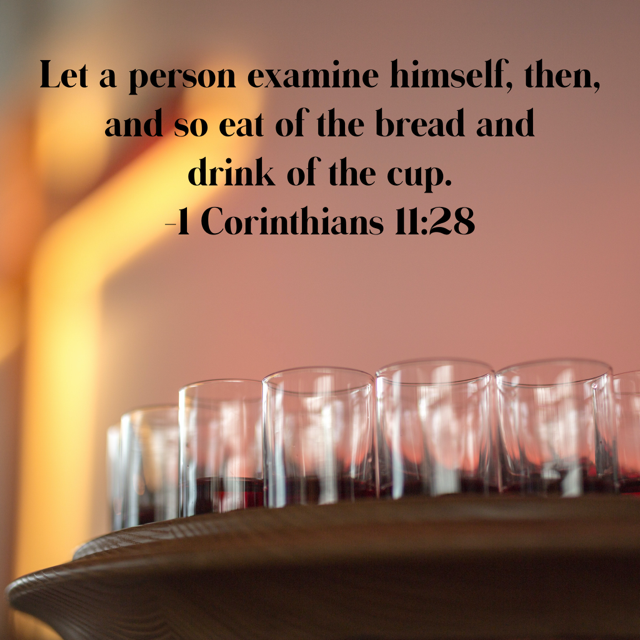
Often, the second half of 1 Corinthians 11 is read before communion (or the Lord’s Table or the Lord’s Supper, as it has also been called). In that passage, Paul recounts how Jesus instituted communion with the disciples the night before He was betrayed. Then Paul issues this solemn warning:

 Whoever, therefore, eats the bread or drinks the cup of the Lord in an unworthy manner will be guilty concerning the body and blood of the Lord. Let a person examine himself, then, and so eat of the bread and drink of the cup. For anyone who eats and drinks without discerning the body eats and drinks judgment on himself. That is why many of you are weak and ill, and some have died. But if we judged ourselves truly, we would not be judged. But when we are judged by the Lord, we are disciplined so that we may not be condemned along with the world (verses 27-32).

The pastor preparing for communion would echo the same warning. Anyone who was saved was welcome to join in, but we were encouraged to examine ourselves beforehand. It would be incongruous to partake of the symbols representing Christ’s body broken and blood shed for us while harboring known sin in our hearts.

In the church we attended after we were married, time was provided during the communion service for self-examination. That was the largest church we attended, and it took time to pass the elements to everyone. Piano music would be playing softly while we waited, and there was plenty of time to pray.

My pastor there compared confession of sin to opening a series of boxes. You open a box only to find another box within. You open that box and find another one, and keep going til there are no more boxes.

As you pray and ask the Lord to search your heart, you confess to Him whatever sin comes to mind. Then you wait and see if anything else comes to mind, and confess that. And so on until nothing else comes to mind. This particular church allowed time for this.

At subsequent churches we attended, there was not much quiet time to pray. Some pastors would have people stand up and share a testimony or a passage of Scripture while we waited for the elements to be passed. Nothing wrong with that, but without that time to pray, I often felt unready to participate unless I went through this self-examination process at home beforehand.

Even with time to pray, though, I often felt unready. What if I missed confessing something? The part of the passage about eating and drinking judgment on ourselves to the point of becoming sick or dying scared me. Ending up in the ER a few days after one communion service fed that fear.

So, often I would refrain from taking the elements as they were passed, just to be safe.

Then our pastor began to address those who refrained from communion. (Had an usher told on me? Was I the only one?) I don’t remember what the pastor said except to encourage people to participate.

Over the years, God graciously helped me overcome this fear. I thought I’d share what helped in case I’m not the only one who has dealt with this.

Unworthily, not unworthy

The KJV that I grew up with translates 1 Corinthians 11:27 as “Wherefore whosoever shall eat this bread, and drink this cup of the Lord, unworthily, shall be guilty of the body and blood of the Lord.” Unworthily is an adverb describing how we partake. Newer translations are clearer in saying “in an unworthy manner.” But for years I struggled with this. Of course, none of us is worthy in ourselves. We’re only made worthy to commune with God because Jesus died for us and has saved and cleansed us—the very thing communion portrays.

The paragraph above this text in 1 Corinthians 11 (verses 17-22) addresses the way the Corinthians partook unworthily. They were making a feast out of communion in a way that showed up who had more vs. who had little. The remembrance of the Lord’s table was dividing people instead of unifying them. Plus some were drinking to the point of getting drunk while others went hungry. The rest of the passage was instruction and reminders of what communion represented and how it was to be partaken of, with reverence and remembrance of the Lord’s death.

So that’s what Paul meant by partaking in an unworthy manner–flippantly, self-indulgently, forgetfully. He didn’t mean that no one who was unworthy of God’s love and forgiveness could partake, because that would include all of us.

I’m not off the hook even if I don’t partake.

If I am examining my heart, asking God to search me, and confessing my sin to Him, and I come across something I am not willing to give up, I’m not off the hook by just not partaking of communion that day. God still wants me to deal with whatever it is and will eventually chastise me if I refuse to submit to Him.

I couldn”t remember every sin anyway.

I’ve always been thankful for the way 1 John 1:9 is phrased: “If we confess our sins, he is faithful and just to forgive us our sins and to cleanse us from all unrighteousness.” When we confess our sins, we’re not likely to remember every little sin. And as we grow in the Lord, we become aware of thoughts and actions that are sinful that we didn’t realize before. But when we confess our sins, God cleanses us from all unrighteousness.

Self-examination doesn’t need to be a long process.

Self-examination is a good thing. But we don’t need to save everything up until communion time. We need to confess sin to God as soon as we’re aware of it and convicted by it. I have become more and more aware that we all have blind spots. Jesus warned people about looking for specks in other people’s eyes when they had big logs in their own. God told people in Malachi what they were doing wrong, but they denied there was a problem. He told the church in Laodicea, “For you say, I am rich, I have prospered, and I need nothing, not realizing that you are wretched, pitiable, poor, blind, and naked” (Revelation 3:17). I’ve been regularly asking the Lord to show me my own blinds spots. When we’re seeking to walk closely with Him every day, asking Him to show us where we fall short, confessing sin to Him as we become aware of it, we won’t need extremely long periods of self-examination before we’re right with God.

Consciences need training.

I’ve discovered about myself that I have an oversensitive conscience. It would make a long post even longer to go into why I say this. The solution to that isn’t to ignore my conscience: conscience is a tool in the hands of God. Ignoring it can lead to the opposite problem of not being sensitive enough. The more I read God’s Word, the more my conscience is trained according to His will so I don’t lapse into legalism on one side or license on the other. (A good book on this subject is Conscience: What It Is, How To Train It, and Loving Those Who Differ by Andrew David Naselli and J. D. Crowley.)

Now, instead of dreading communion, I appreciate the time to remember what Jesus did for me. We get so caught up in the daily cares of life, and we’re such forgetful people, it’s good to get back to basics. I’m thankful that most of the churches I have been in have taken communion seriously. I’m thankful for God’s tender patience as I worked through some of these issues. And I am thankful that most times of communion end with joy and renewed appreciation for God’s grace.

(I often link up with some of these bloggers.)

Laudable Linkage

I have just a few links to share this week:

Prayers That God Will Not Answer. “There are times when it seems like God does not hear us. There are times when it seems like God has become deaf to our prayers and unresponsive to our cries. There are times when we seek but do not find, knock but do not find the door opened. Why is it that God sometimes does not answer our prayers?”

Embodied Discernment: Learning to Discern With Our Hearts. Minds, and Actions, HT to Challies. “Where I went wrong is that my discernment only engaged my mind—and if you’re like me, maybe you’ve gone wrong in this way too. Why is this a problem? Doesn’t discernment only require logic and study?”

5 Steps to Deal with a Distressing Situation. “Based on 1 Samuel chapter 30, I want to share with you these five biblical steps when we face adverse situations which cause great distress and bitterness.”

Patsy at InstaEncouragements is hosting a summer book club reading and sharing insights on Aging With Grace: Flourishing In an Anti-Aging Cultureby Sharon W. Betters and Susan Hunt. Discussion on the first chapter is here. It’s not too late to join in!

Friday’s Fave Five

It’s time to slow down for a moment with Susanne and friends at Living to Tell the Story to think about the blessings of the week before their memory is gone forever. Please feel free to join in!

1. End of school celebration. We had a little party with pizza and confetti cake after Timothy finished his school year.

2. A long talk with an old friend. We had touched base on Facebook, but it was good to have an extended conversation and catch up on all the family.

3. Timothy’s help. Jim bought a big pile of dirt to fill in several paces in our yard. Timothy wanted to bring his shovel over to help. 🙂

4. Not cooking. Jason and Mittu brought dinner the night Timothy helped with the shoveling. Jim was out of town one night, and I splurged with a takeout meal. With dinner for Timothy’s party and takeout Sunday, I’ve had a light week in the kitchen.

5. Humor. One evening when the sky was overcast, I asked Alexa if it was going to rain. It gave me a weather report, but said nothing about rain. Then Jim asked it, “Is it raining?” It said, “It will start raining in half an hour.” I sighed and shook my head and said, “We’re a long way from making a Commander Data,” the human-looking android in Star Trek. Then we began to come up with ways Data might answer like Alexa does:

Captain: Data, fire phasers!
Data: Would you like me to put phasers in your shopping cart?

Captain: Data, are the Borg nearby?
Data: Here’s what I found on the web. . .

Captain: Data, plot a course to Deep Space Nine.
Data: Setting a course for Deep Space Nine. By the way, I can also track meteors.
Captain: Okay, do that.
Data: Go to the Data app on your phone . . .

We shared these on the family group text, and my oldest son added this one:

Captain: Data, slow the ship to one-quarter impulse.
Data: I don’t know any devices named “Ship.”

This reminds me of a quote by Henry Ward Beecher: “A man without mirth is like a wagon without springs, in which everyone is caused disagreeably to jolt by every pebble over which is runs.” I’m thankful for the way humor can turn irritations into a fun exchange.

Eugene Onegin

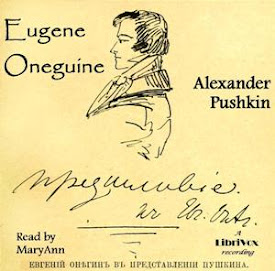
Eugene Onegin is a classic Russian story by Alexander Pushkin, first published serially in the early 1800s before being published as a book. The most unique feature of the story is that it is all written in verse. In fact, Wikipedia says the form of poetry used in the book has come to be known as the “Onegin stanza” or the “Pushkin sonnet.”

Eugene is only 26, but he is rich and bored with his world, tired of balls, parties, etc. He’s self-centered: when the uncle who was to provide his inheritance was sick, Eugene complained of how boring it was to sit by his uncle’s sickbed. Euegen is described a couple of times as a misanthrope.

Eugene meets and befriends a young poet named Vladimir Lensky. Lensky is engaged to Olga Larina and invited Eugene to dine at the Larina’s house.

Olga is fun-loving and carefree. Her sister, Tatyana (or Tattiana, depending on the translation) is introverted and bookish. Tatyana is particularly fond of romance novels. For some reason, she falls hard for Eugene. After he leaves, she pours out her heart to him in a letter.

When Eugene comes again, he tells her he is flattered but not interested in marriage. She would be his pick if he did marry, but even though they might love each other intensely, he would eventually grow bored with her. He also warns her about naively being so open and vulnerable—some men might take advantage of her.

Tatyana is, of course, embarrassed and heartbroken. They don’t see each other for a while, until Lensky invites Eugene to Tatyana’s name day celebration. Lensky leads Eugene to understand that the celebration will be with just a few people. But instead he finds it’s a country version of the type of balls he is so bored with. He’s so irritated with the situation, he flirts and dances a lot with Olga. Lensky gets mad and challenges Eugene to a duel.

In duel having killed his friend
And reached, with nought his mind to engage,
The twenty-sixth year of his age,
Wearied of leisure in the end,
Without profession, business, wife,
He knew not how to spend his life

Some years later, Eugene attends a ball in St. Petersburg. He sees a beautiful woman and realizes it’s Tatyana. She is married to an older man now, called a prince in one place and a general in another. Eugene finally feels alive and determines to declare his love. Tatyana still loves him but refuses him. She’s determined to remain faithful to her husband.

That’s pretty much the whole plot, though there are a few side scenes, including a nightmare of Tatyana and a visit from her to Eugene’s house when he is not there.

I listened to the audiobook available free at Librovox. Even though it was nicely read, it was very hard to follow. The parts that contained action or dialogue were understandable, but suddenly the narrator would be off in some kind of musing where I wasn’t sure what he was talking about. At one point, he even says, “Haste, haste thy lagging pace, my story!” I read parts of it, but I think it would have been better to read the whole thing (this Kindle version was 99 cents but Project Gutenberg also has it online here). This version was translated by Henry Spalding, who gives some helpful comments on footnotes. One example: “It is perhaps worthy of remark, as one amongst numerous circumstances proving how extensively the poet interwove his own life-experiences with the plot of this poem, that it was by this road that he himself must have been in the habit of approaching Moscow from his favourite country residence of Mikhailovskoe, in the province of Pskoff.” It’s amazing that he could translate from Russian to English and still have it come out rhyming.

Wikipedia’s article helped me get more from the story than I would have on my own. I especially liked this line: “Another major element is Pushkin’s creation of a woman of intelligence and depth in Tatyana, whose vulnerable sincerity and openness on the subject of love has made her the heroine of countless Russian women.” There’s also an interesting section on how the duel didn’t conform to the usual rules.

Probably most people are familiar with the story through the opera by the same name written by Tchaikovsky. I watched it last night on YouTube (which thankfully had subtitles) while Jim was out of town. The music was wonderful (only the music at the opening of Act III was familiar to me, but it all sounded very Tchaikovsky-ish). The opera left out the boring parts and added in a few things, but it kept the greater part of the story elements. In fact, I picked up on points that I missed in the book. I have to say I much preferred the opera to the book in this instance. While looking for more information on some of the singers, I found this nice review of the DVD version of this performance.

I’ve not watched opera in a long time. I’m always amazed by the power of operatic voices. Opera writers and singers know how to milk a dramatic moment for all it’s worth. 🙂 I thought the first ball, the country one, looked a little clunky and mused that the smoother ones in movies are probably heavily edited: we usually just see various steps and moments rather than zooming out to see the whole thing. But then the later ball in St. Petersburg was very synchronized. So perhaps the first one was clunky on purpose to show it was a “country” one.

One side note I found interesting. I had wondered how Onegin was supposed to be pronounced. The narrator of the audiobook pronounced it with a long O and E and soft G, accent on the second syllable. But in the opera it sounded like O-nya-gin–long O and A and soft G, which I am sure is more accurate.

I read/listened to this book for the “Classics in translation” category of the Back to the Classics Challenge hosted by Karen at Books and Chocolate. One advantage this book has as opposed to others in its category is that it’s a lot shorter. Other Russian books I’ve read are some of the longest novels. But I am glad to be familiar with the story now in both the book and the opera.

Are you familiar with Eugene Onegin?

Shadowed by Grace: A Story of Monuments Men

In the novel Shadowed by Grace: A Story of Monuments Men by Cara Putman, Captain Rachel Justice is a photojournalist during WWII. Her mother is dying of tuberculosis, and Rachel takes an overseas assignment to Italy to try to find the father she never knew to see if he can help provide for her mother’s treatment. All Rachel has to go on is a sketchbook given by her father to her mother with the initials RMA on some of the pages. Her mother refuses to say any more about her father and does not want Rachel to find him.

Lieutenant Scott Lindstrom is an officer with the Monuments, Fine Arts, and Archives Division, and stationed in Naples. He had arts degrees from Harvard and was a curator of a museum in Philadelphia. But he felt he could use his expertise to do something meaningful, to save history, to salvage beauty and meaning to sustain people after the war. He says, “We are defined by what we love and respect” (p. 28, Kindle version).

The problem was, his superiors and many soldiers didn’t take his job seriously. When lives were at stake, what did art matter to them? He had trouble getting the men and resources he needed.

When he did get a chance to talk to local people who might know where art was hidden, they didn’t trust him. The Germans had said they’d protect art, too—but they stole or destroyed much of it.

And now he was assigned to babysit a woman photojournalist who shouldn’t be so close to the danger.

So Scott and Rachel get off to a rocky start. But as they get to know each other, they appreciate each other’s mission and characters.

When Rachel shows Scott the sketchbook, hoping his knowledge of art and Italy may help her identify the artist, she doesn’t say the artist is her father. Scott thinks he recognizes the early work of an artist friend and mentor in the sketches, but he’s suspicious about why Rachel would have such a prize.

Scott is a Christian. Rachel isn’t sure she believes or trusts God. Her own father’s disinterest in her colors her view of God.

There is historical fiction that contains a romance, and romances that occur in a historical setting. I prefer the former, but this story is the latter. Still, the peek into the Monuments Men work, art history, photojournalism, the problems women in the military faced, the refugee situations in Europe all made for an interesting story.

One thing that jarred me just a bit was a major betrayal in the story that seemed to blow over much more quickly and easily than I would have expected.

But all in all, this was an enjoyable book.

Cara shares some of the influences that went into the book in an afterword and in the video below.

Were you familiar with the “Monuments Men” and their work?

What Can We Learn About Depression from Elijah?

You probably remember the big showdown between Elijah and the prophets of Baal from the Bible. If you grew up in Sunday School or children’s church, I’m pretty sure you heard the story taught with flannelgraph figures.

Ahab was one of the most wicked kings of Israel. God had told the prophet Elijah to tell Ahab there would be no rain in Israel for three years. No rain meant no crops; no crops meant famine. Finally, after three years, God sent Elijah to confront Ahab. Elijah called for the 450 prophets of Baal to set up an altar, as would Elijah. A bull would be cut up and laid on their altars. They would each call on their God, and the one who answered by fire was the real God.

Elijah let the other prophets go first. They prayed, cried, cut themselves for hours, but nothing happened.

Then Elijah’s turn came. He had men dig a moat around the altar and then pour enough water to soak the meat and altar and fill up the moat. Then Elijah prayed, “O Lord, God of Abraham, Isaac, and Israel, let it be known this day that you are God in Israel, and that I am your servant, and that I have done all these things at your word. Answer me, O Lord, answer me, that this people may know that you, O Lord, are God, and that you have turned their hearts back” (1 Kings 18:36-37).

And God did! Fire fell and consumed the bull, the wood, the stones, and all the water. “And when all the people saw it, they fell on their faces and said, ‘The Lord, he is God; the Lord, he is God’” (verse 39).

The prophets of Baal were slain. Rain came. That should have been that.

But it wasn’t. When Jezebel, Ahab’s wicked wife, heard what had happened, she sent a message to Elijah threatening his life.

And Elijah was afraid and ran, asking God to take his life.

How did Elijah go from facing down 450 false prophets to running from one woman? How did he go from the heights of such victory to the depths of wanting to die?

Some teachers are very hard on Elijah here. Some have even said that when God told Elijah to anoint Elisha as his successor, Elijah basically lost his ministry. Just this week, after starting this post, I saw someone accusing Elijah of “pouting.”

Thankfully, I’ve heard this passage treated differently more recently. And in my last read-through a few days ago, several things stood out to me.

Ministering to the physical ministers to the spiritual.

A lot of preachers say Monday morning is their worst time of the week. I’m not a preacher, but when I have taught or ministered in some way, I am pretty depleted afterward.

It’s significant to me that at the outset, God lets Elijah sleep, feeds him, and lets him sleep again.

We have a tendency to think it’s noble to disregard our physical needs for spiritual purposes. At times that is necessary: fasting, taking care of a new baby, ministering to someone who is ill. Sometimes you have to just do your best and trust God to make up for the deficit. But as a general rule, God has built a need for nourishment and rhythms of rest into our being. Especially when we’ve had a major crisis, or even a major victory, we can expect a crash afterward and a need for rest and recovery.

Time with God brings a change in perspective.

I find the questions that God asks people fascinating. “What are you doing here, Elijah?” (1 Kings 19:9). God knows the answers. But when He asks a question, instead of starting off with confrontation or instruction, He gives people opportunity to examine their hearts.

Elijah had thought he was all alone. He shouldn’t have—Obadiah had just told him about hiding a hundred prophets in caves for their protection. Maybe Elijah didn’t feel he was God’s only prophet, but he was the only one taking a stand. But God said, no, there were 7,000 who had not bowed the knee to Baal. The next few chapters tell of the work of some other prophets of the Lord.

God often works in quiet ways.

Like Elijah, we would have expected everything to change after the confrontation on Mt. Carmel. That demonstration had proved conclusively that the God of Israel was the real God, hadn’t it? Probably some people’s hearts turned, but Ahab’s and Jezebel’s hadn’t.

It’s interesting that the Bible most often shows God working through quiet ways rather than the miraculous. Of course, God is God. He can work a miracle any time He wants, and He still does today. But most of the miracles took place in the time of Moses, Elijah and Elisha, Jesus’ ministry, and the days of the early church in Acts. People in Jesus’ day begged Him for a sign, but He knew that if they wouldn’t believe the truth they had, they wouldn’t believe a sign, either.

God told Elijah to stand on the mountain. God passed by, and a strong wind tore rocks away. But God wasn’t in the wind. Then there was an earthquake, but the Lord wasn’t in the earthquake. Then came a fire, but God wasn’t in the fire. Then came a low whisper: other translations say a gentle whisper or a still, small voice.

The ESV Study Bible says, “God has other ways of working than the spectacular (though He is always free to work in supernatural ways)” (p. 637). This doesn’t mean God didn’t use the showdown. But the work wasn’t finished yet, and “the quiet ways of God must take their course before” this part of history is over (p. 637).

Trust God with the results.

It’s hard to pour your heart into something that apparently hasn’t done any good. The key word there is apparently. We can do God’s will God’s way and still look like we failed. But God knew what would happen and what He would do. It may look like God isn’t winning, but the story isn’t over yet.

Just a few chapters later, God’s prophecies about Ahab and Jezebel would come to pass. A king of Judah would see a revival come to the land.

Don’t go it alone.

When Elijah anointed Elisha as his eventual replacement, he didn’t retire immediately. For the rest of his ministry, he had a friend and mentee. “Then [Elisha] arose and went after Elijah and assisted him” (1 Kings 19:21). Some years after Elijah was gone, Jehoshaphat asked for a prophet of the Lord. “Then one of the king of Israel’s servants answered, ‘Elisha the son of Shaphat is here, who poured water on the hands of Elijah'” (2 Kings 3:11). Before Elisha became a mighty prophet in his own right, he served Elisha, ministering to his needs.

Do the next thing God has for you.

Was God done with Elijah?

No. God gave him three different men to anoint for different purposes (Elijah handed off two of those to Elisha). In chapter 21, God sent Elijah to confront Ahab over his theft of Naboth’s vineyard (apparently with no fear of Jezebel this time). In 2 Kings 1, God gave Elijah a message for King Ahaziah.

In 2 Kings 2, Elijah was taken up in a chariot of fire, the only person we know of who was ever taken to heaven that way. (Interestingly, God did not answer Elijah’s prayer that he might die. God had something different in mind.)

An angel said John the Baptist would come in the spirit and power of Elijah (Luke 1:8-17).

Elijah and Moses appeared when Jesus was transfigured (Matthew 17:1-8).

May believe that one of the two witnesses in Revelation 11 will be Elijah.

Does that sound like someone God was done with, or even displeased with?

Not to me.

God doesn’t cast us off when we get discouraged. If He did, all the psalmists who cried out to God in anguish and momentary disillusionment would have been in trouble. But He does want us to come to Him and renew our minds with His Word.

Of course, there is a type of depression that involves brain chemistry and can benefit from medication. But these measures—taking care of physical needs, gaining perspective, fellowship with others, trusting God with results and serving Him—can help even in those cases.

(I often link up with some of these bloggers.)

Laudable Linkage

Here’s the latest thought-provoking reads seen around the Web lately.

Our Hope In the Ascension, HT to Challies. “Of all the aspects of Christ’s work in his state of exaltation, the Ascension is one of the most overlooked.”

God Matures Us Through Suffering, not Miracles, HT to Challies. “Suffering, not miraculous deliverance, is the primary way God matures his children. A supernatural event can encourage us, of course, but it doesn’t mature us. Maturity comes through trusting God when things are really hard, even seemingly unbearable. Will we trust God when the miracles don’t happen?”

A Letter to All the Marthas. “It struck me that Jesus hadn’t written Martha offHe saw her faith and hard work as well as her weaknesses. And he loved Martha just as much as Mary. I began to view Jesus’ words through a lens of love.”

Why You Should Stop Being Responsible and Start Being Faithful. “Losing my mother as a teenager accompanied by my father’s paralyzing grief amped my firstborn sense of responsibility. I equated being responsible with being dependable. But when being responsible means depending on myself and my resources instead of relying on God it’s unhealthy and ungodly.”

Are Cuss Words Sinful? HT to Challies. “You hear them in movies, television series, and in actual conversations. To some, these words sound cool, and they have made them part of their lives. Yet when you learn their meaning, cuss words will make you cringe.”

The Sugar Coating, HT to Challies. “I have some authority to say that self-pity doesn’t get you anywhere. Trust me, I’ve tried it. Even on those occasions when people who really ought to know better don’t recognise the sheer weight of the scars you bear, and you feel like you must delve into the pools of pity to shake them out of their repose—it still isn’t worth it.”

4 Guidelines for Dating Without Regrets. “Somewhere between my generation and the current one, dating became difficult—far more difficult than it had once been. I am sure the so-called “purity movement” bears at least some of the responsibility as does the modern-day hookup culture. So, too, do the ubiquity of pornography and the rise of social media and dating apps. What was once relatively straightforward seems to have become strangely complicated.”

Adventures in Aging. Melanie writes about a change of heart from being depressed about age to embracing new possibilities.

Dementia’s Drowning Caregiver. Lots of good tips.

How to Think Wisely About Becoming a Social Media Celebrity, HT to Challies. In these days when we’re told we have to have a big enough “platform” before an agent or publisher will even consider looking at our manuscripts, we need to keep grounded in God’s truth of who we are in Him.

Friday’s Fave Five

Here we are at the first Friday of June already. It’s time to slow down for a moment with Susanne and friends at Living to Tell the Story. to think about the good things of the week before they are gone forever. Please feel free to join in!

1. Memorial Day. I am thankful beyond words for those who gave their lives in the defense of our country. It has become something of a tradition for me to watch the National Memorial Day Concert on PBS the Sunday evening before. They always have a few actors retelling the stories of a few veterans, and they are so moving.

2. A long weekend. All the family was off Monday, and Jim took off the previous Thursday and Friday as well.

3. A clean patio. Jim spent part of the weekend readying our patio for summer–pressure-washing the concrete, cleaning the patio furniture, etc. It all looked so nice.

4. Cookout with the family. Jim grilled burgers and everyone contributed something else to our meal. Timothy played with a water table we’ve had since he was a toddler. I wish I had thought to take a picture for a then-and-now comparison. We played games after the meal. A nice evening and a good kickoff for summer.

5. Ad free apps. I play a few games on my iPad mini while eating lunch and then again in the evening while watching TV. I usually get the free versions, which include ads. I understand the need for ads or fees. But sometimes the ads were SO annoying. Words with Friends was the worst—very long ads that would then hang up somehow so I’d have to force close and then restart the app. But the ad-free version was $9.99–way too much, in my opinion. One day I remembered I had a gift card for Apple from someone in the family. I hadn’t been sure what to use it for, but suddenly it occurred to me I could use it to go ad-free for some of my apps. It has made such a difference! Truly a gift.

Last week I mentioned taking a trip to Jan Karon’s Mitford Museum. I told more about it and shared some photos here.

What’s something good from your week?

A Visit to Jan Karon’s Mitford Museum

I first discovered Jan Karon several years ago in the pages of Victoria magazine, which my “adopted mom” used to send me. Jan was Victoria‘s “Writer in Residence” one year. I don’t remember what she wrote in those pages, but I liked it and was inspired to look up her books.

Jan has written a whole series of novels set in Mitford, a fictitious small North Carolina town. The main character, Father Tim, is not your typical novel hero. He’s not suave, handsome, young, and muscular. He is middle-aged, balding, a little overweight, and often unsure of himself. But he and the other Mitford residents are some of the most endearing characters in literature.

I loved the stories and characters, but I was also amazed at the amount of spiritual truth woven in them. These books were not marketed as Christian fiction, yet they contained clear salvation decisions, Scripture, and scriptural applications.

I know I have read through all the Mitford books at least once, maybe twice, and I have listened to the audiobooks once. I have not reviewed them individually, but I gave a brief synopsis of each Mitford book here.

My friend, Melanie, is also a Mitford and Jan Karon fan. I think she was the one who alerted me that a Mitford Museum was being created in the school Jan attended in Hudson, NC. Their grand opening was last October, with many special events planned for the day. We would have loved to have gone then, but felt it would be too busy. Plus Covid was more active then. We decided we’d try to go this spring.

And we finally went this past week! My dear husband agreed to drive us. The museum was a little over three hours from us, but we planned to leave about 8, get there by 11:30, have lunch, and then spend the next few hours at the museum before heading back home.

It was closer to 12:30 by the time we got there, due to traffic, weather, and detours.

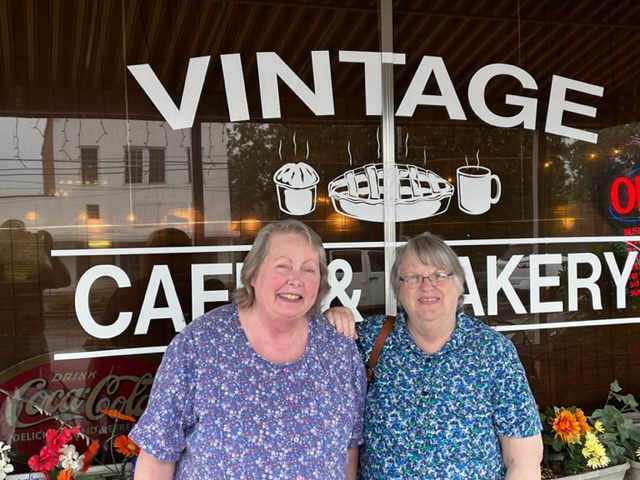
Melanie is on a few Mitford Facebook groups and had asked for recommendations for restaurants. We went to the Vintage Cafe and Bakery. It was so good. I loved the atmosphere of the place. They brought the best yeast rolls and sweet butter I have ever had to the table as an appetizer. We didn’t take a picture of any of the food–we were too hungry. But it was wonderful.

One interesting tidbit about the Vintage Cafe: sometimes they make the Orange Marmalade Cake that appears in almost every Mitford book. They didn’t have it when we were there. They don’t make it often because it is expensive, plus the owner had just made several servings of it for a Mitford tea the week before at the Museum.

We also had a couple of neat encounters at the cafe. Melanie knew a couple of people who worked at the museum through the Facebook groups. One of the ladies was eating there as we came in. Melanie had asked her to tell another lady that we would miss her, because we were running late, and this lady got off before we’d get to the museum. But in a little while, the second lady came to the cafe to see Melanie after she got off. I thought that was a sweet gesture.

On to the museum.

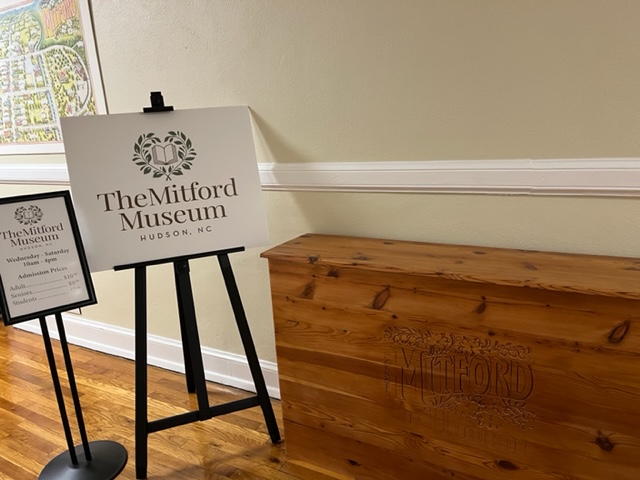
I had not realized that the museum was only one part of a larger enterprise. I did not take a picture of the front of the building, but I had seen it here. I thought that was the whole building, and that all of it was the Mitford Museum. But the building is three times the length of what’s in the picture and houses several businesses, arts-related offices, little shops, etc. It’s called the Hub Station and was formerly the Hudson School. The Mitford Museum takes up two classroom-sized rooms and a gift shop. One of the rooms was Jan’s actual classroom.

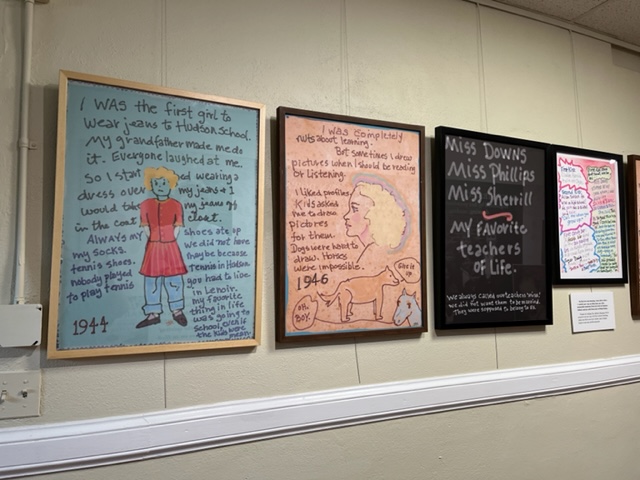
These are in the hallway leading up to the museum door.

Jan Karon's Mitford Museum

The two rooms that make up the museum are filled with memorabilia. There are notes from Jan at each display, telling what objects were or explaining some behind-the-scenes detail about them. Some items are from her childhood, like a big cast iron pot that her grandmother did laundry in. Some have to do with Jan’s life as an author. I had not known that she wrote ads for NC before writing books, but some are on the walls there–I think I have even seen them in magazines. Her descriptiveness and way with words shines through even there. One section shows the different houses she lived in and which books she wrote in which house.

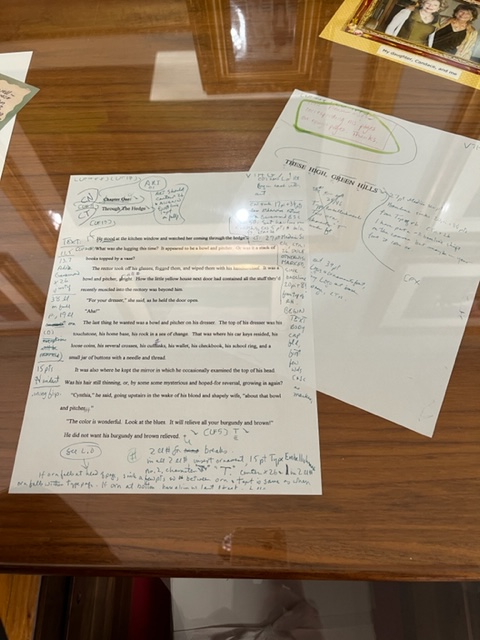
One of Jan’s actual desks is in the museum, along with some of her manuscripts. I wish I had taken a picture of the whole desk–it’s massive.

Jan’s typewriter, a gift from her daughter
An edited part of a manuscript

Above the desk is framed art work from the original covers of several of the books.

I had not read Jan’s children’s books, but one, Miss Fanny’s Hat, was based on her actual. . . I can’t remember if it was her mother or grandmother. But there is a picture of the real “Miss Fanny” wearing her hat, and the hat itself in a curio cabinet.

This was in a space between the two rooms:

If you’ve read Shepherds Abiding, you know Father Tim picked up an old, broken down Nativity set that he restored for Cynthia. That story grew from an old Nativity set Cynthia bought. If I remember correctly, I think Jan had a local artist restore it and included some of her experiences in Father Tim’s. That Nativity is in the museum. It’s huge.

Another interesting story was that Cynthia married Father Tim in an aquamarine suit. Some time later, Jan saw this suit on eBay and said it looked exactly like what she had envisioned for Cynthia’s wedding suit. So Jan bought it, and now it’s in the museum.

I don’t know if you can read the print here, but this house was the basis for the Meadowgate Farm in the books, home of Father Tim’s friend and veterinarian who becomes his adopted son Dooley’s mentor.

And I took this picture for the Author game that inspired Jan (which I had never heard of but now what to find!) But at the time, I missed reading the plaque above talking about how Jan declared to herself in the mirror passed down from her mother, grandmother, and great-grandmother that she was going to be an author some day. I wish I had gotten a photo of the mirror, too!

The friendly and informative docent took this picture of Melanie and me “with” Jan.

Melanie and I with Jan

Unfortunately, we didn’t get any pictures with Jim!

The gift shop is called Happy Endings after the bookstore in the books.

Those are some of my favorite spots in the museum. Melanie shared some of hers here. There is much more to see.

We made it just a day trip since there wasn’t much else to see in Hudson (though I spied some antique shops for those interested). Blowing Rock is nearby, but we didn’t want to stay overnight this time.

Because of the distance, I don’t know that I would go to the Museum again unless there was something going on I didn’t want to miss. They had just had a Mitford Tea at the Museum the week before, with Jan in attendance, and they’re planning another next May. I’m thinking about that. There is also a play about Mitford that I’d love to see sometime with Jim, since he’s not familiar with the books, but probably not this year. It sounds like they’ve done it before, so hopefully they’ll do it again.

I’ve shared links to the museum and Jan’s web page above, but the Museum has an active Facebook page with photos of events and the latest news here. And Jan Karon shares a lot of neat things on her Facebook author page here.

Are you a Mitford fan? Have you been to the Museum? I’d love to hear about it.

(I often link up with some of these bloggers.)