Book Review: Same Kind of Different As Me

When I first saw the book Same Kind of Different As Me by Ron Hall and Denver Moore popping up here and there, I saw the front cover went on to say, “A modern-day slave, an international art dealer, and the unlikely woman who bound them together.”

Hmm, I thought. Might be interesting. But not enough to compel me to get it. It just didn’t seem to “grab” me.

Then I began seeing it on more and more blogs, getting rave reviews by people I knew and respected.

Hmm, I thought. Maybe I’d better check it out.

So I got it. And put it on my shelf. And it sat there for weeks.

Finally I had a desire to pick it up and read it — after I found it in a box of books that wouldn’t fit on my bookcases.

Wow. I am so glad I did.

I don’t know if most of us have a truly correct view of poverty in this country. I’ve personally known people who lived quite comfortably and happily under what the government set as the poverty level. I’ve known others who felt they were poverty-stricken because they could not afford cable TV service. The poverty described in this book is raw, real, stark, and almost inescapable — almost unfathomable. Denver Moore escaped from virtual slavery on a plantation in Louisiana by riding the rails to what he truly perceived as a better life as a homeless man in Texas.

Ron Hall began serving at a homeless shelter only because his wife wanted him to come with her. “I hate to admit this now,” he writes, “but I had pictured myself more as a sort of indulgence benefactor: I would give him a little bit of my valuable time, which, had I not been so benevolent, I could have used to make a few more thousand dollars. And from time to time, I imagined, if Denver stayed cleaned up and sober, I’d take him of field trips from hobo land to restaurants and malls, a kind of peep show where he could glimpse the fruit of responsible living and perhaps change his ways accordingly” (p. 111).

It didn’t exactly turn out that way.

Both men were challenged, both learned of their own ignorance, assumptions, and prejudices, both were stretched beyond themselves and the world they had known. Both taught each other, learned from each other, and supported each other.

This is a riveting book. Parts of it horrified me, parts had me in tears, parts were sheer beauty.

And it’s true. A real story with real people.

(This review will be linked to Semicolon‘s Saturday review of Books and the next 5 Minutes For Books I Read It column.)


What’s On Your Nightstand: October

What's On Your NightstandThe folks at 5 Minutes For Books host What’s On Your Nightstand? the fourth Tuesday of each month in which we can share about the books we have been reading and/or plan to read. You can learn more about it by clicking the link or the button.

Wow, I can’t believe it is the last week in October already. The month just flew by.

Here’s what I read since last time:

Her Daughter’s Dream by Francine Rivers, the sequel to Her Mother’s Hope, reviewed here.

The Thorn by Beverly Lewis, reviewed here, the first of a new Amish series about two sisters on different paths.

I’m Outnumbered!: One Mom’s Lessons in the Lively Art of Raising Boys by Laura Lee Groves, reviewed here.

Faithful Women and Their Extraordinary God by Noel Piper, short biographies of Sarah Edwards, Gladys Aylward, Lilias Trotter, Esther Ahn Kim, and Helen Roseveare, reviewed here.

Same Kind of Different as Me by Ron Hall, Denver Moore, and Lynn Vincent, reviewed here, about an unlikely friendship between an art dealer and a homeless man.

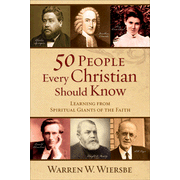
I’ve started 50 People Every Christian Should Know: Learning From Spiritual Giants of the Faith by Warren Wiersbe and A Novel Idea: Everything You Need to Know about Writing Inspirational Fiction (that one wasn’t on my Fall Into Reading challenge goals, — it was on my shelf for “some day” — but I felt a sudden urge to start it) and just picked up Start Somewhere: Losing What’s Weighing You Down from the Inside Out by Calvin Nowell and Gayla Zoz.

Next up: Here Burns My Candle by Liz Curtis Higgs, In the Company of Others by Jan Karon, and something by Agatha Christie — still haven’t decided yet.

Happy Reading!

Book Review: Faithful Women and Their Extraordinary God

Faithful Women and Their Extraordinary God by Noel Piper contains short biographies of five women exemplary in their faith and walk with Christ.

Sarah Edwards came from a distinguished family and was intelligent and noted for her graciousness. Her husband, Jonathan Edwards, was brilliant, shy, and very much lacking in social graces. Their personalities complemented each other in a way helped each fulfill his and her ministries against the backdrop of war, uncertainty, and the consequences of taking a firm but unpopular stand based on Scriptural teaching.

Lilias Trotter was a gifted artist whose work impressed John Ruskin and caused him to take her under his wing. Yet she had a heart for ministry and “knew it isn’t possible to be wholly consumed twice” (p. 45) and that one or the other would have to take first place. She chose ministry first among the poorest women in society to an extent which was frowned on in Victorian England, and ultimately to Muslim women in Algiers despite a serious heart condition. Her art influenced her ministry both in her perspective and in producing literature decorated in a distinctly Arab style which appealed where “the visible beauty of a piece of literature” was thought to “validate its worth” (p. 61).

Gladys Aylward was an English parlor maid who dreamed of going to China as a missionary. She thought her hopes were dashed when she was turned down by the China Inland Mission and told that she probably could not handle learning the language, yet the Lord did lead this small 4′ 10″ woman on a remarkable journey to a great and fruitful ministry there. Among other things she was asked to aid in enforcing the new ban on foot-binding, despite telling the mandarin that she would share the gospel as well as enforce the law, and she led 100 children away from the Japanese Army over mountains through several days journey with little food to safety, alone.

Esther Ahn Kim faced the same dilemma as Shadrach, Meshach, and Abednego when Japanese authorities in Korea commanded everyone in her school to bow down to an idol. She was the only one who stood firm and erect. She escaped authorities for a while and hid out with her mother, preparing herself for imprisonment, which did in fact eventually come.

Helen Roseveare was a doctor who knew even before becoming a Christian that she would be a missionary. She ministered in the Belgian Congo, where her drive for excellence was challenged in situations where medical standards were a far cry from what she had been taught, yet she persevered and came up with ways to adapt. She chafed against needing to make bricks when her services were needed medically until one man told her that it was when she was down at the kilns with her hands as rough as theirs that they most knew she loved them and that they could trust her and listen to her tell of God. In fact, one hallmark of her life was her willingness to listen to the rebukes and instruction of those around her. It was in her ministry that an incident occurred which you may have received as an anonymous e-mail forward: a hot water bottle was needed to keep a newborn premature baby warm whose mother had died in childbirth. When the orphanage children were told and asked to pray, one girl prayed that they would receive a hot water bottle that afternoon and that a doll would be sent as well so the little baby girl’s sister would know God really loved her. And a parcel from Helen’s home, the first ever after four years there, arrived that very afternoon containing both a hot water bottle and a doll. Helen persevered through hardships, exhaustion, and an attack by rebel insurgents in which she was beaten, had her teeth knocked out, and raped. She was rescued by the National Army and went home for a year, but could not remain away and so went back to the newly renamed Zaire, which was then recovering from the devastation of war. The only one of the five women still living, she now lives in England where she writes and witnesses and tries to encourage others to consider the “fields white unto harvest.”

In some ways I am not sure why I picked up this book, because I had already read full biographies of Sarah Edwards (Marriage to a Difficult Man: The Uncommon Union of Jonathan and Sarah Edwards), Gladys Aylward (The Small Woman), and Esther Ahn Kim (If I Perish), and most of the material on them came from the books I had read. Yet it was a good refresher course of their lives, and there was even a bit of new information on some of them. I didn’t know, for instance, that Elisabeth Elliot had met and talked with Gladys. Lilias and Helen’s stories were new to me: I think I was only vaguely aware of their names before.

One reason I enjoy reading biographies is that the examples speak to me in my everyday life. For instance, when I find myself sometimes fearful to go certain places, I remind myself of situations like Gladys’s when she was alone in the middle of nowhere in Russia in wintertime, having just been put off the train that could go no farther because of the war. If God could keep her safe in those circumstances, can He not keep me, too, in situations far less perilous? I am challenged by women like Esther’s mother: could I help my child prepare to face certain suffering rather than seek for a way to hide her and protect her? There is so much I learn through what they learned and how God worked in and through them.

There is so much I wish I could share of the faith, faithfulness, and examples of God’s working in the lives of each of these women, but I would have to nearly reproduce the book to share all I’d like to. I highly recommend it to you.

(This review will be linked to Semicolon‘s Saturday Review on Books and 5 Minutes For Books‘ I Read It.)

Book Review and Giveaway: I’m Outnumbered!: One Mom’s Lessons in the Lively Art of Raising Boys

(The giveaway and comments are closed: the winner is Ann!)

I first “met” Laura Lee Groves at her blog through Susanne‘s Friday’s Fave Five weekly meme (thanks, Susanne!) I identified with her immediately as we’re near the same age and stage of life and she has four boys while I have three. She mentioned in one of her earliest comments that it was like we were in parallel universes. 🙂

When she announced she was about to have a book published, I was on the alert for it. And then when I heard it was about raising boys, well, that especially made me want to read it even though I only have one still at home.

In I’m Outnumbered!: One Mom’s Lessons in the Lively Art of Raising Boys, Laura Lee Groves draws from her own experience in raising four young men as well as her years of experience in the classroom as an English teacher, plus she weaves together quotes from a number of books on the subject. She writes as a mom who was the only female in her house trying to relate to the male mindset and who wants to share what she has gleaned with other moms. There are a few pointers for those households who have girls and boys especially along the lines of their relating to each other.

There is a lot of practical wisdom as well as a solid Scriptural basis in Laura Lee’s advice. She writes in a conversational style that is easy to follow. The book includes chapters on managing expectations, sibling rivalry, intentional parenting, education, conversation, organization, respect, and media influences and management. She also includes a chapter titled “A Word From the Boys” with some of their thoughts on the way they were raised and a list of resources.

I think this book is a treasure trove for any mom of boys. In fact, I’d like to give this copy to a mom who would benefit from it, so if you’d like it or know someone who might, just let me know in the comments. I’ll draw a name a week from today, Thursday, October 21.

Laura also sends out a helpful weekly newsletter which can be signed up for at her blog.

(The giveaway and comments are closed: the winner is Ann!)

(This review will be linked to Semicolon‘s Saturday review of Books and the next 5 Minutes For Books I Read It column.)

Booking Through Thursday: Rewrite

btt  button Booking Through Thursday is a weekly meme centering on the subject of books. The question for this week is:

Suggested by Joy:

If you could rewrite the ending of any book, which book would it be? And how would you change it?

I wouldn’t really rewrite an ending: I respect the author’s decision to end things as he or she sees fit. But I have wished for a different ending some times. The only one that comes immediately to mind is Angela Hunt’s Uncharted, reviewed here. Of course, I can’t reveal the ending without spoiling the book, but it is very sobering. It fits with what the book is portraying, and the warning that choices have consequences, some of which cannot be undone, and that we only have a short time in life to make the right choices or rectify wrong ones. The ending does reinforce the gravity of the message, so it is justified and understandable. I guess there is a part of me that wishes the characters could have somehow had a wake-up call and have been allowed to make changes based on what they learned, yet I understand that a happier ending might have taken away from the message of the book. God does warn that “My spirit shall not always strive with man” (Genesis 6:3), and some day an end will come for each of us, with no do-overs, and we need to be prepare for that now.

98 books and book series that have enriched my life

Sherry at Semicolon posted a link to one pastor’s list of 99 Books That Made My First 50 Years Worth Living. He was going to make a list of 50 but ended up with 99. That, of course, got me to thinking about what books I would put on such a list. If I keep strictly to the first 50 years, I can’t include the ones I have read in the last three, which is unfortunate since I’ve only been chronicling the books I have read since starting a blog. But I might just sneak a couple of those on the list. I think I am going to separate them into categories just because that will help me, I think.

Later in his post he asked for ideas for books one should not die without reading. That would be a much shorter list. So I am going here for those that have most enriched or impacted my life.

OK, let’s see how many I end up with…

Classics:

David Copperfield by Charles Dickens

A Tale of Two Cities by Dickens

Little House on the Prairie series by Laura Ingalls Wilder

Little Women, Little Men, and Jo’s Boys by Louisa May Alcott

Anne of Green Gables and all its sequels by Lucy Maud Montgomery

Pilgrim’s Progress by John Bunyan

Les Miserables by Victor Hugo

Jane Eyre by Charlotte Bronte

To Kill a Mockingbird by Harper Lee

The Princess Bride by William Goldman

Ben Hur by Lew Wallace

The Chronicles of Narnia by C. S. Lewis

Lord of the Rings by J. R. R. Tolkien

The Count of Monte Cristo by Alexandre Dumas

Uncle Tom’s Cabin by Harriet Beecher Stowe

Persuasion by Jane Austen

Biographies:

Amy Carmichael of Dohnavur by Frank Houghton

Hudson Taylor: Growth of a Soul by Dr. and Mrs. Howard Taylor

By Searching, In the Arena, and Second Mile People by Isobel Kuhn

Mountain Rain: A New Biography of J. O. Fraser by Eleen Crossman

Goforth of China by Rosalind Goforth

Climbing by Rosalind Goforth

The Small Woman by Alan Burgess (about Gladys Aylward)

Evidence Not Seen: A Woman’s Miraculous Faith in the Jungles of World War II by Darlene Deibler Rose

In the Presence of My Enemies by Gracia Burnham

Mimosa by Amy Carmichael

Gifted Hands by Ben Carson

The Valley Is Bright by Nell Collins and Mary Beth Moster

Marriage to a Difficult Man:The Uncommon Union of Jonathan and Sarah Edwards by Elisabeth D. Dodds

Through Gates of Splendor, The Savage My Kinsman, Shadow of the Almighty, The Journals of Jim Elliot by Elisabeth Elliot

To the Golden Shore: The Life of Adoniram Judson by Courtney Anderson

Heir to a Dream by Pete Marovich

Beyond My Dreams by Dr. Bill Maher

Twice Pardoned by Harold Miller

The Autobiography of George Muller

The End of the Spear by Steve Saint

Daktar: Diplomat in Bangladesh by Viggo Olsen

Mrs. C. H. Spurgeon by Charles Ray

Mary Slessor: Queen of Calabar by Sam Wellman

Cowboy Boots In Darkest Africa by Bill Rice

The God I Love by Joni Eareckson Tada

Charlie’s Victory by Charlie and Lucy Wedemeyer

One Candle to Burn by Kay Washer

Children of the Storm: The Autobiography of Natasha Vins

The Reel Story by Larry D. Vaughn

More Precious Than Gold: The Fiery Trials of a Family’s Faith by John Vaughn

Dorie: The Girl Nobody Loved by Doris Van Stone

Biography of William Cary (can’t remember which exact one I read)

The Hiding Place by Corrie Ten Boom

Christian Books (not fiction or biography):

The Bible

Changed Into His Image by Jim Berg

Spiritual Depression by David Martin Lloyd Jones

Spiritual Leadership by J. Oswald Sanders

Full Assurance by H. A. ironside

Sometimes I Prefer to Fuss by Verda Peet

Let Me Be a Woman by Elisabeth Elliot

Winning the Inner War: How To Say No to a Stubborn Habit by Erwin Lutzer

The Shaping of a Christian Family by Elisabeth Elliot

Dare to Discipline by James Dobson

The Ministry of Marriage by Jim Binney

On Asking God Why, Passion and Purity, Keep a Quiet Heart, A Path Through Suffering by Elisabeth Elliot

The Power of a Praying Wife by Stormie Ormartian

When God Weeps by Joni Eareckson Tada

When Is It Right To Die by Joni Eareckson Tada

Rose From Brier by Amy Carmichael

A Woman After God’s Own Heart by Elizabeth George

Becoming God’s True Woman by Nancy Leigh DeMoss, et al

The Art of Homemaking by Edith Schaeffer

Hoping For Something Better by Nancy Guthrie

Disciplines of the Beautiful Woman, Disciplines of the Heart, and Disciplines of the Home by Anne Ortlund

Hints on Child Training by H. Clay Trumbull

Christian Fiction:

Jan Karon’s Mitford series

Not My Will by Francena Arnold, possibly the first Christian novel I read

Janette Oke’s Love Comes Softly and A Prairie Legacy series, particularly A Quiet Strength

Ted Dekker’s Circle trilogy

Francine Rivers’ Mark of the Lion series

The Princess and Sophie’s Heart by Lori Wick

This is an almost impossible task, especially with the last category, because I have enjoyed and been greatly enriched by many books, but to keep this list at all manageable, I’ve just listed the ones which had the most major impact on me in some way. They are in no particular order — I mostly jotted them down as they came to mind. By my count that is 98 if I only count each series as one. On any given day this list would probably vary a bit, but these, I think, are the standouts. Yet even so, I feel I must be forgetting something….

Any of these on your list? Which ones? What others would you include?

Book Review: The Thorn

The Thorn by Beverly Lewis is the first of her new Rose trilogy. Rose’s sister, Hannah (Hen for short) had run off a few years earlier to marry an Englisher and leave the Amish lifestyle behind, but now that her young daughter is displaying worldly attitudes, Hen’s roots tug at her heart and pull her back to her home and community. Her husband wants no part of Amish life, leaving Hen at a seeming impasse.

Rose has long been the only real friend to the bishop’s foster son, Nick, who seems to resent his Amish upbringing and has never quite fit in. Rose has been the primary caretaker for her invalid mother since her accident, and though she loves caring for her mother, she wonders if she will ever be free to marry. When kind and handsome Silas shows an interest, Rose is thrilled. But Nick seems to be pulling her closer to what he calls “the edge,” the desire to experience what the non-Amish world is like beyond the confines of their community.

Beverly Lewis was the first author I read in the Amish fiction genre, and to me she’s the best. I enjoyed the exploration of some of the different issues that came up in this book, and, as always, immediately identified with her characters. I am looking forward to seeing what is in store for Rose, Hen, and Nick.

The Gospel and Christian Fiction

The Gospel and Christian Fiction

I have commented many times in book reviews on authors’ treatment of the gospel. After one author recently took me to task for my comments in several e-mails, I thought perhaps I should explain myself further.

A novel is a work of fiction. It’s primary purpose is to tell a story. The very best witness a Christian fiction author can have is to tell his or her story well, just as a painter’s best witness is to do his absolute best job painting rather than inscribing John 3:16 somewhere in it. A story that is a thinly-veiled sermon, doctrinal treatise, or tract will likely turn away readers, especially lost readers who most need the message. Some stories will hopefully be a springboard to awaken a thirst or a need in the reader which will then lead him or her to seek out someone to talk further, but a full exposition of the gospel is a rarity just because of the nature of story-telling.

In addition, the style of writing most prevalent in this era is the “show, don’t tell” variety. Subtlety, suggestion, nuance, illustrating what is going on in the characters’ hearts through their actions are all considered a better form of story-telling than spelling everything out for the reader. The Bible even does this in some places; for example, the book of Esther does not mention God’s name at all, but He is clearly evident in the events. Thus the gospel might be only suggested or referred to, or the author might show the character’s change of belief in the change in his or her actions rather than sharing the details of that character’s conversion.

I do understand and agree with those points. What I have sometimes criticized in book reviews is not so much the amount the the gospel that is presented in a book, but rather the clarity of the gospel. Whatever there is of the gospel in a work of fiction needs to be accurate and not misleading. For example, in one work of Amish fiction, a girl who had gone to live among the Amish to  find answers for her own heart is told, when she finally opens up to talk to someone about her need, to keep living as they are living and following their rules, and eventually it will come to her. I can understand encouraging someone who does not yet understand to keep coming to church and hearing the gospel in the hopes that it will eventually become clear, but the advice given in this book seemed more like, “Keep living like a Christian and eventually it will become real to you.” That is unbiblical advice and confusing to one who is searching.

In another book I read recently, a seeking soul is told that “Jesus invites you to join him on the journey.” There is a sense in which that might be said, but as a stand-alone sentence, I feel that is confusing and misleading.

In other books, a Christian’s faith is attributed to having been in church “all her life.” If that’s the only evidence of a person’s faith, it can be misleading because a lost person would obviously conclude that church attendance is what makes a person a Christian rather than a relationship with Christ, and an unbeliever who attends church might think they’re all right spiritually.

Christian fiction has been criticized in some instances for being formulaic and predictable in that the main character has some crisis of faith and “sees the light.” I don’t really have a problem with that in one sense, because each genre has a certain amount of predictability: you expect the guy and girl to declare their love for each other in a romance, or the good guys to win in a western, or the detective to solve the mystery and find the criminal he is searching for. It’s how each of those things happens which makes them interesting and keeps us reading even when we have a good idea of what will happen in the end. But I do understand how some readers would be turned off by a blatant formula. However, now it seems some authors have swung the pendulum so far the other way that often the gospel is so buried in subtext that it is almost completely hidden. “But if our gospel be hid, it is hid to them that are lost,” Paul says in II Corinthians 4:3. Even if the context of the story precludes a full explanation of the gospel, what is included needs to be correct, accurate, and clear rather than so shrouded it is unclear at best, or at worst, misleading.

I was accused of being insular by the author I first mentioned, of wanting Christian fiction to be such that it would only appeal to Christians. That is totally untrue. Christians are those who would pick up on the nuances of the gospel even when it is not spelled out. It is the lost who wouldn’t understand.

I was also told that to include a gospel presentation would mean writing on a fifth grade level. Again, I disagree. I have seen some wonderful salvation stories in fiction told in an effective way within the context of the story that was beautiful and fit very well in the flow of the story. Not every piece of Christian fiction will have a salvation story: some will deal with those who are already believers, with their problems and issues and growth. But for those involving a conversion experience, it can be done and done well.

I think perhaps I am sensitive to this issue because for many years I sent my mother copies of Christian fiction books I enjoyed, and she loved them, even though she was not a believer at that point. She did want to learn more, and she did benefit from seeing how Christians interacted in books. I did not send her only “conversion story” books: she probably would have gotten turned off if every book was like that. Yet there are some books that I would not have sent to her, not because it was not a “salvation story,” but because it was misleading, and I felt she would have gotten the wrong idea from it.

Rather than being insular and wanting Christians books written just for those who already believe, on the contrary, it is precisely for those who don’t yet understand or believe that I want the gospel to be clear and accurate, as well as for the glory of the Lord who gave us the gospel. Understanding, conceding, and supporting everything I mentioned in the first paragraphs about the nature of fiction, I still do believe and expect that whatever allusion there is to the gospel should not be misleading. I know it can be done: I have read wonderful examples of it.

St. Francis is supposed to have said “Preach the gospel; if necessary, use words.” I agree that a life should back up and reinforce the words we speak, but someone likened this to saying, “Feed starving children, when necessary use food.” Jesus said, “The words that I speak unto you, they are spirit, and they are life” (John 6:63). He also said, “Now ye are clean through the word which I have spoken unto you” (John 15:3). Paul said, “So then faith cometh by hearing, and hearing by the word of God” (Romans 10:17). Words do matter; words are necessary to convey the gospel. Within the medium of Christian fiction those words may not take the same form as a tract or a sermon, but they ought to at least not obscure the truth.

Book Review: Her Daughter’s Dream

Her Daughter’s Dream by Francine Rivers is the sequel to Her Mother’s Hope, which I reviewed earlier here. Though you could say the main subject of both books is mother-daughter conflict, that statement hardly does the books justice.

In the first book, Marta escapes an abusive father to make a life for herself in America with grit and hard work. When her daughter, Hildemara, is born early, sickly, and frail, Marta’s memories of her fragile sister, Elise, and her untimely end make Marta determined that Hildie will grow up strong. Hildie does survive but views her mother’s tough-love as a lack of love, and she leaves home to pursue a dream she loves that her mother initially hates.

At the opening of Her Daughter’s Dream, Hildie is gravely ill and reluctantly allows her husband to call her mother for help. Hildie’s daughter, Carolyn, has experienced trauma unknown to Hildie, but as Oma Marta comes, Carolyn’s nightmares stop and she bonds with Marta during Hildie’s illness, adding to the rift in their relationship. As Carolyn grows up feeling she will never measure up enough to earn her mother’s approval, she drops out of college with free-spirited roommate Chel to protest the war and experience the counter-culture of the 60s. She comes home a few years later lost, broken, and pregnant. As her mother takes care of her daughter, May Flower Dawn, they bond closely, making Carolyn once again feel left out. But as Dawn grows up, she begins to wonder how all these fractured relationships can be healed and prays and works to that end.

As I said with the first book, you just ache with these people for the mistakes that they make and the pain they experience. I envision each woman with her arms wrapped around herself: Marta’s in fear of loss, Hildie’s in bitterness, Carolyn’s in a self-protective cocoon. But when one’s arms are wrapped around oneself, they are not open to other people or to fully receiving all the Lord has in store. Though each woman has faith in God, during major parts of her life she is not actively trusting Him. This really spoke to me about the dangers of grasping self-protection and the need to let go and trust God for the protection that only He can provide.

I enjoyed how Francine Rivers set each generation and its relationship issues in context in its historical setting. This is a wonderfully written epic story.

What’s On Your Nightstand: September

What's On Your NightstandThe folks at 5 Minutes For Books host What’s On Your Nightstand? the fourth Tuesday of each month in which we can share about the books we have been reading and/or plan to read. You can learn more about it by clicking the link or the button.

Wow, I can’t believe I forgot this again until I saw it at Janet’s!

Here’s what I have finished since last time:

Emma by Jane Austen, reviewed here. A charming, beautiful, rich young woman tries her hand at matchmaking with dismal results — you could say that is the basic plot line, but the book is so much richer than that. Though I have seen it referred to as a comedy, I found much depth in Emma’s maturing. And her dear friend and sharpest critic, Mr. Knightly, lives up to his name as the quintessential English gentleman.

The Unfinished Gift and The Homecoming by Dan Walsh, reviewed here. The first book tells how a death, a war, a grandson, and a box of old letters bring an estranged father and son together; the second continues the story of their family, focusing on the son’s adjusting to life after the death of his wife and the journey of faith of the young woman he hires to be his son’s nanny. Both were great reads.

A Distant Melody by Sarah Sundin was reviewed here with the above two as they are all set in the WWII era and I read them one after the other. This was a delightful book of an ordinary, flawed couple who have various relationship problems when they meet (he can’t talk to girls, she is expected to marry a man her parents approve of but whom she does not love). They keep in contact with each other despite a series of misunderstandings and wartime complications.

Hoping for Something Better: Refusing to Settle for Life as Usual, a Bible study through the book of Hebrews by Nancy Guthrie, reviewed here. I cannot recommend this one highly enough. Excellent.

The Pirate Queen by Patricia Hickman, a story of “finding treasure in unexpected places,” reviewed here. On the very day a woman packs to leave her philandering husband, he comes home to announce he is dying and wants them to go to their coastal home for treatment, where she finds herself in a series of unexpected and difficult circumstances. I enjoyed her journey and her discoveries.

Her Mother’s Hope by Francine Rivers, reviewed here. A mother’s tough-love attempts to raise her daughter to be strong are understood by the daughter as a lack of love, and their relationship problems affect future generations. Epic story against the backdrop of two world wars. Enjoyed it very much.

The Note by Angela Hunt, reviewed here. A short note of love and forgiveness washes up on the Florida coast after a terrible plane crash, and a newspaper columnist seeks for its intended recipient while being unexpectedly affected by its message herself. Loved it!

I am currently reading and almost finished with Her Daughter’s Dream by Francine Rivers, the sequel to Her Mother’s Hope, and am still working on Faithful Women and Their Extraordinary God by Noel Piper. I got bogged down with that one and need to move it to the forefront and finish it.

Next I want to start one of the non-fiction books from my fall reading goals, either Start Somewhere: Losing What’s Weighing You Down from the Inside Out by Calvin Nowell and Gayla Zoz or I’m Outnumbered!: One Mom’s Lessons in the Lively Art of Raising Boys by Laura Lee Groves. I think next up after one of those will be Same Kind of Different as Me by Ron Hall, Denver Moore, and Lynn Vincent or The Thorn by Beverly Lewis.

Happy Reading!