
Here are a few short reviews of books I’ve finished recently.
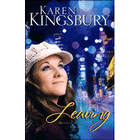 Leaving by Karen Kingsbury is a new series with Bailey Flanigan from previous series. I think Karen provides enough background information so that a reader could enjoy the book without having read all the books leading up to it, but the story would probably be richer for those who have shared this journey with Bailey so far.
This book, as the title suggests, sets us up for Bailey’s leaving her family to go out on her own. She has a Broadway audition she has always dreamed of and faces her future with excitement but naturally dreads leaving her family. Cody, her off-and-on love interest is currently off. He has struggled in the past with feeling like Bailey, from an ideal Christian family, would be better off with someone without his baggage of past alcoholism and a mom in jail for drug abuse. He seemed to overcome that in a past book, but threats from his mother’s drug-dealing boyfriend cause him to leave the area completely so as to keep Bailey safe. Unfortunately, he doesn’t tell Bailey what’s going on (a bad habit of his), so she is hurt and confused. They both struggle with their feelings for each other but wonder whether to pursue other relationships.
There are almost parallel plots in Bailey’s and Cody’s lives as well as a subplot with Ashley and Landon Baxter, also from previous series. They struggle as well with their oldest son growing up and a new health issue threatening Landon.
I enjoyed keeping up with the characters and could identify with the feelings of the first child leaving the nest.
I picked up Love Finds You in Camelot, Tennessee by Janice  Hanna on a whim because we’re new transplants to TN ourselves. Come to find out the area Janice writes about is not terribly far from were we live. I do want to drive out to it some day. Janice also lives where some of my family members do, so I felt we had a lot in common before I ever got into the story.
That story has to do with a small community called Camelot which sorely needs to raise funds. One member of the city council, Amy Hart, comes up with a grand idea: the townsfolk will put on the musical Camelot to try to draw in tourists dollars from nearby Pigeon Forge and Gatlinburg. As Amy casts various eccentric townspeople, she can’t find a suitable King Arthur — until it dawns on her to ask her childhood friend, Steve, the town’s mayor. He agrees if she’ll play Guinevere. A handsome out-of-towner who volunteers to play Lancelot shows interest in Amy, setting up a love triangle that parallels that of the musical.
I would classify this book as a romantic comedy, and it’s a lot of fun, but it’s not without depth as well as the characters deal with the various issues that arise. I felt the Christianity of the main characters was very natural as was the way they applied Scriptural principles to their lives and situations.
Evidently there are a number of “Love finds you…” books by various authors set in various US cities. I don’t normally gravitate toward this type of book, but I definitely enjoyed it and might be tempted to pick up another in the series or from this author.
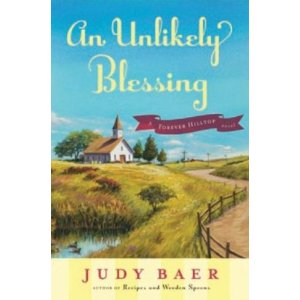 I wasn’t planning to review An Unlikely Blessing by Judy Baer, but someone said they’d like my thoughts on it.
In this book, new pastor Alex Armstrong comes from city life to a new rural parish. Alex obviously deals with situations that are completely new to him both in meeting new, often eccentric people and getting the lay of the land both in his church and in the community as well as adjusting to rural life and dealing with having just broken up with his fiancee. He is over two churches, one of which is doing fine, but the other keeps its distance emotionally as well as physically due primarily to the bitterness of it leading member.
The first part — maybe even the first half of the book has Alex meeting the people in his parish, and though that’s necessary and I don’t know how the author could have handled it differently, it just seemed like I was waiting that whole time for something to happen. Indeed, the whole pace of the book seemed a little slow and sleepy to me. That may have been on purpose to reflect the slower rural community. But it was several pages after the climax before I realized, “Oh! That was it!” In fact, when I was assembling my last “What’s On Your Nightstand” post, I had completely forgotten that I had read this book until I saw the title listed. I described it there as a “pleasant but not riveting read about a new pastor of two churches in a rural town. Similar in many ways to Mitford but not quite as charming.” It wasn’t a bad book at all — it just wasn’t compelling, at least to me.
But, as Levar Burton used to say on Reading Rainbow, you don’t have to take my word for it — the reviews of this book I skimmed through on Amazon were all quite positive, so I may have just been a little off while reading it.
And my shortish reviews ended up longer than I had planned, but I’d rather keep them together than string them out throughout the week.
The book I am reading now IS a riveting, don’t-want-to-put-it-down, wish I could let everything else go to read it type of tale. Can’t wait to finish and tell you about it!
(These reviews will also be linked to Semicolon‘s Saturday Review of Books.)


 Faithful
 Just Between You and Me

