Every Now and Then is the third in Karen Kingsbury’s 911 series dealing with various people affected by the tragedy of 9/11. Though the major characters from the previous books are also in this story, it can be read and enjoyed as a stand-alone book as well.
Alex Brady’s father was a firefighter who died on the job when the Twin Towers collapsed on 9/11. Alex had been a teen-ager with everything going for him — good grades, good family, sweet girlfriend — but he shut down after 9/11. He closed himself off to everyone else in his life and moved away to California. Since he felt God had failed him in allowing the bad guys this horrendous victory, he made it his mission to take as many of them off the street as he could and to prevent tragedies from happening to others. He became a sheriff’s deputy with the K-9 unit, establishing a reputation for courage, bravery and dedication — almost to the point of recklessness and danger. Alex was totally unaware that his boss’s family and circle of friends, who were trying to include Alex, had also been personally affected by 9/11, nor that the girl he loved and turned away now lived in the area.
Eco-terrorists targeted some of the higher-end residential building sites for arson to make their point that excess and affluence was taking a toll on the environment. Alex decided to infiltrate the organization on his own time to try to find the leaders and stop them.
Though I could tell fairly early where the plot was going to lead, the climax still had me riveted, on the edge of my seat. The plot line seemed more realistic to me than the previous two books, and Alex’s struggles in regard to the evil God allows in the world are some that every thinking Christian wrestles with. Karen brings up some points in that regard that are new to me and very helpful.
There were just a few problems I had with the book. The most minor one I’ve mentioned before when reviewing Karen’s books, and that is her penchant for ending chapters with a sentence fragment, as well as sprinkling them throughout. It can be done every now and then for effect, but when it becomes a noticeable habit, it loses its effect. Secondly, it seems odd that a group concerned about the environment would make a point with arson, which is bad for the environment, especially during California’s windy season. That point is made several times in the story, and I suppose the idea is that the terrorist group is not really interested in the environment at all. My last “issue” is a theological and therefore more major one: at the beginning of the book it seems that Alex is a believer, but he turns his back on God in bitterness and grief. Yet in the midst of a fire, he “wondered… if this was what hell felt like…maybe he was about to find out” (p. 263). If he was a true believer, he wouldn’t be facing hell.
Karen’s books are always easy to read, her characters likable and easy to relate to, and her plot lines easily draw one in, while she deals effectively with issues of the heart. This was my favorite of the books in this series.
I saw this over at Shelley’s, and thought it sounded like a great question for all of you:
“This can be a quick one. Don’t take too long to think about it. Fifteen books you’ve read that will always stick with you. First fifteen you can recall in no more than 15 minutes.”
1. The Bible
2. By Searching by Isobel Kuhn
3. In the Arena by Isobel Kuhn
4. Climbing by Rosalind Goforth
5. Amy Carmichael of Dohnavur by Frank Houghton
6. Changed Into His Image by Jim Berg
7. David Copperfield by Charles Dickens
8. A Tale of Two Cities by Charles Dickens
9. A Path Through Suffering by Elisabeth Elliot
10. Little House on the Prairie series by Laura Ingalls Wilder
11. Anne of Green Gables series by Lucy Maud Montgomery
12. Lord of the Rings series by J. R. R. Tolkien
13. Narnia series by C. S. Lewis
14. Rose From Brier by Amy Carmichael
15. Through Gates of Splendor by Elisabeth Elliot
It was hard to stop at 15, and on another day the list would vary a little, but overall these are books that have deeply influenced my thinking and that I go back to time and time again, either rereading or thinking about something I read there.
Feel free to join in and use this as a meme whether you particpate in Booking Through Thursday or not, but if you’d like to see what others listed, check today’s post there.
Through all the changing scenes of life,
In trouble and in joy,
The praises of my God shall still
My heart and tongue employ.
The four women Sharon James writes about in this book exemplify that truth: in varying degrees of trouble and joy, they lived for God.
Margaret Baxter was a rebellious, glamorous, well-to-do teen-ager who became a Christian under the preaching of her Puritan pastor, Richard Baxter. Though he was twice her age, Margaret fell in love with him, and in time her feelings were reciprocated, and they married. The union was a step down for Margaret financially (Richard took care to arrange their finances in such a way that he did not have access to her money so it would not be thought he married her for her money) and socially, but she had found her purpose in life and blossomed. This was a time when “Non-conformists” were persecuted, and when Richard was imprisoned for a while, Margaret voluntarily joined him. Both were, like all the rest of us, very human. Margaret was known for being generous, cheerful (Mrs. James notes, “It is simply not true that the Puritans went around looking miserable. Indeed, Richard Baxter wrote, “Keep company with the more cheerful sort of the godly; there is no mirth like the mirth of believers'” [p. 49]), industrious, competent, capable, patient, supportive — and anxious, fearful, perfectionist, and over-zealous. Yet she was aware of and grieved by her faults, and it was her desire to live a holy life for God.
Sarah Edwards had eleven children as the wife of Jonathan Edwards in the early 1700s. The Edwards were known for their “uncommon union,” their great love and respect for each other, and Sarah’s hospitality. Sarah thrived as a wife and mother, but the Edwards’ faced their share of difficulty as well when Jonathan was dismissed from the church where he pastored and some of their children died.
Anne Steele lived in a small English village in the 1700s, never married, suffered from poor health most of her life (with what is thought now to have been malaria), published two volumes of hymns and poems, and was known for her cheerfulness and faith. It was expected at that time that young women would marry and have a family, and there is some correspondence of teasing between Anne and her sister about Anne’s unmarried state even though the sister admitted her life was not all rosy.
Frances Ridley Havergal lived in the Victorian 1800s and is best known as the writer of hymns such as “Take My Life and Let It Be” and “Like a River Glorious.” Her father was a pastor and she was very active in the ministry of the church, thriving in personal work, one-on-one discussions with others about the gospel and spiritual truth. When her father died, her step-mother made unusual demands and seemed to even be mentally unstable, but Frances did her best to honor her. She did travel a lot and kept running, amusing accounts of her experiences: letters from her travels to Switzerland were gathered together in a book titled Swiss Letters. She turned down several proposals of marriage, though she “once wrote of the sense of ‘general heart-loneliness and need of a one and special love…and the belief that my life is to be a lonely one in that respect…I do so long for the love of Jesus to be poured in, as a real and satisfying compensation'” (pp. 193-194). She was a prolific writer of hymns and books. She “loved life, enjoyed people, revelled in nature, and laughed a lot” (p. 200).
The book deals with each woman individually, detailing her historical setting, the story of her life, her character and significance, and excerpts from her writing. Mrs. James’ style of writing is somewhat academic, more like teaching a class than telling a story: that’s not a bad thing, but I had picked up this book because I had read and enjoyed her earlier one, My Heart In His Hands about Ann Judson, and I don’t remember it being quite that way, though it has been years since I read it.
I didn’t agree with all of Mrs. James’ conclusions about why the women did what they did or the few things for which she criticized them: for example, she faults some of the women for not being more socially active. She wrote of Frances: “Although she was always ready to give benevolent help on an individual level, there is little evidence that Frances had strong feelings about the blatant social and political inequalities of that time” (p. 201). Some of us feel that dealing with individual hearts, resulting in a true heart change, will take care of the larger issues, and that Christians are called to share the gospel and make disciples, not necessarily battle the culture itself (though it’s not wrong to fight social ills). Mrs. James does go on to say of Frances, “And yet the ‘limiting’ of her vision to gospel issues meant that she was extraordinarily focused. Her mental and spiritual energies were not diffused into many different areas,” allowing a greater concentration on vital issues of “salvation, consecration, and worship” (p. 201). These women had their hands full enough with what they did do to warrant criticism for what they didn’t do.
I did appreciate Mrs. James research, insight, and masterful compilation of the details of these women’s lives. There is much about each woman’s life to instruct Christian women. To give just one example, one of Frances’s letters tells of the hostility and “appalling service” she received at an inn in Switzerland. Where most of us would be fuming and calling for the manager, Frances reacted patiently and finally said to the angry, spiteful woman, “You are not happy. I know that you’re not.” the woman was startled, “tamed…made a desperate effort not to cry” and listened while Frances spoke to her “quite plainly and solemnly about Jesus.” She received a tract, promised to read it, and thanked Frances over and over. Frances concluded, “Was it not worth getting out of the groove of one’s usual comforts and civilities?” (pp. 250-251). I have to confess that was a rebuke to me: I rarely think of such situations as a means of service to others.
Mrs. James concludes:
They had different personalities and varied situations, but each of these four women lived focused lives, wanting to praise God through days of trouble as well as joy. As is true of many women, they had to juggle all sorts of responsibilities. Pursuing holiness did not mean running away from these responsibilities: it involved living every day wholeheartedly for God (p. 253).
The folks at 5 Minutes For Books host What’s On Your Nightstand? the last Tuesday of each month in which we can share about the books we have been reading and plan to read. You can learn more about it by clicking the link or the button.
Is it the last week of May already?!
I am still working on classic missionary biography To the Golden Shore by Courtney Anderson about Americas’ first missionary, Adoniram Judson. I finished In Trouble and In Joy: Four Women Who Lived for Godby Sharon James, a collection of short biographies and writing excerpts of four women: Margaret Baxter, wife of Puritan preacher Richard Baxter; Sarah Edwards, wife of Jonathan Edwards; Anne Steele and Frances Ridley Havergal, both hymn writers, but have not yet reviewed it — hopefully will within the next week or so. I still haven’t reviewed Passionate Housewives Desperate For God by Jennie Chauncey and Stacy McDonald: I decided to go back over parts of it before reviewing it.
My excuse for not getting to these: we had a college graduation, out-of-town company twice, a piano recital, a spring concert, and an annual ladies’ luncheon all within the last several weeks.
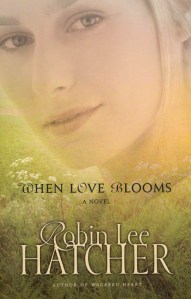
Some weeks ago I saw Robin Lee Hatcher offering advance copies of her book When Love Blooms in exchange for reviews. Sounded like a good deal to me!
When Love Blooms is set in Idaho in the latter 1800s. Emily Harris has been caring for her sister and nephew and their household during a serious illness, but everything is back to normal now, and she is at a restless crossroads in her life, wondering what to do next. She sees an ad in a newspaper for a governess for two young children at a mountain ranch.
The ad has been placed by Drucilla Blake, who is dying of cancer. Emily sees that she is not well, but the full extent of her illness is not yet made known. Also unknown to anyone else is Dru’s ulterior motive: to find someone to take her place when she is gone, someone that her husband and children could love.
Even Dru’s husband, Gavin Blake, is unaware of the real reason Dru wants to hire someone to help with the children, but he knows, with her illness, she could use the assistance. However, he is unimpressed with her choice of Emily: he doesn’t believe the wealthy, high-society young woman will last until spring in the harsher conditions of mountain ranch life.
A city woman proving herself in the country, a dying wife and mother seeking for someone to care for her family…it may seem like these story lines have been explored before, and they have — yet Robin weaves them together with unexpected backgrounds and underlying feelings and motives of the characters to make it all seem new.
Though I would describe the book as an easy read, it deals with weightier themes: Gavin’s lack of faith in God and his bitterness over his own mother’s actions; Dru’s illness and her daughters’ adjustments; Emily’s fortitude in dealing with difficultulties she encounters; each character’s seeking God for direction, help, and comfort.
Overall I enjoyed the book, though I did wince a little at the line, “[Emily] wanted to do something before she got married. She wanted to make some sort of difference in the world.” Having been married for nearly 30 years, I do understand that being a wife and mother takes priority and can often preclude other endevaors, so I can understand wanting to accomplish certain things befiore marriage, but this line almost makes it sound like getting married is a lesser goal, a lack of “doing something” worthwhile in the world. And Emily’s and Gavin’s feelings for each other are awkward and uncomfortable to read about at first, though their actions are honorable and they fight against those feelings until it is proper. But I think the rest of the story overrides these two uncomfortable areas, and everything is brought to rights at the end. I am happy to recommend it.
No Booking Through Thursday for me this week: the question was about graphic novels, about which I know next to nothing. But as I am used to doing a bookish post on Thursdays, I decided to share several quotes I’ve collected over the last few years about books and reading.
“And indeed, what is better than to sit by one’s fireside in the evening with a book, while the wind beats against the window and the lamp is burning?”
~ Gustave Flaubert
“Books are chocolate for the soul. They don’t make one fat. One need not brush one’s teeth after reading. They are quiet. One can bring them anywhere–no passport required. Books have only one downfall: even the fattest book has a last page, and then one needs a new one again.”
~Antonie Schneider
“Consider what you have in the smallest chosen library. A company of the wisest and wittiest men that could be picked out of all civil countries, in a 1000 years, have set in best order the results of their learning and wisdom. The men themselves were hid and inaccessible, solitary, impatient of interruption, fenced by etiquette; but the thought which they did not uncover to their bosom friend is here written out in transparent words to us, the strangers of another age.”
~ Ralph Waldo Emerson
“We read literature for a lot of reasons, but two of the most compelling ones are to get out of ourselves and our own life stories and–equally important–to find ourselves by understanding our own life stories more clearly in the context of others’.”
~ From Leave Me Alone, I’m Reading: Finding and Losing Myself in Books by Maureen Corrigan, page 34 (I haven’t read the book and I know nothing of the author, but I saw this quote somewhere and liked it.)
“…and to all this she must yet add something more substantial, in the improvement of her mind by extensive reading.”
~Jane Austen, Pride and Prejudice
“In reading, a lonely quiet concert is given to our minds; all our mental faculties will be present in this symphonic exaltation.”
~Stéphane Mallarmé
“These are not books, lumps of lifeless paper, but minds alive on the shelves. From each of them goes out its own voice… and just as the touch of a button on our set will fill the room with music, so by taking down one of these volumes and opening it, one can call into range the voice of a man far distant in time and space, and hear him speaking to us, mind to mind, heart to heart.”
~Gilbert Highet
“Some books are to be tasted, others to be swallowed, and some few to be chewed and digested.”
~Francis Bacon
“A truly great book should be read in youth, again in maturity, and once more in old age, as a fine building should be seen by morning light, at noon and by moonlight.”
~ Robertson Davies
“Be as careful of the books you read, as of the company you keep; for your habits and character will be as much influenced by the former as by the latter.”
~ Paxton Hood
“Books are the quietest and most constant of friends; they are the most accessible and wisest of counselors, and the most patient of teachers.”
~ Charles W. Eliot
“Books let us into their souls and lay open to us the secrets of our own.”
~William Hazlitt
“A little before you go to sleep read something that is exquisite and worth remembering; and contemplate upon it till you fall asleep.”
—Erasmus
“A good book has no ending. ”
~R.D. Cumming
Where My Books Go
All the words that I utter,
And all the words that I write,
Must spread out their wings untiring,
And never rest in their flight,
Till they come where your sad, sad heart is,
And sing to you in the night,
Beyond where the waters are moving,
Storm-darken’d, or starry bright.
~ William Butler Yeats
Do you have any good quotes about books or reading?
The Centurion’s Wife by Janette Oke and Davis Bunn is set in Israel immediately after the crucifixion and resurrection of Christ.
Leah is the niece of Pilate, but due to a financial disaster in her family, she becomes a servant to Pilate’s wife, Procula, until a marriage can be arranged for her. Leah does not want to marry, but her pleadings avail little. Procula had had troubling dreams about Jesus during His trial which continue to plague her, and she sends Leah out to try to find the disciples of Christ and learn what she can about whether revolt is planned among them. She befriends some of the women who followed Christ and is drawn to them while at the same time she is increasingly troubled about her impending arranged marriage.
Pilate had thought he appeased the Jews by giving them the crucifixion of Christ which they had clamored for, but now with the news that Jesus’ grave is open and His body missing, Pilate is concerned that His followers are planning a revolt. One of his centurions, Alban, has a good relationship with the Jews in his area, so Pilate sends him to learn what is going on and to ferret out any information he can. Alban is the centurion whose servant Jesus healed and whose faith Jesus praised, yet in this story it is thought that the faith that his servant could be healed was not quite yet saving faith. Alban sets out first of all to find the soldiers assigned to guard Jesus’ tomb: something doesn’t quite add up, because if the disciples had broken into the tomb and stolen Jesus’ body, the soldiers on guard would have been killed for letting that happen. But they are alive, and Alban wants to hear their side of the story.
What Alban and Leah both find separately has profound implications for their future.
I have to admit I approach Biblically-based fiction somewhat warily. It has to be understood that the events and personalities beyond what the Bible delineates are products of the authors’ imaginations, and sometimes an author’s characterization can ring not quite true with one’s own summations. But I have read all of Janette Oke’s books and many of Davis Bunn’s, and I felt they wouldn’t go too far afield. I just happened to pick this book up just after Easter, the same time setting as the book, and it brought to mind what that time must have been like. Pilate thought he had closed a chapter in regard to Jesus but now finds he may have more trouble than before; the disciples are convinced at this point that Jesus has risen and they are waiting, at His command, but they don’t know what is next; other people don’t know what to make of the events. It’s easy to imagine the incredulity many experienced upon first hearing that Jesus is not just missing, but resurrected, yet for several reasons they can’t just dismiss the possibility.
It took me several chapters to really connect with the characters, but I can’t put my finger on exactly why: perhaps it was just that initial confusion and unrest conveyed by the times carrying over into my perceptions. But I did feel more drawn in as the story progressed. I enjoyed “meeting” some of the early disciples: my favorite was Martha. I felt her personality was the most well-developed and realistic. Every church kitchen has a lady like her: bustling, efficient, matter-of-fact, perhaps a little too blunt, yet she had learned well the lesson Christ taught her. Mary Magdalene seemed the least well-developed and almost a little too other-worldly to me.
Overall I enjoyed the book and am looking forward to the next in the series.
The folks at 5 Minutes For Books host What’s On Your Nightstand? the last Tuesday of each month in which we can share about the books we have been reading and plan to read. You can learn more about it by clicking the link or the button.
I was surprised at first to find that I had not participated in this since January, but then I remembered that was primarily because I was still in the unabridged Les Miserables and To the Golden Shore all those months and didn’t want to just keep listing the same books.
I did finally finish Les Miserables and reviewed it here. I am still working on classic missionary biography To the Golden Shore by Courtney Anderson about Americas’ first missionary, Adoniram Judson. I just recently started In Trouble and In Joy: Four Women Who Lived for Godby Sharon James, a collection of short biographies and writing excerpts of four women: Margaret Baxter, wife of Puritan preacher Richard Baxter; Sarah Edwards, wife of Jonathan Edwards; Anne Steele and Frances Ridley Havergal, both hymn writers. Anne was the only one I knew nothing about before the book. I’ve only just started it within the last week or so, so it is too early to have much of an opinion on it yet.
I read The Centurion’s Wife by Janette Oke and Davis Bunn but haven’t had a chance to review it yet. It is set during the time just after the crucifixion and resurrection of Christ, about a young woman, Leah, who is a servant to Pilate’s wife, sent out by her mistress to find out more about Christ’s followers and their intentions. She is betrothed against her will to a centurion who is sent out by Pilate on the same mission. It took me a while to get into the book, but overall I enjoyed it. I hadn’t specifically planned to read it just after Easter, the same time frame as the book, but that’s when I happened to start it, and it added a nice dimension to enter into their experiences around the same season as the setting of the book.
I also completed Passionate Housewives Desperate For God by Jennie Chauncey and Stacy McDonald, a book primarily encouraging stay-at-home wives and mothers. Overall it was good, but there were a couple of things I wouldn’t agree with quite 100% the way they were presented. More on that when I am able to review it.
I also read the last of the Four Seasons of Marriage books by Palmer and Chapman, Winter Turns to Spring.
I am not sure which of the books on my Spring Reading Thing list I will pick up next, but I would like to go through some of the Christian fiction books I have listed there.
I have also been consistently reading a daily devotional book titled Our Daily Walkby F. B. Meyer. I am convinced it is the devotional book for me for this year. It has ministered to me greatly and I have quoted from it several times here.
You can join in sharing what’s on your nightstand or see others’ entries here.
My husband is not an avid reader, and he used to get very frustrated in college when teachers would insist discussing symbolism in a literary work when there didn’t seem to him to be any. He felt that writers often just wrote the story for the story’s sake and other people read symbolism into it.
It does seem like modern fiction just “tells the story” without much symbolism. Is symbolism an older literary device, like excessive description, that is not used much any more? Do you think there was as much symbolism as English teachers seemed to think? What are some examples of symbolism from your reading?
Wow, I was surprised to see my question pop up today! Unfortunately it’s a day when I don’t have a lot of extra time to deal with it, but I’ll look forward to see what others had to say when I can.
I haven’t read a lot of modern fiction, but it does seem to me that, just as there is more free verse poetry now than the more heavily structured kind, fiction seems more “free verse” as well, employing fewer literary devices than it used to. I mentioned description as well — many older books are filled with minute descriptions of places and people, whereas today, if the description doesn’t advance the plot line or have some telling necessary detail, people get impatient with it. I think many modern readers want their books served like their fast food — something quick and simple that fills the need of the moment. That is not a bad thing in itself: I enjoy fast food as well as home-cooked multi-course dinners just as I enjoy both the quick and simple fiction as well as the old classics. But one is certainly a lot richer than the other.
Interestingly, I did a quick search on “Symbolism in literature” and found articles at polar opposites: “The Silliness of looking for symbolism in literature” by John T. Reed, which, as you can tell by the titles, espouses that there is no, or at least very little purposeful symbolism (I do disagree with his harsh words against English teachers), and “Symbolism in Literature” by Karen Bernado, which seems to be saying in one part that it doesn’t really matter if the author intended symbolism or not; it is all open to interpretation, and if something symbolizes something to you, that’s great. Personally, my views would be somewhere between those two. I do think there are times, especially these days, when an author writes a story just to write a story with no symbolism intended. But I do think a degree of symbolism can greatly enhance what the author is trying to convey. On the other hand, if I were to write a book, I think any symbolism I used would be specific and purposeful: I would not want Bernado’s approach that what I had written was open to interpretation and anyone could see any symbolism they chose.
One good example of symbolism I’ve seen was in A Tree Grows in Brooklyn by Betty Smith. I said in my review of it:
The symbolism of the tree in the title and in the story is clear: the tree that “liked poor people,” that grew in “sour earth” where it wasn’t given much inducement to grow, that continued to grow even after it was cut down, is parallel to Francie’s life.
Another excellent example is The Chronicles of Narnia. You can enjoy the story without understanding what it symbolizes, but when you realize the symbolism in it, you’re blown away by the depth and beauty in it.
This discussion ties in somewhat with another question I submitted and hope we get to some time, which is whether our experiences with literature in school enhanced our love of it or interfered with it. I have had both types of English teachers. Some were very clinical and academic, losing the excitement of the story in examining its parts, and others used the academic study of literature to enhance the enjoyment and learning from it.
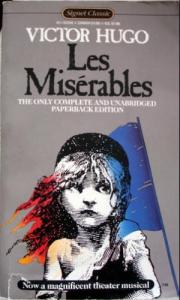
I’ve read a couple of different abridged versions of Les Miserables by Victor Hugo and made it my goal to read the unabridged version.
A brief synopsis for those who might be unfamiliar with the story: Les Miserables at its most basic is the story of Jean Valjean. He lived with his sister and her family in extreme poverty in France after the French Revolution. In one act of desperation he broke a window and stole a loaf of bread. His sentence was lengthened by multiple escape attempts until he was finally released 19 years later. His hardness and bitterness increased by the response he got when he was required to show his papers at each new town he visited, resulting in lower pay and refusal of the townspeople to rent him a room or serve him a meal because he was an ex-convict. An act of grace by a bishop resulted eventually in transforming him.
When he traveled into a new town, his help in saving someone’s life and the confusion and excitement around the event resulted in the town officials’ forgetting to ask him for his papers. He was hired on in a factory and devised a way to improve the factory’s production, leading to his promotion, eventually to the head of the factory, and further still to his being elected the mayor. He was known as a quiet but kind and and benevolent man, using much of his wealth to aid those in need.
Thus it would seem his life was set on a new course of usefulness and happiness, except…except…
Except for Javert, a former prison guard who became the new police inspector in Valjean’s town, who thinks he recognizes the mayor as an ex-convict who has broken his parole.
Intersecting Valjean’s story is that of Fantine, a young, naive girl who gave herself to a man who only wanted to use her as a diversion one summer, leaving her with child, Cosette. In that day a single woman with a child was a scandal, so Fantine found an innkeeper and his wife whom she paid to keep her child while she went to another town to look for work. She ended up in Valjean’s factory, where she was fired after it was discovered that she had a child. In the meantime, the innkeeper, Thenardier, made up stories about Cosette needing more clothes, needing medicine, becoming very ill, all in an effort to extort money from Fantine. Fantine, worried and desperate, sold her teeth, her hair, and eventually her body (which is handled discreetly, without explicitness, in the book and was viewed by Hugo as a form of slavery). She became gravely ill from neglect of her own care, and an altercation in the street brought her to the attention of Valjean. When he heard her story, he felt responsible for her situation since she was dismissed from his factory, and he paid her her care and promised to take care of her daughter. The Thenardiers resented Valjean’s rescue of Cosette and the subsequent loss of income.
The rest of the book details the pursuit of Valjean by Javert, and, at times, Thenardier, his care of Cosette, her growth into a young woman, her falling in love with Marius, much to the dismay of Valjean, who has never loved anyone else and is afraid of losing Cossette.
That is the basic plot, but there are so many more layers, subplots, and characters in Les Miserables. There are discussions of poverty, politics, French history. One of the major themes is the righteousness of the law, as represented by Javert, versus the righteousness of grace, represented by Valjean. While not a Christian book in itself (it portrays the innate goodness of man, whereas Scripture portrays the innate sinfulness of man, and it includes some strange philosophies, and its politics are much more socialistic than I am comfortable with), it does portray Christian themes of redemption, forgiveness, sacrifice, and selflessness, and Valjean does depend on God for salvation and strength.
I have mentioned here before that I had read a couple of different abridged versions and had wanted to read this unbridged version for a long time. Though normally I am a book purist, wanting a book to remain as untouched as possible, I can see now why this book is abridged. The sheer 1,463 page length of the book is not so much the problem as the frequent asides. It is rather like rush hour traffic in some places — very slow going interspersed by brief interludes of acceleration. It’s like a mini-series interrupted at the climactic moments by a documentary. Valjean’s escape with Cosette to a convent leads to a discussion of the history of convents in general, this convent in particular, whether convents are right or wrong. An incident at the end of the battle of Waterloo which has repercussions for two characters later in the book is preceded by a 57-page description and discussion of Waterloo. A student revolt at the barricades leads to a discussion of the differences between an insurrection and a riot and which, in the author’s opinion, is right and wrong. Valjean’s escape from the barricades with a wounded Marius through the sewers involves a detailed description of the history of sewers and the author’s suggestions for how they could be made better (and I never knew there were so many different synonyms for sewage). Hugo must have been an intensely curious man as well as a thinker and a philosopher, but the asides do get tiresome. Though at times I found myself interested in them in spite of myself, particularly the battle of Waterloo section, a few times I was tempted to skip through them, reminding myself that I wanted to read the unabridged version, not skim through it.
And I am glad that I read it. It did give me a fuller understanding of the story, and I particularly enjoyed learning more of Fantine’s early story than other versions included and more of Javert’s mental struggle that led to his actions at the end of his life.
There are moments of sheer beauty in the book, moments of identification with the very human struggle, such as Valjean’s dilemma when he learns another man has been arrested under his name. One of the most poignant moments iss when he returns home after Cossette’s wedding and pulls out the little clothes he had bought for her when he first rescued her, and weeps into them. One of my favorite sections is when Thenardier seeks to implicate Valjean to Marius, unwittingly clearing his name instead.
And for all of Hugo’s wordiness, there are moments of clever, succinct, descriptive phrasing: “For dowry, she had gold and pearls; but the gold was on her head and the pearls were in her mouth.” “A torn conscience leads to an unraveled life.” “There is a way of falling into error while on the road of truth. He had a sort of willful implicit faith that swallowed everything whole.” “Skepticism, that dry rot of the intellect.” “He suffered the strange pangs of a conscience suddenly operated on for a cataract’.” “This man…was…still bleeding from the lacerations of his destiny.”
Just a word about the musical based on the novel: it was through the musical that I first discovered this story. I was in the library video section one day, saw a video of the tenth anniversary production of the musical, and decided I’d check it out just to see what it was all about, having heard the title for years but knowing little of the story. I was absolutely enthralled. The music is gorgeous and the story so touching. But for the information of those whose standards are as conservative as mine or more so, there is a smattering of four-letter words, and the section dealing with Fantine’s prostitution is much more explicit than the book is. Unfortunately, though I’d love to see a stage production, I could not in good conscience because of that section. As it is we skip the “Lovely Ladies” song on the video and CD. I was delighted to discover, though, that the musical does go back to the original for many things, using even some exact lines from the book. It’s fairly faithful to the book except for the section mentioned, and the fact that Eponine and Marius’s relationship is not as it was in the book, and the scene of Valjean praying over Marius before the battle of the barricade and regarding him as a son was not on the book: at that point, even after rescuing Marius, Valjean hates him for the threat he is to taking Cosette away and is only caring for him for her happiness, though he does come to love him as a son much later. Plus Valjean doesn’t fight Javert after Fantine’s death before rescuing Cosette: he is arrested and escapes again later.
I’ll leave you with a couple of scenes from the musical. The first is the confrontation between Valjean and J avert after Fantine dies.
The second takes place after Valjean learns another man has been arrested in his name, and he struggles within himself as to what to do about it. The number 24601, which is mentioned in both songs, was Valjean’s number in prison.

 Every Now and Then is the third in Karen Kingsbury’s 911 series dealing with various people affected by the tragedy of 9/11. Though the major characters from the previous books are also in this story, it can be read and enjoyed as a stand-alone book as well.


 Some weeks ago I saw
 The Centurion’s Wife