Wrestling with an Angel

Wrestling with an Angel: A Story of Love, Disability, and the Lessons of Grace

When Greg Lucas and his wife adopted a baby that had been abandoned to the hospital where his wife worked, they had no idea what was ahead of them. Their son, Jake, seemed normal, healthy, and happy at first. But after his first birthday, he began having seizures where he’d suddenly stop breathing. Various doctors and medications were tried. The seizures eventually stopped, but Jake was left with a series of issues: Sensory Integration Disorder, Obsessive-Compulsive Disorder, Pervasive Developmental Disorder, and autism—just to name a few.

I had read a few of Greg’s blog posts at Wrestling with an Angel via links from Tim Challies. Then in 2010, Greg’s book was published as Wrestling with an Angel: A Story of Love, Disability and the Lessons of Grace. I’ve had the Kindle version for a while, but just recently the audio version was included free with my Audible subscription.

Greg tells of what he’s learned through helping Jake over eighteen years. Jake operated at the level of a two-year-old. Every bath time became a wresting match due to Jake’s severe sensory issues. As Jake got older and stronger, taking care of him became harder.

How do you care for someone who resists your love with violence, who opposes your very presence even when that presence is necessary for his good? How do you keep on loving when the person you are devoted to seems incapable of affection? The only way to make any sense of this kind of relationship is to experience it through the truly unconditional love of the Father (p. 23, Kindle version).

Over and over, Greg and his wife were brought to the total end of themselves in caring for Jake. But they found that a good place to be, because there they could only lean on God’s grace.

Greg writes with raw honesty but also with great sensitivity and beauty. He writes of the grace of an occasional easy day, a glimpse of his son as normal; how humiliation leads to humility, how they found ways to communicate when Jake had only five words in his vocabulary, how dangerous it is when someone can’t express himself, concerns over whether and how much Jake can understand about Jesus and salvation, Jake’s tendency towards injury, concerns about how to take care of Jake as he got older, agonizing over whether to send him to a specialized residential school away from home.

I think this would be an excellent book for someone with a mentally or developmentally disabled child or relative or friend. But I found it beneficial as well, even though I don’t know anyone with problems as severe as Jake’s. The lessons of faith and grace shine through as we realize the spiritual disabilities we all have and our Father’s abundant love in caring for us.

Dakota December and Dakota Destiny

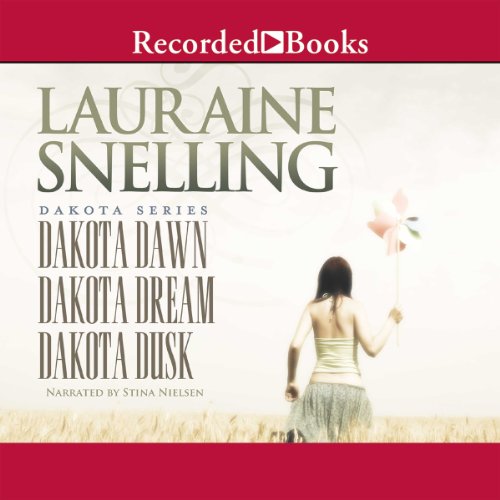
Lauraine Snelling’s Dakota Plans series is made up of five novellas about Norwegian immigrants to North Dakota in the early 1900s. The first three, Dakota Dawn, Dakota Dream, and Dakota Dusk, were packaged together in an audiobook I reviewed here.

The last two, Dakota December and Dakota Destiny, were packaged together in a separate audiobook.

In Dakota December, Sheriff Caleb Stenesrude’s dog needed to go out during a Christmas Eve blizzard, but then stayed out yipping instead of coming back in. Caleb went out to see what was wrong and found a woman collapsed on a horse. He caught her as she fell and discovered a young child clinging to her. When he brought them into the house, he saw that the woman was with child. Her cries let him know she was in labor. He was in for a unique Christmas Eve.

Later, the woman, Johanna Carlson, is ensconced with her children in a widow’s home until she can recover and the weather settles down. She’s reluctant to tell these good people her troubles. But she needs to get away as soon as possible, before her angry and violent husband finds them.

In Dakota Destiny, Pastor Moen’s daughter, Mary, is grown up and in a teacher’s school, thanks to a wealthy benefactress. Mary is in love with Will, the blacksmith’s apprentice we met in the second book, who is also now grown up. But when World War I begins, Will feels he must enlist. Mary spends the summer taking care of a sick woman’s children while Will goes to training camp and then out to sea. When Mary goes back to school, she receives the devastating news that Will is missing and presumed dead.

She carries on with her school and finds her first job as a teacher. A year later, another man seeks her hand. But she can’t shake the feeling that Will is still alive.

The last book was much shorter and seemed a little underdeveloped. It was odd that characters in books 3 and 4 had the same last name, but didn’t seem to be related to each other. The narrator of all the books was really good, but used a different voice for the pastor in book 4 than in the rest of the books. And I disagreed with a statement in the last book that we are all God’s children (we’re not).

But otherwise, I enjoyed both these books. A few characters from the previous books were rarely mentioned again, but others played prominent parts. I’m going to miss this little community. I especially appreciated an older lady, Mrs. Norgard, and the ways she found to help and encourage people.

Dakota Dawn, Dream, and Dusk

Dakota series by Lauraine Sneling

Lauraine Snelling wrote a series of five novellas about Norwegian immigrants to North Dakota in the 1900s. The first three, Dakota Dawn, Dakota Dream, and Dakota Dusk, were packaged together in a free-with-my-subscription audiobook. I don’t know what’s up with the picture on the cover—no one dressed that way in the 1900s!

In Dakota Dawn, Norah Johanson’s fiance had gone to America three years ago, promising to send for her. Now she’s on her way. But when she arrives, she finds that Hans has just recently died. Reverend and Mrs. Moen take her in for as long as she needs to decide what to do. She doesn’t have the money to go back home, so she must find work.

Carl Detchman is a quiet but stubborn German immigrant whose wife has just died in childbirth. The Moens have taken care of his young daughter and infant son, but he can’t expect them to do so forever. The Moen’s house guest who has been helping with the children seems capable. But he can’t invite a beauitful young single woman to his home without tongues wagging. So he proposes a marriage of convenience. If she’ll come and keep house and take care of the children until he can make other arrangements, then they can annul the marriage and he’ll pay for her ticket back home.

Norah is shocked at first, but agrees. And, of course, the two fall in love. This is a frequently seen story line with an inevitable conclusion, but it was enjoyable to see the two work through their issues and come first to appreciate, and then to love each other.

In Dakota Dream, Clara Johanson, Norah’s sister, received a ticket to her sister’s town and a picture from a handsome stranger offering to pay her way to Dakota if she’ll be his wife. Clara agrees. But when she arrives at her sister’s house, no one knows who this man is.

What she doesn’t know is that Jude Weinlander brought Clara over to play a trick on his brother, Dag. He signed Dag’s name to the letter but sent his own picture. Dag is tasked with meeting Clara at the train station and taking her to the Detchman’s. He does not make a good first impression, with matted hair and beard and filth from the livery where he works.

Clara stays with her sister until the pastor asks if she can come and stay with an elderly woman who is not doing well and needs full time care. Clara has no idea the change this will make in her life—and in her relationship with Dag.

In Dakota Dusk, Jude Weinlander is disgusted. His trick on Dag backfired. He’s run out of money due to drinking and gambling and has to move with his wife back to his mother’s house.

When a fire destroys his home, after he heals, he becomes a drifter, traveling from place to place looking for work. He doesn’t drink or gamble any more, but he can’t go home. He comes upon a town rebuilding their school after a prairie fire. He stays to help, and then is asked to stay on to help rebuild other homes.

He can’t help but notice the pretty school teacher, Rebekka Stenesrude. But he can never pursue a relationship. He’s not worthy. No one could love him if they learned what he had done.

These stories were set some years after Laura Ingalls Wilder’s Little House series, so there are many similar incidents—grasshopper infestations, prairies fires, etc .But these stories are told primarily from the viewpoint of immigrants adjusting to a new land. I felt the same way I did after reading Laura’s books—glad I was born in my time and not hers!

There were so many hardships in those times. The services for help that we take for granted didn’t exist then, so people had to help each other, and accept help, or die.

But great faith and character emerged as well. I enjoyed these stories as well as the characters and the obstacles they overcame.

The Space Between Words

In The Space Between Words by Michele Phoenix, Jessica and two friends in Denver take a vacation to Paris. Though they’ll do some sight-seeing, they are mainly there to scout out treasures at antique stores and flea markets.

But then Jessica is shot during the Paris attacks in 2015. She’s traumatized by all she saw in the attacks. When she heals enough to be moved, she wants to get out of Paris as quickly as possible.

But one of her friends talks her into staying, at least for a little while. In one flea market, Jessica find an antique sewing box that seems to draw her. Back at her room, she discovers a secret compartment in the box which contains several sheets of handwritten paper and a few pages from an antique French Bible.

A new friend helps Jessica translate the ancient French. The sheets held the writing of a young woman named Adeline Baillard in 1695. She and her family were Huguenots when the Catholic King outlawed their faith and sanctioned torture and persecution against them. Adeline’s family gets her sister and brother and his family out, but Adeline stays with her parents. She’s a teacher and wants to help her students as much as she can while there is time.

As Jessica reads Adeline’s words, she feels compelled to find what happened to her and her family, especially her sister. Her own healing and mental and spiritual health are wrapped up in Adeline’s fate. She can’t understand how Adeline could believe so strongly in a God who would allow such atrocities to happen.

I’m sorry to say that I had completely forgotten about the Paris attacks of 2015. The year isn’t given in the novel, but the details seemed more reality than fiction, so I looked up and read more about them in Wikipedia.

This is the first book of Michele’s I have read, and I was captivated. So much of the story is touching, but subtle humor is sprinkled throughout as well. One surprise twist was heart-wrenching.

Just a few quotes that stood out to me:

I knew he worried, as I did, that that part of my life had been amputated by fear.

Father held what remained of our Bible in both hands and declared, “This is the Truth that binds us to each other and to God. These are the words exhorting us to faithfulness and strength. These are the pages that emancipated our faith from the dictates of a King. We will carry them with us as a testament to our resistance, as a reminder of all the Huguenot community has endured” (p. 115).

My grandmother believed in the power of words, in the capacity of story to transcend both time and place. This scroll is evidence of the temerity of her escape, a tribute to the ancestors who lost their world to save their faith (p. 288).

There were a couple of odd places where a child seemed to see someone who wasn’t there. But other than that, I loved everything about this book.

Unveiling the Past

In Kim Vogel Sawyer’s novel, Unveiling the Past, Megan DeFord and Sean Eagle are married cold case detectives. They are working on a case about the death of two young brothers when their captain interrupts them. A friend of the captain’s wants to investigate her father’s disappearance from several years before. The missing father was accused of embezzling from his bank, though there was no evidence to suggest he did. But his sudden disappearance lent credence to the idea that he did steal the money. His daughter, Sheila, wants to find out what happened, and she wants a woman detective. Since Meghan is the only woman in the office, the captain wants her to take the case.

Sean, however, feels strongly about the case they are on. He could give it to one of the other detective teams, but he has been personally involved with the family and feels he would be letting them down to drop the case now.

Reluctantly, Sean and Meghan decide to work with another detective team so Sean can finish his case while Meghan works on the one from the captain. Unfortunately, that leaves Sean working with Tom Farber, the most cantankerous detective on site.

On a personal level, Sean longs to start a family. But Meghan’s highly dysfunctional mother and absentee father make her uncertain of her own maternal capacities.

In fact, Meghan’s lack of a father in her life makes her sympathize with Sheila. Meghan’s mother had finally given her the name of her father a few years ago. Maybe it’s time to look him up.

This book is the sequel to Bringing Maggie Home, one of my top books of last year. Each book could be read on its own, but I would recommend both of them.

The title of the book reflects many layers of unveiling, both in the two main characters, the people they are investigating, Meghan’s parents, and Farber.

I mentioned in my review of the first book that I like Christian fiction that shows Christian people doing normal Christian things. Two characters in the book are new Christians. Meghan, in particular, wrestles with discerning between her own desires and God’s will.

Overall, I enjoyed this book quite a lot.

I listened to the audiobook, nicely read by Barbara McCulloh.

Quotes about Reading

Reading is one of my favorite pastimes, and for years I’ve collected quotes about reading and books that rang true for me. Here are a few:

“And indeed, what is better than to sit by one’s fireside in the evening with a book, while the wind beats against the window and the lamp is burning?”
~ Gustave Flaubert

“…and to all this she must yet add something more substantial, in the improvement of her mind by extensive reading.”
~Jane Austen, Pride and Prejudice

“I declare after all there is no enjoyment like reading! How much sooner one tires of any thing than of a book! — When I have a house of my own, I shall be miserable if I have not an excellent library.”
~ Jane Austen, Pride and Prejudice

“When I am king, they shall not have bread and shelter only, but also teachings out of books, for a full belly is little worth where the mind is starved.”
~ Mark Twain, The Prince and the Pauper

“Words can be like X-rays if you use them properly — they’ll go through anything. You read and you’re pierced.”
~ Aldous Huxley, Brave New World

“A classic is a book that has never finished saying what it has to say.”
~ Italo Calvino, The Uses of Literature

“The author who benefits you most is not the one who tells you something you did not know before, but the one who gives expression to the truth that has been dumbly struggling in you for utterance.”
~ Oswald Chambers, My Utmost for His Highest, Dec. 15

“Far from being an escape from reality, good literature is a window into reality.”
~ Gladys Hunt, Honey for a Woman’s Heart

Which of these resonates with you? Do you have any other good quotes about books or reading?

(I often link up with some of these bloggers.)

Writing for the Soul

Writing for the Soul: Instruction and Advice from an Extraordinary Writing Life by Jerry B. Jenkins is part memoir as well as instruction, advice, and tips about writing. But even the biographical parts are written to share what he learned.

Jenkins started out working for a newspaper writing for the sports section while he was still in high school. His goal was to write for the Chicago Tribune until a message at camp about surrendering his all to the Lord led him to do just that. A job editing a Sunday School paper for Scripture Press under a tough editor caused him to hone his skills. An interview led to his first book, a biography. Many of his next books were biographies or “as told to” stories. Then he branched into fiction. Left Behind, the book for which he is probably most well known, was his 125th book.

In Writing for the Soul, Jenkins covers everything from his family policy, motives and tools for writing, discovering what to write and your audience, characters, plot, perspective, and much more. Some of the chapters end with a question and answer section. Interspersed through the chapters are smaller sections covering topics ranging from working with celebrities to the need for humility to internal dialogue of characters. In a paper book, these might have been sidebars: in the Kindle version I read, they were paragraphs withing the chapter but set off by dividing lines.

In-between chapters, Jenkins shares experiences with some of the people whose biographies he has written, from Meadowlark Lemon and other sports figures to musician B. J. Thomas to Billy Graham.

I especially appreciated the sections on making inspirational writing not sound “preachy.”

As you can imagine, I have myriads of quotations marked in this book. Just a few:

Know where your audience is coming from, imagine someone you know or know of who fits in that audience, and pretend you’re writing to that person alone (p. 5, Kindle version).

What’s your passion? Your strength? What field do you really know? Write about it. Fashion a short story, write a poem, interview a leader in the field, or work on a novel. Put yourself and your interests into it (p. 11).

Big doors turn on small hinges (p. 13).

The most attractive quality in a person is humility. Sometimes money and fame will come whether or not you expect or seek them. But if you become enamored with the trappings of success, they become your passion. You need to return to your first love . . . Don’t let success or pressure change you. If you become a success, stick with what got you there (p. 38).

Choice words in precise order bear power unmatched by amplified images and sound and technical magic (p. 54).

Don’t confuse inspiration with initiative. Initiative solves your procrastination problem and pulls you through writer’s block. Inspiration gives you something worth writing about (p. 57).

Variety still keeps the batteries fresh (p. 71).

The stuff that comes easy takes the most rewriting. And the stuff that comes hard reads the easiest (p. 194).

This book was first published in 2006, and my copy was updated in 2012. Just a couple of places seem a little out of date, like working with cassette tapes for interviews (unless people still do that. I’d assume most recording is done digitally now).

He also doesn’t have much esteem for self-published books, thinking the goal of self-publishing is to be picked up by a major publisher. But self-publishing has increased exponentially in the last few years and garners much more respect now than when the first self-published books came across as “homemade” and unprofessional. I wonder if his views have changed on that.

But the majority of his advice is timeless, and I gained much from it.

You can also find Jerry Jenkins’ advice at his web site and blog.

(This book would work for either the memoir or arts category of the Nonfiction Reader Challenge.)

The Pilgrim’s Regress

The Pilgrim’s Regress was the first fiction book written by C. S. Lewis after his conversion to Christianity. Lewis’ book is not a retelling of Bunyan’s Pilgrim’s Progress: Lewis just borrows the allegorical format.

The book’s protagonist is John, a young man from a land called Puritania. The country is ruled over by a Landlord who is reportedly very good and kind but who will throw anyone who disobeys him into a black hole.

One day John catches a glimpse of a beautiful island through a window. The sight, sounds, and smells raise an ineffable longing to see the island again and even visit it.

John journeys towards the island, but instead finds different philosophers and detractors. He meets a “brown girl,” who assures him she’s what he really wanted. But she represents lust, and John eventually finds he’s dissatisfied with her. (This article makes a good case that Lewis was neither racist or misogynistic by designating lust as a brown girl).

John continues on and meets Mr. Enlightenment, the Spirit of the Age, Mother Kirk, Mr. Sensible, Mr. Neo-Angluar, Mr. Humanist, History, Reason, and others. Some say his island is an illusion. Others offers various suggestions for how to get there. Some argue for or against the against the existence of the Landlord. History tells John the landlord sent truths about himself in the form of various pictures. But many interpreted the pictures the wrong way.

Finally John understands the way to the island. Wikipedia says, “The Regress portion of the title now comes into play as John journeys back home and now sees everything in a new light and sees how the road he took is a knife’s edge between Heaven and Hell.”

In a preface to the third edition of the book, written ten years after it was originally published, Lewis apologized for the book. Although he hadn’t intended the book to be strictly autobiographical, he hadn’t realized that not everyone’s journey was quite like his.

On the intellectual side my own progress had been from ‘popular realism’ to Philosophical Idealism; from Idealism to Pantheism; from Pantheism to Theism; and from Theism to Christianity. I still think this a very natural road, but I now know that it is a road very rarely trodden. In the early thirties I did not know this. If I had had any notion of my own isolation, I should either have kept silent about my journey or else endeavoured to describe it with more consideration for the reader’s difficulties.

He says that in the new edition (online here), he added headlines before the different sections. He apologizes for doing so, but the headlines would have been a great help if I had read rather than listened to the book.

I think I would have gotten more out of the book of I had read an annotated edition, which explained more about the different references and philosophies (one GoodReads reviewer recommended C. S. Lewis and Narnia for Dummies as an aide). But I got the gist of the story and understood most of the discussions between characters. To me, this book illustrates what Lewis said in Mere Christianity:

If I find in myself a desire which no experience in this world can satisfy, the most probable explanation is that I was made for another world. If none of my earthly pleasures satisfy it, that does not prove that the universe is a fraud. Probably earthly pleasures were never meant to satisfy it, but only to arouse it, to suggest the real thing.

Be Committed: Commentary on Ruth and Esther

The books of Ruth and Esther are the only ones in the Bible named for women. The two women lived in different times and came from very different backgrounds. So why did Warren Wiersbe group them together in his commentary, Be Committed (Ruth and Esther): Doing God’s Will Whatever the Cost? He says:

Why do we bring these two women together in this study? Because, in spite of their different backgrounds and experiences, both Ruth and Esther were committed to do the will of God. Ruth’s reply to Naomi (Ruth 1: 16–17) is one of the great confessions of faith found in Scripture, and Esther’s reply to Mordecai (Est. 4: 16) reveals a woman willing to lay down her life to save her people. Ruth and Esther both summon Christians today to be committed to Jesus Christ and to do His will at any cost (pp. 15-16).

And then Dr. Wiersbe says something he has repeated in many of his commentaries: “Faith is not believing in spite of evidence but obeying in spite of consequence” (p. 16).

Ruth lived during the time of the judges, before Israel had kings. She was from Moab, people who were enemies to Israel. But her in-laws had come to Moab from Israel during a time of famine. Ruth had married one of their sons, but over time her father-in-law, husband, and brother-in-law all died. Ruth had come to believe in Naomi and Israel’s God, and she traveled with her mother-in-law, a bitter and broken, Naomi back to Israel.

The only recourse the women had for food was for Ruth to glean in someone else’s fields. The law at that time told farmers not to harvest every single piece of produce they grew, but to leave some for the poor. Ruth “happened” upon the fields of kind Boaz (one of my favorite OT people), who told his workers to leave some extra on purpose for her.

Near relations had the right to redeem the land of their deceased relatives, but part of the deal was marrying the widow. The nearest relation to Ruth’s husband was not willing to do this. But Boaz was the next nearest relation, and he was willing. Thus Ruth and Naomi were taken care of, and Naomi’s joy returned with the birth of her grandson–who became the grandfather of King David.

There’s much that could be said about this wonderful book. One point Wiersbe makes is this:

It is encouraging to see the changes that have taken place in Naomi because of what Ruth did. God used Ruth to turn Naomi’s bitterness into gratitude, her unbelief into faith, and her despair into hope. One person trusting the Lord and obeying His will can change a situation from defeat to victory (p. 43).

Esther lived hundreds of years after Ruth. Israel went through several kings, most of whom did not follow God. After much warning and preaching, with little response, God sent His people into exile in Babylon, which was later conquered by Persia. After 70 years, many Israelites were permitted to go back to their land. But Esther and her cousin, Mordecai, were among many Jews still in Persia.

Mordecai raised Esther because her parents had died. The pagan king, Ahasuerus, dismissed his wife for reasons found in Esther 1. His advisors encouraged him to gather the virgins of the land and . . try them out, and then choose from among them a new bride. Esther was one of the young women, and she happened to be chosen as the new queen.

Neither Esther nor Mordecai were known to be Jews at first. Wiersbe talks about the possibility that this may have meant they were not living according to God’s laws, because even the dietary laws would have separated them from other people in the land. We don’t know if this means they weren’t being faithful or if there were other reasons their nationality was not known. There also would have been problems with Esther, as a Jew, marrying a Gentile, and of course with her sleeping with the king before they were married (though she may not have had a choice about that).

At any rate, one person knew Mordecai was a Jew: Haman. Haman was a high official and hated that Mordecai would not bow to him like everyone else did. He was so angry, he plotted to kill not only Mordecai, but all the Jews. When he proposed this to the king, oddly, the king agreed without much discussion.

One interesting thing about the book of Esther is that God’s name is not mentioned once. But His fingerprints are all over the book. The suspense and irony of how God delivered the Jews from destruction is one of the most exciting stories in the Bible.

The highlight of the book is when Esther goes before the king to petition his protection for her people. According to the law of the land, if she came uninvited to see him, and he refused her, she could have been killed. But after fasting and praying for three days and asking others to do the same, she determined to go. Her “if I perish, I perish” (Esther 4:16) has rung through the centuries as an example of doing what’s right and what’s best for others despite what happens to us.

Both of these books show God’s guiding hand in the lives of His people, individually and as a nation. One encouragement to me was that God did this despite and even through a pagan king and an enemy to His people.

Finally, there is a powerful personal message in the book of Esther; for Esther, like Ruth, is a beautiful example of a woman committed to God. Ruth’s “Whither thou goest, I will go” (Ruth 1: 16 KJV) is paralleled by Esther’s “And if I perish, I perish” (Est. 4: 16 KJV). Both women yielded themselves to the Lord and were used by God to accomplish great things. Ruth became a part of God’s wonderful plan for Israel to bring the Savior into the world, and Esther helped save the nation of Israel so that the Savior could be born (p. 79).

We must never think that the days of great opportunities are all past. Today, God gives to His people many exciting opportunities to “make up the hedge, and stand in the gap” (Ezek. 22: 30 KJV), if only we will commit ourselves to Him. Not only in your church, but also in your home, your neighborhood, your place of employment, your school, even your sickroom, God can use you to influence others and accomplish His purposes, if only you are fully committed to Him (p. 80).

Seasons of Sorrow

One November day in 2020, Tim and Aileen Challies learned the stunning news that their 20-year-old son, Nick, had suddenly died. He had not been ill. There were no known congenital health issues. He was playing a game with his sister and their friends at college when he suddenly collapsed. Efforts to revive him failed.

Though grief never goes completely away, it is probably at its most intense the first year. Like many of us who write, Tim processed what he was thinking and feeling by writing. Some of what he wrote was published on his blog. But much was not. He gathered his writings from the year into a book titled Seasons of Sorrow: The Pain of Loss and the Comfort of God. The book is laid out across seasons, beginning with fall, when Nick died, through winter, spring, summer, and then fall again on the first anniversary of Nick’s passing.

Nick was a young man training for gospel ministry. This is not the first time I have wondered why would God take someone with so much potential to heaven instead of allowing them to do His work here. We don’t know all the answers. But we do know our times are in His hands. Anyone’s death, but especially that of one so young, reminds us that we’re not guaranteed a certain number of years. By all accounts, Nick used his time here well. May God give us grace to do with same, with a heart fixed on eternity.

Even though the book deals with the recent loss of an adult child, much of it can be applied to any loss. I found help and comfort in dealing with the seventeen year loss of my mom, who died seemingly (to us) too early at 68.

One of the things I appreciated most about Tim’s testimony was his desire to honor God in the midst of his grief. There is nothing wrong with grief and tears. Jesus wept with his friends at the loss of Lazarus, even while knowing He was about to raise him from the dead. We don’t go off on a season of grieving and then come back to faith in and peace with God. Tim demonstrates that we can trust Him through and in the midst of grief.

Tim wrestles honestly with what he knows of the goodness of God in circumstances that don’t seem good.

One aftermath of loss is fearing more loss.

I, whose son collapsed and died, cannot fall asleep in the evening until I have received assurance that both my daughters are still alive and cannot be content in the morning until I am sure both have made it through the night. Nick’s death has made us face mortality and human fragility in a whole new way. My children may as well be made of glass. I’m just so afraid that if Providence directed I lose one, it may direct that I lose another. If it has determined I face this sorrow, why not many more?

How, then, can I let go of such anxiety? How can I continue to live my life? The only antidote I know is this: deliberately submitting myself to the will of God, for comfort is closely related to submission. As long as I fight the will of God, as long as I battle God’s right to rule his world in his way, peace remains distant and furtive. But when I surrender, when I bow the knee, then peace flows like a river and attends my way. For when I do so, I remind myself that the will of God is inseparable from the character of God. I remind myself that the will of God is always good because God is always good. Hence I pray a prayer of faith, not fatalism: “Your will be done. Not as I will, but as you will”  (p. 76).

Another section that particularly spoke to me was when Tim found his longings for heaven mixed up with seeing Nick again as much, and sometimes more, than seeing Jesus. He confessed this to a friend, ending with the thought that he must sound like a pagan. The friend replied, “No, you sound like a grieving father” (p. 122).

And I’m content to leave it there. It was God who called me to himself and God who put a great love for himself in my heart. It was God who gave me my son, God who gave me such love for him, and God who took him away from me. The Lord knows I love the Lord, and the Lord knows I love my boy. I’ll leave it to him to sort out the details (p. 122).

Ecclesiastes 7:2 tells us, “It is better to go to the house of mourning than to go to the house of feasting, for this is the end of all mankind, and the living will lay it to heart.” God doesn’t condemn feasting and gladness: He incorporated such into Israel’s calendar year and tells us the joy of the Lord is our strength (Nehemiah 8:10). But we do tend to learn deeper lessons through mourning. I appreciate Tim’s sharing what he experienced and learned with us.

(I often link up with some of these bloggers.)