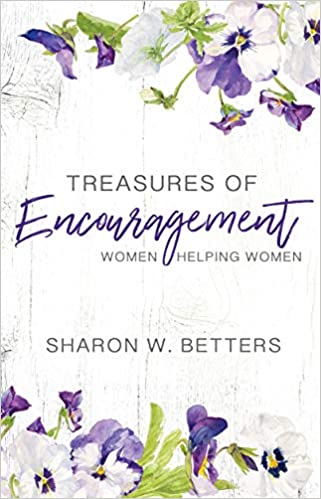
Treasures of Encouragement

Although Treasures of Encouragement: Women Helping Women is not primarily about author Sharon W. Betters, the book grew out of her situation. Her teenage son and his friend were killed in a car accident within minutes of leaving the Betters’ home in 1993.

The book’s theme verse comes from Isaiah 45:3, where Sharon found hope in her deep grief: “I will give you the treasures of darkness and the hoards in secret places, that you may know that it is I, the Lord, the God of Israel, who call you by your name.” Though God sometimes leads through dark valleys, treasures are there that can’t be found anywhere else.

Sharon writes:

The healing balm of encouragement eventually stopped the spread of despair’s infection and began replacing it with hope’s healthy glow. God’s Word was the healing balm, and God’s people applied it lavishly to sooth the searing pain in my soul. Biblical encouragement is soul work. God unleashes its mysterious power every time a child of God follows the Holy Spirit’s direction and steps into the suffering of another person (pp. 9-10).

Each chapter starts with one or two women’s testimonies about being either on the receiving or giving end of encouragement.

Throughout the book. two points are repeatedly emphasized. First, encouraging someone else spiritually is the outgrowth of our own walk with the Lord and time spent in His Word. Second, because we have those resources–God’s Word to inform and guide us and His Spirit within us—we have what we need to encourage others.

Part 1 of the book explores thinking Biblically: defining and exploring what encouragement involves and what our responsibilities are as believers to each other.

To ease the guilt of noninvolvement, we charge the church with the job of meeting needs. We forget that we are the church! (p. 18)

Biblical encouragers know that their role is part of a process; it is seldom, if ever, the solution. They understand God is doing soul work through the interaction of members of His body. They recognize that He uses circumstances to strip people of obstacles that keep them from knowing Him, and so they ask themselves, How can I help this person through the peeling process of sanctification without hindering what the Holy Spirit is doing?

Often we want to rush into a difficult situation and make everything better. But that is not God’s method. He uses the rough spots of life to sand away the rough spots in character so that the reflection of “Christ in us” becomes increasingly clear (p. 73).

Because of who our Father is, and because of the riches of our inheritance, we always have something to offer to others (p. 37).

Part 2 covers living Biblically: the necessity of prayer, listening well, helpful vs. non-helpful words, spiritual mothering, pursuing restoration rather than judgment, Biblical exhortation, letting God use your spiritual gifts in large or small ways, offering practical help.

The church, like a home, is not a place where perfect people enjoy each other’s company. It’s a place where spiritual nurture, training, and discipline help imperfect people take on the image of their perfect heavenly Father. The church is not a place for hibernation; it’s a place where we learn, grow, take risks, make mistakes, and get up and try again (p. 99).

Will it be easy? No. Initially, obedience is hard, but in the long run, disobedience is harder (p. 131).

When we have a clear picture of our own sinfulness and inadequacies, we may conclude that we are unfit to carry the great gospel message. But our wrong conclusions will not thwart God’s purposes. For reasons we do not understand, God has chosen us to spread His message of hope and redemption (p. 198).

Spiritual mothering often happens more around a kitchen table that in a structured study (p. 213).

Though the book can be read by individuals, it’s designed for a twelve-week group study. Each chapter ends with six day’s work of questions or exercises. On one hand, I didn’t want to take twelve weeks to read the book. But on the other, I didn’t want to skip over the “homework” between chapters. I felt the time exploring further or meditating on each chapter’s truths would help the ideas take firmer root. I did sometimes combine some of the individual days’ exercises, though.

One appendix shares 50 very practical ideas for extending encouragement to others. All 50 won’t appeal to or be possible for everyone, but they give a rich variety to choose from.

I appreciated the address to older and younger women in the church with encouragement to settle the differences that can sometimes arise between the two groups (pp. 137-138).

This book was originally published twenty-five years ago. It was updated and reprinted in 2021.

Just occasionally, I found the tone in the book got a little more authoritarian than encouraging. One example from the exercise questions after the first chapter: “Who will you encourage today? Write a brief statement about how Christ, through you, can encourage that person. Now do it!” (p. 26).

But overall, I found much good food for thought on both the necessity to be an encourager and the ways God can work in and through us. This is a book I am sure I will return to in the future.

(I often link up with some of these bloggers.)

Books Shape Our Thinking

A couple of times in our lives, my husband and I attended churches where we didn’t quite agree with everything, but we felt these churches were the closest we could find to our own understanding of Scripture. The differences weren’t a matter of false teaching or heresy: they were areas where good people could differ and should be able to give each other grace. We felt as long as the Bible was preached and taught rather than a particular system, then everything would be okay.

In one church, over time, we began to notice that everyone from the pastor to Sunday School teachers to lay leaders began quoting the same authors. Then their vocabulary began changing to match the authors they revered. Concepts that used to be alluded to were now main points. Sermons and lessons changed emphasis to feature points from these authors, and Bible passages were viewed through their lens. When one man spoke about this belief system as being “in the club,” it almost seemed a little cultish.

In another church, the issue wasn’t a particular belief system. But every Christian bestseller that came along was eventually taught in our church. When we moved, I found sermon notes from our first year there which were rich and meaty and directly from the Bible. Later sermons were second- or third-hand thoughts from popular books.

One of my favorite writers reads and quotes authors that I am uncomfortable with because their view of Scriptural truth seems a little skewed to me. Instead of following standard hermeneutics, principles for interpreting Scripture, they twist things a little to get a different outcome more in line with popular culture. They are not quite heretical yet, but this subtle shift will lead that way if continued. This lovely author, with so much talent and potential, is getting more entrenched in this kind of thinking every year. It grieves me to see it.

We’ve seen a couple of young men we’ve known get caught up in belief systems that, again, I don’t think are heretical, but I don’t agree with. It wouldn’t be a problem except that these belief systems now dominate their conversation and online presence. They like to bait and argue over their points of belief. Even though they are not being heretical, their ministry and outreach has been hijacked into debating rather than gently persuading people of God’s truth.

We observed over the course of years a definite shift in thinking and beliefs in each of these cases. The speaker or writer didn’t come to their new views from their Bible reading, but from the books they read. Those books then colored their view of Scripture.

One of our former pastors used to frequently quote Charlie “Tremendous” Jones as saying, “You will be the same person in five years as you are today except for the people you meet and the books you read.

If that’s true, and I think it may be, we need to be watchful about what we read. Of course, these days many people read online articles and listen to podcasts as well.

Does this mean we should only read books where we know we’ll agree with everything? Not necessarily. It’s good to exercise discernment. Sometimes when we are entrenched in our own tenets and lingo, we can get a little myopic.

But we should filter everything we read through the Scriptures. The Bible tells us to “test everything; hold fast what is good” (1 Thessalonians 5:21). Early Christians were called noble because they checked everything even the apostle Paul said against the Scriptures.

We need to be careful not to swallow everything an author says just because they use Scripture or religious talk. The devil does that. “Satan disguises himself as an angel of light. So it is no surprise if his servants, also, disguise themselves as servants of righteousness. Their end will correspond to their deeds” (2 Corinthians 11:14-15). With Eve, Satan questioned what God said and then skewed His meaning. He quoted and misapplied Scripture when tempting Jesus. Peter said of Paul’s writing:

There are some things in them that are hard to understand, which the ignorant and unstable twist to their own destruction, as they do the other Scriptures. You therefore, beloved, knowing this beforehand, take care that you are not carried away with the error of lawless people and lose your own stability. But grow in the grace and knowledge of our Lord and Savior Jesus Christ.(2 Peter 3:16-18).

Some writers don’t go that far–they are not exactly heretical. But a subtle shift in emphasis can skew their teaching, and therefore our thinking. Then a particular facet of their understanding becomes a hobbyhorse. So we need to be discerning not just with writing we might be prepared to be on guard with, but also with popular writing.

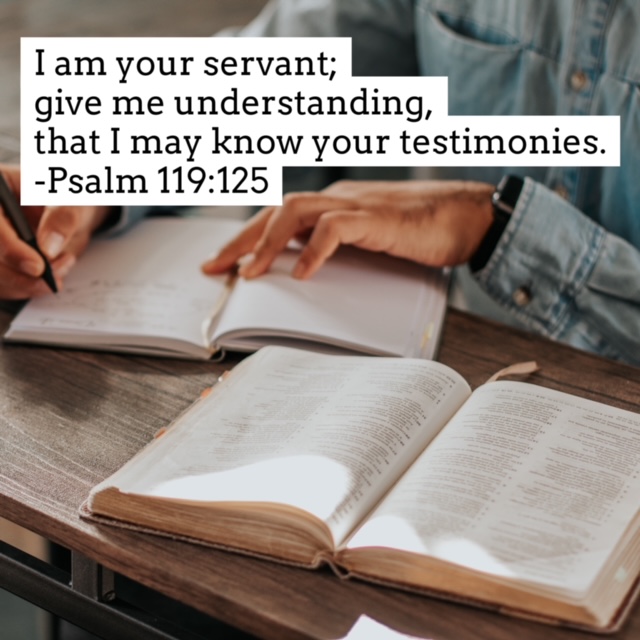
We need to make sure we are spending more time with the Bible itself than even books about the Bible. If we’re spending thirty minutes a day in a theological book and ten minutes in the Bible, we’re off balance. One former pastor used to say that bank tellers were instructed in discerning counterfeit money not by studying counterfeits, but by studying the real thing. The more familiar they were with legal money, the more easily they could tell when something was a little off with money they were handling. “Do your best to present yourself to God as one approved, a worker who has no need to be ashamed, rightly handling the word of truth” (2 Timothy 2:15). As we read and study, we need to pray with the psalmist, “I am your servant; give me understanding, that I may know your testimonies!” (Psalm 119:125). Then our “powers of discernment” will be “trained by constant practice to distinguish good from evil” (Hebrews 5:14).

We need to ask God to search our hearts, show us our blind spots, and “Open my eyes, that I may behold wondrous things out of your law” (Psalm 119:18).

I love good books. I’ve had my thinking shaped in good ways by authors who faithfully studied and represented God’s truth shared in His Word. I especially love writers and teachers who, like the Levites in Nehemiah’s time, “read from the book, from the Law of God, clearly, and they gave the sense, so that the people understood the reading” (Nehemiah 8:8).

But we need discernment to know when a teacher is giving the sense of the Word itself or twisting it a bit for their own purposes or from their own mistaken understanding.

And we need to be careful that our thoughts, understanding, and resulting actions are shaped by the Bible itself.

(I often link up with some of these bloggers.)

Reading Plans for 2022

One of my favorite activities is setting my reading plans for the year.

For many years I just read whatever came to hand, whatever I was in the mood for. I like to allow for that and for reading new books and unplanned discoveries. But making plans for the year helps me be more intentional, work in the books I plan to “get to someday,” and broaden my horizons.

Reading challenges also help with those purposes, plus they are fun. And some offer prizes!

The reading challenges I plan to participate in this year are:

The Back to the Classics Challenge hosted by Karen at Books and Chocolate. This is one of my favorites. Through this challenge, I’ve been introduced to classics I never knew about before and authors I had never tried. My usual classics taste tend toward 19th century Britain: Dickens, Wilkie Collins, Anthony Trollope, Elizabeth Gaskell, George Elliot. These are the cozy classics to me, and I try to read from them every year. But it’s good to branch out, and Karen’s categories help me do that. The categories this year are:

  • A 19th century classic.
  • A 20th century classic.
  • A classic by a woman author.
  • A classic in translation.  Any book first published in a language that is not your primary language.
  • A classic by BIPOC author. Any book published by a non-white author.
  • Mystery/Detective/Crime Classic. It can be fiction or non-fiction.
  • A Classic Short Story Collection.
  • Pre-1800 Classic.
  • A Nonfiction Classic.
  • Classic That’s Been on Your TBR List the Longest.
  • Classic Set in a Place You’d Like to Visit.
  • Wild Card Classic. Any classic you like, any category, as long as it’s at least 50 years old!

Since the categories were just posted, I haven’t had time to think about them and decide what to read. But I’ll enjoy contemplating them! I’m sure I’ll continue with the next in Trollope’s Barsetshire series for the 19th century classic. I might delve into The Four Loves by C. S. Lewis for the nonfiction: I’ve been wanting to read that for a while.

Shelly Rae at Book’d Out hosts the Nonfiction Reader Challenge. She provided 12 categories of nonfiction, and participants choose which level they want to aim for. Thankfully, this year she has included a Nonfiction Grazer category where we set our own goals for how many and what kind of nonfiction to read. That will work best for me this year.

I’m going to plan on at least 12 nonfiction books. I usually read more than that, but many are in the same categories. This year I want to read:

  • At least one biography, autobiography, or memoir.
  • One writing book
  • One book of humor
  • One Bible study book
  • One Christian living book
  • One book of letters or journals
  • One book by C. S. Lewis that I have not read yet
  • One book on organization or productivity (I have 13 on my shelf! Some read, some dipped into, some unread.)
  • One book pertaining to a holiday (probably Christmas)
  • One book related to midlife or aging

Bev at My Reader’s Block hosts the Mount TBR Reading Challenge. The idea is to read books you already owned before the start of this year. Bev has made levels in increments of twelve, each named after a mountain, and we’re to choose a level to shoot for. Even though I’ve reached Mt. Ararat (48 books) the last couple of years, I think I will play it safe and stick with Mt. Vancouver (36 books).

There are a couple of other TBR challenges I have participated in for previous years, but the rules of each are slightly different. So, to keep it simple, I think I’ll just stick with this one. It’s such a feeling of accomplishment to get to those books!

These next to are new to me. They focus on books I usually read anyway, so they won’t require extra effort except for the record keeping.

The Audiobook Challenge is hosted by Caffeinated Reader. Last year I listened to 25 audiobooks, so I’ll aim for that again with the Binge Listener level at 20-30.

The Historical Fiction Reading Challenge is hosted by The Intrepid Reader. I read 15 in this genre last year, so I will aim for that again with the Medieval level.

I’ve seen some other interesting-looking challenges with various categories, like this one. But I don’t want to get involved in too many to keep up with. I may have already! We’ll see how it goes.

Do you participate in reading challenges? Which ones?

Reading Challenge Wrap-Ups

It’s that time of year–time to close and report the results of the different reading challenges I participated in this year.

I finished the the Back to the Classics Challenge early this year! I completed all twelve categories, and I posted what I read for each here.

The Nonfiction Reading Challenge hosted by Shelly Rae at Book’d Out encourages us to read nonfiction in particular categories. The categories and the books I read for them:

1.Biography: Becoming Elisabeth Elliot by Ellen Vaughn
2. Travel: EPIC: An Around-the-World Journey Through Christian History by Tim Challies
3. Self-help: Don’t Overthink It by Anne Bogel
4. Essay Collection: Christian Reflections by C. S. Lewis
5. Disease
6. Oceanography: Gift From the Sea by Anne Morrow Lindbergh
7. Hobbies: How to Read a Book by Mortimer J. Adler and Charles Van Doren
8. Indigenous Cultures
9. Food
10. Wartime Experiences: Woman Heroes of World War II: 26 Stories of Espionage, Sabotage, Resistance, and Rescue by Kathryn J. Atwood
11.Inventions: The Secret War of Charles Fraser-Smith, the “Q” Gadget Wizard of World War II by Charles Fraser-Smith.
12. Published in 2021: Ten Words to Live By: Delighting In and Doing What God Commands by Jen Wilkin.

My post listing all the book I read this year shows I competed 38 nonfiction books. But they didn’t all fit these categories, so I only reached “Nonfiction nibbler” status as far as this challenge goes.

Bev at My Reader’s Block hosts the Mount TBR Challenge to encourage us to read the books we already own.. Every 12 books read is another level or “mountain” climbed.

The Backlist Reader Challenge hosted by The Bookwyrm’s Hoard has the same idea as Mt. TBR.

I used to list all of the previously-owned books I read for this challenge, but that’s not a requirement, and seems redundant after listing all the titles I read this year. But I completed 48 books from my own shelves and Kindle app, reaching Mt. Ararat for the Mount TBR challenge. That feels like an accomplishment!

I enjoy reading Christmas books after Thanksgiving through the end of the year. Tarissa at In the Bookcase hosts a Literary Christmas Reading Challenge for that purpose each year. This year, my Christmas reading included:

  • Expecting Christmas, a 40-day devotional by multiple authors
  • A Quilt for Christmas by Sandra Dallas, a Civil war-era novel. A woman makes a quilt for her soldier husband. When he dies, she assumes the quilt was buried with him. But the quilt shows up again in a surprising way. Meanwhile, she has to determine how far her beliefs go when she is asked to shelter a runaway slave wanted for murder.
  • Last Christmas in Paris: A Novel of World War I by Hazel Gaynor and Heather Webb. An epistolary novel set during WWI. Four friends plan to meet in Paris for Christmas the year WWI starts, thinking it will be over by then. Obviously, it wasn’t, and they don’t make that date. The last of them goes to Paris for Christmas in the 1960s to read the last unopened letter. So good.
  • A Christmas by the Sea by Melody Carlson. A woman and her son travel to the beach house she has inherited. She plans to fix it up and sell it to replenish their resources after her husband’s long illness. But her son thrives in the new town and wants to stay.
  • The Yuletide Angel by Sandra Ardoin. A Victorian-era novel in which an anonymous donor, dubbed the Yuletide Angel, gifts needy families with supplies in the middle of the night. Only one person knows the benefactor’s identity is female, and he follows her unseen to insure her safety. But soon someone else stalks her in the darkness.
  • The Ornament Keeper by Eva Marie Everson. A woman unpacks the special ornaments her husband has given her each of their twenty years together. But now they have separated due to festering anger and unforgiveness. Can they find their way back to each other before it’s too late?
  • Letters from Father Christmas by J. R. R. Tolkien. Tolkien wrote letters to his children as Father Christmas for several years, complete with disasters set off by the kind but bumbling North Polar Bear. Delightful.

Letters from Father Christmas and Last Christmas in Paris weren’t on my radar when I started the challenge, but I am so glad I found them. Otherwise, I did read all I set out to read for the challenge this year.

I also listened to a Christmas story laid out as a podcast series by Audible, The Cinnamon Bear: A Holiday Adventure. It was styled like a modern version of old radio serials. It was a little bizarre in places, kind of a conflation of Candy Land and Oz. But it had some clever writing here and there.

We watched a couple of Christmas movies, but not our usual White Christmas and It’s a Wonderful Life. We saw A Castle for Christmas, in which an author running from her problems visits a castle in Scotland where her father worked as a child. She learns the castle is for sale, but the curmudgeonly owner doesn’t really want to let go of it. It’s a pretty cute movie. One not-good part, but nothing explicit is shown. And we also watched Elf, which was a lot of fun.

And that wraps up for reading challenges for this year! I’ll hammer out my reading plans for next year next week. I’ll probably participate in each of these again. They all enhance my reading and broaden my horizons.

Three Christmas Reads

I thought I’d group together short reviews of three books I enjoyed this December.

Expecting Christmas is a 40-day devotional book by multiple authors. I didn’t know any of the author names except one (Jennifer Dukes Lee). It’s put out by New Hope Publishers.

The selections are short, which is appreciated in a month like December. Each began with a verse or two of Scripture, a page and a half to two pages (at least in the Kindle version) of text, then three questions for refection.

The readings cover a variety of Christmas topics, though several deal with light.

A couple of samples: Day 15 talks about how horses in past years were seen as “labor animals, forms of transportation, and even weapons of war” (p. 44). After describing war horses, the writer points out Zechariah 9:9-10: Jesus did not come as an overthrowing conqueror, at least as the kind of conqueror society expected. His second coming will be more like that. But this time, He came humbly on a donkey. The author concludes, “Take time now to thank the Lord for being both just and humble, for bringing salvation instead of condemnation, for riding peacefully on a colt rather than on a warhorse. Ask Him to help you trust Him, especially when you don’t understand His ways. When you find yourself confused by His methods, remember the salvation He brought and the joys of that great gift” (p. 46).

In mediating on Jesus being given “the tongue of the learned” (Isaiah 40:4-5), another writer says, “Jesus didn’t use His deep knowledge and gift for oratory to make a name for Himself or climb social ladders. Rather, as seen in the Gospel accounts of His ministry, Jesus used His words to unburden people, free minds from the lies they had learned from false religions, and draw weary hearts closer to the Living God” (p. 54).

Another points out that people responded differently in praise and worship of the Savior, and that’s okay. “Mary’s response was one of quiet introspection as she treasured the good news of the gospel in her heart. The shepherds, on the other hand, left young Jesus, glorifying God and praising Him with outward enthusiasm and passion. People celebrate the gospel in different ways” (p. 77).

I only wish this book was 25 or 31 days so it would fit within the month of December. I didn’t get started 40 days ahead, so I have a bit yet to finish up. But I wanted to mention it before the month was over. Overall, I enjoyed it.

The second book I mentioned in my top twelve post yesterday. I had never heard of Letters From Father Christmas by J. R. R. Tolkien. I discovered it while looking for a short Christmas audiobook to finish out the year. This fit the bill nicely.

Tolkien sent letters and drawings as if from Father Christmas to his children from 1920 to 1943. He wrote with a shaky script because he was so old, he said (probably also to disguise his handwriting). The letters would comment on happenings in the children’s lives as well as at the North Pole. The North Polar Bear was Father Christmas’s helper and companion, a cheerful but bumbling fellow who unwittingly caused a lot of accidents. Polar Bear adds his own commentaries with a thick script because of his paws. Later an elf named Ilbereth acts as Father Christmas’s secretary. The last few letters mention “this horrible war” (WWII) and the people displaced, the shortage of supplies even at the North Pole, etc.

I got the audiobook superbly narrated by Derek Jacobi as Father Christmas and a couple of others for the infrequent voices of the bear and elf. But when I realized the book had photos of the letters and drawings, I had to get the Kindle version, too.

I thought in passing of Tolkien’s penchant for languages but figured that wouldn’t have a place in this book. But he did come up with a made-up language called Arktic that is spoken at the North Pole, and Polar Bear shares a few lines of it.

He also included some battles with goblins, who at times liked to raid Father Christmas’s supplies.

These letters are wonderfully imaginative. I especially loved the banter between Father Christmas, Polar Bear, and Ilbereth.

My last Christmas book this year is The Ornament Keeper, a contemporary fiction novella by Eva Marie Everson.

It’s Felicia Morgan’s custom to begin decorating the Christmas tree with the special, customized ornaments her husband has given her, one each year except for the last year. Each represented something special about their year: their first Christmas together, their children, her job advancement, etc.

This year, though, Felicia is dragging her feet. She and Jackson have separated after twenty years of marriage. Her daughter convinces Felicia to put up decorations as usual, but the memories are painful.

As Felicia hangs each ornament, we see a flashback to the circumstances surrounding each of them. Felicia’s marriage began with a mistake which has haunted the couple’s twenty years. Though God has redeemed and worked together for good their indiscretion, seeds of resentment and unforgiveness threaten to destroy what they have. Can they find their way back to each other before it’s too late?

I enjoyed the story and the truths brought out. I appreciated that the book wasn’t superficial or treacly.

Have you read any of these? Did you read any Christmas books this year?

My Top 12 Favorite Books Read in 2021

I posted all the books I read this year, but I also like to share my top ten or so favorites. (Forgive me for doubling posts today—I’m trying to fit a few things in before year’s end. Plus I don’t know how many people are interested in the list of every book read this year. 🙂 )

It’s hard to narrow the list down, but I came up with twelve favorites. A few were published this year, but most were just discovered this year. I had an even list of fiction and nonfiction this year. The titles link to my reviews.

Favorite Nonfiction Read in 2021:

  1. Ten Words to Live By: Delighting In and Doing What God Commands by Jen Wilkin. This is my overall top favorite this year. Jen deals with the Ten Commandments overall and individually, what they meant to the original audience, and how they apply today.

2. The Good Portion: Scripture: The Doctrine of Scripture for Every Woman by Keri Folmar. As I said in my review, most of us don’t get excited about doctrine. But right doctrine is our bedrock. Knowing what we believe and why comforts us and keeps us on course. This book was written “to shed light on the treasure and sweetness of the sacred Scriptures. The book attempts to summarize the doctrine of the Word of God in a way that keeps the relational nature of the Bible at the forefront. After all, the Bible is God speaking to us. It is God revealing Himself with words and calling us into relationship with Him.”

3. Gentle and Lowly: The Heart of Christ for Sinners and Sufferers by Dane Ortlund.

I wasn’t familiar with Dane Ortlund before reading this, and I was a little wary. Some who emphasize the gentleness and meekness of Christ de-emphasize His other qualities, such as righteousness and holiness and purity.

Yes, he is the fulfillment of the Old Testament hopes and longings (Matt. 5: 17). Yes, he is one whose holiness causes even his friends to fall down in fear, aware of their sinfulness (Luke 5: 8). Yes, he is a mighty teacher, one whose authority outstripped even that of the religious PhDs of the day (Mark 1: 22). To diminish any of these is to step outside of vital historic orthodoxy. But the dominant note left ringing in our ears after reading the Gospels, the most vivid and arresting element of the portrait, is the way the Holy Son of God moves toward, touches, heals, embraces, and forgives those who least deserve it yet truly desire it (p. 27).

.4. The Devil in Pew Number Seven by Rebecca Nichols Alonzo. This is a true story that reads like a novel. A man in Rebecca’s father’s congregation disagreed with him and began terrorizing the pastor’s family in unbelievable ways, leading to tragedy. Though that makes the book sound depressing, Rebecca’s journey to forgiveness and the aftermath are quite inspiring.

true story of reigious persecution and forgiveness

5. The Secret War of Charles Fraser-Smith, the “Q” Gadget Wizard of World War II by Charles Fraser-Smith. A missionary with a penchant for thinking outside the box and rigging up what he needed was tapped to design or find items soldiers and spies needed during WWII. He needed not only to provide gadgets, tools, and maps, but he had to come up with ingenious ways to conceal them from enemy searches. This was a thoroughly fascinating book.

6. Write Better: A Lifelong Editor on Craft, Art, and Spirituality by Andrew T. Le Peau. I try to read at least one book on writing each year, and this was my choice this year. It catapulted to my top favorite writing book, one I need to reread regularly.

Favorite Fiction Books Read in 2021:

1. Catching the Wind by Melanie Dobson. In this time-slip novel, two children escape Nazi Germany but then get separated. The one has spent his life trying to find the other. He enlists the help of a reporter because of the heart revealed in her stories.

2. Memories of Glass by Melanie Dobson. Another WWII time-slip novel, but with different characters and settings. Four friends in Amsterdam face different fates as the war escalates. Some fight secretly for the resistance. One, a Jewess, is caught in an impossible situation, but rises above her fears to help as much as she can. In modern times, a woman who was reunited with family she didn’t know she had after her mother died looks into history the family tries to keep hidden. One thread of the storyline was based on true events.

3. Sons of Blackbird Mountain by Joanne Bischof. This post-Civil War story involves a widow who goes to help her husband’s cousins thinking they were children. But they are grown men. One is deaf. Two are attracted to her, causing strife, but she had not planned to remarry. The men strive to keep the farm going, protect escaped slaves, and battle the Klan. There were a lot of interesting layers to this book. I had not read this author before, but I look forward to reading more from her.

4. The Orchard House by Heidi Chiavaroli. Another time-slip novel, this one involves Louisa May Alcott and her home along with two modern women who work there and investigate a packet of letters they found there.

5. Last Christmas in Paris: A Novel of World War I by Hazel Gaynor and Heather Webb. This story is made up of letters, mainly between two childhood friends. Two brothers and a sister and her friend make plans to meet in Paris for Christmas, thinking the war will be done by then. Of course, that doesn’t happen because the war wears on for years. The book opens and closes with one of the men at the end of his life going to Paris for Christmas to read the last letter from his friend’s sister. This was so poignant and beautifully written.

6. Letters From Father Christmas by J. R. R. Tolkien (not reviewed yet). Tolkien wrote letters to his children as Father Christmas for several years. He wrote in a wobbly script because Father Christmas was so old (and probably to disguise his handwriting. Sometimes he would include drawings of happenings at the North Pole. North Polar Bear would add a few lines sometimes. The poor bear was the accidental cause of a lot of mischief. Of course, this being Tolkien, there are battles with goblins and a little dabbling in made-up languages. I loved the delightful imagination in these letters. Plus it was interesting learning differences between a British Father Christmas in that time and our modern American version (fourteen reindeer, two white ones for when he was in a special hurry). The audiobook narrated by Derek Jacobi is delightful, but the Kindle or paper version is a must-have for copies of the letters and pictures themselves.

It’s been fun reminiscing over my reading year. What were some of your favorite books read this year?

(I often link up with some of these bloggers.)

The Yuletide Angel

In The Yuletide Angel by Sandra Ardoin, someone mysteriously leaves gifts at the homes of the needy during Christmas season nights in the 1890s. The town dubs the mysterious visitor the Yuletide Angel.

No one knows that the Yuletide Angel is shy, timid Violet Madison.

No one except her neighbor, Hugh Barnes. Hugh had seen Violet on her mission one night, and ever since he has followed her at a discreet distance to protect her.

When Violet learns her brother is planning to marry soon, she begins to worry. Her brother inherited the family home and plans to bring his bride there. They plan for Violet to live with them, but she would feel like she’s intruding on their lives. Her father did not leave her much because he assumed she would marry. But she is plain and not well-spoken, and no one has shown an interest. What could she do to make her own way that would be socially acceptable? She has some ideas of things she could sell in the Hugh the grocer’s shop.

Hugh has been fond of Violet for a long time. He speaks cheerfully to her and tries to gently draw her out. He enthusiastically endorses her plan for selling her baked goods in his store.

Just when it seems their relationship is unfolding well, Hugh’s ne’er-do-well brother, Kit, shows up. When Hugh sees Violet and Kit together, he feels betrayed.

And on top of everything else, an unseen stalker is following Violet on her nightly rounds and stealing her gifts.

This was an enjoyable story. I appreciate that as a Christian author, Sandra is not afraid to deal with Christian issues outright rather than just hinting at them. Yet her style is not heavy or preachy.

As a novella, this was a quick read. But the characters and story arc were well-developed. All in all, a good quick read.

Last Christmas in Paris

Last Christmas in Paris: A Novel of World War I by Hazel Gaynor and Heather Webb opens with the beginning of WWI. Two friends from childhood, Will Elliott and Thomas Harding, head out for France to fight, enthusiastically expecting the war to be over by Christmas. Then they plan to meet Will’s sister, Evie, and her friend, Alice, in Paris for Christmas to celebrate.

But of course the war drags on much longer than the few months til Christmas.

Evie writes Will and Thomas with all the support and hope she can send. Will is not much of a writer, so Evie gets most of her news about him from Tom.

Over time, enthusiasm and naiveté wanes and the realities of war weigh them all down. Tom gets more discouraged by what he has seen and has to do.

Tom also faces pressure from his father’s illness and business troubles. His father owns and operates the London Daily Times and always planned for Tom to follow in his footsteps. Tom’s interests fall more into a literary and scholarly vein, and he has no interest in the newspaper, which causes tension with his father. But when his father falls ill, Tom is consulted. He can’t do much from France, so he asks his cousin, John, to step in. There has been some longstanding feud between Tom’s and John’s families, but Tom never knew what it was all about, and he has to hope John will keep the paper’s best interests in mind.

Evie, meanwhile, chafes at home. She wants to do something to help, but her mother insists that for girls in her class, the only acceptable activity is aiding her mother with her charities and looking for a suitable husband. But Evie branches out from her protective gilded cage. Though she puts herself at risk, she also grows through her efforts.

The book opens with an aged and ill Thomas planning to go to Paris for Christmas in 1968 to read one last letter from Evie. Most of the book is made up of letters, mostly between Tom and Evie, but also with Will, Alice, their parents, and Tom’s contacts at his father’s business. At different places throughout the novel, the scene switches back to Tom and his current situation and reflections over his life.

This book was not in my Christmas reading plans, not even on my radar until Becky mentioned it. It sounded interesting, and I needed a new audiobook, so I got it. Epistolary novels are not my favorite style of writing, but I have enjoyed some.

I am so glad I listened to this book. I enjoy historical fiction, and not as many books are written about the first world war. I like how this one shared details of everyday life in England as well as on the front.

But mostly I enjoyed the growth of Evie and Tom’s characters and their relationship with each other. From lighthearted banter to lifting each other up from the deepest discouragement, from heartbreak to hope, from misunderstanding to shared poetry, they get to know one another better than they ever had before but almost miss each other in the end.

Though there is some mention of God and prayer, this is a secular book. It has maybe three bad words, but is remarkably clean.

The audiobook is excellently done, with different narrators for the different characters.

This is a beautiful book, and I am so glad I listened to it.

Christmas By the Sea

In A Christmas by the Sea by Melody Carlson, Wendy Harper and her son, Jackson, are in the midst of hard times. Wendy’s husband passed away, and she is left with a mountain of medical bills.

Then she learns that she has inherited her grandparents’ cottage by the sea. She had visited them several summers as she grew up. Though she loves the cottage, she knows she has to sell it to get back on her feet financially. So she and Jackson drive down to spend a few days fixing the cottage up.

Jackson, who has been having a hard time since his father died, is renewed by the town and the cottage. He thinks they are going to stay. Wendy doesn’t want to disappoint him, so she puts off telling him that they have to sell the place.

When Wendy goes shopping for supplies, she meets a helpful man, Caleb, who she takes to be store employee. Later she discovers he is a local craftsman who owns his own store, while his mother owns the tourist shop Wendy remembers from her childhood.

Wendy faces challenges in her renovations, her need to tell Jackson her plans for the house, her deciding what to do next in life, and her growing relationship with Caleb.

I loved the nontraditional setting for a Christmas story. As I’ve mentioned before, I grew up on the coast of southern Texas, so my early Christmases didn’t contain snow and sledding and such.

My one complaint is that the story wrapped up awfully quickly and a bit unrealistically. But otherwise, I thought it was a nice book.

Book Review: Be Available

The book of Judges is one of the oddest in Scripture. The phrases “There was no king in Israel” and “Everyone did what was right in his own eyes” are repeated. In the preceding book, Joshua was the nation’s leader who had followed Moses. Now there was no national leader and Israel had by and large fallen away from following God as they had promised. The behavior in the book dramatically shows the need for godly leadership and personal righteousness.

Warren Wiersbe helps readers navigate through the book of Judges in Be Available: Accepting the Challenge to Confront the Enemy.

Wiersbe points out that, ““Deuteronomy 6 outlined the nation’s basic responsibilities: Love and obey Jehovah as the only true God (vv. 1–5); teach your children God’s laws (vv. 6–9); be thankful for God’s blessings (vv. 10–15); and separate yourself from the worship of the pagan gods in the land of Canaan (vv. 16–25). “Unfortunately, the new generation failed in each of those responsibilities” (p. 18, Kindle version). “The sin in our lives we refuse to conquer will eventually conquer us” (p. 26).

“The first step the new generation took toward defeat and slavery was neglecting the Word of God, and generations ever since have made that same mistake” (p. 23). Wiersbe applies this across the ages: “I fear that too many believers today are trying to live on religious fast food dispensed for easy consumption (no chewing necessary) by entertaining teachers who give people what they want, not what they need” (p. 23).

Wiersbe makes this interesting observation: “Whether in a nation or a local church, the absence of qualified leaders is often a judgment of God and evidence of the low spiritual level of the people” (p. 112).

By the time of the Judges, ““Unfortunately, God’s people aren’t working together to defeat the enemy, but here and there, God is raising up men and women of faith who are experiencing His blessing and power and are leading His people to victory” (p. 20, Kindle version).

Sometimes those leaders were a surprise: ““When God goes to war, He usually chooses the most unlikely soldiers, hands them the most unusual weapons, and accomplishes through them the most unpredictable results” (p. 31). “Never underestimate the good that one person can do who is filled with the Spirit of God and obedient to the will of God” (p. 36). Others were a disappointment: though they yielded to God and were used by Him, at other times they yielded to the flesh.

The last few chapters show the low level Israel sank to and set us up for the monarchy to come. But even though some of the future kings were godly and inspiring, all of them failed in various points. One of my former pastors used to say that throughout the OT, we see the best of the judges and kings, but we also see the worst. These point us to the only completely righteous and perfect King, the Lord Jesus Christ.