Animal Farm

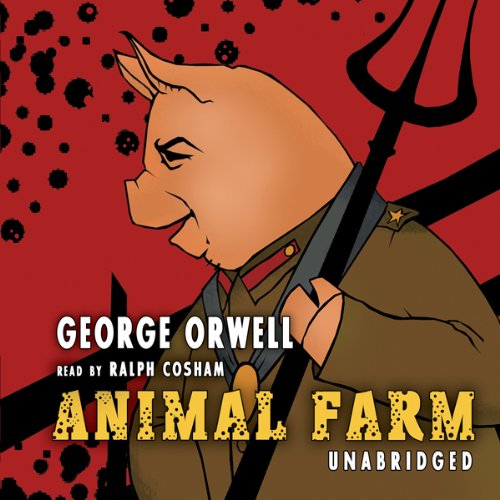
My youngest son and I were discussing communism and capitalism not long ago. I don’t know if you realize it, but there is a lot of anti-capitalism sentiment out there. Young people are frustrated with the greed of capitalism. But, as I told my son, no economic system is going to be perfect, because no individual or group of people is perfect. Those at the top in communism are just as oppressive (more so, in my opinion). Nothing illustrates this better than Animal Farm by George Orwell, a combination fable, allegory, and satire about the Russian revolution of 1917 and Stalin’s takeover.

But even if you’re not familiar with the details of the Russian revolution, Animal Farm is a good illustration of what often happens when oppressors are overthrown: the formerly oppressed become the new oppressors.

In the book, Manor Farm is owned by a careless man who likes to drink a lot: Mr. Jones. One night the old boar, Old Major (Marx/Lenin), calls all the animals of the farm to a meeting. He encourages them to overthrow Jones and adopt animalism (communism), where they work for themselves.

Old Major passes away, and soon the animals’ opportunity comes. Jones forgets to feed them for several days. The animals don’t really plan an organized revolt, but they are so hungry and fed up, they drive Jones and his men off the property with great rejoicing (the revolution).

Two pigs, Napoleon (Stalin) and Snowball (Trotsky) become the leaders. The farm’s name is changed to Animal Farm. Seven commandments of Animalism are adopted, like “No animal shall sleep in a bed,” “No animal shall kill another animal,”etc. But the most important is “All animals are equal.”

The pigs teach themselves to read from a child’s primer in the house. Snowball tries to teach the other animals to read. They adopt a green flag with a horn and hoof emblem. Napoleon takes the newborn litter of puppies to train them. Snowball and Napoleon clash sometimes, but things come to a head when Snowball proposes that they build a windmill and outlines all the improvements it will bring. Napoleon disagrees and downplays the idea. But then Napoleon brings out the dogs he has been training into his own personal guard. They turn on Snowball and chase him off. Then Napoleon declares the windmill was his idea, which Snowball had stolen. Snowball is conveniently blamed for everything that goes wrong.

Since the pigs are the smartest an therefore the leaders, they take up residence in the house. They take the best food and all the milk, because of course they need to be in top form for all the decisions they have to make.

One by one, the promises made to the animals in the early days are broken. The pigs’ spokesman, Squealer, comes out and explains away anything that looks untoward. When the animals object to anything, they’re reminded, “We’re better off than when Jones was here” and “You don’t want Jones to come back, do you?” If any animal object too much, some reason is found for those animals to be executed. When the rest think they remember something about animals not killing each other, some who remember how to read go to check the seven commandments that had been painted on the barn wall. Now the sixth commandment reads, “No animal shall kill another animal without cause.”

When the pigs are discovered to be sleeping in beds in the farmhouse, the barn wall reads “No animal shall sleep in a bed with sheets.”

And as the pigs become more and more like the human oppressors, the barn is found to say, “All animals are equal, but some animals are more equal than others.”

Wikipedia says that Orwell wrote in an essay “Why I Write” “that Animal Farm was the first book in which he tried, with full consciousness of what he was doing, ‘to fuse political purpose and artistic purpose into one whole.'”

I hadn’t realized until now that this book first came out in 1940s, when the UK and the Soviet Union were allied against Germany. Publication was delayed, and the book “became a great commercial success when it did appear partly because international relations were transformed as the wartime alliance gave way to the Cold War” (Wikipedia).

The Wikipedia article details many more of the symbolic details and allegoric references.

Some of the most noteworthy quotes from the story:

Do not imagine, comrades, that leadership is a pleasure! On the contrary, it is a deep and heavy responsibility. No one believes more firmly than Comrade Napoleon that all animals are equal. He would be only too happy to let you make your decisions for yourselves. But sometimes you might make the wrong decisions, comrades, and then where should we be?

The needs of the windmill must override everything else, he said. He was therefore making arrangements to sell a stack of hay and part of the current year’s wheat crop, and later on, if more money were needed, it would have to be made up by the sale of eggs, for which there was always a market in Willingdon. The hens, said Napoleon, should welcome this sacrifice as their own special contribution towards the building of the windmill.

But the luxuries of which Snowball had once taught the animals to dream, the stalls with electric light and hot and cold water, and the three-day week, were no longer talked about. Napoleon had denounced such ideas as contrary to the spirit of Animalism. The truest happiness, he said, lay in working hard and living frugally.

Somehow it seemed as though the farm had grown richer without making the animals themselves any richer–except, of course, for the pigs and the dogs.

I had read this book back in high school and remembered the overall story, but had forgotten a few particulars. Orwell did a masterful job. Reading the book as an adult, it’s easy to recognize the “spin” that leaders and their influencers can put on events. I don’t advocate mistrusting all political leadership, but it’s wise to be aware and wary.

I listened to the audiobook nicely read by Ralph Cosham. This will count for a classic about animals for the Back to the Classics Reading Challenge.

(I often link up with some of these bloggers)
Brave New World

Brave New World by Aldous Huxley is a dystopian novel set in 2540 London. The book opens with the Director of Hatcheries and Conditioning explaining the institution’s processes to new students. Babies aren’t “born” any more: they’re “decanted.” In fact, the students are embarrassed when the director refers to the “old” way of conception and childbirth. Now ova and spermatozoa are joined in the lab and treated to become Alphas (the highest intelligence and functions), Betas, and so on, down to the nearly automaton Epsilons. Children are raised in the hatchery and conditioned against love of art or books or discomfort about death. The nuclear family is no more: the word “mother” is an obscenity.

The goal of the world controllers is that everyone be happy. Everyone works for the good of society. They spend their evenings in fun encounters and rarely are alone. Without the stresses of family and relationships, they’re free to just be . . . happy. If they’re not, there’s always soma—a drug that does anything from relax you a bit to keep you on a “holiday” for days.

Yet Bernard Marx isn’t happy. He’s in the highest caste for intelligence, but his physique is smaller than other Alphas. Rumor has it that alcohol was accidentally poured into his test tube, stunting his growth.

He feels inferior about his body, but he’s also out of step with a lot of society. He likes to be alone. He doesn’t like that men look at women like meat, and women seem to expect and like it. He has a crush on the popular Lenina, but is embarrassed when she wants to discuss plans for a date in an elevator full of other people.

Part of Bernard’s discomfiture stems from the fact that he’s a sleep-learning specialist. He helps program hypnopedia, the maxims and slogans that are repeated to the children in the hatchery while they sleep. So he knows much of society’s values come from this kind of conditioning.

Bernard and Lenina take a trip to a Native American-type reservation where some people have been allowed to live untouched by the new civilization. They live in family groups and their worship is an amalgam of religions. Bernard discovers a woman there who had come from the outside world several years earlier with a visiting group and gotten separated. They couldn’t find her and left her for dead, but in fact, she had been injured. She was also somehow pregnant, despite the measures society took to prevent such from happening. She was still an outsider on the reservation after all these years, partly because she was white, but mainly because her “everyone belongs to everyone” sexuality didn’t sit well with the tribe’s wives. Her son, John, is in his twenties and also an outsider. His mother had taught him to read, but their only books were a manual from her lab and a mouse-nibbled copy of Shakespeare.

John’s mother had told him of the world she came from, and now he would have an opportunity to go back with Bernard. He quotes Shakespeare’s The Tempest: “O wonder! How many goodly creatures are there here! How beauteous mankind is! O brave new world, That has such people in’t.”

However, John finds he doesn’t fit in the “brave new world,” either. He likes Lenina but can’t abide this civilization’s flippant attitude about sex. His mother has become addicted to soma to deal with her misery. He can’t function without time alone but can rarely find it.

People call him “the savage” or sometimes “Mr. Savage.” But the savage may be the most civilized person of all.

I had heard of this book but had no inclination to read it until I came across a quote comparing it to George Orwell’s 1984. I found out later the quote came from the introduction to Neil Postman’s Amusing Ourselves to Death: “What Orwell feared were those who would ban books. What Huxley feared was that there would be no reason to ban a book, for there would be no one who wanted to read one.” The quote went on to say, “Orwell feared those who would deprive us of information. Huxley feared those who would give us so much that we would be reduced to passivity and egoism. Orwell feared that the truth would be concealed from us. Huxley feared the truth would be drowned in a sea of irrelevance. Orwell feared we would become a captive culture. Huxley feared we would become a trivial culture. . . . In 1984, Huxley added, people are controlled by inflicting pain. In Brave New World, they are controlled by inflicting pleasure. In short, Orwell feared that what we hate will ruin us. Huxley feared that what we love will ruin us.”

Nearly thirty years later, Huxley wrote Brave New World Revisited, a nonfiction piece discussing how much of what he prredicted in the earlier book had come true.

Wikipedia goes into some of the influences behind the book. It started out as a parody of “utopia stories” popular at the time, but then he “got caught up in the excitement of [his] own ideas.” He was also influenced by a visit to the US where he “was outraged by the culture of youth, commercial cheeriness, and sexual promiscuity, and the inward-looking nature of many Americans.” He also came across Henry Ford’s My Life and Work and “he saw the book’s principles applied in everything he encountered after leaving San Francisco.” In fact, in Brave New World, time is measured not in BC and AD, but AF (After Ford).

The book got particularly interesting to me after John appeared. And it was intriguing to me to see the potential ramifications of a world filled with pleasure but not with meaning, as Huxley describes.

One of the main pleasures is sex, which is referred to a lot in this book. It’s not included to be titillating: it’s no more explicit than in Song of Solomon. It’s one of the main illustrations of pleasure with no meaning and probably meant to be disturbing. Still, it ‘s a lot.

Neither 1984 nor Brave New World portray a future that anyone would look forward to. But maybe, for the discerning, they can help us avoid some of the pitfalls they warn against.

I listened to the audiobook nicely read by Michael York. This book will count for my 20th century classic for the Back to the Classics Reading Challenge.

Peter Pan

I’ve seen several movie version of Peter Pan: the Disney cartoon, of course, a 2003 live-action version, and Hook. But I had never read the book by J. M. Barrie.

Peter was originally a character in Barrie’s book The Little White Bird. A few years later, the chapters about Peter were extracted and published separately as Peter Pan in Kensington Gardens. Later Barrie wrote a play with Peter as the central character, and later still he expanded the story into a novel, Peter Pan and Wendy, in 1911. These days it’s usually published as just Peter Pan.

Some think that inspiration for Peter came from Barrie’s older brother, who died young and was always thought of as still a boy. The name “Peter” came from the son of friends, the Llewelyn Davies. “Pan” was from Greek mythology.

You’re probably familiar with the story, but Peter lives in Neverland with Lost Boys. Occasionally he travels around. He lands outside the Darling family nursery and is captivated by the stories he hears there. He entices the daughter, Wendy Darling, to come to Neverland and be the Lost Boys’ mother. Wendy’s brothers, John and Michael, come, too. They have a lot of adventures with fairies and a Neverbird and Indians and pirates. The pirate captain is a man named Hook due to the prosthesis he had to wear after Pan was responsible for cutting off his arm in a fight.

Though Peter is portrayed as fearless, cunning, and skilled with a sword, he’s also selfish and thoughtless of others’ feelings. I’m glad Barrie portrayed the immature side of his childishness rather than just making him idyllic.

Barrie had tried different subtitles and settled on The Boy Who Couldn’t Grow Up. But a producer didn’t like that and suggested changing “Couldn’t” to “Wouldn’t.” I think “wouldn’t” is much more fitting. If he couldn’t grow up, we’d feel sorry for him. But since he wouldn’t, that adds a little bit of exasperation with him and explains why everyone else did grow up.

A few years after Peter Pan was published, Barrie wrote When Wendy Grew Up. An Afterthought. Peter returns after a absence of some years and is dismayed to find that Wendy has grown up and married. But then Wendy’s daughter, Jane, goes with Peter with her mother’s permission. This was sometimes published separately, but it was included at the end of the volume I read.

There has been some criticism in modern times of the way that Indians were portrayed. Wikipedia says, “Later screen adaptations have taken various approaches to these characters, sometimes presenting them as racial caricatures, omitting them, attempting to present them more authentically, or reframing them as another kind of ‘exotic’ people.” I don’t recall that they were portrayed negatively at all: they were respected even as enemies, and eventually became friends. But they were written rather stereotypically.

I was surprised that the book was darker in places than I remember the films being, though I admit it has been a long time since I have seen any of the films. It seems like in the Disney version, there was a lot of fighting but no bloodshed or real injuries except Hook’s hand. But in the book, people did die.

In the 2003 film, it didn’t dawn on me until fairly late that the same actor portrayed both the father and Hook. I read somewhere that the play usually does the same thing. Also, that film has something of a romance between Peter and Wendy, but in the book he always thinks of her as a mother.

I can’t say Peter Pan will be my favorite children’s classic, but I am glad to be acquainted with the original story now. I am counting it as my children’s classic for the Back to the Classics Reading Challenge.

(I often link up with some of these bloggers)

Hungry for God, Starving for Time

Lori Hatcher has to have one of the best titles ever in her book Hungry for God . . . Starving for Time.

Most of us can identify with what Lori says in her introduction: we don’t always have an hour to spend in the Bible, but “even when we can’t sit down to a five-course feast, even a quick nibble from God’s Word can nourish and sustain us” (p.16).

The devotions in this book each begin with a question to ask God, results of Lori’s own search for answers in the Bible since her early life as a Christian. The responses are designed to take about five minutes to read. They include experiences from Lori’s life and applicable insights from God’s Word.

Some entries are heavier: “The Day the Car Caught Fire” and “When This Sad, Sick World gets You Down.” Some are whimsical: “Bad Hair Days and the Kingdom of God,” “Sometimes I Wake Up Grumpy,” and “Caesar, the 115-Pound Lap Dog.”

One of my favorite chapters was “Distressed or Damaged?” Lori and her daughter were furniture shopping when Lori was amazed at the asking price for a chest of drawers with “dinks, scuffs, and chipped paint.” Her daughter explained that “distressed” furniture was considered highly valuable. Another piece, though, was actually damaged rather than distressed. Lori talks about how we can be distressed–shiny finish worn off, chipped surfaces as a result of encountering life. After discussing a few verses about God’s healing and help, Lori concludes: “God’s care reminds us that distressed and damaged is not discarded and defeated. Perhaps the designers have it right—distressed can be beautiful.” (p. 48).

If you’re eating on the run, it’s important to eat something substantial and healthy. Lori’s devotions are like a spiritual protein bar.

Lori’s not advocating that we never spend more than five minutes a day in the Bible. But on those days when we hardly have time to sit down, we can still have meaningful time in God’s Word.

In my case, our church is reading through Numbers. The book of Numbers has some dramatic moments, but it also has some dryer portions. Most of its chapters are fairly short as well. I enjoyed finishing my devotional time with a section from Lori’s book.

I had heard Lori speak at two of the writer’s conferences I attended, so I was sure I would enjoy her book. You can find her also at her blog, also named Hungry for God, Starving for Time, and her Facebook group by the same name.

(I often link up with some of these bloggers)

Daughters of Northern Shores

Daughters of Northern Shores is the sequel to Joanne Bischof’s Sons of Blackbird Mountain (linked to my review).

Picking up in 1894, four years after the first book, youngest Norgaard brother Haakon has fled his family and gone to sea after betraying his family’s trust. He wrote just a brief note to them when he left and has not written since. They don’t have an address for him. He has lived far from the morals he was raised with. One particular woman who was only a good friend makes him wonder if life could be different for him, if he could settle down with a family. But first he must go home and face those he wronged.

Back on Blackbird Mountain in Virginia, Thor and Aven had married and are expecting their first child. Business has gone well since Thor decided to quit making hard cider with his apple orchard produce after his grueling battle with alcoholism. Aven and her sister-in-law make apple pie fillings, applesauce, and other items for the local grocer. But Thor has a nagging pain in his side that is growing stronger. He had watched his father succumb to liver disease after years of alcoholism, so he knows the signs. But he has been sober four years—he thought he staved off affecting his liver.

To add to their troubles, their former neighbors, the Sorrels, cruel former Rebel soldiers and Klansmen, are back for revenge after the Norgaard brothers routed them in the last book. The sheriff has searched for them without success, but the Sorrel men know how to hide. Thor and oldest brother, Jorgan, try to attend to business while keeping their families safe and watching out for a Sorrel ambush.

I loved the first book so much, I was eager to continue on with the Norgaard family. I enjoyed this book just as much. Haakon was not my favorite of the brothers due to his personality and wrong choices in both books. But his desire to come back and apologize to his family starts him on the right path, and I warmed up to him as he slowly learned and changed.

A couple of my favorite quotes:

While words were potent, a man’s caring ran through deeper waters. It dwelled right there in what he was willing to do.

She moved as though wood being forced to bend to wind rushing in.

Both the major and minor characters are so well-drawn, and Joanne weaves together the various threads of the plot so well. Parts of the book were touching; other parts were edge-of-your-seat suspenseful. I also enjoyed the author’s afterword about how this book was not planned at first, and then didn’t go the way she expected. Originally she was going to have Haakon die at the end of the first book. I’m glad God led this way instead. I’m sorry to leave the Norgaards behind.

I listened to this via the audiobook nicely read by Amy Rubinate. I kept forgetting, while reading the first book, that Aven was Irish rather than Norwegian. So Amy’s adding an Irish lilt to Aven’s voice was pleasant in itself, plus a reminder of her heritage. Then, since audiobooks don’t usually contain the back matter of a book, I got the library edition to read Joanne’s comments about the story.

. (I often link up with some of these bloggers)

The Laura Ingalls Wilder Companion

For several years, I hosted a Laura Ingalls Wilder Reading Challenge during the month of February. I often referred to Annette Whipple’s site, the Laura Ingalls Wilder Companion. Now Annette has written a book: The Laura Ingalls Wilder Companion: A Chapter-by-Chapter Guide.

A chapter is devoted to each book in the Little House series. Annette summarizes the plot, then, as the title suggests, she goes chapter by chapter sharing interesting background information, discussing life in Laura’s time, explaining concepts or situations that might be confusing, etc. Sidebars share even more information.

Laura had not written the Little House books as strict autobiographies. So some information is made up to smooth out the story. For instance, her nemesis, Nellie Olsen, was actually based on three different girls Laura knew. Annette’s “Fact or Fiction?” inserts discuss some of those made-up parts.

Next, each chapter shares instructions and illustrations for several Little-House-related activities. For instance, the first chapter, based on Little House in the Big Woods, tells how to make homemade butter, paper dolls, vinegar pie, snow pictures, pancake people, snow maple candy, and more–all activities that Laura’s family did in the books.

Each chapter ends with a “House Talk” section, several questions for thought and discussion. A few from the first chapter: what would you like and dislike about living in the Big Woods, what kind of work did Laura and Mary do to help their parents, how do you help your family, how did Charlie lie, why didn’t Pa shoot the deer at the end of the book?

Scattered throughout the book are photos of the Ingalls family, their various homes, news photos from the times (like a snowed-in train in The Long Winter chapter).

A final chapter tells “What Happened Next”—what ultimately happened with each of the Ingalls family members.

Annette didn’t shy away from or gloss over the difficulties in Laura’s book, like how African-Americans were depicted or the treatment and feelings towards the Indians.She points out what was wrong and how attitudes have changed today.

[Laura] didn’t tell readers how or what to believe. Instead, she let readers like you decide what to think.

We change and grow as a country and a people. When we do, we realize the ways people lived and thought in the past weren’t always right. We can learn from the past and make changes in ourselves (p. 42).

An extensive glossary defines unfamiliar terms, and a final section lists resources to explore.

This book is a great companion for exploring the Little House books personally, as a family, or as a class or home school. Highly recommended.

(Sharing with Carole’s Books You Loved, Booknificent, Senior Salon)

The Narrative of Sojourner Truth

Sojourner Truth was a freed slave who became a well-known speaker for abolition and women’s rights.

She was born Isabella Bomefree (or Baumfree—I’ve seen it both ways) in a Dutch community in New York. She spoke only Dutch until around age 9, when she was sold for $100 at an auction along with a flock of sheep. She was sold a total of four times over her lifetime. She endured hard work and excessive physical punishments until her last master promised her freedom a year before the state of New York promised emancipation in 1827. However, he reneged on his promise when a hand injury kept Isabella from her usual work output. Isabella took her youngest daughter and fled to an abolitionist family, the Van Wagenens, who paid her master for her services for the rest of the year so she could go free. Her master then illegally sold hr son, whom she’d had to leave behind. The Van Wagenens helped her sue her former master, and Isobella became one of the first Black women to successfully win a case against a white man.

Isobella had a major religious experience soon afterward and felt God wanted her to “preach the truth,” and she changed her name to Sojourner Truth. Her religious views were somewhat muddled. She had never learned to read or write, so her only knowledge came through what she heard. She asked people to read the Bible to her without commentary, but they invariably started explaining as they went along. Finally she found some children to read to her. She had some visions and for a time got in with some folks who believed Jesus would come back in 1843-44. She was a little confused as to just who Jesus was:

She conceived, one day, as she listened to reading, that she heard an intimation that Jesus was married, and hastily inquired if Jesus had a wife. ‘What!’ said the reader, ‘God have a wife?’ ‘Is Jesus God? ‘ inquired Isabella. ‘Yes, to be sure he is,’ was the answer returned. From this time, her conceptions of Jesus became more elevated and spiritual; and she sometimes spoke of him as God, in accordance with the teaching she had received.

But when she was simply told, that the Christian world was much divided on the subject of Christ’s nature-some believing him to be coequal with the Father-to be God in and of himself, ‘very God, of very God;’-some, that he is the ‘well-beloved,’ ‘only begotten Son of God;’-and others, that he is, or was, rather, but a mere man-she said, ‘Of that I only know as I saw. I did not see him to be God; else, how could he stand between me and God? I saw him as a friend, standing between me and God, through whom, love flowed as from a fountain.’ Now, so far from expressing her views of Christ’s character and office in accordance with any system of theology extant, she says she believes Jesus is the same spirit that was in our first parents, Adam and Eve, in the beginning, when they came from the hand of their Creator. When they sinned through disobedience, this pure spirit forsook them, and fled to heaven; that there it remained, until it returned again in the person of Jesus; and that, previous to a personal union with him, man is but a brute, possessing only the spirit of an animal.

She became well-known as a speaker, worked for various causes, eventually met Frederick Douglass, Abraham Lincoln, Ulysses Grant, and others.

One of Sojourner’s most famous speeches was called “Ain’t I a Woman.” But there are different versions of it around, and no one knows which is closest to her original words. A Frances Dana Barker Gage transcribed the speech to sound as if it were written by a Southern ex-slave, and that became the most famous version. Yet Sojourner was born in NY and spoke Dutch in her early life, so it’s unlikely she had a Southern accent and phraseology. The speech also speaks of thirteen children, when Sojourner had five.

When looking back on what slaves endured, it’s hard to fathom how and why people thought the way they did and treated their fellow humans so cruelly. In describing the poor and unhealthy living conditions one master placed her family in:

Still, she does not attribute this cruelty-for cruelty it certainly is, to be so unmindful of the health and comfort of any being, leaving entirely out of sight his more important part, his everlasting interests,-so much to any innate or constitutional cruelty of the master, as to that gigantic inconsistency, that inherited habit among slaveholders, of expecting a willing and intelligent obedience from the slave, because he is a MAN-at the same time every thing belonging to the soul-harrowing system does its best to crush the last vestige of a man within him; and when it is crushed, and often before, he is denied the comforts of life, on the plea that he knows neither the want nor the use of them, and because he is considered to be little more or little less than a beast.

Of the practice of selling slaves’ children, Isobel said:

She wishes that all who would fain believe that slave parents have not natural affection for their offspring could have listened as she did, while Bomefree and Mau-mau Bett,-their dark cellar lighted by a blazing pine-knot,-would sit for hours, recalling and recounting every endearing, as well as harrowing circumstance that taxed memory could supply, from the histories of those dear departed ones, of whom they had been robbed, and for whom their hearts still bled.

Isabella’s parents, as well as several older slaves, were granted their freedom in their last years when they could no longer work. But then they had no place to live and no way to care for themselves. So the slaveholder was not being generous, but rather relieving himself of the obligation to provide for people who could no longer produce.

In 1850, Sojourner began dictating her memoir to a friend named Olive Gilbert, who added her own commentary and observations. Olive’s opinion of Sojourner was:

Through all the scenes of her eventful life may be traced the energy of a naturally powerful mind-the fearlessness and child-like simplicity of one untrammelled by education or conventional customs-purity of character-an unflinching adherence to principle-and a native enthusiasm, which, under different circumstances, might easily have produced another Joan of Arc.

I listened to this book through Librivox. Librivox is free because all the narrators are volunteers. I am thankful for their service, but they vary in skill, not just in narrating, but in basic reading. So this was not the most enjoyable audiobook experience. But I am glad to be more acquainted with a name I knew very little about. I looked up certain passages in the online version here.

I’m counting this book as a classic by a person of color for the Back to the Classics Reading Challenge.

Barchester Towers

BarchesterTowers is the second book in Anthony Trollope’s Chronicles of Barsetshire series.

Archdeacon Grantly from the first book (The Warden) sets his sights on being named bishop when his father dies. But the new Prime Minister names a Mr. Proudie as bishop instead. Grantly and Proudie are on opposite sides of politics and church issues, thus setting up factions within the diocese.

To make things worse, Proudie is weak and overrun by his wife and his chaplain. The chaplain, Mr. Slope, is smarmy, conniving, and ambitious. He and Mrs. Proudie are allies until they differ on one particular issue: who should take over as warden of the hospital, a position vacated by Mr. Harding in the last book.

Mr. Harding’s youngest daughter, Eleanor, has married, had a son she adores, and has been widowed. Her husband left her well off, so Slope sets his sights on her and finagles to have her father reinstated as warden in order gain her favor.

But Bertie Stanhope, a ne’er-do-well but charming young man with a lot of debts, also decides to woo Eleanor.

This book was much more comedic than the other two of Trollope’s that I have read. Even the names of some of the minor characters are amusing: two farmers are named Greenacre and Topsoil; a clergyman with fourteen children is Dr. Quiverful; a lady with a temper is Mrs Clantantram.

Trollope satirizes the clergy who spend their time battling each other or manipulating events for their own purposes. That, to me, was more sad than funny, but satire is a way to bring such inconsistencies to light. Thankfully, not all of the clergy acted this way.

But there are some sweet moments, too. I can identify much with Mr. Harding, who doesn’t want to cause trouble, doesn’t want any fuss, just wants to live a quiet peaceful life. When he’s stressed (often in conversations with his son-in-law, the archdeacon), in his mind (and sometimes with his hands) he plays an imaginary violincello. The moments with him and his daughter, Eleanor, are some of my favorites.

Some of my favorite quotes:

Considering how much we are all given to discuss the characters of others, and discuss them often not in the strictest spirit of charity, it is singular how little we are inclined to think that others can speak ill-naturedly of us, and how angry and hurt we are when proof reaches us that they have done so.

Mr. Slope was big, awkward, cumbrous, and, having his heart in his pursuit, was ill at ease. The lady was fair, as we have said, and delicate; everything about her was fine and refined; her hand in his looked like a rose lying among carrots, and when he kissed it, he looked as a cow might do on finding such a flower among her food.

Mrs. Proudie: “The bishop merely intends to express his own wishes.”
[The henpecked] Mr. Proudie: “I merely intend, Mr. Slope, to express my own wishes.”

In a long aside from the author on how difficult it is to satisfactorily wrap up a book: “Do I not myself know that I am at this moment in want of a dozen pages, and that I am sick with cudgeling my brains to find them?”

Trollope wrote during the same time as Dickens—he even mentions someone reading the latest Dickens publication. But his style is somewhat milder and gentler.

I listened to the audiobook superbly read by Simon Vance, who also narrated The Warden. Both books were included in my Audible subscription, so I didn’t have to buy them.

I had read the third book in the series, Doctor Thorne, last year, which set me to reading the rest of the series. I’ll take a break before finishing, but I look forward to the last three books.

I’m counting this as the humorous or satirical classic for the Back to the Classics Reading Challenge.

(Sharing with Carole’s Books You Loved, Booknificent)

Sons of Blackbird Mountain

In Joanne Bischof’s novel, Sons of Blackbird Mountain, Aven Norgaard is newly widowed in 1890 Norway. She had long corresponded with her husband’s aunt in Virginia, who now invited her to come help keep house for “the boys,” Aven’s husband’s cousins.

But when Aven crosses the sea and arrives on Blackbird Mountain, she finds that Aunt Dorothe has died and “the boys” are grown men.

The three Norgaard brothers invite her to stay. Aven has no other prospects, so she does.

The oldest brother, Jorgan is steady and wise and soon to be married. The youngest, Haakon, is energetic and mischievous. The middle brother, Thor, is deaf. He’s also addicted to the alcohol the brothers produce with their apple orchard. His last attempt to wean himself off the hard cider ended in disaster. But he is kind and considerate.

Thor and Haakon both find themselves attracted to Aven. She had not come thinking about getting married again, she doesn’t want to come between the brothers.

There are so many layers to this story. Thor, Haakon, amd Aven each carry their own private pain. Then there are conflicts with their nearest neighbors, the Sorrels, who head up the local Klan and threaten the Norgaards’ longtime housekeeper and the youths they hire to help at harvest. The fact that the Sorrels own the deed to the Norgaard orchard creates extra pressure.

The author includes a brief preface where she explained a bit about ASL (American Sign Language). I had not realized that the deaf don’t sign every part of a sentence. But it makes sense that they’d streamline their words while signing. So when Thor jots a note (since Aven doesn’t know sign language yet), his sentences are mainly subject and verb with no articles, because that’s how he thinks. The author shared in her afterword how she became interested in sign language and the challenges of having a deaf character who can’t express himself in the usual ways.

All of the characters are nicely drawn, but Thor was the most intriguing. I don’t feel I am doing this book justice, but I enjoyed it very much. I had never read Bischof before, but I am eager to read more from her.

(Sharing with Senior Salon, Carole’s Books You Loved, Booknificent)

Be Confident: Live by Faith, Not by Sight

Our church’s Bible reading program alternates between Old and New Testament books. After we finished Leviticus, our next book was Hebrews.

That was fitting, because Hebrews explains how the OT sacrificial system pictured Christ.

My companions through this reading were my ESV Study Bible notes as well as Warren Wiersbe’s Be Confident (Hebrews): Living by Faith, Not by Sight.

Hebrews was written to Jewish believers in Christ in the first century. Mention is made of the temple as if it were still in operation, and it was destroyed in 70 AD. So we know Hebrews was written before that time.

Jewish believers were facing persecution for varying from what their community practiced. Some were tempted to go back. But the author of Hebrews urges them to keep persevering and reminds them that what they have in Christ is far superior to what they had before.

In fact, the word “better” occurs repeatedly in the book. Jesus is show to be better than angels, Moses, and the priesthood. His once-for-all sacrifice was better than the repeated ones the priests offered. His new covenant was better than the old.

It’s not that the old covenant and practices were wrong: God gave them to Israel. But they were always meant to be temporary, picturing and leading up to Christ’s revelation and ministry.

There are also five major warnings in Hebrews, a couple of which have created confusion. Wiersbe demonstrates that these warnings don’t indicate one can lose salvation, but they do emphasize the need to be sure we’re in the faith and growing in the Lord. “Without faith it is impossible to please him, for whoever would draw near to God must believe that he exists and that he rewards those who seek him” (Hebrews 11:6).

Hebrews 11 is the “Hall of Faith,” sharing examples of those who walked with God through the centuries. Just as they “desire a better country, that is, a heavenly” (Hebrews 11:16), so readers are reminded that “here we have no lasting city, but we seek the city that is to come” (Hebrews 13:14). And in the meantime, the God of peace will “equip you with everything good that you may do his will, working in us that which is pleasing in his sight, through Jesus Christ, to whom be glory forever and ever” (Hebrews 11:21).

As modern Gentiles, we might not be tempted to go back to Judaism. But we need this book as well to appreciate what we have in Christ and to heed its warnings and benefit from its encouragements.

Here are just a few of the quotes that stood out to me from this book:

More spiritual problems are caused by neglect than perhaps by any other failure on our part. We neglect God’s Word, prayer, worship with God’s people (see Heb. 10: 25), and other opportunities for spiritual growth, and as a result, we start to drift. The anchor does not move; we do (p. 35).

What does Canaan represent to us as Christians today? It represents our spiritual inheritance in Christ (Eph. 1: 3, 11, 15–23). It is unfortunate that some of our hymns and gospel songs use Canaan as a picture of heaven, and “crossing the Jordan” as a picture of death. Since Canaan was a place of battles, and even of defeats, it is not a good illustration of heaven! Israel had to cross the river by faith (a picture of the believer as he dies to self and the world, Rom. 6) and claim the inheritance by faith. They had to “step out by faith” (see Josh. 1:3) and claim the land for themselves, just as believers today must do (pp. 49-50).

The Canaan rest for Israel is a picture of the spiritual rest we find in Christ when we surrender to Him. When we come to Christ by faith, we find salvation rest (Matt. 11: 28). When we yield and learn of Him and obey Him by faith, we enjoy submission rest (Matt. 11: 29–30). The first is “peace with God” (Rom. 5: 1); the second is the “peace of God” (Phil. 4: 6–8). It is by believing that we enter into rest (Heb. 4: 3); it is by obeying God by faith and surrendering to His will that the rest enters into us (p. 54).

The second conclusion is this: There is no need to go back because we can come boldly into the presence of God and get the help we need (Heb. 4: 16). No trial is too great, no temptation is too strong, but that Jesus Christ can give us the mercy and grace that we need, when we need it (p. 61).

The believer who begins to drift from the Word (Heb. 2: 1–4) will soon start to doubt the Word (Heb. 3: 7—4: 13). Soon, he will become dull toward the Word (Heb. 5: 11—6: 20) and become “lazy” in his spiritual life. This will result in despising the Word, which is the theme of this exhortation (p. 136).

God wants our hearts to be “established with grace” (Heb. 13: 9). That word established is used, in one form or another, eight times in Hebrews. It means “to be solidly grounded, to stand firm on your feet.” It carries the idea of strength, reliability, confirmation, permanence. This, I think, is the key message of Hebrews: “You can be secure while everything around you is falling apart!” We have a “kingdom which cannot be moved” (Heb. 12: 28). God’s Word is steadfast (Heb. 2: 2) and so is the hope we have in Him (Heb. 6: 19) (p. 23).

Faith is only as good as its object, and the object of our faith is God. Faith is not some “feeling” that we manufacture. It is our total response to what God has revealed in His Word (p. 144).

I enjoyed delving into Hebrews again, especially with the faithful, helpful companions I found in these aids.

(Sharing with InstaEncouragements, Grace and Truth, Senior Salon, Carole’s Books You Loved, Booknificent)