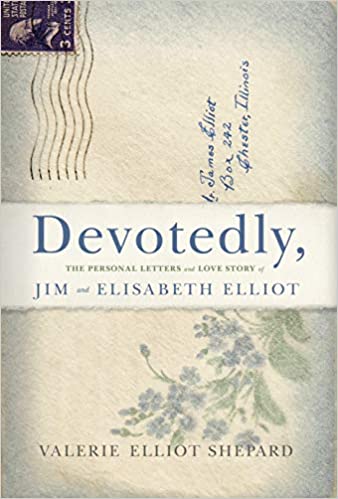
Devotedly, The Love Story of Jim and Elisabeth Elliot

If you’ve read here long, you know Elisabeth Elliot is a heroine of mine, a mentor from afar.

If you’re not familiar with Elisabeth, her husband and four of his colleagues were killed by a tribe they were trying to reach in the Ecuadorian jungle in 1956. She told the men’s stories in Through Gates of Splendor. Then, a few years later, she and her young daughter and the sister of one of the men went to live with the tribe in the jungle. A few years later, Elisabeth brought her daughter back to the US and became an author and speaker.

Jim and Elisabeth’s love story is unusual because they both thought God was going to send them to the mission field single. Jim was Elisabeth’s brother’s roommate in college and spent one Christmas vacation at their home. Then they had several classes together and began to study together.

They were different in personality. Jim was outgoing and spoke freely and easily (a little too freely sometimes). “The same bold, aggressive temperament that served him well as a daring disciple of Christ could sometimes come across as harsh and abrupt, even meddling, especially when dealing with a woman” (p. 258). Elisabeth was intellectual and reserved. But they thought alike on many subjects and began to find themselves drawn to each other.

Elisabeth seemed willing to take this development as from the Lord much sooner than Jim was. He had taken to heart Matthew 19:12 about some making themselves “eunuchs” for the kingdom of God (remaining single, unattached) and 1 Corinthians 7 about people being better able to serve God without distraction if they are single. He had given other guys in college a hard time about dating. He knew God was calling him to a pioneering field which would include rough living conditions. He didn’t feel he could ask a wife into that situation.

On top of everything else, he wrestled in his journal with the thought that if he loved a woman, it would mean that Jesus wasn’t enough for him. Somehow he missed that God Himself said “It is not good for man to be alone” when He created woman.

But for him, the thought of being romantically involved was a complete paradigm shift. It wasn’t something he could change his mind about in a short time. Plus, as they both graduated from college, each was not sure where God would have them. They worked at different jobs and helped in different ministries until they both felt led to go to Ecuador.

Elisabeth had told their love story in Passion and Purity and used it as a springboard to talk with young people about dating issues. She gave her letters and journals to her daughter, Valerie, to go through “when she had time.”

As a mother of eight, Valerie only recently had time. After reading the letters and journals and rereading her mother’s books, she felt she needed to share her parents’ love story. There was too much to copy entirely, so Lifeway helped her decide what to share. The result is Devotedly, The Personal Letters and Love Story of Jim and Elisabeth Elliot.

Valerie tells the story, interspersing the narrative with excerpts from her parents’ letters and journals. At times she adds a word of explanation, a little further insight, her thoughts on different points, or how her parents influenced her own story.

We’re so used to hearing the mature Elisabeth, who did most of her writing and speaking after decades of walking with the Lord. It’s interesting to read her young adult thoughts.

They spent a great deal of their relationship apart, so they got to know each other through letters. They went through the same difficulties as everyone else, with one person taking something the wrong way, the other having to explain, etc. They had no problem taking each other to task when they disagreed, but they did it as kindly as they could.

But mostly they encouraged each other to draw close to God and be and do all He wanted them to.

When they struggled with whether they should even be corresponding, they concluded that “what they shared together, even knowing the possibility they would spend their lifetimes apart, was more than worth it” (p. 42).

Valerie says they handled their love “with extraordinary sacredness” and “modeled—not perfectly, but persistently—the way God intends us to handle love, steward it, and keep it continually under His guidance” (pp. xiv-xv).

It’s interesting (and fun) to note the change in Jim’s writing from wrestling to acceptance that his love for Elisabeth was from God. He found that these two loves enriched each other rather than detracting from each other.

A few other thoughts that stood out to me:

Valerie noted that In the earliest pages of her mother’s journals, the words “though punctuated, of course, with the typical cares and crises of any young woman’s life—would never shift from this due-north orientation. God was first; God was supreme; God was all” (p. 1).

I thought this principle was a good one: comparing Christian life to a railroad, Jim wrote about decisions, “A block signal—a crisis—is lighted only where there is a special need. I may not always be in sight of a ‘go’ light, but sticking to the tracks will take me where the next one is” (p. 109).

Though we consider both Elliots stalwart examples of faith today, they each had their discouragements. Valerie wrote, “When you hear my mother at twenty-two saying she feels ‘useless’ and ‘fearful’ and ‘ashamed,’ recall what she went on to become in life by God’s grace and power. Think what our Father is capable of doing, encouraging you to press into Him, as she did, for His glory” (p. 66). As Elisabeth “grew older in Christ,” she realized she enjoyed “having the floor” and saw her tendency to want to “have the last word” and “straighten people out.” “She could be cut to the quick at times by her own insensitivity towards others who were speaking to her, and she wanted to become more gracious to those who didn’t have their words or facts straight” (p. 104).

Elisabeth had a nice singing voice and was often asked to sing in meetings. She wrote:

Oh, sometimes I wonder if I should not abstain from singing altogether until I know that Christ is my motive. Truly I do desire that my voice, as well as my life and will, be wholly given to His praise. But the flesh is ever with me—it manifests itself in the most singular forms sometimes. I discover that self-effacement, springing wholly from selfish motives, taints my very highest aspirations to act of God’s glory. So I am driven once again out of myself, for I am all unprofitable. . . I am but a branch, and without Thee can do nothing (pp. 138-139)

In Becoming Elisabeth Elliot, Ellen Vaughn mentions almost in passing an article someone had written proposing that perhaps Jim’s strong friendships with other men, his aversion to marriage, and his long wrestling over his relationship with Elisabeth meant that perhaps he was really homosexual at heart. One can’t read much of his writing without rendering such a possibility ridiculous. He wrote often of struggling against lustful thoughts, even more so the closer they got to their wedding. After one such entry, Valerie noted, “Let’s not pretend that my father was above the temptation. Yet, in response to it, he did what all godly men (and women) must do when accosted by strong, unholy thoughts. He called them out, considered it war, and made impassioned pleas that God would be his strength to endure” (p. 164). Even before, his teenage relationship with girls “warned me that my affections go out very easily and are jealously tenacious. Recognizing this fact, that I would lose my heart at every turn if I didn’t discipline myself carefully, I withdrew from dating and even close associations with girls whom I knew attracted me, or to whom I was somehow attractive” (p. 53).

Jim also wrestled with feeling inferior to Elisabeth and feeling “I can never be all she ought to have in a husband” (p. 192).

So we see that neither of them was perfect. That’s an encouragement to me, because I’m not, either. I wrestle with some of the same things they did. Sanctification is a lifelong process. But God’s grace is available every step of the way.

We miss a lot by not writing letters today. These letters are not only deeply spiritual, but they’re often poetic and literary as well. I’d love to include some of the more lyrical entries, but this is too long already.

Some years ago a philosophy started going around Christendom that God did not have a specific will for people regarding life work, location, spouse, etc.; He left it up to individuals to do what they wanted. That never set well with me, for too many reasons to go into here. But I saw anew one reason through these letters and journals: the sanctifying affect that waiting for and trying to discern the will of God could have. Near the end of the book, Valerie records her father’s words: “I have sought slowly the will of God, and the slowness has brought strength into the conviction of it, and joy in the realization of it” (p. 233).

Jim wrote, “The Lord has a certain slow dignity about His movings which constantly shames my fretting unbelief” (p. 163).

It touched my heart that they chose for their wedding verse Isaiah 25:9: “Lo, this is our God; we have waited for Him.”

Valerie shares that “If I could express my one hope for compiling this book, my prayer is that these entries of theirs would call us to search faithfully for God in His Word. And upon discovering His unchanging, faithful, merciful, and loving character, I pray we would be more fully moved in obedience to Him that we too might leave a lasting legacy of faith as my parents did” (p. 45).

The Elliots’ writing does encourage me in my walk with God and continues to spur me on to seek Him in His Word and find and do His will.

(By the way, last year, Revive Our Hearts did a series of interviews with Valerie about her parents’ story and writing the book here. I enjoyed listening to them then, and they have the transcripts up now.)

(Sharing with Grace and Truth, Hearth and Soul, Senior Salon,
InstaEncouragements,Carol’s Books You Loved, Booknificent)

Book Review: The Invitation

In Nancy Moser’s The Invitation, four ordinary people in different areas of the country receive a mysterious, hand-delivered invitation to come to Haven, Nebraska, on August 1. The invitations didn’t list a host or organization name or any other information except a Bible verse about faith as a mustard seed and a drawing of a mustard plant.

One of the invitees was an ex-governor. The others were a TV news producer, and wife and mother in an unhappy marriage, and a single young aspiring writer. Some are curious, but most are dismissive of the invitation at first. There’s not enough information and it all seems too weird.

But one by one, events occur that convince them to go. And even though some arrive without an invitation—a homeless stowaway, a disgruntled husband, and a thief—they are all expected and planned for.

Some are confronted with issues in their lives—some more than others. Some are nudged to use their gifts and talents in new ways. The faith of all is tested. Lives are changed.

I can’t say much more than that without giving away too much of the story. It doesn’t take long to figure out who the ultimate host is and who the mentors in Haven are. Because the visitors to Haven are confronted to varying degrees,at times the mentors come across as more didactic than we usually see in fiction. But it works because of the nature of the story.

I don’t know if I have ever read a story quite like this. Nancy Moser says in her afterword that she’s never written a story quite like this. But this story was on her heart.

It would be nice in some ways if there was such a place to go (or send people . . . ) where someone could put their finger exactly on what was wrong in your life, tell you what to do about it, and tell you what your next step should be. It doesn’t usually work like that, though. God uses His Word and prayer and the ministry of the church to guide us in less direct ways. But, still, the premise makes for an interesting imaginative tale.

And I love Nancy’s main two takeaways: that God has invited each of us to participate in His work, and He uses people with faith as small as a mustard seed.

(Sharing with Carol’s Books You Loved, Booknificent)

Do You Read More than One Genre?

Reading different genres

Do you read primarily one main genre? Or do you read several?

My favorite is contemporary Christian fiction along the lines of the Mitford series by Jan Karon. I love to hear about everyday people, their encounters with problems and neighbors and loved ones, and how God works in and through them. I have learned from and been deeply affected by Christian fiction..

But I also read a lot of historical fiction and a fair amount of suspense. I am not a big fan of romance. Most fiction has a love story, but I like books that have more to them than that. I don’t care for westerns or Amish fiction, but I have read some of each. I enjoyed some fantasy or speculative fiction. I wouldn’t read horror or erotica.

I love biographies and memoirs. Some biographies have had a profound influence on my life.

I read a lot of Christian nonfiction and enjoy it, but I have to make myself start and keep going with most of it. I gravitate more to stories.

I also like many classics. Someone once said “A classic is a book that has never finished saying what it has to say.” Classics still speak to us today even though writing styles and society customs have changed.

I read a little from non-Christian sources. Unfortunately, much secular fiction has a lot of language, sexuality, or gratuitous violence problems, which I don’t want to read. And you have to keep on guard against wrong philosophies. But some of it is still beneficial.

One reason I ask is just because I am interested. I love to talk books and reading interests.

But I am also curious. I’ve heard and read that authors should write primarily one genre so readers know what to expect from them. If they write in another genre, they’re told they’ll need to search for another audience. Some go so far to say that authors should use pen names if they write in two different genres.

That makes sense. If a writer is known for Amish fiction, it would be jarring to her readers to get that author’s latest work and discover it’s a gruesome murder mystery.

On the other hand, I have followed authors over to a different genre from what I have read from them before. In fact, I am more likely to try a different genre if an author I like has written in it, if only to see how they handle it. I wouldn’t want a favorite author to use a pen name for a different genre, unless they make it known that they’re doing so, because that makes it harder for fans to follow their work.

So I can see the wisdom of not disappointing readers who come to expect a certain kind of story from an author. And it’s probably wise for those just getting started to stay with one genre until they get established.

But I think sometimes a genre crossover can work.

What do you think? Would you follow an author from one genre to another? And what’s your favorite genre? Do you read more than one?

(Sharing with Grace and Truth, Hearth and Soul, Senior Salon,
InstaEncouragements, Booknificent)

Book Review: Influence: Building a Platform that Elevates Jesus (Not Me)

In the very first workshop of the very first writer’s conference I attended, the speaker commented that publishing had changed significantly over the past ten years.

He didn’t say how publishing worked before. I assume writers wrote books and sent them in to the publisher, who did the rest. The author would have to fix some things after editors combed over their manuscript. But the publisher would market the book to the waiting world. And that makes sense: the publisher has a much bigger reach than individual authors in their homes.

Now, however, publishers expect authors to do most of the marketing on their own.

One reason is the rise of online book purchasing. Publishers have lost the opportunity to create attractive signs and displays to catch shoppers’ eyes as they browse a bookstore. Many brick and mortar bookstores have closed.

Additional reasons are the success of bloggers with big followings who then publish books and the availability of “influencers” on social media. And though I have not read this, I can’t help but wonder if it’s a cost-cutting measure to significantly reduce a marketing department by having writer’s do their own marketing.

So in these times, one can’t publish a book with a traditional publisher without a significant “platform.” In the blogs and Facebook writer’s groups and Twitter accounts I follow, would-be authors have lamented multiple times that they were told their concept, writing, and style were all good, but they were rejected because their platform wasn’t big enough (as determined by their social media followers and newsletter subscribers). One recent tweet I saw said the writer was told he needed upwards of 20,000 followers. I don’t know if that’s the norm. But all of this is discouraging.

Sure, anyone can self-publish these days. But a self-published book won’t get much beyond family and friends without taking some measure to get it out in front of the public.

All of this puts unknown Christian writers in a quandary. We’re supposed to humble ourselves, not exalt ourselves. We’re not supposed to be self-promotional. Drawing attention to ourselves in that way is distasteful to most of us. And we don’t want to annoy friends by constantly sharing “Buy my book!” posts on social media. So how in the world can we build a platform that publishers require and still maintain a clear conscience and a Christian testimony?

Kate Motaung and Shannon Popkin have wrestled through these issues and shared their conclusions and experiences in Influence: Building a Platform that Elevates Jesus (Not Me). They begin with this helpful analogy: instead of viewing platform like a stage where celebrities seek attention and applause, think instead of a lifeguard’s platform. He’s not there to elevate himself, but to see who needs help and get a life jacket to them. He “puts himself out there” not to be admired, but so those who need help can find him.

As Christian writers, we have a message the world needs. Focusing on serving others will help us maintain the right perspective.

Then there’s the other side of the problem: What if my book is a success? What if my blog post goes viral? How can I guard against getting big-headed and puffed up?

Kate and Shannon acknowledge that praise, attention, “likes,” and such can be addicting. They discuss pride and humility and the biblical foundations necessary for a right perspective.

They also go into envy, comparison, heart motivations, disappointments, dealing with unexpected wrenches thrown into the works. They look at how people in the Bible got their message out.

And they discuss “imposter syndrome”—the feeling that we’re fakes, that we really don’t have anything worthy to say.

The right perspective is to realize and admit that we can’t do it on our own. That we are nothing without Him. That we don’t have anything to say without His enabling. Humility is essential for the people of God. It’s a good thing to think less of ourselves. But it’s not biblical or honoring to the Lord if we doubt His ability to use us for His purposes and His glory (p. 19).

If He has called us to something, He will enable us. He doesn’t want to hide our talents in the ground. He wants us to let our lights shine where they can be seen and point the way to Himself.

There’s no need to shrink yourself down or deflate your gifts. That’s not humility any more than inflating your importance is (p. 77).

Finally, the authors discuss conquering anxiety over our platforms, times to turn down opportunities, and trusting that God is in control over all.

They’re not only grounded in Scripture, but they are transparent about their own struggles.

There are discussion questions at the end of the book for personal use to to facilitate group discussions.

The one thing I wish they had included was a chapter or appendix on practical ways to build a platform. They mention some in passing. But it would have been helpful to have a list and a brief description. No one can do all the things. Each person can only do what resonates with them and works within their time constraints and personality. But such a list might have given some new ideas to try.

Overall I thought this was an excellent book. It’s one I can highly recommend and one I should probably reread once a year or so.

(Sharing with Booknificent, Grace and Truth, InstaEncouragements,
Carol’s Books You Loved)

Book Review: In Between

In Jenny B. Jones YA novel, In Between, 16-year-old Katie Parker finds herself a ward of the state when her mother goes to prison. Her father is out of the picture. Just about the time she gets adjusted to a group home, she’s sent to new foster parents in the small town of In Between, Texas.

But Katie doesn’t want a foster home with strangers. Her foster dad is a pastor, of all things. Katie knows next to nothing about churchy ways. Her first plan of action is to make herself as unappealing as possible so James and Millie Scott will send her back to the group home.

Meanwhile, she has multiple misadventures navigating a new school, avoiding friendship with the near-perfect Frances, who has been assigned to help her, making sense of church, and getting into trouble with her foster grandmother, “Mad Maxine.” She suspects her foster parents are hiding some secret sorrow and determines to find out what it is.

Though light and humorous in tone, the book brings out several deep truths without being preachy or didactic. I enjoyed Katie’s outside-looking-in perspective.

Some of my favorite quotes from the book:

My own mother thought variety in your diet meant eating a different Hot Pocket than you did the night before.

I was gonna read my Bible. I’m sure it’s a great book, but I decided I’d just wait for the movie.

Sometimes Christians are like Shakespeare. It’s English, but a totally different version.

I winced at Katie’s reference to God as “the Big G-man,” but she doesn’t know any better.

I don’t normally read YA (Young Adult) books. But the plot attracted me, it was on a Kindle sale, and I had enjoyed a book or two by Jenny B. Jones before. I enjoyed getting to know Katie and thought Jones did a great job telling her story.

This is the first of five books in the Katie Parker Production series.

(Sharing with Booknificent, Carol’s Books You Loved, Booknificent)

Book Review: Fear and Faith

I was telling a friend recently that I wished we could pray and study the Bible on certain issues like anxiety or anger or being more loving and then have them settled for all time. But some of these issues seem to require a regular (sometimes daily) dose of truth. Fear and Faith: Finding the Peace Your Heart Craves by Trillia J. Newbell is another dose of truth for me.

I was not familiar with Trillia until someone I knew on Twitter kept retweeting her posts. I always liked what she had to say, so I started following her myself. I don’t remember if I discovered this book or had it recommended, but when I saw Trillia’s name, I got it. But then, it’s been sitting on my shelf for a while. I enjoyed her God’s Very Good Idea, a book for children about God’s design for different races and types of people. And then I finally picked up Fear and Faith, going through a chapter on recent Saturday mornings.

Trillia confesses she is one who “struggles with fears regularly and is fighting for faith . . . who firmly believe God is in control and yet still struggles with fear” (pp. 13-14). Exactly! I know God is in control, powerful, wise, loving, and kind. Yet fears and anxieties still come unbidden. Trillia reminds us that we’re not perfect yet, but we’re in a state of continual growth.

Trillia mentions control in almost every chapter. And it’s true, we’re less anxious in situations where we have control and we know what’s coming (or think we do).

The very thing we are holding onto (control) is, ironically, the thing we most need to let go of. As you and I come to understand that our God isn’t ruling as a tyrant but is lovingly guiding and instructing as a Father, we can loosen the tight grip on our lives that produces the bad fruit of fear. This isn’t “Let go and let God.” It’s “Let go, run hard toward your Savior, and learn to trust God” (pp. 16-17).

Trillia spends a chapter each on different kinds of fear: fear of man, fear of the future, fear of tragedy, of not measuring up, of other women, etc. She spends one chapter on “Why We Can Trust God” and another on “The Fear of the Lord”—the right kind of fear we’re supposed to have. One later chapter discusses “When Your Fears Come True”—when God allows the thing we feared or worse.

During our storms, you and I have the same God with us that the disciples had with them; we can trust that He is in the boat. He may or may not calm the storm immediately—we may have to endure great suffering—but He will not leave us (p. 141).

Trillia grounds everything she says on God’s Word. She shares from her experience and that of other women. Her writing is easily readable and relatable.

This is a good resource if you, like me, need regular doses of truth to combat anxiety and fear.

(Sharing with Carole’s Books You Loved, Booknificent, Senior Salon)

Book Review: Don’t Overthink It

Many life decisions require a time of waiting and serious thought. But some of us get stuck giving too much thought to things that don’t really matter. I can’t tell you how many times I have hovered between punching in 45 or 50 seconds on the microwave before finally entering 47.

Anne wrote Don’t Overthink It: Make Easier Decisions, Stop Second-Guessing, and Bring More Joy to Your Life to help fellow overthinkers combat “analysis paralysis” and “decision fatigue.”

Overthinking also carries a significant opportunity cost. Mental energy is not a limitless resource. We only have so much to spend each day, and how we choose to spend it matters (p. 15).

I could identify with Anne Bogel’s opening illustration. She had to make a road trip, but a severe storm was predicted to come across her route. Her two main options were to leave at the appointed time and hope she was okay driving through the storm, or leave several hours earlier and miss some family activities as well as the storm. Instead of coming to a decision, she kept refreshing the weather page on her computer.

One of the biggest takeaways from the book that helped me was the realization that sometimes there is no one right perfect answer. Anne realized that in her travel decision mentioned above: she wasn’t going to be entirely happy with either option. That took some of the pressure off, and she used other factors to arrive at a decision.

I went through this a few years ago when I needed a new bedspread. I found two that I liked—unusual for me, because my favorite colors haven’t been trendy in home decorating for a number of years. I loved the fabric pattern in both. One was a little busy: a faux quilt with fabric squares in no particular order. The other was a little too plain: mostly white with a design made out of a floral fabric strip. I spent weeks (maybe months?) dropping in the two different stores to look at my choices and coming away empty-handed. I finally bought the patchwork one, put it on my bed—and immediately wished I had bought the other one. Then I realized I would have had the same reaction with whichever one I bought because neither was 100% perfect. (I did come to enjoy the bedspread I bought. But I think realizing that neither choice was perfect freed me to like the one I got instead of pining away for the other. “It doesn’t have to be perfect to be good,” p. 43)

Some of the other strategies Anne discusses are starting small, approaching change with the belief that it’s possible, examining the causes of analysis paralysis, letting go of perfectionism, letting values inform decisions, creating routines to eliminate everyday decisions, not beating yourself up over mistakes, but learning from them and moving on, building in margins for the unexpected, adopting a “try and see” approach rather than a pass/fail one, and so much more.

The last resonated with me. Anne described a yearly trip her family took in which they squeezed all the driving into one day to get it over with and have more time at their destination. For years they discussed the pros and cons of breaking the trip into two days. Finally one year they decided to just try it and see how it worked out. It was an experiment: it wouldn’t ruin their vacation. If they didn’t like it, they could go back to their one-day drive next time. That takes the pressure off.

Another tip that stood out to me: “complete the cycle,” or, basically, finish what you start. Putting things where they belong, filing the paperwork while you have it in your hand, etc. “When we promptly complete our cycles, we get to bypass all kinds of avoidable last-minute emergencies” (p. 69).

Here are a few of the many quotes I highlighted:

When seeking a solution, highly intelligent people may see whole landscapes of possibilities that others don’t see—which may inadvertently lead them to make simple decisions needlessly complex. These positive traits have an unintended consequence: they make us prone to analysis paralysis because they prod us to search for additional options, whether or not we need them. Those extra options don’t lead to better decisions; they just overwhelm us. And when we’re overwhelmed, we can’t decide anything (p. 38).

When we put off doing something we don’t want to do, we keep the unpleasant thing right in front of us for much longer than we need to. As long as we’re contemplating the issue, we’re dwelling on the negative. If we’re dreading something, we can serve ourselves well by dealing with it sooner rather than later. If we’re overthinking something we can actually do something about, the best thing we can do is speed up to move on. Take action as quickly as possible (p. 88).

It’s a mistake to give all your thoughts equal weight. Some thoughts don’t deserve to be taken seriously, so don’t dignify them with a response (p. 105).

The book is divided into three parts with questions at the end of each chapter. Linda led a discussion of each part which really enhanced our reading. (Part 1 is here, 2 is here, 3 is here.) Thank you, Linda!

I appreciated that Anne’s tips were both practical and flexible. I think this book is a good resource for anyone prone to overthink.

(I’m counting this book for the Self-Help category of the Nonfiction Reading Challenge.)

(Sharing with Carole’s Books You Loved, Booknificent)

Book Review: Becoming Elisabeth Elliot

Elisabeth Elliot has been one of my heroes for decades. I first discovered her in college when I read Through Gates of Splendor, her book about the ministries and deaths of her husband and four friends. Then I read nearly everything she had written, received her newsletter and a Back to the Bible devotional mailing of her writings for years, and got to hear her speak in person twice.

The Elliots and their friends had wanted to reach out to a seemingly unreachable tribe in Ecuador. Though the beginning seemed promising, all five men were speared to death by the tribe, known then as Aucas (later by their own name for themselves, Waodani). A few years later, Elisabeth and her young daughter, Valerie, and Rachel Saint, sister to one of the other men, went to live among the Waodani. Some became believers, with a testimony that still stands to this day.

Elisabeth eventually came back to America. She authored 30 books and spoke to women, eventually hosting a radio program, Gateway to Joy, and sending out a monthly newsletter.

She surprised herself by remarrying a college theology professor, Addison Leitch. He succumbed to cancer four years later. She was an adjunct professor for a while. A few years later, she married Lars Gren. She had dementia the last several years of her life, lost the ability to speak, and died at age 88 on June 15, 2015.

Those are the spare details of her life. But they don’t capture her personality, her character. Why did so many women love to read her words and hear her speak and write her letters asking her advice about their problems?

Ellen Vaughn has attempted to answer those questions in her authorized biography, Becoming Elisabeth Elliot. I admit I had mixed emotions when I first heard of this project. Vaughn was well aware that she was going to be up against a number of expectations. She had access to Elisabeth’s multiple journals as well as many friends and relatives.

Of course, Elisabeth didn’t start out as the Elisabeth Elliot of such wisdom and depth. She began life as Betty Howard. Her early journals reflect a normal girlhood and a fair amount of teenage angst over boys and disagreements with her mother. Yet even as young as eleven, she showed a depth of thought and desire to follow and obey God. Betty Stam, who was killed by the Chinese along with her husband, John, had been a guest in the Howard home and made a great impression on young Betty. As a child, Betty Howard wrote and took Betty Stam’s prayer for her own.

Vaughn goes on to follow Betty’s education, meeting of Jim Elliot, and the long wrestling over whether they should marry. Jim had thought God wanted him to be a single missionary. When he became attracted to Betty, he wasn’t sure whether that was a result of God’s leading or his own desires. It took a few years to figure out. Finally he and Elisabeth married and worked among the Quichua Indians in Ecudaor. Then there are the details leading up to the Waodani outreach, the men’s deaths, Elisabeth’s wrenching grief, working with Rachel Saint, and return to the US.

The biography stops there, with a second volume in the works. I hadn’t realized that this was only part one until I started reading it. I wish that had been made more plain, but it wouldn’t have affected my desire to own and read the book.

Elisabeth was a critical thinker and wrestled with the ways of God, pat, churchy answers, what worldliness and being a missionary even meant, and so much more. She was strongly introverted and could come across as distant and aloof (when she first met Jim’s parents, he told her she had “made a universally horrible impression.”) She could seem unemotional, but she poured out her emotions in her journals.

One thing that Elisabeth discovered in her walk of faith was that God’s ways are inscrutable. She was a gifted linguist, and her first mission was an effort to reduce the Colorado language to writing. But the one man who knew both Spanish and Colorado well and who was willing to help her was senselessly murdered. Her careful work and notes were stolen. Her husband died. Her time of living with the Waodani bore some fruit but was fraught with frustrations. She felt all her work to that point was in ashes.

But she knew God was good and trustworthy, and the best thing, the only thing she could do was obey him, even when she didn’t understand. Her experiences and wrestling over issues of faith and practice made her who she was and gave her a depth and realism that struck chords with other women.

I felt overall that the biography did a good job. Ellen didn’t put Elisabeth on a pedestal, nor did she present her as unworthy of esteem. My one criticism is that, perhaps in an effort to show that Elisabeth was an ordinary woman and not a super-saint, some excerpts from her journals were shared that I can’t imagine Elisabeth would have wanted public. I understand why some people destroy their journals and letters before they die. I’m thankful Elisabeth didn’t, and I appreciate the insight they gave into her thinking. Still, some of it was probably not meant for public consumption.

Also, an index would have been helpful.

I’m looking forward to the next volume. I knew much about Elisabeth’s early life from her writings, but I’m not as familiar with the second half. I did learn several new things, however. For instance, I didn’t know (or forgot, if I had known) that Elisabeth was told about and wanted to go to the Waodani long before she and Jim married, and that part of the groups urgency to reach them was “rumors that the Ecuadorian government and the oil companies might well solve the ‘Waodani problem’ by using the military” (p. 139). Also, Through Gates of Splendor was written in a six-week period while she was in a hotel and her folks took care of her daughter. The publishers urgently wanted the story to be available. In her previous writings, I had sensed some tension between her and Rachel. The problems there are detailed here, and understandable. They were two very different personalities with completely different methods and training. I appreciate Elisabeth’s discretion in not dragging all of it out into the public eye.

I appreciate this summation of the Elliots near the end of the book:

Whether you agree or disagree with their choices, whether you resonate or not with their particular personalities, the takeaway from their lives is a reckless abandon for God. A willingness to cast off any illusions of self-protection, in order to burn for Christ. An absolutely liberating, astonishing radical freedom that comes only when you have, in fact, spiritually died to your own wants, ambitions, will, desires, reputation, and everything else (p. 274).

A couple of my friends reviewed this book as well:

Michele: A Life of Reckless Abandon for God
Ann: Becoming Elisabeth Elliot

(Sharing with Tell His Story, InstaEncouragements, Carole’s Books You Loved, Booknificent)

(I’m counting this book for the Biography category of the Nonfiction Reading Challenge.)

Book Review: Daddy Long Legs

I’ve read a couple of books based on the 1912 Daddy Long Legs by Jean Webster (Dear Mr. Knightly by Katherine Reay and Sincerely, Jem by Kate Willis in A Very Bookish Christmas). But I had never read the original story. I figured it was time to remedy that.

Jerusha Abbott,, who calls herself Judy, has grown up in the John Grier Home orphanage. She has just about aged out of the system. She’s finished high school and is working at the home.

Then she receives word that one of the trustees has offered to pay her way through college. One of Judy’s teachers had told him she could be an excellent writer. The trustee will pay all of Judy’s expenses and give her an allowance. The donor does not want Judy to know who he is. He’ll communicate through his secretary. His only requirement is that she write him a letter once a month about what she’s learning.

The rest of the book is made up of Judy’s letters. She was told to address her letters to Mr. John Smith. She had caught a glimpse of him from behind during one of the trustees’ monthly meetings to the orphanage. She could only make out that he was very tall, so she nicknames him Daddy Long Legs.

Although thoroughly excited by her opportunity, Judy faces challenges as well. An East Coast girl’s college is a different environment from an orphanage. Judy faces a social learning curve as well as an academic one.

But for the most part she faces life optimistically. Her letters are usually lively and cheerful. But sometimes she’s downhearted or angry—sometimes with Daddy Long Legs.

Since I’d read other books based on this story, I knew the surprise twist near the end of who “Daddy” was. But it was still satisfying to see how it came about and to see little clues appear.

The original books contained some drawings by the author (Judy refers to them in her letters). But, unfortunately, the free Kindle version didn’t have them.

One thing that irked me, though, was that Judy seemed to feel obligated to make several “digs” at religion. Yes, this is a secular book, and so I don’t expect it to portray Christian values. But I don’t expect it to poke at them, either. What religious instruction Judy had at the orphanage seemed institutional and cheerless (she says of one dinner with new friends, ““We don’t have to say grace beforehand. It’s a relief not having to thank Somebody for every mouthful you eat. [I dare say I’m blasphemous; but you’d be, too, if you’d offered as much obligatory thanks as I have.”]) Maybe that’s what she’s rebelling against. But I couldn’t help wonder if some of these thoughts were the author’s and this was her way to get them out into the world. One thing Judy shares from her vast amounts of reading in college was that “I didn’t know that people used to be monkeys and that the Garden of Eden was a beautiful myth.” Maybe that’s what starts her on a negative religious path; maybe it was there before and this new “learning” brought it to the forefront. Elsewhere she says, “Thank heaven I don’t inherit God from anybody! I am free to make mine up as I wish Him. He’s kind and sympathetic and imaginative and forgiving and understanding—and He has a sense of humour.”

A couple of quotes I enjoyed:

It isn’t the big troubles in life that require character. Anybody can rise to a crisis and face a crushing tragedy with courage, but to meet the petty hazards of the day with a laugh—I really think that requires SPIRIT.

Most people don’t live; they just race. They are trying to reach some goal far away on the horizon, and in the heat of the going they get so breathless and panting that they lose all sight of the beautiful, tranquil country they are passing through; and then the first thing they know, they are old and worn out, and it doesn’t make any difference whether they’ve reached the goal or not.

Normally epistolary novels aren’t my favorite, but this was a pleasant read. The author has a nice style. Someday soon I hope to get to the sequel, Dear Enemy, focusing on one of Judy’s roommates.

I am counting this book as my classic by a new-to-me author for the Back to the Classics Challenge.

(Sharing with Carole’s Books You Loved)

Book Review: Be Delivered

The book of Exodus contains some of the most dramatic passages in the Bible: baby Moses being placed in a basket in a river after Pharaoh’s command to kill Israelite male babies and being found and rescued by Pharaoh’s daughter, God speaking from a burning bush, the plagues in Egypt, the parting of the Red Sea, Moses receiving the Ten Commandments, the golden calf.

But Exodus also contains chapters that seem a little tedious at first, like the instructions for the tabernacle and all its furnishings and the priests’ wardrobe.

A good study Bible like the ESV Study Bible and a short commentary like Warren Wiersbe’s Be Delivered (Exodus): Finding Freedom by Following God help fill out understanding of these passages.

At the end of Genesis, Joseph had brought his family to Egypt to provide for them during the prophesied famine. He knew this people would be returning to their homeland, but evidently he didn’t expect that to happen in his lifetime. He made his family promise to take his bones with them when they went back.

Wiersbe notes that “the Hebrew text of Exodus begins with the word and, for God is continuing the story He started in Genesis” (p. 17). We’re not sure how much time passed before “there arose a new king over Egypt, who did not know Joseph” (Exodus 1:8), but by that time all Joseph’s generation had died off (1:6) and the children of Israel had multiplied so much that Pharaoh was afraid they could turn on Egypt. So the Egyptians “ruthlessly made the people of Israel work as slaves and made their lives bitter with hard service” (1:13-14). Pharaoh went so far as to call for the killing of Israel’s male babies.

After Moses’ miraculous deliverance, he got off to a rocky start trying to help his brethren: in trying to save one from a fight, he killed an Egyptian. When he realized his deed was known, he fled, married, and tended sheep for 40 years, until God called to him from a burning bush. After a lot of convincing, Moses answered God’s call to go back to Egypt to deliver Israel from 400 years of slavery.

That process did not go as Moses had thought it would, but God was in control. The plagues sent on Egypt were not random. Each plague countered a god the Egyptians worshiped. God was not just rescuing His people: He was making Himself known as the one true God. There’s evidence that at least some Egyptians came to believe on Him.

After Pharaoh finally let Israel go in defeat, they started a new chapter. Not only did God miraculously deliver them: He wanted to actually dwell among them. He taught them His ways and gave them instructions for building a meeting place.

But, though they had been delivered from Egypt, they still carried Egypt in their hearts. They complained over every little thing and blamed Moses. God was patient with them at first: they had been in Egypt for a long time and needed to become better acquainted with Him and trust Him. Eventually the people made a golden calf to worship while Moses was away receiving God’s law. And God had to deal with that. Moses’ intercession in 32:30-34 and chapter 33 are some of the most touching places in the Bible.

When the people repented, they responded to God’s command and made the tabernacle just as God had instructed. And God’s glory filled the tabernacle.

There’s a lot of symbolism in the different parts of the tabernacle, and that’s one area where study Bibles and commentaries help a lot. Wiersbe’s book had a diagram and the ESV Study Bible had several drawings about what the tabernacle and its parts looked like. Wiersbe went into a lot of detail about what each part represented.

Wiersbe’s overarching theme was freedom: the Israelites needed to be freed from Egypt physically but also in their hearts.

Fools use freedom as a toy to play with; wise people use freedom as a tool to build with (p. 13).

Exodus teaches us that freedom is not license and discipline is not bondage. God tells us how to enjoy mature freedom in His will, a quality that is desperately needed in our churches and in our world today (p. 13).

I have multitudes of places marked, but here are a few other quotes that stood out to me:

God used Israel’s experiences in Egypt to prepare them for the special tasks He gave them to accomplish on earth: bearing witness to the true and living God, writing the Holy Scriptures, and bringing the Savior into the world (p. 18).

The phrase as weak as a baby doesn’t apply in the kingdom of God, for when the Lord wants to accomplish a mighty work, He often starts by sending a baby. This was true when He sent Isaac, Joseph, Samuel, John the Baptist, and especially Jesus. God can use the weakest things to defeat the mightiest enemies (1 Cor. 1: 25–29). A baby’s tears were God’s first weapons in His war against Egypt (p. 21).

What does it mean to harden your heart? It means to see clear evidence of the hand of God at work and still refuse to accept His Word and submit to His will. It means to resist Him by showing ingratitude and disobedience and not having any fear of the Lord or of His judgments. Hardhearted people say with Pharaoh, “Who is the LORD that I should obey His voice?” (5: 2) (p. 41).

The same sun that melts the ice also hardens the clay. It all depends on the nature of the material (p. 41).

There was one place where I disagreed with Wiersbe. He says of Moses’ famous argument about why he couldn’t do what God commanded in Exodus 3-4 , “Moses was clothing his pride and unbelief in a hollow confession of weakness” (p. 26). I don’t think his claims of weakness were hollow. When Moses left Egypt, he was a wanted man. His misguided attempts to help his brethren had backfired. God didn’t say Moses was wrong when Moses listed his weaknesses. But God promised to be with him and give him everything he needed. I can identify with Moses a lot in these passages and have to lean on the same truth: that it’s through God’s presence and ability that I can accomplish anything for Him.

One aspect I noticed in this trek through Exodus was how Moses grew as a leader from quaking in his boots to confident in God’s working.

Overall I found this commentary very helpful and informative.

(Sharing with Carole’s Books You Loved, Booknificent)