Book Review: The Wednesday Letters

Jack and Laurel Cooper were married for 39 years. The last few years they’ ran a bed-and-breakfast in VA. Jack had been battling cancer and knew his time was short. Laurel had heart issues they were both unaware of. At the end of the first chapter, Jack and Laurel died in each other’s arms.

The Coopers had three adult children. Matthew, the oldest, is a tightly wound businessman. Samantha, the only daughter, is a police officer who originally wanted to be an actress. Malcolm, the youngest, is a bit of a wild card, living in South America and writing a book at the time of his parents’ deaths.

As the three converge at their parents’ place and start going through papers, they discover a collection of letters. They had never known that their father wrote a letter to their mother every Wednesday of their marriage. Some are fun (especially one about a chance meeting with Elvis). Some recall daily or major events, some are silly, some are poignant. Some reveal deep and painful secrets that are of particular consequence to Malcolm. Can he forgive as his parents forgave?
___

I first saw this book advertised in the Victoria Trading Company catalog and thought it sounded interesting. Because it was in that catalog, I thought it would be from the Victorian era. Instead, it’s set in 1988. I don’t often take chances with modern secular fiction, unless I have heard favorable reviews from someone I trust, because it usually contains bad language or explicit scenes. But I decided to go ahead with this book. And I was pleasantly surprised. There were no objectionable elements, and the story was well-written and touching with an undercurrent of faith.

I did not know until after I finished the book and was looking for more information that the author is a Mormon. I have serious disagreements with much Mormon doctrine, but I didn’t pick up on anything of that nature in the story.

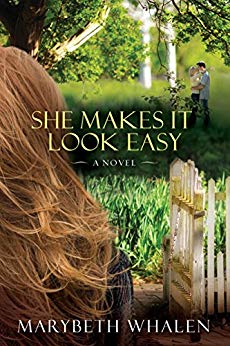
Book Review: She Makes It Look Easy

In the novel She Makes It Look Easy by Marybeth Whalen, Ariel Baxter is a stay-at-home mom and photographer. Her photography side business has taken off to such a degree that she and her husband can afford a nice new home in a neighborhood she has dreamed of living in for years. Though Ariel has her gifts, her life and home are disorganized and chaotic.

Through my lens I watched the dynamic of friendship play out among Heather and her friends: the familiarity laced with timidity, the chance to open up paired with the fear of being exposed, the awkward dance of really knowing another person. . . somehow the girls always found a way to come back together, to find what made them stick and hold on to that. I envied their natural rapport, the ease that can only come with time together. How ironic, I thought as I focused and clicked, that these girls already had what I couldn’t seem to find.

Ariel’s neighbor, Justine is one of those women who has it all together. She’s pretty, fit, perfectly made up for a pool party, her daughters wear matching outfits. She’s organized – she even has an organizing notebook! And she’s creative and speaks to her church’s ladies’ group.

Ariel is delighted that Justine deigns to befriend her and help her start organizing and exercising. As they spend more time together, Ariel is sometimes frustrated that Justine calls the shots in what they do. But she doesn’t want to jeopardize the friendship, so she goes along. She even acquiesces when Justine steers her away from another neighbor, Erica, whom Ariel actually likes.

As events unfold, we see that Justine’ life is not as perfect as everyone else thinks. She may be organized, but her happiness, marriage, and spiritual life are facades.

We had been living in denial for months, fooling ourselves into thinking that we were safe if we stayed inside the bubble of our affluent neighborhood, not realizing that’s the problem with bubbles: They shimmer and shine, but they burst easily.

I think we all have a little bit of Eve in us. She had perfection and everything she could ever want and still she reached for more.

I fell asleep praying for the strength to do what was right and for God to guard me from situations that could land me in the same situation Justine had gotten herself into. I was learning we all need protection from ourselves.

The not-so-subtle theme of the book is that no one is perfect and we shouldn’t put people up on pedestals. No matter how great everything looks on the outside, we all have our issues. While I think this is an important point, and we get into a lot of trouble comparing ourselves to each other, I felt the author took the theme and characters to extremes. I don’t think she’s saying that organized, put-together people are bad and disorganized people with messy lives are on the right track, but it almost looks that way in the book.

Another theme is the contrast between healthy and toxic friendships. Justine is the suburban equivalent of the “queen bee” at school whose favor almost everyone seeks and who decides who is “in” and “out.” Ariel’s just glad to be “in” at first and she’s entirely too trusting. Slowly and painfully her eyes are opened to the truth.

Motivations are another key factor. Justine seems to be primarily motivated by finding “happiness,” even if it takes her on a path that she knows is wrong. Her organization, ministries, and everything else were not for God and His glory or to benefit her family and others. They were her personal search for significance.

Some readers would want to know that a couple of characters engage in adultery, but there are no explicit scenes.

Overall, this story uncovers important truths to consider in our friendships, motivations, our evaluation of ourselves, and our walk with the Lord.

(Sharing with Carole’s Books You Loved)

Book Review: Love Is Not a Special Way of Feeling

I’ve mentioned before that I sometimes struggle with the concept that Christian love, agape love, is said to be more about what we do than how we feel. Yet 1 Corinthians 13 warns that we can do notable, even sacrificial things without love, which sounds like clanging gongs and such. So if I go through the motions of, say, caregiving without feeling warm and loving about it, is that lacking in Christlikeness and therefore assigned to the gong department?

Evidently this question has been on my mind for a long time, because I got this book, Love Is Not a Special Way of Feeling, way back in college. Yet, somehow, I never got around to reading it. I just rediscovered it recently and determined to get it read this year.

First of all, I do not know much about the author, Charles G. Finney. I had heard him quoted favorably in my first few years as a Christian (which probably was a factor in my picking up this book). In more recent years I’ve heard him referred to negatively as somewhat manipulative in his revivalist methods. His Wikipedia page says he was an advocate of Christian perfectionism, which I do not believe in (not until heaven, anyway). So I especially prayed for discernment while reading this book.

As it turns out, the text of this 1963 book is taken from a section of Finney’s 1846 Lectures on Systematic Theology titled “Attributes of Love.” The latter is much more accurate. The back of the 1963 books admits the new title was an attention-getting device.

After a chapter on “What is Implied in Obedience to the Moral Law?” Finney discusses three to four attributes per chapter. Some you would expect: kindness, impartiality, holiness, truth, justice, sincerity, self-denial. Some were a surprise and took a bit of reading to discern how he meant them in regard to love: economy, efficiency, severity, complacency, and others. Some words have changed since the book was originally written. Finney supports some of these attributes with Scripture; others seem based on conjecture.

The language was very difficult to work through: the back of the book and the foreword concede that. But if I am reading him correctly, he seems to be saying that emotions are in themselves neutral. They are only good or bad depending on one’s will or intention. Anger can be a sin or not, depending on what one is angry about. There’s a righteous anger against wrong-doing, like slavery, human trafficking, abuse, etc. But there’s an anger the Bible warns against, especially in Proverbs, Colossians, and Ephesians. I don’t think I’d agree entirely with the thought that emotions are totally neutral, because some of them spring from my sinful nature before I even have time to think about will and intent.

On the other hand, faith is not based of feelings: it is based on facts. He remarks rightly, I believe, that too many Christians, when asked about their spiritual life, will reply with how they feel.

They judge their religious state not by the end for which they live–that is, by their choice or intention–but by their emotions. If they find themselves strongly exercised with emotions of love to God, they look upon themselves as in a state well-pleasing to God. But if their feelings or emotions of love are not active, they of course judge themselves to have little or no religion (p. 31).

I agree that our spirituality is not just a matter of our feelings. But I disagree “that feeling and outward action are only results of ultimate intention and in themselves neither virtue or vice” (p. 125).

Some of Finney’s statements were helpful. Some I strongly disagreed with.

The biggest takeaway from the book for me was that a thought or feeling can sometimes be just a temptation and not a sin in itself. I’m sure I knew this to a degree, but these pages brought it home to me in a new way.

Patience as a phenomenon of the will, tends to patience as a phenomenon of the sensibility. That is, the quality of fixedness and steadfastness in the intention naturally tends to keep down and allay impatience of temper. As, however, the states of the sensibility are not directly under the control of the will, there may be irritable or impatient feelings, when the heart remains steadfast. Facts or falsehoods may be suggested to the mind which may, in despite of the will, produce a ruffling of the sensibility, even when the heart remains patient. The only way in which a temptation, for it is only a temptation while the will abides firm to its purpose, I say, the only way in which a temptation of this kind can be disposed of, is by diverting the attention from that view of the subject that creates the disturbance in the sensibility. I should have said before, that although the will controls the feelings by a law of necessity, yet, as it does not do so directly, but indirectly, it may and does often happen, that feelings corresponding to the state of the will do not exist in the sensibility. Nay, for a time, a state of the sensibility may exist which is the opposite of the state of the will. From this source arise many, and indeed most, of our temptations (pp. 66-67).

I wish now, then, to state distinctly what I should have said before, that the state or choice of the will does not necessarily so control the feelings, desires, or emotions, that these may never be strongly excited by Satan or by circumstances, in opposition to the will, and thus become powerful temptations to seek their gratification, instead of seeking the highest good of being. Feelings, the gratification of which would be opposed to every attribute of benevolence, may at times co-exist with benevolence, and be a temptation to selfishness; but opposing acts of will cannot co-exist with benevolence. All that can be truly said is, that as the will has an indirect control of the feelings, desires, appetites, passions, etc., it can suppress any class of feelings when they arise, by diverting the attention from their causes, or by taking into consideration such views and facts as will calm or change the state of the sensibility. Irritable feelings, or what is commonly called impatience, may be directly caused by ill health, irritable nerves, and by many things over which the will has no direct control. But this is not impatience in the sense of sin. If these feelings are not suffered to influence the will; if the will abides in patience; if such feelings are not cherished, and are not suffered to shake the integrity of the will; they are not sin. That is, the will does not consent to them, but the contrary. They are only temptations. If they are allowed to control the will, to break forth in words and actions, then there is sin; but the sin does not consist in the feelings, but in the consent of the will, to gratify them. Thus, the apostle says, “Be ye angry, and sin not: let not the sun go down upon your wrath.” That is, if anger arise in the feelings and sensibility, do not sin by suffering it to control your will. Do not cherish the feeling, and let not the sun go down upon it. For this cherishing it is sin. When it is cherished, the will consents and broods over the cause of it; this is sin. But if it be not cherished, it is not sin (pp. 67-68).

The example from which Finney posits this truth is Christ in Gethsemane.

Patience as a phenomenon of the will must strengthen and gird itself under such circumstances, so that patience of will may be, and if it exist at all, must be, in exact proportion to the impatience of the sensibility. The more impatience of sensibility there is, the more patience of will there must be, or virtue will cease altogether. So that it is not always true, that virtue is strongest when the sensibility is most calm, placid, and patient. When Christ passed through his greatest conflicts, his virtue as a man was undoubtedly most intense. When in his agony in the garden, so great was the anguish of his sensibility, that he sweat as it were great drops of blood. This, he says, was the hour of the prince of darkness. This was his great trial. But did he sin? No, indeed. But why? Was he calm and placid as a summer’s evening? As far from it as possible.

Patience, then, as an attribute of benevolence, consists, not in placid feeling, but in perseverance under trials and states of the sensibility that tend to selfishness. This is only benevolence viewed in a certain aspect. It is benevolence under circumstances of discouragement, of trial, or temptation. “This is the patience of the saints.” (pp. 69-70).

In conclusion, at the very least I can say that I have finally read this book. I gained perhaps a bit more insight into my original question of faith vs. feeling, but not a definitive answer.

As I have thought through this repeatedly over the years, I agree that love sometimes means doing the right thing despite feelings. A weary mom awakened by her baby for a 2 a.m. feeding probably doesn’t feel warm and loving at first. She probably feels groggy and maybe even grumpy at having to get up in the middle of the night. But those warm, loving feelings kick in later. I don’t necessarily feel the joy of ministering to my family as I make dinner: sometimes I am frustrated at not being able to finish whatever I was doing. I don’t feel kind and loving when I’m interrupted at the computer just when I’m on a roll in my writing. And some of those irritations at being interrupted are selfish. But the kind and loving thing to do is to give my attention to my loved one and hope that the brilliant ( 🙂 ) thoughts come back to me later. “For the flesh lusteth against the Spirit, and the Spirit against the flesh: and these are contrary the one to the other: so that ye cannot do the things that ye would” (Galatians 5:17, KJV). But, hopefully, as I grow in the Lord, my feelings as well as my actions will line up more and more with a true expression of godly love.

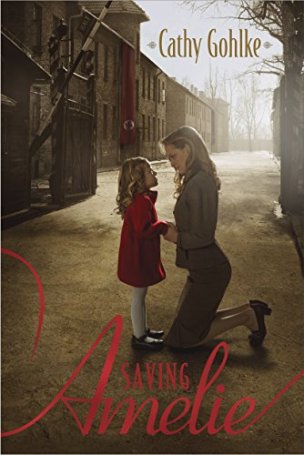
Book Review: Saving Amelie

AmelieIn the novel Saving Amelie by Cathy Gohlke, American Rachel Kramer’s dreams for her life do not match her father’s, so she is eager to get away and start her own life. But she agrees to accompany him for one last trip together to Germany in 1939.

Her father, Dr. Kramer, has done extensive work in the field of genetics, specifically eugenics. Motivated by a desire to eradicate tuberculosis, he argues for sterilization of those who might spread the disease. He shares his work with German scientists who want to apply eugenics much more broadly.

While in Germany, Rachel plans to meet with an old friend, Kristine. But instead of a joyful reunion, Rachel is alarmed at the changes. Kristine is cowed by her controlling husband, SS officer Gerhardt Schlick. Furthermore, Kristine is afraid for the life of her daughter, Amelie, who is deaf and thereby a blight on Gerhardt’s Aryan bloodline. Kristine begs Rachel to take Amelie away before something terrible happens to her. But Rachel has her own plans. She’s not good with children and doesn’t know how she would ever get her out, much less what to do with her afterward.

But as Rachel checks further into her father’s research, she finds that eugenics goes far beyond the prevention of disease, and the German scientists are running experiments on a wide variety people whom they deem imperfect in some way. She’s further stunned to find that she herself has been an object of experimentation, and she has a family she never knew of.

American journalist Jason Young’s reports have been censored by the authorities before leaving the country. But even though his reporting has been hampered, he’s aware of much more than he lets on. At first he thinks Rachel is a part of the Nazi regime and scientific community, then realizes she doesn’t know the full extent of it. Once she does, they join together to save Amelie and others, even crossing paths with theologian Dietrich Bonhoeffer. Rachel herself has to go into hiding, with Gerhardt Schlick determined to find her.
___

This is the first book I’ve read by Cathy Gohlke, but it won’t be the last. Not only was the story was riveting, but Cathy deftly showed how some of the policies of that day are making inroads in modern times, with some less than perfect children deemed unworthy of life. I love how she wove the philosophical discussion in without weighing down the action of the story. The secondary characters are just as well-drawn as the main ones. Highly recommended.

(Sharing with Literary Musing Monday, Carole’s Books You Loved)

Book Reviews: If I Run Trilogy

If I RunTerri Blackstock’s If I Run trilogy follows Casey Cox on the run from the law. In the first book, also titled If I Run, Casey went to meet her friend, Brent, at his home only to discover his bloody, lifeless body. Horrified, she ran from the scene, leaving a trail of evidence and DNA between his house and hers. She threw a few things together and fled in disguise.

Dylan Roberts has been hired by Brent’s parents to find Casey. He and Brent grew up together, but Dylan had never met Casey. Dylan had been a criminal investigator while in military service, but his severe PSTD has prevented him from landing the police job he wanted. As Dylan searched for Casey, he can’t help but do a bit of his own investigating and profiling. Nothing pointed to Casey as a killer — except her DNA at the crime scene.

Dylan is a Christian and struggles with gaining victory over his PTSD. Casey is not a believer, but comes across a Christian lady in her new location.

As Casey starts life with a new look, name, and job, she discovers that a missing girl is being kept captive. If Casey helps her, she risks blowing her cover and being discovered. But how can she not?

The chapters go back and forth from Casey’s and Dylan’s viewpoints as more of the story unfolds. Casey’s reasons for running become clear.

If I'm FoundIn Book 2, If I’m Found, Casey is on the run again in a different town with a different look and name. Dylan believes her story and finds an untraced way to communicate with her. They agree that it’s too dangerous for Casey to come back: first they need to have a solid case against the people who killed Brent and are after her. Dylan has to be careful to make it seem like he is still searching for Casey while he’s actually seeking evidence to clear her.

Meanwhile Casey accidentally witnesses parents giving their daughter to a man who pays them for time with the girl to abuse her. By the time Casey realizes what is going on, it’s too late to stop the incident. But she can’t let this happen again and looks for ways to rescue the girl and bring the adults to justice.

If I LiveI was a little afraid the plot would follow the same formula in Book 3, If I Live, with Casey risking her own safety to help an innocent victim. Thankfully, that was not the case. By this point in the story, Casey is getting weary. She and Dylan have not only met, but have come to care for each other. But they still need further evidence to bring a solid case against Casey’s pursuers. Dylan is having a harder time keeping up the ruse that he’s still looking for Casey, which puts his own life in danger. Meanwhile Casey is having an even harder time avoiding notice as the police have issued several pictures of her in different disguises taken from various business security cameras. Danger escalates on all sides as Brent’s killers get more desperate. In this book some of the chapters are from the killer’s point of view as well as Dylan’s and Casey’s. Dylan is gaining victory over his PTSD, but his parents’ misunderstanding makes it even harder.

Finally Dylan and Casey have what the evidence they need. But who can they give it to? They can’t trust anyone in the police department, because the killer has several of them under his thumb. As they concoct a plan, they draw closer to each other, closer to God, and the plot comes to an exciting conclusion.

____

I read the first two books in this series in quick succession while traveling. Since I had the third one on hand, I decided to wait to review the series all togteher after reading the last book.

The story grabbed me from the very beginning. Each book was hard to put down. I was glad I had them all before I started so I could immediately go to the next one instead of waiting. I’ve loved Terri’s books since I first read her Newpointe 911 series decades ago and passed them on to my mom. I love that her characters are relatable. I enjoyed getting to know both Casey and Dylan and felt with them through their stresses and faith journeys.

Terri says in the afterword of the last book that this series was inspired by the old TV show, The Fugitive. That was one of my favorites shows as a kid, with the innocent man on the run from the relentless detective. I also didn’t realize until that afterword that the three covers go together to form a picture. Clever!

If I Run seriesAn excellent series all together. Highly recommended if you like suspense stories. Even though that’s not the genre I read most often, I enjoyed this series very much. As it happens, just now the first book is on sale for the Kindle app for $1.99.

(Sharing with Literary Musing Monday, Carole’s Books You Loved)

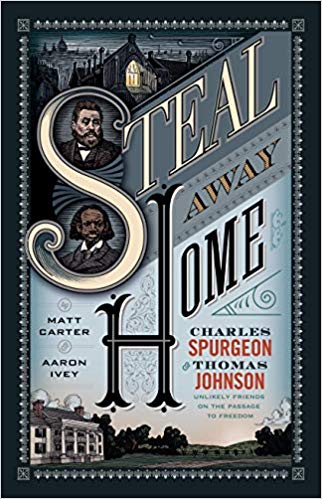
Book Review: Steal Away Home

Steal Away Steal Away Home: Charles Spurgeon and Thomas Johnson, Unlikely Friends on the Passage to Freedom by Matt Carter and Aaron Ivey is a fictional book based on facts. It parallels lifelines of two men growing up in very different circumstances and their eventual meeting and friendship.

The two men in question are Charles Haddon Spurgeon, famous and oft-quoted English preacher in the 1800s, and Thomas Johnson, a Southern slave who was freed after the Civil War, became a pastor, and eventually became a missionary to Africa. “In 1879, there were only two Christian missionaries in the entire country, and Thomas Johnson would be the very first African-American missionary to ever step foot on Cameroon soil as an ambassador for the Good News.”

It’s unlikely that two men from such different lives would cross paths. But a member of Johnson’s congregation knew Spurgeon, knew that Johnson lamented his lack of education, and knew there were funds for students who needed them to go to Spurgeon’s college, so he recommended Johnson to Spurgeon. The story has Johnson hearing of Spurgeon while still a slave, when slave owners were burning Spurgeon’s books and papers because of his stance against slavery. So meeting Spurgeon had special meaning for Johnson. They became friends after their first meeting, even to the point of Johnson traveling with Spurgeon for a retreat and being present at Spurgeon’s death.

Though this tells the story of both men, it’s not a full biography of either. It mainly tells their stories as they relate to each other.

And because the book is fictional, we don’t know what’s real and what’s made up. I would have preferred a realistic account.

I’ve read two biographies of Susannah, Charles’ wife, and several accounts of his life. I know he suffered from depression. Most accounts portray him as joyful with occasional bouts of depression: this book characterizes him as mostly depressed with occasional bouts of joy.  The truth is probably somewhere in-between. Probably depression affected him much more than anyone knew. I knew he had gout as well, but didn’t know just how extensive the pain from that could be. But the authors seemed to play up the negative physical and spiritual effects of both Susannah and Charles.

I did not know anything about Johnson, so of course I can’t compare what was said of him. I did learn that he wrote his autobiography, Twenty-Eight Years a Slave, or the Story of My Life in Three Continents. I would love to read that some time.

In a fictionalized story, naturally we expect there will be a few made-up scenes – conversations that did not happen yet reflect events or characteristics of the person’s life, etc. But according to this and this review, some scenes were revised, even the details in the account of Thomas’ conversion. If that’s true, I am very disappointed that the authors would make such revisions. The authors themselves say the book is “not a biography, and it’s not a history book, but a story, based on real events that occurred in history. Many passages in the book are word-for-word quotations from Spurgeon’s or Johnson’s own writing.” They were inspired by another historical book written as fiction that brought the characters and situations to life an wanted to do the same with this book. They admit that they “take literary license, and deviate slightly from the historical record,” but assert that “the overwhelming majority of the persons, places, dates, and even the dialogue of this book are based on real events.”

But aside from those quibbles, I did enjoy learning the relationship between these two men. I felt the hopelessness of Johnson’s situation as a slave, the palpable fear as the slaves met privately late at night to quietly worship together, the long road he had to face even after freedom was granted. I appreciated that Spurgeon was a leading voice against slavery and in treating people of all colors as equals. And though I think the authors over-emphasized Spurgeon’s suffering (they often portray him as incapacitated and don’t show much of the productive aspects of his life), I did appreciate the window into what his down times might have been like.

The title, Steal Away Home, comes from an old spiritual which is referred to often throughout the book. It’s sung here by Mahalia Jackson and Nat King Cole.

(Sharing with Literary Musing Monday, Carole’s Books You Loved)

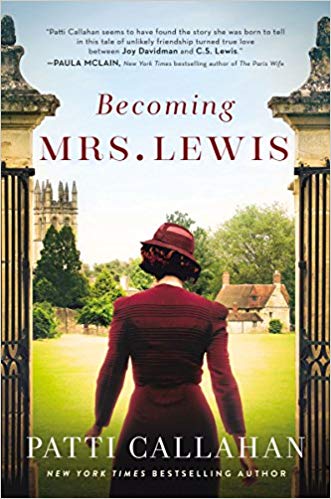
Book Review: Becoming Mrs. Lewis

I did not start reading anything by or about C. S. Lewis until about twenty years ago. Something I read then indicated that his marriage was just one of convenience so his American wife could stay in England. Since then I’ve read varying accounts of his relationship with his wife, Joy. Patti Callahan asserts that the woman whom Lewis mourned in A Grief Observed and who inspired Til We Have Faces had to have been more than just a dear friend. The letters between the two have been lost, but Patti researched all of the other pieces of Joy’s and Lewis’ writings she could find plus biographies of them to get to know Joy. Based on her findings, she crafted a fictional story titled Becoming Mrs. Lewis: The Improbable Love Story of Joy Davidman and C. S. Lewis.

Mrs. LewisJoy was something of a child prodigy, graduating from high school and college early and earning a master’s degree by age twenty. She was Jewish, an atheist, and, for a brief time, a Communist. She married William Gresham in 1942 and had two sons, but the marriage was troubled almost from the start. Bill was an alcoholic with some seeming mental issues after his military service. In one incident when Bill was drunk, despairing, and talking of suicide, Joy dropped to her knees and prayer to a God she did not believe in – and felt something of an encounter. It was enough to change her perspective and start her searching for answers. She had read and respected C. S. Lewis and knew he had converted to Christianity from atheism, so she wrote to him.

They corresponded for three years. In the meantime, due to health issues and a need for more answers, Joy took a trip to England, where she stayed with a friend, rested, wrote, and finally met Lewis, who asked her to call him Jack. By this time, Joy’s marriage was seriously crumbling, and she was beginning to have feelings beyond friendship for Jack. But she wanted to keep her friendship with Jack pure. She determined to try to save her marriage – until she learned that her husband and cousin were having an affair. Then she asked for a divorce.

Joy returned home as soon as she was able and returned to England with her boys. She and Lewis visited often. She and the boys even stayed with Lewis and his brother, Warnie, for several weeks. They read and edited each other’s writing, walked, ate, drank. Joy fell hard for Jack, but he treasured the philea (brotherly, friendly) type of love they had. He felt he was too old to start thinking about romance, and, besides, in the eyes of his Anglican church, she was still married. When Joy had to face leaving the country due to bureaucratic regulations, Jack offered a civil marriage and bought her a house. When Joy was diagnosed with cancer, Jack realized his true feelings for her and married her in earnest.

Joy was an intelligent, complicated woman. She reminds me very much of the woman at the well in John 4, “looking for love in all the wrong places,” as the saying goes. Early in her life, she was made to feel that she could never “measure up.” Her father punished her for besmirching her A report card with a B. Her mother compared her unfavorably to her prettier, more graceful cousin. She sought for acceptance and assurance of her worth in a string of sexual encounters. She came to learn that sex in itself does not equal love.

Joy is also a reminder that true Christians don’t always fit in a nice, neat box. Really, we have to look no further than our Bibles to know that. Almost every major figure in the Old Testament had serious family and/or personal issues, and the NT epistles dealt with issues in churches that we scratch our heads over these days. Yet even in the messiness of her life both before and after salvation, and the up and down pattern of her growth, there’s a steady trajectory of growing in grace and knowledge.

I must know when it is enough. And I must trust God — again and again I was learning and relearning to trust the truth who had entered my sons’ nursery. The rusty and decrepit habit of trusting in only myself, only abiding in my own ability to make things happen, died hard and slow (Chapter 40).

Much of what I’d done — mistakes, poems, manipulations, success and books and sex — had been done merely to get love. To get it. To answer my question: do you love me? . . . From that moment on, the love affair I would develop would be with my soul. [God] was already part of me; that much was clear. And now this would be where I would go for love — to the God in me. No more begging or pursuing or needing. Possibly it was only a myth, Jack’s myth [Til We Have Faces], that could have obliterated the false belief that I must pursue love in the outside world — in success, in acclaim, in performance, in a man.

The Truth: I was beloved of God.

Finally I could stop trying to force someone or something else to fill that role (Chapter 44).

Jack: I’ve spent all my life in an attempt to find Truth and moral good and then to live it. I can’t discard my moral habits for feelings, which are just that — feelings (Chapter 42).

I enjoyed getting to know Joy and seeing Jack as a normal person in everyday mode. And I loved the truths quoted above that Patti incorporated into the story.

However, even given Joy’s penchant for looking for love through sex at first, there seems to me to be more of a sensual aspect of the story than needed to convey Joy’s misdirection. Even a hill is unnecessarily described as appearing “like the breast of a woman in recline.” Another friend mentioned the preponderance of alcohol in the story. Even allowing that different Christians have different convictions about whether and how much a Christian can consume, alcohol seems the major drink of choice for any occasion here. It’s mentioned even when we really have no need to know what the characters are drinking. I’m left wondering why. I don’t know how much of these things are the author’s choices and how much of it is integral to Joy’s story. Because of these issues, this book won’t appeal to everyone. While I don’t endorse everything in the book,  I think if one can set aside some of the objectionable elements, Joy’s growth as a person, as a Christian, and her impact in Jack’s life and work can be seen and appreciated. The choice whether to read it or not must be left to individuals.

Linda is currently hosting a four-week book club to discuss this book. Week one’s discussion is here: week two is here. Week three is here., just posted today, with one more session coming next week. So it’s not too late to join in if the discussion if you’d like.

Linda also pointed us to a couple of nice videos. In this one, the author shares her thoughts and shows photos of Jack and Joy and videos of Jack’s house, the Kilns.

This one shows aspects of Oxford, integral to both Jack and Joy:

An interview with the author is here (HT to Linda).

(Sharing with Carole’s Books You Loved)

Laura Ingalls Wilder Reading Challenge Wrap-up for 2019

The end of February closes the Laura Ingalls Wilder Reading Challenge for this year. I hope you had fun with it, and I look forward to hearing about what you read!

A week from today I’ll use random.org to draw a name from the comments on this post to win either The Little House Cookbook compiled by Barbara M. Walker, Laura’s Album: A Remembrance Scrapbook of Laura Ingalls Wilder by William Anderson, The Little House Coloring Book, or a similarly-priced book related to Laura. A week should give some of us who are still reading time to finish up and post about our reading. You don’t have to have a blog to participate: you can tell us what you read in the comments here. If you have a blog, you can either let us know what you read in the comments or share the links back to any reviews or challenge-related posts from your blog or even from Goodreads if you review books there. Due to shipping costs, I’m afraid I can only ship to those in the US, unless you’d like a Kindle version.

For my part, I read:

Fairies

Laura Ingalls Wilder’s Fairy Poems, compiled by Stephen W. Hines, illustrated by Richard Hull. I had forgotten that Laura wrote such poems until Rebekah mentioned them. Laura is usually more matter-of-fact than fanciful, though some of her descriptions are lovely. So I was interested to see how she did with fairy poems. Hines provides a brief introduction, telling how Laura came to write the poems for the San Francisco Bulletin. Then he shares an adaptation of an essay Laura wrote called “Fairies Still Appear to Those With Seeing Eyes.”

There are only five poems in the book, spread out over several pages with a number of illustrations. The poems are very old-fashioned, naturally, as they describe the various activities fairies are involved in. I’m not normally into fairy poems, so I don’t know how they would measure up for young readers today.

Honestly, I didn’t care for the illustrations much. I think I would have preferred lighter colors, maybe a watercolor effect. I liked the detail of the plants and animals, but not the fairies and people.

Have you or your children read this book? What did you think?

LIW song book

The Laura Ingalls Wilder Songbook compiled and edited by Eugenia Garson.

The copy I checked out from the library looks like the one above, but I saw other copies on Amazon with a Garth Williams illustration of Pa with his fiddle on the front.

What I appreciated most about this one was Garson’s research. She looked up every song mentioned in the Little House books, provided a few sentences of background for it (when it could be found), and a quote from the LH book where it was mentioned. Sheet music is provided for all the songs, making me wish I could play the piano enough to pick out the tunes. I was familiar with just a few of them. This would be a nice resource for anyone wanting to learn more about music from this era.

Traveler

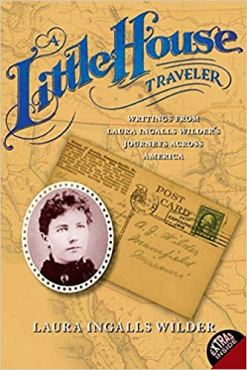
I also read On the Way Home and The Road Back by Laura Ingalls Wilder. These two books have been packaged together with West From Home, Laura’s letters to Almanzo while visiting Rose in San Francisco for the World’s Fair, into one volume called A Little House Traveler. Since I had read West From Home a few years ago, I did not read that one at this time. The first is Laura’s record of moving with her husband and daughter by covered wagon from South Dakota to Mansfield, Missouri; the second is her journal of traveling back to South Dakota to visit her two remaining sisters 40 years later in an un-air-conditioned Buick. I reviewed them here.

I also wrote Why Laura Ingalls Wilder Is Still Worth Reading because some question whether she is any more. No, she and her family were not perfect. But we can still learn from them.

That’s it for me. How about you? Remember, leave a comment on this post about what you read or did for the challenge before Thursday of next week to be eligible for the drawing.

Update: The giveaway is closed. The winner is Rebekah! Congratulations!

(Sharing with Carole’s Books You Loved)

Traveling with Laura Ingalls Wilder

I read two short books about Laura Ingalls Wilder’s travels as an adult. They weren’t written with an eye toward publication, at least not in the form she left them. They were just travel journals, notes she made for herself along the way. Perhaps she just wanted to remember certain things about her trips, perhaps she wanted to note details for letter-writing, or perhaps she did plan on incorporating some of the information into future articles or books. But since she did not start writing for publication until seventeen years after her first trip, it seems more likely that these were just notes she kept for herself. Both were published after her death.

The first book, On the Way Home, details Laura’s move with her husband and daughter from De Smet, South Dakota to Mansfield, Missouri in 1894. Laura’s daughter, Rose, who was seven at the time, provides an introduction and ending to set the context from her vantage point as a child. Rose had had to stay with her grandparents (Ma and Pa Ingalls) while her parents had diphtheria. Dire prediction were forecast about their health, but they survived, although Almanzo walked with a limp the rest of his life and “was never as strong as he had been” (p. 8). In addition there was a worldwide “panic,” which Rose explained was different from a depression. For these and various other reasons, the Wilder family decided to move, traveling with anther family, the Cooleys. Rose shares details of some of their preparations, like Laura’s sewing to make money. Once Laura “made sixty good firm buttonholes in one hour, sixty minutes; nobody else could work so well, so fast. Every day, six days a week, she earned a dollar” (pp. 11-12). I enjoyed seeing a few glimpses of the Ingalls family through Rose’s eyes, like her “aunt Grace, a jolly big girl,” singing “Ta-ra-ra boom-de-ay” (p. 9).

After the family got their covered wagon ready, packed it, and said good-bye to their loved ones, the narrative shares Laura’s notes. Often she jotted down little details like the price of crops, landscape conditions, places they found to bathe or trade, and the weather. (The first day, their thermometer showed 102 degrees inside the wagon!) Of course, as with any trip, there were various mishaps, like a horse running away, causing a later start one day.

Some of her most interesting notes involved the people they met along the way, like a Russian settlement.

Laura’s notes end just after the family’s arrival in Mansfield. Rose takes up the narrative again, describing her father going out every day to search for just the right spot. When he found it, the family dressed up to take the $100 bill they had hidden in Laura’s writing desk to the banker and buy the land. But the $100 was missing. Rose was highly offended that her parents asked her if she had told anyone about it or played with the desk. Since they could not find the money, Almanzo looked for work for a few days while still keeping an eye out for an ideal property. Finally they found the $100 and bought what they later named their Rocky Ridge farm.

To be honest, I have never been fond of Rose. I read one biography of her years ago in which she just did not seem like a likeable person. Then in more recent years I read that she played fast and loose with facts, even in biographies she wrote. So I have never really trusted her. I enjoyed her writing and the scenes from her viewpoint here, but she paints Laura rather harshly most of the time. Then again, Rose seems highly sensitive. For instance, when her father cut wood from the property to sell in town, she greeted him outside when he came back and learned he had sold the whole load. Excited by the news, she ran in to tell her mother. When she “pranced out to tell my father how glad she was . . . he said, with a sound of crying in his voice, ‘Oh, why did you tell her? I wanted to surprise her.'” Rose then writes:

You do such things, little things, horrible, cruel, without thinking, not meaning to. You have done it; nothing can undo it. This is a thing you can never forget (pp. 106-107).

She might have been referring to her father being cruel for his reaction, but I think she’s talking about herself. Somehow she magnified what would have been in the grand scheme of things a minor misunderstanding and disappointment into something “horrible” and “cruel.”

There’s one really odd sentence in Laura’s section. She described hating to leave the Russian settlement where they were camping. As she looked back on the scene:

I wished for an artist’s hand or a poet’s brain or even to be able to tell in good plain prose how beautiful it was. If I had been the Indians I would have scalped more white folks before I ever would have left it (p. 30).

She wasn’t wishing the Russians harm, because she had enjoyed her time there. Looking at it again just now, she seems to be saying if she lived there, she would have put up a fight rather than leave the area – or perhaps she understood the Indians fighting to stay on their land in a way she had not when she was a child.

The Road Back contains Laura’s notes made some forty years later on a trip back to De Smet to visit Carrie and Grace, the only remaining family members. It was interesting reading this right after the previous book, because they covered the same ground, only going the opposite direction, in an un-air-conditioned Buick instead of a covered wagon. Laura was 64 and Almanzo was 74.

I marveled at how many times Laura remarked on the good dirt or gravel roads. Some roads were made of cement, but many were not: yet in that day they still beat the trails or prairies they had come in on.

They had not been back in the forty years they had lived in Mansfield. Laura had written Little House in the Big Woods, but it had not been published yet. So she was not well known as a writer at that point except for her columns for the Missouri Ruralist.

Once again Laura detailed road, weather, crop, and economic conditions of the places they traveled through. She also listed their travel expenses: their first night on the road, they spent $3.42 for gas, food, a night in a cabin, and paper. They got a lot of their news about different areas from filling station attendants. Once again, Laura’s humor winks in places. She described seeing a group of signs along the road that said, “For the land’s sake, eat butter.” When they stopped to eat, she wrote, “I had bacon and eggs and coffee, bread, and for the land’s sake ate the best butter I’ve tasted” (p. 305).

I enjoyed her different observations about seeing again the places and people she had know. She said of Carrie, “She had changed a great deal but I knew her.” (I guess so, after 40 years.)

She waxed a bit more philosophical in this journal. She and Almanzo and those they visited also did some sight-seeing. One interesting stop was observing the carving of Mount Rushmore in progress.

The narrative ends near the end of the trip, where they stopped to eat and call Rose to say they were nearly home. Laura noted that though she didn’t keep up very well with the accounting, the trip cost “$120 for 4 weeks and 2,530 miles” (p. 344) for the trip to De Smet and back.

TravelerThese two books have been packaged together with West From Home, Laura’s letters to Almanzo while visiting Rose in San Francisco for the World’s Fair, into one volume called A Little House Traveler. Since I had read West From Home a few years ago, I did not read that one at this time. On the Way Home and West From Home had been published as stand-alone books, but The Road Back has only been published here. Rose had On the Way Home published a few years after her mother’s death. Roger Lea MacBride, Rose’s lawyer and heir, found the notes for the other two book in Rose’s papers after her own death. He had West From Home published and wrote the introduction. Abigail MacBride, Roger’s daughter, provided the introduction for The Road Back. It’s interesting that the mode of transportation for the first trip was a covered wagon; for the second, a train; and for the third, a car.

Sprinkled throughout the book are pictures of the Ingalls and Wilder family, their homes, and some of the scenes the Wilders might have seen in their travels. At the end is a short (three-page) biography of Laura, a family tree, photographs of notes children had written to her, and a copy of her last letter to Rose.

I enjoyed visiting with Laura on her travels. Even though her notes were off the cuff and not polished, I enjoyed her powers of observation and descriptions as well as her characteristic humor.

(Sharing with Literary Musing Monday, Carole’s Books You Loved)

Book Review: I’d Rather Be Reading

ReadingAnne Bogel’s I’d Rather Be Reading is aptly subtitled The Delights and Dilemmas of the Reading Life. Anne is the blogger behind Modern Mrs. Darcy, where books and reading are among her primary topics.

In this book Anne covers nearly every aspect of being an avid reader communicating with other avid readers.

Since she writes so much about books, people sometimes feel compelled to divulge their guilty reading secrets: hating books that everyone else loves, never having gotten around to reading a well-loved classic, having books on their shelves for decades that they haven’t read yet.

She discusses the books that we seem to come across at just the right time, even though we picked them up randomly, the books that “hooked” us into lifelong readership, the puzzling love for books that make us cry, the charm of libraries and bookstore, books that we keep because they were given to us or remind us of friends, how reading enhances real-life experiences, “bookworm problems” like never having enough storage space for books or needing to stop just at the best part of a book to go to work  or pick up a child from school, the different types of readers we are at different stages of life, the discoveries made in an author’s extra notes (acknowledgements, introductions, afterwords), and much more. Along the way she references a plethora of books she’s read.

Maybe because I am only an occasional visitor rather than a regular follower of Anne’s blog, I didn’t have the same sense of conspiratorial camaraderie I might have had in discussing some of these same topics with friends. But I enjoyed plenty of head-nodding and “me, too!” moments, which, along with Anne’s breezy style, made this book a pleasant read.

(Sharing with Carole’s Books You Loved)