Book Review: I’m No Angel

im-no-angelI’m No Angel: From Victoria’s Secret Model to Role Model by Kylie Bisutti tells the story of her successful rise through the modeling world only to abandon it at the height of her success.

As a young girl Kylie was thin and pretty with “freakishy long legs,” and constantly people would tell her she looked just like a model or should be a model some day. Kylie makes an important point when she says:

Adults don’t always realize the profound effect their words can have on young kids—girls in particular. These people mean well, of course. What harm could possibly come from telling a little girl she’s pretty? Technically, none—unless that’s the only affirmation she ever hears…

It wasn’t as though I didn’t have anything else going for me…but whenever anyone looked at me, all they seemed to see was model.

As my identity became wrapped up in being pretty, it also became the primary attribute I used to define my value. If people weren’t praising me for my looks, I started feeling like I was lacking somehow, and I would go out of my way to make them like me. This would turn into a cycle that would haunt me for years to come.

In her junior high years, she felt a growing disconnect with her father, who had taken a new job and was working all the time so that she could “have what [he] didn’t have growing up.” She “missed their old life…when we had less money but more time together.” Then her height and thinness started getting her teased at school, with girls saying she was anorexic and boys calling her a giraffe.

So when opportunities for modeling did come her way, the positive attention and affirmation soothed. her. She hoped to “prove something to all the people who had teased me at school” and even to “regain [her] dad’s attention.”

From the very start, at just 14, she was made up and dressed to look older than she was and to appear sultry and sexy and pose provocatively. Being expected to change clothes in a room with models of both sexes made her uncomfortable, but she figured it was part of the job and she needed to get used to it. In addition:

That’s one of the harsh realities I learned early on about the modeling industry: ultimately, your body doesn’t really belong to you.  It belongs to the client.  Since they’re paying, they figure they can do pretty much whatever they want to you.  They can curl your hair, straighten it, dye it, cut it –even shave it.  I’ve seen hair extensions being pulled out by the roots and smoke billowing out of flat irons while the hair inside gets singed and fried.  I’ve watched models squeeze their feet into shoes so small their feet literally bled, and I’ve seen false eyelashes torn off so quickly that the natural lashes came off with them.  Modeling may look glamorous on the outside, but believe me, beauty can be an ugly business.

Some girls even had surgery to remove ribs to look thinner, Kylie herself, at a size 2 and 115 lbs., was referred to as “the big model,” and her agent called her a “fat pig” and a “cow” and told her she needed to lose weight.

After a devastating heartbreak in high school, Kylie was open when a friend invited her to her church’s youth group. She began going to her church and learning about God, Jesus, and salvation for the first time. At a youth camp some time later, she finally put her faith in the Lord Jesus as her Savior. After she came home, her mom saw such a difference that she was open to what Kylie shared about what she was learning.

It still took years, though, for Kylie to come to a realization that there might be a problem with her modeling, especially modeling lingerie. We are saved in a moment, but growth and sanctification are processes that come with time in God’s Word and in His church. Kylie tells how her modeling career continued until she reached what she considered the pinnacle: winning a Victoria’s Secret Runway Angel competition. Aspects of modeling continued to bother her, but at first she just thought it was part of the job, then didn’t want to displease her agent or company or jeopardize her job or risk rejection. Finally she was convicted, but continued to compromise. She “wasn’t mature enough to understand this at the time, but it wasn’t simply a question of what you can or can’t see in those types of photos. My sinful choice was rooted in something deeper: what the photos represented. I can only imagine how sad it made God to see my complete lack of honor and purity and respect, not only for myself, but also for my parents, for my future spouse, and most of all, for Him.”

Had I been further along in my Christian walk and more focused on serving God rather than myself, I might have seen that. But I still had a long way to go in my faith. In my mind, being a Christian meant that God loved me and that He wanted me to be happy, healthy, and successful. I’d been listening to CDs that taught me how to transform my mind, when I should have been immersing myself in the Bible so God could transform my heart through His Word. Up to that point, I’d been treating God like a genie in a lamp, making childish wishes and then waiting for Him to deliver.

But God didn’t send His Son to die on the cross so that one day I could become a famous fashion model. He doesn’t exist to serve me; I exist to serve Him.

When she married, her husband at first didn’t realize all that was involved in her modeling, and once he did, instead of “making” her quit, he just quietly prayed for God to convict her. And He did. “God was opening my eyes to the fact that I couldn’t glorify Him in my life while at the same time taking modeling jobs that compromised His values. The disconnect was too great, and if I kept trying to do both, I would end up despising one. I had to choose. Would I serve the world, or would I serve God?”

When she repented and chose to serve God, at first she thought she would continue t model but avoid jobs that were immodest.

But as I continued to grow in my relationship with the Lord, I started to lose the desire to model at all. Regardless of the type of clothing, I knew that modeling promotes the world’s sense of beauty. This wasn’t the type of beauty I wanted to endorse for girls and women. Not only that, but the temptation would always be there to be thinner, prettier, and more in demand. I’d seen how addictive those desires can become, and I didn’t want any part of it anymore.

Unfortunately a sad consequence of modeling is that the photos that were taken of her will forever be available on the Internet, even some by a unscrupulous photographer who sold some to a porn site. There’s no way to get them back or have them erased. “I could make godly decisions related to my future, but I couldn’t control how others chose to exploit my past.” She chooses to think of them as “a powerful reminder of the consequences of sin and the depths of God’s redemptive grace.”

Now she is married with two children and a ministry encouraging women in their walk with the Lord. She blogs at I’m No Angel.

A few years ago during Victoria’s Secret show on TV, Kylie was watching Twitter and finding mostly negative comments about it, some from women who felt that it was a negative not only because of the immodesty, but because of making “everyday” women feel inadequate. One man tweeted, “I’d rather have a Proverbs 31 woman than a VS model.” Kylie responded, “I quit being a VS model to become a Proverbs 31 wife.” Within minutes she was contacted and asked to do a guest blog post which went viral and led to interviews on a number of news sites. There were some verbal attacks as a result, but there were also words of encouragement in unlikely places in the industry.

At the end of the book is a 30-day devotional section titled “The Master’s Makeover,” with Scripture and words of wisdom about beauty from God’s point of view.

I found this quite an eye-opening book and was blessed by Kylie’s growth. As far as I can tell no one sat her down and had “a talk” about modesty with her, but God dealt with her heart and brought her to conviction Himself. In the few pictures shared in the book, she looks so much healthier and happier, in addition to being more modest, in her more recent photos.

Genre: Autobiography
My rating: 9 out of 10
Objectionable elements: I think Kylie does a good job showing the seamy side of the industry without getting unnecessarily explicit, but there are scenes that might bother some. In addition, a lady preacher is mentioned with whose teaching I would disagree, but I think that was who Kylie was talking about when she referenced listening to CDs teaching that God wanted her to be positive, happy, and successful rather than teaching the whole counsel of God.
Recommendation: Yes.

(Sharing at Semicolon‘s Saturday Review of Books, Literary Musing Mondays, and Carol‘s Books You Loved)

Books you loved 4

Save

Save

Save

Save

What’s On Your Nightstand: August 2016

What's On Your NightstandThe folks at 5 Minutes For Books host What’s On Your Nightstand? the last Tuesday of each month in which we can share about the books we have been reading and/or plan to read.

Between the Olympics, two birthdays, and a ten-day “stay-cation,” it’s been a different kind of month for us. I’ve been wondering how my reading record will go for this month. Let’s see:

Since last time I have completed:

Leaving Oxford by Janet W. Ferguson, reviewed here. Christian fiction about an ad exec who can’t leave her small town due to anxiety issues but falls in love with a coach who has a chance to go to the big leagues in another town. Good story.

More Things in Heaven and Earth by Jeff High, audiobook, reviewed here. A new doctor from Atlanta reluctantly starts his first practice in a small TN town only because of a program that will pay off his school bills and gradually finds good in the town and its people. Some bad language, and it took me a while to warm up to the characters, but ultimately good.

Be Mature (James): Growing Up in Christ and Be Hopeful (1 Peter): How to Make the Best Times Out of Your Worst Times by Warren Wiersbe. Not reviewed but very good.

Tuck Everlasting, reviewed here. Children’s story about a girl who stumbles across a family who are stuck forever at their current ages. Thought-provoking, nice writing.

The Green Ember, reviewed here. Children’s fantasy about rabbits who are preparing for a better world while fighting against wolves and birds of prey who are trying to extinguish them. Fairly good, though there are some odd things about the writing in spots.

Rescuing Finley by Dan Walsh, reviewed here. Heartwarming story about how various lives with various sets of problems intersect with that of a dog in need.

Ten Fingers For God: The Life and Work of Dr. Paul Brand by Paul Brand, reviewed here. A reread from 20 or so years ago, it’s a wonderful biography of a man raised in a small village in India who goes on to become a pioneer surgeon for lepers.

Well, I’m surprised! I read less due to the Olympics but more during our stay-cation, so I guess it averaged out. Plus last month’s last Tuesday for the Nightstand post left us with several days to be counted for this month.

I’m currently reading:

The Promise of Jesse Woods by Chris Fabry, audiobook.

Give Them Grace: Dazzling Your Kids with the Love of Jesus by Elyse M. Fitzpatrick and Jessica Thompson. This one keeps getting pushed behind others – I need to finish it.

Home to Chicory Lane by Deborah Raney

I’m No Angel: From Victoria’s Secret Model to Role Model by Kylie Bisutti

Up Next:

These were all listed as “next up” on last month’s nightstand post – but I didn’t get to them yet:

I’m Still Here: A New Philosophy of Alzheimer’s Care by John Zeisel, HT to Lisa’s review.

June Bug by Chris Fabry

Waiting For Peter by Elizabeth Musser

After that, I’ll choose from my TBR pile (to which I’ve added half a dozen or more books from my birthday) or the multitudes loaded on my Kindle app.

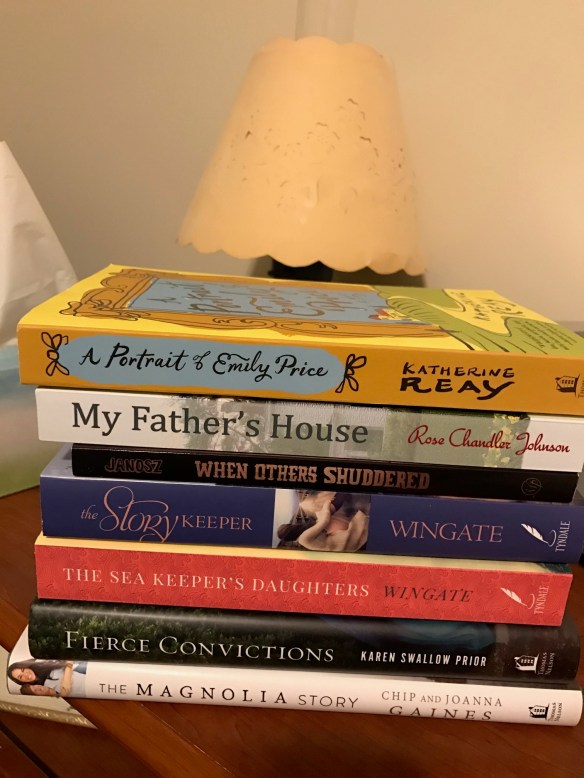
IMG_1820

I also did a post about my bookcases. I’d love to see yours!

Save

Book Review: Rescuing Finley

Rescuing FinleyI don’t read many dog stories, but I have enjoyed past books by Dan Walsh, so when Rescuing Finley came up for sale for the Kindle app, I got it.

Many dog stories are designed to be heartwarming, and Walsh is known for his heartwarming stories. My heart needs warming as much or more than everyone else’s, but when I know a story is aiming for that, I can find myself kind of resistant. But, they got me. I was touched and even in tears for part of the story.

The book tells the story of a few different people. One is Amy Wallace, a young woman who has been in trouble with drug addiction and stealing. Her family has cut ties with her, and when she’s caught shoplifting, the value of the item she stole lands her in prison.

Chris Segar is a minesweeper while in the Marines in Afghanistan, who steps on a silent mine, losing a leg and coming home with PTSD.

Then there’s Alicia Perez, whose son is killed in Afghanistan. She had been taking care of his dog, Finley, but she can’t handle him any more and takes him to the pound.

Kim Harper is an “Animal Behavior Manger and dog trainer” for the place where Finley is taken.

And then there is Finley himself, depressed by the loss of his owner and confused by his circumstances.

Walsh weaves their stories all together into a very satisfying book. You may even be able to guess where the story goes, but it’s worth the journey.

The sections from Finley’s point of view could have come across as cheesy, but I thought Walsh did a good job suggesting what Finley might be thinking without going that far.

I enjoyed the Author’s Note at the end, where he explains that, after his wife finished homeschooling all of their children, he encouraged her to do something she enjoyed. She wanted to train and be certified as a dog trainer. He explains that the book isn’t directly based on her or the organization she works with, but they greatly informed his story, along with the other research he did.

There are a few odd mistakes in the book (accept for except, bare for bear, our for are, etc.) that I was really surprised at. I don’t remember seeing anything like this in any of the author’s previous books: I’m wondering if something weird happened when formatting it for the Kindle. But I know it’s possible for little things to be missed in the process between writing and publishing.

This was a really nice read. It would make a great Hallmark movie.

Genre: Christian fiction
My rating: 10 out of 10
Objectionable elements: None.
Recommendation: Yes, I gladly recommend it.

(Sharing at Semicolon‘s Saturday Review of Books)

Save

Save

Save

Book Review: Ten Fingers For God

Ten Fingers For GodI first read Ten Fingers For God about Dr. Paul Brand by Dorothy Clarke Wilson some 25-30 years ago when we attended a church with a solid lending library of mostly biographies. After reading this book I read the same author’s book about Paul’s mother, Granny Brand, and I believe I also read her Take My Hands: The Remarkable Story of Dr. Mary Verghese, after seeing her story mentioned in this book. I reread Granny Brand a few years ago, and that caused me to want to reread Ten Fingers, so I found an inexpensive used copy online.

Originally my primary interest in Ten Fingers For God was stirred when I was told it mentioned Dr. John Dreisbach, who attended our church whenever he was in the country. But I was soon caught up in Paul’s story on it’s own merits.

He was the son of unconventional pioneer missionaries to India, Jesse and Evelyn Brand. He and his sister were allowed to roam pretty freely, his mother even letting him do his school work up in a tree and drop finished assignments down to her. “If [his work] was wrong, he had to climb down and get [it], reascend, and start over again” (p. 14). So it was a pretty strong shock to his system when, at the age of 9, I believe, he was taken to live with two maiden aunts in England for his schooling. Some of my favorite parts of the book are his and his sister’s antics there, like hanging upside down on the crosspiece of a streetlight in front of the aunt’s house, smiling at passers-by, or pretending the floor was lava and trying to make it around the room on the furniture without touching the floor. The aunties handled it as well as they could.

Paul’s father died when he was 15, and his mother returned to England for a time, devastated, but eventually she went back to India. It was understood that Paul would follow. Initially his main interest was in carpentry, so he apprenticed to a man his mother knew. When he applied to be a missionary, however, he was turned down. His father had had to build structures, which is one reason why Paul was interested in building, but it wasn’t accepted as a main missionary occupation. Medicine had originally been repulsive to him, with memories of his father treating gross and disgusting conditions. But once Paul decided to go that way and got into it, he marveled at the way God created the body and its systems and saw it as a wonderful way to help people.

He married and went to India and was thrust into more than full time medical ministry. Leprosy was still a mystery with a huge stigma attached. Sadly, most lepers were not actively contagious, but once the disease began they were ostracized. It was thought that their flesh wasted away, so much so that they couldn’t even be operated on, but Paul discovered that the cause for their ulcers and even lost digits was lack of pain sensation. He pioneered a surgery to transform their hands from their clawed version to workable, usable hands.

But that actually created more problems. People would not hire them because of the stigma of leprosy, but they couldn’t successfully beg any more because they no longer could garner the sympathy their clawed hands had elicited. Paul found employment for some at the hospital, but of course he could not do that for all of them. Eventually a training center was built where patients could not only learn a trade, but learn how to handle their tools in safe ways that wouldn’t damage hands that couldn’t feel, and in turn, as Paul and his crew became aware of problem areas, they could adapt tools or processes to the patients’ needs. Paul’s carpentry experience was valuable many times over in these endeavors.

Not many doctors were treating leprosy patients, so when possible, Paul traveled to other parts of the world to gain more insight (which led him to Dr. Dreisbach in Africa).

Eventually treatment expanded to include operations on feet, noses, and restoration of eyebrows. Paul’s wife, Margaret, became an expert in her own right on how leprosy affects the eyes.

I had forgotten that Paul worked in the ministry founded by Dr. Isa Scudder, someone else whose biography I enjoyed.

The last third or so of the book was not quite as interesting to me, as it got further away from Paul himself and more into how his procedures and methods gained worldwide attention, what organizations he became affiliated with, which organizations sent people or set up additional centers in Vellore, etc. There’s a nice epilogue in this edition which I don’t believe was in the one I first read, telling what happened in the lives of Paul, his wife, and each of his children.

He was so incredibly busy, I don’t know how he found time to even have a family. Yet he was known for being unflappable in just about any circumstance.

A lot of his insights into pain are in this book, but perhaps his best known book was originally titled Pain: The Gift Nobody Wants, which I’ve not read. It’s been republished and retitled The Gift of Pain with Philip Yancey, but I don’t know if the text has been altered or what Yancey’s contribution to the book was. They did collaborate on other books, Fearfully and Wonderfully Made and In His Image (I’ve not read these, either.)

Overall this was a fascinating look into a unique and remarkable man, perfectly fitted to what God called him to. I’m glad I read it again.

Genre: Biography
My rating: 10 out of 10
Objectionable elements: None
Recommendation: Yes, I highly recommend it.

(Sharing at Semicolon‘s Saturday Review of Books)

Save

Save

Save

Save

Book Review: The Green Ember

Green EmberThe Green Ember by S. D. Smith is a children’s story about rabbits. Brother and sister Heather and Picket live a normal (for storybook rabbits), almost idyllic life with their parents and baby brother until one day when a mysterious stranger comes to talk with their parents. Heather and Picket are shooed out to pick berries, but while they are gone, their home is attacked by wolves and burned. Not knowing where their parents are and being spotted by wolves, they try for a harrowing escape, being rescued at the last minute by an uncle they didn’t know they had and his adopted son, Smalls.

Their uncle, Wilfred, and Smalls take them to a community of rabbits hidden away. They see and hear evidences of other wolf attacks. While rabbit forces are training to fight the wolves, rabbit artisans and workmen are keeping their skills honed for a time when the heir of their fallen king will rise up and claim his place and lead them to a season of peace. When injustices or suffering occur, they comfort themselves with the saying, “It shall not be so in the Mended Wood.” Meanwhile discord threatens the community, and Heather and Picket struggle to find their place, especially when they learn their family’s history with the king.

My thoughts:

I don’t read children’s stories other than classics often, though I agree with C. S. Lewis that a good children’s story should appeal to adults, too.

I was expecting to be wowed, and maybe that’s the biggest problem with why I wasn’t. I think when expectations are so high, that can actually set one up for disappointment. I’ve seen it compared to Narnia, and though there are similarities, I think such a comparison helps set up those lofty expectations and the resulting letdown.

It’s not a bad story at all. It has a lot of great elements. I tend to enjoy “coming of age during adversity” type stories generally. I bought and looked back through the Kindle version after listening to the audio, and the things that bothered me while listening didn’t stand out so much while reading. I am not sure if that’s because it lends itself better to being read than listened to or if I was already familiar with it, so certain things did not then stand out.

I don’t mean to sound nitpicky and critical. I really don’t read or listen to books with an editing pen handy, ready to pounce on any little infraction. But there were a few things that were like speed bumps, pulling me out of the story to wonder why some things were phrased the way they were.

I think the arc of the story, the characters, the conflict, and most everything else is fine: it’s just these little things that could be tightened up to make it stronger, or at least provide fewer distractions.

To be fair, let me share some of the great quotes that stood out to me:

“If you aren’t angry about the wicked things happening in the world all around, then you don’t have a soul.”

“Why not just apologize to Smalls, to everyone, and move on? But he couldn’t do it. It would feel too much like surrendering ground he felt entitled to.” Thought that was quite insightful – that’s exactly how one feels when not wanting to apologize.

“All of life is a battle against fear. We fight it on one front, and it sneaks around to our flank.”

My place beside you,
My life for yours,
‘Til the Green Ember rises
Or the end of the world!

I like the way the community is not just surviving, but also focusing on and preparing for the time to come: “Here we anticipate the Mended Wood, the Great Wood healed. Those painters are seeing what is not yet but we hope will be. They are really seeing, but it’s a different kind of sight. They anticipate the Mended Wood. So do all in this community in our various ways. We sing about it. We paint it. We make crutches and soups and have gardens and weddings and babies. This is a place out of time. A window into the past and the future world. We are heralds, you see, my dear, saying what will surely come. And we prepare with all our might, to be ready when once again we are free.”

The story ends rather abruptly, obviously setting up for a sequel, which is due out in September: Ember Falls. Between these two a prequel was published, The Black Star of Kingston.

It’s not an overtly Christian book, but there are spiritual parallels, mainly of a fractured, hurting world longing for its king to come, and many spiritual truths along the way. A good discussion of this aspect is in this review.

The illustrations by Zach Franzen are gorgeous. I was glad the Kindle included them.

If you’d like to read a much more enthusiastic review, the great majority on Amazon or Goodreads are positive.

(Sharing at Semicolon‘s Saturday Review of Books)

Save

Save

Save

Save

Bookcases

When I visit someone’s home and see an assortment of books, at some point during the visit I like to meander over and see what books my host has. I’ve been thinking for some time about sharing my own bookcases. Someone mentioned a long time ago that she thought it would be interesting to see blogging friends’ book collections, and then recently Melanie shared her own, which brought the idea to the forefront of my thinking again and spurred me on to share my own.

So these are the main two in the living room:

IMG_1812(1)

My husband made one in the early years of our marriage, and then as my collection grew, he made a second one to match. But he says we don’t have any room for more. 🙂 And we truly don’t, unless we get rid of something else which we’re not ready to do yet. He doesn’t quite understand my penchant for keeping books except for reference. He figures once you know the story, you don’t need the book any more. 🙂 But he tolerates my obsession as much as he can. To me, most of my books are treasured friends, and some I do read over and over. Others I might not read as often, but I’m still not ready to let them go. But I have had to purge my collection when we moved here and have had to delete a few here and there as I have added others and needed a space.

Above the couch is most of my Boyd’s Bear figurine collection. I like having them behind glass where I can see them but they don’t get dusty, but they do seem a little farther removed than when they were out and around the room. But not having to dust wins. 🙂 To the right you can see a bit of Timothy’s corner, where we keep toys for when he’s here.

On the bookcase on the left I have Christian fiction and classics and some assorted others along with some photo albums at the bottom:

IMG_1814

IMG_1815

The carved wooden box was a gift from my middle son, Jason, from a mission trip he took with his youth group to Cameroon. The bears were gifts from my kids: Timothy plays with these sometimes now.

The one on the right holds biographies, assorted Christian nonfiction, and college yearbooks.

IMG_1817

This got cut off in the above picture, but on the left is a special Valentine from Timothy, and on the right is a special photo from Jason and Mittu of my husband and Timothy when he was in the NICU. My reflection is blurring it a little, but not the essential part.

IMG_1826

IMG_1818

Some of you may remember that the book with the wedding photo was one our kids put together for our 35th anniversary, and it’s one of my treasures. 🙂 I have a set of Matthew Henry commentaries on the bottom shelf that were given to me 35 or so years ago by my former youth pastor when he left that position to go to Mexico as a missionary. I used them some, but the commentary on each verse is quite long, so I just don’t dig them out often unless I am really puzzling over something. I keep thinking I should sell them online or give them to someone, but then I am reluctant to do so in case I just might want to use them again. 🙂 I know you can find some of them online: they probably have the complete set online somewhere, but so far when I have looked, I’ve found condensed versions which were  a little easier to read but didn’t make quite as much sense with what was left out.

This one is in my sewing/ craft room and holds mainly craft-related books or Christian non-fiction relating specifically to women. I just got rid of a number of old “how to save money and live frugally” books because I figured they were out of date now, plus you can find a lot of that kind of thing online these days.:

IMG_1821

On top are several sets of cassette-taped messages, some from women’s conferences, some a few special sermon series.

IMG_1822

My mom gave me the little girl on the top left: she’s designed to hold thread and notions, but I don’t want to leave my thread out to get dusty. But I think she’s cute. 🙂 The hearts in the vase on the right were leftover from a ladies’ luncheon a few years ago. The girl in the photos was me in college. 🙂 I think my husband had those in his dorm room when we were dating, and I just rediscovered them recently and stuck them there for now. I have a few Dee Henderson and other books there partly because there was no room elsewhere and partly because this room doubles as a guest room, and someone might like to read them while visiting.

IMG_1823

The little pile there is cards, notes, mementos that I need to figure out what to do with. 🙂

IMG_1824

I admit I cleaned up this last one pretty extensively before taking a picture. 🙂 It’s a small one in my bedroom, and I plop my purse there on top. When I go out again, I usually clean any receipts and papers from it and just leave it in a pile until I decide whether I need to keep them. Plus any new books or books I’ve just finished but haven’t decided whether or where to keep end up in piles here. So I sorted and organized all of that. This is kind of a hodgepodge, but it’s mostly humor, women’s books, child-rearing books, and writing books.

IMG_1819

The pile on top is To Be Read books (and this doesn’t include the bunch on my Kindle and a few in a drawer in my nightstand!

IMG_1820

In addition to these, I have, I think, three boxes in various closets. I do need to go through them and probably give most of them away: they’re not doing anyone any good in a closet. When we first moved here I just wasn’t ready to get rid of them yet, but it’s been 6 years now…so probably most of them can go.

I’m sorry some of these turned out a bit blurry – they looked clear when I took them, but enlarged they are not very crisp.

What’s on your bookshelves? I’d love to see!

Book Review: Tuck Everlasting

TuckI hadn’t planned to read Tuck Everlasting by Natalie Babbitt until I saw Carrie’s review of it, and even then, it wasn’t high on the TBR list. But a couple of weeks ago I was looking for a quote about August and came across this one:

“The first week of August hangs at the very top of the summer, the top of the live-long year, like the highest seat of a Ferris wheel when it pauses in its turning. The weeks that come before are only a climb from balmy spring, and those that follow a drop to the chill of autumn, but the first week of August is motionless, and hot.”

It’s the opening sentence from Tuck Everlasting, and it so arrested me that I had to read the book. Thankfully it was available for the Kindle for a good price.

Ten year old Winnie Foster is contemplating running away. As an only child of a fairly strict and controlling family, she’s restless to get out from under the constant watchfulness and longs to do “something interesting–something that’s all mine. Something that would make some kind of difference in the world.” She can’t quite muster the courage to run away, but she does venture out into the woods near her family’s home, something she has never done before. She is startled to come upon a teenage boy drinking from a stream, and they converse easily. But when she wants a drink from the stream, he tries to keep her from doing so, which raises her ire. When the boy’s mother and brother happen along, they whisk Winnie away to their home.

After Winnie simmers down from being kidnapped, the Tuck family explains that they had to do what they did, and after they explain, they’ll be very glad to take her back home the next day. They share that 87 years ago, they came across this same woods and spring and drank from it, as did their horse. They didn’t know at first that anything was different. But when different ones of them had serious accidents but didn’t die, and after a while they realized that none of them was aging (not even the horse), they tried to trace back the cause. When they came back to the spring years later, the tree near where they stopped had not grown at all, and the “T” the father had carved there looked freshly done. So they covered up the spring with rocks. They could not stay in one place for long because when people noticed they didn’t age, they accused them of witchcraft.

Winnie isn’t sure she believes the story, but she likes the Tucks. The father, Angus, explains why it is so important for her to keep their secret. But what neither of them realize is that the secret is already out: a nameless man in a yellow suit has been following, questioning, and has overheard. But he’s not inclined to keep any secrets: in fact, he wants to profit by them.

I’ll leave the story there so as not to spoil it for those who haven’t read it. As I read, I kept wondering what the author was trying to say about life and death. But according to one interview, she said:

People are always looking for a lesson in it, but I don’t think it has one. It presents dilemmas, and I think that’s what life does! I dealt with a lot of dilemmas before I even started school. I think a lot of adults would like to think that things are simple for kids, but that’s not so. I get a lot of letters from students and teachers saying they spend a lot of time debating the things that happen in Tuck.… I think the book doesn’t present any lessons about what’s right and what’s wrong, but it does point out how difficult these decisions are.

(Warning: The interview does contain vital plot points, so it might be best read after reading the book.)

Each of the Tucks has a different viewpoint about their situation. The mother, Mae, feels that there is nothing they can do about it so they may as well make the best of it. The father, Tuck, mourns the fact that in the normal course of things, they’re “stuck,” that everything and everyone else is “moving and growing and changing” except for them.

Your time’s not now. But dying’s part of the wheel, right there next to being born. You can’t pick out the pieces you like and leave the rest. Being part of the whole thing, that’s the blessing. But it’s passing us by, us Tucks. Living’s heavy work, but off to one side, the way we are, it’s useless, too. It don’t make sense. If I knowed how to climb back on the wheel, I’d do it in a minute. You can’t have living without dying. So you can’t call it living, what we got. We just are, we just be, like rocks beside the road.

Miles, the oldest son, has lost the most. He was married with two children when his wife noticed he wasn’t aging, and she took the children and left, fearing witchcraft. This was before they figured out what caused it, so he had no explanation. He tells Winnie, “It’s no good hiding yourself away, like Pa and lots of other people. And it’s no good just thinking of your own pleasure, either. People got to do something useful if they’re going to take up space in the world.”

And Jesse, forever seventeen, thinks life to be enjoyed to the hilt.

I’ve thought that if I had the option to stay forever at one certain age, which would I choose? I don’t know – they all have their advantages and disadvantages. But being stuck at one age, you would lose that anticipation of what’s around the next bend. Thankfully eternal life in heaven will be a different situation.

I thought the story was certainly interesting and thought-provoking, and the characters were well-drawn and likeable. But what stood out to me was Babbitt’s writing. Beside the quote at the beginning, these sentences or phrases stood out to me:

…A stationery cloud of hysterical gnats suspended in the heat above the road.

The toad…gave a heave of muscles and plopped its heavy mudball of a body a few inches farther away from her.

…An enormous tree thrust up, its thick roots rumpling the ground ten feet around in every direction.

The sun was dropping fast now, a soft red sliding egg yolk…

I have not seen the recent film, but I’d like to some day.

(Sharing at Semicolon‘s Saturday Review of Books)

Save

Save

Save

Book Review: More Things in Heaven and Earth

More ThingsMore Things in Heaven and Earth by Jeff High first came to my attention through this post about “gentle fiction.” He described the kind of books and stories I love to read, and he writes about Tennessee, where he grew up and where I have been living for six years now. So I wanted to give his books a try.

In this story, Luke Bradford has just finished medical school, and his first practice in in the small town of Watervalley, TN. He would have preferred a position as a research assistant, but that doesn’t pay as well, and he has school loans to pay off. He also would have preferred a large city to a small town, but a program that will allow his school bills to be paid off for a few years of service in an out-of-the-way town was one that could not be passed up. So he enters Watervalley reluctantly.

The book is peopled by a variety of characters. After accidentally causing a fire in his oven, which set off an alarm at the fire department, the mayor suggests that Luke hire a housekeeper. He sends over Connie Thompson, a “large and robust black woman in her mid-fifties” who brooks no nonsense. But she does cook well and keeps house nicely, and it’s fun to see their relationship develop. His neighbor is a 12 year old boy who likes to wear bicycle helmets and whose mother keeps to herself. Finding an apple orchard on a hike and getting nearly shot by its owner starts a tentative friendship with John Harris, former leading citizen of Watervalley who has become an intelligent but bitter near-recluse. And every encounter with the beautiful Christine Chambers goes awry, leaving him with little hope of forming any kind of relationship, though he still likes to try.

The author has degrees in literature and nursing, and his knowledge of both show through in his writing. Luke’s aunt had taken him in when his parents were killed when he was twelve, and her love of literature passed on to him. At one point she had given him a book of poetry with a note that his medical knowledge would help people physically, but words had the power of “hope and joy and courage” and could help hearts. The title of the book, quoted in it at one point, is from Hamlet: “There are more things in heaven and earth, Horatio, than are dreamt of in your philosophy.” In a sense that could be the theme of the book. Luke looks down on the people of Watervalley at first, but finds a goodness and kindness in them he admires; he holds himself aloof and feels out of place, but eventually finds a home. Though I wouldn’t call this Christian fiction, Luke doesn’t have much of a place for faith in his life at first, but does come to (or returns to) the conviction that there is a caring Designer behind life.

It took me a while to warm up to the characters. The first couple of chapters involved a series of comic disasters, which are okay occasionally, but are not the type of stories I enjoy. But the book grew on me the further I read (or listened), and by the end I loved it. The only thing that mars it is a smattering of bad language.

I listened to the audiobook wonderfully read by Will Damron. There is more about Watervalley at WatervalleyBooks.com, particularly How It All Began.

(Sharing at Semicolon‘s Saturday Review of Books)


Save

Book Review: Leaving Oxford

Leaving OxfordThe setting for Leaving Oxford by Janet W. Ferguson is not in England, but in a small town in Mississippi. There advertising expert Sarah Beth LeClair works remotely for her company in CA and teaches a few classes at the University of Mississippi. A trauma has left her suffering from severe panic attacks, and she only feels safe in Oxford, where she grew up. Because of the limitations of her anxieties, she avoids getting into a dating relationship. But a new coach from FL enters her world as a friend and eventually becomes something more. When he has an opportunity to advance in his career by taking a college coaching position in another state, that puts him in a dilemma with the woman he has come to love who can’t leave town.

I thought the first chapter, especially about seven paragraphs in, was just kind of silly, but knowing the subject matter, I knew it would have to get deeper before long. And it did. Overall it was a good story, though I felt the writing fell a little flat in some places. I loved the cover.

The thing I appreciated most about the book will require me to back up to explain. I am a fan of Christian fiction, but some plot lines have everything being resolved in one act of repentance or in the character getting right whatever it is he or she needs to get right in their hearts, and they live happily ever after, when in real life, that act of repentance is just the starting point, not the end. For instance, in one book I read years ago, a couple had a troubled marriage and were even planning to divorce after an event in their daughter’s life. They were just marking time until they could get to that point. The author ended the book in a climatic and dramatic surrender of each to the Lord and to acceptance of each other. In real life, that would be a beginning, but it would still take a lot of work for the marriage to recover from everything it had gone through.

That said, I was happy to see that this author didn’t go that route. Though there is drama that advances the characters to where they need to be, there is also acknowledgment that change and recovery are journeys.

My favorite quote from the book: “Put God first. Don’t confuse passion for love. Love includes the work that happens after the passion. Love becomes a choice.”

Oddest incident in the book: the folk song “The Water Is Wide” is used in an engagement and played at a wedding. It’s one of my favorites and has a gorgeous melody, and the first stanza sounds very romantic – but in most versions, it’s about a love that “proved false” and “grows old and waxes cold And fades away like the morning dew.”

Some readers would want to know that a few of the characters discuss past indiscretions in their relationships, but not in an explicit way.

So, overall it was a good story, though I probably wouldn’t place it on my top ten favorites of the year. But there is a sequel I am considering reading to see what happens to one of the other characters.

(Sharing at Semicolon‘s Saturday Review of Books)

Save

Save

What’s On Your Nightstand: July 2016

What's On Your NightstandThe folks at 5 Minutes For Books host What’s On Your Nightstand? the last Tuesday of each month in which we can share about the books we have been reading and/or plan to read.

There are a few days left in July, but the fourth Tuesday is here, and that means WOYN!

Since last time I have completed:

Pioneer Girl: The Annotated Autobiography by Laura Ingalls Wilder and Pamela Smith Hill. Finally! And enjoyed it very much. A very thorough and exceedingly well done resource. Reviewed here.

Eight Twenty Eight: When Love Didn’t Give Up by Ian and Larissa Murphy, nonfiction. They were engaged when Ian was in a serious car accident and suffered brain trauma. Reviewed here.

City of Tranquil Light by Bo Caldwell, audiobook, reviewed here. Lovely novelization of the author’s grandparents’ time as missionaries in China in the early 20th century.

 The Methuselah Project by Rick Barry, fiction, reviewed here. WWII American pilot shot down in Germany is experimented on by  Nazi doctor trying to accelerate the body’s healing and prolong life. Excellent!

Thin Places: A Memoir on by Mary DeMuth, nonfiction, reviewed here. God’s grace in healing from childhood trauma including drug-using parents and rape.

They Almost Always Come Home by Cynthia Ruchti, fiction, reviewed here. Libby and Greg’s marriage is crumbling due to blame, guilt, and emotional distancing, and Libby is planning to leave, but then Greg goes missing and she must find him.

Great British Short Stories: A Vintage Collection of Classic Tales, audiobook, reviewed here. Not my favorite, but not unpleasant.

C. S. Lewis’ Letters to Children, reviewed here, in conjunction with Carrie’s Chronicles of Narnia Reading Challenge. Enjoyed it quite a lot.

I’m currently reading:

Ten Fingers For God: The Life and Work of Dr. Paul Brand by Paul Brand. A reread from 20 or so years ago.

Leaving Oxford by Janet W. Ferguson. Just started this one – not sure what I think yet.

More Things in Heaven and Earth by Jeff High. Ditto.

Give Them Grace: Dazzling Your Kids with the Love of Jesus by Elyse M. Fitzpatrick and Jessica Thompson

Be Mature (James): Growing Up in Christ by Warren Wiersbe

Up Next:

Home to Chicory Lane by Deborah Raney. I know I have listed that several times, and it keeps getting pushed back, I think partly because it’s the first in a series, and I think I am going to want to read the series straight through once I start it.

I’m Still Here: A New Philosophy of Alzheimer’s Care by John Zeisel, HT to Lisa’s review.

June Bug by Chris Fabry

Waiting For Peter by Elizabeth Musser

Happy Reading!

Save