Book Review: It Happens Every Spring

Gary Chapman and Catherine Palmer coauthored It Happens Every Spring, the first of a series, in order to illustrate through fiction some of Chapman’s teachings about dealing with seasons of marriage. I don’t think I have read any of Chapman’s books, but I have enjoyed several of Palmer’s.

The group of ladies in different stages of marriage meet in the “Just As I Am” beauty salon (though I love the truth of the song by the same name, I thought it was kind of ironic for the name of a place where people go to change something about themselves) which also has a tea room where the ladies chat while waiting for their appointments.  Though we see glimpses into all of the marriages, the main focus of this book is on Brenda and Steve, a middle-aged couple whose children are grown and gone, one to the mission field and two to college. Brenda’s dreams of spending their empty nest years doing things together are dimmed when Steve finds a second wind in a new career and is gone from the house most of the time, even taking clients out to eat most evenings a week. They both know that they have problems, but they both withdraw and inwardly blame the other, until the resulting vulnerability of Brenda brings the marriage to a crisis.

I thought the subject was handled well and the changes in point of view illustrated how each other’s behavior looked and was interpreted by the other. The conflicts and feelings were realistically expressed and handled. The other ladies show a great range in ages and personalities as well as seasons in relationships. Even though in some places it seemed obvious that the plot was fitted around Chapman’s teaching points, overall if flowed well and the book was a good read. I am looking forward to the next in the series.

This book review is being linked to Semicolon’s Saturday Review of Books.

When someone tells me I am doing something wrong…

…what should my response be?

Well, my usual (inward) reaction is to think, “Who do you think YOU are?” or to think of their flaws. Not a very spiritual reaction, is it?

On the one hand we all know we are far from perfect, but on the other hand, we bristle when anyone points out an imperfection. Really, we should just be grateful it doesn’t happen as often as it could.

These days we feel that if anyone tries to reprove us about anything, they’re judging. But what does the Bible say?

As an earring of gold, and an ornament of fine gold, so is a wise reprover upon an obedient ear. Proverbs 11:12.

Reprove not a scorner, lest he hate thee: rebuke a wise man, and he will love thee. Proverbs 9:8.

The way of a fool is right in his own eyes: but he that hearkeneth unto counsel is wise. Proverbs 12:15.

A wise son heareth his father’s instruction: but a scorner heareth not rebuke. Proverbs 13:1.

The ear that heareth the reproof of life abideth among the wise. He that refuseth instruction despiseth his own soul: but he that heareth reproof getteth understanding. Proverbs 15:31-31.

A reproof entereth more into a wise man than an hundred stripes into a fool. Proverbs 17:10.

Seest thou a man wise in his own conceit? there is more hope of a fool than of him. Proverbs 26:12.

What if the reprover isn’t very kind about it? Though there are instructions throughout Scripture about how to rebuke someone in a right way, there is also throughout Scripture the principle that I am supposed to do what’s right regardless of what the other person does. In all of the instructions in Ephesians 5 and 6 about relationships, it does not say, “You do this IF he does that.” No, each person is responsible for the instructions given to him or her whether the other person fulfills his or her responsibilities as instructed. And in this, too, just because someone doesn’t correct us in a “right” way doesn’t mean we’re off the hook and can write off whatever they’re saying.

But what if the person really is judging? We just can’t please everyone. Wherever our convictions are, someone will always be more conservative, and usually in a heartfelt rather than a Pharisaical way, even if that might be what they sound like — usually they do have some reason for the convictions they have. Romans 14:3 does say, “Let not him that eateth despise him that eateth not; and let not him which eateth not judge him that eateth: for God hath received him” in regard to the disputations over eating meat, and we can extract that principle of not judging the one whose convictions are looser than ours or despising the one whose convictions are stricter than ours and apply it to other areas of difference where the Bible doesn’t give clear instructions. But Paul does go on in the rest of that chapter to make the case that sometimes we need to restrain ourselves even from something we might feel it is all right to do if it offends someone else. Paul says in I Corinthians 8:12-13, “But when ye sin so against the brethren, and wound their weak conscience, ye sin against Christ. Wherefore, if meat make my brother to offend, I will eat no flesh while the world standeth, lest I make my brother to offend.”

How unlike the spirit of many Christians in this age, in which the attitude is often, “If you’ve got a problem with something I am doing, it is YOUR problem and you’re being a judgmental hypocritical Pharisee.” And then often each side creates schisms by trying to drum up supporting opinions from others.

Christ did have harsh words for true Pharisees, but if you study out those instances in Scripture, it was a far different situation than what we have today when one earnest Christian approaches another about something in his or her conduct. The Pharisees were not true believers and were basing their acceptance before God on their excessive works, rituals, and rites that went far beyond what God outlined in the Old Testament law. It is totally uncalled for to name another Christian brother among their ranks just because he has a different view of things than we do.

So how should I respond if someone tells me I am doing something wrong? In meekness, not anger and defensiveness, I should assume they have the best intentions and examine what they say, bringing it before the Lord to see if it is something truly wrong, or if it is something that is all right, but I should refrain myself for the sake of that person’s conscience. If it is something I still free to do, I should still react kindly to the person doing the rebuking. Maybe they can accept that the issue is an honest and allowable difference of opinion; maybe not. But they are a lot more likely to if we handle the matter with grace (even though it stings) than if we react harshly.

If we’re truly in the right, we have the example of Christ to emulate in I Peter 2:

19 For this is thankworthy, if a man for conscience toward God endure grief, suffering wrongfully.

20 For what glory is it, if, when ye be buffeted for your faults, ye shall take it patiently? but if, when ye do well, and suffer for it, ye take it patiently, this is acceptable with God.

21 For even hereunto were ye called: because Christ also suffered for us, leaving us an example, that ye should follow his steps:

22 Who did no sin, neither was guile found in his mouth:

23 Who, when he was reviled, reviled not again; when he suffered, he threatened not; but committed himself to him that judgeth righteously:

24 Who his own self bare our sins in his own body on the tree, that we, being dead to sins, should live unto righteousness: by whose stripes ye were healed.

25 For ye were as sheep going astray; but are now returned unto the Shepherd and Bishop of your souls.


What shall we do?

I am in the book of John for my devotions just now, and this morning I came across this passage, a conversation that took place when the people among the 5,000 who were miraculously fed came looking for Jesus the next day:

26 Jesus answered them and said, Verily, verily, I say unto you, Ye seek me, not because ye saw the miracles, but because ye did eat of the loaves, and were filled.

27 Labour not for the meat which perisheth, but for that meat which endureth unto everlasting life, which the Son of man shall give unto you: for him hath God the Father sealed.

28 Then said they unto him, What shall we do, that we might work the works of God?

29 Jesus answered and said unto them, This is the work of God, that ye believe on him whom he hath sent.

That last verse is one of the most precious to me. There is no other “work,” no ritual, no hoping the good things outweigh the bad that will make me acceptable to God.

No merit of my own His anger to suppress.
My only hope is found in Jesus’ righteousness.

For me He died, For me He lives,
And everlasting life and light He freely gives.

(Words and music by Norman J. Clayton)

Green Leaf in Drought

In 1950, Arthur and Wilda Mathews and their 13 month old baby, Lilah, traveled to Hwangyuan, China. China had fallen to Communism, and other missionaries were leaving, yet the Chinese church had invited them to come, with the approval of the Communist government. They felt this was a miraculously opened door God would have them go through.. Yet, when they arrived, they could sense that all was not well. The Christians pastors who met them were strained, and they discerned that between the time of their invitation and arrival, the Chinese learned that association with the white people would be a liability under Communism, not a asset. The Mathews thought perhaps then that, if they could not be a help to the church, they could endeavor to evangelize the unreached Mongols in the area and nearby. They had a few weeks in which to minister, but soon found that they were restricted in ways they could help. They endeavored to set up an inn with which to reach the Mongols, but Chinese troops took it over the day before it was to open. Arthur protested, but soon found it would have been wiser to have said nothing. In two days a policeman came to the mission compound to announce that no one there could do village work without permission, and the white people were forbidden everything: they could not have meetings outside the compound, they could not give out tracts or dispense medicine. They were restricted to the mission compound.

They finally decided that since they were more of a hindrance than a help, they would apply for exit visas. They thought, since the government did not want them, they would be allowed to leave quickly, and so gave away or sold dishes, curtains, etc., keeping just the bare minimum to function until they could leave. Arthur was summoned to the police station and asked to sign a statement that he was for world peace. He had heard of another missionary having to sign some document before leaving, so he signed without thinking much of it. The government official then asked what contribution Arthur was then willing to make toward world peace, outlining a plan in which Arthur would go to India and essentially be a Communist spy. Arthur realized that the Communist definition of world peace was a world dominated by communism, and of course could not consent.

A government official called Arthur in and promised his exit visas if he would do something for them, like write a report of five other missionaries. At first Arthur did write glowing reports of the missionaries in question, but someone told him he dare not turn that in: the Communists would change what he had written but keep his signature. So Arthur threw his report in the fire and told the official he could not be a Judas. The official then told him that he could have given him a pass, if he had cooperated, but now a charge had been laid against him which must be investigated, and “investigations take a long time.”

Thus began a two and a half year ordeal. Their provisions from their mission were frozen by the government, which made Arthur submit a report of what he would need, and then they doled out to him much less than what the report said he needed. Every victory they mentioned in a letter seemed to be immediately challenged by the enemy of their souls: once when they wrote what a blessing Lilah was, she then came down with scarlet fever, and they almost lost her. All of them had turns being ill. Eventually they were told that no one could speak to them, and they could only leave home to draw water from the creek and get food.

They wrestled with the “what-ifs” and the frustration of what they called “second causes,” finally coming to the conclusion that they had to trust that the Lord was in control and had them there for a reason, though it was hard to discern that reason when they were so restricted. Yet the Lord did use them even when they could not speak to the people. The few weeks they had had to minister before restrictions set in, people knew their hearts and saw their love. When the Mathews could no longer speak openly, the people saw them in tattered clothes, persecuted, attacked by illness without much medical aid, laughed at, jeered, humiliated, doing menial, degrading work just to survive, tantalized by the government offering release and then not giving it or doling out money that was theirs in the first place. They saw the Lord provide miraculously for them in many ways. Yet more than that, they saw them endure graciously and joyfully until, finally, the Mathews became the last CIM missionaries to leave China.

How the Lord provided for them and ministered through them in unexpected ways are some of the most exciting parts of the book Isobel Kuhn wrote of their story titled Green Leaf in Drought. She says,

But most amazing of all was their spiritual vigour. Whence came it? Not from themselves: no human being could go through such sufferings and come out so sweet and cheerful. As I was in a small prayer meeting… one prayed thus: ‘O Lord, keep their leaf green in times of drought!’ I knew in a moment that this was the answer. Jeremiah 17:8: “He shall be as a tree planted by the waters, and that spreadeth out her roots by the river, and shall not see when heat cometh, but her leaf shall be green; and shall not be careful in the year of drought, neither shall cease from yielding fruit.” That was it! There was an unseen Source of secret nourishment, which the Communists could not find and from which they could not cut them off…That is needed by all of us. Your drought may not be caused by Communism, but the cause of the drying up of life’s joys is incidental. When they dry up — is there, can we find, a secret Source of nourishment that the deadly drought cannot reach?…Is it possible for a Christian to put forth green leaves when all he enjoys in this life is drying up around him?

The answer, by God’s grace, is yes!

Poetry Friday: To a Waterfowl

I have always enjoyed poetry, but I have neglected it in recent years. I have enjoyed seeing Poetry Friday selections at Findings and Semicolon, but this is my first time to participate.

I probably first read William Cullen Bryant’s poem “To a Waterfowl” in college, but the first time it really stood out to me was when Elisabeth Elliot quoted some of these stanzas in her book The Savage My Kinsman after her husband’s death.


Whither, ‘midst falling dew,
While glow the heavens with the last steps of day,
Far, through their rosy depths, dost thou pursue
Thy solitary way?

There is a Power whose care
Teaches thy way along that pathless coast,–
The desert and illimitable air,–
Lone wandering, but not lost.

Thou’rt gone, the abyss of heaven
Hath swallowed up thy form; yet, on my heart
Deeply hath sunk the lesson thou hast given,
And shall not soon depart.

He, who, from zone to zone,
Guides through the boundless sky thy certain flight,
In the long way that I must tread alone,
Will lead my steps aright.

As a young wife then I empathized with Elisabeth’s picking up and going forward in the comfort of God’s care after the loss of her husband and was comforted with the thought that, if the Lord should ever ask me to “tread alone,” He would lead me and care for me, too. Even within 28 years of marriage, there have been many days of treading alone while my husband traveled, and I have been comforted to know that I am never truly alone.

The rest of the poem, which describes Bryant’s observation and thoughts of the bird’s activity, can be found here along with some instructive links. Becky’s Book Reviews is hosting Poetry Friday today.

“Thy Calvary stills all our questions.”

The following is excerpted from Rose From Brier by Amy Carmichael, a book compiled from letters she wrote to those in the hospital on the Dohnavure compound after she herself had been bedridden and in pain for many years. This is from the chapter “Thy Calvary Stills All Our Questions.”

Yet listen now,
Oh, listen with the wondering olive trees,

And the white moon that looked between the leaves,
And gentle earth that shuddered as she felt
Great drops of blood. All torturing questions find

Answer beneath those old grey olive trees.

There, only there, we can take heart to hope

For all lost lambs – Aye, even for ravening wolves.

Oh, there are things done in the world today
Would root up faith, but for Gethsemane,

For Calvary interprets human life;
No path of pain but there we meet our Lord;

And all the strain, the terror and the strife
Die down like waves before his peaceful word,
And nowhere but beside the awful Cross,
And where the olives grow along the hill,
Can we accept the unexplained, the loss,
The crushing agony – and hold us still.

Children who love their Father know that when He says, “All things work together for good to them that love God,” He must mean the best good, though how that can be they do not know. This is a Why? of a different order from that of the little mosquito. It is immeasurable greater. It strikes at the root of things. Why is pain at all, and such pain? Why did God ask Satan the question which (apparently) suggested to the Evil One to deal so cruelly with an innocent man? Why do the innocent so often suffer? Such questions generally choose a time when we are in keen physical or mental suffering, and may (the questioner hopes will) forget our comfort. They seize us like fierce living things and claw at our very souls.

Between us and a sense of the pain of the world there is usually a gate, a kind of sluice gate. In our unsuffering hours it may be shut fast. Thank God, it is shut fast for tens of millions. But let severe pain come, and it is as though the torture in us touched a secret spring, and the door opens suddenly, and straight upon us pour the lava floods of the woe of a Creation that groans and travails together….

O Lord, why?

…I have read many answers, but none satisfy me. One often given is our Lord’s to St. Peter: “What I do thou knowest not now; but thou shalt know hereafter.” And yet it is not an answer. He is speaking there of something which He Himself is doing, He is not doing this. “Ought not this woman whom Satan hath bound be loosed?” That was always His attitude toward suffering, and so that blessed word is not an answer to this question, and was not meant to be.

There are many poetical answers; one of them satisfied me for a time:

Then answered God to the cry of His world:
“Shall I take away pain,
And with it the power of the soul to endure,
Made strong by the strain?
Shall I take away pity that knits heart to heart,
And sacrifice high?
Will you lose all your heroes that lift from the fire
White brows to the sky?
Shall I take away love, that redeems with a price,
And smiles at its loss?
Can you spare from your lives that would climb unto mine
The Christ on His cross?”

But, though, indeed, we know that pain nobly born strengthens the soul, knits hearts together, leads to unselfish sacrifice (and we could not spare from our lives the Christ of the Cross), yet, when the raw nerve in our own flesh is touched, we know, with a knowledge that penetrates to a place which these words cannot reach, that our question is not answered. It is only pushed farther back, for why should that be the way of strength, and why need hearts be knit together by such sharp knitting needles, and who would not willingly choose relief rather than the pity of the pitiful?

No, beautiful words do not satisfy the soul that is confined in the cell whose very substance is pain. Nor have they any light to shed upon the suffering of the innocent. They are only words. They are not an answer.

What, then, is the answer? I do not know. I believe that it is one of the secret things of the Lord, which will not be opened to us till we see Him who endured the Cross, see the scars in His hands and feet and side, see Him, our Beloved, face to face. I believe that in that revelation of love, which is far past our understanding now, we shall “understand even as all along we have been understood.”

And till then? What does a child do whose mother or father allows something to be done which it cannot understand? There is only one way of peace. It is the child’s way. The loving child trusts.

I believe that we who know our God, and have proved Him good past telling, will find rest there. The faith of the child rests on the character it knows. So may ours, so shall ours. Our Father does not explain, nor does He assure us as we long to be assured… But we know our Father. We know His character. Somehow, somewhere, the wrong must be put right; how we do not know, only we know that, because He is what He is, anything else is inconceivable. For the word sent to the man whose soul was among lions and who was soon to be done to death, unsuccored, though the Lord of Daniel was so near, is fathomless: “And blessed is he whosoever shall not be offended in me.”

There is only one place we can receive, not an answer to our questions, but peace — that place is Calvary. An hour at the foot of the Cross steadies the soul as nothing else can. “O Christ beloved, Thy Calvary stills all our questions.” Love that loves like that can be trusted about this.

Book Review: Peculiar Treasures

I had enjoyed all of Robin Jones Gunn‘s Sisterchicks series, so when I saw a new release from Robin titled Peculiar Treasures, I picked it up.

If I had realized it was a continuation of the Christy Miller series, aimed, I think, at teens and younger women, I probably wouldn’t have picked it up since I am not in that target audience. But I am glad I did. It was a good story, plus it was a reminder of the kinds of things women that age face.

The story opens with Katie’s maid of honor duties at Christy’s wedding. Katie has just finished her junior year of college, has summer school classes, a part-time job, an “almost boyfriend,” an almost-rival, an offer for a new job and level of responsibility, questions about her major and direction in life, hurts from the lack of involvement and care from her parents an incredibly busy senior year ahead, and adjustments to make as one friend has just gotten married, another friend and her husband are expecting their first child, and another friend is out of the country.

How did any of us ever survive that time of life?

But Katie survives and thrives, growing and learning along the way with grace and humor.

I think this book is not only good for women in this age group but also for any of us who have women in this age group in our lives. It’s a good reminder for those looking back and an encouragement for those looking ahead that God’s grace is sufficient for even the busiest seasons of life.

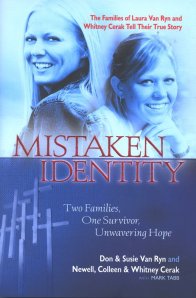
Book Review: Mistaken Identity

I had seen the book Mistaken Identity on bookshelves, but hadn’t really looked at it. I thought it was fiction, and I had read other fiction books with a mistaken identity plot line, and, though they were interesting reads, there was still an air of unreality about them. This couldn’t really happen, at least not to this extent where closest family members are mistaken.

But it can. And it did.

I caught an interview with the families on one of the evening news magazine programs, and my heart was knit to theirs as their faith shined through their tragedies. I then went out and bought the book as soon as possible.

Laura Van Ryn and Whitney Cerak were among several university students riding in a van back to school after working at a banquet when they were all involved in a horrific accident. Five people died, and Laura was taken to the hospital with several broken bones and a traumatic brain injury. Only it wasn’t Laura: it was Whitney. She was misidentified based on a nearby purse with Laura’s driver’s license in it. Though at first glance the girls look different enough to tell apart, when you look at individual features, they share an uncanny resemblance. Laura’s family had no reason to believe this girl was not Laura, and all the little inconsistencies could be explained by the accident (calling her sister by four different names, for instance, was consistent with the type of brain injury she had). Whitney’s family had chosen not to see her body; they wanted to remember her as she was.

It was not until five weeks later, when Whitney was able to communicate a little more clearly, that they realized she had been misidentified. The Ceraks were at first unbelieving but then overjoyed to find their daughter alive while the Van Ryns had to come to terms with their daughter’s death, and they all had to deal with unwelcome media attention during these events.

What touched my heart even more than their stories was the way their faith was evident at every turn. The Scriptures shared at various junctures perfectly upheld them, though of course it did not take away from the pain they experienced. Their grace in dealing each each other, the truck driver who caused the accident, and everyone along the way is evidence of God’s grace in their lives.

In Isobel Kuhn’s book, In the Arena, she quotes I Corinthians 4:9 (“For I think that God hath set forth us the apostles last, as it were appointed to death: for we are made a spectacle unto the world, and to angels, and to men”) and explains that Paul probably had in mind the Roman arena where Christians were thrown in to be devoured by wild animals. Our trials great and small can have multiple purposes, but, she says, one of them surely is to reveal God, His power, character, and grace as it is worked out in His people’s lives (not only to people, both believers and unbelievers, but to “principalities and powers in heavenly places“) . I often think of that when I hear news stories that have captivated the nation and then find out that the people involved are Christians.

One of the paragraphs that most grabbed me was a journal entry by Carly, Whitney’s sister, before she knew that Whitney was still alive:

Death is Satan’s greatest way to attack this world. Amazingly, then God takes what Satan uses to attack us and uses it to bring us together and reveal Himself the most. Through Satan’s greatest strength, God’s power still overcomes and is stronger.

I had never thought of death in that way, but it is so true that even at Satan’s strongest point, God overcame not only to resurrect those who have died but to provide immeasurable comfort to those who are left behind.

I highly recommend this book to you.

With all our feebleness

Two glad services are ours,
Both the Master loves to bless.
First we serve with all our powers —
Then with all our feebleness.

Nothing else the soul uplifts
Save to serve Him night and day,
Serve Him when He gives His gifts —
Serve Him when He takes away.

C. A. Fox

With my mother-in-law’s moving here plus my husband and I both reaching the half-century mark, I have been thinking a lot about aging and the decline of our strength and abilities. And though originally this post was just going to be about aging, I realized many of the principles also apply to those who are affected by illness or injury.

I discovered the above poem in Amy Carmichael of Dohnavur by Frank. L. Houghton preceding the last section of the book which told about Amy’s final years. After spending most of her adult life as a missionary in India, she suffered a fall which rendered her an invalid for twenty years. She remained in India. It is remarkable that these days most mission boards would send an invalid missionary home, yet Amy continued to have a ministry there.

In the early days after my TM diagnosis, though I wasn’t a complete invalid, in my “down” times I would think of the word “invalid,” meaning someone who is ill to the point of not being able to function, and change the accent to the second syllable to mean something that is not longer valid, or in other words, useless. Invalids can feel invalid. But they are not. God has a purpose for every person on the planet.

Our culture tends to glorify youth and vigor. But “God hath chosen the weak things of the world to confound the things which are mighty” (I Corinthians 1:27) and to showcase His strength (II Corinthians 12:8-10).

Elisabeth Elliot wrote in A Lamp For My Feet:

But my limitations, placing me in a different category from… anyone else’s, become, in the sovereignty of God, gifts. For it is with the equipment that I have been given that I am to glorify God. It is this job, not that one, that He gave me.

For some, the limitations are not intellectual but physical. The same truth applies. Within the context of their suffering, with whatever strength they have, be it ever so small, they are to glorify God. The apostle Paul actually claimed that he “gloried” in infirmities, because it was there that the power of Christ was made known to him.

If we regard each limitation which we are conscious of today as a gift–that is, as one of the terms of our particular service to the Master–we won’t complain or pity or excuse ourselves. We will rather offer up those gifts as a sacrifice, with thanksgiving.

I used to think, “Lord, I could serve you so much better without these problems.” But it’s as if He were saying, “No, this is what I am using to shape your service for Me.” As life changes, either through illness or aging, we need not lament what we can’t do any more. We can seek God’s will for what to do now.

As I wrote earlier, sometimes God’s purpose for our decline is that other people might learn and grow by ministering to us. This is hard to accept, because we don’t want to trouble them, we don’t want to be an inconvenience, we don’t want to need that kind of help. But graciously accepting that kind of help can be an example and a blessing to others.

My mother-in-law and I were discussing some of the…indignities of aging and wondering why the Lord allowed people to have to go through those kinds of things. Of course, our bodies are affected by the effects of the Fall of man and the entrance of sin in the world, one of those effects being decline and death. But years ago I heard one preacher say that our bodies fall apart as we age to make us willing to let loose of them. We have such a strong instinct of self-preservation, of wanting to live to see our children grow up, then our grandchildren, etc. But God can use the gradual decline of our bodies and their functions in order to wean us away from this world, to remind us that this body is just a temporary tabernacle, and to set our minds on getting ready for heaven.

Titus 2:3-5 tells us that older women are to teach the younger a multitude of things. I don’t think this always has to be in a classroom setting. It can be, in our culture, but at the time it was written there probably were not such things as seminars and retreats for women. But by their example and specific opportunities to say a word or give a testimony or share something learned along the way of life, older women can both teach and model those characteristics mentioned in Titus.

Psalm 71:16-18 says, “I will go in the strength of the Lord GOD: I will make mention of thy righteousness, even of thine only. O God, thou hast taught me from my youth: and hitherto have I declared thy wondrous works. Now also when I am old and greyheaded, O God, forsake me not; until I have shewed thy strength unto this generation, and thy power to every one that is to come.”

That’s our ultimate purpose: to show forth His strength and His power.

Psalm 78:2-8:

2 I will open my mouth in a parable: I will utter dark sayings of old:

3 Which we have heard and known, and our fathers have told us.

4 We will not hide them from their children, shewing to the generation to come the praises of the LORD, and his strength, and his wonderful works that he hath done.

5 For he established a testimony in Jacob, and appointed a law in Israel, which he commanded our fathers, that they should make them known to their children:

6 That the generation to come might know them, even the children which should be born; who should arise and declare them to their children:

7 That they might set their hope in God, and not forget the works of God, but keep his commandments:

8 And might not be as their fathers, a stubborn and rebellious generation; a generation that set not their heart aright, and whose spirit was not stedfast with God.

Tone makes a difference

Recently I came across something written by a woman for women for the purpose of helping women, the content of which was excellent, but the tone was quite harsh.

I don’t know about other people, but a harsh tone tends to put me off and make the message hard to receive even when I know it is good. What does tend to draw me in is a coming-alongside, desiring-to-help attitude.

I don’t mean that we should be namby-pamby, cowardly, and spineless, or sacrifice truth under the guise of “love.” I know some of the prophets in Scripture could seem pretty harsh in their denunciations. But some of the tenderest expressions of God’s love and care are also found in those messages from the prophets. “The LORD hath appeared of old unto me, saying, Yea, I have loved thee with an everlasting love: therefore with lovingkindness have I drawn thee” (Jeremiah 31:3) and “Is Ephraim my dear son? is he a pleasant child? for since I spake against him, I do earnestly remember him still: therefore my bowels are troubled for him; I will surely have mercy upon him, saith the LORD” (Jeremiah 31:20) are just a couple.

I know in my own life, before salvation, realizing that I deserved hell all made me see my need. And though perhaps it was the fear of hell that drove me to seek deliverance, it was the grace and love of God that drew me to Him. Since then, holding up the standard of God’s Word and the realization that I have missed the mark and that I need to get something right with Him convicts me, but the knowledge that “we have not an high priest which cannot be touched with the feeling of our infirmities” and the invitation to therefore come boldly unto the throne of grace, that we may obtain mercy, and find grace to help in time of need” (Hebrews 15:16) draws me.

One of my children in particular who seemed most to “need,” by his actions, scolding and reprimand, would just close up and withdraw when I “let him have it” verbally. It not only didn’t change his behavior, it put a wall between us. I had to learn to balance dealing with the issue and showing love, care and concern. Other times a harsh scolding produces a defensive reaction.

I also had to learn that exasperation (which can often lead to that kind of harsh attitude) is often a fleshly response: I’m irritated that this is still going on, that I have to deal with it again, that the child doesn’t “know better” and hasn’t “gotten” it by now. How unlike God, whose mercies are new every morning (Lamentations 3:22-23). How unlike the “wisdom that is from above” which “is first pure, then peaceable, gentle, and easy to be intreated, full of mercy and good fruits, without partiality, and without hypocrisy” (James 3:17).

We need to be careful, too, in any kind of mentoring situation that we don’t approach it with an eye-rolling, exasperated, “Young people these days!” kind of attitude. That is sure to turn others off to any good we might want to do them. And we need to remember the purpose: when we have to deal with an issue, whether with a child, an employee, a committee member, or the general public in a book, blog, or talk, the purpose for dealing with the issue is not just to “get it off our chests.” That’s one sure way to come across as “scolding.” The purpose is to get them to see the importance of the issue and to change, not for our personal satisfaction, but for the stake of the truth we’re presenting.

Once I was listening to a sermon on the radio from a local pastor. I knew of him, I had read his books, I agreed with what he was preaching…yet at the end of it, something bothered me, and I couldn’t figure out what at first. Then I realized his main message, hammered over and over, was, “You need to get right.” Nothing wrong with that message: we do. But my own pastor at the time, whose ministry I was under for over fourteen years, would have said, “We need to get right” and then “There’s hope: here’s how to get right.” Though my pastor was one of the godliest men I have ever known, he, like Daniel (Daniel 9:1-19) and Ezra (Ezra 9), though they had not participated in Israel’s sin, yet they took their place with Israel and confessed the sins of the nation as though they were their own. I think that attitude of a fellow sinner helping sinners will help our message come across more compassionately.

We’ve all been under different kinds of authority figure in our lives and know what is it to have an infraction dealt with in such a way that we’re left hurt, deflated, discouraged, or angry, or, on the other hand, inspired to want to do right and to make restoration.

Of course, we’re responsible for the truth we hear no matter what tone or form it comes in. When we stand before God to give account of our lives, the excuse that we didn’t like how so-and-so delivered the message won’t hold up as a reason for not obeying it. If we are on the receiving end of a message with a harsh or scolding attitude, we still need to hear and apply and respond to the truth in the way the Lord would have for us to. But when we are sharing truth in any venue, let us remember to “Walk in wisdom toward them that are without, redeeming the time. Let your speech be always with grace, seasoned with salt, that ye may know how ye ought to answer every man” (Colossians 4:5). The salt — the truth — is needed, but don’t forget the wisdom and the grace.