Books Shape Our Thinking

A couple of times in our lives, my husband and I attended churches where we didn’t quite agree with everything, but we felt these churches were the closest we could find to our own understanding of Scripture. The differences weren’t a matter of false teaching or heresy: they were areas where good people could differ and should be able to give each other grace. We felt as long as the Bible was preached and taught rather than a particular system, then everything would be okay.

In one church, over time, we began to notice that everyone from the pastor to Sunday School teachers to lay leaders began quoting the same authors. Then their vocabulary began changing to match the authors they revered. Concepts that used to be alluded to were now main points. Sermons and lessons changed emphasis to feature points from these authors, and Bible passages were viewed through their lens. When one man spoke about this belief system as being “in the club,” it almost seemed a little cultish.

In another church, the issue wasn’t a particular belief system. But every Christian bestseller that came along was eventually taught in our church. When we moved, I found sermon notes from our first year there which were rich and meaty and directly from the Bible. Later sermons were second- or third-hand thoughts from popular books.

One of my favorite writers reads and quotes authors that I am uncomfortable with because their view of Scriptural truth seems a little skewed to me. Instead of following standard hermeneutics, principles for interpreting Scripture, they twist things a little to get a different outcome more in line with popular culture. They are not quite heretical yet, but this subtle shift will lead that way if continued. This lovely author, with so much talent and potential, is getting more entrenched in this kind of thinking every year. It grieves me to see it.

We’ve seen a couple of young men we’ve known get caught up in belief systems that, again, I don’t think are heretical, but I don’t agree with. It wouldn’t be a problem except that these belief systems now dominate their conversation and online presence. They like to bait and argue over their points of belief. Even though they are not being heretical, their ministry and outreach has been hijacked into debating rather than gently persuading people of God’s truth.

We observed over the course of years a definite shift in thinking and beliefs in each of these cases. The speaker or writer didn’t come to their new views from their Bible reading, but from the books they read. Those books then colored their view of Scripture.

One of our former pastors used to frequently quote Charlie “Tremendous” Jones as saying, “You will be the same person in five years as you are today except for the people you meet and the books you read.

If that’s true, and I think it may be, we need to be watchful about what we read. Of course, these days many people read online articles and listen to podcasts as well.

Does this mean we should only read books where we know we’ll agree with everything? Not necessarily. It’s good to exercise discernment. Sometimes when we are entrenched in our own tenets and lingo, we can get a little myopic.

But we should filter everything we read through the Scriptures. The Bible tells us to “test everything; hold fast what is good” (1 Thessalonians 5:21). Early Christians were called noble because they checked everything even the apostle Paul said against the Scriptures.

We need to be careful not to swallow everything an author says just because they use Scripture or religious talk. The devil does that. “Satan disguises himself as an angel of light. So it is no surprise if his servants, also, disguise themselves as servants of righteousness. Their end will correspond to their deeds” (2 Corinthians 11:14-15). With Eve, Satan questioned what God said and then skewed His meaning. He quoted and misapplied Scripture when tempting Jesus. Peter said of Paul’s writing:

There are some things in them that are hard to understand, which the ignorant and unstable twist to their own destruction, as they do the other Scriptures. You therefore, beloved, knowing this beforehand, take care that you are not carried away with the error of lawless people and lose your own stability. But grow in the grace and knowledge of our Lord and Savior Jesus Christ.(2 Peter 3:16-18).

Some writers don’t go that far–they are not exactly heretical. But a subtle shift in emphasis can skew their teaching, and therefore our thinking. Then a particular facet of their understanding becomes a hobbyhorse. So we need to be discerning not just with writing we might be prepared to be on guard with, but also with popular writing.

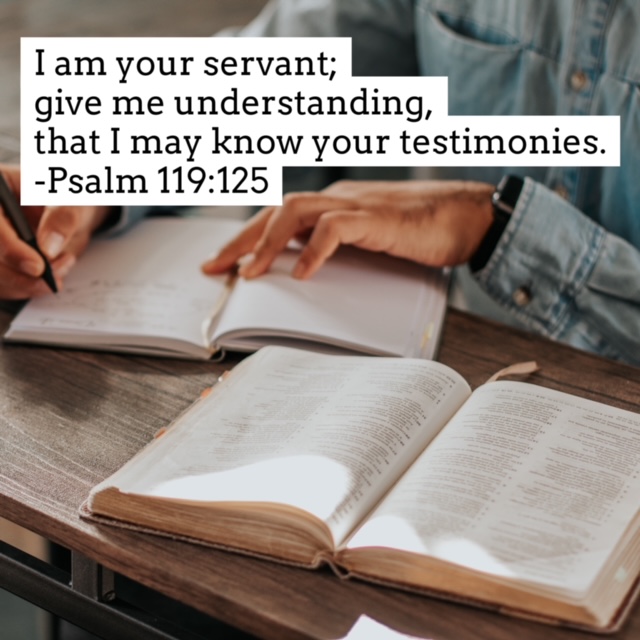
We need to make sure we are spending more time with the Bible itself than even books about the Bible. If we’re spending thirty minutes a day in a theological book and ten minutes in the Bible, we’re off balance. One former pastor used to say that bank tellers were instructed in discerning counterfeit money not by studying counterfeits, but by studying the real thing. The more familiar they were with legal money, the more easily they could tell when something was a little off with money they were handling. “Do your best to present yourself to God as one approved, a worker who has no need to be ashamed, rightly handling the word of truth” (2 Timothy 2:15). As we read and study, we need to pray with the psalmist, “I am your servant; give me understanding, that I may know your testimonies!” (Psalm 119:125). Then our “powers of discernment” will be “trained by constant practice to distinguish good from evil” (Hebrews 5:14).

We need to ask God to search our hearts, show us our blind spots, and “Open my eyes, that I may behold wondrous things out of your law” (Psalm 119:18).

I love good books. I’ve had my thinking shaped in good ways by authors who faithfully studied and represented God’s truth shared in His Word. I especially love writers and teachers who, like the Levites in Nehemiah’s time, “read from the book, from the Law of God, clearly, and they gave the sense, so that the people understood the reading” (Nehemiah 8:8).

But we need discernment to know when a teacher is giving the sense of the Word itself or twisting it a bit for their own purposes or from their own mistaken understanding.

And we need to be careful that our thoughts, understanding, and resulting actions are shaped by the Bible itself.
(I often link up with some of these bloggers.)


When God Changes Your Plans

Probably many of you have set plans or goals for the new year. I don’t usually have time to think about it much until the rest of the family’s first work day after Christmas. Then, when I have some quiet moments to myself, I can sort through what I’d like to do in the year ahead.

I don’t make resolutions. I used to be against them as a set-up for failure until I did a study on the “I will” statement in the Bible. Then I saw anew 2 Thessalonians 1:11-12 where Paul prays that God “may fulfill every resolve for good.” So it’s not wrong–and in fact, it’s much needed—to resolve by God’s grace and prayer to make changes. We’re not going to float into godly living. We can’t do it on our own, but we need to “think on [our] ways” and then “turn [our] feet to your testimonies” (Psalm 119:59).

Still, though a new year is a good time to take stock, I am more likely to make those kinds of changes as I see the need for them rather than on Jan. 1.

But I do like to make plans for the year. Sometimes the tasks are mundane: reorganize the pantry or closet; complete the dress I started last year (or the year before. . . ), etc. Sometimes the listed items are more involved and will take a major shift, like the changes that will need to take place if I am ever going to finish this book I am trying to write.

I know better than to make plans first and then ask God to bless them. I try to remember to pray, asking God’s guidance as I make plans. I take into account James’ admonition:

Come now, you who say, “Today or tomorrow we will go into such and such a town and spend a year there and trade and make a profit”— yet you do not know what tomorrow will bring. What is your life? For you are a mist that appears for a little time and then vanishes. Instead you ought to say, “If the Lord wills, we will live and do this or that.” (James 4:13-15).

When I pray and plan that way, I feel that any interruption or change of plans is a signal that something’s wrong. Did I sin? Did I miss God’s guidance? Is Satan trying to trip me up? Is someone else sinning against me? I prayed asking for God to guide me, so these plans must be His will.

But sometimes the change is part of the plan. I don’t know why God seems to lead people one way and then changes courses. Maybe to increase their trust and dependence, maybe because there was something they were to learn or do along the way. Sometimes interruptions are the ministry, not a hindrance to ministry.

Whatever the case, I am coming to learn that God’s highest blessing may not be having my plans and dreams turn out like I want.

Coming through this last Christmas season, I was struck once again by Mary’s willingness to have her plans totally overturned when the angel announced that she was chosen to mother the Messiah.

We don’t know what Mary’s plans for life were except that she was betrothed to Joseph, a carpenter. He seemed to be a quiet, godly man of character. They would not be well off, but I am sure Mary planned a cozy domestic life with a good man and a house full of children.

She did receive those things, but with a major twist. Her firstborn child would come before she knew a man physically, and that child would not end up leading a quiet, obscure life once He came to adulthood.

We don’t know if Mary realized everything that bearing and carrying Christ would mean: the gossip, the possibility that she would lose Joseph, the sorrow to come at Jesus’ death. But she was willing to do whatever God wanted her to do.

I think of Moses, who had thought he was supposed to help his fellow Israelites in Egypt. But that hadn’t worked out so well. Now he was resigned to keeping his father-in-law’s flock in Midian. Then suddenly God speaks to him from a burning bush. Yes, God planned for him to aid Israel, but He had a much bigger plan than Moses had imagined.

Numerous people in Scripture were stopped in their tracks to change course at God’s direction: Abraham and Sarah were sent from Ur to a land of God’s promise; David was called from tending sheep to being anointed king; Zechariah and Elizabeth found out they’d be having a baby at an advanced age; all the disciples were called from their occupations to follow Christ.

We knew a young couple on deputation to be missionaries when one of their children developed leukemia. One of our former pastors was in seminary when he was in a car accident that left him a quadriplegic.

I think Elisabeth Elliot probably assumed she would be on a foreign mission field all her life. And when Joni Earcekson Tada went diving one day as a teenager, she had no idea how her life was about to change. But where would we be without the testimonies of these two dear ladies that came about as a result of their changed plans?

Sometimes it’s hard to know when an obstacle to our plans is from God or Satan. Isobel Kuhn‘s mother was violently opposed to Isobel’s going to Bible college. Isobel received wise advice from a mentor about how to pray and wait for God to open the way. He taught her to pray something like, “Lord, if this obstacle is from you, I accept it. If it is from Satan, I refuse him and all his works.” This stood her in good stead in later years when she and her husband were on furlough, ready to go back to China, and they received word that the way was closed. The other missionaries were ready to acquiesce and take it as the Lord’s will, but Isobel felt strongly that God wanted them to go. She didn’t argue, but she went quietly into another room and prayed—and soon they received the okay to go.

So it’s good to pray and wait when a situation isn’t clear. But when a change in plans is obviously from God, we need to accept it. I’m afraid I am more like Moses, arguing with God, or reluctant like Gideon, or, sadly, sometimes even resistant like Jonah, whether changes are minor or life-altering. Oh, for grace to be like the disciples who dropped their fishing nets or left their tax desk immediately when the Savior called, or like Mary, who readily yielded herself to God’s will.

Often it seems that when God changes our plans, the end result is a greater usefulness and greater display of His power and glory than we had imagined. And that’s what it’s all about, isn’t it?

(I often link up with some of these bloggers.)

Why Does God Make Us Wait?

When our children were little, my husband and I learned that it wasn’t always a good idea to tell them about an upcoming event until it was nearly time for it.

If the event was a happy one, we’d get dozens of questions a day. How many days? What will we do? Can’t we do it sooner?

If the event was not one they were looking forward to, we’d get questions as well. Do we have to? Can’t we put it off?

With that in mind, I wondered why God promised Abraham a son without telling him the promise would be so long coming to fruition. Or why He had David anointed king so long before David came to the throne. Or why He told Adam and Eve about a coming Redeemer without letting them know He wasn’t coming for a few millennia. Or why we have no idea when His promised return will occur.

Doesn’t God know how torturous it is for us to wait? Besides the big-picture waiting, we often have to wait for a mate, financial provision, test results at the doctor’s office, and so one. How do we navigate waiting on a large or small scale?

I think first of all, God wants to grow our faith by our waiting. He doesn’t delight in torturing us. “He knows our frame; he remembers that we are dust” (Psalm 103:14). But we need to trust in His timing. He sent the promised Messiah “in the fullness of time.” Hundreds of threads came together to form the perfect time and setting for Jesus to be born. We don’t always know the details behind a wait, but we can trust God has good reason for it. One reason for the wait for Jesus to return is found in 2 Peter 3:9: “The Lord is not slow to fulfill his promise as some count slowness, but is patient toward you, not wishing that any should perish, but that all should reach repentance.”

I think God also wants to grow our patience. As a parent, I can’t hide all coming events from my children until I am ready for them to know. Waiting for Christmas or a birthday or a special occasion can stretch a child’s limits, but they need to be stretched. They need to learn delayed gratification and patience in waiting. So do we.

I think God also wants to teach us to live in light of His promise. When we know someone is coming or something is going to happen, we plan for it and around it. For example, Abraham’s expectation of Isaac shaped his decisions. Abraham sometimes made wrong decisions, trying to manipulate circumstances to accomplish God’s will instead of waiting for God’s timing. Mary and Joseph’s lives were changed forever by the news that Mary would bear Jesus. 2 Peter 3:11 says, “Since all these things are thus to be dissolved, what sort of people ought you to be in lives of holiness and godliness.”

God also wants us to wait in readiness. When I was old enough to babysit my siblings, my parents would give us an expectation of when they’d return. If they planned to be home by 5, guess when we’d start getting the house picked up and in order? Around 4:45. If we knew exactly when Jesus was going to return, imagine how many people would live for self all their lives and “get right” just before He came. Jesus told His disciples to “be like men who are waiting for their master to come home from the wedding feast, so that they may open the door to him at once when he comes and knocks” (Luke 12:36). Jesus promised, “Blessed is that servant whom his master will find so doing when he comes” (verse 43). But the servant who lived self-indulgently and mistreated others would be severely punished (verses 45-48). Peter tells us. “The end of all things is at hand; therefore be self-controlled and sober-minded for the sake of your prayers” (1 Peter 4:7).

God also wants to give us hope. 1 Thessalonians 4:13-18 tells us to encourage (some translations say comfort) each other with the hope that He will someday come for us. That hope isn’t a flimsy wish, but a confident expectation. When we get discouraged with our world, it helps to know this isn’t all there is.

Waiting also creates anticipation. Half the fun of Christmas is getting ready for it. Graduation, wedding days, having children all come with years of excited anticipation before them. There is an almost delicious joy when something you’re waiting for finally comes to fruition, a joy that wouldn’t have been quite the same without the wait. And when the wait is for something less joyful, the time can be used in preparation as well. Before I had surgery a few years ago, I read a book about fear and anxiety in the days leading up to it. Though the time was difficult and challenging, it increased my faith and dependence on God.

God knows just what to tell us about upcoming events, good or bad. As one old song says:

If we could see, if we could know, we often say,
But God in love a veil doth throw
Across our way;
We cannot see what lies before,
And so we cling to Him the more,
He leads us till this life is o’er;
Trust and obey.

That first Christmas, “the hopes and fears of all the years are met in Thee tonight (“O Little Town of Bethlehem” by Phillips Brooks). Finally, the “fullness of time” came at just the right moment. Now we wait for His second return, and Peter tells us. “Therefore, beloved, since you are waiting for these, be diligent to be found by him without spot or blemish, and at peace. And count the patience of our Lord as salvation” (2 Peter 3:14-15a).

How does God want us to wait? Not like Abraham, manipulating circumstances. Not like those who forgot or denied His promise or did their own thing. But like Anna and Simeon, in hope, expectation, anticipation, relying on His promises, busy about His business.

The Lord is good to those who wait for him, to the soul who seeks him (Lamentations 3:25).

I wait for the Lord, my soul waits, and in his word I hope (Psalm 130:5).

(I often link up with some of these bloggers.)

Is Love More Important than Doctrine??

Some would say so. The reasoning goes that the Bible says God is Love. It doesn’t say God is doctrine. Therefore, love trumps doctrine.

Part of the confusion or disagreement comes from what is meant by doctrine. I’m using the word here as the truth God declares about Himself and His requirements for us.

And the Bible also says God is truth.

Jesus said, “I am the way, and the truth, and the life. No one comes to the Father except through me” (John 14:6).

The Holy Spirit is “the Spirit of truth” (John 14:17; 15:26; 16:13).

Some translations of Deuteronomy 32:4 say God is “a God of truth and without iniquity, just and right is he.”

Not only is God truth, but His Word is characterized as truth.

The psalmist declared, “The sum of your word is truth, and every one of your righteous rules endures forever” (Psalm 119:160).

Jesus prayed, “Sanctify them in the truth; your word is truth” (John 17:17).

God wants us to respond to Him in truth.

Jesus said, “God is spirit, and those who worship him must worship in spirit and truth” (John 4:24).

“The LORD is near to all who call on him, to all who call on him in truth” (Psalm 145:18).

Most of the books of the Bible warn against false doctrine, false prophets, and false teachers in the strongest terms. It’s not loving to cut corners on truth for the sake of not sounding adamant. It’s not loving to God or to others to teach something untrue about Him or about how He wants us to live.

But it’s also not loving to bludgeon people with truth like a club.

And it’s wrong to elevate every little disagreement to the same level as doctrine. There are areas where we can’t give any ground: the deity and humanity of Christ, our need for salvation, Christ’s death on the cross for our sins, salvation by grace through faith, the resurrection, the Bible as God’s Word, and so on. But there are areas in Scripture where good people can disagree and should give each other grace. Too many Christians spend way too much time and effort on these issues than on declaring unequivocal truth and loving each other and the lost.

We don’t need to put love and doctrine in competition with each other. We need them both. Both are aspects of God, and both should permeate our lives.

(I often link up with some of these bloggers.)

Celebrating His Coming by Neglecting His Presence

Several years ago, a couple from our church invited us to their home for dinner.

I had long admired the wife. She was one of those people about whom I wondered, “How does she do all she does?” She had the same number of children I did, close to the same ages. She was active in several church ministries. She sewed for herself, her daughter, her home, and for other people. Her home was not only clean every time I saw it, it was nicely decorated.

Meanwhile, I felt I was barely keeping my head above water as a wife and mother. I concluded that God gave people different capacities. Maybe she was a ten-talent person, while I . . . was not.

As we enjoyed our visit at this couple’s home, the wife often popped up to go check on or do something. I understood that. As a hostess, you have to check on the kids or the potatoes or whatever. But her forays away from us seemed excessive. I wondered if we caught them at a busy time, and if so, why they didn’t reschedule. I mused that maybe she was the type of person who couldn’t sit still for very long, and maybe that’s how she got so much done.

I am not so needy a guest that I want 100 per cent of the hostess’s time and attention. But I confess to feeling just a little neglected.

As a child, I often saw a plaque in peoples’ houses which contained words about Jesus being the unseen guest of the home. Some time after I became a Christian, I understood that when we accept Jesus as our Lord and Savior, He is not just an occasional guest. He is with us all the time. He is Lord. It’s His house.

Through our church’s Bible reading program the last few years, I’ve particularly noted God’s desire and effort to be with His people. First, He walked with Adam and Eve in the garden. When they sinned, they broke fellowship with Him. When He delivered Israel from Egypt, He instructed them to build a tabernacle. Later, after they settled in the promised land and David was king, he wanted to build a temple. Both tabernacle and temple had a heavy curtain between the holy place and the most holy place. No one could just barge in there. Only the high priest could enter once a year with a sacrifice for the people’s sins. When Jesus died on the cross, that curtain was torn in two, signifying that the ultimate sacrifice had been made and the way was now open to God. His kingdom was within those who believed on Him. Someday, when He comes again, we’ll dwell with Him as we never have before.

God desires our fellowship, to the point of sacrificing what was dearest to Himself. This season of the year, we run amok doing so many sweet and lovely things fraught with nostalgia, ostensibly for the sake of remembering the birth of His Son. Yet, in a sense we leave Him sitting at the table, neglected. It’s not that He needs us. He loves and and desires our fellowship. And we need Him.

Yes, He is with us all the time. With even our closest human relationships, much of our time and conversation together occurs while doing something else: shopping, cooking, working in the yard, etc. But even in those relationships, we sense a need to sometimes just stop, lay everything else aside, focus on and listen to each other.

How much more should we spend that focused time with our Lord? Yes, we can talk with Him all through the day, thanking Him for a good parking place or a good sale or a beautiful sunset, telling Him the concerns on our hearts, singing along with the hymns on our playlist. But sometimes we just need to sit with Him, spend time in His Word, listening, learning, worshiping. loving.

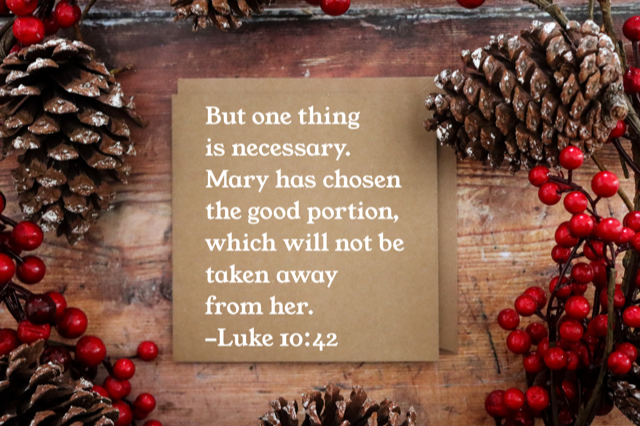
We are prone to celebrate the fact that He came by neglecting Him now that He is here. We need wisdom in the use of our time, simplifying, maybe laying some things aside. But most of all we need to remember who and what we’re actually celebrating. Let’s not neglect His presence. Like Mary, let’s choose the good portion, sitting at His feet and listening.

(I often link up with some of these bloggers.)
Your Soul Needs Food Even When It Doesn’t Want It

Your Soul needs food even when it doesn't want it

You’re sick. Your sinuses are inflamed, your throat is raw, your nose is red, drippy, and chafing. You have a fever and ache all over. And you don’t feel like eating.

But you do eat. Nothing sounds good (except maybe the proverbial remedy for a cold, chicken soup). But you eat because your body needs it. And the very food you don’t have an appetite for not only nourishes you, but helps your body fight infection and get well.

The same is true spiritually. When something is wrong in our lives—someone has hurt us, we’ve given way to some sin, we don’t feel we fit in at church, maybe we’re even a little malnourished from lack of time at church or in the Bible—we tend to put God’s Word aside. Our appetite for it has waned.

But we need the Bible now more than ever. We may not be able to keep up with our usual routine or an intense study. But we need to keep sipping and tasting. We might spend more time in the Psalms or the gospels than some of the other books. We might listen instead of read.

And the very Word we don’t have an appetite for not only nourishes us, but helps us heal. It will strengthen us and help us fight spiritual infection.

So when your appetite for the Word of God is off, keep partaking. Your soul needs it. You may not feel instant refreshment. It may seem a little dry. But ask God to open “the eyes of your heart” and minister to you.

Often a subdued appetite can be aroused by tasting food. It didn’t sound good, but once we had a few bites, we wanted more. We may feel like reading the Bible is the last thing we want to do. But it’s been my experience, many times over, that once I start reading it, I want more.

Incline my heart to your testimonies, and not to selfish gain! Turn my eyes from looking at worthless things; and give me life in your ways (Psalm 119:36-37).

They loathed any kind of food,
    and they drew near to the gates of death.
Then they cried to the Lord in their trouble,
    and he delivered them from their distress.
He sent out his word and healed them,
    and delivered them from their destruction.
Let them thank the Lord for his steadfast love,
    for his wondrous works to the children of man!
And let them offer sacrifices of thanksgiving,
    and tell of his deeds in songs of joy!

(Psalm 107:18-22)

Jeremiah 15:16 Partaking of God's Word

(I often link up with some of these bloggers.)

A Perfectly Ordinary Thanksgiving

I was working through a couple of blog post ideas, trying to decide which to use. Then I remembered this was Thanksgiving week.

“Hmm,” I thought. “I should probably say something about Thanksgiving.”

But what could I say that I hadn’t already said? What new angle or twist could I come up with?

Then I thought—does Thanksgiving really need an angle? Can’t we just—be thankful?

But what if we’re not feeling so thankful?

Well, thanksgiving isn’t a feeling. It’s an action, an act of the will. And once we start giving thanks, it’s not long before we feel thankful.

If you’re not feeling so grateful this week, maybe you could read some psalms, like 100 or 103 or 107 or 145.

Or you could sing or read some hymns, like “Great Is Thy Faithfulness” or “Come Thou Fount of Every Blessing.”

Or you could recount your Ebenezers, those times in your life you especially saw God’s hand at work.

Or you could make a list of simple blessings: a beautiful sunset, a warm home, friends and family, food to eat, and so on.

Though we should be thankful every day, Thanksgiving is a good reminder that we do have a lot to be thankful for. I’ve found that once I get started looking for things to be thankful for, it’s hard to stop.

It’s fine to create a Thanksgiving feast (we will) or try some new ideas to spur thankfulness (we have) or set out Pinterest-worthy decorations or or try some Thanksgiving-ish crafts (done those, too).

It’s also fine to eat out or use paper plates or grill hamburgers or make sandwiches.

But simply giving thanks to the Giver of all good things often gets lost in the shuffle of everything else. Whatever else we do, may giving thanks to Him be our main focus.

Here’s both a hymn and a thankful list! It’s beautifully sung by the Sacred Music Services‘ men’s chorus.

I wish all of you a wonderful Thanksgiving Day, someone to share it with, something good to eat, some time to rest, and some time to “give thanks to the Lord, for he is good, for his steadfast love endures forever!” (Psalm 107:1).

(I often link up with some of these bloggers.)
Don’t Reject God Because of His People

There are a number of reasons people walk away from Christianity, or at least from church. Some have faced disdain or hurt from those who were supposed to model and minister Christ to them. Some groups or ministry leaders were found to have shocking hidden pasts or current sins. Some movements displayed racist thought in their pasts.

Sometimes leaving a particular group or church or dissociating from an individual is the right thing to do.

But we shouldn’t reject the whole body of God’s truth because some of His people, or those who professed to be His people, fell so far from His ideal. They’re accountable for their sins and failures, but what they do doesn’t void the truth they taught. We’re accountable for the truth we’ve heard despite the vessels it sometimes came through.

Someone once said if you look for the fatal flaw, you’ll find it. And you don’t have to look very far in some cases. That’s because we all have one—or more than one. Some seem worse, or more obvious, than others.

When you look through the Bible, you find people who loved and followed God, yet they failed in spectacular ways. Though we grieve over their falls, we don’t dismiss the truth they taught. We don’t throw out Proverbs because Solomon failed to keep his own admonitions. We lament David’s sins, but we don’t reject the psalms because of them. The disciples fought over who was greatest and fled when Jesus was arrested. Yet God transformed and used each of them in mighty ways.

Instead of throwing out “the baby with the bath water,” we can learn from the failures of others.

We’re all at risk of falling. Proverbs 16:18 warns that “Pride goes before destruction, and a haughty spirit before a fall.” 1 Corinthians 10:12 says, “Therefore let anyone who thinks that he stands take heed lest he fall.” Verse 13 goes on to say that we’re not tempted beyond our ability, but God will provide a way of escape. But we need to look to Him: we can’t take pride that we would never do certain things.

Most have or will experience failure of others. Joseph’s own brothers wanted to kill him and sold him into slavery. Abigail’s husband, who should have been her leader and protector, nearly caused their household to be attacked by the king. Saul, who should have been David’s mentor, instead was jealous and tried to kill David. At some point, we will fail others and they will fail us.

Learn from people who failed what not to do, what precautions could have been taken, etc.

For all the bad ones, there are many good ones. When I worked with the general public, the rude and obnoxious customers and comments hurt and stayed with me a long time. Yet there were many more kind and thoughtful customers than bad ones. Though none is perfect, there are many within Christendom who love God and others well. Don’t let the bad ones obscure the good ones.

Compare what we see and hear with Scripture. Those noble Bereans “received the word with all eagerness, examining the Scriptures daily to see if these things were so” (Acts 17:11). They took what they were told even of Paul and Silas and checked it against Scripture.

Others’ failures don’t nullify truth. In Romans 3:, Paul writes, “What if some were unfaithful? Does their faithlessness nullify the faithfulness of God? By no means! Let God be true though every one were a liar” (Romans 3:3-4). Does that mean faithfulness doesn’t matter, or people get away with being unfaithful? No. God will deal with them. But their unfaithfulness doesn’t make God unfaithful or disprove His truth.

Hold fast. Hebrews 10:23 says, “Let us hold fast the confession of our hope without wavering, for he who promised is faithful.” Then verse 35-36 says, “Do not throw away your confidence, which has a great reward. For you have need of endurance, so that when you have done the will of God you may receive what is promised.”

Stir up others to love and good works. “Let us hold fast the confession of our hope without wavering, for he who promised is faithful. And let us consider how to stir up one another to love and good works,” which, interestingly, takes place in the context of church: “not neglecting to meet together, as is the habit of some, but encouraging one another, and all the more as you see the Day drawing near” (Hebrews 10:23-25). Perhaps some would have been prevented from a fall by a loving friend’s kind rebuke.

Forgive. Most have found that when they refuse to forgive others, the one they end up hurting the most is themselves. Unforgiveness can lead to bitterness and unanswered prayer or keep us from being forgiven. Jesus said, “For if you forgive others their trespasses, your heavenly Father will also forgive you, but if you do not forgive others their trespasses, neither will your Father forgive your trespasses” (Matthew 6:14-15). He taught that we’ve been forgiven so much, we should not withhold forgiveness for lesser sins than the ones we’ve committed against Him (Matthew 18:21-35).

Overcome evil with good” (Romans 12:21). This sentence comes at the end of a section about loving enemies and not avenging ourselves, but leaving vengeance to God. That’s not to say we don’t report or deal with wrong-doing. Sometimes we need to allow consequences to catch up to someone for their own good and for protection of ourselves and others. But we don’t seek to “get them back.” Instead, we go the extra mile and do them good.

Jesus knows what we’re going through. No one has been failed by others as much as Jesus. His family didn’t understand Him. His disciples missed the point of His teaching much of the time. They fled when He was arrested. The people He came to save rejected Him. But He didn’t walk away from them. He loved even when they didn’t love Him. He patiently kept working with them. “Since then we have a great high priest who has passed through the heavens, Jesus, the Son of God, let us hold fast our confession. For we do not have a high priest who is unable to sympathize with our weaknesses, but one who in every respect has been tempted as we are, yet without sin” (Hebrews 4:14-15).

Keep our eyes on Christ. Others will fail us, even those who mean well. “Let us run with endurance the race that is set before us, looking to Jesus, the founder and perfecter of our faith,” (Hebrews 12:2b-3a).

In Psalm 55, David tells of his fear, trembling, horror, and anguish due to the oppression of an enemy. Then he reveals in verses 12-14:

For it is not an enemy who taunts me—    then I could bear it;
it is not an adversary who deals insolently with me—    then I could hide from him.
But it is you, a man, my equal, my companion, my familiar friend.
We used to take sweet counsel together; within God’s house we walked in the throng.

Instead of letting a friend’s betrayal drive him away from the God he professed, David let the situation drive him to God.

But I call to God, and the Lord will save me.
Evening and morning and at noon I utter my complaint and moan, and he hears my voice. He redeems my soul in safety  from the battle that I wage (verses 16-18).

Cast your burden on the Lord, and he will sustain you;
he will never permit the righteous to be moved (verse 22).

When others fail you, betray you, ignore you, or hurt you, they are accountable to God. But don’t walk away from Him because of them. Run to His arms and let Him heal, soothe, encourage, and strengthen you.

“The Lord builds up Jerusalem; he gathers the outcasts of Israel.
He heals the brokenhearted and binds up their wounds.”
(Psalm 147:2-3)

Man may trouble and distress me;
Twill but drive me to Thy breast.
Life with trials hard may press me.
Heaven will bring me sweeter rest.
Oh, tis not in grief to harm me
While Thy love is left to me.
Oh, twere not in joy to charm me
Were that joy unmixed with Thee.

Henry Francis Lyte, “Jesus, I My Cross Have Taken”

(I often link up with some of these bloggers.)

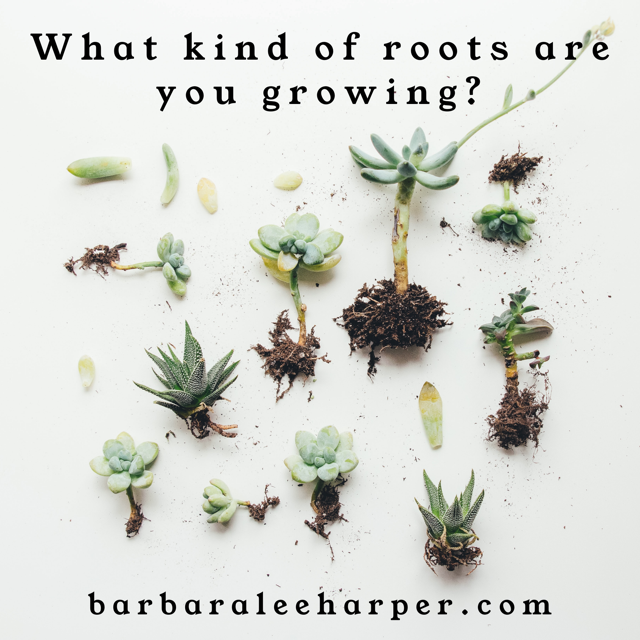
What Kind of Roots Are You Growing?

I am guilty of negligent planticide. Multiple counts of it.

Houseplants rarely survive my care . . . or lack thereof. I forget to seek out their specific needs. I just stick them in front of a window and water them . . . when they look a little droopy. Turns out, that’s not healthy for them. And not all of them require full sunlight. And fertilizer? You mean there’s not one generic plant food for them all?

My hanging baskets outside fare better since my dear husband has taken it upon himself to keep them watered.

But plants in the ground or big planters do best for me. At least they get dew every morning and enough rain to keep going, and they have enough room for a deep root system.

Occasionally, though, I’ll do battle with a plant that not only survives my neglect, but actively thrives despite my attempts to get rid of it.

Once I had what I thought was a pretty kind of ivy. I think it may have come in a mixed basket of some kind. I planted a few strands along the front edge of of two outdoor planters so they would spill out over the front, making a pretty foreground to the begonias and petunias behind it.

The only problem was, the ivy took over. It stretched over the other plants until eventually it was the only thing growing in the planter. It took all the nutrients so there was none left for anything else. Despite my frequent trimming, the ivy grew so fast that it began to attach itself to the ground around the planters. I pulled up several cords of ivy vines, but in a few days there would be new shoots. I thought we’d never get rid of it.

When a book I read recently mentioned a root of bitterness, some of a root’s imagery came to mind. The phrase comes from Hebrews 12:15: “See to it that no one fails to obtain the grace of God; that no ‘root of bitterness’ springs up and causes trouble, and by it many become defiled.” Deuteronomy 28:18b warns: “Beware lest there be among you a root bearing poisonous and bitter fruit.”

Despite my botanical ignorance, I know a few things about how roots function.

Roots need room to grow. We planted two crepe myrtle trees at the same time in different parts of the yard. One did well and is now as tall as the house. The other is only about three feet tall. The latter is in a small area between the sidewalk and house, where there must not be enough room for it to spread its roots out.

Roots anchor the plant to the ground. Plants could easily blow over or be dug up without a sufficient root system. Somehow weeds seem to have the strongest or deepest roots, making it difficult to eradicate them completely. Some taproots can grow 200 feet downward according to this article.

Roots take nutrients and water from the soil and feed the plant. Some roots even store food for later use.

Roots help some plants reproduce in other areas. And weeds return unless you dig them up or kill them at their roots.

A root of bitterness will act the same way as a persistent plant’s root system. If we’re not careful, that kind of root will anchor itself in our souls. We can’t easily brush it away or dig it out. It will spread so it takes over our thinking. It will leach nutrients away from other areas of life, so we fail to grow spiritually while the bitterness increases. Eventually we plant bitterness in others as we spread our discontent.

I need to frequently examine my heart. Even when I am not aware of any deep roots of bitterness, I often find seedlings of grudges, resentment, or irritation. I need to avoid giving these roots room to grow. If I don’t dig these up right away, they can send their roots deep and cause bitterness.

Instead I want to be “rooted and built up in him and established in the faith, just as you were taught, abounding in thanksgiving” (Colossians 2:7).

I want to be like the blessed “man who trusts in the Lord, whose trust is the Lord. He is like a tree planted by water, that sends out its roots by the stream, and does not fear when heat comes, for its leaves remain green, and is not anxious in the year of drought, for it does not cease to bear fruit” (Jeremiah 17:7-8).

I pray “ that according to the riches of his glory he may grant you to be strengthened with power through his Spirit in your inner being, so that Christ may dwell in your hearts through faith—that you, being rooted and grounded in love, may have strength to comprehend with all the saints what is the breadth and length and height and depth, and to know the love of Christ that surpasses knowledge, that you may be filled with all the fullness of God” (Ephesians 3:16-19).

I want to be anchored in Jesus, the “root of Jesse” (Romans 15:12-13), the “root of David” (Revelation 5:4-6), the “root and the descendant of David, the bright morning star” (Revelation 22:15-17).

Guarding against spiritual weeds takes diligent care. While we pull out weeds by the root, we plant in their place the right kind of roots. The verse just before the one that mentions the root of bitterness says, “Strive for peace with everyone, and for the holiness without which no one will see the Lord” (Hebrews 12:14).

Even those of us without a physical green thumb can carefully tend our hearts, pulling up weeds, planting good things, sinking our roots deeply into Christ.

(I often link up with some of these bloggers.)
Is This the Right Way?

“I hope you know where we’re going.”

My mother-in-law would say this whenever I drove her anywhere.

Ten years before my mother-in-law passed away, we moved her from her long-time home in Idaho to be near us, then in SC and later in TN.

For the first five years, she was in an assisted-living facility. She was still mobile (with a walker) and verbal then.

When she first came, we had to gently insist that she needed new hearing aids. We could yell right next to her, and she’d encourage us to “just speak up.” When we finally got the new aids, she could hear much better and didn’t fuss about them any longer.

The new hearing aids required that we visit the audiologist’s office every few months for a tune-up and tube replacement. It was my responsibility to chauffeur Mom to these appointments.

Mom had never driven. She had several physical issues as a result of being born two months premature in the days before the streamlined NICUs we have today. She was used to her husband driving her wherever she needed to go. And she was used to the familiar roads in her small town in Idaho.

She did not have Alzheimer’s, but she had a degree of dementia that flared up most often when she was nervous or agitated.

So on our drives, in a place and vehicle and with a driver she wasn’t used to, she would frequently express her hope that I knew the way.

I would reassure her again and again. Once I teased, “No, I thought I’d just get in the car and drive around until we found it.” But her uncertain look told me that teasing probably wasn’t wise.

Later I would learn that when we’d get in these repetitive conversational loops, logic didn’t work. It was best to respond factually and then divert her attention. Trying to keep up a conversation kept her mind from reverting back to wondering where she was going . . . most of the time.

Her repeated question often reminded me of a poem I saw in one of Rosalind Goforth’s books. She and her husband were ministering in China when “foreign devils,” as they were called, were not welcome. They were staying in a “barn-like room” with paper windows full of holes. She couldn’t get warm. She got sick. She cried out, “O Lord, have you no pity? Oh, help me! Why should I suffer so?”

Just then someone brought in two baskets with a letter from two missionaries who had stayed with them the day before. The missionaries saw the Goforths’ meager accommodations and must have sensed that they had used most of their supplies to serve them. So the caring guest missionaries sent an assortment of food. Rosalind rejoiced at the kind provision. “But the most timely and precious evidence of God’s love and care came, when tearing paper off a bottle of grape juice,” she noticed this poem:

Is this the right road home, O Lord?
The clouds are dark and still,
The stony path is hard to tread,
Each step brings some fresh ill.
I thought the way would brighter grow,
And that the sun with warmth would glow,
And joyous songs from free hearts flow.
Is this the right road home?

Yes, child, this very path I trod,
The clouds were dark for Me,
The stony path was sharp and hard.
Not sight but faith, could see
That at the end the sun shines bright,
Forever where there is no night,
And glad hearts rest from earth’s fierce fight,
It IS the right road Home!

The poem was from an English paper printed in 1914, four years earlier, with no author listed. Who knows how it “happened” to find its way to Rosalind right when she needed it. She read the words over and over and finally prayed, “O Lord, if this is the right road home, then I will not murmur!”

Two days later, Rosalind returned to their home in Changte while others went on with the tour. Noting that she looked like a ghost of herself, friends cared for her until she recovered (Climbing, pages 118-120).

Even those of us who know the “prosperity gospel” is false sometimes fall into the trap of thinking the Christian life is akin to the “American dream.” When troubles come, we’re dismayed, because this isn’t what we thought the Christian life would be like. Did we take a wrong turn? Did God really mean for this to happen?

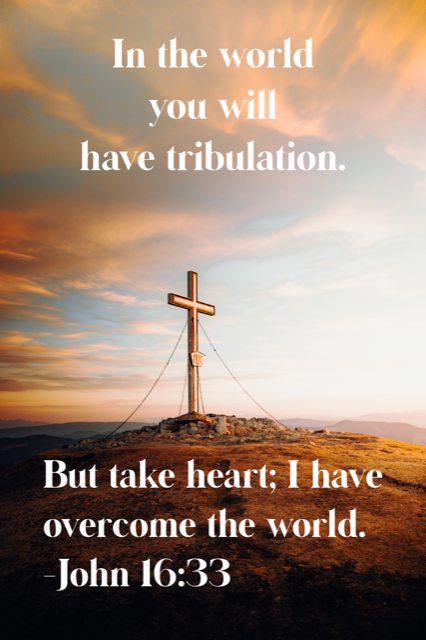
But He told us, “In the world you will have tribulation.” Yet He sandwiches that truth between two promises:

I have said these things to you, that in me you may have peace. In the world you will have tribulation. But take heart; I have overcome the world (John 16:33).

Several people in the Bible must have wondered if they, too, were on the right road:

Abraham and Sarah waiting long years for the son God promised.

The children of Israel wandering for forty years in the desert.

David, though anointed as the next king, hiding out in a cave from Saul.

John the Baptist in prison.

Peter when he heard Jesus speak of suffering and dying.

We’ve had friends who also must have wondered at times why life looked so different than they thought it would: a couple on deputation for the mission field when their son was diagnosed with leukemia; a young man in seminary who was in a car accident which left him paralyzed; a woman who is still alone though she thought she would have a husband and children; another woman who had to leave her beloved mission field due to her husband’s sin.

The Bible tells us often that trouble is part of life here. But the Bible also assures us time and again that God will be with us and help in trouble. God tells us not to lean on our own understanding, but to trust God (Proverbs 3:5).

He promises that when—not if—we pass through deep waters or fire, He will be with us:

When you pass through the waters, I will be with you; and through the rivers, they shall not overwhelm you; when you walk through fire you shall not be burned, and the flame shall not consume you (Isaiah 43:2).

What’s the best way to stay on the right path? “In all your ways acknowledge him, and he will make straight your paths” (Proverbs 3:6). If we’re seeking Him day by day, step by step, we can be assured we’re on the right path even if the circumstances are confusing.

What if we do stray from the path of God’s will? Sometimes trials are God’s chastening or His attempt to get our attention. Jonah went the opposite direction God told him and ended up inside a big fish. The prodigal son deliberately walked away from his father and ended up in a pigsty. Most of us don’t have one dramatic turn, but we gradually drift. We miss a few times with the Lord until we get out of the habit. We make excuses for a sin instead of killing it. Then we find ourselves either lukewarm and apathetic like the Laodicean church, or in a tangled mess. God issues many invitations in the Bible to repent and turn back to Him. One is Isaiah 55:7:

Let the wicked forsake his way
And the unrighteous man his thoughts;
And let him return to the Lord,
And He will have compassion on him,
And to our God,
For He will abundantly pardon.

A beautiful song based on this passage:

And I love this new version of the old hymn, “Coming Home”:

We can trust that God knows the way home and is with us every step.

(I often link up with some of these bloggers.)