What is Success?

What is success in the Bible?

What does the word “success” bring to mind?

Money in the bank—enough to cover bills plus a little extra? A house and two cars? A desired promotion? A vibrant ministry with thousands of followers? Plans that turn out exactly as we wanted?

Sometimes people are smack dab in the center of God’s will, yet their lives don’t appear successful.

But wait—doesn’t God promise success if we follow Him? Doesn’t Joshua 1:8 say:

This Book of the Law shall not depart from your mouth, but you shall meditate on it day and night, so that you may be careful to do according to all that is written in it. For then you will make your way prosperous, and then you will have good success.

And Psalm 1:3 says of the person who meditates on God’s Word day and night:

He is like a tree planted by streams of water that yields its fruit in its season, and its leaf does not wither. In all that he does, he prospers.

And Proverbs 3:3-4 says:

Let not steadfast love and faithfulness forsake you; bind them around your neck; write them on the tablet of your heart. So you will find favor and good success in the sight of God and man.

The very next verses in Proverbs 3 are the more well known, but we usually take them out of context:

Trust in the Lord with all your heart, and do not lean on your own understanding. In all  your ways acknowledge him, and he will make straight your paths. Be not wise in your own eyes; fear the Lord, and turn away from evil (verses 5-7).

Look at John the Baptist. He had faithfully preached and prepared the way of the Messiah. He pointed others to the Lamb of God, not caring that he lost “followers” to Jesus. But he spent his last years in prison and then was beheaded by an evil ruler.

After God gave Jeremiah the message He wanted him to share with the people, God said, “So you shall speak all these words to them, but they will not listen to you. You shall call to them, but they will not answer you” (Jeremiah 7:27).

When Elisabeth Elliot went to the mission field, she had every expectation that God would bless her work and that of other missionaries “in beautiful, demonstrable ways.”

Her words sounded naive. After all, she’d read missionary biographies; she knew the stories of men and women who had lost their lives, like John and Betty Stam, or lost their health, or lost their minds, in service of Christ. She was ready to pay any price to be obedient to His leading.

But, like many, she believed that God would surely take her sacrifices and make them into successes for His sake . . . glorious victories that human beings could see, that could be reported to supporters back home, bringing glory to God (Ellen Vaughn, Becoming Elisabeth Elliot, pp 100-101).

Instead, during this period in her life, Elisabeth lost a vital coworker to murder, the results of several months of linguistic study to theft, her husband and four colleagues to spears from the very tribe they were trying to reach, and the ministry she thought God had been preparing her for to relationship issues.

Elisabeth titled the book about this period of life These Strange Ashes, words taken from an Amy Carmichael poem which begins:

But these strange ashes, Lord, this nothingness,
This baffling sense of loss?

For many years, people often asked Elisabeth “if the men’s mission on Palm Beach was a ‘success.'”

To her, the only measure of any human action came down to one thing: obedience. She’d look at an interviewer as if the “success” question was dull. Yes, yes, of course. After all, they knew God wanted them to go to the tribe, and they were obedient to His leading (Vaughn, p. 259).

Vaughn goes on to say that “If ‘success’ is defined not by obedience, but by measurable outcomes, then we’ve got to get into metrics” (p. 259)—how many people were saved or called to service, and how many people the men reached as opposed to what the men might have accomplished had they lived, etc. But we can never know those things. And God doesn’t always measure success in numbers.

Elisabeth wrote:

I believe with all my heart that God’s story has a happy ending. . . . But not yet, not necessarily yet. It takes faith to hold onto that in the face of the great burden of experience, which seems to prove otherwise. What God means by happiness and goodness is a far higher thing than we can conceive (Vaughn, p. 260).

Success, basically, is doing the will of God and leaving the results to Him..

Sometimes He brings about visible results. Sometimes He turns things around, like He did for Joseph, who was the favorite son, then sold into slavery, then falsely accused and imprisoned before becoming Pharaoh’s right-hand man and saving nations from starvation. Elisabeth went on to have a long and fruitful writing and speaking ministry, made all the richer and deeper by what she went through in her early adult life. A strong group of believers grew up among the tribe she worked with her husband died for, the Waodani, with a world-wide witness despite human foibles.

Sometimes the visible outcome doesn’t occur in this life. Lazarus–not the one whom Jesus raised from the dead—was a neglected beggar at the gate of a rich man. Things weren’t set “right” in his life til he went to “Abraham’s side” and was comforted. Poor, loyal Uriah, who was so faithful that he wouldn’t enjoy the pleasures of home while the king’s soldiers were in battle, was sent to the forefront of the battle to be killed off by the king who impregnated his wife.

Hebrews 11 tells wonderful success stories of those “who through faith conquered kingdoms, enforced justice, obtained promises, stopped the mouths of lions, quenched the power of fire, escaped the edge of the sword, were made strong out of weakness, became mighty in war, put foreign armies to flight. Women received back their dead by resurrection” (verses 33-35). However, “Some were tortured, refusing to accept release, so that they might rise again to a better life. Others suffered mocking and flogging, and even chains and imprisonment. They were stoned, they were sawn in two, they were killed with the sword. They went about in skins of sheep and goats, destitute, afflicted, mistreated—of whom the world was not worthy—wandering about in deserts and mountains, and in dens and caves of the earth” (verses 35-38). Yet they were all “commended through their faith” (verse 39).

For this light momentary affliction is preparing for us an eternal weight of glory beyond all comparison” (2 Corinthians 7:14).

The ultimate example of what looked like failure from a human standpoint is the life and death of Jesus

His life on earth had a most inauspicious beginning. There was the scandal of the virgin birth, the humiliation of the stable, the announcement not to village officials but to uncouth shepherds. A baby was born – a Savior and King – but hundreds of babies were murdered because of Him. His public ministry, surely no tour of triumph, no thundering success story, led not to stardom but to crucifixion. Multitudes followed Him, but most of them wanted what they could get out of Him and in the end all His disciples fled. Yet out of this seeming weakness and failure, out of His very humbling to death, what exaltation and what glory (Elisabeth Elliot, These Strange Ashes, p. 145).

The seeming failure was not a failure at all. Christ’s death accomplished salvation for all who will believe in Him.

Therefore, if anyone is in Christ, he is a new creation. The old has passed away; behold, the new has come. All this is from God, who through Christ reconciled us to himself and gave us the ministry of reconciliation; that is, in Christ God was reconciling the world to himself, not counting their trespasses against them, and entrusting to us the message of reconciliation. Therefore, we are ambassadors for Christ, God making his appeal through us. We implore you on behalf of Christ, be reconciled to God. For our sake he made him to be sin who knew no sin, so that in him we might become the righteousness of God. (2 Corinthians 5:17-21).

So those verses in Joshua and Psalms and other places about success are true. God does grant success to those who meditate on His Word and walk with Him. The circumstances may or may not look successful. If things seem to be going wrong, it’s good to pray and examine our hearts and actions for sin, for blind spots, for better ways to do things. But otherwise, we can leave the results to God.

The success Psalm 1 promises is that our “leaf does not wither.” We won’t “dry up” spiritually. God will continue to give grace and strength, no matter the circumstances.

But sometimes we look at outcomes in this life, seeking the reassurance of a happy ending, and it’s just not there. What then? As Betty put it, His ways are “inscrutable.” So we have to rest, not in the peace of a pretty story, but in the reality of faith in a Person we cannot see (Vaughn, p. 245).

Psalm 1:3

(Sharing with Sunday Scripture Blessings, Selah, Scripture and a Snapshot,
Hearth and Soul, Inspire Me Monday, Senior Salon, Remember Me Monday,
Tell His Story, InstaEncouragements, Let’s Have Coffee, Recharge Wednesday,
Share a Link Wednesday, Heart Encouragement, Grace and Truth.
Linking does not imply 100% agreement.)

Spiritual Sacrifices

Sacrifice doesn’t seem like a beautiful word. It conjures up images of animals, blood, and altars, or it makes us think of something we should give up that we don’t want to.

Definition.org has this as one meaning of sacrifice: “Forfeiture of something highly valued for the sake of one considered to have a greater value or claim.”

On the one hand I think of the sacrifices God made for us. Think of the trouble humanity has cost Him on an everyday basis for millennia. Yet He created us and He desires our fellowship. Amazing! And because He does, He sent only begotten sinless Son, the Lord Jesus Christ, to lay down His life and take on Himself our sin and the just punishment we deserved. Jesus, in full agreement and in full submission to His Father, willingly surrendered, sacrificed His life for us. If we repent of our sin and believe on Him, we can be saved, cleansed, forgiven, and made His own children. In addition, we have a home waiting for us in heaven and His grace, presence, and help here and now. We don’t merit that forgiveness and salvation by any kind of sacrifice we make: there’s nothing we could ever do that would be enough to earn it. It’s a free gift based on His sacrifice.

In His example, though, I think the definition doesn’t fit in the sense of surrendering something highly valuable for something of more value. We are certainly not of more value than God’s Son. But He did love us enough to give His greatest treasure for our redemption.

In light of that, any kind of sacrifice we might make for Him pales in comparison. I’ve known of dear folks who echo David Livingstone’s sentiments:

People talk of the sacrifice I have made in spending so much of my life in Africa. Can that be called a sacrifice which is simply paid back as a small part of a great debt owing to our God, which we can never repay? Is that a sacrifice which brings its own blest reward in healthful activity, the consciousness of doing good, peace of mind, and a bright hope of a glorious destiny hereafter? Away with the word in such a view, and with such a thought! It is emphatically no sacrifice. Say rather it is a privilege. Anxiety, sickness, suffering, or danger, now and then, with a foregoing of the common conveniences and charities of this life, may make us pause, and cause the spirit to waver, and the soul to sink, but let this only be for a moment. All these are nothing when compared with the glory which shall hereafter be revealed in, and for, us. I never made a sacrifice. Of this we ought not to talk, when we remember the great sacrifice which HE made who left His Father’s throne on high to give Himself for us. (Speech to students at Cambridge University, December 4, 1857)

I get what he’s saying. Jesus did so much for us, and we don’t appreciate it nearly enough. We should be so filled with love and gratitude that we can’t help giving back to Him.

And yet—the Bible calls us to sacrifice to God and acknowledges the high cost. The animal sacrifices in the Old Testament were fulfilled in the life, death, and resurrection of Christ. But God calls us to other kinds of sacrifice.

You yourselves like living stones are being built up as a spiritual house, to be a holy priesthood, to offer spiritual sacrifices acceptable to God through Jesus Christ. 1 Peter 2:5

What kind of spiritual sacrifices are we to make?

For you will not delight in sacrifice, or I would give it; you will not be pleased with a burnt offering. The sacrifices of God are a broken spirit; a broken and contrite heart, O God, you will not despise. Psalm 51:16-17

Even in Old Testament times, the sacrifices which were a picture of the coming perfect Sacrifice could be an empty ritual if one’s heart was not broken and contrite before God. I think this is the first sacrifice: our pride, our stubborn clinging to our “own” way, our laying aside of anything in our lives that is not pleasing to God. It’s also a continual sacrifice as we walk daily with the Lord, read His Word, grow in Him, and become more aware of how much that desire for our “own” way is ingrained in our thinking.

I appeal to you therefore, brothers,by the mercies of God, to present your bodies as a living sacrifice, holy and acceptable to God, which is your spiritual worship. Romans 12:1

Not just our broken spirit and heart, but even our bodies are to be surrendered to Him. He reminds us that this is only our reasonable service in light of God’s mercies to us.

Through him then let us continually offer up a sacrifice of praise to God, that is, the fruit of lips that acknowledge his name. Hebrews 13:15

I’ve wondered why our praise to God would be called a sacrifice: perhaps because we have to get our attention off ourselves and our concerns.

Do not neglect to do good and to share what you have, for such sacrifices are pleasing to God. Hebrews 13:16

Some years back my husband commented on the honesty of this verse, acknowledging that it does cost us something to do good to others.

I have received full payment, and more. I am well supplied, having received from Epaphroditus the gifts you sent, a fragrant offering, a sacrifice acceptable and pleasing to God. Philippians 4:18

This and the previous verse indicate that sometimes those spiritual sacrifices manifest themselves in meeting physical needs. Paul’s response to the Philippians’ sacrifice shows forth some of the beauty of a sacrifice given and received.

Several years ago, my husband took our youngest son out to shop for my birthday. My son was excited about perhaps buying a little something for himself after getting Mom’s present. As my son chose the item he wanted to purchase for me, my husband told him that item would take all the money he had. It took my son a few moments to process the realization that if he bought that gift for me, he wouldn’t be able to buy anything for himself. Finally, though a little teary, he decided to go ahead with the purchase. I can’t tell you how that touched my heart to realize that he denied himself to do something special for me.

Even if I am to be poured out as a drink offering upon the sacrificial offering of your faith, I am glad and rejoice with you all. Philippians 2:17

Paul was willing for his life to be poured out in ministry to others.

And walk in love, as Christ loved us and gave himself up for us, a fragrant offering and sacrifice to God. Ephesians 5:2

Even more than Paul, Christ is our example of walking in love and giving oneself.

It’s okay to call a sacrifice a sacrifice. The Bible does. It’s even okay to say it hurts. Jesus agonized in the garden of Gethsemane. Hebrews 12:1-2 says that Jesus endured the cross for the joy set before Him.

Therefore, since we are surrounded by so great a cloud of witnesses, let us also lay aside every weight, and sin which clings so closely, and let us run with endurance the race that is set before us, looking to Jesus, the founder and perfecter of our faith, who for the joy that was set before him endured the cross, despising the shame, and is seated at the right hand of the throne of God.

We can look ahead, too, to the time when every sacrifice will fade away for joy.

For I consider that the sufferings of this present time are not worth comparing with the glory that is to be revealed to us. Romans 8:18

So we do not lose heart. Though our outer self is wasting away, our inner self is being renewed day by day. For this light momentary affliction is preparing for us an eternal weight of glory beyond all comparison, as we look not to the things that are seen but to the things that are unseen. For the things that are seen are transient, but the things that are unseen are eternal. 2 Corinthians 4:16-18

Often, what makes a sacrifice seem hard is the struggle to give up what we think is ours: our time, our schedule, our goods, our lives. But as David prayed after the people of Israel offered the things needed for the building of the temple, “But who am I, and what is my people, that we should be able thus to offer willingly? For all things come from you, and of your own have we given you.” (1 Chronicles 29:14). If we remember that anything we have is not our own but was given to us by God in the first place, and if we meditate on His mercies and all He has done for us, it doesn’t seem so hard then to surrender it back to Him. Back to our definition, whatever the value of what we sacrifice, it pales in comparison to the worth of the One to whom we are sacrificing.

The beauty of sacrifice is the humble surrender to God of what He freely gave us, in response to His great love and mercy, for use in His service in a life of love and ministry to others, which He regards as wellpleasing, as a “sweetsmelling savour.”

The Lord is God, and he has made his light to shine upon us. Bind the festal sacrifice with cords, up to the horns of the altar! Psalm 118:27

(Revised from the archives)

(Sharing with Hearth and Soul, Sunday Scripture Blessings, Selah, Scripture and a Snapshot, Inspire Me Monday, Senior Salon, Tell His Story, InstaEncouragements, Let’s Have Coffee, Recharge Wednesday, Share a Link Wednesday, Heart Encouragement, Grace and Truth, Blogger Voices Network, Faith on Fire)

When It Looks Like Evil Is Winning

Sometimes when I am dismayed over the state of the world or a personal problem, I am tempted to think, “God, why aren’t you winning? You’re stronger than evil. You’re bigger than this problem. Why isn’t all of this taken care of? It would be nothing to You to right these things.”

The psalmists wrestled with this question in a slightly different way. In Psalm 73, Asaph struggled with not only the presence of the wicked, but the fact that they prospered. He even came to the point of thinking that his efforts to live purely had been in vain. Job’s friends’ asserted that God blesses the righteous and punishes the wicked, and therefore Job must have done something wrong to be experiencing so much trouble. One of Job’s arguments against their theory was that the wicked often prosper in this life.

But nothing in Job’s circumstances indicated that God wasn’t “winning,” that He was absent, didn’t care, or had lost control of the situation. God was with Job all along, even though Job couldn’t sense His presence. God displayed mercy and compassion to Job, even though it looked different from what we might expect. All of the physical, material blessings that God restored to Job at the end of the book are items that he once again lost at the end of his life. But through the first loss of them, God taught him eternal truths and drew Job closer to Himself. Job’s relationship with God and the spiritual truths he learned would affect the rest of his life. Though it might have looked like Satan was winning, God was working out His purposes.

I love the Psalms for their honest emotion. Whether the psalmists faced personal danger or lamented the seeming triumph of evil in the world, they brought their own thoughts and those of their listeners back to the truth they knew about God. Psalm 10 (ESV) starts out, “Why, O Lord, do you stand far away? Why do you hide yourself in times of trouble?” But the psalmist reminded himself, “But you do see, for you note mischief and vexation, that you may take it into your hands; to you the helpless commits himself; you have been the helper of the fatherless.” He concludes back on solid ground:

 The Lord is king forever and ever;
    the nations perish from his land.
O Lord, you hear the desire of the afflicted;
    you will strengthen their heart; you will incline your ear
to do justice to the fatherless and the oppressed,
    so that man who is of the earth may strike terror no more.

When God seems far away, we remind ourselves of the truth we know about Him from His Word. He sees what is going on. He loves us. He will deal justly. He might be waiting to answer for a number of reasons. We ask Him to search us and show us anything that might be hindering His answer to our prayers. And we rest in His wisdom, love, righteousness, and strength.

Trusting that God has control of the situation doesn’t mean inaction on our part. Only God can take care of all the needs of the world, but He often works through people. A needy world is a call to pray and then to look for ways to help those in need. William Wilberforce and Hannah More not only prayed against the evil of slavery but fought against it. We may not be able to solve world pproblem, but we can help those within our sphere of influence.

In the May 19 selection of Spectacle of Glory by Joni Eareckson Tada, she wrote:

On the whole, the good that we are able to tally in this life doesn’t seem to outweigh the bad that we observe. We keep praying, but we don’t see some of the answers closest to our hearts. Only heaven will reveal a clear picture of how the sweet fragrance of our faith in Jesus, even in times of grief and loss, influenced the lives of those around us. Only eternity will show how our fainthearted prayers changed the destinies of people on our prayer list. Great faith believes in God even when He plays His hand close to the vest, not showing all His cards. God wants to increase your “measure of faith.” He does this whenever He conceals a matter and you trust Him nevertheless (p. 156).

The Bible tells us the world will get worse before the end. “But as for you, continue in what you have learned and have firmly believed, knowing from whom you learned it and how from childhood you have been acquainted with the sacred writings, which are able to make you wise for salvation through faith in Christ Jesus” (2 Timothy 3: 14-15).

God not only wins in the end. He is winning now. He’s working out His purposes even now.

Ye fearful saints fresh courage take,
The clouds ye so much dread
Are big with mercy, and shall break
In blessings on your head.

His purposes will ripen fast,
Unfolding ev’ry hour;
The bud may have a bitter taste,
But sweet will be the flow’r.

Blind unbelief is sure to err,
And scan his work in vain;
God is his own interpreter,
And he will make it plain.

(From “God Moves in a Mysterious Way” by William Cowper, 1773)

Revised from the archives. I had another post in mind for today, but then was inclined to this one.

(Sharing with Hearth and Soul, Sunday Scripture Blessings, Selah, Scripture and a Snapshot, Inspire Me Monday, Senior Salon, Remember Me Monday, Tell His Story, Legacy Link-Up, InstaEncouragements, Recharge Wednesday, Let’s Have Coffee, Share a Link Wednesday, Heart Encouragement, Grace and Truth, Faith on Fire, Blogger Voices Network)

What’s Normal, Anyway?

God is faithful though any circumstances

The transition from December 31 to January 1 is just a change from one day to the next. But January 1 is not just a new day or even the start of a new month: it’s a whole new calendar of blank pages, full of hope and possibilities.

The most prevalent hope I hear is that life gets “back to normal,” especially in regard to the coronavirus. We’d love for it go away completely, or at lease recede to rare occurrences, like the swine flu or the bird flu. We want to go about our business without worrying about exposure and masks how many people are gathered in one place.

It’s harder to hope for some of the other issues prevalent during the last year. We still have a long way to go in race relations. And I don’t know if the political landscape will ever improve.

But desiring normalcy for the last several months has led me to wonder—what’s normal, anyway?

America has always had its troubles, but we’ve had it a good deal better than many. We have poverty here, but people who travel to third-world countries are often stunned by the breadth and depth of poverty in other places. Some countries are almost perpetually in a state of war. Some areas are rife with corruption. Armed guards regularly patrol some streets. Some citizens risk their lives to vote.

Through the Bible, Israel was in captivity to Egypt 400 years, Babylon 70 years. Most of their rulers were evil.

Early Christians were persecuted under wicked emperors. More recent believers suffered under Communist oppression. Many are persecuted in several countries even now.

The prophet Habakkuk complained to the Lord:

Destruction and violence are before me; strife and contention arise. So the law is paralyzed, and justice never goes forth. For the wicked surround the righteous; so justice goes forth perverted. (Habakkuk 1:3b-4)

He basically asked God, “What are you going to do about this?

God replied that he was sending the “dreaded and fearsome” Chaldean army (vv. 5-11).

Habakkuk wonders, “What? You can’t let that happen!”

But in their further conversation, God established that He can and He will. But, He says, “but the righteous shall live by his faith” (2:4b).

By the end of chapter 3, Habakkuk concludes that, though his body trembles and lip quivers (3:16):

Though the fig tree should not blossom,
    nor fruit be on the vines,
the produce of the olive fail
    and the fields yield no food,
the flock be cut off from the fold
    and there be no herd in the stalls,
yet I will rejoice in the Lord;
    I will take joy in the God of my salvation.
God, the Lord, is my strength;
    he makes my feet like the deer’s;
    he makes me tread on my high places. (3:17-19)

I hope with everything in me that life improves on every front this year. But whatever happens, these are some of the truths I carry with me:

  • God is good, even if circumstances aren’t.
  • God is at work, even if it doesn’t look like it.
  • God loves me, even if life is hard.
  • My job is the same: trust in Him, live for Him, rejoice in Him, love Him, grow in Him, fortify and feed myself with His Word.

In the book of Deuteronomy, Moses repeated God’s instruction to Israel before they entered the promised land after 40 years of wilderness wandering. One of the things He promised them was:

But the land that you are going over to possess is a land of hills and valleys, which drinks water by the rain from heaven, a land that the Lord your God cares for. The eyes of the Lord your God are always upon it, from the beginning of the year to the end of the year. (Deuteronomy 11:11-12)

Though our context is different, I think we can take comfort and courage in these same truths. Through the “hills and valleys” of the coming year, God eyes are on us and He cares for us.

The righteous shall live by his faith

(Sharing with Inspire Me Monday, Senior Salon, Hearth and Soul, Selah, Tell His Story, Instaencouragements, Recharge Wednesday, Share a Link Wednesday, Let’s Have Coffee, Heart Encouragement, Grace and Truth, Faith on Fire, Blogger Voices Network)

What God Tells Us to Remember

Many of us spend the last days of the year looking back at it. Maybe that reminiscence is sparked by the Christmas letters we wrote loved ones, or by the pause before putting up our shiny new calendars for the new year.

There used to be a saying on memes that went something like, “Don’t look back—you’re not going that way.” However, though we shouldn’t live in the past, we benefit from considering it at times.

I jotted down for my own remembrance the ESV Study Bible note for Isaiah 44:21, where God pointed out the futility of idols and told Israel to remember certain things:

Remember. God calls his people to focused thought, in contrast to the muddled delusions described in vv. 9-20 about “these things,” both the all-sufficiency of the God who makes true promises to his people and the emptiness of the false gods with their lies (p. 1321).

The note on Isaiah 46:8 says something similar:

Mental focus on who God is must be renewed, for the idolatrous culture of the world erodes clarity (p. 1326).

God calls us to remember, to exercise “focused thought.” Verses came floating to mind about what God tells us to remember. So I did a quick word study, which resulted in four pages of references. I can’t put all of them here, but I’ll share several.

“Remember all the commandments of the Lord, to do them, not to follow after your own heart and your own eyes, which you are inclined to whore after. So you shall remember and do all my commandments, and be holy to your God.” (Numbers 15:39-40)

“Remember the whole way that the Lord your God has led you these forty years in the wilderness, that he might humble you, testing you to know what was in your heart, whether you would keep his commandments or not.” (Deuteronomy 8:2)

“Remember also your Creator in the days of your youth, before the evil days come and the years draw near of which you will say, ‘I have no pleasure in them’” (Ecclesiastes 12:1)

“Remember the days of old; consider the years of many generations; ask your father, and he will show you, your elders, and they will tell you”. (Deuteronomy 32:7). (The rest of the chapter details God’s gracious dealings in Israel’s history.)

Remember God’s provision: “Beware lest you say in your heart, ‘My power and the might of my hand have gotten me this wealth.’ You shall remember the Lord your God, for it is he who gives you power to get wealth, that he may confirm his covenant that he swore to your fathers, as it is this day.” (Deuteronomy 8:17-18) (Jesus reminded his disciples, when they discussed having no bread, about his past provision of loaves and fishes. Matthew 16:5-12.)

“Remember the wondrous works that he has done, his miracles and the judgments he uttered.” (1 Chronicles 16:12)

“Remember and do not forget how you provoked the Lord your God to wrath in the wilderness. From the day you came out of the land of Egypt until you came to this place, you have been rebellious against the Lord.” (Deuteronomy 9:7). (It’s not that God wanted to hold their past rebellion over their heads forever, but they needed to remember their tendency to sin so that they might be humbled and appreciative of His grace.)

Remember how God dealt with other people’s sin, to learn from their example. “Remember what the Lord your God did to Miriam on the way as you came out of Egypt” (Deuteronomy 24:9); “Remember Lot’s wife” (Luke 17:32).

“Remember therefore from where you have fallen; repent, and do the works you did at first. If not, I will come to you and remove your lampstand from its place, unless you repent.” (Revelation 2:5)

Remember his Word:

“Remember his covenant forever, the word that he commanded, for a thousand generations.” (1 Chronicles 16:15)

“This is now the second letter that I am writing to you, beloved. In both of them I am stirring up your sincere mind by way of reminder, that you should remember the predictions of the holy prophets and the commandment of the Lord and Savior through your apostles.” (2 Peter 3:1-2)

“But you must remember, beloved, the predictions of the apostles of our Lord Jesus Christ.” (Jude 17)

“Remember, then, what you received and heard. Keep it, and repent. If you will not wake up, I will come like a thief, and you will not know at what hour I will come against you.” (Revelation 3:3)

Remember the nothingness of idols and the greatness of his salvation (Isaiah 44:9-26, “Remember these things,” v. 21; Isaiah 46, “Remember this and stand firm, recall it to mind, you transgressors, remember the former things of old; for I am God, and there is no other; I am God, and there is none like me,” vv. 8-9).

“Remember those who are in prison, as though in prison with them, and those who are mistreated, since you also are in the body.” (Hebrews 13:3)

“Remember your leaders, those who spoke to you the word of God. Consider the outcome of their way of life, and imitate their faith.” (Hebrews 13:7)

Besides imperative sentences, I noticed some sweet examples of focused remembrance about God, his truth, his ways, his past provision, and the effect of this remembrance. Some were in Psalm 77, Psalm 78, and Isaiah 63. One was in Psalm 63:5-7:

“My soul will be satisfied as with fat and rich food, and my mouth will praise you with joyful lips, when I remember you upon my bed, and meditate on you in the watches of the night; for you have been my help, and in the shadow of your wings I will sing for joy.” 

Another is in Psalm 143:3-6:

“For the enemy has pursued my soul; he has crushed my life to the ground; he has made me sit in darkness like those long dead. Therefore my spirit faints within me; my heart within me is appalled.

“I remember the days of old; I meditate on all that you have done; I ponder the work of your hands. I stretch out my hands to you; my soul thirsts for you like a parched land.”

One more in Lamentations 3:19-26:

Remember my affliction and my wanderings, the wormwood and the gall! My soul continually remembers it and is bowed down within me. But this I call to mind, and therefore I have hope:

The steadfast love of the Lord never ceases; his mercies never come to an end; they are new every morning; great is your faithfulness. “The Lord is my portion,” says my soul,  “therefore I will hope in him.”

The Lord is good to those who wait for him, to the soul who seeks him. It is good that one should wait quietly for the salvation of the Lord.

Any time is a good time to remember God’s character and dealings with us. But I hope that before the year ends, you’re able to have some “focused thought” on his particular provision and expressions of love in your life.

(Sharing with Inspire Me Monday, Hearth and Soul, Selah, Scripture and a Snapshot, Remember Me Monday, InstaEncouragement, Recharge Wednesday, Let’s Have Coffee, Grace and Truth)

Merry Christmas! Come Behold the Wondrous Mystery

I wish for you and yours a special time of wonder remembering God’s love for us and showing His love to each other.

Come behold the wondrous mystery
In the dawning of the King
He the theme of heaven’s praises
Robed in frail humanity

In our longing, in our darkness
Now the light of life has come
Look to Christ, who condescended
Took on flesh to ransom us

From “Come Behold the Wondrous Mystery” by Matt Papa, Matt Boswell, Michael Bleecker

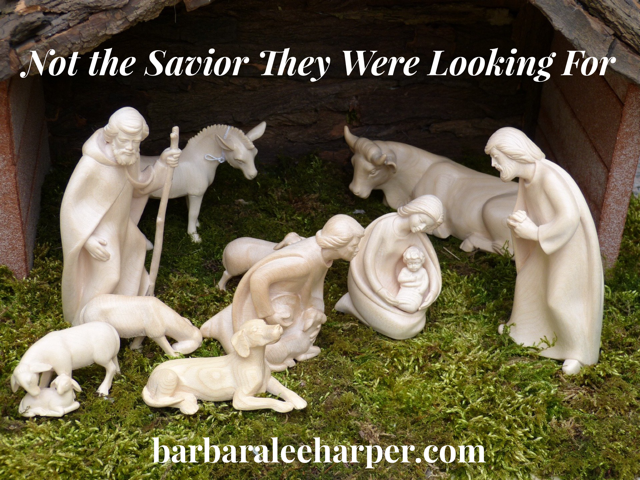
Not the Savior They Were Looking For

From the first book of the Bible, from the first instance of sin, God promised that some day a Redeemer would come. God repeated and expanded on the promise all through the Old Testament. The coming One, the promised One, the Messiah, would be a perfect prophet, priest, king. He would overthrow evil, rule in justice, defeat all Israel’s enemies. Though he was particularly given so the Jews, he was also promised to the Gentiles.

And in that day there shall be a root of Jesse, which shall stand for an ensign of the people; to it shall the Gentiles seek: and his rest shall be glorious. (Isaiah 11:10)

And he said, It is a light thing that thou shouldest be my servant to raise up the tribes of Jacob, and to restore the preserved of Israel: I will also give thee for a light to the Gentiles, that thou mayest be my salvation unto the end of the earth. (Isaiah 49:6)

Multiple prophecies foretold his coming. Multiple images depicted him: the Passover lamb, the scapegoat, sacrifice for sin, the suffering servant.

But when he came, when he claimed to be the Messiah, his people did not recognize him. “He came to his own, and his own people did not receive him” (John 1:11). The Jews of New Testament times looked for a warrior king who would overthrow Roman oppression and establish his physical kingdom. When he pointed out their errors and sins, they had him killed.

People today make a similar mistake. They want a particular kind of Savior:

One who will solve their problems but never require anything of them.

One who will align with and carry out their political aspirations.

One who will increase their health and wealth.

One who will smile indulgently at their sin and never chasten.

One who would never let anything unpleasant happen.

One who will never require anything difficult.

One who never says no to their desires and plans.

Instead of worshiping the Savior as he is, they’ve created one from the own imagination. And when He doesn’t perform according to expectations, well, then, who needs Him?

We all need Him. But we need Him as He truly is, not as we think He should be. Even those of us who have been Christians  for a long time still have to continually “renew our minds” and adjust our thinking according to truth. We come to know Him as Savior and Lord, but then we spend the rest of our lives getting to know Him better and adjusting ourselves away from our preconceived notions and expectations and toward who He really is. And we’re not disappointed, because in the end He’s a much better Savior than we could ever have imagined.

Do you know Him today as He truly is? Get to know Him through His Word. If you’re new to the Bible, start reading the gospel of John. See what He does and what He says about Himself.

And if you’ve known Him for years, keep getting to know Him better. Keep learning more and more what a wonderful Savior He is.

(Revised from the archives)

(Sharing with Hearth and Soul, Senior Salon, Remember Me Monday, InstaEncouragement, Recharge Wednesday, Grace and Truth)

Christmas Lights

symbolism of Christmas lights

Christmas lights are my favorite holiday decorations. Just when the landscape becomes bare and dreary and the nights are longest, cheery lights go up inside and outside. I miss them when we take them down at the end of the month.

I don’t know if I did a good job teaching my children the symbolism behind many of our Christmas customs. But the symbolism behind Christmas lights is a favorite.

God began creation by saying “Let there be light”. But He soon saw His world engulfed in darkness when sin came in. Nevertheless, He promised light would shine again.

“I am the LORD; I have called you in righteousness; I will take you by the hand and keep you; I will give you as a covenant for the people, a light for the nations, to open the eyes that are blind, to bring out the prisoners from the dungeon, from the prison those who sit in darkness (Isaiah 42:6-7).

“But for you who fear my name, the sun of righteousness shall rise with healing in its wings. You shall go out leaping like calves from the stall” (Malachi 4:2).

The Isaiah passage that foretells of the child born, the son given who will take David’s throne, rule in righteousness, whose “name shall be called Wonderful Counselor, Mighty God, Everlasting Father, Prince of Peace” begins with “The people who walked in darkness have seen a great light; those who dwelt in a land of deep darkness, on them has light shone” (Isaiah 9:2).

Scripture points repeatedly to Jesus as the light.

Jesus said, “ “I am the light of the world. Whoever follows me will not walk in darkness, but will have the light of life.” (John 8:12).

In him was life, and the life was the light of men. The light shines in the darkness, and the darkness has not overcome it (John 1:4-5).

When we believe on the Lord, His light shines through us:

At one time you were darkness, but now you are light in the Lord. Walk as children of light (for the fruit of light is found in all that is good and right and true), and try to discern what is pleasing to the Lord. Take no part in the unfruitful works of darkness, but instead expose them. For it is shameful even to speak of the things that they do in secret. But when anything is exposed by the light, it becomes visible, for anything that becomes visible is light (Ephesians 5:8-14a).

The NKJV renders that last phrase “But all things that are exposed are made manifest by the light, for whatever makes manifest is light.”

This is the message we have heard from him and proclaim to you, that God is light, and in him is no darkness at all. If we say we have fellowship with him while we walk in darkness, we lie and do not practice the truth. But if we walk in the light, as he is in the light, we have fellowship with one another, and the blood of Jesus his Son cleanses us from all sin (1 John 1: 5-7).

Someday, for God’s children, “night will be no more. They will need no light of lamp or sun, for the Lord God will be their light, and they will reign forever and ever” (Revelation 22:5). How desperately we need to choose light now, because those who don’t will be “thrown into the outer darkness. In that place there will be weeping and gnashing of teeth” (Matthew 8:12).

For now, though we have the light, we live in a dark world.

Who among you fears the Lord and obeys the voice of his servant? Let him who walks in darkness and has no light trust in the name of the Lord and rely on his God (Isaiah 50:10).

Keep looking to the light!

In your light we see light. Psalm 36:9

(Sharing with Hearth and Soul, Inspire Me Monday, Senior Salon, Remember Me Monday, Selah, Scripture and a Snapshot, Tell His Story, InstaEncouragement, Recharge Wednesday, Let’s Have Coffee, Grace and Truth, Faith on Fire, Blogger Voices Network)

How to Get Out of a Bible Reading Rut

How to get out of a Bible reading rut

Routines can help us establish good habits. Half the battle in establishing a regular quiet time or devotional time is staking out a workable, regular time and place. Some days—and some seasons of life—upend our schedules, and all we can do is watch for any available minutes. But we usually do better when we plan to work Bible reading into our day.

But a routine can become—routine. A rut, even.

How can we keep our Bible reading from becoming routine—or dig it out of the rut if it’s already there?

Pray. Ask God to remind us of the treasure His Word is. Sometimes I pray Psalm 119:18 just before starting my Bible reading: “Open my eyes, that I may behold wondrous things out of your law.” Or Psalm 119:25: “My soul clings to the dust; Revive me according to Your word” (NKJV).

Remember. Perhaps make a list of reasons to read the Bible or read Psalm 119 to renew our appreciation of it.

Don’t expect high excitement every time. A Thanksgiving feast is wonderful and memorable. But the monthly tuna casserole and everyday peanut butter sandwiches nourish us as well. Some devotional times leave us overflowing with joy or conviction or inspiration. Most quiet times don’t end that way, yet the Word feeds us every time we partake of it.

Remember the purpose of time in the Word: not just to get through a certain number of chapters or a certain amount of time, but to meet with the Lord and get to know Him better.

Change your plan. If you usually read the Bible through in a year, maybe switch to a two-year plan or a five-year plan—or a 90-day plan. Or a biographical plan or a chronological plan. Bible Gateway lists 18 different plans. Near the end of the year you’ll see a number of posts and articles about ways to read the Bible in the New Year (though you don’t have to wait til then to start).

Change your style. We benefit from both reading and studying the Bible, but most of us are inclined one way or the other. If you usually read large chunks for an overview, perhaps study a particular book in more detail. If you like to camp out in one passage for days, maybe get the bigger picture by reading several chapters or a whole book at one sitting.

Add aids. I’ve only had a study Bible the last few years. The background information and notes help so much in comprehending more of the passage. One year I used Warren Wiersbe’s With the Word as a companion. This year I am using his “Be” commentaries.

Have a Bible reading project. Once I read through the gospels looking particularly for claims Jesus made about Himself. I put a “C” in the margin beside every verse of Jesus’ claims and then put them all together. Doing so provided a valuable resource plus woke me up from falling into familiar patterns from familiar passages. I’d love to read through the Bible noting every reference to God as Creator and what the passage shares about Him (His greatness, His power, etc.) I’d love to do the same thing with every passage where God promises to be with someone. Mardi Collier started reading the Psalms, jotting down every truth about God that she came across. As she came to a new truth, she’d write it across the top of a notebook page, and then list verses underneath as she found them. Some of the page titles focused on what kind of Person God is: My God is holy, My God is good, etc. Others shared God’s actions: My God hears me, My God is in control, and so on. Her study ended up covering the whole Bible and eventually became a book, What Do I Know About My God?

Ask different questions. When I first started reading the Bible on my own, I was instructed to look for a command to follow, a warning to heed, a promise to claim. I underlined them in different colors as I found them. Later I heard of asking the old journalism questions of a passage: who, what, when, where, why, and how. Those are great questions, but If you’ve asked them several times, chances are you already know the answers. Maybe ask, instead or along with those, what does this passage show me about God? Or, how does this person change over the course of his story? For example, the first few times I read Genesis, I missed the transition of Judah from Genesis 37-50. Now, reading in Exodus, I am noticing Moses’ change from arguing with God that he couldn’t fulfill His calling in Exodus 3 and 4 to becoming a great leader over the rest of the book. The changes in people in the Bible come about as God works in them and enables them through the circumstances He puts them in. That can inspire us that He is doing th same in our lives.

Try a different translation. I used the KJV for some 25 years. When I read the NASB and ESV, I saw passages with new eyes. I prefer to stay with the translations that are as close to word-for-word as possible rather than paraphrases. But sometimes I look up the paraphrases as commentaries.

Remove the references. Before we could cut and paste from the Internet, one of our former Sunday School teachers suggested that we type out some of the epistles as the actual letters they are without the verse numbers and headings. The chapter and verse numbers weren’t in the original text, but they do help us find and discuss passages. Sometimes, however, they are not well placed. One sentence can be broken up into several verses. So sometimes reading without the verse numbers can help us not to fragment the verse. Now you can buy Bibles printed without chapter and verse numbers.

Stop and think. Paul tells Timothy in 2 Timothy 2:7: “Think over what I say, for the Lord will give you understanding in everything.” It’s easy to sail through a familiar passage. In the narrative portions, we see how everything turned out just a few pages later. Remember the people in those situations—David hiding in caves from Saul, Joseph in prison, Daniel facing the lion’s den, etc.—didn’t know how everything would turn out. If we put ourselves in their situations the passage opens up to us more.

Make notes. I stopped journaling during my quiet time when I found I was spending more time writing than reading. But recently I’ve gone back to just writing a few notes both to reinforce what I just read or to remind myself later. My notes are usually just a short summary, but thinking about how I’d describe the passage helps me not gloss over it. Some people like to draw charts and diagrams and arrows and circles to engage the Scriptures more.

Don’t compartmentalize. Often we read for so many chapters or minutes and then pray, or vice versa. But we don’t have to separate prayer and reading. If we’re in a section of praise, we can stop and praise God. If a passage convicts us about something we’re doing wrong, we can stop and confess it to God right then.

How about you? What ways have you found to avoid or get out of a Bible reading rut?

I delight in God's Word

(Sharing with Hearth and Soul, Sunday Scripture Blessings, Selah, Scripture and a Snapshot), Inspire Me Monday, Tell His Story, Let’s Have Coffee, Grace and Truth, Faith on Fire)

God with Us

The guest speaker was pointing out bad prayer habits. One, he said, was asking God to be with us or another Christian. God is with believers all the time; He has promised never to leave us forsake us. So we don’t need to ask Him to be with us.

That made sense to me. So I tried to eliminate the phrase “be with” from my prayers. I’d get a little irritated when someone else said it. (Isn’t it sad how easily self-righteousness creeps in?)

Then a few days ago, I read Exodus 3 about God’s call to Moses. Moses had tried to help his brethren, the Israelites, forty years earlier. But his efforts had not been received, and he ended up fleeing for his life from Egypt. No wonder he didn’t jump at the chance to go back. His first objection to God’s call was, “Who am I?”

God answered, “I will be with you.” The ESV Study Bible‘s notes on this verse say:

Moses’ initial question is surely sensible, and God does not reprove him for asking it (v. 11). However, God does not answer Moses’ question in the way that he asks it, but instead says, “I will be with you,” indicating that his presence with Moses is essential to the call (v. 12). When the OT says that God is “with” someone, it stresses God’s power that enables a person to carry out his calling” (p. 148, emphasis mine).

The thought of God being with us in our calling was totally new to me, but this note brought it out in a way I hadn’t thought about it before. I recalled how God expressed this same promise to others when He called them: Isaac, Jacob, Joshua, Gideon, Jeremiah, Mary, Paul, and others.

I’ve often thought of God’s presence with us in terms of fellowship, comfort, and help. One of my favorite verses in Isaiah 41:10: “Fear not, for I am with you; be not dismayed, for I am your God; I will strengthen you, I will help you, I will uphold you with my righteous right hand.”

And this passage from Exodus almost always brings me to tears. Israel had sinned in worshiping the golden calf, and God told Moses He would send the people on to the promised land, but He would not go with them (Exodus 33:1-3).

 Moses said to the Lord, “See, you say to me, ‘Bring up this people,’ but you have not let me know whom you will send with me. Yet you have said, ‘I know you by name, and you have also found favor in my sight.’ Now therefore, if I have found favor in your sight, please show me now your ways, that I may know you in order to find favor in your sight. Consider too that this nation is your people.”

And he said, “My presence will go with you, and I will give you rest.”

 And he said to him, “If your presence will not go with me, do not bring us up from here. For how shall it be known that I have found favor in your sight, I and your people? Is it not in your going with us, so that we are distinct, I and your people, from every other people on the face of the earth?” (Exodus 33:12-16)

In another favorite passage, God promises to be with us when—not if, but when trouble comes:

When you pass through the waters, I will be with you; and through the rivers, they shall not overwhelm you; when you walk through fire you shall not be burned, and the flame shall not consume you. (Isaiah 43:2)

Matthew shares in the first chapter of his gospel that an angel visited Joseph and told him that his betrothed was to be the mother of the Messiah, the one promised all through the Old Testament. The angel quoted a prophecy: “Behold, the virgin shall conceive and bear a son, and they shall call his name Immanuel, (which means, God with us)” (Matthew 1:23). Though God has always been omniscient and omnipresent, He was going to be with His people in a special way through this promised child.

Then Matthew closed His book with that child grown, crucified, and risen again, promising His disciples, “All authority in heaven and on earth has been given to me. Go therefore and make disciples of all nations, baptizing them in the name of the Father and of the Son and of the Holy Spirit, teaching them to observe all that I have commanded you. And behold, I am with you always, to the end of the age” (Matthew 28:18-20).

Does that mean we don’t need to ask God to be with us or our loved ones? I’m still inclined to pray that God will help someone know or rest in His presence rather than just that he will be with them. But I am not going to fuss with anyone about the phrasing. As I studied this concept, I noticed that Paul closed many of his epistles with a phrase similar to Romans 15:33: “May the God of peace be with you all.” Did that mean God had not been with them, and Paul was praying that He would be? No, not in the context of all he had written before. I think he means it in the same sense as when he said “that I may know him and the power of his resurrection, and may share his sufferings” in Philippians 3:8-11. Paul already knew Him. But He wanted to know Him better, to grow in his experience of Him. So when he says, “God be with you,” perhaps he is emphasizing that he hopes they know His presence in a fuller way.

The more I looked up passages about God being with us, the more I found—much more than will fit in one blog post. This would make for a rich study some day.

But as I considered them in light of our calling, I realized they are all bound up in our calling. When God calls us to Himself, He promises to take care of us. We have His fellowship, comfort, help, and whatever else we need.

Whatever God has called us to do—pick up and go to another location, teach our children at home, work in a busy office or store, or any other task—He has promised Himself. And with Him, we can do anything.

(Sharing with Sunday Scripture Blessings, Selah, Hearth and Soul,
Scripture and a Snapshot, Inspire Me Monday, Senior Salon, Tell His Story, InstaEncouragement, Recharge Wednesday, Share a Link Wednesday,
Let’s Have Coffee, Heart Encouragement, Grace and Truth, Blogger Voices Network)