God’s Word: Our Sure Guide

My husband sat on the Zoning Board of Appeals in the town where we used to live. People would come before the board to settle disputes over property lines or usage or appeal a ruling. The board had a thick book of zoning regulations which the members were to consult in order to make their decisions.

Sometimes people would appeal to all the work they had put into a structure that they had placed in a wrong area without checking the zoning regulations first. “It’s already there. It’s not hurting anyone. Can’t we just leave it?”

Sometimes the board sympathized with the plaintiff. Occasionally public sentiment swung heavily toward one side.

But the board members could only make their decisions based on the zoning regulations.

Why? Because they were Pharisaical hard-nosed rule-followers who only cared about regulations?

No. The regulations were there to insure the greatest efficiency and happiness of the people and businesses of the city. To allow a structure in a wrong place or a usage of land that went against the zoning ordinances would cause problems for other people down the line.

This need to go back to the book, to make every decision in accord with the zoning regulations already in place, reminded me of the Bible.

People don’t want to hear their choices are harmful, they are worshiping a false god, they’re going in the wrong direction.

Sometimes it’s easier to go with the flow. “If I take a stand on this issue, I’ll only stir up a hornet’s nest.” But we don’t do people any favors by hiding truth.

There are some issues where the Bible allows for differences (Romans 14). We don’t die on those hills. We pray and study God’s Word and make the best informed decision we can, and we allow others to do the same.

But where God draws the line in the sand, we need to draw the line also. We speak the truth in love, with kindness and compassion.

Satan still questions, attacks, and twists God’s Word today just as he did with Adam and Eve. He even masks his falsehood by seeming as an angel of light.

Our church is almost finished reading through the major and minor prophets in the Old Testament. Many of the prophets had to contend with false prophets who told the people what they wanted to hear. When Jeremiah warned that God was sending the Babylonians to take Judah into captivity, he was considered a traitor. Who wouldn’t rather listen to the prophets who said everything was going to be all right? But who would be better prepared to face what was coming—those who listened to Jeremiah or those who listened to false prophets?

The New Testament warns:

For the time is coming when people will not endure sound teaching, but having itching ears they will accumulate for themselves teachers to suit their own passions, and will turn away from listening to the truth and wander off into myths. As for you, always be sober-minded, endure suffering, do the work of an evangelist, fulfill your ministry (2 Timothy 4:3-5).

Who do we listen to? Those who make everything pleasant, who never mention sin and repentance, who never take unpopular stands, who promise prosperity and blessing no matter what? Or the ones who tell the truth according to God’s Word, even when it’s hard, even when it’s painful, trusting that He is good and right and true and kind and will work everything out for good in the long run?

Do we go to the doctor who says everything is okay when we have an insidious cancer growing in us? Or the one who says, “We have to treat this thing aggressively or it’s going to kill you?”

Jesus said, “If you love me, you will keep my commandments” (John 14:15). John said, “For this is the love of God, that we keep his commandments. And his commandments are not burdensome” (1 John 5:3). The KJV says His commandments are not “grievous.”

But His Word is not just about rules.

Your testimonies are my delight; they are my counselors (Psalm 119:24).

Sanctify them through thy truth: thy word is truth. (John 17:17)

Remember your word to your servant, in which you have made me hope. This is my comfort in my affliction, that your promise gives me life (Psalm 119:49-50).

The unfolding of your words gives light; it imparts understanding to the simple (Psalm 119:130).

Faith comes from hearing, and hearing through the word of Christ (Romans 10:17).

All Scripture is breathed out by God and profitable for teaching, for reproof, for correction, and for training in righteousness, that the man of God may be complete, equipped for every good work (2 Timothy 3:16-17)

His divine power has granted to us all things that pertain to life and godliness, through the knowledge of him who called us to his own glory and excellence, by which he has granted to us his precious and very great promises, so that through them you may become partakers of the divine nature, having escaped from the corruption that is in the world because of sinful desire (2 Peter 1:3-4).

Blessed is the man who walks not in the counsel of the wicked, nor stands in the way of sinners, nor sits in the seat of scoffers; but his delight is in the law of the Lord,  and on his law he meditates day and night. He is like a tree planted by streams of water that yields its fruit in its season, and its leaf does not wither (Psalm 1:1-3).

What a treasure trove we have in God’s Word! We can echo the psalmist: “How precious to me are your thoughts, O God! How vast is the sum of them!” (Psalm 139:17). How we need to consult His Word every day and build our lives around it.

(Sharing with Hearth and Home, Inspire Me Monday, Global Blogging, Senior Salon,
Purposeful Faith, InstaEncouragement, Recharge Wednesday,
Share a Link Wednesday, Let’s Have Coffee, Heart Encouragement,
Grace and Truth, Blogger Voices Network)


My Journey with the Bible

My journey with the BibleI never heard Handel’s Messiah until I was in high school.

I had not grown up listening to either classical or religious music. (I grew up hearing “Your Cheatin’ Heart” and other such lovely little ditties). So while I was impressed with the beauty and grandeur of Handel’s oratorio, I can’t say I got much out of it. It was like drinking from the proverbial fire hydrant.

But my college performed selections from the Messiah frequently. And the church we attended the first fourteen years we were married did the same. I even got to be in the choir at church some of those years, so I learned the songs in more detail. Plus, I had become a Christian in later high school, so I could understand more of the spiritual significance and message of the piece.

When I learned that The Messiah had been composed during the Baroque era, with its “excessive ornamentation or complexity,” I understood why it was written the way it was.

As a result of hearing The Messiah over and over, becoming more familiar with it, learning more about it, and growing in the Lord, I came to love this piece of music. I anticipated each section just like I would rereading a favorite book or rewatching a favorite movie.

And then, just from growing familiarity with the music, I began to notice details. For instance, I had always thoughts of Isaiah 53:6 as somber and sad: “All we like sheep have gone astray; we have turned—every one—to his own way; and the Lord has laid on him   the iniquity of us all.” But the tune Handel put to this verse seemed almost jaunty to me at first. Then one day I noticed the notes on the word “astray” were going astray.

Further into that piece, on “We have turned,” the notes are turning over and over.

Isaiah 40:4 says, “Every valley shall be exalted, and every mountain and hill shall be made low: and the crooked shall be made straight, and the rough places plain.” In the song based on this passage, the notes on the word “crooked” go up and down—they would look crooked on the sheet music. And the melody on “straight” and “plain” is mostly straight. The notes on “exalted” go up.

The melodies illustrate the words! And I had listened to and sung this I don’t know how many times before that clicked. In fact, I just caught “exalted” going up watching this video.

In many ways, my journey with the Bible parallels my journey with this piece of music.

I had attended church occasionally growing up. I knew some basic Bible truths and narratives. But I didn’t start reading the Bible myself until high school. The church I started attending when I was sixteen strongly encouraged its people to read the Bible through in a year. So I did.

And it was like trying to drink from a fire hydrant.

But I am so thankful for that emphasis at the outset of my Christian life. That grounded me more than anything else and set me off with good habits.

I didn’t understand everything I read. Similarly, in church, I couldn’t have told you the main points of the sermon afterward. But I got enough to chew on and to nourish me. The Bible speaks of those young in the faith as taking in milk from the Word. So I took in and digested what I could, and my life was changed.

When I got to something I didn’t understand, I’d just keep going.For instance, Psalm 60:4-5 says:

Thou hast given a banner to them that fear thee, that it may be displayed because of the truth. Selah. That thy beloved may be delivered; save with thy right hand, and hear me.

And I would think, “Wow, that’s good!” Then the next few verses listed a bunch of names I didn’t know. And then I came to verse 8: “Moab is my washpot; over Edom will I cast out my shoe: Philistia, triumph thou because of me.”

And I thought, “Huh?”

And then I’d keep going to verses 11 and 12: “Give us help from trouble: for vain is the help of man. Through God we shall do valiantly: for he it is that shall tread down our enemies.” And I’d think, “Wow, so good!”

I don’t know if that’s the best way for a new Christian to go about Bible reading. But no one had told me what to do about the parts I didn’t understand. I had never heard of study Bibles in those days. Still, the Lord met me in those times with His Word.

And as I kept reading in the 40+ years since (though not through the whole Bible in a year any more), I understood more and more. I saw how individual verses and books fit within the whole. I know what Moab and Edom and Philistia are now. There are parts that are as familiar as any favorite, much-read book. There are parts holding dear memories of God giving me just the right words in an hour of need. I anticipate what’s coming next in a passage. But I am still learning new things even from old, familiar stories and chapters.

So, why am I telling you this today?

I want to encourage you to get into a habit of reading your Bible, if you’re not already doing so.

And I want to encourage you to read all of it. Maybe not in a year. There are two-year plans and five-year plans and almost any kind of plan you could think of. But if we just keep turning to our old favorite passages, we’ll miss so much.

And if you’re discouraged because there is so much you don’t understand, I want to encourage you to keep reading. You’ll “get” more and more of it the more you read it. Someone has said that the Bible is shallow enough for a child to wade in, but deep enough for an elephant to swim in. God can speak to you and minister to you even if you don’t understand every little thing in the passage. In fact, we’ll never exhaust the Bible in this lifetime.

The Bible says to “long for the pure spiritual milk, that by it you may grow up into salvation” (1 Peter 2:2-3), and then to go on to solid food (1 Corinthians 3:1-2) as we “ mature, for those who have their powers of discernment trained by constant practice to distinguish good from evil (Hebrew 5:11-13).

But even more than spiritual food, the Bible provides spiritual fellowship. We don’t read the Bible as an end in itself, but to get to know God better. The Bible is the primary way God speaks to us. From the time God’s words were first written all the way through until the end of time, God expected His people to read and follow it.

God’s thoughts are precious to us. The Bible bears witness about Christ, increases our faith, guides us, teaches, improves, corrects, trains us in righteousness, equips us, builds us up, gives us hope and comfort, helps us avoid sin, makes us stable and fruitful, gives us life, understanding, joy, hope, wisdom and discretion.

His divine power has granted to us all things that pertain to life and godliness, through the knowledge of him who called us to his own glory and excellence, by which he has granted to us his precious and very great promises, so that through them you may become partakers of the divine nature, having escaped from the corruption that is in the world because of sinful desire (2 Peter 1:3-4).

What a treasure trove we have in the Bible! May we partake of it every day.

Your words were found, and I ate them, and your words became to me a joy and the delight of my heart, for I am called by your name, O Lord, God of hosts (Jeremiah 15:16).

Taking in and rejoicing in God's WordSee also:

Finding Time to Read the Bible

Ways to Both Read and Study the Bible

Real Life Devotions

Studying the Parts to Understand the Whole

(Sharing with Inspire Me Monday, Hearth and Home, Global Blogging, Senior Salon,
Tell His Story, Purposeful Faith, InstaEncouragement, Recharge Wednesday,
Share a Link Wednesday, Let’s Have Coffee, Faith on Fire, Grace and Truth,
Blogger Voices Network. Links do not imply 100% agreement.)

The Cares of This Life

Cares of life can choke God's wordThere’s a lot to be concerned about in this life, isn’t there? Making a living, maintaining a marriage, raising children, getting along with coworkers and neighbors, car and house repairs, health concerns, preparing for retirement, church ministries, political discord, the latest negative news. And that was before a global pandemic and rioting in the streets. We truly have a lot to occupy our thoughts and time. Sometimes we feel we can’t keep up with it all.

But the cares of this life can have a detrimental impact in unexpected ways.

In Mark 4:1-9, Jesus told a parable of a sower—a planter—planting seeds. Only a few of the seeds took root and grew. Some were eaten by birds, some landed on rocky ground, some were choked out.

The disciples asked Jesus the meaning of this parable in Mark 4:10-20. He said that the seed was the word of God. The seed being eaten by birds is a picture of Satan snatching the word away before it can germinate from people who don’t understand (Matthew 13:19). The rocky ground represents a stony heart that might have soil enough for a plant to sprout, but not enough to nourish the plant. Some people seem to believe, but then never progress because they never dealt with the bedrock in their hearts. Then some of the word is choked by “the cares of the world and the deceitfulness of riches and the desires for other things” (verse 19). The ESV Study Bible notes say, on the account of this parable in Matthew 13, “Competing for nutrients from the soil, weeds choke out the good plants, which are then unable to reach maturity and bear fruit.”

Some say that this parable is about the gospel, not the whole word of God. Even if that’s the case, we can choke out the word of God in general when we’re distracted, can’t we? I’ve experienced not being able to take in or rest in God’s promises because my attention is on my cares.

In Luke 21, Jesus mentions the cares of this life again, along with “dissipation and drunkenness.” These distractions can preoccupy people from warnings to prepare for His coming, and then that day will “come upon you suddenly like a trap.”

How can we keep the cares of this life, this world, from distracting us from more important things?

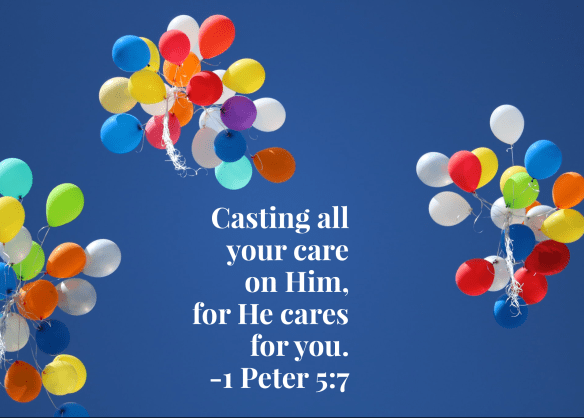
“Casting all your care upon him; for he cares for you” (1 Peter 5:7, NKJV; other versions say “anxieties” or “worries”). The word for “care” is the same Greek word as “cares” in the two passages above:

But before we can cast our cares on Him, we have to back up to the verses that come before this:

Clothe yourselves, all of you, with humility toward one another, for “God opposes the proud but gives grace to the humble.” Humble yourselves, therefore, under the mighty hand of God so that at the proper time he may exalt you, casting all your anxieties on him, because he cares for you (1 Peter 5:5b-7, ESV). 

We have to humble ourselves before God, acknowledge Him for who He is and ourselves for who we are. He’s our sovereign Lord. He made us. He redeemed us through Christ’s death on the cross. He is wise. He has the right to call the shots. But He is also love. He is kind. He is our provider. He cares for us.

Then we “cast our cares” on Him. The Greek word for cast means “to throw upon; to place upon.” In prayer and in faith, we place them on Him, knowing He loves us, knowing He can take care of the problems and meet our needs.

How do we know these things? From His word.

Psalm 1 tells us that the person whose “delight is in the law of the Lord” and who “meditates day and night” on it is “like a tree planted by streams of water that yields its fruit in its season, and its leaf does not wither.”

Instead of our cares choking out the Word, we sink our roots deep into it. When concerns swirl in our minds, we take our thoughts captive and remind ourselves of God’s truth.

I don’t think it’s going too far to say that spending time with God is the most important thing we can do each day. Some seasons of life, we may have half an hour to an hour to spend with the Bible. Other seasons, we’re doing good to get five minutes. But I like what Sue Donaldson says here: “I figure if I can’t give God five minutes anytime on any given day, I’m not taking Him and our relationship seriously. ”

Psalm 1 speaks of not just reading, but delighting in and meditating in God’s word. We can write a verse out that spoke to us and keep it before our eyes through the day. We can listen to the Bible itself or to Christian music, sermons, podcasts while we’re driving, cooking, etc., setting our “minds on things that are above, not on things that are on earth” (Colossians 3:1-2).

Some years ago, I attended a ladies retreat where, on the last day, the speaker had us write down a concern, burden, or prayer request on a small piece of paper. Then she asked us to fold the paper and turn it in. She collected all the papers and put them into a bag, then tied the bag onto a collection of helium-filled balloons. Then we all went outside. I think she prayed, giving all the concerns we had collected to the Lord. Then she released the balloons, symbolizing releasing these concerns to God.

Honestly, at the time I thought it was a little silly. And I wondered what the person who eventually found the little bag would think.

But a few days later, something I had written on my little paper came to mind. I don’t even remember what it was now. But as I turned it over in my thoughts, suddenly I remembered: “I gave this to the Lord. I don’t need to keep worrying about it.”

Perhaps some physical way of handing our cares over to Him might help cement the idea in our minds. I don’t think releasing more balloons would be good for the environment. One friend used to cup her hands and raise them up to the Lord while praying, physically reminding herself that she was giving her concerns to Him. Maybe a prayer journal would be a concrete way to note the concerns and requests we’ve given over to God.

Giving concerns to Him doesn’t mean we never pray about them any more. But when we do, we remind ourselves that He invites us to place on Him all our cares, and He’s the only one who can take care of them. Some prayer requests last a lifetime. But when God does answer others, we can record how and when. What an encouragement to faith to look back over that record.

What helps you to cast your cares on God?

1 Peter 5:7

(Sharing with Hearth and Home, Global Blogging, Senior Salon, Purposeful Faith,
Tell His Story, InstaEncouragement, Legacy Linkup, Recharge Wednesday, Let’s Have Coffee), Share a Link Wednesday, Faith on Fire)


When others don’t do their part

When others don't do their partYears ago, it dawned on me that when Ephesians 6:1-3 and Colossians 3:20-21 teach that children should obey and honor their parents, it doesn’t add any qualifiers. Those passages, as well as the ten commandments in Exodus 20, don’t say “Obey your parents if they are Christians” or “if they are perfect” or “if anything.”

Some time later, I noticed that these passages mentioned responsibilities on both sides of relationships.

  • Wives submit to husbands as unto the Lord (Ephesians 5:22-24; Colossians 3:18); Husbands, love your wives as Christ loved the church (Ephesians 5:25; Colossians 3:19).
  • Children, obey and honor your parents (Ephesians 6:1-2; Colossians 3:20); Fathers, do not provoke your children to anger, but bring them up in the discipline and instruction of the Lord (Ephesians 6:4; Colossians 3:21).
  • Servants, obey as bondservants of Christ, doing the will of God from the heart (Ephesians 6:5-8; Colossians 3:22-25); Masters, do the same to them, and stop your threatening, knowing that he who is both their Master and yours is in heaven, and that there is no partiality with him (Ephesians 6:9; Colossians 4:1). (I wrote about slavery in the Bible here. Generally we apply these verses to employee/employer relationships these days.)

Beyond these, the Bible speaks of relationships between people and rulers. When Paul in Romans 13:1-6 and Peter in 1 Peter 2:13-17 spoke of obeying and even honoring rulers, do you know who their ruler was? Nero, one of the worst rulers ever.

Then, most of the epistles speak to how we’re supposed to act towards our fellow church members.

Now, as an aside, we know from other passages of Scripture that we obey authorities unless they ask us to do something sinful. Then we have the right to refuse. And this passage does not give parents or spouses or anyone else the right to be abusive. If you’re suffering from abuse, please let a trusted teacher, doctor, neighbor, or someone know.

But for the purposes of this post, we’re just talking about everyday normal interactions.

In all of these pairs of relationships, it’s easier for one side to do their part if the other person is doing theirs. It’s generally easier for a wife to submit to a husband who loves her like Christ loves the church. It’s easier for a husband to love a wife who isn’t always at cross purposes with him. It’s easier to parent cooperative, obedient children; It’s easier to obey parents who are loving and nurturing. And so on.

But the Bible doesn’t say to do your part only if the other person does his.

It just says to do your part as unto the Lord.

That doesn’t mean we can’t discuss what’s wrong in a relationship. That’s healthy to do, even to call in help when needed.

But sometimes the grace shown by doing our part even when the other person doesn’t can lead to conviction, restoration, and encouragement.

We’re not only to love and do good to our friends and closest loved ones. Jesus said we’re to love, pray for, and do good even to our enemies.

God exemplifies this for us. In most of His relationships with His people, they fail. There are a very few people in Scripture against whom no sin is recorded. That doesn’t mean they never sinned, because we’re all sinners, except for Jesus. It just means their wrong-doing wasn’t pertinent to the narrative about them. It may mean they sinned less than others. But the point is this: there is no fault, no failing, on God’s side. We fail Him often. But He doesn’t stand apart, arms folded, rescinding His promises because we didn’t keep ours. He pursues us in love, drawing us to Himself, leading us in His goodness to repentance. Jesus died for us when we were His ungodly enemies. He didn’t wait for us to clean up our act first. He knew that was impossible. Yes, God disciplines and chastens, but in love. He’s always faithful to His own.

And, by His grace, He calls us to be faithful to Him and to the others we have relationships with.

For to this you were called, because Christ also suffered for us, leaving us an example, that you should follow His steps: Who committed no sin, Nor was deceit found in His mouth; who, when He was reviled, did not revile in return; when He suffered, He did not threaten, but committed Himself to Him who judges righteously; who Himself bore our sins in His own body on the tree, that we, having died to sins, might live for righteousness—by whose stripes you were healed. For you were like sheep going astray, but have now returned to the Shepherd and Overseer of your souls (1 Peter 2:21-25, NKJV).

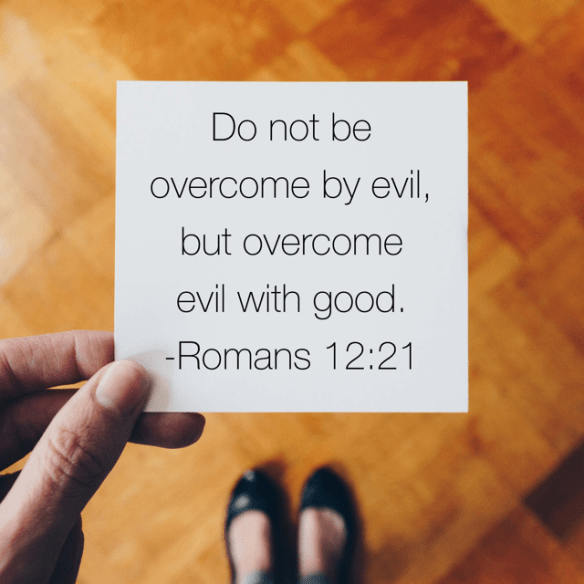
It’s natural to want to strike back or withhold love or respect or obedience when the other person fails to hold up their end. Doing so only widens the chasm. And as Christians, we’re not called to react naturally, but supernaturally—something we can only do with God’s help. We seek His grace do the right thing. “Do not be overcome by evil,” or failure or disappointment, “but overcome evil with good” (Romans 12:21).

Therefore, as the elect of God, holy and beloved, put on tender mercies, kindness, humility, meekness, longsuffering; bearing with one another, and forgiving one another, if anyone has a complaint against another; even as Christ forgave you, so you also must do. But above all these things put on love, which is the bond of perfection (Colossians 3:12-14, NKJV).

Romans 12:21, overcome evil with good

(Sharing with Inspire Me Monday, Global Blogging, Hearth and Soul, Senior Salon,
Tell His Story, InstaEncouragement, Recharge Wednesday, Worth Beyond Rubies.
Let’s Have Coffee, Faith on Fire, Grace and Truth,
Blogger Voices Network.
Links do not imply 100% endorsement.)

Psalm 91 and COVID-19

Does Psalm 91 protect from COVID-19?When COVID-19 first broke out, a lot of Christians posted verses from Psalm 91 on their social media accounts. Several verses sound like God will protect people who believe in Him from pestilence:

For he will deliver you from the snare of the fowler
    and from the deadly pestilence.
He will cover you with his pinions,
    and under his wings you will find refuge;
    his faithfulness is a shield and buckler.
You will not fear the terror of the night,
    nor the arrow that flies by day,
nor the pestilence that stalks in darkness,
    nor the destruction that wastes at noonday.
A thousand may fall at your side,
    ten thousand at your right hand,
    but it will not come near you (Psalm 91:3-7).

A friend said in an email recently that some psalms seemed to provide blanket protection, yet she didn’t think that’s what was meant. Therefore, she was having trouble knowing quite how to apply them.

Psalm 91 is one of those passages for me, so as I responded to my friend, I looked up commentary on it. One interpretation said we may have to face these trials, but we don’t have to fear them. That conclusion was based on verse 5: “You will not fear the terror of the night, . . . ” the arrow, the pestilence, etc. Another spiritualized it: we may have to face physical trials but we’re safe spiritually. The ESV Study Bible notes said on these verses:

Pestilence (Psalm 91:3, 6) and destruction are diseases that God sends on his enemies or his unfaithful people (cf. Ex. 5:3; 9:15; Lev. 26:25; Deut. 32:42, “plagues”). The terror and arrow, together with a thousand may fall, envision God’s people under attack. If the psalm were describing every situation of danger, it would clearly be untrue: faithful people have fallen prey to these and other perils. It is better to allow Psalm 91:8 to guide the interpretation [“You will only look with your eyes and see the recompense of the wicked.“], pointing to cases in which these events (plague, battle) are sent as God’s recompense on the wicked (whether Gentile or Israelite); in such cases, the faithful can be sure of God’s protection (ESV Study Bible, p. 1054).

As much of a stickler as I am for context, somehow I had missed the importance of verse 8. And though I’ve read these comments before, I didn’t remember them.

So this psalm isn’t blanket protection: it’s not saying that God’s people will never suffer from disease or attack. But if God is sending disease or an invading army as a punishment or judgment, those who “dwell in the shelter of the Most High,” who “abide in the shadow of the Almighty,” and who trust in the Lord as their “refuge and my fortress, my God, in whom I trust” (Psalm 91:1-2) will be safe.

However, not all plagues and diseases are sent as judgment on God’s enemies. Sometimes He allows His own to get deadly viruses, to suffer attacks. Hebrews 1 speaks of some who “were tortured, refusing to accept release, so that they might rise again to a better life. Others suffered mocking and flogging, and even chains and imprisonment. They were stoned, they were sawn in two, they were killed with the sword. They went about in skins of sheep and goats, destitute, afflicted, mistreated—of whom the world was not worthy—wandering about in deserts and mountains, and in dens and caves of the earth” (Hebrews 11:35-38). They were commended for their faith (verse 39) just as much as those who “conquered kingdoms, enforced justice, obtained promises, stopped the mouths of lions, quenched the power of fire, escaped the edge of the sword, were made strong out of weakness, became mighty in war, put foreign armies to flight” (33-34).

A missionary in Colombia takes issue with the phrase, “The safest place to be is in the center of God’s will.” He has amended that statement to say, “The most fulfilling, joyful, and peaceful place to be is in the center of God’s will. But it is not necessarily the safest.” After citing Scriptural examples, he says, “Most prayers in Scripture focus not on the personal safety and benefit of believers but on the power, majesty, testimony, and victory of God over his-and, of course, our-enemies.” He asks supporters to pray for their faithfulness.

If you’re like me, it’s unsettling to know that anything could happen to us. Does that mean we can’t trust in God’s protection?

We can. We can pray for it. We know that nothing that happens to us comes as a surprise to Him. We know He loves us and He is good: in Him is “no darkness at all.

In Daniel 3, everyone was called to bow down to the king’s idol. Shadrach, Meshach, and Abednego refused, even in the face of the fiery furnace and the king’s threats. They stood firm, saying, “Our God whom we serve is able to deliver us from the burning fiery furnace, and he will deliver us out of your hand, O king. But if not, be it known to you, O king, that we will not serve your gods or worship the golden image that you have set up” (Daniel 3:17-18). They were thrown into the furnace, and God manifested His presence to them, and to the king, in a marvelous way.

As Jesus prayed in Gethsemane, “Father, if you are willing, remove this cup from me. Nevertheless, not my will, but yours, be done” (Luke 22:42).

If God allows disease or trauma to come into our lives, He promises His presence:

I will be with him in trouble; I will rescue him and honor him (Psalm 91:15).

And behold, I am with you always, to the end of the age (Matthew 28:20b).

He promises His strength and help:

Fear not, for I am with you; be not dismayed, for I am your God; I will strengthen you, I will help you, I will uphold you with my righteous right hand. . .For I, the Lord your God, hold your right hand; it is I who say to you, “Fear not, I am the one who helps you. (Isaiah 41:10, 13).

Let us then with confidence draw near to the throne of grace, that we may receive mercy and find grace to help in time of need (Hebrews 4:16).

He promises His love:

Who shall separate us from the love of Christ? Shall tribulation, or distress, or persecution, or famine, or nakedness, or danger, or sword? . . . No, in all these things we are more than conquerors through him who loved us (Romans 8:35, 37).

He promises His peace:

Peace I leave with you; my peace I give to you. Not as the world gives do I give to you. Let not your hearts be troubled, neither let them be afraid (John 14:27).

I have said these things to you, that in me you may have peace. In the world you will have tribulation. But take heart; I have overcome the world (John 16:33).

He promises His purpose:

We rejoice in our sufferings, knowing that suffering produces endurance, and endurance produces character, and character produces hope, and hope does not put us to shame, because God’s love has been poured into our hearts through the Holy Spirit who has been given to us (Romans 5:3-4).

 So we do not lose heart. Though our outer self is wasting away, our inner self is being renewed day by day. For this light momentary affliction is preparing for us an eternal weight of glory beyond all comparison (2 Corinthians 4:16-17).

We can rest in the hollow of His hand, knowing that nothing reaches us there but what He allows. He provides His grace to deal with anything that comes our way.

God is our refuge and strength, a very present help in trouble (Psalm 46:1).

The Lord is good, a stronghold in the day of trouble; he knows those who take refuge in him (Nahum 1:7).

In peace I will both lie down and sleep; for you alone, O Lord, make me dwell in safety (Psalm 4:8).

(Sharing with Inspire Me Monday, Global Blogging, Hearth and Soul,
Senior Salon, Purposeful Faith, InstaEncouragement,
Recharge Wednesday, Worth Beyond Rubies,
Share a Link Wednesday, Let’s Have Coffee,
Grace and Truth, Faith on Fire,
Blogger Voices Network)


Philippians 4:13 is for losers, too

Philippians 4:13 I can do all things through Christ who strengthens meTwo rival Christian school basketball teams get revved up for their annual match.

All day long they hear Philippians 4:13: “I can do all things through Christ which strengtheneth me” (KJV).

Someone quotes it at the pep rally. Both coaches share it in the locker room. Some players repeat it to themselves. Some write the reference on their person.

Both teams hit the court trusting God to help them win the game.

But one will have to lose.

Did Philippians 4:13 fail the losers somehow? Did they not have enough faith? Did God not hear their prayers?

Have you ever read Philippians 4:13 in context? Switching to the ESV now, here’s the rest of what Paul said:

Not that I am speaking of being in need, for I have learned in whatever situation I am to be content. I know how to be brought low, and I know how to abound. In any and every circumstance, I have learned the secret of facing plenty and hunger, abundance and need. I can do all things through him who strengthens me.

Notice, Paul wasn’t just trusting God for grace in abundance and plenty. He also relied on God’s strength when brought low, in need, in hunger.

Hunger? Wait—doesn’t God know we need to eat? He made us to need food. Why would He let people hunger for a time?

Well, in one case He said:

And he humbled you and let you hunger and fed you with manna, which you did not know, nor did your fathers know, that he might make you know that man does not live by bread alone, but man lives by every word that comes from the mouth of the Lord (Deuteronomy 8:3).

So He might let us suffer need or fail in an endeavor to humble us. Sometimes not getting what we want or need causes us to do some soul-searching. James 4:3 says, “You ask and do not receive, because you ask wrongly, to spend it on your passions.” Perhaps a victory would have done us more harm than good.

He might be bringing sin to our attention. Israel faced a stunning defeat at Ai, which they should have won easily, because there was “sin in the camp.”

He might be working to make us more dependent on Himself. Sadly, when things are going well, we tend to forget we need him. We lean on our own strength instead of His.

He might be trying to help us remember that everything we have comes from Him. In order to strengthen our faith, sometimes God has to put us in situations requiring faith.

He might be teaching us to lose graciously. To honor others. Not to envy someone else’s success—especially when we think we deserved that success.

He might be spurring us to work harder or better. Our salvation depends on God’s work in us and not our own efforts. And He miraculously delivers us out of some situations. But in others, He wants us to trust Him and put forth effort. Someone said, “God feeds the birds, but He doesn’t throw food in their nests.” We can’t ace the test without studying. We can’t lose weight without exercising and making wise food choices. We can’t grow in grace without spending time in God’s Word and obeying what it says. Paul said, “For this I toil, struggling with all his energy that he powerfully works within me” (Colossians 1:29).

He might be drawing us closer in our personal relationship with Himself, reminding us that that’s more important than whatever it is we’re hoping for.

He might be reminding us that His Word is not a talisman or good luck charm.

There are a number of reasons why God might say no to our prayer or expectation.

I’m thankful Paul that he learned contentment in any situation. That tells me that contentment doesn’t come naturally, that it can be learned, and that it is a process.

Yes, it’s good to rely on God for strength, to remember that without Him we can do nothing. When a situation doesn’t come out like we hoped, when we have legitimate unmet needs, we can go to our good Father in faith, ask Him what He wants to teach us through the situation, and rest in Him to provide in His good time.

(Sharing with Inspire Me Monday, Global Blogging, Senior Salon, Hearth and Home,
Purposeful Faith, Tell His Story, InstaEncouragement,
Recharge Wednesday, Worth Beyond Rubies,
Share a Link Wednesday, Let’s Have Coffee, Legacy Link-Up,
Grace and Truth, Faith on Fire, Blogger Voices Network)

Flawed people in a cancel culture

flawed people in a cancel culture

I have not seen the musical Hamilton. But I watched a special on TV called Hamilton’s America, which interlaced how Lin Manuel Miranda became interested in Hamilton’s story, early American history, the road to writing and production, clips from the musical, and commentary from several actors and observers. It was a fascinating special, and I learned much that I hadn’t known about our history.

The musical is famous for is using an ethnically diverse cast. As Miranda said in one interview, he wanted to represent what America looks like today.

In one of the most moving parts of the documentary to me, Christopher Jackson, a black actor who portrayed George Washington, visited Mount Vernon, George Washington’s home. He sat in Mount Vernon’s slave quarters, pondering the disparity of such a great man owning people.

Several of the actors portraying founding fathers wrestled with the fact that these men did both great and terrible things The only conclusion they could come to was that people are are flawed. Appreciating their contributions didn’t mean endorsing everything they said or did.

It doesn’t take much searching to find that most historical figures were flawed. Even most Bible people were flawed. My favorite Bible character, David, was guilty of some of the most heinous sins.

In our fiction, we don’t like a hero or heroine who isn’t flawed because they aren’t realistic.

But somehow, in our modern day, we can’t seem to allow for the fact that people can have sides of themselves that we don’t like or agree with. In today’s “cancel culture,” if you make a single mistake in the public eye, you’re out. People have lost jobs and even been personally threatened when a simple reprimand or correction would have been effective.

Last week when I opened Twitter, I noticed a particular celebrity’s name trending. I don’t follow many celebrities, and am not even all that interested in this man. But I was curious, so I clicked on the hashtag of his name. A backlash had erupted over one of his tweets, which probably could have been worded better. One of those enraged by his comment wrote of “taking great delight in destroying his career.”

It’s horrifying that anyone would enjoy destroying someone’s career in the first place. But it’s even worse to do so while swept along by the mob without taking the time to clarify what was meant or give the benefit of the doubt.

The cancel culture offers no understanding, empathy, forgiveness, or redemption. Just instant judgment, mob rule, and destruction.

We need to hear first.

It’s true, sometimes we need to take a stand or call people. But “If one gives an answer before he hears, it is his folly and shame” (Proverbs 18:13).

By contrast, James 1:19 says, “Know this, my beloved brothers: let every person be quick to hear, slow to speak, slow to anger.”

People post links and commentaries fast and furiously online. We should give the benefit of the doubt and not assume. It’s always a good idea to fact-check, to wait to hear the whole story, before forming an opinion.

We need to be careful in judgment

Jesus said, “For with the judgment you pronounce you will be judged, and with the measure you use it will be measured to you” (Matthew 7:2). He went on to talk about the ridiculousness of trying to get a speck out of someone else’s eye when we have a log in ours. He also said that if we don’t forgive others, we won’t be forgiven.

Some things are obviously wrong. But if someone is on the opposite side of the political fence than we are, or has a different opinion on a major societal issue, the tendency these days is to write that person off completely. It’s all or nothing.

We need to react redemptively.

Maybe someone made an insensitive remark. Instead of trying to ruin their career or lives, wouldn’t it be better to tell them what was wrong with what they said and give them a chance to see the light?

In the passage mentioned above, Jesus did not say that everyone should just live with logs and specks in their eyes. “First take the log out of your own eye, and then you will see clearly to take the speck out of your brother’s eye” (Matthew 7:5). We’re supposed to help each other see clearly, after we see clearly ourselves. 

Our church has been reading through the major prophets in the Old Testament, and now we’re working our way through the minor prophets. Though God threatened judgment on His sinning people, His preference was that they repent and change their hearts and ways. Repentance would avert the judgment, as was the case with Nineveh in the book of Jonah. In the New Testament, chastening and discipline was not destructive but refining. If God gives undeserving people grace, shouldn’t we?

We need to accept each other as flawed.

We know that we are not perfect. We know that no one is perfect. So why do we have trouble accepting people who are not perfect? As the actors of Hamilton came to grips with, good people can do bad things. We all have our blind spots. That doesn’t make wrongdoing okay. But we have to recognize that most people aren’t all or nothing, politically or any other category.

Granted, there are some people with whom it’s impossible to live peaceably. “If possible, so far as it depends on you, live peaceably with all” (Romans 12:18). I have unfriended or hidden toxic people on social media because there is just no peace with them. But that was not after the first disagreement; it was after long years of interaction.

There are even times the Bible tells us to separate from someone else. Again, that’s not for every difference or infraction, and it’s with the ultimate hope for the person’s salvation. But most situations don’t need to go that far.

And we need to remember, if we cancel each other out because of our sins, flaws, and mistakes, there will be no one left.

(Sharing with Inspire Me Monday, Global Blogging, Senior Salon, Hearth and Soul,
Literary Musing Monday, Purposeful Faith, Tell His Story, InstaEncouragement,
Recharge Wednesday, Worth Beyond Rubies, Share a Link Wednesday,
Let’s Have Coffee, Grace and Truth, Faith on Fire, Blogger Voices Network)


When the props are removed

Have you ever felt like the rug has been completely pulled out from under you? Or have the props you leaned on been pulled away? Are the things you always depended on just not there for you any more?

Those hard times of life contain some of the greatest potential for spiritual growth.

Here are some of my prop-removal times:

Family

When I was fifteen, my mother left my father and took us children to Houston. My parents’ marriage had been floundering for some time, so I knew something was bound to happen. But the family break-up was still a shock to my system.

We also moved from a very small town (less than 200 people) to a teeming metropolis of over a million. The culture shock hit me the worst when I went to register at the local high school. I left without registering.

To further complicate matters, these were the days before Internet and cell phones. We had moved during the summer. I had no way to make new friends and couldn’t afford land line long distance calls to my old ones.

So there I was in a new and vastly different city, a new family situation, facing a new school I did not want to go to. I felt alone and cast adrift.

Ours had not been a church-going family, but my parents had let me attend services with my aunt and grandfather or friends. I didn’t know a lot, but I knew I could go to God for help. I prayed.

God answered by leading us to a Christian school and laying it on someone’s heart to pay my tuition for two years. I started attending the church connected to the school and started reading my Bible at the pastor’s urging. I had prayed and asked the Lord to save me several times over the years, but this time I finally understood and believed. My life turned totally around.

Marriage

Fast-forward four years. God provided for me to go to a Christian college, where I met my husband. When we were first married, I still had one semester left and he had two. We went to school together and worked together. I guess I thought that blissful togetherness would continue!

But I graduated, he went back to school, and we had separate jobs. I spent a lot of time at home alone. Then he took a third shift job, and I was a basket case home alone at night. Then, after graduation, his jobs required traveling. With two different moves, while kids finished their school year, my husband worked in the town we were moving to during the week and came home on weekends. Before the last move, we lived like that a whole year.

I cried and wailed to the Lord. It’s not supposed to be like this. I didn’t get married to spend so much time alone.

It’s natural to want companionship and to depend on a spouse. But God wants us to know our ultimate source of companionship, provision, protection, and security come from Him. A few years ago I shared some of what I learned through this experience in Coping When a Husband Is Away, and that has been my most-viewed post several years in a row.

Health

I’d had some health issues, but most were fixed by surgery and/or medication. But when I was 38, one morning my left hand felt numb, like I had slept on it wrong. Within three hours, my left arm and both legs were numb, I couldn’t walk, and I was having trouble using the restroom. I thought I was having a stroke.

After eight days in the hospital and multitudes of tests, the diagnosis came back: transverse myelitis. A virus attacks the spine, and the body’s autoimmune system attacks the myelin sheath around the nerves as well as the virus. Symptoms vary depending on where the virus hits the spine. Some have mild numbness and tingling; on the other end of the spectrum, some are paralyzed and ventilator-dependent.

I was fortunate that my symptoms were somewhere in the middle. With physical therapy and much prayer, I progressed from a wheelchair to a walker to a cane, and finally to my own wobbly gait.

But the body I had always depended on was changed. Continuing numbness, weird nerve signals, balance and urinary issues plagued me the first few years. My neurologist told me whatever I didn’t gain back, I’d get used to. No way, I thought. I could never get used to this.

But I did. And in the meantime, I had to draw close to God in the midst of uncertainty and limitations. In the early days, it was hard to make plans because I never knew how I would be feeling. Any outing or exertion would set me back for a day or two. I often asked God for complete healing, pleading that I could serve Him so much better without the distractions and frustrations my body experienced.

But Elisabeth Elliot’s words about limitations helped me. “My limitations…become, in the sovereignty of God, gifts. For it is with the equipment that I have been given that I am to glorify God. It is this job, not that one, that He gave me.” Limitations didn’t hinder my ministry; they defined it.

I’ve always loved this poem, which I found in Amy Carmichael of Dohnavur by Frank Houghton:

Two glad services are ours,
Both the Master loves to bless.
First we serve with all our powers —
Then with all our feebleness.

Nothing else the soul uplifts
Save to serve Him night and day,
Serve Him when He gives His gifts —
Serve Him when He takes away.

C. A. Fox

Other health issues have sprung up over the last couple of decades, reinforcing my dependence on God day by day.

Pandemic

When this pandemic first started, I was shaken. We know much more about it now, and the recovery rate is high for most. But at first, I felt like I was taking my life in my hands any time I left the house. I’d seen shortages of bread and milk before a snow forecast, but nothing like store shelves completely empty of paper products. I was grateful for directives to stay home, but worried about the economy.

Our total way of life had been affected by an unknown invader.

I had to remind myself of lessons learned before: God is in control. He’s not taken by surprise. He has promised to take care of His children.

Our church has been reading through the Old Testament prophets. God often had to deal with His people’s trust in everything else but Him. Some objects of their trust were bad, like false gods and despicable religious practices. Some were not wrong in themselves, like other nations or their own wealth and military might; but those things could and did fail them. Some were even wonderful things, like the fact that they were God’s people, and they had the temple and the holy city. But they didn’t realize that they were trusting in everything except God Himself.

Family, a spouse, a healthy, capable body, and our normal routines are not sinful things: they are God’s good gifts. There’s nothing wrong with depending on them and enjoying them.

But sometimes, instead of seeing God worth through those “props,” we lean on them instead of Him. God weans us away from depending on anything instead of Him, because nothing else will satisfy or help in the long run, and because He alone is capable and worthy.

The eternal God is your dwelling place, and underneath are the everlasting arms. Deuteronomy 33:27

The Lord is my light and my salvation; whom shall I fear? The Lord is the stronghold of my life; of whom shall I be afraid? Psalm 27:1

God is our refuge and strength, a very present help in trouble. Psalm 46:1

And we know that for those who love God all things work together for good, for those who are called according to his purpose. Romans 8:28

Trust in the Lord with all your heart, and do not lean on your own understanding. In all your ways acknowledge him, and he will make straight your paths. Proverbs 3:5-6

Blessed is the man who trusts in the Lord, whose trust is the Lord. He is like a tree planted by water, that sends out its roots by the stream, and does not fear when heat comes, for its leaves remain green, and is not anxious in the year of drought, for it does not cease to bear fruit. Jeremiah 17:7-8

When our props are pulled away, we’re shaken for a bit til we remember the One who never fails. He may not answer prayer just the way we’d like, but we learn to trust His will. When we know God and rely on Him, we find Him abundantly faithful and capable. Then we come to know Him better and our faith grows even more.

Have you ever struggled with the loss of something you depended on and learned to lean more on God? I’d love to hear about it in the comments.

IMG_0653

(Sharing with Global Blogging, Senior Salon, Hearth and Home, Inspire Me Monday,
Purposeful Faith, Tell His Story, InstaEncouragement, Anchored Abode,
Recharge Wednesday, Worth Beyond Rubies, Share a Link Wednesday,
Let’s Have Coffee, Grace and Truth, Faith on Fire, Blogger Voices Network)

(On a side note: The original graphic I had here showed feet with clouds underneath and a building off to the side. I wanted to convey the idea of free-falling, the way we sometimes feel when props are taken away. It didn’t occur to me until Facebook showed only a grey area in place of the picture that perhaps that image might have been disturbing to some. It was obviously photoshopped and edited by the person who originally made it (I found it in the WordSwag app). But it could have conveyed the idea of jumping off a building. We knew a family whose son committed suicide that way. I didn’t realize that connotation at first, and I apologize if that was a trigger or unsettling for anyone. Also, if the graphic you clicked on to get here had a different picture than the one above, this is why I decided to change it.)  

Real Life Prayer

IMG_2234 ?ver2A couple of weeks ago I wrote about #RealLifeDevotions, which often look different from Instagram-worthy ideals. That post focused on Bible reading, but the other half devotions, or quiet time, or “God and I” time, or whatever we want to call the time we meet with the Lord, is prayer. Just like Bible reading, we often neglect to pray until we can set aside a certain amount of time or set up prayer time the way we think is ideal.

Like Bible reading, my prayer time has varied through different seasons of life. For a while I had a regimented system of what to pray for on certain days. Another season, I used the acronym ACTS: Adoration, Confession, Thanksgiving, Supplication (requests). That seemed a little artificial (who else do we talk to in acronyms?), but it did help me to include other elements besides requests. When my children were young, I prayed while rocking or nursing or falling asleep.

I used to think I hadn’t officially prayed for something unless I brought it before God during devotional time. But then I reasoned that real life conversations aren’t crammed into one 10-15 minute segment of the day. We speak to those closest to us throughout the day as well as setting aside special times to talk.

The Bible is the best textbook on prayer. God gives us instruction about prayer, more than can be included in one blog post (avoid vain repetitions, empty phrases, praying for “show,” ask in faith, confessing known sin, etc.).

Not only does God give us specific instructions about prayer, but He also gives us examples of how and when people prayed and what they prayed for.

Prayer isn’t a ritual: it’s a conversation with God. Like any other relationship, we need one-on-one time, with everything else set aside. Daniel had set times to pray. Jesus’ life on earth was incredibly busy, but He got up early in the morning to be alone with His Father or prayed through the night. His prayer time was interrupted, just as ours sometimes is.

But Jesus and others Bible people also prayed “in the moment.” One of my favorite prayers in the Bible is Nehemiah’s quick appeal sent up to God right after the king asked him a question. So I began praying for a need as soon as I heard it, or thanking God for something just as it happened, or asking for wisdom, forgiveness, guidance, strength, etc., all through the day.

The psalms give us examples all over the spectrum, from the highest praise to the deepest lament. The epistles share some of the deepest prayer requests I’ve seen. For a long time, I had a sheet of Paul’s prayers typed out and tucked in my Bible, and I would pray through them for myself and loved ones. One of my favorites is Colossians 1:9-12:

And so, from the day we heard, we have not ceased to pray for you, asking that you may be filled with the knowledge of his will in all spiritual wisdom and understanding, so as to walk in a manner worthy of the Lord, fully pleasing to him: bearing fruit in every good work and increasing in the knowledge of God; being strengthened with all power, according to his glorious might, for all endurance and patience with joy; giving thanks to the Father, who has qualified you to share in the inheritance of the saints in light.

We’re not restricted to Biblical language, but Biblical prayers help us know we’re praying God’s will. But, really, we can turn almost any Scripture into prayer. We can ask God to help us heed the warning we’ve read, obey the command, trust in the promise, etc.

Usually I speak to God off the top of my head with whatever I’m thinking or concerned about at the moment. But sometimes I feel the need of structure to corral my wandering thoughts. The acronym mentioned above helps, but often I like to use what we call “the Lord’s prayer” in Matthew 6 as a basis. I first saw this idea in a book by Anne Ortland. It might go something like this.

Our Father

Thank you for being my Father. Thank you for drawing me to yourself and making me your child. Thank you for your tender love and care for me.

Which art in heaven

I’m grateful that You are not just my father, but my heavenly Father. You are all-wise, all-knowing, all-powerful.

Hallowed be thy name.

Help me to honor your name in everything I say and think and do. May the nations come to know you and consecrate your name.

Thy kingdom come

I look forward to the day when your kingdom comes, when sin is done away, when all wrongs will be made right.

Thy will be done in earth, as it is in heaven.

Help me to know and do your will. Help me to trust, when the world seems so far from you, when circumstances seems most antithetical to your will, that you are working all things together for good behind the scenes. I pray that you would turn people’s hearts toward you, open their eyes, that they might clearly understand who you are and believe on you.

Give us this day our daily bread.

Thank you that you have always supplied all that I needed and much that I wanted. I ask and trust you for today’s needs.

And forgive us our debts

Please search my heart and show me anything I need to confess to you, anything I need to turn from or make right.

As we forgive our debtors.

Help me to remember I have no right to ask your forgiveness if I am not willing to forgive others (Matthew 6:14-15). Help me not to hold grudges or resentment, but to forgive as freely and fully as you have forgiven me.

And lead us not into temptation

You know what’s ahead today. You know my weaknesses. Please strengthen me and help me to remember your truth to combat the devil’s lies.

But deliver us from evil

I’m trusting you for protection, spiritually, physically, emotionally, and mentally.

For thine is the kingdom, and the power, and the glory, for ever. Amen.

Then there are times in life we just don’t have the words. “Likewise the Spirit helps us in our weakness. For we do not know what to pray for as we ought, but the Spirit himself intercedes for us with groanings too deep for words. And he who searches hearts knows what is the mind of the Spirit, because the Spirit intercedes for the saints according to the will of God” (Romans 8:26-27). A favorite from the OT that I love is when Jehoshaphat says, “We do not know what to do, but our eyes are on you.” I’ve had to say something like that often.

The more we know what the Bible says about prayer, the more we can pray confidently, asking God to “do as you have spoken” (2 Samuel 7:25). “And this is the confidence that we have toward him, that if we ask anything according to his will he hears us” (1 John 5:14).

I saw a Twitter post once that spoke of “throwing the promises of God back in His face.” It’s good to base prayer on God’s promises, but not like this. Some have advocated storming heaven and demanding God answer a certain way. No, we approach Him in humility. That doesn’t mean we’re not honest or fervent. But we’re not belligerent or demanding. We don’t remind Him of His promises because He doesn’t remember them. He does. We plead them to be in accord with His will and to pray in faith.

You’ve heard the phrase “Prayer changes things.” Sometimes it does. More often, prayer changes us. Elisabeth Elliot once said, in answer to the question, “Does prayer work?”:

The answer to that depends on one’s definition of work. It is necessary to know what a thing is for in order to judge whether it works. It would be senseless, for example, to say that if a screwdriver fails to drive nails into a board it doesn’t “work.” A screwdriver works very well for driving screws. Often we expect to arrange things according to our whims by praying about them, and when the arrangement fails to materialize we conclude that prayer doesn’t work. God wants our willing cooperation in the bringing in of his kingdom. If “Thy kingdom come” is an honest prayer, we will seek to ask for whatever contributes to that end. What, after all is said and done, do you want above all? Is it “Thy will be done”? If so, leave it to Him.

Is it “My will be done”? Don’t waste your time and God’s by praying. Have it your way (A Lamp for My Feet).

Even knowing how beneficial prayer is, sometimes we just don’t feel like praying. A former pastor once said that one of his best times of prayer started out with confessing to the Lord that he didn’t want to pray. J. Sidlow Baxter has an almost amusing story of praying despite his emotions until they came along.

Elisabeth Elliot wrote of starting prayer time saying, “Lord, here I am again to talk to you. It’s cold. I’m not feeling terribly spiritual,” but then finding help in the psalms and hymns.

The point of praying isn’t to have an Exhibit A of ideal form. It isn’t about impressing God. It’s about getting to know Him, growing in our love for Him and likeness to Him. The more we read His Word, the more we talk to Him, the more natural and effectual prayer will be.

Has your prayer life changed through the years? Has prayer been a struggle? What has helped you learn to pray?

(Sharing with Inspire Me Monday, Global Blogging, Senior Salon, Hearth and Soul,
Purposeful Faith, Tell His Story, InstaEncouragement, Anchored Abode,
Recharge Wednesday, Worth Beyond Rubies, Share a Link Wednesday,
Let’s Have Coffee, Grace and Truth, Faith on Fire,
Blogger Voices Network. Links do not imply 100% agreement.)

Why Doesn’t God Explain?

Why doesn't God explain?I promised myself that I would not be the kind of mom to say, “Because I said so.”

I believed in discipline and obedience. But I also believed in helping children understand what was requested of them. Understanding would make everyone happy and make life easier.

So I thought. Until I actually had children.

Have you ever tried to explain to a three-year-old why they can’t have dessert before dinner? Why they really do need a nap? Why they can’t stay at their friend’s or the playground for the rest of the day?

Children have an uncanny ability to find loopholes or come up with alternatives. They don’t have the frame of reference to understand why their parents won’t allow what seems perfectly reasonable.

No parent is infallible. We all learn that some of the things we insisted on really didn’t matter in the long run. But usually we do the best with what we know. And sometimes we have to play the authority card.

Sometimes we want to say, “My dear child. I’ve been around the block a few times. I know you. I know how life works. I have your best interests in mind, really. I know you don’t understand, but just trust me on this. It will make sense when you’re older.”

As Christians, our heavenly Father doesn’t always explain Himself. He doesn’t have to, of course. He is God.

Still, we often want to offer our own suggestions. Or we want to dig in our heels and wail until everything is explained to our understanding.

I think one reason God doesn’t always explain what He is doing because He wants us to trust Him. He tells us plenty in His Word. He gives us some reasons He allows and even ordains suffering. He’s given us multiple narratives that show how He worked behind the scenes to bring everything together to fulfill a promise or to deliver His people. The more we get to know Him, the more we realize He knows what He is doing, the more we can rest in His wisdom and love and care.

But I think sometimes He doesn’t explain because we wouldn’t get it if He did. His thoughts are as high above ours as the heavens are higher than the earth (Isaiah 55:8-9). “Man’s goings are of the Lord; how can a man then understand his own way?” (Proverbs 20:24, KJV). We don’t see the big picture. We don’t have His frame of reference. No matter how much He explained, we still wouldn’t understand some things.

John Piper has said, “God is always doing 10,000 things in your life, and you may be aware of three of them.”

I’ve always felt a bit frustrated that nobody ever told Job what went on in the heavenlies that led to all his suffering. God didn’t explain, but He did manifest Himself. And that satisfied Job. His glimpse of God’s power, majesty, wisdom, and care was enough.

There are songs that say we’ll understand everything better in heaven. I don’t know if that’s actually the case. He is God, and we are not and never will be. Though we’ll understand much more then than we do now, we still won’t know and understand everything He does. But in heaven, we probably won’t care. We won’t see through a glass darkly any more. Our sin nature will have been left behind. Our faith will be turned to sight. We’ll behold the King in His beauty. We may not understand all there is to understand. But we’ll wonder why we ever questioned Him.

It’s not wrong to ask why. Many Biblical people did. A lot depends on whether we’re asking our of defiance, challenge, contempt, or pain and confusion. God might answer. He might not. We might not be able to understand His answer, anyway. But the better we know Him, the more we can trust Him.

Amy Carmichael wrote in Rose From Brier, a book to suffering people from her own experience of suffering:

What, then, is the answer? I do not know. I believe that it is one of the secret things of the Lord, which will not be opened to us till we see Him who endured the Cross, see the scars in His hands and feet and side, see Him, our Beloved, face to face. I believe that in that revelation of love, which is far past our understanding now, we shall “understand even as all along we have been understood.”

And till then? What does a child do whose mother or father allows something to be done which it cannot understand? There is only one way of peace. It is the child’s way. The loving child trusts.

I believe that we who know our God, and have proved Him good past telling, will find rest there. The faith of the child rests on the character it knows. So may ours, so shall ours. Our Father does not explain, nor does He assure us as we long to be assured… But we know our Father. We know His character. Somehow, somewhere, the wrong must be put right; how we do not know, only we know that, because He is what He is, anything else is inconceivable. For the word sent to the man whose soul was among lions and who was soon to be done to death, unsuccored, though the Lord of Daniel was so near, is fathomless: “And blessed is he whosoever shall not be offended in me.”

There is only one place we can receive, not an answer to our questions, but peace — that place is Calvary. An hour at the foot of the Cross steadies the soul as nothing else can. “O Christ beloved, Thy Calvary stills all our questions.” Love that loves like that can be trusted about this.

Trust in the Lord with all your heart, and do not lean on your own understanding. In all your ways acknowledge him, and he will make straight your paths (Proverbs 3:5-6).

I love Ron Hamilton’s song, “Abba Father” (lyrics here). It tenderly ministered to me after transverse myelitis, especially the line, “Help me when I can’t see Your will is best for me.”

(Sharing with Inspire Me Monday, Global Blogging, Senior Salon, Hearth and Home,
Tell His Story, InstaEncouragement, Recharge Wednesday, Worth Beyond Rubies,
Share a Link Wednesday, Let’s Have Coffee, Grace and Truth, Blogger Voices Network)