I Could Not Do Without Thee

The first time I heard this hymn was from an ensemble visiting our church, and I was riveted. I thought it was a new hymn, but looking it up after I got home, I saw it was written by Frances Ridley Havergal in1873. I like the newer melody better, but I don’t know who wrote it.

I have usually only heard it sung with these four stanzas, but cyberhymnal.org lists several more.

I could not do without Thee
O Savior of the lost,
Whose precious blood redeemed me
At such tremendous cost.
Thy righteousness, thy pardon
Thy precious blood, must be
My only hope and comfort,
My glory and my plea.

I could not do without Thee,
I cannot stand alone,
I have no strength or goodness,
No wisdom of my own;
But Thou, beloved Savior,
Art all in all to me,
And weakness will be power
If leaning hard on Thee.

I could not do without Thee,
O Jesus, Savior dear;
E’en when my eyes are holden,
I know that Thou art near.
How dreary and how lonely
This changeful life would be,
Without the sweet communion,
The secret rest with Thee!

I could not do without Thee,
For years are fleeting fast,
And soon in solemn loneness
The river must be passed;
But Thou wilt never leave me,
And though the waves roll high,
I know Thou wilt be near me,
And whisper, “It is I.”

The first time I heard it I was struck with the repetition of “lone,” “alone,” and “loneness.” I was feeling very much alone at the time because Jim was traveling a lot, and I was reminded that I am never alone with Christ, and that’s not just a trite saying but a meaningful reality. And then the second stanza has been a help to me so many times. We truly have no strength, goodness, or wisdom of our own, but because of the redemption mentioned in the first stanza, we can experience the strength in the second stanza.

Absent From the Body, Present With the Lord

My pastor, who has been battling pancreatic cancer the last few months, passed away last night.

It’s been hard to know how to pray the last few weeks as we’ve seen the effects of cancer continually decimate his body. We wanted him to have as many days with his family as possible, but we didn’t want him to have to suffer any more than necessary. My youngest son has frequently prayed that Pastor “would have as many good days as possible,” which I thought was probably the best way to pray in addition to asking for God’s will and grace for him and his family and all those who loved him.

As people arrived for prayer meeting last night, a few men were stationed at the church doors and would go out to greet people individually as they approached the building to let them know Pastor had passed away just a short time before. That was probably the best way to handle it rather than waiting for everyone to come in and then starting the evening with a shock moment, or having someone who didn’t know accidentally overhear it mentioned in the conversation of someone who did. This way everyone had a moment to react, absorb the news, and collect their thoughts for a moment before going in, and we could start the service more or less on the same page. One of our assistant pastors led us in singing a song Pastor Tom had requested often lately, “O The Deep, Deep Love.” Another of our men shared some Scripture, someone prayed, people in the congregation were given opportunity to  share Scripture that was comforting to them, we broke up into smaller groups to pray, and we sang “O The Deep, Deep Love” one more time.

O the deep, deep love of Jesus, vast, unmeasured, boundless, free!
Rolling as a mighty ocean in its fullness over me!
Underneath me, all around me, is the current of Thy love
Leading onward, leading homeward to Thy glorious rest above!

The comforting and sharing have continued through the night and into this morning on Facebook. It has been a great blessing to me, and I am sure to many others, as we’ve shared with each other through this journey, particularly in the last several hours. This extension of community has been both comforting and edifying as I’ve seen photos and read various thoughts, memories, Scriptures, and bits of song that people have shared.

I’ve only known Pastor Tom for four years. Two main things stand out to me about himself as a person and his ministry. One, he continually led (even gently pushed) us to be deeply grounded in the Bible and in our relationship to God: to see Him in the Scriptures, not to “surface” read the Bible or pray in cliches. He constantly encouraged us to make it real and make it deep. Secondly, he had a true pastor’s heart. He deeply cared for his people, would be with them through any trial as much as he could. When we came forward at the end of a service to join the church, my mother-in-law was with us in her wheelchair. He got down on one knee to speak to her face to face and tell her how he wanted to be her pastor. When my husband was facing his kidney surgery (they joked about being in the “one kidney club” – Pastor also had a kidney removed when he was younger), we had told him that I’d probably be more comfortable getting lost in a book while waiting than having someone outside the family with me – then I’d feel pressured to keep a conversation going. He understood. But he showed up at the hospital in the early hours just as we arrived and signed in, and we had a few minutes to chat and pray before we were called back. That meant a lot to both of us.

Two verses came to mind as we shared during prayer meeting last night. One was shared with me when my mother passed away and it ministered to me greatly then: Psalm 119:76: “Let, I pray thee, thy merciful kindness be for my comfort, according to thy word unto thy servant.” This, among other things, is what I pray for Pastor Tom’s family. I am so thankful he was able to walk his two older daughters down the aisle at their weddings this summer and that they were all able to be there when he passed. Though we “sorrow not, even as others which have no hope” (I Thessalonians 4:13), we do sorrow, “Sorrowing most of all …that they should see his face no more” (Acts 20:38) until we join him there. I know I felt it was much too soon when my mother passed away in her 60s: I can imagine that feeling is even more magnified when a father and husband passes away in his early 50s. Even trusting that this is God’s will and plan and rejoicing that he is with his Savior and out of pain, it still hurts in a way that only God can heal. Death is called an enemy (I Corinthians 15:26), and though its sting is removed and it’s “swallowed up in victory” (I Corinthians 15:54-57), grief is wrenching, and I pray for His special kindness and comfort for them and our church in the days and months to come.

The second was the verse I did share last night: not long before His own death, Jesus prayed, “Father, I will that they also, whom thou hast given me, be with me where I am; that they may behold my glory, which thou hast given me: for thou lovedst me before the foundation of the world” (John 17:24). That’s where Pastor Tom is now – with Him who loved him since before he was even born, where he is, beholding His glory. Though we miss him, we rejoice and look forward to joining him there.

Craigs

I once scorned ev’ry fearful thought of death,
When it was but the end of pulse and breath,
But now my eyes have seen that past the pain
There is a world that’s waiting to be claimed.
Earthmaker, Holy, let me now depart,
For living’s such a temporary art.
And dying is but getting dressed for God,
Our graves are merely doorways cut in sod.

 Calvin Miller

When you sailors see the haven before you, though you were mightily troubled before you could see any land, yet when you come near the shore and can see a certain land-mark, that contents you greatly. A godly man in the midst of the waves and storms that he meets with can see the glory of heaven before him and so contents himself. One drop of the sweetness of heaven is enough to take away all the sourness and bitterness of all the afflictions in the world. ~ Jeremiah Burroughs

“But if not…”

Since our pastor has been diagnosed with cancer and given only 6 months or so to live, he has had a couple of sessions of combined adult Sunday School classes in order to discuss with us some issues and some of his vision and burden for us. A couple of weeks ago he was feeling poorly enough not to be able to make it for Sunday School for one of these sessions. Our assistant pastors took that opportunity to share a bit of their perspective and then a few men prayed for the family. That time was greatly beneficial and therapeutic for me: outside of our own family and sharing of thoughts on blogs or Facebook with other members, I hadn’t really had a chance to partake of that kind of sharing and praying together. Though I’m sorry our pastor was feeling so sick that day, I think the time was very well spent.

Though those who prayed aloud mentioned varying aspects – the pastor’s physical needs, grace for his wife and family, his two daughters who were getting married in what was supposed to have been one of the best summers of their lives, direction for the youngest daughter scheduled for college in the fall, and many others – there was a recurring theme in several of them. They prayed for the miracle of healing (and it would take a true miracle) and promised to give God the glory for it, but, acknowledging that might not be God’s will, prayed for His grace for the family and our church.

I’ve known some who belittle the Christian faith to point to this kind of praying as a lack of faith, as providing an “out” if God doesn’t answer prayer the way we ask, or even a lack of evidence for God since we can explain away the lack of an answer with it’s not being God’s will. But that’s not why we pray that way. We have good Biblical precedent.

In Daniel 3, Shadrach, Meshach, and Abednego were threatened with being thrown in a fiery furnace if they did not bow down and worship the king’s golden image. They refused and replied, “Our God whom we serve is able to deliver us from the burning fiery furnace, and he will deliver us out of thine hand, O king.  But if not, be it known unto thee, O king, that we will not serve thy gods, nor worship the golden image which thou hast set up” (verses 17-18).

Jesus, in the garden of Gethsemane the night before He was crucified, prayed, “Father, if thou be willing, remove this cup from me: nevertheless not my will, but thine, be done” “Luke 22:42).

Someone once said, “Prayer is asking God to align you with His will rather than asking Him to be aligned with yours.”

Can God heal someone diagnosed with cancer and only months to live? Sure. Why doesn’t He do so every time we ask Him to? I don’t know.

In Goforth of China when Rosalind recounted their miraculous deliverance during the Boxer rebellion, she had been asked why God didn’t deliver all the missionaries in China at that time. Some were horribly murdered. She responded:

Truly a vital question, which could not lightly be set aside! Humbly and prayerfully we pondered this “Why” in the light of Scripture. In the twelfth chapter of Acts, we read of Herod’s succeeding in putting James to death by the sword, and directly after comes the story of how Herod was hindered in carrying out his intention to kill Peter who was delivered by a miracle. Then who could read that marvelous eleventh chapter of Hebrews with its record of glorious martyrdom and miraculous deliverances without being thrilled? In face of these and many other passages, while still unable to answer the “why” we saw our Almighty God used His own prerogative to glorify His name whether in the glorious martyrdom of some or in the miraculous deliverance of others (p. 129-130).

James was killed while Peter was delivered. Uriah was killed while David lived. Many Hebrew babies died while Moses was rescued. Not only was Moses answered “no” to his request to see the Promised Land, but God admonished him not to speak about it any more. Jesus escaped Herod while the rest of the children under 2 in Bethlehem were slaughtered. Many people were healed, but God answered Paul’s request for deliverance with a “No” and a promise of His grace instead. The people in the first part of Hebrews 11 experienced glorious deliverance: the people at the end experienced trials, mocking, imprisonment, stoning, being sawn asunder, homelessness, “being destitute, afflicted, tormented” – yet these were included with the rest as “having obtained a good report through faith” (verse 39) even though they weren’t delivered.

Sometimes there are reasons why prayer isn’t answered, or at least isn’t answered the way we’d like. God has many reasons for allowing suffering, but we can’t know all the reasons or see the big picture of what He is doing in the world or even in the life of any one person and his or her sphere of influence. But those who know Him can trust Him as a father. Even the best of fathers has to sometimes say “no.”

Why does God have to use such means to accomplish His purposes? Somewhere I read that Elisabeth Elliot wrote that, though she had heard many wonderful stories of how God used her husband Jim’s death in many people’s lives, that knowledge still didn’t really satisfy. Didn’t God save people and call them to His service through other means than someone’s death? Sure, all the time. Why was that required this time? She didn’t know, but she trusted that God had His reasons. In “Thy Calvary Still All Our Questions” in the book Rose From Brier, Any Carmichael wrestled with this:

This is a Why? of a different order from that of the little mosquito. It is immeasurable greater. It strikes at the root of things. Why is pain at all, and such pain? Why did God ask Satan the question which (apparently) suggested to the Evil One to deal so cruelly with an innocent man? Why do the innocent so often suffer? Such questions generally choose a time when we are in keen physical or mental suffering, and may (the questioner hopes will) forget our comfort. They seize us like fierce living things and claw at our very souls.

Between us and a sense of the pain of the world there is usually a gate, a kind of sluice gate. In our unsuffering hours it may be shut fast. Thank God, it is shut fast for tens of millions. But let severe pain come, and it is as though the torture in us touched a secret spring, and the door opens suddenly, and straight upon us pour the lava floods of the woe of a Creation that groans and travails together….

O Lord, why?

After considering several answers which did not really satisfy her, she wrote,

But, though, indeed, we know that pain nobly born strengthens the soul, knits hearts together, leads to unselfish sacrifice (and we could not spare from our lives the Christ of the Cross), yet, when the raw nerve in our own flesh is touched, we know, with a knowledge that penetrates to a place which these words cannot reach, that our question is not answered. It is only pushed farther back, for why should that be the way of strength, and why need hearts be knit together by such sharp knitting needles, and who would not willingly choose relief rather than the pity of the pitiful?

…What, then, is the answer? I do not know. I believe that it is one of the secret things of the Lord, which will not be opened to us till we see Him who endured the Cross, see the scars in His hands and feet and side, see Him, our Beloved, face to face. I believe that in that revelation of love, which is far past our understanding now, we shall “understand even as all along we have been understood.”

And till then? What does a child do whose mother or father allows something to be done which it cannot understand? There is only one way of peace. It is the child’s way. The loving child trusts.

I believe that we who know our God, and have proved Him good past telling, will find rest there. The faith of the child rests on the character it knows. So may ours, so shall ours. Our Father does not explain, nor does He assure us as we long to be assured… But we know our Father. We know His character. Somehow, somewhere, the wrong must be put right; how we do not know, only we know that, because He is what He is, anything else is inconceivable. For the word sent to the man whose soul was among lions and who was soon to be done to death, unsuccored, though the Lord of Daniel was so near, is fathomless: “And blessed is he whosoever shall not be offended in me.”

There is only one place we can receive, not an answer to our questions, but peace — that place is Calvary. An hour at the foot of the Cross steadies the soul as nothing else can. “O Christ beloved, Thy Calvary stills all our questions.” Love that loves like that can be trusted about this.

There are many strong and positive verses about prayer that we can rely on, yet we have to include “if it be Thy will” and trust that even if God doesn’t heal or deliver or provide like we wanted Him to, He is still good and wise and accomplishing His purpose.

God is doing good things in our own church and across the country through our pastor’s situation. One of our church members has shared some of those things. If you feel led, I’m sure all involved would appreciate your prayers. In addition, some are attempting to help raise funds for the family’s needs through https://www.idoitfor.org/Tom/.


tom

When People Say the Wrong Thing

In the last couple of years I have seen an abundance of articles about “What not to say to…” single people, a pregnant person, a childless couple, adoptive parents, a depressed person, the chronically ill etc. Some are actually quite helpful and enlightening. For the record, never ask a single person why they’re not married yet (they may be wondering the same thing themselves), or a couple when they’re going to start a family (it’s not our business, and if they’ve been trying without success such questions are extremely painful), or any lady when she’s due (unless you know she’s pregnant!) I remember when my husband and I were dating during college, whenever we’d come back from any kind of break, I”d hear remarks like, “Let me see that left hand!” or “Are you engaged yet?” I wanted to whimper, “We’re trying to figure it out. When we have news to share, you can be sure we’ll tell everyone we know.” We can easily make people feel hurt or pressured or frustrated by such questions. A friend shared on Facebook a chart of some of these common statements (or thoughts) to parents, and a lively discussion ensued of those on the receiving end of some of these comments:

how many kids

Sometimes it’s not so much hurtful speech as thoughtless speech.Years ago friends with the last name of Fox had their first child, and when I saw them at church I smilingly quipped the verse about “little foxes spoiling the vine.” The husband looked at me and said wearily, “Everyone says that.” I instantly realized what a thoughtless, inane statement that was, and later was convicted that it was a horrible misuse of Scripture.

Sometimes people can rival Job’s “miserable comforters,” who meant well, sympathized (at least at first), and said many true things, but misapplied much of the truth they shared. We need to be especially careful about telling people why we think God allowed something to happen in their lives. We don’t really know, but we can comfort and encourage them in many others ways.

Ephesians 4:29b reminds us make our speech “that which is good to the use of edifying, that it may minister grace unto the hearers,” and Colossians 4:6 says, “Let your speech be alway with grace, seasoned with salt, that ye may know how ye ought to answer every man.” We need to be careful, thoughtful, prayerful, and edifying in what we say.

Yet not everyone is going to get the memo or read these kinds of articles. Eventually we’re all going to have someone say or ask something that hits us wrong. What’s the best way to react?

Avoid sarcastic retorts. Most times they don’t realize they’ve said something hurtful. Sending back a zinger will only escalate the incident.

Educate if needed. If they’ve never been in our situation, of course they are not going to understand. A friend with a child with severe life-threatening allergies has often had to shed light on common misconceptions, as have many others in different situations.

Appreciate their interest. At least they are interested in your life and they’re not ignoring you.

Give the benefit of the doubt. Most people truly do mean well. If they are trying to say hurtful things on purpose – then we need to have a different kind of conversation with them.

Realize sometimes we’re the problem. Sometimes something is meant well but we take it the wrong way.

View the opposite end of the spectrum. Sometimes, particularly when a person is in a very difficult situation like marital problems or illness or a death in the family, people are so afraid of saying the wrong thing that they say nothing and avoid them. We can foster that by too much complaining about the wrong things that have been said.

Give them grace, the same grace we would want people to extend to us if we said the wrong thing…because we likely will at some point. In fact, we probably have at some time without realizing it.

You may need to talk to them about why their comment hurt and try to resolve the issue. (Matthew 18:15: “If your brother sins against you, go and tell him his fault, between you and him alone. If he listens to you, you have gained your brother.”)

Or you may decide just to overlook it (I Peter 4:8: “Above all, keep loving one another earnestly, since love covers a multitude of sins,” Proverbs 10:12: “Above all, keep loving one another earnestly, since love covers a multitude of sins.”)

But we need to deal with it one way or the other and let it go. Don’t hold it against them, don’t carry a grudge, don’t let it fester, don’t avoid them afterward.

We need to forgive:

Matthew 6:14-15: “For if you forgive others their trespasses, your heavenly Father will also forgive you, but if you do not forgive others their trespasses, neither will your Father forgive your trespasses.”

We need to forgive on the basis of the great wrongs we have been forgiven, not on the basis of whether or not they “deserve” it (See Matthew 18:20-35). We didn’t deserve God’s forgiveness, and He has forgiven us so much more than anything anyone has done or said to us.

We need to exercise patience and forbearance:

Colossians 3:12-13: “Put on then, as God’s chosen ones, holy and beloved, compassionate hearts, kindness, humility, meekness, and patience, bearing with one another and, if one has a complaint against another, forgiving each other; as the Lord has forgiven you, so you also must forgive.”

Ephesians 4:1-3: “I therefore, a prisoner for the Lord, urge you to walk in a manner worthy of the calling to which you have been called, with all humility and gentleness, with patience, bearing with one another in love, eager to maintain the unity of the Spirit in the bond of peace.”

We need to be filled with and manifest the fruit of the Holy Spirit:

Galatians 5:22-23: “But the fruit of the Spirit is love, joy, peace, patience, kindness, goodness, faithfulness, gentleness, self-control; against such things there is no law.

Whether we’re the speakers or the receivers, we need to walk closely with the Lord, seek His guidance, and manifest His grace.

(Update: I’m not saying there is anything at all wrong with those “What not to say” type posts. Sometimes they are very informative and enlightening and usually help dispel our notions of stereotypes. There is nothing wrong with telling someone that something they’ve said is off-base or hurtful. But I’ve known people to carry around a personal bitterness because of something another person has said in ignorance about their situation, and that’s not healthy.)

Book Review: Women of the Word

WOTWI have to confess that my first thought when I saw Women of the Word by Jen Wilkin mentioned favorably around the blogosphere was, “Hey! She took my title!” That’s not a very spiritual reaction, I know. 🙂 I’ve been blessed to have been able to compile a ladies’ newsletter for our current church for a couple of years and for a former church for about 9 years, and one column I’ve had in it  for a long time has gone by that same title, “Women of the Word.” It began after a discussion about devotions during one of our ladies’ meetings and the realization that no matter how long one has been a believer, there are always going to be struggles either maintaining a devotional time or making it what it ought to be. So I began the column to encourage ladies along that line and have begun to wonder lately if perhaps I might put them all together and see if they might possibly form a book.

My second thought, after reading a little bit about this book, was that I must get it. Everything I’d heard about it indicated that the author had the same passion as I do for getting women into the Word of God.

And the book definitely did not disappoint in any way.

Jen is not content to just get you into the Bible, however. She wants to equip women to dig for the true meaning of the Bible rather than using the Xanax approach (just seeking something to get through the day) or any number of other faulty approaches. She reminds us that God wants us to love Him not just with our hearts and souls, but also with our minds. She says that when she first began to read her Bible, she approached it with questions like, “Who am I?” and “What should I do?” Though the Bible did give her some insight for those questions, she eventually realized that “I held a subtle misunderstanding about the very nature of the Bible. I believed that the Bible was a book about me…I believed the purpose of the Bible was to help me” (p. 24). She learned that “We must read and study the Bible with our ears trained on hearing God’s declaration of Himself” (p. 26).

When I read that God is slow to anger, I realize that I am quick to anger. When I realize that God is just, I realize that I am unjust. Seeing who He is shows me who I am in a true light. A vision of God high and lifted up reveals to me my sin and increases my love for Him. Grief and love lead to genuine repentance, and I begin to be conformed to the image of the One I behold.

If I read the Bible looking for myself in the text before I look for God there, I may indeed learn that I should not be selfish. I may even try harder not to be selfish. But until I see my selfishness through the lens of the utter unselfishness of God, I have not properly understood its sinfulness (pp. 26-27).

“It’s possible to know Bible stories, yet miss the Bible story” (p. 11). In our quest for Biblical literacy, “we may develop habits of engaging the text that at best do nothing to increase literacy and at worst actually work against it” (p. 37). “We must be those who build on the rock-solid foundation of mind-engaging process, rather than on the shifting sands of ‘what this verse means to me’ subjectivity” (p. 87).

The author then shares ways to read the text within the context and to read it for comprehension, interpretation, and application. There is  an excellent chapter as well for teachers, one section of which makes an excellent case for women Bible teachers. She appears to believe, as I do, that women should teach women rather than men, but she gives some excellent reasons why women should teach other women.

I also appreciated how she dealt with an issue in the conclusion that I have seen some up in just the last couple of years. These days, when you try to encourage Bible reading and study or try to bring to bear what the Bible says on a conversation, you can sometimes be accused of “worshiping the Bible.” Jen answers:

I want to be conformed to the image of God. How can I become conformed to an image I never behold? I am not a Bible-worshiper, but I cannot truly be a God-worshiper without loving the Bible deeply and reverently. Otherwise, I worship an unknown God. A Bible-worshiper loves an object. A God-worshiper loves a person (p. 147).

In short, I love this book and highly recommend it. I do more than recommend it: I don’t often do this, but I encourage you to get it. I’m more than happy that the title I was considering using for a book has been attached to such a one as this.

I’ll close with one last quote:

We must make a study of our God: what He loves, what He hates, how He speaks and acts. We cannot imitate a God whose features and habits we have never learned. We must make a study of Him if we want to be like Him. We must seek His face…

We see Him for who He is, which is certainly a reward in itself, but it is a reward with the secondary benefit of being forever altered by the vision (p. 150).

(This will also be linked to Semicolon‘s Saturday Review of Books.)

Is This the Right Road Home?

dark_forest_path_shadows_m44453

Is this the right road home, O Lord?
The clouds are dark and still,
The stony path is hard to tread,
Each step brings some fresh ill.
I thought the way would brighter grow,
And that the sun with warmth would glow,
And joyous songs from free hearts flow.
Is this the right road home?

Yes, child, this very path I trod,
The clouds were dark for Me,
The stony path was sharp and hard.
Not sight but faith, could see
That at the end the sun shines bright,
Forever where there is no night,
And glad hearts rest from earth’s fierce fight,
It IS the Right Road Home!

I don’t know the author to this little poem. I rediscovered it in a devotional book yesterday, and when I looked it up online today, found this neat story of God’s using it in the life of Rosalind Goforth. That’s probably where I had seen it before, in one of her books.  That link goes on to tell about its inspiring a song, which I’ve not heard.

But we have this treasure in earthen vessels, that the excellency of the power may be of God, and not of us. We are troubled on every side, yet not distressed; we are perplexed, but not in despair; Persecuted, but not forsaken; cast down, but not destroyed; Always bearing about in the body the dying of the Lord Jesus, that the life also of Jesus might be made manifest in our body. For we which live are always delivered unto death for Jesus’ sake, that the life also of Jesus might be made manifest in our mortal flesh…

For which cause we faint not; but though our outward man perish, yet the inward man is renewed day by day. For our light affliction, which is but for a moment, worketh for us a far more exceeding and eternal weight of glory; While we look not at the things which are seen, but at the things which are not seen: for the things which are seen are temporal; but the things which are not seen are eternal. II Corinthians 4:7-11, 16-18.

Book Review: The Knowledge of the Holy

Knowledge of the HolyI read The Knowledge of the Holy by A. W. Tozer some years decades ago, but The Cloud of Witnesses Challenge inspired me to pick it up again, and I am so glad I did.

“True religion confronts earth with heaven and brings eternity to bear upon time,” Tozer begins. He writes that the church has lost its view of the majesty of God and their awe of Him, and that in turn is having an effect on what kinds of Christians it is producing (if that was true at the time of the book’s publication in 1961, how much more is is true now!) “No people has ever risen above its religion…no religion has ever been greater than its idea of God. Worship is pure or base as the worshiper entertains high or low thoughts of God” (p. 1).

“A right conception of God is basic not only to systematic theology but to practical Christian living as well. It is to worship what the foundation is to the temple; where it is inadequate or out of plumb the whole structure must sooner or later collapse. I believe there is scarcely an error in doctrine or a failure in applying Christian ethics that cannot be traced finally to imperfect and ignoble thoughts about God” (p. 3).

“The one mighty single burden of eternity begins to press down upon him with a weight more crushing than all the woes of the world piled one upon another. That mighty burden is his obligation to God. It includes an instant and lifelong duty to love God with every power of mind and soul, to obey Him perfectly, and to worship Him acceptably. And when the man’s laboring conscience tells him that he has done none of these things, but has from childhood been guilty of foul revolts against the Majesty in the heavens, the inner pressure of self-accusation may become too heavy to bear.

The gospel can lift this destroying burden from the mind, give beauty for ashes, and the garment of praise for the spirit of heaviness. But unless the weight of the burden is felt, the gospel can mean nothing to the man; and until he sees a vision of God high and lifted up, there will be no woe and no burden. Low views of God destroy the gospel for all who hold them” (p. 4).

Tozer’s purpose, then is to help people think about God “as He is in Himself, and not as…imagination says He is” (p. 16), at least as much as we can know about Him from His Word, for we could never comprehend Him totally. He does so in readable everyday language rather than that of a theologian.

“The study of the attributes of God, far from being dull and heavy, may for the enlightened Christian be a sweet and absorbing spiritual exercise. To the soul that is athirst for God, nothing could be more delightful” (p. 19).

After a chapter on the Trinity and on what an attribute is, Tozer then discusses some of God’s attributes one by one, from omniscience, self-sufficiency, and self-existence to His justice, love, mercy, grace and several others. As He discusses each one, he also discusses how they relate to each other.

“I think it might be demonstrated that almost every heresy that has afflicted the church through the years has arisen from believing about God things that are not true, or from over emphasizing certain true things so as to obscure other things equally true. To magnify any attribute to the exclusion of another is to head straight for one of the dismal swamps of theology; and yet we are all constantly tempted to do just that” (p. 123).

“We can hold a correct view of truth only by daring to believe everything God has said about Himself. It is a grave responsibility that a man takes upon himself when he seeks to edit out of God’s self-revelation such features as he in his ignorance deems objectionable. Blindness in part must surely fall upon any of us presumptuous enough to attempt such a thing. And it is wholly uncalled for. We need not fear to let the truth stand as it is written. There is no conflict among the divine attributes. God’s being is unitary. He cannot divide Himself and act at a given time from one of His attributes while the rest remain inactive. All that God is must accord with all that God does. Justice must be present in mercy, and love in judgment. And so with all the divine attributes” (p. 124).

“God is never at cross-purposes with Himself. No attribute of God is in conflict with another” (p. 136).

“Both the Old and the New Testaments proclaim the mercy of God, but the Old has more than four times as much to say about it as the New” (p. 140). (Interesting! Especially as people seem to think the NT is more “merciful” than the Old.)

“When viewed from the perspective of eternity, the most critical need of this hour may well be that the Church should be brought back from its long Babylonian captivity and the name of God be glorified in it again as of old. Yet we must not think of the Church as an anonymous body, a mystical religious abstraction. We Christians are the Church, and whatever we do is what the Church is doing. The matter, therefore, is for each of us a personal one. Any forward step in the Church must begin with the individual” (p. 180).

It’s not unusual for me to think of God as He is or to think high thoughts of Him: that comes with having regular times in the Word of God and hearing His Word proclaimed by faithful preachers. Yet too often my response is something like “Wow, that’s neat!” or a quick prayer of thanks as I go on to the next verse or go about the tasks for the day. Having this sustained time of focusing on what He says about Himself and Who He is has been both humbling and uplifting. I highly recommend this book to everyone.

I wanted to say just a word about reading what some friends have called “deep” books. It’s actually been a long time since I’ve read this kind of book, and I’m thankful to the The Cloud of Witnesses Challenge for encouraging me to get back into them. It works best for me to read a little bit from a book like this after my regular devotional time. It’s not that I couldn’t pick it up at odd times during the day and get something out of it, but personally I just get more out of it by regularly plodding through in the morning before my attention is diverted. For some people other times of day work best. Mere Christianity was a little easier to do this with because the chapters were very short: the chapters here were longer, so some days I was only able to read a few pages at a time. Someone encouraged me once that just fifteen minutes a day in a book will eventually get you through it, and get you through more in a year than you’d think. Neither of these books was hard to read or understand.

I’ll close as Tozer does:

Thus far we have considered the individual’s personal relation to God, but like the ointment of a man’s right hand, which by its fragrance “betrayeth itself,” any intensified knowledge of God will soon begin to affect those around us in the Christian community. And we must seek purposefully to share our increasing light with the fellow members of the household of God.

This we can best do by keeping the majesty of God in full focus in all our public services. Not only our private prayers should be filled with God, but our witnessing, our singing, our preaching, our writing should center around the Person of our holy, holy Lord and extol continually the greatness of His dignity and power. There is a glorified Man on the right hand of the Majesty in heaven faithfully representing us there. We are left for a season among men; let us faithfully represent Him here (pp. 183-184).

(This will also be linked to Semicolon‘s Saturday Review of Books.)

Book Review: Loving the Church

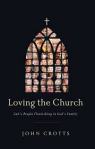
loving the churchI first noticed Loving the Church by John Crotts a few years ago when Carrie reviewed it. It struck a chord with me because I have seen a general trend in recent years of people leaving the church, primarily because of all its problems or imperfections or its lack of meeting their needs. When I commented to Carrie that I would probably get the book, she offered to send me her copy. And I am ashamed to say it has been sitting in my bedroom neglected all this time, mainly because I tend to gravitate toward fiction rather than nonfiction, even though this is a topic important to me. But the TBR challenge provided a good opportunity to get to some of those books I hadn’t yet, and I knew this was one I wanted to include.

Crotts begins the book with a fictional group of people coming together at a coffee shop. None are rebellious or malcontents, but all except one are not attending what we would call a conventional church for various reasons: one is involved in a fulfilling ministry, one attends a house church because it keeps his family from being split up into different groups, one has been deeply wounded by the way the church responded to her when she found she was pregnant while unmarried, one has sacrificed some depth of preaching for a high tech church with a lot of singles that he can identify with and where he can possibly find a wife. As this group discusses church, they decide to continue to meet together to study what the Bible says about the church.

They turn up here and there throughout the rest of the book, but the majority of the book is a straightforward discussion of exactly what the Bible says about the church and why believers should attend.

After a brief chapter on the trend away from church over the last few years, Crotts shares from the Bible why the church is valuable. A few of the concepts he discusses are that Jesus loved the church and gave His life for it: “Husbands, love your wives, even as Christ also loved the church, and gave himself for it; That he might sanctify and cleanse it with the washing of water by the word, That he might present it to himself a glorious church, not having spot, or wrinkle, or any such thing; but that it should be holy and without blemish” (Ephesians 5:25-27), and that the church is the “pillar and ground of the truth” (I Timothy 3:15) and described as the bride of Christ. ( Search for the word “church” in a Bible search engine to discover many more. I don’t remember if he includes this one, but one of the most intriguing to me is that “now unto the principalities and powers in heavenly places might be known by the church the manifold wisdom of God,” Ephesians 3:9-11. Somehow through the church God displays His wisdom to those principalities and powers.) It’s abundantly clear that the church is important to Christ.

Crotts then goes on to define the church and discusses the difference between what we call the universal church (all believers everywhere) and the individual local church. Some say that the verses about the church refer to the church universal, but the epistles were written to specific local assemblies which were called churches. “A local assembly…is not just some tiny part of the universal church, like the pinkie toenail in the universal body of Christ. It is better understood as a local expression of the body of Christ – complete in itself” (pp. 44-45).

Crotts also discusses the description  and function of the church from the Bible, the headship of Christ, the purpose of elders and deacons, the giftedness each member provides to minister to the others in the assembly.

Of the several quotes I marked, here are a couple that stood out to me:

The goal of mutual ministry within the church is maturity in Jesus. This is described as “the unity of the faith and of the knowledge of the Son of God” (Ephesians 4:13). The combination of unity and the knowledge of Christ shows that Paul is not maximizing superficial togetherness by minimizing doctrinal content. Voices calling Christians to forget about doctrinal differences and just love Jesus do not represent Christian maturity….Community-wide gatherings or projects that merge churches that don’t believe in the Bible, Jesus, or salvation with churches that do, are a hollow shell of what the Lord intends when he commands us to be in unity around the truth. No matter how sincere the motives of people organizing such events, in the end, the truth becomes watered down instead of strengthened, and unfortunately, weak doctrine turns out weak Christians. In Colossians 1:28, Paul describes the goal of his ministry: “Him we proclaim, warning everyone and teaching everyone with all wisdom, that we may present everyone mature in Christ” (p. 56)

Don’t you need shepherds to guide you? Jesus thinks you need them! It is terrible pride to assume that you don’t need what Jesus designed for his glory and your family’s good (p. 95).

What I find most refreshing about this book is that it is a discussion and exposition from the Bible, not just opinions or quotes from what this or that author says. It’s very readable but very thorough. I also appreciate that in general he didn’t go further than the Bible. I think he said some place, but I forgot to mark where, that every church in every time and culture will not look exactly the same because the Bible does grant a certain amount of latitude in exactly how to “do church.” Missionaries through the centuries have had to learn that their goal isn’t to replicate a church exactly like the one back home, but they’re to keep to Biblical principles and incorporate them into the culture in which they minister.

The last couple of pages of this book lists negative consequences of neglecting church, among them, “thwarting Jesus’ plan, unconsciously saying that your plan for your Christian life and family is superior to His,…rejecting a chief means He has given for your spiritual growth,…boycotting the place He designed for your service,…missing great opportunities for spiritual influence from like-minded believers,…teaching your children to disobey Jesus by your example” (pp. 129-130).

One thing I wish the author would have included was a brief history of the church. He didn’t really answer the question about house churches except to say that they don’t include the authority structure of elders and deacons that the Bible calls for. I’ve often wondered exactly how the early church in Acts met. Acts 2:41 says 3,000 were added to the church in one day, but Romans 16:5 and Colossians 4:15 refer to churches that meet in someone’s house. They didn’t have mega-churches or large places to meet in that day and obviously some did meet in houses. I don’t know if perhaps the individual house churches were connected to each other or exactly how it worked. I know some who have felt that house churches are more Scriptural, but personally I think that’s where the latitude of Scripture comes in: in Acts the church was a new enterprise and they were under persecution. A 21st century church in a country with religious freedom is going to look a little different. But I would say that making individual churches into little empires is going beyond from the Bible’s intentions.

Some will quibble about the author’s definition of pastors and elders, but I think that can be set aside for the larger purposes of the book (I think that is an area Christians can disagree on and still be friends). I may have disagreed with a minor point here and there, but nothing that I thought important enough to make note of. The only note that jarred me a little was his continual emphasis on Christians helping each other toward Christlikeness by helping them see their sins and blind spots. While that’s true, and overemphasis on that point can lead to nit-picking and fault-finding. That’s an area I admit to having a hard time finding the balance in. I tend to avoid confrontation, but when I feel most stirred up towards it, it is usually due to personal irritation and offense rather than a concern about the other person’s maturity in Christ. Sometimes we see things not so that we can jump in to do the Holy Spirit’s job, but rather to pray for the person involved. It takes a great deal of care, delicacy, and being closely in tune with and filled with the Holy Spirit to confront someone. I think the author would say that as well, and he is not advocating that we all become spiritual policemen. He does emphasize that  “love must mark a Christian’s motives and manner in ministering God’s Word to other believers” (p. 58).

I want to close with a brief comment about leaving church because of its faults and failures. The church has always been full of faults and failures because it is full of sinners. Many of the epistles are written to churches about how to correct their problems (which is an admission that they have them!), and in Revelation 2 and 3, Jesus commends and condemns certain aspects of seven churches. One of the things we’re supposed to do in church is help each other towards more Christlikeness, and all the Bible “one anothers” are to be exercised in the context of church (in everyday life, too, but they were given specifically in letters to churches). One of them is “Forbearing one another, and forgiving one another, if any man have a quarrel against any: even as Christ forgave you, so also do ye” (Colossians 3:13). There wouldn’t be a need for forbearance and forgiveness unless we failed each other or irritated each other. But because we do, we’re to “Put on therefore, as the elect of God, holy and beloved, bowels of mercies, kindness, humbleness of mind, meekness, longsuffering…And above all these things put on charity, which is the bond of perfectness” (Colossians 3: 12,14). There may be times to leave a specific church if it falls away from the truth of the Bible, and in Revelation Jesus said some churches were in danger of their candlestick removed, but the Bible doesn’t portray completely leaving the church as an option.

I don’t know anything about John Crotts other than what I have read in this book, but I heartily recommend it.

For more on this topic, see also previous posts here on Why Go to Church? and The Community of Believers as well as Lisa’s 7 reasons why I still go to church. Incidentally, at the time of this writing Loving the Church is available in a Kindle format for $1.99.

(This will also be linked to Semicolon‘s Saturday Review of Books.)

Eternal Glories Gleam

Our church was stunned and heartbroken yesterday to learn that our dear pastor has cancer of the liver and pancreas and is only expected to live 6 months to a year.

He had been losing weight over the past few months, had been really sick the past few weeks, went to the doctor – thankfully a member of our church and long time friend – last week for tests, where it discovered both his liver and pancreas are full of cancer. The pancreatic cancer is incurable and inoperable. He is having biopsies this week to confirm it, and there is a small chance that what they saw on the scans is not cancer, but everything else points to it. They are planning to start chemotherapy in hopes of slowing it down to some degree, but of course that carries its own set of problems.

He is in his early 50s with a wife and three daughters, two of whom are getting married this summer, and the youngest is schedule to go to college in the fall.

He has been preaching through the book of Romans, and providentially we were in the latter half of chapter 8 yesterday, which was so applicable to his situation. As he spoke to us yesterday, one of his concerns was that we think in a right way about his situation, that we not think God is mean or unfair or unkind. He had different men from the church read passages like Psalm 23 and II Corinthians 4:7-11:

.But we have this treasure in jars of clay, to show that the surpassing power belongs to God and not to us. We are afflicted in every way, but not crushed; perplexed, but not driven to despair; persecuted, but not forsaken; struck down, but not destroyed; always carrying in the body the death of Jesus, so that the life of Jesus may also be manifested in our bodies. For we who live are always being given over to death for Jesus’ sake, so that the life of Jesus also may be manifested in our mortal flesh.

And II Corinthians 4:16-18:

So we do not lose heart. Though our outer self is wasting away, our inner self is being renewed day by day. For this light momentary affliction is preparing for us an eternal weight of glory beyond all comparison, as we look not to the things that are seen but to the things that are unseen. For the things that are seen are transient, but the things that are unseen are eternal.

And II Corinthians 12:9-10:

But he said to me, “My grace is sufficient for you, for my power is made perfect in weakness.” Therefore I will boast all the more gladly of my weaknesses, so that the power of Christ may rest upon me. For the sake of Christ, then, I am content with weaknesses, insults, hardships, persecutions, and calamities. For when I am weak, then I am strong.

We know and love and take comfort in those truths but sometimes we tuck them away for “some day…”

Ecclesiastes 7:2 says, “It is better to go to the house of mourning than to go to the house of feasting, for this is the end of all mankind, and the living will lay it to heart.” Not that there is anything inherently wrong with feasting or celebrations: God created some for the Israelites to enjoy, and Jesus attended a wedding. But when someone faces death, certain truths crystallize into sharp focus. All of a sudden the petty irritation that was bothering me that morning wasn’t important. I was reminded that death comes to us all, sooner to some than expected, but God’s grace so wonderfully provided that we can be forgiven; that heaven is real; that this life really is but a vapor; that however good it is, heaven is better. I was reminded that we weren’t promised a life free from suffering on this earth; in fact, the Bible gives us plenty of warning about it and promises God’s help for it and assures us that He really, truly is our refuge and strength, a very present help in trouble (Psalm 46:1).

Last night a line from a hymn kept coming to mind, “Eternal glories gleam afar.” I couldn’t remember what hymn it was from, so I looked it up this morning and was surprised to find it was from “I’ve Found a Friend,” a song I haven’t heard in ages. The stanza containing that phrase says:

I’ve found a Friend, O such a friend! All pow’r to Him is given,
To guard me on my onward course, and bring me safe to heaven.
The eternal glories gleam afar, to nerve my faint endeavor;
So now to watch, to work, to war, and then to rest forever.

In situations like this, those eternal glories aren’t quite so far off: they are up close and personal.

This is going to be a heart-wrenching journey, especially for this man and his family, but also for our church as a whole. I know you all have your own churches and issues and prayer lists, but if you feel led, I’m sure all involved would appreciate your prayers.

Repost: God Does So Much More Than Just “Show Up”

(With different circumstances in my life right now, I am finding it a little difficult to have my brain working on all cylinders and be awake and alert when I have time to spend at the computer. I have a few posts percolating on the back burner that I hope to get a chance to work through soon. But I thought in the meantime maybe once a week or so I’d repost something from my archives here. I thought about making it a series and calling it “The Summer of Reruns.” 🙂 Seriously, though, sometimes going back over something God has taught or encouraged me with in the past makes for fresh blessings. I hope some of these will bless you as well, whether you saw them the first time or not.)

From October, 2009:

I have seen a particular phraseology going around recently that really bothers me:

“God really showed up.” “Pray that God shows up in a big way.” “I hope God shows up for this event.”

If you have said or written this, please don’t take offense or think I am fussing at you. I can’t remember for sure where all I have seen it. I’m speaking in generalities because I am starting to see this more and more and I want people to realize what it sounds like.

It bothers me for a few reasons.

1. God does not “show up.” He is omnipresent. (See Psalm 139:5-12, Jeremiah 23:23-24.)

2. Making our plans and then hoping God “shows up” is going about things backwardly. We should be seeking His guidance beforehand and all along the way.

3. The phrase “show up” seems to indicate the person wasn’t really expected, or at least his attendance was iffy. “I invited Tom, but I am not sure he’ll show up.”

4. The phrase also seems to indicate the person showing up took the invitation casually and just decided to “show up” — maybe on a whim, maybe because he couldn’t find any better options.

5. When I posted this the first time, someone commented that sometimes we say God “showed up” in a meeting when things got exciting. Sometimes we have more of a sense of His working or we’re touched in a special way, but that’s not to say He is not always meeting with us. Jesus said, “Where two or three are gathered together in my name, there am I in the midst of them” (Matthew 18:20). We know He is present by faith, not when we “feel” it or when the bells and whistles go off.

I think I know what people mean when they want God to “show up”:

“I hope God really blesses this event/situation in such a way that people see it was something only He could do.”

“I want God’s presence to be manifested in a way that touches people’s hearts and draws them to Him.”

“I pray God’s power will be evident.”

Why not say it that way? It’s more accurate, more reverential, and more glorifying to God.

Here are some Scriptural examples of those desires:

“Help me, O LORD my God: O save me according to thy mercy:That they may know that this is thy hand; that thou, LORD, hast done it.” Psalm 109:26-27.

“O God, thou art my God; early will I seek thee: my soul thirsteth for thee, my flesh longeth for thee in a dry and thirsty land, where no water is; To see thy power and thy glory, so as I have seen thee in the sanctuary.” Psalm 63:1-2.

“This beginning of miracles did Jesus in Cana of Galilee, and manifested forth his glory; and his disciples believed on him.” John 2:11.

“Jesus answered, Neither hath this man sinned, nor his parents: but that the works of God should be made manifest in him.” John 9:3.

“And [Moses] said, I beseech thee, shew me thy glory.” Exodus 33:18.

“That all the people of the earth might know the hand of the LORD, that it is mighty: that ye might fear the LORD your God for ever.” Joshua 4:24.

“And it came to pass at the time of the offering of the evening sacrifice, that Elijah the prophet came near, and said, LORD God of Abraham, Isaac, and of Israel, let it be known this day that thou art God in Israel, and that I am thy servant, and that I have done all these things at thy word.Hear me, O LORD, hear me, that this people may know that thou art the LORD God, and that thou hast turned their heart back again.” I Kings 18:36-37.