Dealing with Distractions During Prayer

Distractions during prayer

If you’re like me, settling down to pray triggers all kinds of distractions. It’s not so much that other people interrupt me, though that happens occasionally. The problem is usually in my own mind going a dozen different directions.

Here are some practices that have helped me:

Allow for quiet time during the day. I think one reason our thoughts scatter so much is that we don’t often have quiet time to just think any more. If I am cooking or cleaning in the kitchen, I turn the Christian radio station on. If I am driving or getting ready for the day, I listen to music or an audiobook. All of those things can be edifying in themselves. But especially if you are an internal processor like me, your mind needs time to think things through. So allowing for some quiet thinking time during the day helps our thoughts not to go so far afield when we sit down to pray.

Keep a notepad nearby. If I suddenly remember an item I need to add to the grocery list or a blog idea or an appointment I need to make while I am praying, I jot it down to take care of when I am done. That way my mind isn’t struggling to remember those things while also praying. You could also use the notes app on your phone, if the phone itself wouldn’t be a distraction.

Deal with your phone. You may want to silence your phone, depending on whether someone might need to get in touch with you. I have some prayer prompts on my phone, but otherwise I put it in my pocket or turn it face down on my desk. I have most notifications turned off anyway because I don’t like my phone dinging all day. I check my email and social media often enough that I don’t need my phone to tell me every time something comes through for me.

Pray out loud. Depending on whether or not I am alone, praying aloud or in a whisper can keep me focused.

Walk or do something active while praying. Sitting with head bowed and eyes closed makes some of us sleepy. I know many people who like to pray when they take a walk.

Integrate prayer with Bible reading. We often divide prayer and reading into two separate activities. But we can pray as we read. When we come to a passage about praise, we can praise the Lord right then. If something from the Bible convicts us, we can confess that o the Lord immediately and ask for His help.

Use prayer lists. I didn’t always like prayer lists. I felt that if prayer is just talking to my Father, then wouldn’t it seem weird to bring Him a list instead of just talking to Him normally? But then I realized I do use lists when I talk to people. I always jot down things I want to discuss with the doctor before I see him. I might even do the same before calling or FaceTiming my son–even though we can text or email, some things that are better discussed when we’re actually talking. I think God knows our frailties and doesn’t mind if we use aids to prayer.

Pray throughout the day. In my early Christian life, I felt like I hadn’t officially prayed for something unless I prayed about it during my devotional time. But that can result in a ridiculously long prayer list. Plus I might forget a request I heard during the day. Now I try to pray for a request immediately when I hear or see it. With all our other relationships, we have shorter conversations throughout the day and then longer, one-on-one times. It can be that way with the Lord, too: we don’t have to confine all our prayer to our devotional time.

Divide up requests. Some people pray for their country one day, their church another day, their family another day, missionaries one day, and so on. Others pray through their church directory a few people at a time.

Use prayer prompts. I like to use Scriptural prayers to start off my prayer time. Most often I use what we call “the Lord’s prayer.” For instance, I might start, “Our Father . . . Thank you for being My Father. Thanks for making me Your child. Thank you for giving us a picture of a loving Father and child to understand your care of us.” And I go through the rest of that prayer in like manner.

I also like to use prayers like Paul’s in Colossians 1:9-12 or Ephesians 3:14-19 for myself and others. I’ve made a list of them in my notes app as I have found them.

Though I am not quite as fond of prayer acronyms, I did find them helpful in keeping me focused when I first started praying. One is PRAY:

Pray
Repent
Ask
Yield

Another is ACTS:

Adoration
Confession
Thanksgiving
Supplication

Confess and carry on. When I find my thoughts miles away while praying, I just usually say, “I’m sorry, Lord,” and get back to it. Sometimes the thing my mind runs to is something to stop and pray about.

Let distractions remind us of our need. Elisabeth Elliot once wrote in A Lamp For My Feet:

Distractions can be useful. They provide constant reminders of our human weakness. We recognize in them how earthbound we are, and then how completely we must depend on the help of the Holy Spirit to pray in and through us. We are shown, by a thousand trivialities, how trivial are our concerns. The very effort to focus, even for a minute, on higher things, is foiled, and we see that prayer–the prerequisite for doing anything for God–cannot be done without Him. We are not, however, left to fend for ourselves. The Spirit too comes to help us in our weakness.

What about when people distract us? Jesus faced that as well. He took care to pray alone at night or early in the morning, but people still found Him and interrupted Him. A Sunday School teacher from years ago once said that when someone called his home during family devotions, he wanted to answer the phone by saying, “Do you realize you’re being used of the devil right now?” But Jesus never responded in such a way when His time with His Father was interrupted. He always responded graciously. It is taking me a long time to learn that God is over even our interruptions.

I think one of the most important things to remember about prayer is that it is not a performance or a ritual. We’re talking to our loving Father when we pray. We can lay our hearts bare in all our humanness and imperfection, knowing He loves us and wants what is best for us.

Romans 8:26

(I often link up with some of these bloggers.)
When Spiritual Disciplines Seem Dull

When Spiritual Disciplines Seem Dull

Some parts of the Old Testament are exciting, but others can be a little tedious to read. Our Bible study group is in the section of Exodus talking about the furniture in the tabernacle and the priest’s garments. Thankfully, the book we’re using as an accompaniment has been helpful in pointing out the symbolism behind each item.

I wondered, though, how much the people in that day understood the symbolism. Some connections might be obvious: the cherubim in the curtain between the Holy Place and the Most Holy Place echo the cherubim standing guard at Eden after Adam and Eve sinned. The names of the children of Israel on the high priest’s ephod symbolized his carrying the whole nation into the presence of God to pray for them. The mercy seat situated on top of the ark of the covenant, which contained the tablets on which were written the ten commandments, is a rich picture of God’s mercy and righteousness meeting together.

But Old Testament saints didn’t have the fulfillment of some of those symbols in Jesus or further explanation in the book of Hebrews. So I wondered if sometimes they got lost in the details, or if carrying them out felt as tedious as reading about them. I’m pretty sure they did. Israel had to be called back to true worship of God many times over the centuries. The Pharisees had mastered the letter of the law but missed the point of it all. In Malachi, God rebuked His people for bringing polluted offerings and saying, “What a weariness this is” (Malachi 1:13).

Sadly, we can feel that way in our day, even with all the information and explanations we have. The Bible sometimes seems dull and our spiritual disciplines seem lifeless.

First, we need to ask the Lord to search us and show us whether any sin is interfering. When there is a problem in any of our close relationships, our interaction with that person will be somewhat strained, maybe a little artificial, certainly not as free and natural as usual until we deal with the issue. It’s the same with the Lord. When there’s something wrong between us, things won’t feel right until we clear the air.

Often, though, dullness or tedium in our spiritual routines comes from our flesh, our humanness.

What do we do then?

I appreciated what one lady in our Bible study said. When she read parts that were less than exciting, she reminded herself, “All Scripture is breathed out by God and profitable for teaching, for reproof, for correction, and for training in righteousness, that the man of God may be complete, equipped for every good work” (2 Timothy 3:16-17). God’s Word doesn’t have to be what we think of as exciting to be profitable.

Then, as she got into the Bible study, she saw things she hadn’t realized before that opened the passage up to her. Bible study aids, commentaries, and even just discussing the passage with others can shed new light for us.

We can pray, asking God to open our minds and hearts to His truths and revive us. Sometimes I remind myself that His Word is true and precious and spiritual disciplines are helpful even if the right feelings aren’t there. The writer of Psalm 80 requests three times, “Turn us again, O God of hosts, and cause thy face to shine; and we shall be saved.”

Sometimes reading through parts of Psalm 119 can reinspire my love and appreciation for God’s Word.

I remind myself as well that God doesn’t adapt Himself to my way of thinking and my ideas of how things should be. He expects me to adapt to His.

And I remind myself to keep reading and obeying. Our spiritual disciplines–prayer, Bible reading, communion, serving, etc.–are valuable even when nothing seems to be coming from them. Sometimes a session with the Bible that starts out feeling dry can suddenly touch my heart in an unexpected way. Even if that doesn’t happen, His Word is still beneficial. I’ve often said that every meal is not a Thanksgiving feast, yet even the peanut butter sandwiches and tuna casserole nourish us, and in the same way, the Bible does good things in our hearts and minds whether the passage is exciting or not.

It’s the same with prayer, communion, and the rest. Sometimes it seems we’re just going through the motions. It helps to stop and remind ourselves why we do what we do and do them in faith even if inspiring feelings aren’t there.

May God give us grace to always see His word and ways as precious and beneficial. When we get weary, may He revive us and open our hearts.

Psalm 119:14

(I often link up with some of these bloggers.)
Do You Need a Fresh Word from the Lord?

Do you need a frsh word from the Lord?

Have you ever heard anyone say they needed a “fresh word” from the Lord?

I pondered recently what would prompt someone to say that.

Perhaps they’re bogged down in Leviticus.

Perhaps the old truths just seem . . . old.

Perhaps they haven’t felt the fervency they used to when reading the Bible.

Perhaps they have questions they can’t find the answer to in the Bible.

Perhaps they haven’t seen God move in life like He did in His Word.

It’s good to ask ourselves these questions and try to figure out where the problem is. I want to encourage us that the Bible is living, active, sharp, piercing, discerning (Hebrews 4:12).

The Bible is breathed out by God and profitable for teaching, for reproof, for correction, and for training in righteousness (2 Timothy 3:16).

God has granted to us all things–all things–that pertain to life and godliness, through the knowledge of him who called us to his own glory and excellence, by which he has granted to us his precious and very great promises (2 Peter 1:3-4).

All of these and other passages show that we don’t need something new and fresh from God. What He has given us is more than sufficient for our spiritual needs.

Why doesn’t it always feel that way?

Well it could be something as simple as not getting enough sleep. I know what it is to battle drowsiness all through my Bible reading and not get anything out of it. Going to bed earlier or moving devotions to later in the day might help. Doing something active before reading can help wake us up.

Distractions are a problem. I don’t know how many times I have started to pray or read and had to keep bringing my mind back from other thoughts. Sometimes I treat my thoughts like my phone and mentally swipe away all the open tabs. I pray for God’s help and then perhaps read out loud or change my position or location. I keep a notepad nearby to jot down thoughts about things I need to take care of.

Something might be blocking our communication. In any relationship, when something is wrong, our communication isn’t what it should be. If we ask God to search us and show us what is wrong, He will. We can then confess any sin and put away anything that is displeasing to Him.

What about Leviticus–what a friend referred to as the place where Bible reading plans go to die? Someone said all of the Bible is inspired but it’s not all inspiring. It helps to remind ourselves of the verses above, that this is part of God’s Word, too, and He has a purpose for it in our Bibles.

Studying some of these difficult passages with others, or using a good study aid or commentary, helps as well. They can open our eyes to things we missed in our own study.

When our ladies’ Bible study went through Hebrews, someone remarked that it would be good to study Leviticus and Hebrews together. Hebrews explains a lot of the symbolism in the Old Testament systems of worship.

Also, after reading from Leviticus or Chronicles, it might help to spend time in the psalms or in passages that have been especially meaningful to us in the past.

What about those unanswered questions? Sometimes the answers are there, but we haven’t found them yet. Asking a friend who is further along in their Christian walk or a pastor or Bible study leader can shed light.

But sometimes the answers just aren’t there. Deuteronomy 29:29 says “The secret things belong to the LORD our God, but the things that are revealed belong to us and to our children forever, that we may do all the words of this law.” God wants us to know Him well enough through the Word He has given us we can trust Him for what He hasn’t shared.

In New Testament times, people called Gnostics taught that there was a secret, special knowledge that only a few people knew. Though Gnostics are not named in the Bible, the epistles warn against their teachings. Mark Howell writes “The proclivity of many Christians is to be constantly on the lookout for some new thing to breathe life into the church. But according to Paul, the answer will not come by finding something new; it will come when the church renews its focus on something old—the Scriptures.” (Exalting Jesus in 1 & 2 Thessalonians [Christ-Centered Exposition Commentary], p. 238)

If we’re feeling bored, maybe we need to change our routine. Or we may need to pray for God to wake us again to the wonders in His Word. I love the King James word “quicken,” often translated “revive” in other versions. Many verses talk about God’s Word itself quickening us (Psalm 119:25, 50, 93; John 6:63).

We need to remember, too, that feelings aren’t always the mark of spirituality. Nothing beats those times in the Bible when God speaks to our hearts in a special way and we’re encouraged, our hearts are warmed, and we’re ready to face the day with hope and love. But just like any relationship, those warm, close times will come and go. Many of our conversations with loved ones are filled with necessary but mundane everyday details.

Every meal won’t be a Thanksgiving feast. But even the tuna casseroles and peanut butter sandwiches nourish us. Similarly, every time in the Bible won’t bring 4th of July sparks, but every reading benefits us. It’s that faithful everyday adding to and building upon what we know that strengthens us. And that in turn lays the foundation for those special, eye-opening, heart-warming moments.

We’ll always find new insights as we keep reading the Bible. But often what we need is the reminders of what we’ve learned before.

The hymn “How Firm a Foundation” begins with this stanza:

How firm a foundation, ye saints of the Lord,
Is laid for your faith in His excellent word!
What more can He say than to you He hath said,
To you who for refuge to Jesus have fled?

Dan Forrest’s arrangement of this hymn weaves that phrase from the first stanza–“What more can He say?”–between each of the other stanzas that focus on specific passages from the Bible. . 

He’s already given us “all things that pertain unto life and godliness.” What more can He say?

2 Peter 1:3-4

(I often link up with some of these bloggers.)
Your Soul Needs Food Even When It Doesn’t Want It

Your soul needs food

You’re sick. Your sinuses are inflamed, your throat is raw, your nose is red, drippy, and chafing. You have a fever and ache all over. And you don’t feel like eating.

But you do eat. Nothing sounds good, except maybe the proverbial remedy for a cold, chicken soup. But you eat because your body needs it. And the very food you don’t have an appetite for not only nourishes you, but helps your body fight infection and get well.

The same is true spiritually. When something is wrong in our lives, when we’re in some kind of dark valley—we tend to put God’s Word aside. Our appetite for it has waned.

But we need the Bible then more than ever. We may not be able to keep up with our usual routine or an intense study. But we need to keep sipping and tasting. We might spend more time in the Psalms or favorite passages than other passages. We might listen instead of read.

And the very Word we don’t have an appetite for not only nourishes us, but helps us heal. It will strengthen us and help us fight spiritual infection.

So when our appetite for the Word of God is off, we need to keep partaking. Our souls need it. We may not feel instant refreshment. It may seem a little dry. But we can ask God to open “the eyes of our heart” and minister to us.

Often a subdued appetite can be aroused by tasting food. It didn’t sound good, but once we had a few bites, we wanted more.

We may feel like reading the Bible is the last thing we want to do. But it’s been my experience, many times over, that once I start reading it, I want more.

Incline my heart to your testimonies, and not to selfish gain! Turn my eyes from looking at worthless things; and give me life in your ways (Psalm 119:36-37).

They loathed any kind of food,
    and they drew near to the gates of death.
Then they cried to the Lord in their trouble,
    and he delivered them from their distress.
He sent out his word and healed them,
    and delivered them from their destruction.
Let them thank the Lord for his steadfast love,
    for his wondrous works to the children of man!
And let them offer sacrifices of thanksgiving,
    and tell of his deeds in songs of joy!

(Psalm 107:18-22)

Jeremiah 15:16

(Revised from the archives)

(I often link up with some of these bloggers.)

Cultivating Awe of God’s Word

Cultivating awe of God's Word

Are you in awe of God’s Word?

If you’re like me, you’d probably say, “Not as often as I’d like to be.”

There are times when our meeting with God is special, when He gives us just what we need in the moment, we notice something new, or we’re blessed by an old, familiar, but beloved passage.

But other times—we’re sleepy, distracted, hurried, or we’re slogging through a book like Leviticus.

I was struck recently by a quote from G. K. Chesterton in Winter Fire: Christmas with G.K. Chesterton: “The world will never starve for want of wonders; but only for want of wonder.” Though he wasn’t talking about the Bible there, I felt what he said was true of the Bible as well.

Chesterton’s quote reminded me a couple of verses:

How precious to me are your thoughts, O God! How vast is the sum of them! (Psalm 139:17.

My heart stands in awe of your words. I rejoice at your word like one who finds great spoil (treasure, plunder) (Psalm 119:161a-162).

So what can we do when we feel less than awed by God’s Word?

Employ practical helps. It’s hard to be awed when we’re sleepy or distracted. Getting enough sleep, choosing a more wakeful time of day, taking a shower or doing a few minutes of exercise first can help us be more alert. Removing distractions as much as possible helps: turning off the phone, choosing a time you can be somewhat alone, etc.

Pray. Psalm 119:18 is an apt prayer: “Open my eyes, that I may behold wondrous things out of your law.” When we’re dull in spirit, we can appropriate another of the psalmist’s prayer: “I am greatly afflicted; Renew and revive me [giving me life], O LORD, according to Your word” (Amplified Version).

Remember:

Who is speaking to us. I’m inspired by what George Guthrie says here: “I am still blown away by the idea that the God of the universe wants to communicate with us on a daily basis and that he has chosen to do so in this miraculous book we call the Bible.” As we meditate on who He is and the ways He has worked in our lives, our hearts will warm towards Him and His Word.

That God chose these specific words for us. Psalm 139:17-18 says God’s thoughts are vast, more than the sand. One of our former pastors used to say that the Bible is divinely brief. Out of the multitudes of things God could have said, He inspired and preserved in the Bible what He wants us to know. So each sentence has a purpose.

The cost and privilege of having a Bible in our own hands. Most people didn’t until after the printing press was invented in 1440 AD. Even when it became widely used, books were too expensive for many people to have. When books became more widespread, brave men like William Tyndale labored and gave their lives to have it translated into English that everyday people could read.

Past experiences with the Bible. Remembering some of those special times in the Bible that I mentioned at the beginning can reawaken our desire for it to speak to us again.

Our enemies: the world, which tries to turn our heads; our flesh, prone to wander, to laziness, to self-indulgence; and the devil, who wants to deceive and distract us. It’s no wonder we often have to fight for time and attention while reading the Bible. But the struggle is worth it.

Slow down. Sometimes we rush through our time in the Bible just to get it done or to get to other tasks. Reading a smaller amount and taking time to reflect on it is better than zipping through several chapters without retaining anything.

Ask why this passage is in the Bible. If God inspired all of Scripture, each passage is there for a purpose. What does it tell us about God?

Begin with hymns or praise. I’ve often been encouraged by missionary and writer Elisabeth Elliot’s confession in On Asking God Why: “When I stumble out of bed in the morning, put on a robe, and go into my study, words do not spring spontaneously to my lips–other than words like, ‘Lord, here I am again to talk to you. It’s cold. I’m not feeling terribly spiritual. . . .'” She found help by reading through hymns or psalms.

Get help from a good study Bible, commentary, or study group. All three have helped me by giving some background or explanation of the passage or pointing out things I overlooked in my own reading.

Keep reading in spite of feelings, or the lack of them. Another former pastor said that one of his best times of prayer began with his confession that he didn’t feel like praying. It often happens that way with Bible reading, too. We might not feel awe-inspired as we begin. But the Bible says it is living and active (Hebrews 4:12). As we read, God speaks to us and enlivens us. Even if we don’t feel any differently after reading, God has fed us.

Thank God for what we read. We often divide our quiet time with the Lord into prayer and Bible reading. But we can integrate those activities. When we read of God’s love, we can thank Him for sharing His love with us. When we read an example of His love, power, or wisdom, we praise Him for them right as we read. We can turn some of the verses into prayer and praise. Awe of God’s Word is not an end in itself, but leads us to awe of our God.

In the Everyday Gospel Christmas Devotional, Paul David Tripp says:

The beginning of Matthew presents us with a majestic one-time moment in history that you shouldn’t run past in your desire to complete your daily Bible reading. God has recorded and preserved it for you because he wants it to leave you in gratitude and awe. And that awe is meant to capture your heart with such force that it changes the way you think about who you are and how you live your life. (December 16 reading).

Awe in our Bible reading doesn’t just help us enjoy it more. As Tripp says, awe captures our hearts in order to change us. Awe is part of beholding Him: “And we all, with unveiled face, beholding the glory of the Lord, are being transformed into the same image from one degree of glory to another” (2 Corinthians 3:18).

“The world will never starve for want of wonders; but only for want of wonder,” Chesterton said. There is much to inspire awe and wonder in the Bible. May God give us eyes to see and hearts to understand.

awe of God's words

(I often link up with some of these bloggers.)

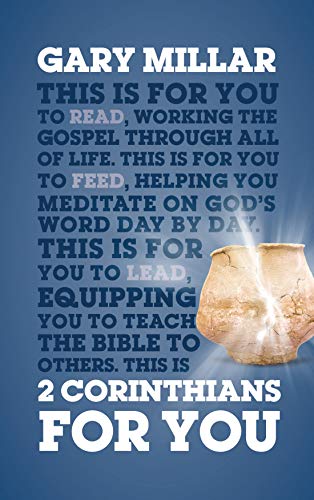
Review: 2 Corinthians for You

2 Corinthians for You by Gary Millar

The Corinthian church was one of the messiest ever known. Factions divided over favorite preachers. Their church dinners became feasts for the well-off members, while the poor ones were left out. Some were involved in such blatant sin as a man sleeping with his mother-in-law. Their culture honored eloquence in public speaking and scorned Paul because he didn’t speak or write that way. They rejected his authority as an apostle.

Most of us would avoid a church like that. But God hadn’t given up on them. He inspired Paul to lovingly rebuke, plead with, teach, and encourage them toward a right relationship with God, each other, and himself.

2 Corinthians is actually the fourth letter Paul wrote to the church. 1 Corinthians was the second. We don’t have the first and third, but Paul refers to them. Between the second and third letter, Paul made a “painful visit” to them to try to set things right and sent some of his coworkers to them as well. His care was evident: he didn’t just dash off a rebuke and leave it at that.

Gary Millar guides us through Paul’s letter in 2 Corinthians for You. He takes an expository approach, covering anywhere from a few verses to a chapter and a half from 2 Corinthians in each of his chapters. He explains the culture of Corinth at that time, a Grecian city with heavy Roman influence and a large number of Jewish exiles. He puts the pieces together from 1 Corinthians and Acts to help us understand this letter of Paul’s better.

Though he gives us a lot of helpful information, his style is easy to read and not academic. He does an excellent job pulling out application from the Corinthians and Paul to our lives hundreds of years after 2 Corinthians was written.

One of the themes throughout the book is weakness. The Corinthians thought Paul was weak, and he said, in effect, “That’s right.” He refers to his weakness thirteen times in this letter. One reference is the famous passage many of us lean on in 12:9-10, where, after praying three times for God to remove whatever his “thorn in the flesh” was, Paul writes, “But he said to me, ‘My grace is sufficient for you, for my power is made perfect in weakness.’ Therefore I will boast all the more gladly of my weaknesses, so that the power of Christ may rest upon me. For the sake of Christ, then, I am content with weaknesses, insults, hardships, persecutions, and calamities. For when I am weak, then I am strong.”

Paul repeatedly points out to the Corinthians that the church is God’s, to be conducted the way He wants. And ministry is done for Him and through His power.

Throughout both letters, Paul demonstrates Christian love, which mourns over sin, rebukes when needed, pursues even those who think we’re enemies, and gives of itself. One of many verses that stood out to me was “I will most gladly spend and be spent for your souls” (2 Corinthians 12:15). At times I have felt utterly spent after ministering in some way, and this verse reminds me, yes, it’s supposed to feel that way. As God pours into us, we give out to others.

I have mnay places underlined and noted in Millar’s book, but here are a few quotes that stood out to me.

When the gospel is our absolute priority, we will be predictably, reliably faithful to the gospel, even if it means that our plans may change when the progress of the gospel demands it. And how can we pull that off? Once again, it’s because God hasn’t simply told us to be like Christ, he has intervened in our lives powerfully and dramatically to enable us to be like Christ (p. 35).

When Christ is preached, God works by the Spirit to show people how stunningly, gloriously beautiful Christ is. We should keep going because the ministry which God has given us reveals the glory of God in the face of Christ, and there is no greater beauty, no greater privilege, no greater experience for human beings than this (p. 57).

A basic step in a lifetime of gospel ministry is to get over ourselves, to realise that ultimately whether people like us or not doesn’t really matter. Whether we’re perceived as successful or not doesn’t matter. Whether we’re recognised or not doesn’t matter. All that matters is preaching Christ as Lord. We keep going because it’s about him, not us (p. 67).

Ministry that isn’t borne out of love for people will be miserable for you and miserable for the people you are supposedly serving! (p. 114).

Investing in people is costly and time-consuming. The hardest this about ministry is always people. It doesn’t matter how extrovert or introvert you may be, it doesn’t matter how much you like the person or you struggle with them. Investing in people always drains energy and sucks up time. But remember—people don’t take you away from your ministry; they are your ministry (p. 115).

We must do everything in our power to remember that we never get past needing God to work in us (and through us) by his grace (p. 146).

Every time we look at another person and measure ourselves against them—we are throwing the door wide open to pride (if we can find a way to score ourselves higher than them) or its twin sister, self-pity (if we can’t). Every time we compare, we throw living by grace through faith out the window and start to run with a gospel of good works. Every time we compare, we swap living to please God with living to please ourselves, under the guise of impressing other people—and it stinks! (p. 151).

Let me challenge you right now to set yourself to hold onto the truth, and to ask God to give you a highly sensitive theological radar for the sake of the church in years to come. Be ready to think through the implications of every new idea, and be ready to fight for the truth . . . don’t swap the truth for lies (p. 160).

Real ministry is always accountable to God, saturated in and motivated by Christ himself, and has the clear aim of building up the church. Everything Paul did was done with the clear purpose of building up the Corinthians (p. 178).

There were a couple of minor points where I disagreed with Millar, but overall, I thought this book was a great companion and aid in getting the most out of 2 Corinthians.

(Sharing with Bookish Bliss Quarterly Link-Up)

God’s Grace for This Moment

God's grace for this moment

As we were preparing for bed one night last week, my husband shared a concern on his heart for our country, especially in regard to the next election.

I’m thankful for a husband who keeps informed and understands more about these things than I do. I’m afraid I am not nearly as interested in politics as my husband is. It’s not that I stick my head in the sand and ignore what’s going on. I believe in being informed, voting, and using our voice, especially since we have a voice and vote in this country. But sometimes it seems nearly impossible to know what’s really happening behind closed doors and what news services are trustworthy.

The country’s and the world’s problems are too big for me. There’s not much I can do about any of them besides pray. And though I acknowledge that praying is the main and best thing I can do, I get overwhelmed, frustrated, and burdened if I think too much about the needs of the world. I have enough to do with the things I have responsibility for.

As I continued my nightly routine, I began to think of some of those responsibilities closer to home. We had a few more events than usual on the calendar. At this stage of life, having a busy calendar stresses me even when I look forward to the events.

Before I go to bed, I like to read the evening selection from Daily Light on the Daily Path. At that time of night, I don’t dive deep, pull out commentaries, or look up definitions like I might during my main Bible reading in the mornings. I mainly read a few verses of truth at night to settle my mind and close my day.

This night, however, I had trouble focusing even for those few minutes. It’s not that I was worried or stressed at the moment because of national or personal needs. But my thoughts pinballed at high speed between all the different concerns on my mind.

I told myself I needed to shut everything else down and just focus at this very moment on the words of truth before me. I think I prayed that, but I don’t remember for sure.

As God helped me concentrate, these are some of the verses I read:

My God shall supply all your need according to his riches in glory by Christ Jesus (Philippians 4:19).

God is able to make all grace abound toward you; that ye, always having all sufficiency in all things, may abound to every good work (2 Corinthians 9:8).

We have this treasure in earthen vessels, that the excellency of the power may be of God, and not of us (2 Corinthians 4:7).

Instantly, my mind, heart, and soul were at rest. All of these verses were familiar to me, but I needed them once again. Whatever is ahead, on a personal, national, or global level, God’s grace is sufficient.

Decades ago when we took a childbirth class during my first pregnancy, our instructor had a couple from one of her previous classes come back and share their experiences. I remember the new mom saying that during labor, if she thought, “How many hours will I have to do this?” she felt defeated and tired. But if she took each contraction as it came and used the techniques she had been taught, she coped better.

All we have to do is trust God and walk with Him in this very moment. That’s what a walk is, after all—a series of steps. We don’t have grace for what’s ahead, because we don’t need it yet. As we rely on Him step by step, He’ll carry us through whatever we have to face.

When life seems too much, just focus on this moment and rely on your heavenly Father. God’s grace is available every step.

Day by day, and with each passing moment,
Strength I find to meet my trials here;
Trusting in my Father’s wise bestowment,
I’ve no cause for worry or for fear.
He, whose heart is kind beyond all measure,
Gives unto each day what He deems best,
Lovingly, its part of pain and pleasure,
Mingling toil with peace and rest.

Every day the Lord Himself is near me,
With a special mercy for each hour;
All my cares He fain would bear and cheer me,
He whose name is Counsellor and Pow’r.
The protection of His child and treasure
Is a charge that on Himself He laid;
“As thy days, thy strength shall be in measure,”
This the pledge to me He made.

Help me then, in every tribulation,
So to trust Thy promises, O Lord,
That I lose not faith’s sweet consolation,
Offered me within Thy holy Word.
Help me, Lord, when toil and trouble meeting,
E’er to take, as from a father’s hand,
One by one, the days, the moments fleeting,
Till I reach the promised land.

Lina Sandell Berg, 1865

2 Corinthians 9:8: And God is able to make all grace abound to you, so that having all sufficiency[a] in all things at all times, you may abound in every good work.

(I often link up with some of these bloggers.)
Updated to add: I wrote this a week ago without thought of Hurricane Helene. If anything would overwhelm, what I’ve seen and heard of Helene’s effects would. My heart goes out to those who are suffering in the hurricane’s wake, and I pray they find God’s presence, comfort, and provision sufficient for all their needs.

One Book That Can Speak to Everyone

One Book That Can Speak to Everyone

A few years ago, I attended my first writer’s conference. I hadn’t given any thought to attending one until I learned of a small one in a town where I used to live. I decided to try it out, and it spurred me to get serious about my desire to “write a book someday.”

I kept hearing at that conference that publishing was not what it used to be. Writers could no longer simply finish a manuscript and send it to a publisher, who would do the rest. Now publishers want potential authors to have an audience before their company will consider taking on a book.

Since shortly before that conference, I’ve been reading books, blog posts, magazine articles, and listening to podcasts about writing and publishing.

One piece of wisdom I’ve seen over and over is that telling a potential agent or publisher our manuscript is for “everyone” is a fast route to a closed door. Authors are advised to be as specific as possible in the audience they aim for.

I confess I struggle with this a little. For several years I wrote a newsletter for the ladies of the church we attended. I’m used to writing to women of all ages and stages. Occasionally we’d have an article focusing on one aspect of womanhood or another–single women, young wives and moms, older women—but most of what was written was applicable across the board. I’ve had the same approach with this blog.

Some of my favorite books seem the same way. The authors may have had a specific age group in mind, but it’s not obvious to me as I read their books. People of various ages and situations have bought certain books for years.

This trend towards specific audiences has led some books, like Gary Chapman’s Five Love Languages, to be transformed into versions for parents of children. parents of teens, singles, couples, men, and women. I wondered how he managed to write the same material for all these different groups. The illustrations would likely change in each, but it seems the basic principles would be the same.

Similarly, Stormie Omartian’s The Power of a Praying Wife led to the power of a praying husband, praying woman, praying mom, praying kid, praying teen, praying grandparent, and more.

In my more cynical moments, I wonder if this converting general books to several different audiences is a ploy of publishers and their marketers to sell more books.

But I can see that it would be helpful to take general principles and apply them to different specific situations.

These musings led me to this thought: there is one book that’s good for any age, gender, or life situation. The Bible is inspired and “for teaching, for reproof, for correction, and for training in righteousness” (2 Timothy 3:16).

There are study Bibles packaged in camouflage or sports paraphernalia for boys and pink or unicorns for girls. Bibles have been designed and illustrated for teens, women, men, even outdoorsmen.

The packaging would appeal to different specific groups, as would any devotional material or added notes. Those things can be useful. But I wouldn’t say they are truly necessary. The Holy Spirit can help us understand and apply the Bible at any age and stage of life.

Someone has said that the Bible is shallow enough for a child to wade in, but deep enough for an elephant to swim in. (1)

There are parts a child can understand. God told parents in the Old Testament to teach His Word to their children and grandchildren. Paul says Timothy has “from childhood . . . been acquainted with the sacred writings, which are able to make you wise for salvation through faith in Christ Jesus” (2 Timothy 3:15).

Of course, there are parts a child would not understand. There are parts the wisest theologian doesn’t understand completely. But I can testify, coming up on fifty years of reading the Bible with some degree of regularity, that it speaks to us and is applicable to us all through life. As we read it through different life stages, we continue to find applications to our situations.

The Bible is even good for those who oppose it. Psalm 119:130 says, “The entrance of Your words gives light; It gives understanding to the simple.” Viggo Olsen tells in his book, Daktar, how he and his wife promised her Christian parents that they would look into the claims of Scripture. However, they secretly planned to disprove the Bible so they could get her parents off their backs about Christianity. Instead, they became convinced the Bible was true and God was real. They became Christians and later went as missionaries to Bangladesh.

The same thing happened to Lee Strobel. He and his wife were both atheists and planned to remain that way. When his wife became a Christian, he tried to disprove the Bible’s reliability and claims with the zeal of the investigative reporter he was. He says in his book, The Case for Christ, that the more he searched, the more convinced he became that the Bible was true after all. He became a Christian and went on to become a minister and wrote several more books about Christianity.

There are multitudes of reasons for reading the Bible: it provides light, joy, comfort, encouragement, builds our faith, helps us fight sin, tells us more about God. But the primary reasons for reading Scripture are that it is God’s message for us and our main means of getting to know Him.

If you’ve never read the Bible, I encourage you to. You might start with one of the gospels. John gives the most in-depth look at the Son of God and His ministry.

If you’ve had a stop-and-start pattern of Bible reading, don’t be discouraged. Many of us tried in fits and starts before getting into some kind of regular pattern of Bible reading. I shared tips for finding time to read the Bible here. I’d advise starting small and simple. Too often, we make grandiose plans but then can’t keep up with them.

If you’ve been reading the Bible regularly for years, wonderful! Keep at it! There’s always more to learn, but we need the reminders of old lessons, too. If you feel you’re in a devotional rut, these tips might help.

Whatever stage of life you are in, the Bible can speak to you.

Psalm 119:130

_____

(1) Variations of this statement have been attributed to Augustine, Gregory the Great, Jerome, and John Owen, among others. Andy Naselli tells why he thinks Gregory the Great is the original source here.

(I often link up with some of these bloggers.)

Review: Read This First

Gary Millar wrote Read This First: A Simple Guide to Getting the Most from the Bible to “help people who would like to read the Bible but don’t really know where to start or how to go about it” (p. 2, Kindle version). Whether one is a new Christian or has never really gotten into regular reading, Millar hopes you will “read this first and go back to the Bible with the skills and confidence to truly enjoy it (p. 3).

First, Gary deals with the question, “Why bother with the Bible?” and lists reasons people don’t.

But he says, “I’ve written this book to help you meet a person—a living, loving, being like no other—through the pages of a book like no other. . . He made us, he loves us, he knows us inside out, and he speaks to us. And he does that through the Bible. That’s why reading the Bible matters so much—because when we read it, we meet the one and only God ” ( p. 10).

Millar assures that “the Bible was written to be understood by ordinary people like us. It doesn’t need insider knowledge or a special code to make sense of it. It’s not written for experts and professionals. It’s written for people like you and me (pp. 17-18).

Millar then gives tips on how to read, to pick up what he calls the “vibe” of a given passage, to understand different genres within the Bible, to discern meaning, and to apply what we’ve learned.

Every chapter ends with a couple of examples of Scripture to work through using the skills detailed in that chapter.

The appendix, titled “What Is the Bible?” gives a little background such as the difference between the two testaments, how we got the chapter and verse references that weren’t in the original manuscripts, and more.

Gary writes in a warm and simple style, so this book would be accessible to almost anyone.

This would be an excellent resource for someone new to reading the Bible or to anyone who feels they need a refresher course in how to do so.

Song of Solomon

Song of Solomon

Long-time readers know that I have been using Warren Wiersbe’s “Be” commentaries as companions on my current trek through the Bible. I thought he had written one for every book of the Bible. But when I came to the Song of Solomon, I couldn’t find a corresponding “Be” commentary for it. I searched all the titles. Since SoS is a smaller book, I figured its commentary was probably tucked in with another book’s. But I looked at the table of contents for all the Be books I thought it might be included with, and didn’t see it.

Then I found The Bible Exposition Commentary: Wisdom and Poetry by Wiersbe which covered Job through Song of Solomon. I found a used copy online for $3.99, so I went ahead and got it. As it turns out, the Bible Exposition Commentary series is made up of Wiersbe’s “Be” commentaries. The part dealing with SoS is only about eleven pages.

The subtitle of Song of Solomon says “The Song of Songs, which is Solomon’s.” Both Wiersbe and the ESV Study Bible notes say this means something like “the greatest of songs”—similar wording used in King of kings and Holy of holies.

There are a number of different ways to interpret SoS. Wiersbe thinks Solomon is the bridegroom in the book. The ESV notes say it’s more likely that the book was written in Solomon’s honor or during his reign, but the bridegroom in the story is a shepherd. Both sources also disagree on when exactly in the book the couple marries. But neither of these are major factors in understanding the book.

They do agree that, to some extent, the book is an allegory of God’s love for His people (Ephesians 5:31-21 also says marriage pictures Christ and the church), and on another level it’s a celebration of married love.

While the Song of Solomon illustrates the deepening love we can have with Christ, we must be careful not to turn the story into an allegory and make everything mean something. All things are possible to those who allegorize—and what they come up with is usually heretical.

It’s almost laughable to read some of the ancient commentaries (and their modern imitators) and see how interpreters have made Solomon say what they want him to say. The language of love is imaginative and piles one image on top of another to convey its message. But to make the bride’s breasts represent the two ordinances, or the garden stand for the local church, or the voice of the turtledove mean the Holy Spirit speaking, is to obscure if not destroy the message of the book. Other texts in the Bible may support the ideas expressed by these fanciful interpreters, but their ideas didn’t come from what Solomon wrote (p. 542).

(I love that line—“All things are possible to those who allegorize.” 🙂 )

There are different speakers in the book: the shepherd, shepherdess, and a chorus of others, often referred to as the daughters of Jerusalem. Thankfully, the editors of the ESV and most other modern versions puzzled out who was speaking when and provided us with designations.

We follow the bride and groom through various troubles (she doesn’t open her door to him one night and regrets it, then goes searching for him), deepening love, marriage, and admiring descriptions of each other

Both sources give helpful details in understanding the text. For instance, the bride is compared to a “mare among Pharaoh’s chariots”–but that probably means “the best of its kind,” not that she looked like a horse. Wiersbe says of some of the other descriptions of the bride in Chapter 4:

Doves’ eyes would reflect peace and depth. The bride’s teeth were clean, even beautiful. When you remember that ancient peoples didn’t quite understand dental hygiene, this was an admirable trait. Healthy teeth would also affect her breath (7:8). She had a queenly neck and a posture with it that exuded control, power, and stability. She was a tower of strength! (p. 546).

Another comment that stood out to me came from 2:10, 13), where the bridegroom says, “Arise, my love, my beautiful one, and come away.”

“Come” is the great word of the Gospel of God’s grace. It is God’s loving invitation to the weary who need rest (Matt. 11:28-30), the sin-stained who need cleansing (Isa. 1:18), the hungry who need nourishment (Luke 14:17), and all who thirst for the water of life (Rev. 22:17). But “come” is also His invitation to His own people: “Come and see” (John 1:39), “Come and drink” (John 7:37-38), “Come and dine” (John 21:12). In this text, the king invited his beloved to  leave her home and work and go with him to enjoy an adventure in the country (p. 544).

Chapter 2:3-4 says, “As an apple tree among the trees of the forest, so is my beloved among the young men. With great delight I sat in his shadow, and his fruit was sweet to my taste.
He brought me to the banqueting house, and his banner over me was love.” Elizabeth Poston wrote a beautiful song based on this passage called “Jesus Christ the Apple Tree:

The first time I read SoS, which was probably in high school, I was surprised that it contained some graphic phrases and images. The Bible is often quite frank about the body and its functions.

In early married years, I was comforted by SoS. Growing up even in an unchurched family, about all I heard about sex growing up was “DON’T.” This book and passages like Hebrews 13:4 (“Marriage is honorable among all, and the bed undefiled; but fornicators and adulterers God will judge,” NKJV) helped me understand that God created sexual love to be enjoyed by a husband and wife.

In his last couple of paragraphs, Wiersbe acknowledged the difficulty of preaching or teaching Song of Solomon in such a hyper-sexualized society as we have these days. He advised its use in premarital or marital counseling. He closed by saying:

In using this book in public ministry, we must be wise as serpents and harmless as doves and not allow our good works to be classified as evil. Some people are against anything in the pulpit that deals with sex, while others wonder where they can get the help that they desperately need. Wise is the minister and teacher who can keep the right balance (p. 550).

It had been a long while since I read Song of Solomon. It was a blessing to spend time there again, aided by the ESV Study Bible and Wiersbe’s commentary.

(I often link up with some of these bloggers.)