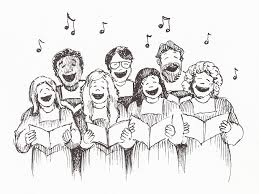
Let me say at the outset that I know some people object to the term “special music” in church, meaning songs that are performed by instrumentalists or sung as solos or groups as opposed to congregational singing, because it sounds like we’re elevating that type of music above congregational singing. In the order of service in our own church bulletin, a “special” is listed as “Ministry in music,” and that’s perfect. But if I used that phrase as a blog title, it would sound like I was writing about the whole panorama of music in the life of a church, and I am not doing that. I just wanted to share a few thoughts on this particular aspect of church music.
These thoughts were spurred some time ago by an article I saw (which I can’t find now) which advised that one way to encourage more and better congregational singing was to deemphasize the special music. I don’t know how many people saw that particular article, but it seems like that is the current trend, and I think it is a sad one, for reasons I’ll get into in a moment. We always have such a tendency to be unbalanced in one direction or another, and I think to scrap or at least downplay personal ministry in music creates a loss for the church, a loss for the musicians and their gifts as well as for the hearers who would be ministered to.
The writer of the article in question suggested that one reason people weren’t singing as well as they could congregationally was that having worship leaders and a band on stage made it seem more like they were “the professionals” and everyone else was just there primarily to listen and maybe to sing along occasionally. I have never experienced a set-up like that personally; the churches we have attended have been more traditional, with a songleader behind the pulpit and a choir behind him, and a few instrumentalists to one side. I am not knocking the other style, but I can see the point that if it is set up more like a concert, the audience will be more likely to listen than to participate. However, I really don’t think that’s the problem in most churches.
Some think that when we listen to others “perform” a spiritual song, we’re more likely to enjoy the performance rather than be ministered to by the words. And I do admit that is a danger. But I don’t think it is a reason to deemphasize performed hymns and spiritual songs. I can get distracted by how well I like a song or its melody even in congregational singing, so I think that’s largely a matter of training our minds and taking “every thought captive.” I don’t think it is wrong to enjoy the music, the harmony, the performance aspect of it, but we need to let that enhance the message rather than become the main point.
Some want to downplay “special” music in church because they feel congregational singing is more participatory, whereas with special music we’re just listening. But I disagree: listening is participating if done right. (And besides that, we don’t apply the same logic to the preaching, which is done by one and listened to by everyone else.) I think we need to train our families and ourselves to concentrate, to pay attention to the words especially, not to talk or fidget or otherwise distract ourselves and others during the performance. Part of that is just consideration and respect for those performing, but another part of it is to enhance our own ability to receive the song’s message.
For me personally, the special music, whether an offertory, solo, or ensemble, is the most worshipful part of the church service. (By the way, I don’t believe the musical segment of a service is the only time where worship takes place: worship should be what we do in every part of the service.) I do enjoy congregational singing very much, but I do get more distracted by my own voice, by the voices of those around me, by wondering when we’re going to get to sit down because my knees are killing me, by what I need to do to start dinner, etc. That is my own problem, and I work on it constantly. Our church does display the words to the songs we’re singing, and that helps immensely, but that time is the hardest time in the whole service for me to keep my mind on what I am doing. During special music, however, I’m all in and focused without really trying to be.
Besides being able to focus better personally, I think special music has value in other ways as well. Some people are gifted vocally or in ways of expressing what they are singing so that we can get more of the nuance of a song than when we’re just barreling through it with everyone else. And though I have a wealth of recorded Christian music I can listen to any time, and do often, it means more to hear someone I know personally who is dealing with a chronic illness sing, “Day by day and with each passing moment, strength I find to meet my trials here,” or someone who recently lost her husband sing about the New Jerusalem, or a sweet couple who have walked with the Lord for decades together singing about Him whom their souls love, or someone undergoing a longstanding trial singing:
What if Your blessings come through raindrops?
What if Your healing comes through tears?
What if a thousand sleepless nights
Are what it takes to know You’re near?
What if trials of this life are Your mercies in disguise?
(“Blessings” by Laura Story)
I can and have been ministered to through music sung by someone I don’t know, but when I know the people and observe how they walk with the Lord, that adds a valuable layer of ministry to a church.
The article I mentioned also proposed that singers and musicians should take it down a notch and not sound so professional so as not to discourage those of us with more average voices to sing out. But Psalm 33:1-3 talks about playing music skilfully. Those who sing and play need to have some skill in doing so (and that is another reason I enjoy it: I can sing and praise in my own spirit vicariously through them, since I don’t have the skills they do.) I don’t think special music has to sound “professional”: it can be very simple. But it is not wrong for it to sound professional, either. Different people have different skill levels, and I can enjoy a variety of them just as I enjoy reading from writers at various levels of writing skill or listening to preaching from men whose style or gifts vary. A child’s first piano offertory or a simple solo with a guitar can minister just as much as a full scale performance of Handel’s Messiah, and I like them all in different ways.
Not long after I came across the article I mentioned, I came to Chronicles in my Bible reading. Among the many people with various specific functions in the temple were musicians and singers.
I Chronicles 16:4-7: Then he appointed some of the Levites as ministers before the ark of the Lord, to invoke, to thank, and to praise the Lord, the God of Israel. Asaph was the chief, and second to him were Zechariah, Jeiel, Shemiramoth, Jehiel, Mattithiah, Eliab, Benaiah, Obed-edom, and Jeiel, who were to play harps and lyres; Asaph was to sound the cymbals, and Benaiah and Jahaziel the priests were to blow trumpets regularly before the ark of the covenant of God. Then on that day David first appointed that thanksgiving be sung to the Lord by Asaph and his brothers.
I Chronicles 16:41-42: With them were Heman and Jeduthun and the rest of those chosen and expressly named to give thanks to the Lord, for his steadfast love endures forever. Heman and Jeduthun had trumpets and cymbals for the music and instruments for sacred song.
I Chronicles 25 gives great detail about David appointing different people for different musical functions. One of the most interesting verses to me is I Chronicles 25:1: “Moreover David and the captains of the host separated to the service of the sons of Asaph, and of Heman, and of Jeduthun, who should prophesy with harps, with psalteries, and with cymbals.” A former pastor used to say that even instrumental music was a form of prophecy.
When the ark was brought into the temple,
all the Levitical singers, Asaph, Heman, and Jeduthun, their sons and kinsmen, arrayed in fine linen, with cymbals, harps, and lyres, stood east of the altar with 120 priests who were trumpeters; and it was the duty of the trumpeters and singers to make themselves heard in unison in praise and thanksgiving to the Lord), and when the song was raised, with trumpets and cymbals and other musical instruments, in praise to the Lord, “For he is good, for his steadfast love endures forever,” the house, the house of the Lord, was filled with a cloud, so that the priests could not stand to minister because of the cloud, for the glory of the Lord filled the house of God. II Chronicles 5:12-14.
“Special” music was also performed at the dedication of the temple, before the army, at the crowning of a king, when Hezekiah reestablished worship in the temple, at the restoration of the Passover, at the Passover in Josiah’s time, when the foundation for the temple was laid again in Ezra’s time. But special or performed music wasn’t just for special occasions: II Chronicles 8:14 says “According to the ruling of David his father, he appointed the divisions of the priests for their service, and the Levites for their offices of praise and ministry before the priests as the duty of each day required.” Singers are mentioned multiple times from Chronicles to Nehemiah: Ezra 2: 65 says they were male and female.
Then of course the Psalms are themselves songs and mention music throughout. Whether they were song congregationally or by the temple musicians, or both, I don’t know. Now I am in Isaiah: I am not sure whether I’ll find references to singing in the prophets, as their focus and purpose is different.
That is all Old Testament: what about the New? I’ll look for specific references when I come to it in my reading, but two passages there come to mind. Colossians 3:16 says, “Let the word of Christ dwell in you richly in all wisdom; teaching and admonishing one another in psalms and hymns and spiritual songs, singing with grace in your hearts to the Lord.” I think that can apply to both congregational and performed music. I Corinthians 14:6 says, “How is it then, brethren? when ye come together, every one of you hath a psalm, hath a doctrine, hath a tongue, hath a revelation, hath an interpretation. Let all things be done unto edifying.” The ESV has “hymn” in place of “psalm.”
I think songleaders and preachers can enhance the performed music of a church by emphasizing the message of it just before or after the person or people sing. If there is one thing I could say to preachers everywhere on this topic: please don’t joke just after someone has ministered in song, especially about that person. I’m not against laughter, I love to laugh as much as the next person, I know the Lord loves a merry heart, but joking just after someone sings is one of the quickest ways to quench whatever ministry their testimony in song could have had.
Instead of downplaying ministry in musical performance, I think songleaders can enhance congregational singing in a number of other ways: reminding us to sing as unto the Lord and what the Bible says about singing or commenting on something the song teaches (not long: a little sermon before each song or each stanza can dull its effect). Please, however, don’t do what I have heard often through the years and say something like, “Are you a Christian? Do you love the Lord? Then please tell your face!” or “If you could see the view from here, you’d be really depressed. Smile!” That’s basically saying, “Paste a smile on so you look better,” an emphasis on the outer rather than the inner man and not conducive to worship. How much better to encourage better singing by encouraging worship of the one we’re singing about and thinking about the message of the song.
Please understand that I am not trying to exalt “special” or performed music above congregational singing because I have emphasized it here: I’m just asking that we don’t discourage or downplay special music in our efforts to encourage congregational singing. Both have vital places in our worship: both can be great tools the Lord can use to minister to our hearts.


