

Show and Tell Friday

show-and-tell.jpg Kelli at There’s No Place Like Home hosts the “Show and Tell Friday,” asking “Do you have a something special to share with us? It could be a trinket from grade school, a piece of jewelry, an antique find. Your show and tell can be old or new. Use your imagination and dig through those old boxes in your closet if you have to! Feel free to share pictures and if there’s a story behind your special something, that’s even better! If you would like to join in, all you have to do is post your “Show and Tell” on your blog, copy the post link, come over here and add it to Mr. Linky.

Over 25 years ago as a college student I first heard the well-known story of the five missionaries who were killed by the tribe of Indians in Ecuador known then as the Aucas (later it was discovered their name for themselves was the Waodani) with whom they were trying to make contact. I read the book Through Gates of Splendor by Elisabeth Elliot, whose husband, Jim, was one of the five, which tells of these men, how they came to Christ and then to Ecuador, the events leading up to this moment, and the miraculous way the Lord opened the door for Elisabeth , her young daughte Valerie, and Rachel Saint, sister of Nate Saint who was another of the men, to go live with the same Indians who killed their loved ones and to bring them the gospel.

It’s a story that has been impacting lives for years. My life was one of them. To read of the faith and devotion of these men and their wives, the willing sacrifices they made, the way the Lord ministered to them and to the Waodani, and then to read about Waodani becoming brethren in the faith and growing in the Lord — I just don’t think I can convey everything the Lord has done in my own heart as a result.

Elisabeth’s book tells of a photographer for Life magazine named Cornell Capa who came out with the first responders to search for the men in the jungles after their deaths and the edition I have includes several of his pictures. It may seem an odd, silly thing, but I have always wished I could get a copy of that edition of Life.

Well, last Christmas I received a copy of it from my oldest son, Jeremy. We each make “Christmas lists” for the others in our family so that we have some idea of what to get for each other, but Jeremy likes to come up with something “just right” for the recipient that is not on the list. He had heard me speak of this and searched the Internet to see if he could find it. He had to buy a whole bundle of other issues that this one was in, but he ordered it and gave me the copy from January 30, 1956, which has a the ten-page story and pictures of this incident.

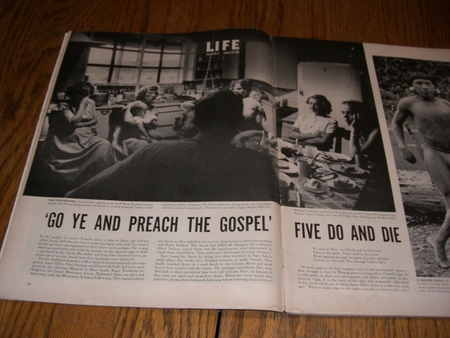
cimg0662.jpg

cimg0663.jpg

This is a treasure to me not only because it is a piece of history from an event that touched my life in so many ways, but also because of Jeremy’s thoughtfulness in getting it for me.

By the way, if you are interested in reading more about this story, besides Through Gates of Splendor mentioned above, several other books have been writen. Rachel Saint wrote The Dayuma Story, but the only copy of that I found searching the Internet shows Ethel Emily Wallis as the author: I don’t know if this is a republication of Rachel’s book or a completely different book. I read Rachel’s: I haven’t read this one. Another of the widows, Olive Fleming Liefeld, wrote Unfolding Destinies. The most recent one is End of the Spear by Steve Saint, son of Nate Saint. (I reviewed the film by the same name here.) These are just the ones I have read: there may be others I don’t know of. I have read most of Elisabeth Elliot’s other books since then as well.

You can visit Kelli’s place to see more “Show and Tell” stories or share your own.

Helping, not hurting

This post by Yekwana Man is an excellent answer to those who think missionaries are having a negative impact on indigenous peoples.

I have known two missionaries, one in person and one through books, who ministered to primitive tribes who were killing each other off, the first by cannibalism and headhunting, the second because that tribe’s only way of dealing with any wrong was murder. This latter tribe was the Waodani, formerly known as the Aucas (an outside name given to them, not their name for themselves) of Ecuador. In the documentary Beyond the Gates of Splendor they told anthropologists that they had been almost down to two people before the missionaries came. Why would even any non-Christian want to see a whole people group extinguished due to infighting or disease? Especially these days when we clamor to save the spotted owl and other endangered species? Shouldn’t endangered people be at least equally as important as endangered animals?

Would anyone in their right minds really want such practices as burying a widow along with her husband or killing twins or deformed babies to continue? So many primitive tribes practice these kinds of things.

Why deny these people the choice of hearing that there are other ways? Why not allow them to hear the gospel and let them make their own choice? So many who bask in the multitudes of freedoms we have here in the US would rather keep people like this in darkness in the name of preserving their culture. Most missionaries I know of these days consciously and conscientiously try not to “Americanize” the native churches but rather try to respect their culture and form churches within that culture while introducing healthier ways of living and civil practices. Who could possibly have a problem with that?

A sense of Him

Isobel Kuhn, missionary to China, wrote a book entitled Second-Mile People, in which she told of seven people in her life who had illustrated the Scriptural principle of going the “second mile.”

She begins one chapter with this poem:

Indwelt

Not merely in the words you say,
Not only in your deeds confessed,
But in the most unconscious way
Is Christ expressed.

Is it a beatific smile,
A holy light upon your brow;
Oh no, I felt His Presence while
You laughed just now.

For me ‘twas not the truth you taught
To you so clear, to me still dim
But when you came to me you brought
A sense of Him.

And from your eyes He beckons me,
And from your heart His love is shed,
Til I lose sight of you and see
The Christ instead.

—by A. S. Wilson

Isobel then tells of meeting a young woman named Dorothy at a conference. Isobel had not been saved very long. “My ideas of the Christian life were still in a crude, unmoulded state.” Dorothy seemed attractive, winsome and sweet, and Isobel was pleased when she asked her to go for a walk. Dorothy had in mind to “speak just a word for Jesus” while on this walk, but as it happened, their conversation centered on happy, funny things. “When we parted Dorothy felt she had been a failure, unconscious that the one she had hoped to help was going away enchanted with this glimpse into the very human sweetness of this Christlike girl. ‘…I felt His Presence when you laughed just now….’ The Spirit-filled life cannot ‘fail’, it is fruitful even when it may seem least to have done anything. That walk gave Dorothy ‘influence’ over me when a ‘sermon’ would have created a permanent barrier. In fact at that time I carried a mental suit of armour all ready to slip on quietly the moment any ‘old fogey’ tried to ‘preach’ at me!”

“Oswald Chambers says, ‘The people who influence us most are not those who buttonhole us and talk to us, but those who live their lives like the stars in heaven and the lilies of the field, perfectly simply and unaffectedly.’ A great mistake is to think that a Spirit-filled man or woman must always be casting sermons at people. Being ‘filled with the Spirit’ (which is a first qualification of Second Mile People) is merely a refusing of self and a taking by faith of the life of Christ as wrought in us by His Holy Spirit.” “We must take the Spirit’s fullness, as we take our salvation, by faith in God’s promise that He is given to us.”

Some weeks later when Dorothy and Isobel met again, Dorothy’s “time had come” to “get in a ‘preach,’” for Isobel then was in a frame of mind and heart to receive it. “The Holy Spirit is never too early and never too late.” Though Isobel did not understand as yet all Dorothy was trying to say, her words did lay the groundwork for future understanding, and “from Dorothy I just drank in the inspiration of herself, the ‘sense of Him’, and the fact that this life of undisturbed peace was no mystic dream but a possible reality who sat before me with earnest sweet eyes and soft pink cheeks.”

Please don’t misunderstand — I don’t mean any of this in any kind of a mystic way. I have written much on being grounded in Scripture and not feeling. But I have known some people who seem to reflect Christ and carry a “sense of Him” in everything they do, every word, action, and attitude. May I live so close to Him that people always sense His presence.

Book of Amy Carmichael poems

I’ve mentioned Amy Carmichael several times. She, Isobel Kuhn, and Rosalind Goforth are my favorite female missionary writers from the past who have had the most influence on my own life.

In my copy of Amy’s biography, Amy Carmichael of Dohnavur, I have little pieces of paper sticking up to mark some of my favorite passages and poetry. Amy wrote a lot of poetry, some for the edification of “her children,” some as expressions of devotion and worship.  Many of Amy’s original books are now out of print. But one day when I was looking for something else on Amazon.com, I saw a book recommendation for a book called Mountain Breezes: The Collected Poems of Amy Carmichael. I was delighted to see that a group of editors have combed through Amy’s writings and collected 586 poems, them put them all together in this book. They are divided by basic categories and there is an index by title and first line in the back of the book. This is a treasure trove for anyone whose life has been touched by Amy Carmichael and anyone who loves Christian poetry.

Here are just a few of my favorites:

Thy John

As John upon his dear Lord’s breast,
So would I lean, so would I rest;
As empty shell in depths of sea,
So would I sink, be filled with Thee.

As water lily in her pool
Through long hot hours is still and cool,
A thought of peace, so I would be
Thy water-flower, Lord, close by Thee.

As singing bird in high, blue air,
So would I soar, and sing Thee there;
No rain nor stormy wind can be
When all the air is full of Thee.

I remember reading in one of her books how hot it was in India and how finding a spot of coolness somewhere was so very refreshing, and that came to mind as I read the second stanza.

This one is probably one of the most well-known:

Make Me Thy Fuel

From prayer that asks that I may be
Sheltered from winds that beat on Thee,
From fearing when I should aspire,
From faltering when I should climb higher,
From silken self, O Captain, free
Thy soldier who would follow Thee.

From subtle love of softening things,
From easy choices, weakenings,
(Not thus are spirits fortified,
Not this way went the crucified)
From all that dims Thy Calvary,
O Lamb of God, deliver me.

Give me the love that leads the way,
The faith that nothing can dismay,
The hope no disappointments tire,
The passion that will burn like fire;
Let me not sink to be a clod:
Make me Thy fuel, Flame of God.

“Silken self” — probably my worst enemy.

This one has been the heart-cry of many a Christian mother:

For Our Children

Father, hear us, we are praying,
Hear the words our hearts are saying;
We are praying for our children.

Keep them from the powers of evil,
From the secret, hidden peril;
Father, hear us for our children.

From the whirlpool that would suck them,
From the treacherous quicksand, pluck them;
Father, hear us for our children.

From the wordling’s hollow gladness,
From the sting of faithless sadness,
Father, Father, keep our children.

Through life’s troubles waters steer them;
Through  life’s bitter battle cheer them;
Father, Father, be Thou near them.

Read the language of our longing,
Read the wordless pleadings thronging,
Holy Father, for our children.

     And wherever they may bide,
Lead them Home at eventide.

New publication of Jonathan Goforth’s original biography

I have mentioned Jonathan and Rosalind Gorforth here many times. I read Rosalind’s biography of Jonathan, Goforth of China, years ago, and just can’t convey how convicted and blessed I was by it. I had read the old one from a lending library at our church. An abridged vesrion came out several years ago which I was really disappointed in — it switched back and forth from first person accounts Rosalind has written to third person summaries the editor or compiler had written with no warning or distinction. I had often told myself that if I could ever find a copy of the older version, I was going to snap it up.

Well, our church is having revival meetings this week with John Van Gelderen. He has a ministry called Preach the Word Ministries through which he sells various helpful books and tracts. Last night he mentioned that a company called Lifeline Ministries has reproduce the original! And he had copies on hand! So I bought one after the service! And I am looking forward to reading it again this winter. I am so glad to have it.

I do encourage you to read about the Goforths. I tried to find an short online biography to link to, but the ones I looked at just didn’t capture the essence of who they were or were from organizations I could not endorse. They were godly people and Rosalind’s writing reveals they were very human, imperfect people.  But God delights in using vessels fully yielded to Him.

What we wanted all the time…

The following was written by Amy Carmichael and included in Amy Carmichael of Dohnavur by Frank Houghton. It is a wonderful picture of our ultimate need and desire: our Father’s fellowship:

It was the hour between lights, and five little people under two years old were waiting for their food. Sometimes the cows belonging to the adjoining village from which part of our milk comes saunter home with more than their usual leisureliness, and then the milk is late. The babies, who do not understand the weary ways of cows, disapprove of having to wait, and that evening they were all very fractious. To add to their woes the boy whose duty it is to light the lamps had been detained, and the quickly gathering twilight fell upon us unawares as we sat together on the nursery veranda. The five fretful babies made discouraging remarks to each other and threw themselves in that exasperated fashion which tells the experienced that the limits of patience have been passed. And the more depressed began to whimper.

At this point a lamp was brought and set behind me so that its light fell upon their toys — a china head long since parted from its body, a tin with small stones in it which when shaken makes a charming noise, several rattles and other sundries. If anything will comfort them their toys will, I thought, as these illuminated treasures caught my attention. But the babies only looked disgusted. One of the most sweet-tempered seized the china head and flung it as far as ever she could. Not one of them would find consolation in toys.

Then a small child endowed with a vivid imagination and a timid disposition was sure she heard something dangerous moving in the bushes outside and she wailed a wail of most infectious misery and terror, and the quick panic which comes upon birds when they hear their own particular warning call, suddenly filled the babies’ hearts, and they howled.

Then I took the lamp and set it in front so that its light did not fall upon the toys but upon myself, and in a moment the whole five were tumbling over me cuddling and caressing — and content.

Are there not evenings in life when our toys have no power to please or soothe? There is not any rest in them or any comfort. Then the one Whom we love best takes the lamp and puts it so that the toys are in the shadow, but His face is in the light. And then we know that that is what we wanted all the time. And He makes His face to shine upon us and gives us peace.

Amy Carmichael: Victory During Illness

God hath caused me to be fruitful in the land of my affliction.
Genesis 41:52b

For the last twenty years of Amy Carmicahel’s life she was an invalid, yet she remained in India as acting head of the Dohnavur Fellowship. What had begun with the rescue of one child from being sold into temple prostitution grew to orphanages and a hospital and a full-fledged compound. In Frank Houghton’s biography of her, Amy Carmichael of Dohnavur, he prefaces this section of her life with the following poem by C. A. Fox, which has been a great blessing to me:

Two glad services are ours,
Both the Master loves to bless.
First we serve with all our powers–
Then with all our feebleness.

Nothing else the soul uplifts,
Save to serve Him night and day,
Serve Him when He gives His gifts–
Serve Him when He takes away.


One day Amy received a shipment of tracts for the ill. As she read them, they just did not do anything for her. As she pondered that, she realized it was because they were written from well people telling sick people how they ought to feel. Over many years she had written notes of encouragement to various ones in the
Dohnavur Hospital (named, in the descriptive Indian way, Place of Heavenly Healing), and some of these were compiled in a book titled Rose From Brier. They are rich in their
spiritual encouragement and insight, partly precisely because they were written by one who had shared in the fellowship of sufferings.

In another of Amy’s books, she wrote the following:

This prayer was written for the ill and for the very tired. It is so easy to fail when not feeling fit. As I thought of them, I also remembered those who, thank God, are not ill and yet can be hard-pressed. Sometimes in the midst of the rush of things it seems impossible always to be peaceful, always to be inwardly sweet. Is that not so? Yet that and nothing less is our high calling. So the prayer is really for us all.

Before the winds that blow do cease,
Teach me to dwell within Thy calm;
Before the pain has passed in peace,
Give me, my God, to sing a psalm,
Let me not lose the chance to prove
The fulness of enabling love,
O Love of God, do this for me;
Maintain a constant victory.

Before I leave the desert land
For meadows of immortal flowers,
Lead me where streams at Thy command
Flow by the borders of the hours,
That when the thirsty come, I may
Show them the fountains in the way.
O Love of God, do this for me;
Maintain a constant victory.

Blessed be God, even the Father of our Lord Jesus Christ, the Father of mercies, and the God of all comfort;Who comforteth us in all our tribulation, that we may be able to comfort them which are in any trouble, by the comfort wherewith we ourselves are comforted of God.
For as the sufferings of Christ abound in us, so our consolation also aboundeth by Christ.
II Corinthian 1:3-5


Amy Carmichael: A Chance to Die

A little more than a week ago, I started a “series” of answers to prayer from the lives of classic missionary biographies. That series was supposed to run every day for a week or so — and that hasn’t quite happened. 🙂 I have one more anecdote in that category I’d like to share, but in the process of looking back over several missionary stories, I found a few other things that have spoken to my heart over the years that I wanted to share. I’m just going to post those as opportunities arise and as I feel led. Here is the first one:

Amy Carmichael was one of the first missionaries I ever read much about, and her life has had a tremendous impact on me as well as on most who read about her. She would have been appalled at the thought of any attention directed toward her, but a look at her life is reveals what it is to walk closely in love and obedience to God. She was a missionary from Ireland who worked in India from 1895 to 1951 without a furlough.

One of the lessons from her life that has stayed with me over the years (in my mind, at least: it is still far from being worked out in practice as often as it should be) comes from her earliest days in India. In Amy Carmichael of Dohnavur, author Frank L. Houghton records that Amy wrote that one of the group of missionaries was

unfair and curiously dominating in certain ways and words. One day I felt the “I” in me rising hotly, and quite clearly — so clearly that I could show you the place on the floor of the room where I was standing when I heard it — the word came, “See in it a chance to die.” To this day that word is life and release to me, and it has been to many others. See in this which seems to stir up all you most wish were not stirred up — see in it a chance to die to self in every form. Accept it as just that — a chance to die.

Often we think of dying to self in the big, martyr-like ways. Yet it is in those everyday situations where, as Amy aptly put it, the “I” in us “rises hotly” that we need to deny self .

How a well was a testimony

“The sinking of a well broke the back of dark religion on Aniwa,” wrote John Paton. He wrote his autobiography in three parts at three different times in his life. Benjamin Unseth used about one-fifth of the material in the three parts written by Mr. Paton to form a shorter biography simply titled John Paton, part of the Men of Faith Series published by Bethany House.

John Paton is the source of one of my all-time favorite missionary quotes. After a struggle, “dreadfully afraid of mistaking my own emotions for the will of God,” he offered himself and was accepted as a missionary to the New Hebrides (now Vanuatu). Most, including his pastor, were dead set against his “throwing his life away among the cannibals.” In a classic exchange, one “dear old Christian gentleman repeatedly exhorted me, ‘The cannibals! You will be eaten by cannibals!’ At last I replied, ‘Mr. Dickson, you are advanced in years now, and your own prospect is to soon be laid in the grave, there to be eaten by worms. I confess to you that if I can but live and die serving and honoring the Lord Jesus, it will make no difference to me whether I am eaten by cannibals or by worms. And in the great day my resurrection body will arise as fair as yours in the likeness of our risen Redeemer.’”

John and his wife, Mary Ann , arrived on the island of Tanna in 1858. The Tannese were curious about them and the Patons had to learn to communicate by gesture and trial and error until they learned the language. They found the people scantily clad, friendly but deceptive, thieving, glorying “in bloodshed, war, and cannibalism,” superstitious, and worshipping nearly everything. When the Patons began to teach them that God wanted them to ”throw away their idols and stop their wrongdoing,” persecution began.

Mrs. Paton and their baby boy died in the same month in 1859. “But for Jesus, and the fellowship He gave me there, I would certainly have gone mad and died beside that lonely grave.”

After a time some men came, like Nicodemus, at night to talk to John. A few believed, but persecution was the norm. John was in danger of his life many times. Sometimes he was led to hide somewhere, but other times, while men were facing him with spears, he kept on about his work as if he didn’t notice them, and God restrained their hands. Once he even directly challenged them to go through their rituals by which they curse people by making incantations over a piece of food from which that person has eaten, to prove that his God was greater than theirs, and God prevailed. He did have to leave the island eventually, escaping for his life. He went to Australia and Scotland to report to churches there. He came back with a wife and many new missionaries. The islanders were amazed that missionaries would return after the way they had been treated, and said, “If your God makes you do that, we may yet worship Him too.”

John and his new wife settled on the island of Aniwa. Though they faced some of the same problems as in Tanna, the Lord did bless them with a fruitful harvest there. Amazingly “the sinking of a well broke the back of dark religion on Aniwa.” The island did not receive much rain and much of the drinking water was not good. John decided to try to sink a well; the islanders thought he was mad. “Rain comes only from above. How could you expect our island to send us showers of rain from below?” The chief was afraid that Paton’s “wild talk” would cause the people to never listen to his word or believe him again. They were also concerned that he would die in the hole he was digging, and then the next Enlgish shape that came by would hold them accountable. He was able to persuade them to help him by offering fishing hooks for labor. They gladly labored, though they still thought he was going mad, until one side of the well caved in; then they were afraid and worried and would help no longer.

Jogn was able to shore up the side of the well and take precautions against another cave-in. He had prayed about the location of the well and struggled with the fear that they might find salty water rather than fresh.

Finally the day came that he broke through and found good, fresh water. He filled a jug, climbed out of the well, and called the people ove to taste it. They were amazed at the water he found and grateful that he would share the well with them. They offered to help him finish it in earnest. Later the islanders tried to sink several wells in various villages, but they either came to coral rock they could not penetrate or to salt water.
Chief Namakei asked if he could “preach” one Sunday. The book records one of the most beautiful sermons I have ever read. The essence of it was that, though they laughed and disbelieved when “Missi” (teacher) said he would find “rain coming up through the earth,” yet Jehovah God answered his prayers. “No God of Aniwa has ever answered prayers as the Missi’s God has done….The gods of Aniwa cannot hear, cannot help us like the God of Missi.” He felt that since what the Missi had said about the invisible water under the earth was true, then what he said about the invisible God was true, too, and he would worship Him. “He (Jehovah) will give us all we need for He sent His Son Jesus to die for us and bring us to heaven. This is what the Missi has been telling us every day since he landed on Aniwa. We laughed at him, but now we believe him.”

There followed a great burning of idols of many of the islanders and many were converted. They began to come to the church services and were baptized. John wrote, after a communion service, “At the moment when I put the bread and wine into those hands, once stained with the blood of cannibalism, now stretched out to Jesus, I had a foretaste of the joy of heaven that almost burst my heart in pieces. I will never taste a deeper bliss till I gaze on the glorified face of Jesus Himself.”

(This is the fourth in a series of missionary anecdotes focusing on specific answers to prayer. Previous posts in this series were about Rosalind Goforth, Jonathan Goforth, and Amy Carmichael.)

Missionary Anecdotes: Isn’t “No” an Answer?

Just a tiny little child
Three years old,

And a mother with a heart

All of gold.

Often did that mother say,

Jesus hears us when we pray,

For He’s never far away
And He always answers.


Now, that tiny little child

Had brown eyes,

And she wanted blue instead

Like blue skies.

For her mother’s eyes were blue

Like forget-me-nots. She knew

All her mother said was true,

Jesus always answered.


So she prayed for two blue eyes,

Said “Good night,”

Went to sleep in deep content

And delight.

Woke up early, climbed a chair

By a mirror. Where, O where

Could the blue eyes be? Not there;

Jesus hadn’t answered.


Hadn’t answered her at all;

Never more

Could she pray; her eyes were brown

As before.

Did a little soft wind blow?

Came a whisper soft and low,

“Jesus answered. He said, No;

Isn’t No an answer?”


The above poem, written by Amy Carmichael, was based on on incident that actually did occur in her life when she was three. It turned out to be in the providence of God for her to have brown eyes. She became a missionary to India in the late 1890s. At first her ministry was primarily evangelistic. But along the way she became aware that some parents in India sold their daughters to the temple, where they were used for immoral purposes. God led one such child to her, and through a series of events and a sense of the Lord’s leading, Amy took the child in. Then more stories of other girls (and later, boys) surfaced and more opportunities to rescue and provide homes for these children arose. Amy had to struggle with this, because the Lord had seemed to be blessing her evangelistic work. Was it right to turn from that ministry to give herself to housing and raising children? She concluded that that was indeed God’s will for her life. The ministry grew exponentially and eventually became a whole compound, with housing for children of all ages, the workers who took care of them, and even their own hospital.


As Amy went “undercover” to find details of these children, she would stain her arms with coffee and wear Indian dress so that she could pass as an Indian woman and move freely in Indian society where she never could have as an Irish missionary. This she could not have done with blue eyes — her eyes would have given her away immediately. Neither she nor her mother could have ever known, all those years ago, the Lord’s purpose for her brown eyes, but the lesson of faith stayed with her all her life.


(Recommended biographies of Amy Carmichael: Amy Carmichael of Dohnavur by Frank L. Houghton; A Chance to Die by Elisabeth Elliot; and With Daring Faith (a children’s book) by Rebecca H. Davis.)