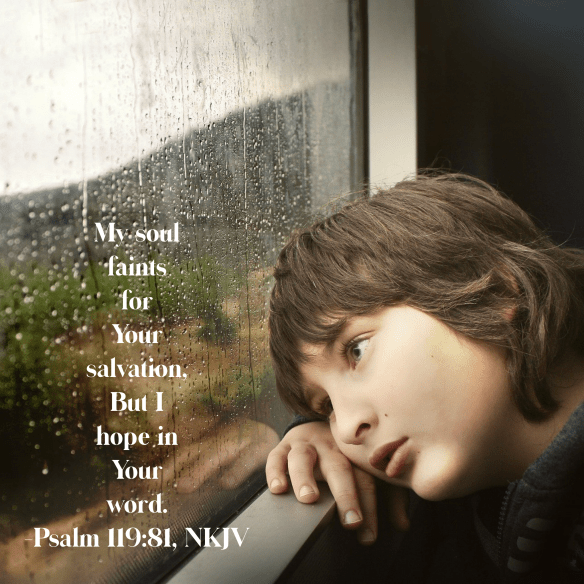
Help for the Fainthearted

Help for the fainthearted, encouragement to endureThere are at least 25 fillers for the saying “____________ is not for the faint of heart.”

Add pandemics and quarantine to the list.

By this time, most of us are tired of it all. The concerns about whether we or our loved ones will get COVID-19, others in public not taking precautions, what the best next steps should be, finding supplies, canceled plans, not being able to go places or see loved ones or friends in person—it all takes a toll.

In Warren Weirsbe’s commentary on Galatians, Be Free, I was especially taken with a section about not “fainting” based on Galatians 6:9. That led me to do a mini word study on “faint” and “fainting.” What I found encouraged me, so I thought I’d share it with you.*

Here are some things that might might help that weary, exhausted, tired out—faint— feeling.

Nourishment. We feel faint physically when we don’t get enough food or the right kinds of food. We’re faint spiritually when we don’t feed our souls. We need spiritual nourishment to stand strong.

Hungry and thirsty, their soul fainted within them. Then they cried to the Lord in their trouble, and he delivered them from their distress…he satisfies the longing soul, and the hungry soul he fills with good things. Psalm 107:5-6, 9

Man shall not live by bread alone, but by every word that comes from the mouth of God. Matthew 4:4

I have treasured the words of his mouth more than my portion of food. Job 23:12

Companionship. We often face trouble better with support. But it’s hard when we’re alone or even when we just feel alone. Though God often graciously gives human companionship, there are times in life when we find His presence is all we need.

When my spirit faints within me, you know my way! In the path where I walk they have hidden a trap for me. Look to the right and see: there is none who takes notice of me; no refuge remains to me; no one cares for my soul. I cry to you, O Lord; I say, “You are my refuge, my portion in the land of the living.” Psalm 142:3-5

Remembering God’s past dealings. Many of David’s psalms were written when someone was after him. There’s nothing like an active enemy to make you feel drained and weary. We can feel the same way with this virus. When it first began, I felt like I was taking my life in my hands every time I went out.

For the enemy has pursued my soul; he has crushed my life to the ground; he has made me sit in darkness like those long dead. Therefore my spirit faints within me; my heart within me is appalled. Psalm 143:3-4

David’s response:

I remember the days of old; I meditate on all that you have done; I ponder the work of your hands. I stretch out my hands to you; my soul thirsts for you like a parched land.

Answer me quickly, O Lord! My spirit fails! Hide not your face from me, lest I be like those who go down to the pit. Let me hear in the morning of your steadfast love, for in you I trust. Make me know the way I should go, for to you I lift up my soul.Deliver me from my enemies, O Lord! I have fled to you for refuge. Psalm 143:5-9

Confession and repentance. Any number of illnesses can make us feel weak and faint. In Isaiah, God likened his sinful, rebellious people to someone with a fatal illness.

They have forsaken the Lord, they have despised the Holy One of Israel, they are utterly estranged. Why will you still be struck down? Why will you continue to rebel? The whole head is sick, and the whole heart faint. From the sole of the foot even to the head, there is no soundness in it, but bruises and sores and raw wounds; they are not pressed out or bound up or softened with oil. Isaiah 1:4a-6

The remedy:

Wash yourselves; make yourselves clean; remove the evil of your deeds from before my eyes; cease to do evil, learn to do good; seek justice, correct oppression; bring justice to the fatherless, plead the widow’s cause.

Come now, let us reason together, says the Lord: though your sins are like scarlet, they shall be as white as snow; though they are red like crimson, they shall become like wool. If you are willing and obedient, you shall eat the good of the land; but if you refuse and rebel,  you shall be eaten by the sword; for the mouth of the Lord has spoken. Isaiah 1:16-20

Right motives*

People in Malachi’s time tried to cut corners on God’s requirements (Malachi 1:6-14) and called it all a weariness (v. 13). The church in Ephesus was commended by God for their work, their doctrinal stand, their endurance (Revelation 2:1-7). But, God said:

But I have this against you, that you have abandoned the love you had at first. Remember therefore from where you have fallen; repent, and do the works you did at first. Revelation 2:4-5

All through the Bible we’re called to love God with our heart soul, mind, and strength, to love Him above all else. When that love seems to wane, we should “go back to our first love”: remind ourselves “God shows his love for us in that while we were still sinners, Christ died for us” (Romans 5:8). He has shown His love for us by saving us, drawing us to Himself, providing for us, answering prayer. He declares His love for us over and over.

The Lord appeared to him from far away. I have loved you with an everlasting love;    therefore I have continued my faithfulness to you. Jeremiah 31:3

But God, being rich in mercy, because of the great love with which he loved us, even when we were dead in our trespasses, made us alive together with Christ—by grace you have been saved—and raised us up with him and seated us with him in the heavenly places in Christ Jesus. Ephesians 2:4-6

Let His love for us rekindle our love for Him.

The Thessalonians had the right combination with their “work of faith and labor of love and steadfastness of hope in our Lord Jesus Christ” (1 Thessalonians 1:3).

Persistent, humble prayer

And he spake a parable unto them to this end, that men ought always to pray, and not to faint. Luke 18:1 (ESV says “lose heart”).

Then Jesus told a parable about a widow who kept coming to an unjust judge to plead her case until the judge finally helped her. God is just and gracious: how much more will He answers His children’s prayers?

Then Jesus told a parable about a Pharisee who prayed boastfully, trusting in his good works, and a tax collector who had none:

 But the tax collector, standing far off, would not even lift up his eyes to heaven, but beat his breast, saying, ‘God, be merciful to me, a sinner!’ I tell you, this man went down to his house justified, rather than the other. For everyone who exalts himself will be humbled, but the one who humbles himself will be exalted. Luke 18:9-14

Centuries earlier, Jonah said in repentance:

When my life was fainting away, I remembered the Lord, and my prayer came to you, into your holy temple. Jonah 2:7

Hope

We get discouraged when we look at circumstances. But we can look ahead in hope:

I had fainted, unless I had believed to see the goodness of the Lord in the land of the living. Wait on the Lord: be of good courage, and he shall strengthen thine heart: wait, I say, on the Lord. Psalm 27:14-15, KJV

And let us not be weary in well doing: for in due season we shall reap, if we faint not. Galatians 6:9

Inward renewal

Paul says:

For which cause we faint not; but though our outward man perish, yet the inward man is renewed day by day. For our light affliction, which is but for a moment, worketh for us a far more exceeding and eternal weight of glory 2 Corinthians 4:16-17, KJV

How is our inward self renewed?

Looking to Jesus

Therefore, since we are surrounded by so great a cloud of witnesses, let us also lay aside every weight, and sin which clings so closely, and let us run with endurance the race that is set before us, looking to Jesus, the founder and perfecter of our faith, who for the joy that was set before him endured the cross, despising the shame, and is seated at the right hand of the throne of God. Consider him who endured from sinners such hostility against himself, so that you may not grow weary or fainthearted. Hebrews 12:1-3

The more we behold His glory, the more we’re changed to be like Him:

And we all, with unveiled face, beholding the glory of the Lord, are being transformed into the same image from one degree of glory to another. For this comes from the Lord who is the Spirit. 2 Corinthians 3:18

Waiting upon the Lord

Have you not known? Have you not heard? The Lord is the everlasting God, the Creator of the ends of the earth. He does not faint or grow weary; his understanding is unsearchable. He gives power to the faint, and to him who has no might he increases strength. Even youths shall faint and be weary, and young men shall fall exhausted; but they who wait for the Lord shall renew their strength; they shall mount up with wings like eagles; they shall run and not be weary; they shall walk and not faint. Isaiah 40:28-31

May these truths renew your spirit today.

_____

*The definition for one Greek word translated “faint” is “To weaken, relax, exhaust; to have one’s strength relaxed, to be enfeebled through exhaustion, to grow weak, grow weary, be tired out; to despond, become faint hearted.” Other Greek and Hebrew words I looked up that the KJV or ESV translate as “faint” say similar things. Sometimes those words are translated “weary,” “longing,” or “give up.”

*Thanks to Wiersbe for the thought about weariness that stems from lack of love (p. 147 in the Kindle version of Be Free.

* Verses not labeled are from the ESV.

(Sharing with Inspire Me Monday, Global Blogging, Senior Salon, Hearth and Home,
Purposeful Faith, Tell His Story, InstaEncouragement, Anchored Abode,
Recharge Wednesday, Worth Beyond Rubies, Share a Link Wednesday,
Welcome Heart, Heart Encouragement, Grace and Truth, Faith on Fire,
Blogger Voices Network)

Songs About Christ’s Death for Us

IMG_2157?ver2One of the best ways to mediate on what this time of year means is by listening (and maybe singing along to!) Scripturally-based songs about the cross.


The song, “See the Destined Day Arise came up on my phone a few weeks ago, and I made a note to share it around Easter. The day Christ died on the cross was the day destined from before the foundation of the world.

This hymn was originally written by Venantius Fortunatus in 569 and was paraphrased or translated by Richard Mant in 1837. The original lyrics are here. In the past few years it has been reworded a bit and a chorus added by Matt Merker.

See the destined day arise! See a willing sacrifice!
Jesus, to redeem our loss, hangs upon the shameful cross;
Jesus, who but You could bear wrath so great and justice fair?
Every pang and bitter throe, finishing your life of woe?

Hallelujah! Hallelujah! Lamb of God for sinners slain!
Hallelujah! Hallelujah! Jesus Christ, we praise your name!

Who but Christ had dared to drain, steeped in gall, the cup of pain,
And with tender body bear thorns, and nails, and piercing spear?
Slain for us, the water flowed, mingled from your side with blood;
Sign to all attesting eyes of the finished sacrifice.

Holy Jesus, grant us grace in that sacrifice to place
All our trust for life renewed, pardoned sin, and promised good.
Grant us grace to sing your praise, ‘round your throne through endless days,
Ever with the sons of light: “Blessing, honor, glory, might!”

Another favorite about His sacrifice is “It Was For Me” by Dave Bolling (words here).

“What Wondrous Love Is This,” author unknown, words here.

“Face the Cross” by Herb Fromach, words here.

“The Power of the Cross” by Keith Getty and Stuart Townend, words here.

There are old and new versions of “Beneath the Cross of Jesus.” The first one was written in 1868 by Eliz­a­beth C. Cle­phane (words and background here. A few more stanzas than are normally sung today.)

The second was written more recently by Keith and Kristyn Getty, titled just “Beneath the Cross” (words here).

“Mercy Tree” by Krissy Nordhoff and Michael Neale, words here.

Of course, once you start thinking of songs about the cross, too many come to mind to name: “The Old Rugged Cross,” “Jesus Paid It All,” “At Calvary,” “Calvary Covers It All,” “When I Survey the Wondrous Cross,” and so many more.

On Sunday I’ll share favorite songs about the resurrection.

What are some of your favorite songs about the death of Christ for us?

(Sharing with Grace and Truth, Faith on Fire)

Coping and Ministering in Isolation

Blessed is the man who trusts the Lord, floruishing even in droughtAs soon as Arthur and Wilda Mathews arrived, they knew something was wrong. The Chinese church in Hwangyuan, China, had asked them to come and minister in 1950. But now the church leaders seemed strained. The Mathews soon learned that the area had fallen to Communism, and association with white missionaries was a detriment to the Chinese Christians.

The Mathews thought it best, then, to leave. But a capricious Chinese official would not grant their exit visas. The money from the Mathews’ mission came through this official, who then made Arthur wait, grovel, and ask repeatedly for the needed funds. The official only gave them a fraction of what they were due. He also slowly tightened the restraints on the Mathews. First, they could not have the building belonging to the mission. Then they could not evangelize or participate in ministry. Then, a short while later, they could not leave their premises except to draw water, buy food, and gather materials for a fire. And finally, they were not allowed to speak to other Chinese.

The Matthews’ story is told in the book Green Leaf in Drought by Isobel Kuhn, which I reviewed a few years ago here. Their story came back to mind in our current situation. They were isolated for different reasons than we are. We’re not suffering persecution, being spied on by people who would benefit from betraying us, or starved out by petty power-mongers. But they did wonder: how in the world could they be a testimony when they couldn’t even speak to people?

What was there inside these walls to do? It just seemed as if every time they tried to engage in any Christian service, they were knocked flat! Life’s accustomed joys were slowly drying up; but the trees of the Lord have a secret supply.

The title and theme of the book come from Jeremiah 17:8:

But most amazing of all was their spiritual vigor. Whence came it? Not from themselves: no human being could go through such sufferings and come out so sweet and cheerful.

As I was in a small prayer meeting one morning one prayed thus: “O Lord, keep their leaf green in times of drought!”

I knew in a moment that this was the answer. Jeremiah 17: 8: He shall be as a tree planted by the waters, and that spreadeth out her roots by the river, and shall not see when heat cometh, but her leaf shall be green; and shall not be careful in the year of drought, neither shall cease from yielding fruit.

That was it! There was an unseen Source of secret nourishment, which the communists could not find and from which they could not cut them off.

This is the story of that secret Source. To add another book to the many telling of trials under communist pressure is not necessary and is not our purpose.
But to tell of the secret Source by which a tree can put forth green leaves when all others around are dried up and dying from the drought—that is timeless. That is needed by all of us. Your drought may not be caused by communism, but the cause of the drying up of life’s joys is incidental. When they dry up—is there, can we find, a secret Source of nourishment that the deadly drought cannot reach?

Here are a few ways that Source helped them cope:

Resting in God’s sovereignty. They wrestled with “Ifs”—if the Chinese church had not asked them to come, if they could have gotten word to them before they came, if this or that had or hadn’t happened. They kept coming back to the fact that God orchestrates our steps.

They fed their souls truth. They regularly read God’s Word and Christian authors. They found help in something Andrew Murray had written (though Isobel doesn’t quote the source):

1. Say, He brought me here. It is by His will I am in this strait place and in that fact I will rest.
2. He will keep me here in His love and give me grace to behave as His child.
3. Then He will make the trial a blessing, teaching me the lessons He intends for me to learn.
4. In His good time He can bring me out again—how and when He knows.
So let me say, I am (1) here by God’s appointment; (2) in His keeping; (3) under His training; (4) for His time.

Before Easter, 1952, Wilda

set herself to study the resurrection story and the resurrection life. As she came to the part that Peter played in the courtyard of the high priest’s palace she suddenly felt heart-condemned. She had not said, I know Him not, but she had no joy. She was not bitter, but she was frustrated and restless. Her opportunity to witness to the Chinese eyes around them that she did know the Lord and that He was satisfying her drought—had she shown that? If not, wasn’t that denying the Lord before man? On her knees before Him she confessed it as such, and the result was a glorious Easter.

They learned to delight in God’s will. While studying Ephesians 5:10, Arthur was arrested by the phrase “learn in your own experience what is fully pleasing to the Lord.”

A few nights later it came to Arthur like a flash: the Son had left heaven, not [just] submitting to the will of God, but delighting in it. Up to now they had been submitting; rather feverishly submitting because they felt they should press His promises. “Lord, why dost thou delay? We could be out spear-heading advance into new mission fields! Open the door now, Lord!” They had been acting like servants who don’t want to do it but have to, because they can’t get out of it. What a different attitude was the Son’s! There came a day in June when together Arthur and Wilda knelt before the Lord and abandoned themselves to live on in that stinted little kitchen as long as He wished them to. And the peace of God poured in like a flood bringing such joy as they had not known before.

Arthur later wrote of this experience to supporters and concluded:

So we came to see that God wanted us to will with Him to stay put; not to desire to run away as quickly as we could persuade Him to let us … It was natural that we should go from there to cry with David, I Delight to do thy will, O my God (Psalm 40: 8)…So we are no longer stupid bullocks being driven or dragged unwillingly along a distasteful road; but sons, cooperating wholeheartedly with our Father…

They endured, trusting God was working through their trials. Arthur wrote, “These trials of faith are to give us patience, for patience can only be worked as faith goes into the Pressure Chamber. To pull out because the pressure is laid on, and to start fretting would be to lose all the good He has in this for us.”

And these are ways God worked through their ministry and testimony even when they were silenced:

The words, actions, and touch expressed earlier were remembered. Their first few weeks in Hwangyuan, Arthur had been able to preach and Wilda had been able to go with the pastor’s wife to minister to the women.

Little did she guess that her loving words and smiles those days were to be the only direct ministry she was to have among them. But it was enough to show the women and girls of Hwangyuan that the white woman in their midst was there to love them.

Those were the days of the touch of the hand, the loving concern in the eyes, the simple testimony of the voice. They would not be forgotten later on when the government forbade it.

People saw God’s provision in their need. Isobel refers often to what she called the Feather Curtain of God, based on Psalm 91:4a: “He shall cover thee with his feathers, and under his wings shalt thou trust.” Story after story relates God’s perfect timing and loving care in supplying their needs.

All the courtyard had heard when the father ordered the milk for the little one to be discontinued for lack of funds; yet that very evening, they not only sang, but the song of praise had an exultant ring in it! (No one knew of Ben’s secret gift.) And the next day the old Tibetan lady was recalled and the milk money was there! Had it fallen from heaven? It most certainly had not come in by the door—that they knew. Did the God of Elijah really live? What more potent message could God have given these people?

People saw them endure the same trials they were experiencing. “The message above all others which the Chinese church needed was to see that truth lived out under circumstances equally harrowing as their own.”

[Arthur wrote} “Then Christmas night, another kind of gift, from the One whose birthday it was. This is what happened. Timothy [the spy] away, the local shepherd voluntarily came to the door to wish us Merry Christmas, and to tell us that the church was packed with outsiders and the few believers, who were met together for singing and the Christmas message.”

What had packed that church with heathen, living under communism? What we lack and lose and suffer are our most prized facilities for bringing home to the hearts of this people the glorious gospel of the grace of God. They had seen green leaves in a time of drought; they themselves were dried up to the point of cracking. What made these Christians able to stay uncomplaining, smiling above their patched clothes, and despite their growing thinness? How did they stay alive when Felix had done his best to starve them? They knew the power of Felix. This was the service which God had planned for His children when He deliberately brought their feet into the net.

In another section:

Was the Chinese Christian falsely accused? So were Arthur and Wilda Mathews. Was he persecuted? So were they. Was he attacked by sickness and bereavement without much medical aid? So were they. Was he laughed at? jeered at? constantly humiliated? So were they. Was he tantalized by specious promises of release? So were they. Was he forced to do menial work, thought very degrading? Much more Arthur Mathews…

And yet as trial piled upon trial; as the ground (their human comforts) grew so parched with drought that it threatened to crack open, their leaf was still green. Every evening the sound of singing and praise to their Lord ascended…Their clothes grew ragged, and their food became so poor that the Chinese themselves were moved with pity. Yet still these missionaries sang on and taught their patched-clothes baby: “In heavenly love abiding, No change my heart shall fear,” until she could sing it too.

Eventually Arthur and a coworker were the very last China Inland Mission members to be evacuated out of China after the Bamboo Curtain fell. Wilda and their little daughter, Lilah, had been sent out a short time earlier. But they all left behind with the Chinese church, the CIM family, and everyone who has read their story a testimony of God’s grace and provision.

Isobel concludes: “But who knows when the drought is going to strike us also? Is it possible for any Christian to put forth green leaves when all he enjoys in this life is drying up around him?” Yes. God’s promises are still true. May He keep our leaves green and flourishing for His glory.

(Sharing with Inspire Me Monday, Global Blogging, Senior Salon, Hearth and Soul,
Tell His Story, Purposeful Faith, Happy Now, InstaEncouragement,
Anchored Abode, Recharge Wednesday, Worth Beyond Rubies,
Share a Link Wednesdays, Heart Encouragement, Let’s Have Coffee,
Grace and Truth, Faith on Fire, Blogger Voices Network,
Carole’s Books You Loved, Booknificent Thursday)

When the Answer to Prayer Is Bad News

IMG_0646?ver2I love the little book of Habakkuk. It’s just three chapters long in what’s called the minor prophets of the Old Testament—minor not because they are less important, but just because these books are shorter than the five books called major prophets.

Habakkuk was a prophet who prayed—or complained or lamented—about what was going on in his country: violence, iniquity, destruction, strife, contention, perverted justice (sound familiar?) (verses 1:1-4). He sounds exasperated when he begins:

O Lord, how long shall I cry for help, and you will not hear? Or cry to you “Violence!” and you will not save? (verse 1:2).

God responds:

Look among the nations, and see; wonder and be astounded. For I am doing a work in your days that you would not believe if told (verse 5).

That sounds good! But God continues:

For behold, I am raising up the Chaldeans … (verse 6).

Wait. What?

The ESV Study Bible notes that the Chaldeans were technically a particular tribe in Babylon which grew to prominence, but eventually Chaldeans and Babylonians became almost interchangeable names. God goes on to describe them. Bitter, hasty, seizing dwellings not their own, dreaded and fearsome … more fierce than evening wolves … they fly like an eagle swift to devour … violent … their own might is their god (verses 6-11).

Habakkuk surely didn’t expect his prayer to be answered by the violence of an invading army. He understands God has “ordained them as a judgment, and you, O Rock, have established them for reproof” (verse 12). But, he asks, “You who are of purer eyes than to see evil and cannot look at wrong, why do you idly look at traitors and remain silent when the wicked swallows up the man more righteous than he?” (verse 13). The age old question: how can a holy God (verse 12) look on and allow evil to flourish? After expanding on this a while (verse 14-17), Habakkuk awaits God’s response (2:1).

God answers in 2:2-20. He doesn’t give a direct answer to Habakkuk’s complaints, just as He didn’t to Job. But He assures Habakkuk He knows what He is doing, He will take care of the Chaldeans in good time, and “the righteous shall live by his faith” (2:4). The ESV Study Bible says:

It will take faith to wait patiently for God’s plan to unfold, but the righteous believe that God will accomplish it. The phrase but the righteous shall live by his faith is quoted in the NT to emphasize that people are saved by grace through faith (Rom. 1:17; Gal. 3:11; cf Eph. 2:8) and that Christians should live by faith (Heb. 10:38-39). The kind of faith that Habakkuk describes, and that the NT authors promote, is continuing trust in God and clinging to God’s promises, even in the darkest days (p. 1724).

The book ends with a final prayer of Habakkuk, changed in attitude from his first. He reverences God. He goes on for several verses about God’s holiness, power, and majesty. He asks:

O Lord, I have heard the report of you, and your work, O Lord, do I fear. In the midst of the years revive it; in the midst of the years make it known; in wrath remember mercy (3:2).

After stating he will quietly wait for God’s timing, Habakkuk ends his prayer in faith and worship:

Though the fig tree should not blossom,
    nor fruit be on the vines,
the produce of the olive fail
    and the fields yield no food,
the flock be cut off from the fold
    and there be no herd in the stalls,
yet I will rejoice in the Lord;
    I will take joy in the God of my salvation.
God, the Lord, is my strength;
    he makes my feet like the deer’s;
    he makes me tread on my high places (3:17-19).

These statements are remarkable in themselves, but even more so in context. Not only did Habakkuk not get the answer to prayer he was hoping for: he got news of impending disaster. He didn’t get an explanation, but he got an encounter with God. Afterward, he was humbled and hopeful. Though even hard times were coming, he rejoiced in the God of his salvation and acknowledged God as his strength.

I don’t think this means he pasted on a smile to face an invading army and loss of resources. What he describes in his prayer in chapter three is horrible. Other prophetic books concur. The Babylonian invasion and captivity were devastating and costly. It’s okay to be sad, to grieve losses, as my friend, Lisa, wrote. Lamentations is Jeremiah’s hope-filled sadness over the same invasion. But Habakkuk had faith, prayed for mercy, and rested in God as his strength for what was coming.

I can’t help but see parallels to our current situation. No one can say exactly why God allowed a pandemic to occur. No one would have asked for it. We hope it will all last as short a time as possible. It might get worse before it gets better.

The same could be said of other bad news situations: a lost job, a scary diagnosis, a failed relationship, and upending of normal way of life. In Daniel 3, Shadrach, Meshach, and Abednego were threatened with being thrown in a fiery furnace if they did not bow down and worship the king’s golden image. They refused and replied, “Our God whom we serve is able to deliver us from the burning fiery furnace, and he will deliver us out of thine hand, O king.  But if not, be it known unto thee, O king, that we will not serve thy gods, nor worship the golden image which thou hast set up” (verses 17-18). Jesus, in the garden of Gethsemane the night before He was crucified, prayed, “Father, if thou be willing, remove this cup from me: nevertheless not my will, but thine, be done” (Luke 22:42). In both of those situations, the immediate deliverance was not granted. But God worked mightily for His glory and the benefit of others and delivered in His own time and way.

Our hopes and prayers aren’t always answered as we would like. But in the face of an invading virus, shortages, or any other bad news, what we most need is an encounter with God. We can trust His wisdom, purposes, and love. We can rejoice because He is with us and is our strength. He will give us grace to go through hard things.

(Sharing with Inspire Me Monday, Global Blogging, Senior Salon, Hearth and Home,
Purposeful Faith, Tell His Story, Happy Now, InstaEncouragement,
Recharge Wednesday, Worth Beyond Rubies, Anchored Abode,
Share a Link Wednesday, Let’s Have Coffee, Heart Encouragement,
Faith on Fire, Grace and Truth, Blogger Voices Network.
Links do not imply complete endorsement.)

An Anxiety Playlist

anxiety playlist

A book I am reading lists a few titles from the author’s playlist at the end of each chapter. I’m not familiar with most of the songs so far. But her playlist sharing gave me an idea.

One of my playlists centers around anxiety and peace. With all that’s happened in the last couple of weeks, music is a welcome respite. However, though any music might take our minds off troubles, music seeped in Scripture helps take our thoughts captive and fills our minds with truth.

So I thought I’d share some of the songs that most help me when I am feeling anxious or even when I just need the reminder that God is in control and will take care of us. Some of these are by the same singers as the ones in my playlist. But I don’t know some of these folks: some of the songs in my phone don’t have a corresponding YouTube video, so I looked for one that sounded the closest to what I have. And I added a few that I don’t have recordings of but sing to myself.

This one is filled with so much good truth:

“Still, My Soul, Be Still” by Keith and Kristyn Getty and Stuart Townend, sung by the Pettit Evangelistic Team. You can find the words here. I’m not posting much of the lyrics because I’m not sure what the copyright restrictions are.

This one, “How Can I Fear With Jesus,” was written by Ron Hamilton. I think it was originally written for children for his Patch the Pirate character. But good children’s songs are good for adults too. The words are on the video, but they are also listed here.

This another one written for children but good for everyone: “Peace,” written by Bob Kauflin, sung here by the Galkin Evangelistic Team (words here). This one is special to me because the first time I heard it was the week after our pastor announced he had terminal pancreatic and liver cancer six years ago (he passed away just a few months later.) The children’s choir director didn’t come up with this song after hearing that news: the children had been practicing it for weeks, long before they knew this news was coming. That was a special message of comfort for our folks.

I have three different version of “Be Not Afraid” on my phone. It’s written by Taylor Davis, orchestrated by Dan Forrest. I can’t find the lyrics online, but they’re taken from Isaiah 43:1-7. I’ve always been struck by the fact that this passage doesn’t say if you pass through the water and fire, but when. (There is a similar song by the same name,based on Isaiah 43:1-4, written by Craig Courtney, which I have on the Soundforth Singers CD, Refuge, but I can’t find it on YouTube).

A different song based on the same passage written by Mac Lynch is “Don’t Be Afraid”: the words are underneath the video on YouTube.

This, “Do Not Let Your Heart Be Troubled,” was written by Lloyd Larson. I have it on the Soundforth CD, When Jesus Comes. That rendition isn’t on YouTube, but this is the same arrangement. The lyrics are based on John 14:1.

“I’ll Never Forsake You,” written by David L. Ward, is another deeply meaningful one to me. Words and a bit of background are here.

.

“Jesus, I Am Resting, Resting” is an old beloved hymn by Jean S. Pigott (words here). I love the traditional melody, but I love this newer one, too:

This one, “Rest,” I know little about except that it’s written by by Phill McHugh and Greg Nelson. It’s on my phone sung by the National Christian Choir, but I couldn’t find a video of their version. It’s much like this one, however. I first heard it on afternoon on the radio when I was waking up from a nap and have loved it ever since.

This is an old one: “Simply Trusting” by Edgar P. Stites in 1876, music by Ira Sankey (words and a bit of background here.). This video is instrumental, but includes the written words. The chorus comes to mind often:

Trusting as the moments fly,
Trusting as the days go by;
Trusting Him whate’er befall,
Trusting Jesus, that is all.

Another old but good one: “Tis So Sweet to Trust in Jesus,” written by by Lou­i­sa M. R. Stead in 1882 (words here):

And, of course, an old one that speaks straight to the subject: “All Your Anxiety” by Edward H. Joy (words here).

“Peace, Perfect Peace” by Ed­ward H. Bick­er­steth, Jr., 1875.

Peace, perfect peace, in this dark world of sin?
The blood of Jesus whispers peace within.

Peace, perfect peace, by thronging duties pressed?
To do the will of Jesus, this is rest.

Peace, perfect peace, with sorrows surging round?
On Jesus’ bosom naught but calm is found.

Peace, perfect peace, with loved ones far away?
In Jesus’ keeping we are safe, and they.

Peace, perfect peace, ’mid suffering’s sharpest throes?
The sympathy of Jesus breathes repose.

Peace, perfect peace, our future all unknown?
Jesus we know, and He is on the throne.

Peace, perfect peace, death shadowing us and ours?
Jesus has vanquished death and all its powers.

It is enough: earth’s struggles soon shall cease,
And Jesus call us to Heaven’s perfect peace.

A newer one titled “Perfect Peace” by Joe Zichterman (words are under the video as well on YouTube).

And another newer one, “Hide Away in the Love of Jesus” (also called “Come Weary Soul,” by Steve and Vickie Cook, words here.)

And I think I’ll end with this one, because ultimately it comes down to remembering who God is and trusting Him: “Bow the Knee” by Chris Machen and Mike Harland (words here). (For those of you who know Ron Hamilton’s music, he has a different song by the same title with a little different focus.)

Well, that’s much more music than any of you can listen to in the time you have to visit, I’m sure. But perhaps you found an old or new favorite, and I hope your heart has been encouraged.

Are there any particular songs that help “calm and quiet your soul?”

(Sharing with Grace and Truth, Faith on Fire, Inspire Me Monday, Global Blogging,
Senior Salon, Hearth and Home, Purposeful Faith, Tell His Story, Happy Now,
InstaEncouragement, Worth Beyond Rubies, Anchored Abode, Let’s Have Coffee,
Heart Encouragement.
Links do not imply complete endorsement.)


How to Avoid Spiritual Automatic Pilot

IMG_2125?ver2I made two mistakes one day that could have been serious.

The first thing I do after I stumble out of my bedroom in the morning is take a pill that needs to be taken on an empty stomach. Then I use my exercise bike, have a quiet time with my Bible and the Lord, shower, have breakfast. After that, I take other medications that I am supposed to take with food.

One Saturday after breakfast, I opened my medication container sorted by day and took the first pill. Then I realized I had actually opened the p.m. side rather than the a.m. No problem: that medication was one I took twice a day. So I opened the a.m. side to take the rest, only to discover that same medication was already gone from that side, and the one I usually take first thing in the morning was still there. I must have taken the wrong medication first thing in the morning—but now I had taken both the morning and evening doses within three hours of each other instead of twelve.

I called the pharmacist immediately to see if I was going to face any dire consequences due to my carelessness. Thankfully, she assured me that some people do take twice the dosage I usually do and told me just not to take any more til the next day.

While immensely relieved, I was also chagrined because this was not the first time I had a medication mix-up. I had purchased my pill sorter to help me keep better track of my medications. But I still have to remind myself not to be distracted or go on automatic pilot while taking them. I need to stop, think, and pay attention.

Automatic pilot isn’t always a bad thing. If you ask me on any given day if I washed my armpits or knees in the shower, I wouldn’t be able to tell you. But I trust the routine process covers all the bases without my thinking about it much. A friend said that operating on automatic pilot got him through the first months after his wife’s death.

Automatic pilot in other areas can cause a range of problems, though. If I am not paying attention while driving, I might miss my turn, drift into the next lane, or miss the person speeding through the red light. I recently turned on the most-used stove burner rather than the one I needed and caught a nearby piece of waxed paper on fire (which thankfully burned itself out in seconds).

It’s all too easy to operate on automatic pilot in my spiritual life as well. I can check off my daily Bible and devotional reading and not remember an hour later what I read. I can pray, lapsing unwittingly into all the same phrases. I can go through the day without seeking God’s guidance and help, unless a major problem arises.

There are a number of ways I can combat automatic pilot living.

Be alert

When I take medicine or drive, I need to be alert. Multitasking is fine with some activities but deadly for others. The same is true spiritually.

Ephesians 8:16 says, “praying at all times in the Spirit, with all prayer and supplication. To that end, keep alert with all perseverance, making supplication for all the saints.” The Greek word for alert means “to watch; give strict attention to, be cautious, active; to take heed lest through remission and indolence some destructive calamity suddenly overtake one.” It’s often translated “watch,” but is also translated “wake” and “vigilant.” It’s used in connection with:

  • prayer (Ephesians 6:18, Colossians 4:2)
  • watching for the Lord’s return (Matthew 24:42-43; 25:13; Mark 13:34-35; Luke 12:37-39; 1 Thessalonians 5:1-7)
  • watching out for false teachers (Acts 20:29-32)
  • guarding against Satanic attack (1 Peter 5:8)
  • In Revelation 3:1-3, the ESV uses “wake up” while the KJV uses “watch”: “I know your works. You have the reputation of being alive, but you are dead. Wake up, and strengthen what remains and is about to die, for I have not found your works complete in the sight of my God. Remember, then, what you received and heard. Keep it, and repent. If you will not wake up, I will come like a thief, and you will not know at what hour I will come against you.”

I shouldn’t walk around half-asleep and inattentive, physically or spiritually.

Be careful

When I operate on automatic pilot, I’m not cautious, not aware of danger, not engaged. Ephesians 5:15 says, “Look carefully then how you walk, not as unwise but as wise.” I like the word the KJV uses: circumspectly. I need to pay attention to my thoughts and actions rather than just drifting through the day.

I need to watch out not only for negative thoughts and attitudes, but I need to look for active ways to minister to others. I’m too often caught up in my own head and miss ways to bless others.

Be purposeful

Any relationship can grow stale when one person stops appreciating the other and starts taking the other for granted. It’s possible to go through daily routines side by side without connecting.

When I read the Bible, pray, attend church, I need to remember that the Christian life is not just a series of duties. It’s a relationship.

Routines can help us maintain good habits. One key to having a regular devotional time is setting a regular time, place, and plan to follow. But if routine creeps into our thinking, we find ourselves just going through the motions.

Nancy DeMoss Wolgemoth said in A Place of Quiet Rest, “But if your study of the Word does not lead you to know God, you have missed the whole purpose” (p. 56). When I pray, I need to remember Who I am talking to and why. When I go to church, I need to remember this is not just what we do on Sunday morning: we’re going to hear God’s Word and fellowship with His people.

Be focused

We always have distractions. They may not be bad in themselves, and they don’t mean there’s anything wrong with us. But we do have to deal with them. One near medication mix-up occurred when I was talking to my son. I needed to either wait til we were finished or ask him to give me a second to attend to what I was doing before resuming the conversation.

We can be distracted by entertaining things, mind-numbing things, or hard things. The current crisis can draw us into a closer dependency on and hope in God, or it can distract us from Him. No matter what else is going on in our lives, we need to remember God’s Word is our truth, food, hope, guidance, and so much more. We may have to adjust our usual course of reading, but we need to keep time with God the priority of the day.

Be engaged

God told Israel in Amos 5 that He hated their sacrifices, offerings, and feasts (see also Isaiah 1:11-20). Hated them? Didn’t He ordain them, require them? Yes. But the offererers weren’t seeking Him (verses 5-6) and their lifestyles were full of injustice and oppression (10-13) and worship of idols and false gods (26). In Hosea 6:6, God said, “For I desire steadfast love and not sacrifice, the knowledge of God rather than burnt offerings.” He wants our obedience, yes, but He wants our hearts most of all.

Though we don’t observe the OT sacrificial system today (see Hebrews), it’s still all too easy to lapse into the forms of worship without engaging our hearts

I remind myself to stop and think before taking medication. I often pray before I drive that God will help me be watchful and careful. And I pray that God will help me stay spiritually focused, alert, intentional, and engaged.

What ways have you found to avoid automatic piloting?

(Sharing with Inspire Me Monday, Global Blogging, Senior Salon, Hearth and Home, Purposeful Faith, Tell His Story, Happy Now, InstaEncouragement, Anchored Abode, Recharge Wednesday, Worth Beyond Rubies, Share a Link Wednesday,
Let’s Have Coffee, Heart Encouragement, Grace and Truth, Faith on Fire.,
Blogger Voices Network. Links do not imply  100% agreement.)

Things I Am Thankful for During the Coronavirus Pandemic

IMG_2116?ver2

These are certainly unsettling times. I have never seen anything like the coronavirus or the mass panic buying.

We all have a number of concerns—the spread of the virus, health and safety of ourselves and our loved ones, availability of supplies, the economic impact of closed or reduced businesses, and so much more. I’ve cycled through feeling mildly ill-at-ease to full-blown panic to peace and back again. Perhaps you have, too.

As with any other crisis, we remind ourselves of what we know to be true. This situation has not taken God by surprise. He knows our needs. He cares even about a sparrow falling. All our worrying can’t add an hour to our lives and will only make us miserable. If God allows us to suffer in some way, He will provide the grace to deal with it.

As I calm and quiet my soul, I have found plenty to be thankful for.

  • The speed of communication. The Spanish flu, the “Black Death,” and other epidemics spread quickly far and wide before anyone could get on top of them. Even though the current virus spread through our global traveling, global communication got the word out quickly. Every day we can get new information and recommendations almost immediately.
  • Medical technology. We live in unprecedented days for medical research, testing, sharing knowledge and equipment.
  • High levels of sanitation. We’ve come a long way since the plagues of yesteryear in our basic knowledge and practice.
  • Easy ways to sanitize. Though supplies are short right now, most of us already had hand sanitizer, wipes, etc. on hand.
  • Many ways to keep in touch. Social distancing is hard on several levels. But we have phones, texting, FaceTime, social media, and other ways to keep in touch with and check on each other. Churches and other groups have found a way to “virtually” meet. Even though all these are not quite the same as being together, they are far better than nothing.
  • A number of ways to keep busy and entertain ourselves at home. Books, home projects, games, program streaming—we’ve never had more access to more means of entertainment than we do now.
  • Time. I’ve seen friends on social media mention time to slow down, to just hang out with their kids.
  • Humor. Even though the virus is serious, a bit of humor diffuses tension. I don’t know if I ever enjoyed America’s Funniest Home Videos more than I did this week. Clever memes and comments on Facebook and Twitter about the realities of a socially distanced life bring a smile.
  • Courageous and generous people. We’ve been frustrated by those who hoard needed goods and then try to profit by selling them or by price gouging. But many other people are going the extra mile, like health care workers. I read of authors helping other authors whose book launch events were canceled. I’ve heard individual stories of ways someone showed a bit of kindness here or there in stores or other places.
  • The ability to work and take classes at home. No, not everyone can work from home. But everyone who can helps “flatten the curve” that much more and helps all the rest of us. Online teaching ensures that the academic year isn’t lost.
  • Better economy and stewardship. I’ve had a tendency to use some supplies as if they will always be available. Putting more thought and care into how I use things will hopefully carry over when life gets back to “normal.”

All of us face degrees of disappointment in our current situation. Long anticipated commencement services, trips, conferences, and outings have all been cancelled. But comparing what could have been, what has been in past epidemics, to what’s going on now will give us a better perspective.

And some of the systems I mentioned still have room for improvement. But better minds than mine are working on those issues, and we need to give grace that most are doing the best they can in unprecedented circumstances.

Much is out of our control. But we can trust God and take measures to help, to foster safety, and to love our brethren.

Have you found anything to be thankful for during the current crisis?

_____

(I don’t mean to minimize the pain some are going through from illness, loss of someone they loved, or dire need. My heart goes out to those folks. Certainly we need to reach out and support them. But in one sense, that’s all the more reason to be thankful for the steps that are being taken so that as few people as possible will experience this virus.)

(Sharing with Grace and Truth, Inspire Me Monday, Global Blogging, Senior Salon,
Hearth and Home, Purposeful Faith, Happy Now, InstaEncouragement,
Worth Beyond Rubies, Let’s Have Coffee, Heart Encouragement.
Links do not imply  100% agreement.)

Let Trouble Draw You Nearer

Let troubles draw you to God

When loved ones go through hard things, I pray that they may be drawn closer to God in all that is happening to them. I know that trials have the potential to turn people away from rather than to God.

In thinking through some of the reasons God allows suffering recently, part of me marveled that God would risk the negative reactions some people would have. Some get angry and rail against God or the universe or their loved ones. Some fear and panic.

But faith is strengthened by testing. And some people won’t turn to God until they are put in a position where there is no other choice.

Thankfully, as the psalms indicate, many work through the bad reactions, remind ourselves of what we know to be true about God, and rest in Him

As we experience this current pandemic, I’ve seen a variety of reactions already. Many are tense and on edge in the face of uncertainties: health of self and loved ones, possible lost time from work, shortage of supplies.

Hudson Taylor once said, “It does not matter how great the pressure is. What really matters is where the pressure lies — whether it comes between you and God, or whether it presses you nearer His heart.”

Let these current trials and pressures draw you to Him. Don’t let them come between you. He knows what’s going on in the world. He is wise, kind, loving, and good. “God is our refuge and strength, a very present help in trouble” (Psalm 46:1). He has promised to supply all our needs.

Do the practical things: wash hands, disinfect, avoid crowds. etc. But in faith. And, as Laura said, watch out for others who night need extra help in times like this.

A stanza in Henry Lyte’s hymn, “Jesus, I My Cross Have Taken,” says:

Man may trouble and distress me, ‘twill but drive me to Thy breast.
Life with trials hard may press me; heaven will bring me sweeter rest.
Oh, ’tis not in grief to harm me while Thy love is left to me;
Oh, ’twere not in joy to charm me, were that joy unmixed with Thee.

(Sharing with Inspire Me Monday, Global Blogging, Hearth and Home, Senior Salon, Purposeful Faith, Tell His Story, InstaEncouragement, Happy Now,
Recharge Wednesday, Worth Beyond Rubies, Share a Link Wednesday,
Let’s Have Coffee, Heart Encouragement, Faith on Fire, Grace and Truth,
Blogger Voices Network)

What More Can He Say?

What more can He say?

One night as I listened through some hymns on my phone while trying to fall asleep, I heard the familiar hymn, “How Firm a Foundation” from the Bob Jones University Singers’ CD, “God of Mercy.” The first stanza says:

How firm a foundation, ye saints of the Lord
Is laid for your faith in His excellent Word.
What more can He say than to you He hath said
To you who for refuge to Jesus have fled?

As I listened to the rest of the song, this particular arrangement by Dan Forrest repeated that phrase, “What more can He say,” in-between the rest of the verses. I either hadn’t noticed before or had forgotten that each stanza is based on specific Scripture texts. That repeated question, “What more can He say,” drove home the message that God’s Word has given us everything we need to know Him and live for Him.

His divine power has granted to us all things that pertain to life and godliness, through the knowledge of him who called us to his own glory and excellence, by which he has granted to us his precious and very great promises, so that through them you may become partakers of the divine nature, having escaped from the corruption that is in the world because of sinful desire (2 Peter 1:3-4).

Did you catch that? “All things that pertain to life and godliness.” All things. Through the knowledge of Him . . . by His precious and very great promises.

What more can He say, indeed?

People have a tendency to always be on the lookout for something new. That’s not necessarily wrong. We enjoy new clothes, decorations, music. Books have been written on the same subjects for hundreds of years, but we want to read contemporary authors.

Yet when it comes to truth, we don’t need to look for anything new. Oh, we’ll always learn new things from God’s Word. We need frequent reminders of what we’ve already learned from it. We’ll never master it completely til we get to heaven.  And in that case, why do we seek new revelation when we neglect or haven’t mined the depths of what we already have?

Let’s renew our efforts to “look, and ask for the ancient paths, where the good way is; and walk in it, and find rest for your souls” (Jeremiah 6:16). God knows the end from the beginning. He knew thousands of years ago what we would need today.

_____________________________________________

Just for fun, I thought I’d share some of the passages that the verses of “How Firm a Foundation” are based on. The song was published in 1787 in a collection put together by John Rippon, but the author is only referred to as “K” according to Wikipedia. I wish I knew how to put this into a side-by-side chart, but this will have to do.

How firm a foundation, ye saints of the Lord,
Is laid for your faith in His excellent Word!
What more can He say than to you He hath said,
To you who for refuge to Jesus have fled?

Everyone then who hears these words of mine and does them will be like a wise man who built his house on the rock. And the rain fell, and the floods came, and the winds blew and beat on that house, but it did not fall, because it had been founded on the rock. And everyone who hears these words of mine and does not do them will be like a foolish man who built his house on the sand. And the rain fell, and the floods came, and the winds blew and beat against that house, and it fell, and great was the fall of it (Matthew 7:24-27).

Forever, O Lord, your word is firmly fixed in the heavens (Psalm 119:89).

“Fear not, I am with thee, oh be not dismayed;
For I am thy God and will still give thee aid;
I’ll strengthen thee, help thee, and cause thee to stand,
Upheld by My righteous, omnipotent hand.”

Fear not, for I am with you; be not dismayed, for I am your God; I will strengthen you, I will help you, I will uphold you with my righteous right hand (Isaiah 41:10).

When through the deep waters I call thee to go,
The rivers of sorrow shall not overflow;
For I will be with thee, thy troubles to bless,
And sanctify to thee thy deepest distress.

When you pass through the waters, I will be with you; and through the rivers, they shall not overwhelm you; when you walk through fire you shall not be burned, and the flame shall not consume you (Isaiah 43:2).

When through fiery trials thy pathways shall lie,
My grace all sufficient shall be thy supply;
The flame shall not hurt thee; I only design
Thy dross to consume and thy gold to refine.

In this you rejoice, though now for a little while, if necessary, you have been grieved by various trials, so that the tested genuineness of your faith—more precious than gold that perishes though it is tested by fire—may be found to result in praise and glory and honor at the revelation of Jesus Christ (1 Peter 1:6-7).

And I will put this third into the fire, and refine them as one refines silver, and test them as gold is tested. They will call upon my name, and I will answer them. I will say, ‘They are my people’; and they will say, “The Lord is my God” (Zechariah 13:9).

But he said to me, “My grace is sufficient for you, for my power is made perfect in weakness.” Therefore I will boast all the more gladly of my weaknesses, so that the power of Christ may rest upon me (2 Corinthians 12:10).

The soul that on Jesus has leaned for repose,
I will not, I will not desert to its foes;
That soul, though all hell should endeavor to shake,
I’ll never, no never, no never forsake.

Be content with what you have, for he has said, “I will never leave you nor forsake you.” So we can confidently say,  “The Lord is my helper; I will not fear; what can man do to me?” (Hebrews 13:5b-6)

 Be strong and courageous. Do not fear or be in dread of them, for it is the Lord your God who goes with you. He will not leave you or forsake you (Deuteronomy 31:6).

There are more passages that reflect these truths, but these are the ones that seem to most fit the wording. There are a couple of other stanzas added later by the Mormon church, but I want to stick with “K’s” original writing.

I couldn’t find a video or clip of this beautiful arrangement from the CD I mentioned in the first paragraph. But I did find this video of another choir singing it. You can’t see much, but they do a beautiful job. And you can hear the repeated “What more can He say?”

(Sharing with Inspire Me Monday, Global Blogging, Senior Salon, Hearth and Home,
Tell His Story, Happy Now, InstaEncouragment, Anchored Abode,
Recharge Wednesday, Worth Beyond Rubies, Share a Link Wednesday,
Let’s Have Coffee, Heart Encouragement, Grace and Truth, Faith on Fire,
Blogger Voices Network. Linking does not imply full endorsement)

Biblical Reasons for Suffering

Biblical reasons for sufferingA little boy falls and scrapes his knee. His father runs to him and . . . gives him a science lesson about velocity and gravity and a lecture on safety. Right?

No, of course not. The father comforts his child and tends his wounds.

I’ve heard some people say that’s all they want when they’re suffering. They don’t need to know the why behind it: they just want their heavenly Father’s comfort and assurance of His love.

But some of us do want to know why. The question of why God allows suffering is one of the biggest issues people wrestle with.

Some think it’s wrong to ask God “Why?” Elisabeth Elliot said in her book, On Asking God Why:

I seek the lessons God wants to teach me, and that means that I ask why. There are those who insist that it is a very bad thing to question God. To them, “why?” is a rude question. That depends, I believe, on whether it is an honest search, in faith, for his meaning, or whether it is a challenge of unbelief and rebellion. The psalmist often questioned God and so did Job. God did not answer the questions, but he answered the man–with the mystery of himself.

When we lived in GA, a man in our church had Von Hippel-Lindau disease, which caused tumors to grow throughout his body. The tumors weren’t cancerous, but their growth caused multiple problems, especially when they began in his spine and brain. He once said, “I could bear this if I knew God had a reason for it.”

We may never know exactly why God allows hard things to happen in our particular cases. But the Bible gives some general reasons why God allows suffering and how He uses it.

Sin

No, suffering doesn’t mean the person experiencing it is being punished for sin. Job’s friends mistakenly thought that of him and God soundly rebuked them. When Jesus’ disciples asked him whether a certain man was blind due to his own or his parents’ sin, Jesus said neither (John 9:1-3).

But sin and suffering entered the world when sin did. Man’s inhumanity to man falls here. Sin, sorrow, sickness, etc., will be eliminated for believers when they get to heaven (Rev. 21:4), but not before. So some degree of suffering is just due to living in a fallen world. That doesn’t mean it’s random: God still is in control over what He allows.

Yet sometimes God does chasten His children, and He may use suffering to do it. Proverbs has a lot of corollaries about the consequences of certain actions. Discipline is actually a proof of our sonship. The psalmist said affliction helped him learn and obey God’s Word. Hebrews 12:1-12 says: “all discipline seems painful rather than pleasant, but later it yields the peaceful fruit of righteousness to those who have been trained by it.

In Revelation, God brings calamities to get people’s attention and accuses, “yet you still did not repent.” At least one purpose behind the events was an attempt to bring them to repentance.

Growth

One of the most meaningful metaphors concerning suffering for me is described in John 15. Jesus said He is the true vine, His Father is the vinedresser, and we’re branches in Him. “Every branch in me that does not bear fruit he takes away, and every branch that does bear fruit he prunes, that it may bear more fruit” (verse 2).

I’m not good with plants. But even in my limited experience, I’ve learned that some plants grow fuller when they are cut back. I’m told that expert rose pruners don’t just cut off the dead blooms: they remove perfectly good blossoms as well. Energy and nutrients are redirected to where they are most needful.

Somehow, when God “prunes” something in our lives, we grow in ways we would not have otherwise. Romans 15:3-4 says our suffering produces endurance, character, and hope. Ecclesiastes 7:2-4 says sorrow teaches our hearts things that could not be learned by feasting and laughter.

Refining

James 1:3-4 says, “The testing of your faith produces steadfastness. And let steadfastness have its full effect, that you may be perfect and complete, lacking in nothing.”

Malachi 3:2-3 speaks of God refining and purifying the sons of Levi. The Hebrew word for “refine” there means to smelt, to apply heat to separate impurities from the ore. Hebrews 12:25-29 speak of God shaking the earth “in order that the things that cannot be shaken may remain” (Spurgeon has a wonderful devotional on this here). Trials and suffering have a way of clarifying what’s important, of burning off any excess in our lives. 

That we may learn who God is

Nebuchadnezzar went through an extensive trial through which he learned that God was God and Nebuchadnezzar was not. Though Job knew God, after his ordeals, he knew Him in a much more intimate way. Many people testify that, although they would not have chosen their trials, they don’t regret them because of how much better they knew God after  the process.

That we may learn what we are and what we trust in

Moses told the children of Israel that “the Lord your God has led you these forty years in the wilderness, that he might humble you, testing you to know what was in your heart, whether you would keep his commandments or not. And he humbled you and let you hunger and fed you with manna, which you did not know, nor did your fathers know, that he might make you know that man does not live by bread alone, but man lives by every word  that comes from the mouth of the Lord” (Deuteronomy 8:2-3). God knew what was in their hearts, but He had to bring it out so they could see it.

One of the reasons God caused the events in Exodus was to get people’s attention and to show that their gods were no gods, that He alone was God. He did get their attention, and there are signs some believed (Exodus 18:5-11; Exodus 14:18; 14:31; 11:9).

Sometimes we don’t realize we’re trusting in something other than God until God removes it. Though that process is painful, it’s ultimately kind in turning us from a false hope to the only true God.

To humble us

As mentioned above, part of God’s purpose for bringing Israel through the wilderness was to humble them. Nebuchadnezzar had to be humbled before he would see his need of God. Paul’s “thorn” mentioned in 2 Corinthians 12:7 was partly to keep him from being too proud because of all the revelations he had received.

For the sake of others

Hereby perceive we the love of God, because he laid down his life for us: and we ought to lay down our lives for the brethren” (1 John 3:16). Paul mentions several times that some of his suffering were for others:

  • Therefore I endure everything for the sake of the elect, that they also may obtain the salvation that is in Christ Jesus with eternal glory.” (2 Timothy 2:10).
  • And most of the brothers, having become confident in the Lord by my imprisonment, are much more bold to speak the word without fear” (Philippians 1:14).
  • If we are afflicted, it is for your comfort and salvation; and if we are comforted, it is for your comfort, which you experience when you patiently endure the same sufferings that we suffer.” (2 Corinthians 1:6).
  • “As for you, always be sober-minded, endure suffering, do the work of an evangelist, fulfill your ministry. For I am already being poured out as a drink offering, and the time of my departure has come” (2 Timothy 4:5-6).
  • Always carrying in the body the death of Jesus, so that the life of Jesus may also be manifested in our bodies. For we who live are always being given over to death for Jesus’ sake, so that the life of Jesus also may be manifested in our mortal flesh. So death is at work in us, but life in you” (2 Corinthians 4:10-12).

Joni Eareckson Tada has suffered for 50+ years since her diving accident. God may have had reasons unknown to us for allowing this, but her suffering has opened a ministry to untold numbers of people.

To glorify God

I mentioned earlier Jesus telling the disciples that a certain man wasn’t born blind due to sin. He went on to say that the man was born blind “that the works of God might be displayed in him” (John 1:3). When Jesus heard that Lazarus was sick, He said this illness was “for the glory of God, so that the Son of God may be glorified through it” (John 11:1-4).

I admit I have wrestled with this one. When I was about 38, I read about the man who had been paralyzed for 38 years and imagined his being paralyzed my whole lifetime. Part of me wondered how God could ask this of him. But 38 years is not that long compared to eternity. Paul said, “For this light momentary affliction is preparing for us an eternal weight of glory beyond all comparison, as we look not to the things that are seen but to the things that are unseen. For the things that are seen are transient, but the things that are unseen are eternal” (2 Corinthians 4:17-18). Paul didn’t use the word “light” lightly: he had been speaking of excruciating suffering earlier in the chapter. But compared to the “eternal weight of glory,” it was light.

It’s like pregnancy: expectant mothers go through a range of discomfort all through pregnancy, culminating in the pain of childbirth. But they count all the suffering worth having that little one in their arms (John 16:21).

After speaking about the inheritance laid up for us in heaven, Peter says: “In this you rejoice, though now for a little while, if necessary, you have been grieved by various trials, so that the tested genuineness of your faith—more precious than gold that perishes though it is tested by fire—may be found to result in praise and glory and honor at the revelation of Jesus Christ” (1 Peter 1:6-7).

For it is all for your sake, so that as grace extends to more and more people it may increase thanksgiving, to the glory of God.” (2 Corinthians 4:15).

That the world may be shown what love and obedience mean

I’m grateful to Elisabeth Elliot for this one. In John 14:27-31, Jesus said, as he was preparing for the cross, “I do as the Father has commanded me, so that the world may know that I love the Father.” Elizabeth wrote in Keep a Quiet Heart:

The disciples’ worst fears were about to be realized, yet He commanded (yes, commanded) them to be at peace. All would be well, all manner of things would be well—in the end. In a short time, however, the Prince of this world, Satan himself, was to be permitted to have his way. Not that Satan had any rights over Jesus. Far from it. Nor has he “rights” over any of God’s children… But Satan is permitted to approach. He challenges God, we know from the Book of Job, as to the validity of His children’s faith.

God allows him to make a test case from time to time. It had to be proved to Satan, in Job’s case, that there is such a thing as obedient faith which does not depend on receiving only benefits. Jesus had to show the world that He loved the Father and would, no matter what happened, do exactly what He said. The servant is not greater than his Lord. When we cry “Why, Lord?” we should ask instead, “Why not, Lord? Shall I not follow my Master in suffering as in everything else?”

Does our faith depend on having every prayer answered as we think it should be answered, or does it rest rather on the character of a sovereign Lord? We can’t really tell, can we, until we’re in real trouble.

Paul said that somehow “through the church the manifold wisdom of God might now be made known to the rulers and authorities in the heavenly places” (Ephesians 3:8-10). So we don’t display His working and wisdom only to other humans, but to beings in the heavenlies.

To learn that His grace is sufficient

Paul had asked God to remove something troubling in his life that he called a thorn. God said No. Instead, God said, “My grace is sufficient for you, for my power is made perfect in weakness.” Paul responded, “Therefore I will boast all the more gladly of my weaknesses, so that the power of Christ may rest upon me. For the sake of Christ, then, I am content with weaknesses, insults, hardships, persecutions, and calamities. For when I am weak, then I am strong” (2 Corinthians 12:7-10).

I believe it was Corrie ten Boom who said, “When all you have is Christ, you find that Christ is all you need.” The times in my life when anything I normally depended on was taken away and I felt the rug pulled out from under me were the  times I came to know by experience that Christ truly was sufficient for every need.

As children grow up, they depend on their parents less and less until they are able to stand alone. But Christians grow more and more dependent on God as they mature.

To spare us from something harder

We tend to overlook this part of Israel’s journey from Egypt. Exodus 13:17-18 says God didn’t bring Israel a nearer way through the land of the Philistines because the people might be tempted to turn back when they saw war. Instead, He led them through the wilderness to the Red Sea—where they were stuck between the sea and Pharaoh’s army. God already knew how He was going to deliver them, and they should have been able to trust Him for that trial.

To teach us to depend on His Word

In Deuteronomy 8:2-3, mentioned earlier, God says He led Israel through the wilderness and gave them manna partly to “make you know that man does not live by bread alone, but man lives by every word that comes from the mouth of the Lord.” Psalm 119:67 says: “Before I was afflicted I went astray: but now have I kept thy word.”

To identify with Christ

This is one of Scripture’s mysteries. I have several passages on this topic, but since this post is long already, I’ll just share a couple:

  • “For it has been granted to you that for the sake of Christ you should not only believe in him but also suffer for his sake” (Philippians 1:29).
  • “Indeed, I count everything as loss because of the surpassing worth of knowing Christ Jesus my Lord. For his sake I have suffered the loss of all things and count them as rubbish, in order that I may gain Christ and be found in him, not having a righteousness of my own that comes from the law, but that which comes through faith in Christ, the righteousness from God that depends on faith— that I may know him and the power of his resurrection, and may share his sufferings, becoming like him in his death” (Philippians 3:8 10).
  • “Who now rejoice in my sufferings for you, and fill up that which is behind of the afflictions of Christ in my flesh for his body’s sake, which is the church” (Colossians 1:24).

Conclusion

These truths from Scripture help, but in some ways they don’t satisfy. Elisabeth Elliot said once, in a source I have not been able to retrace, that even though God accomplished great things through her first husband’s death, he didn’t necessarily have to die to accomplish those things. God calls people to salvation and service all the time without requiring someone’s death. Yet He chose to work that way in this case.

Even when we don’t know why, we know God. We are “afflicted in every way, but not crushed; perplexed, but not driven to despair” (2 Corinthians 4:8). We know His character. We know He is wise and good. We know He is with us (Isaiah 43:2; Daniel 3:24-25) and loves us. He is “our refuge and strength, a very present help in trouble” (Psalm 46:1). He promises His grace is sufficient. and He will bring good out of everything He allows. As Joni Eareckson Tada says, God permits what He hates to accomplish what He loves.”

For the Lord will not cast off forever, but, though he cause grief,
he will have compassion
according to the abundance of his steadfast love;

for he does not afflict from his heart or grieve the children of men.
(Lamentations 3:31-33).

When through the deep waters I call thee to go,
The rivers of sorrow shall not overflow;
For I will be with thee, thy troubles to bless,
And sanctify to thee thy deepest distress.

When through fiery trials thy pathway shall lie,
My grace, all sufficient, shall be thy supply;
The flame shall not hurt thee; I only design
Thy dross to consume, and thy gold to refine.

From “How Firm a Foundation,” attributed to “K”

(Revised from the archives)

(Sharing with Inspire Me Monday, Global Blogging, Senior Salon, Hearth and Soul,
Happy Now, Tell His Story, Purposeful Faith, InstaEncouragement,
Recharge Wednesday, Worth Beyond Rubies, Share a Link Wednesday,
Let’s Have Coffee, Heart Encouragement, Grace and Truth)