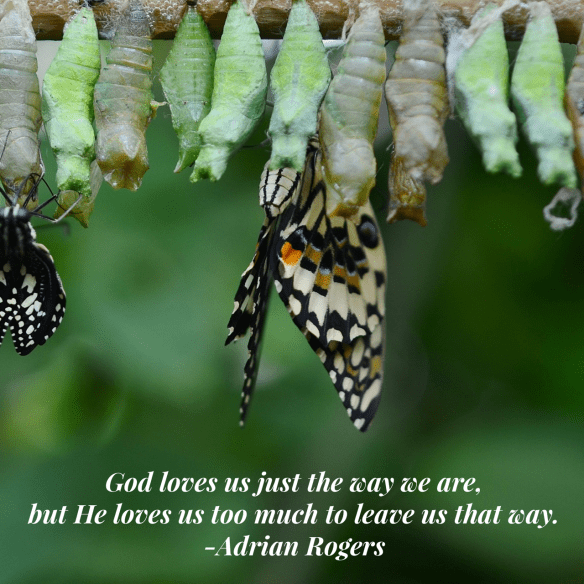
What if we really don’t measure up?

Theodore Roosevelt is credited with saying “Comparison is the thief of joy.” The Bible warns against envy and jealousy. “Not that we dare to classify or compare ourselves with some of those who are commending themselves. But when they measure themselves by one another and compare themselves with one another, they are without understanding” (2 Corinthians 10:12).

We know that no one’s picture-perfect online depictions convey real life, at least not all the time. Everyone has trials and issues, faults and failures. Yet we’re discouraged and depressed when we don’t think we measure up to everyone else.

But what if we really do fall short?

Different personalities and gifts

In early married life, I had a good friend who seemingly could do everything and do it well. While I seemed to struggle to keep my head above water with three children, she had the same number, her house was not only clean but well-decorated, she sewed for her family and for others for pay, she was active in a number of church ministries.

While wondering what was wrong with me for a long time, I finally concluded that God gave different people different capacities. Jesus told a parable of three men who were each given different amounts of money and then had to give account according to what was given them. I could learn from this and other friends and enjoy their different gifts, but I didn’t have to be just like them. God didn’t make us with cookie cutters. I could only be faithful with the abilities He gave me.

Offsetting weaknesses

One night this particular friend and her husband invited our family over for dinner. Everything was wonderful, as expected. But I noticed that this friend could hardly sit still for more than a few minutes. She would excuse herself to go do various things and then come back. It seemed like she didn’t know how to just sit back and relax for very long. And I began to think, if that’s the price one pays for getting so much done, then maybe I don’t that after all. I’m not criticizing her. We just had different personalities.

One former pastor used to say that every strength has an offsetting weakness. One organizational whiz I knew had trouble with flexibility. Someone with a take-charge personality is great when you need someone in charge, but they come across as controlling otherwise.  A person whose primary gift is mercy might have a hard time saying “no” when she should. If we find ourselves envying someone’s gift, we need to remember they have their weaknesses, too. We all have issues for which we need God’s grace.

God’s choices

Many times in the Bible, God set His choice and blessing on particular people. He chose younger Jacob over older Esau, even though by the standards of the times, the older brother received the family blessing and a bigger share on the inheritance. Peter, James, and John had more experiences with Jesus than the other disciples, and Peter got the lion’s share of attention in the gospels. All we know about some of the disciples is their names. Does that mean they were less special that Peter? No: God just had different purposes for them.

A former pastor who preached a series about the disciples said that these lesser-known ones were faithful in obscurity. That’s where most of us find ourselves. We’re not the big names. We don’t have the big followings. When I was growing up, I often heard the saying “God must love the common folk, He made so many of them.”

Accepted in the Beloved

We all fall short of God’s perfect righteousness. But He loved us so much, He gave His only Son to die for our sins, so if we turn from them and believe on Him, we’re saved and cleansed (John 3:16). When I really got hold of the idea that I’m “accepted in the Beloved,” as the KJV puts it, all my securities and self-image issues melted away. Our position in Him has nothing to do with our looks, our abilities, our works, our talents, and how they measure up to anyone else. He made us the way He wanted us. He gives us everything we need to live for Him and grow more like Him.

His divine power has granted to us all things that pertain to life and godliness, through the knowledge of him who called us to his own glory and excellence, by which he has granted to us his precious and very great promises, so that through them you may become partakers of the divine nature, having escaped from the corruption that is in the world because of sinful desire (2 Peter 1:3-4).

Were not enough in ourselves, but we’re complete in Him. He gives us everything we need for everything He’s called us to.

And God is able to make all grace abound to you, so that having all sufficiency in all things at all times, you may abound in every good work (2 Corinthians 9:8).

We each have a gift from God, a purpose, and a unique job to do. We may not have the same reach as others, but we each have a unique sphere of influence. God doesn’t call us to do what others do. He only calls us to be faithful to what He wants us to do.

Someone will always be better than us in every aspect of our lives: better-looking, better cooks, better writers, better home managers, etc. That’s no reason for dismay. We will be better than some in those aspects, too. That’s no reason for pride.

For who makes you different from anyone else? What do you have that you did not receive? And if you did receive it, why do you boast as though you did not?
 (1 Corinthians 4:7, NIV)

The main point isn’t how we compare to others. The main point is being faithful with what God gave us. We seek His purposes and plans for us, grow in grace, knowledge and abilities, and use them to reflect Him, glorify Him, and serve others.

As each has received a gift, use it to serve one another, as good stewards of God’s varied grace: whoever speaks, as one who speaks oracles of God; whoever serves, as one who serves by the strength that God supplies—in order that in everything God may be glorified through Jesus Christ. To him belong glory and dominion forever and ever. Amen. (1 Peter 4:10-11, ESV)

(Sharing with Inspire Me Monday, Kingdom Bloggers, Literary Musing Monday, Hearth and Soul, Tell His Story, Purposeful Faith, Happy Now, Tea and Word, InstaEncouragement, Anchored Truth, Let’s Have Coffee, Worth Beyond Rubies, Recharge Wednesday, Wise Woman, Share a Link Wednesday, HeartEncouragement, DestinationInspiration, Grace and Truth, Faith on Fire, Faith ‘n Friends)

I’ve been featured:GraceTruth-125x125

Forsaking Thoughts

Saturday morning I was arrested by a phrase in Seasons of the Heart, compiled by Donna Kelderman. One sentence of the day’s selection, written by Frances Ridley Havergal, said, “Oh, forsake the thoughts as well as the way, and return unto the Lord, and He will abundantly pardon.”

I’m sure the inspiration for her comment came from Isaiah 55:7: “Let the wicked forsake his way, and the unrighteous man his thoughts: and let him return unto the LORD, and he will have mercy upon him; and to our God, for he will abundantly pardon.”

I’d read this verse before, several times. It and other passages talk about managing our thoughts, so the idea wasn’t new to me. But perhaps because the wording was rearranged just a bit, that idea of forsaking certain thoughts stood out. It’s not enough to forsake a certain sin if we’re still thinking about it all the time. And some thoughts in themselves are sins (lust, pride, etc.). We need to forsake sinful thoughts as well as sinful ways.

But how can we forsake thoughts when they spill into our minds unbidden? We might not want to think them, but we can’t seem to get away from them.

First, we need to pray. Something I sometimes pray is  Psalm 19:14: “Let the words of my mouth and the meditation of my heart be acceptable in your sight, O LORD, my rock and my redeemer.

Then, we can change our thoughts.

In How to Say No to a Stubborn Habit, Erwin Lutzer said that if someone told you to stop thinking about the number 8, suddenly that’s all you can think of. What to do then? Think of other numbers, do equations, arrange them in different orders, etc.

The best way to get rid of one thought is to replace it with another. Instead of passively being at the mercy of whatever thoughts assail us, we can actively think about profitable things. We can take our thoughts captive (2 Corinthians 10:5).

David Martyn-Lloyd Jones put it this way in Spiritual Depression:

Have you realized that most of your unhappiness in life is due to the fact that you are listening to yourself instead of talking to yourself? Take those thoughts that come to you the moment you wake up in the morning. You have not originated them but they are talking to you, they bring back the problems of yesterday, etc. Somebody is talking. Who is talking to you? Your self is talking to you. Now this man’s treatment [in Psalm 42] was this: instead of allowing this self to talk to him, he starts talking to himself. “Why art thou cast down, O my soul?” he asks. His soul had been depressing him, crushing him. So he stands up and says, “Self, listen for moment, I will speak to you.”

So what can we say to our souls?

We can turn our thoughts to anything active, really: planning our next week, what we’re going to serve at the next church fellowship, how to rearrange the desk or living room, etc.

But the best thoughts to turn to are God’s. After the verse about forsaking wicked or unrighteous thoughts and ways in Isaiah 55, God goes on to say His thoughts are higher than ours. Romans 12:2 says “Do not be conformed to this world, but be transformed by the renewal of your mind, that by testing you may discern what is the will of God, what is good and acceptable and perfect.”

Sometimes in an urgent situation, singing a hymn (either out loud or to ourselves) helps in a couple of ways. First, it turns our thoughts to God’s truths. Then, once we start a well-known song, our minds want to finish it out. This has helped me a lot in times of anxiety. There was a period of time where I was often plagued by negative, almost blasphemous thoughts about God. I didn’t believe them. I was quite distressed, unsure where they were coming from. Finally I decided every time such a thought would begin, I’d start singing a hymn of praise to God. If it was Satan suggesting these thoughts, I guess he got tired of it after awhile when his efforts just led to more praise to God.

Either reading or remembering Scripture helps us center our thoughts on God’s. The more we read and memorize, the more the Holy Spirit can “teach you all things and bring to your remembrance all that I have said to you” (John 14:26). If we’re wrestling with a particular temptation—lust, pride, gluttony, etc.—it helps to look up verses to combat those, list some to have them ready, and start memorizing them.

Then, it helps to concentrate on the positive and not just the negative, what we can do instead of what we can’t, doing rather than don’t-ing. 2 Timothy 2:22 says, “So flee youthful passions, and pursue righteousness, faith, love, and peace, along with those who call on the Lord from a pure heart.” Colossians 3 tells us to put off some things—immorality, evil desire, covetousness, anger, wrath, malice, slander, obscenity, lying—and put on other things like humility, forgiveness, kindness, patience, love, compassion.

Just trying to stop thinking about what we can’t do is like trying to stop thinking about the number 8. Not only will our minds keep trying to go there, but we’ll be discontent. But if we focus on what we’re supposed to be doing instead, we’ll have enough to keep us busy for a long time.

How about you? What ways have you found to forsake wrong thoughts?

(Sharing with Inspire Me Monday, Global Blogging, Kingdom Bloggers, Tell His Story, Purposeful Faith, Hearth and Soul, Happy Now, Tea and Word, InstaEncouragement, Anchored Abode, Let’s Have Coffee, Worth Beyond Rubies, Recharge Wednesday,
Share a Link Wednesday, HeartEncouragement, Destination Inspiration, Faith on Fire, Grace and Truth, Faith ‘n Friends)

When Interruptions ARE the Ministry

I hate interruptions.

One reason I dislike them so much is that I try, first thing in the morning, to give God my day. So then whatever plans I make under His leadership must be what He wants me to do. And anyone and anything that disrupts those plans must not be of God, right?

One former Sunday School teacher said that whenever his phone rang during family devotions, he was tempted to answer the phone saying, “Do you know you’re being used of the devil right now?”

I understand the frustration. But then I noticed Jesus didn’t react that way when people interrupted His time alone with His Father. The more I read the gospels, the more I saw that Jesus’s earthly life was full interruptions. But He never acted flustered or put out.

One of the most significant incidents that changed my view of interruptions was when Jesus went with Jairus to heal his daughter. A woman with an issue of blood touched Jesus’s clothes, hoping for healing. Immediately, Jesus, “perceiving in himself that power had gone out from him,” asked who touched Him. The Bible doesn’t say whether Jairus was patiently waiting or upset and fidgeting. While talking with this woman, a messenger came and informed Jairus that his daughter had died. But Jesus told him, “Do not fear, only believe.” And He went on and healed the girl.

That taught me that even if interruptions come, they are not a hindrance to God’s plans or abilities. Interruptions are often an avenue of service.

Take the story of the Good Samaritan. A man was beaten, robbed, and left for dead. Two whose jobs were ministerial passed him by, lest he hinder their calling. The Samaritans were at that time enemies to the Jews, yet one of them stopped and took care of this man. The Samaritan became the prime example of loving one’s neighbor.

Interruptions abound not only in Jesus’s life ministry, and teaching, but all through the Bible. When Abraham saw three visitors passing by his tent, he called them in to eat. That wasn’t just a matter of calling for pizza delivery or slapping sandwiches together. He asked his wife to make cakes (possibly bread) from scratch and one of his hired hands to prepare a calf. Even though the young man “prepared it quickly,” it had to have taken some time to kill and skin the calf and then cut meat and cook it.

Some Biblical interruptions, I noted, were from God Himself: Noah’s call to build and ark, Moses’s call to lead the Israelites out of Egypt, Lot’s call to leave Sodom, Gideon’s call to save Israel from the Midianites, Mary’s call to birth the Messiah, Paul’s call on the road to Damascus, just to name a very few.

Though those incidents interrupted what each person was doing, they were of God. As C. S. Lewis said, “The great thing, if one can, is to stop regarding all the unpleasant things as interruptions of one’s ‘own,’ or ‘real’ life. The truth is of course that what one calls the interruptions are precisely one’s real life — the life God is sending one day by day” (from a 1943 letter from C.S. Lewis in Yours, Jack: Spiritual Direction from C.S. Lewis). Claudia Barba put it similarly in her “Monday Morning Club” newsletter:

Are you annoyed this morning by the wrench some monkey has thrown into your careful plan for today? Relax and remember: interruptions aren’t hindrances to ministry. They are ministry.

So not only is God sovereign over all the interruptions of our day, sometimes He orchestrates them to call us out of what we’re doing into what He wants us to do.

But doesn’t Satan interrupt sometimes? Yes, he interrupted Eve in Eden, Jesus in the wilderness, Paul while he was witnessing to Sergius Paulus. The “strange woman” from Proverbs tries to interrupt people to sin. How do we know if an interruption is from God or Satan? Well, in these cases it was obvious by what the interrupter said or wanted. It’s vital that we know the Word of God so we can correctly discern between good and evil. Then we need to “be strong in the Lord, and in the power of his might. Put on the whole armour of God, that ye may be able to stand against the wiles of the devil” (Ephesians 6:10-11).

But sometimes it’s hard to discern whether an interruption is a call from God for service or a distraction from God’s will. Missionary Isobel Kuhn, when she was trying to discern if an obstacle was from God or Satan, used to pray: “If this obstacle is from Thee, Lord, I accept it; but if it is from Satan, I refuse him and all his works in the name of Calvary.” Jesus taught how to resist Satan: with the Word of God. If God allows temptation to come into our lives, He’ll provide a way of escape.

Satan’s catastrophic interruptions in Job’s life were allowed to by God. If God allows fiery trials, He’ll give grace to endure them.

On the other hand, Jesus did not view every interruption as a call to service. During one of those interruptions of His prayer time, Peter told Him, “Everyone is looking for you.” Jesus has spent the previous evening, as well as previous days before, healing people and casting out demons. Evidently people wanted Him to do more of the same. But instead of saying, “I’ll be right there,” He said, “Let us go on to the next towns, that I may preach there also, for that is why I came out” (Mark 1:29-39). Though healing was a major part of His ministry, His prime mission until the cross was to preach and teach. And he was called to go to various places, not stay in one town.

It’s not wrong to seek to avoid interruptions. Jesus often went out alone late at night or early in the morning to pray. When He was interrupted anyway, He handled it graciously. He called the disciples to come apart and rest. As it turned out, the crowds followed them and they didn’t get to rest. Finally, when it grew late, the disciples asked Jesus to send the crowds away to get something to eat. But He didn’t answer, “That’s a great idea: finally we can rest.” No, He said, “You give them something to eat.” What? They were depleted and weary. They had just a small bit of food. But Jesus told them to share that, and He blessed and multiplied it to be enough for 5,000+ people, with twelve baskets leftover.

I still don’t like interruptions. But I’m learning that dislike is usually due to my own selfishness and desire for control. I’m seeking God for help to respond graciously and His discernment to know what interruptions are from Him. And when I feel I don’t have any more to give, I’ll seek His provision and blessing, which abundantly cover the needs of the day.

(Sharing with Inspire Me Monday, Kingdom Bloggers, Tell His Story,
Tea and Word Tuesday, Purposeful Faith, Let’s Have Coffee,
Worth Beyond Rubies, Recharge Wednesday, Anchored Abode,
Share a Link Wednesday, Grace and Truth, Faith on Fire.
Linking does not imply 100% agreement)

Biblical Prayers

I mentioned in my earlier post about prayer that I sometimes like to pray Scripture directly.

Of course, not every prayer in Scripture is something we would pray today. Sometimes people in the Bible prayed for specific situations or people that we don’t deal with. We can still learn from them, but in our day we wouldn’t pray the same thing.

Also, as I said earlier, praying isn’t a matter of finding a magic formula or reciting certain words rotely.

But some examples of prayer in Scripture lift us up out of everyday life into real soul work, for ourselves and others. Some years ago I started making a list of these prayers when I came across them, and I still add to this list occasionally. So I thought I’d share with you what I have so far (all are from the ESV unless otherwise noted):

  • May the God of endurance and encouragement grant you to live in such harmony with one another, in accord with Christ Jesus, that together you may with one voice glorify the God and Father of our Lord Jesus Christ. Romans 15:5-6 (Though this is talking about the church, I often put this on wedding cards.)
  • For this reason, because I have heard of your faith in the Lord Jesus and your love toward all the saints, I do not cease to give thanks for you, remembering you in my prayers, that the God of our Lord Jesus Christ, the Father of glory, may give you the Spirit of wisdom and of revelation in the knowledge of him, having the eyes of your hearts enlightened, that you may know what is the hope to which he has called you, what are the riches of his glorious inheritance in the saints, and what is the immeasurable greatness of his power toward us who believe, according to the working of his great might that he worked in Christ when he raised him from the dead and seated him at his right hand in the heavenly places. Ephesians 1:15-20
  • For this cause I bow my knees unto the Father of our Lord Jesus Christ, Of whom the whole family in heaven and earth is named, That he would grant you, according to the riches of his glory, to be strengthened with might by his Spirit in the inner man; That Christ may dwell in your hearts by faith; that ye, being rooted and grounded in love, May be able to comprehend with all saints what is the breadth, and length, and depth, and height; And to know the love of Christ, which passeth knowledge, that ye might be filled with all the fulness of God. Now unto him that is able to do exceeding abundantly above all that we ask or think, according to the power that worketh in us, Unto him be glory in the church by Christ Jesus throughout all ages, world without end. Amen. Ephesians 3:14-20 (KJV)
  • And it is my prayer that your love may abound more and more, with knowledge and all discernment, so that you may approve what is excellent, and so be pure and blameless for the day of Christ, filled with the fruit of righteousness that comes through Jesus Christ, to the glory and praise of God. Philippians 1:9-11
  • For this cause we also, since the day we heard it, do not cease to pray for you, and to desire that ye might be filled with the knowledge of his will in all wisdom and spiritual understanding; That ye might walk worthy of the Lord unto all pleasing, being fruitful in every good work, and increasing in the knowledge of God; Strengthened with all might, according to his glorious power, unto all patience and longsuffering with joyfulness; Giving thanks unto the Father, which hath made us meet to be partakers of the inheritance of the saints in light. Colossians 1:9-12 (KJV)
  • May the Lord make you increase and abound in love for one another and for all, as we do for you, so that he may establish your hearts blameless in holiness before our God and Father, at the coming of our Lord Jesus with all his saints. 1 Thessalonians 3:12-13
  • Now may the God of peace himself sanctify you completely, and may your whole spirit and soul and body be kept blameless at the coming of our Lord Jesus Christ. He who calls you is faithful; he will surely do it. 1 Thessalonians 5:23
  • To this end we always pray for you, that our God may make you worthy of his calling and may fulfill every resolve for good and every work of faith by his power, so that the name of our Lord Jesus may be glorified in you, and you in him, according to the grace of our God and the Lord Jesus Christ. 2 Thessalonians 1:11-12
  • Now our Lord Jesus Christ himself, and God, even our Father, which hath loved us, and hath given us everlasting consolation and good hope through grace, Comfort your hearts, and stablish you in every good word and work. 2 Thessalonians 2:16-17 (KJV)
  • And the Lord direct your hearts into the love of God, and into the patient waiting for Christ. II Thessalonians 3:5 (KJV)
  • Now may the Lord of peace himself give you peace at all times in every way. The Lord be with you all. 2 Thessalonians 3:16
  • Now the God of peace, that brought again from the dead our Lord Jesus, that great shepherd of the sheep, through the blood of the everlasting covenant, Make you perfect in every good work to do his will, working in you that which is wellpleasing in his sight, through Jesus Christ; to whom be glory for ever and ever. Amen. Hebrews 13:20-21 (KJV)

And that’s just the epistles!

Many of the psalms are prayers that we could pray in our day, like David’s prayer of repentance in Psalm 51 or  his prayer of wonder and praise in Psalm 8.

A couple of Old Testament pleas come to mind often, like 2 Chronicles 20:12: “For we are powerless against this great horde that is coming against us. We do not know what to do, but our eyes are on you” and 2 Chronicles 14:11: “LORD, it is nothing with thee to help, whether with many, or with them that have no power: help us, O LORD our God; for we rest on thee, and in thy name we go against this multitude. O LORD, thou art our God; let not man prevail against thee.”

Jesus gave us what we call the Lord’s prayer in Matthew 6:9-15:

Our Father in heaven, hallowed be your name.
Your kingdom come, your will be done,
    on earth as it is in heaven.
Give us this day our daily bread,
     and forgive us our debts,
    as we also have forgiven our debtors.
And lead us not into temptation,
    but deliver us from evil.

Phrases from the gospels come to mind as prayers:

Jesus said, “But the Helper, the Holy Spirit, whom the Father will send in my name, he will teach you all things and bring to your remembrance all that I have said to you” (John 14:26). The more we read the Bible, the more the Holy Spirit can bring back to our minds what it says, the more our thoughts and prayers will be infused with God’s truth and will.

Of course, we can’t just rip words out of context and use them in prayer. But as we read the Bible and see how these prayers arise in context, our own hearts can be stirred up to pray according to God’s will.

Even verses that aren’t prayers in themselves can be turned into a prayer request that God will help us understand and incorporate the truth of it into our lives.

Writing this post has given me the idea for a project. Maybe the next time I read through the Bible, I’ll make note of any prayer that we could pray today. That would be an interesting study!

Are there prayers from the Bible you like to use when you pray?

Prayer: Talking with Our Father

Articles abound claiming ways of improving our prayer lives. Some tout titles encouraging us to try new or ancient “forms” of prayer, as if an improved prayer life is a matter of certain words in a certain order. Others proclaim “Five [or however many] Prayers to Unleash God’s Power in Your Life,” as if we have God on a leash.

I’m concerned when improving our prayer lives seems to be a matter of trying different fads or rituals.

We tell unbelievers that Christianity is a relationship with God to help them realize it’s not just a set of certain behaviors. But sometimes we forget the relationship in our own practices. Spiritual disciplines are a means to an end, not an end in themselves. Improving prayer, Bible study, or any other facet of Christian life needs to be a matter of enhancing the relationship, not just finding a better form of practice.

Granted, most of us change and grow in how we practice these disciplines over the years. And different personalities gravitate to different “styles.” I attended a prayer meeting that was so regimented, it seemed to me to choke the life out of what we were doing. I felt constricted, burdened, and frustrated. But perhaps that style of prayer was deeply meaningful to the person leading the meeting.

What helps me most is remembering that prayer is just talking to my Father. Like any relationship, hopefully communication improves over time. But He doesn’t wait for me to get just the right form. He hears my heart.

The best place to learn how to pray is the Bible. God’s Word gives specific instructions about prayer. Just a few:

God also gives us wonderful examples of prayer. Some of my favorites:

From the examples in the Bible, we see how people prayed, in what attitudes and circumstances, and what specifically they prayed for.

One of my favorites of Paul’s prayers is Colossians 1:9-14:

And so, from the day we heard, we have not ceased to pray for you, asking that you may be filled with the knowledge of his will in all spiritual wisdom and understanding, so as to walk in a manner worthy of the Lord, fully pleasing to him: bearing fruit in every good work and increasing in the knowledge of God; being strengthened with all power, according to his glorious might, for all endurance and patience with joy; giving thanks to the Father, who has qualified you to share in the inheritance of the saints in light. He has delivered us from the domain of darkness and transferred us to the kingdom of his beloved Son, in whom we have redemption, the forgiveness of sins.

While it’s fine to pray for health and financial needs, how much more do we need to pray for these kinds of things for ourselves and each other.

Following a certain form would seem artificial to me. I don’t talk to anyone else in my life via specific forms. On the other hand, because we’re talking to someone we can’t see and who doesn’t answer us audibly, sometimes our minds can wander. So in some ways it does help our feeble flesh to have something to corral our thoughts and keep on point. Some use acronyms, like

Pray
Repent
Ask
Yield

Or:

Adoration
Confess
Thanksgiving
Supplication

When my thoughts seem too scattered to pray, most often I use what we call “the Lord’s prayer” as a jumping-off point. It might go something like this:

“Our Father in heaven.” Thank you that I can call you Father, that you loved me and saved me and brought me into your family. Thank you for forgiving, leading, and guiding me. Thank you for being a kind and gracious Father.

“Hallowed be your name.” You’re not just my Father, but also my King. Help me not to forget your greatness and holiness.

Your kingdom come, your will be done, on earth as it is in heaven.” I pray for Your perfect will to be done in these various situations I bring before You.

Give us this day our daily bread.” I’m grateful You know my needs before I even ask. I praise You that I can trust You to provide for me and those I pray for.

“Forgive us our debts, as we also have forgiven our debtors.” I confess these sins to You (naming them individually) and ask Your forgiveness. Help me to forgive others just the way I want to be forgiven.

And lead us not into temptation, but deliver us from evil.” You know what’s ahead this day. I pray for your protection from evil that may come my way and from the temptations of my own heart.

“For yours is the kingdom and the power and the glory, forever. Amen!”

I’ve made a list of different prayers in the Bible that I like to use in praying for myself and for others. Many of them are from the epistles, like the one from Colossians mentioned above or from Philippians. When we pray God’s Word, we know we’re praying according to His will. But, again, it’s not just a matter of praying certain words rotely: it’s talking with our Father.

Elisabeth Elliot wrote once of waking up in the morning, cold, fuzzy-headed, not feeling very spiritual, stumbling into another room to spend time with the Lord. She felt she needed help putting her own heart in the right frame of mind, so she started her prayer and devotional time either reading or singing psalms or hymns (from the chapter “Meeting God Alone” in On Asking God Why). Many hymns are wonderful prayers, like:

Guide me, O Thou great Jehovah,
Pilgrim through this barren land;
I am weak, but Thou art mighty,
Hold me with Thy pow’rful hand.
Bread of heaven, Bread of heaven,
Feed me till I want no more;
Feed me till I want no more.

(William Williams, 1745)

Or:

Be Thou my vision, O Lord of my heart;
Naught be all else to me, save that Thou art;
Thou my best thought, by day or by night;
Waking or sleeping, Thy presence my light.

(Dallan Forgaill, 6th century; translated and published 1912)

Modern hymns like Speak, O Lord and O Great God are prayers meaty with Scriptural truth and greatly meaningful to me.

I also used to think I hadn’t “officially” prayed for something unless I mentioned it in my devotional time. But I learned we can talk to God all through the day. When my first clear thoughts form in the morning, I try to remember right then to give Him the day and ask His help for it. When I hear a bit of good news or find something that perfectly meets my needs, I can thank Him on the spot. When I come across a prayer request, I try to pray for it immediately.

Like with other relationships, we can touch base with God off and on all day. But then we also need times of setting aside everything else just to focus on each other.

And when we have no words, “Likewise the Spirit helps us in our weakness. For we do not know what to pray for as we ought, but the Spirit himself intercedes for us with groanings too deep for words” (Romans 8:26).

In the chapter I mentioned by Elisabeth Elliot, she said:

My own devotional life is very far from being Exhibit A of what it should be. I have tried, throughout most of my life, to maintain a quiet time with God, with many lapses and failures. Occasionally, but only occasionally, it is impossible. Our Heavenly Father knows all about those occasions. He understands perfectly why mothers with small children bring them along when they talk to him.

If hers was not Exhibit A, how much less is mine! I started to take all personal references out of this post for that reason (and due to length). But it has helped me to read others’ experiences with prayer, so maybe this might be a small help to someone else.

What I mainly wanted to share with you is this: if we feel our prayers need livening up, perhaps the first place to start is to remember who we’re talking to and why. Then, as we read His Word, we can take note of what it teaches about prayer and learn from examples there.

(Sharing with Inspire Me Monday, Kingdom Bloggers, Literary Musing Monday,
Tell His Story, Purposeful Faith, Let’s Have Coffee, Recharge Wednesday, Anchored Truth, Worth Beyond Rubies, Woman to Woman, Grace and Truth, Faith on Fire)

“Examine yourselves, to see whether you are in the faith”

Several days ago, many American Christians reeled with the news that a prominent pastor and author announced that he no longer considers himself a Christian.

Speculation and commentary abounds concerning what led to this declaration. Some have traced his history and pointed out problems with the movements he has been associated with. But no one really knows his heart.

When a person becomes a Christian, he is “born again” (John 3:3-21, I John 3:4-10). That’s one of many reasons that a Christian can’t lose his salvation. He can’t become unborn spiritually.

Christians can sometimes fall away from what they’ve been taught to varying degrees. That may be influenced by listening to false teaching, failing to grow in the Lord, neglecting His Word, bitterness, or any number of things.

But that’s a different thing from repudiating their profession of faith alltogether. When that happens, all we can conclude is that they were never genuine believers in the first place.

I hold out hope, as do others, that the man I mentioned has not truly walked away from God and his core beliefs but is instead just confused and out of fellowship. Hopefully with prayer, contemplation, and counsel, he can get things straightened out.

But I shared all of that to say this:

Whenever this kind of thing occurs, I can’t help but ask myself, “How did that happen?

Jesus said one day people will stand before Him who called Him Lord, prophesied, cast out demons, and did mighty works in His name, and yet He’ll have to tell them, “I never knew you; depart from me” (Matthew 7:21-23).

I can’t imagine a more tragic or frightening prospect. For years I feared every time I heard or read this passage. How did I know I won’t end up like these poor people?

When I asked this of a former pastor, he said that these folks all pointed to what they did. None of them said, “I came to Christ confessing my sin, repenting of it, and asking Him to be my Savior and Lord.”

That helped me a lot. But, since then, I have known people who made professions of having done this, yet fell away in later years. How does that happen?

I think perhaps for people who have grown up in a Christian culture, it’s easy to just go with the flow. They’ve heard it all their lives. It’s part of their thinking. Isobel Kuhn was like this. She says in her autobiography, By Searching: My Journey Through Doubt Into Faith, that when she went off to a secular college, she could have held a debate with anybody defending doctrines of the faith. But all it took was one professor saying, “Oh, you just believe that because your parents told you it was so” for her to realize he was right. She went off to gleefully live for herself, free from the restrictions she had grown up with. But God, in His mercy and grace, brought her to Himself.

Perhaps others did not grow up in a Christian culture, but weren’t adequately taught. Some I know responded to “positive peer pressure”–when all their friends were making professions, they figured they needed to get in on it, too. Or the person witnessing to them was so aggressive, they felt they dare not refuse to pray with the person. I’ve heard of many people who raised their hands in a church service, walked an aisle, prayed a prayer, yet did not consider themselves truly saved until later in life. Perhaps they weren’t taught well; perhaps they placed their trust in those acts rather than in Christ. But however it happened, they realized some time later that they were not believers and needed to be. Some had been professing Christians for years and were even pastors or pastor’s wives.

The Bible tells us to “Examine yourselves, to see whether you are in the faith. Test yourselves” (2 Corinthians 13:5).

The last thing I want to do is disturb the peace of genuine Christians. I lived nearly half my life unsure of my salvation, and that’s a miserable way to live. Just about the time I thought I had it settled, some new angle of doubt would creep in. I told more about that situation here.

But I’d dearly love to spare even one person from being told by Jesus, “I never knew you; depart from me.

For more information on how to become a Christian, see How to Know God.

Whoever has the Son has life; whoever does not have the Son of God does not have life.
 1 John 5:12

For God so loved the world, that he gave his only Son, that whoever believes in him should not perish but have eternal life. For God did not send his Son into the world to condemn the world, but in order that the world might be saved through him. Whoever believes in him is not condemned, but whoever does not believe is condemned already, because he has not believed in the name of the only Son of God. John 3:16-18

For the wages of sin is death, but the free gift of God is eternal life in Christ Jesus our Lord. Romans 6:23

(Sharing with Inspire Me Monday, Kingdom Bloggers, Tell His Story,
Purposeful Faith, Let’s Have Coffee, Anchored Abode,
Recharge Wednesday, Share a Link Wednesday,
Worth Beyond Rubies, Wise Woman, Stories of Hope,
Grace and Truth, Literary Musing Monday.
Linking does not imply 100% endorsement)

Longsuffering Is Hard

A former pastor, an older, distinguished Southern gentleman with a deep bass voice, used to pronounce longsuffering with an extended “o”: looooooooooongsuffering. His point was, of course, to illustrate that longsuffering is suffering long.

Newer Bible translations render this word “endurance” or “patience,” and both of those are perfectly accurate. But I like the old word, longsuffering, because it’s a reminder that suffering of whatever nature is hard.

That last thought was a bit of a revelation for me (more like a “duh” moment, actually). I realized I’d been thinking that if I endured something hard for a while, then it wouldn’t “feel” hard any more. Longsuffering would give way to sweetness and ease. When whatever I was enduring still felt hard, I wondered what was wrong with me.

But “longsuffering” indicates it is still hard. And we still need grace to endure. Praying for it doesn’t make it easy, but bearable.

Like long-term physical issues. Or caregiving. Or trying neighbors or coworkers. Or difficult circumstances with no resolution in sight. Or extended loneliness.

Or even our own selfishness. Does anybody else get discouraged by the thought that our selfish nature will always be with us and we’ll have to keep fighting it until we get to heaven?

Sometimes my worst reactions are to little things hardly worth the name of “suffering” and certainly not long. Amy Carmichael once wrote:

The hardest thing is to keep cheerful (and loving) under little things that come from uncongenial surroundings, the very insignificance of which adds to their power to annoy, because they must be wrestled with, and overcome, as in the case of larger hurts. Some disagreeable habit in one to whom we may owe respect and duty, and which is a constant irritation or our sense of the fitness of things, may demand of us a greater moral force to keep the spirit serene than an absolute wrong committed against us. (1)

Thankfully, God is longsuffering with us.

The Lord God, merciful and gracious, longsuffering, and abundant in goodness and truth (Exodus 34:6).

Thankfully, we can pray for His longsuffering in us:

For this cause we also, since the day we heard it, do not cease to pray for you, and to desire that ye might be filled with the knowledge of his will in all wisdom and spiritual understanding; That ye might walk worthy of the Lord unto all pleasing, being fruitful in every good work, and increasing in the knowledge of God; Strengthened with all might, according to his glorious power, unto all patience and longsuffering with joyfulness (Colossians 1:9-11).

Longsuffering with joyfulness, it says. Yes, there will be great joy when whatever we’re suffering is over. But God gives joy in it as well. Maybe not joy for whatever it is in itself, but joy that God is with us, helping us, teaching us through it. “We rejoice in our sufferings, knowing that suffering produces endurance, and endurance produces character, and character produces hope” (Romans 5:3-4).

Wait a minute, you might say. Didn’t Jesus say His yoke was easy and His burden light? Yes, He did, in Matthew 11:28-30. One aspect of His yoke being easy is that the Pharisees had added on or expounded upon the Old Testament law, making it extremely burdensome. People couldn’t keep the OT law as it was. Jesus’s yoke was easy in the sense that He kept the law in our place and took the punishment for our sin upon Himself. Another aspect of His yoke being easy is that He helps us bear whatever He allows. He calls us to cast all our cares on Him and come to Him for help. Those who don’t know Him don’t have that help.

But He never indicated the Christian life is a bed of roses.

There are several reasons in Scripture why God allows suffering of various kinds. And it’s okay to say it hurts or it’s hard. But “His divine power has granted to us all things that pertain to life and godliness, through the knowledge of him who called us to his own glory and excellence, by which he has granted to us his precious and very great promises” (2 Peter 1:3-4a). All things.Through the knowledge of Him. Get to know ever better our great high priest who “sympathize[s] with our weaknesses . . .who in every respect has been tempted as we are, yet without sin. Let us then with confidence draw near to the throne of grace, that we may receive mercy and find grace to help in time of need” (Hebrews 4: 15-16).

I count all things to be loss in view of the surpassing value of knowing Christ Jesus my Lord, for whom I have suffered the loss of all things, and count them but rubbish so that I may gain Christ, and may be found in Him, not having a righteousness of my own derived from the Law, but that which is through faith in Christ, the righteousness which comes from God on the basis of faith, that I may know Him and the power of His resurrection and the fellowship of His sufferings, being conformed to His death; in order that I may attain to the resurrection from the dead. (Philippians 3:8-11, NASB)

___________
(1) Houghton, Frank. Amy Carmichael of Dohnavur. (Fort Washington, PA: Christian Literature Crusade, 1983), 86-87.

All Bible references are from the ESV unless otherwise noted.

(Sharing with Inspire Me Monday, Purposeful Faith, Let’s Have Coffee, Recharge Wednesdays, Share a Link Wednesday, Grace and Truth)

Literary vs. Biblical Redemption

I watched the last episode of a long TV series while riding my exercise bike. The villain of many years had made several attempts to change his ways. Most often he’d fallen back into familiar esponses. But the last couple of years, he had made faltering, but increasing steps in the right direction. In the finale, he sacrificed himself for the good of others, expecting no rewards or good outcomes for himself — and in that final act, finally found his happy ending.

When my children were little, I called this the Curious George philosophy of redemption. The content of the little monkey’s cartoons has changed since then, but 30 years ago the George books and shows mostly ran by a similar formula. George would do something wrong. Sometimes he was naughty; most times he was just a curious little monkey. But inevitably, he’d cause trouble. Something would fall and crash, someone would lose something, a big mess would be made. People would be upset with George, and he’d feel bad. Then George would notice a need that only he could take care of, and everyone would be happy with him again. The good seemingly canceled out the bad.

Daniel Boscaljon says in The Oxford Handbook of English Literature and Theology, in a chapter called “Possibilities of Redemption Through the Novel”:

Redemption is a powerful and uplifting theme that acknowledges the human potential to succeed after having failed. Theological understandings of it focus on how humans can restore their relationships with God despite having fallen from grace into sin. Literature takes the same theme of brokenness and renewal and places it in the context of life on earth, thus including understandings of redemption that may stray from those theologically defined. In this way, even ‘secular’ literatures can be seen as doing ‘theological’ work.

In literary redemption, the character has a transformation of some sort. He changes his ways, either suddenly or gradually. He had been selfish, but now he acts in another’s best interest even at the cost of his own welfare. Literary redemption can provide balance to the plot in sometimes beautiful ways.

A supernatural, unlikely, or convenient ending in literature is called Deus ex machina, a Latin phrase meaning “god from the machine.” In ancient Greek plays, actors playing gods would be brought to the stage in some kind of machine to save the day and set things right. In more modern literature, the rescue may not be from a god: it may be from an act of nature or someone outside the story who swoops in at the last minute. Though sometimes this outside rescue can be used to great effect, usually it’s criticized as contrived.

In real life, though, there’s no hope without outside help from God. God does not weigh our good and bad deeds to determine our fate. Good deeds don’t make up for or cancel the bad. The Bible states many times over in many ways that we’re bound in sin with no way to save ourselves. Jesus Christ, who is both God and the only totally sinless, righteous human, gave Himself in our place to satisfy God’s just demands for holiness and to take the punishment for our sins. It’s His sacrifice that redeems, not ours. Repentance is a change of mind that leads to a change of action, a turning away from sin and our own ways of achieving righteousness to God and His mercy and grace. That change inside us works out into our everyday lives.

To be sure, there’s sacrifice in Christian life. We’re often called upon not to serve self and to sacrifice for the good of others. But this sacrifice isn’t from a desire to rack up enough good points to outweigh our bad ones: it flows from our thankfulness at God’s redeeming us and our love for Him and our fellow humans.

To me, two examples of literary redemption that come closest to the the biblical are Jean ValJean in Les Miserables and Sidney Carton in A Tale of Two Cities, two of my favorite books. Valjean stole a loaf of bread to feed his sister’s starving family and was caught and imprisoned. Escape attempts increased his sentence to 19 years. Prison life and the ill treatment he received when he finally got out turned him into a man so hard that he stole from a bishop and a child. But an unexpected, undeserved act of grace from the bishop undid him and caused him to turn to God. The good acts he did the rest of his life flowed from that one turnaround in his life. I saw an article in some forgotten source years ago quoting an actor who played Valjean in the Broadway musical as saying that it was the greatest act of self-redemption in literature. And I thought, “No, no, no! How can you sing those beautiful songs night after night and miss the fact that God changed him?”

Sydney Carton was a dissolute lawyer in Tale of Two Cities who helped defend Charles Darnay. Sydney’s promising talents have all but drowned in drink. He fell in love with Darnays wife, Lucie, but he knew she could never return his love. She was fully in love with her husband. But, out of love for her, Sydney did the one thing that would help her most. (Spoiler alert.) He looked enough like Darnay to be mistaken for him, so he smuggled himself in and Darnay out of prison. Darnay joined Lucie and escaped Paris: Sydney went to the guillotine. What keeps this from being just a literary redemption is that Sydney finds faith: all through the night before his final act, he walks through Paris reciting to himself John 11:25-26: “I am the resurrection and the life, saith the Lord: he that believeth in me, though he were dead, yet shall he live: and whosoever liveth and believeth in me, shall never die.” One note I read said this quotation showed Sydney was thinking his death would give life to others. That’s true in a sense, but the verse talks about faith in God providing for eternal life. I think Sydney was encouraging himself that God would resurrect him in the end.

I’m thankful we don’t have to provide our own redemption. We never could. Even our most righteousness acts are tainted and soiled compared to God’s perfect righteousness. No many how many we rack up, it would never be enough. But “how much more will the blood of Christ, who through the eternal Spirit offered himself without blemish to God, purify our conscience from dead works to serve the living God” (Hebrews 9:14).

For we ourselves were once foolish, disobedient, led astray, slaves to various passions and pleasures, passing our days in malice and envy, hated by others and hating one another. But when the goodness and loving kindness of God our Savior appeared, he saved us, not because of works done by us in righteousness, but according to his own mercy, by the washing of regeneration and renewal of the Holy Spirit, whom he poured out on us richly through Jesus Christ our Savior, so that being justified by his grace we might become heirs according to the hope of eternal life. Titus 3:3-7

But he was pierced for our transgressions; he was crushed for our iniquities; upon him was the chastisement that brought us peace, and with his wounds we are healed. All we like sheep have gone astray; we have turned—every one—to his own way; and the Lord has laid on him the iniquity of us all. Isaiah 53:5-6

I once heard a story that a traveling preacher was accosted by a man wanting to know how to be saved just as the last call came for the preacher’s train to be boarded. Not having time to go into the gospel message as much as he would have liked, the preacher quoted Isaiah 53:6 above: “All we like sheep have gone astray; we have turned—every one—to his own way; and the Lord has laid on him the iniquity of us all.” Then he told the man, “Go in at the first ‘all,’ and come out at the last one.”

(Sharing with Inspire Me Monday, Tell His Story, Purposeful Faith,
Let’s Have Coffee, Anchored Abode, Share a Link Wednesday,
Stories of Hope, Grace and Truth, Fresh Market Friday)

Do We Know God for Who He Really Is?

Someone recently told me of a gift sent by a friend of her family’s. Though she appreciated that this person thought of her, the gift revealed how much the giver didn’t really know the receiver.

Of course, we don’t always the hit the nail on the head even with those closest to us. I try to always get gift receipts just in case something isn’t right, even if I bought the gift from a link the recipient sent to me. Sometimes we thought we saw the person admiring that item, only to find they considered it and decided against it. Sometimes faulty memory or understanding leads to poor choices. Sometimes we make an educated guess that falls flat.

But usually the better we know a person, the better we are at choosing just the right gift for them.

There are other ways we reveal how much we know another person. I’ve heard myself and my motives described in ways that make me wonder what led the speaker to those conclusions.

Some years ago I read a greeting card for a husband to a wife that was meant to be humorous. The card had several cartoonish drawings of things the husband got wrong with short captions. At the end, the card declared, “I may get all these things wrong, but I sure do love you, honey!”

But blissfully saying, “I love you!” is undermined when one’s actions display a lack of thought or consideration. Yes, we all fail each other sometimes, and need to be forgiving and forbearing. Yet there’s a difference between occasionally letting each other down and a whole lifestyle that shows either blatant ignorance of what pleases the other person or a lack of care.

Truly getting to know someone as they really are takes lots of time together: time talking, doing things together, observing one another.

It’s the same with God. “And this is eternal life, that they know you, the only true God, and Jesus Christ whom you have sent” (John 17:3). Yet so often people describe God in ways the Bible does not portray Him. Or they live out their lives the way they think He wants them to, without finding out for sure what He said.

If we don’t know God for who He really is, the results are more serious than a well-meant but inappropriate gift. We’re in danger of creating a god in our own image, according to our likes and dislikes rather than His. And if eternal life is a matter of knowing Him, then not knowing Him is a matter of eternal death.

We’ll never know God as completely here as we will in heaven, but we should be continually growing in our knowledge of Him and in our own transformation into His likeness. He’s given us His Word. Though it’s relatively short, compared to all the things He could have told us, it contains just what He wants us to know.

The ESV Study Bible notes in one of its appendices:

The Bible is God’s written revelation of who he is and what he has done in redemptive history. Humans need this divine, transcendent perspective in order to break out of their subjective, culturally bound, fallen limitations. Through God’s written Word, his people may overcome error, grow in sanctification, minister effectively to others, and live abundant lives as God intends (p. 2507).

Throughout the Bible, God says that people worship Him with their lips, but their hearts are far from Him. Let’s not just blissfully express our love to Him without regard for who He truly is and what He truly wants. Let’s make it a priority to spend time with Him in His Word and prayer and get to know Him more and more for who He truly is.

 I am the good shepherd. I know my own and my own know me, just as the Father knows me and I know the Father; and I lay down my life for the sheep. John 10:14-15

Let us know; let us press on to know the LORD. Hosea 6:3a

But grow in the grace and knowledge of our Lord and Savior Jesus Christ. 2 Peter 3:18

For further reading: How to Know God.

(Sharing with Inspire Me Monday, Tell His Story, Purposeful Faith,
Let’s Have Coffee, Share a Link Wednesday, Faith on Fire, Grace and Truth)

(Please take my Writer Newsletter Survey)


When Your World Is Shaken

Has your world ever been shaken? Has you ever experienced the rug being pulled from under you and everything going topsy-turvy? An unexpected serious diagnosis, a betrayal, a financial failure, a massive, destructive storm?

My own world was shaken once when I was 15. My parents divorced and we moved from a very small town to a humongous city. On one hand, my parent’s breakup was not a surprise: circumstances had been leading to that conclusion for a long time. But it was still a shock to the system when it happened. On top of family issues, I had to process the loss of friends, familiar neighborhoods, and school and face the culture shock of a totally different area, new school, etc.

Another shaking occurred in my thirties. One morning my left hand felt a little funny, like I had slept on it wrong. Within three hours, my left arm, both legs, and my lower torso were numb, I couldn’t walk on my own, and I was having trouble going to the bathroom. I thought I was having a stroke. After eight days and multitudes of tests, I was diagnosed with transverse myelitis. Would it get better . . . or worse? Would I walk again? How could I live in my split-level house when I couldn’t get up the stairs? How could I take care of my 2-year-old? No one could tell me.

I don’t remember when I first read C. H. Spurgeon’s Morning and Evening, but his meditation on the evening of June 22. was eye-opening for me. The verse for that evening was Hebrews 12:27: “This phrase, ‘Yet once more,’ indicates the removal of things that are shaken—that is, things that have been made—in order that the things that cannot be shaken may remain.” Even though that passage is talking about the ultimate “shaking” at the end of the age, we can apply some its truths to our comparatively smaller shakings.

Spurgeon says:

We have many things in our possession at the present moment which can be shaken, and it ill becomes a Christian man to set much store by them, for there is nothing stable beneath these rolling skies; change is written upon all things. Yet, we have certain “things which cannot be shaken,” and I invite you this evening to think of them, that if the things which can be shaken should all be taken away, you may derive real comfort from the things that cannot be shaken, which will remain.

What are some things that cannot be shaken? These truths are all through Scripture, but I’ll share a representative verse or two for each.

  • God’s sovereignty. Nothing that happens to us is a surprise to God. Well, then, why didn’t He prevent this calamity? That’s a question for another post. But He has a purpose in what He allows.

I am God, and there is no other; I am God, and there is none like me, declaring the end from the beginning, And from ancient times things which have not been done, Saying, ‘My purpose will be established, And I will accomplish all My good pleasure'” (Isaiah 46:9-10).

“The LORD is constantly watching everyone, and he gives strength to those who faithfully obey him” (2 Chronicles 16:9a, CEV).

“Are not two sparrows sold for a penny? Yet not one of them will fall to the ground outside your Father’s care” (Matthew 10:29, NIV).

God’s power, might, and knowledge are all still in force though circumstances are in an upheaval.

  • God’s presence. One of the first things people ask in a crisis is, “Where is God?” He’s there.

“Be strong and courageous. Do not fear or be in dread of them, for it is the LORD your God who goes with you. He will not leave you or forsake you” (Deuteronomy 31:6).

 Keep your life free from love of money, and be content with what you have, for he has said, “I will never leave you nor forsake you” (Hebrews 13:5).

  • God’s love. We might not understand how the turmoil we’re facing fits with God’s love, but we can rest in the fact that His love never leaves us.

 For I am sure that neither death nor life, nor angels nor rulers, nor things present nor things to come, nor powers, nor height nor depth, nor anything else in all creation, will be able to separate us from the love of God in Christ Jesus our Lord” (Romans 8:38-39).

  • Our salvation. Tumultuous circumstances do not indicate that my salvation is in question.

I give them eternal life, and they will never perish, and no one will snatch them out of my hand. My Father, who has given them to me, is greater than all, and no one is able to snatch them out of the Father’s hand” (John 10:28-29).

  • Our home in heaven. Spurgeon concludes his devotion on this topic this way: “Our country is Immanuel’s land, our hope is above the sky, and therefore, calm as the summer’s ocean; we will see the wreck of everything earthborn, and yet rejoice in the God of our salvation.” Sometimes trials remind us of this very thing: we seek “a better country, that is, a heavenly one.” This world is just a temporary dwelling, a tent.

If then you have been raised with Christ, seek the things that are above, where Christ is, seated at the right hand of God. Set your minds on things that are above, not on things that are on earth. For you have died, and your life is hidden with Christ in God. When Christ who is your life appears, then you also will appear with him in glory.” (Colossians 3:1-3).

This is one reason it’s so important that we mine the bedrock truth from the Bible. So often we seek affirmation or warm fuzzy spiritual feelings. But nice feelings will evaporate in hard times. We need to know God’s character and Word are true no matter how we feel and how circumstances seem.

If you’re familiar with Elisabeth Elliot, you know that her world was shaken in a major way a few times. Her first husband was killed by the Indians he was trying to reach with the gospel. Her specialty on the mission field was translation, and years of painstaking work was lost in an instant. Her second husband died of cancer. A recently published book, Suffering Is Never for Nothing, is transcribed from her sessions at a conference. In the third chapter she says:

We are not adrift in chaos. To me that is the most fortifying, the most stabilizing, the most peace-giving thing that I know about anything in the universe. Every time that things have seemingly fallen apart in my life, I have gone back to those things that do not change. Nothing in the universe can ever change those facts. He loves me. I am not at the mercy of chance (p. 43).

Sometimes it’s not the big things that shake us up. It’s the little accumulated everyday frustrations. I never read the book If God Loves Me, Why Can’t I Get My Locker Open, so I don’t know if it’s good. But I’ve had similar thoughts! I love God and I am trying to serve Him here, so why am I stuck in traffic/is my computer not working/is what I need unavailable. Elizabeth wrote in another book of the frustration of spending an inordinate amount of time in the jungle on a stove that wasn’t working. Couldn’t God “make” it function so she could get back to the more important translation work? He could, and sometimes He does. But we live in a fallen world, and He doesn’t take away all the effects of that yet. She wrote in A Lamp For My Feet:

Whatever the enemy of our souls can do to instill doubt about the real purpose of the Father of our souls, he will certainly try to do. “Hath God said?” was his question to Eve, and she trusted him, the enemy, and doubted God. Each time the suspicion arises that God is really “out to get us,” that He is bent on making us miserable or thwarting any good we might seek, we are calling Him a liar. His secret purpose has been revealed to us, and it is to bring us finally, not to ruin, but to glory. That is precisely what the Bible tells us: “His secret purpose framed from the very beginning [is] to bring us to our full glory” (1 Cor 2:7 NEB).

I know of no more steadying hope on which to focus my mind when circumstances tempt me to wonder why God doesn’t “do something.” He is always doing something–the very best thing, the thing we ourselves would certainly choose if we knew the end from the beginning. He is at work to bring us to our full glory.

Sufferings and trials have a way of clarifying for us what’s most important. As the things which can be shaken fall away, the things which cannot be shaken come more clearly into focus. Many of the psalmists go through this process: they come to God shaken by a problem: an enemy is after them, they’re troubled by the prospering of the wicked, etc. But as they pray and remind themselves of the truths they know, they’re brought back to a place of peace.

As Samuel Rutherford said, “Believe God’s word and power more than you believe your own feelings and experiences. Your Rock is Christ, and it is not the Rock which ebbs and flows, but your sea.”

God is our refuge and strength,
    a very present help in trouble.
Therefore we will not fear though the earth gives way,
    though the mountains be moved into the heart of the sea,
    though its waters roar and foam,
    though the mountains tremble at its swelling. Selah

There is a river whose streams make glad the city of God,
    the holy habitation of the Most High.
God is in the midst of her; she shall not be moved;
    God will help her when morning dawns.

“Be still, and know that I am God.
    I will be exalted among the nations,
    I will be exalted in the earth!”
The Lord of hosts is with us;
    the God of Jacob is our fortress.

Psalm 46:1-5, 10-11

(Sharing with Tell His Story, Purposeful Faith, Welcome Heart, Share a Link Wednesdays, Faith on Fire, Grace and Truth, Inspire Me Monday)