This is a hard one, but the last few lines help put it into perspective:
Sometimes our prayers are for deliverance from conditions which are morally indispensable–that is, conditions which are absolutely necessary to our redemption. God does not grant us those requests. He will not because He loves us with a pure and implacable purpose: that Christ be formed in us. If Christ is to live in my heart, if his life is to be lived in me, I will not be able to contain Him. The self, small and hard and resisting as a nut, will have to be ruptured. My own purposes and desires and hopes will have to at times be exploded. The rupture of the self is death, but out of death comes life. The acorn must rupture if an oak tree is to grow.
It will help us to remember, when we do not receive the answer we hoped for, that it is morally necessary, morally indispensable, that some of our prayers be denied, “that the life of Jesus may be plainly seen in these bodies of ours” (2 Cor 4:11 JBP). Then think of this: the agonized prayer of Jesus in the garden went unanswered, too. Why? In order that life–our life–might spring forth from death–his death.
~ Elisabeth Elliot, A Lamp For My Feet
Verily, verily, I say unto you, Except a corn of wheat fall into the ground and die, it abideth alone: but if it die, it bringeth forth much fruit.
John 12:24
To see all the posts in this series, see the bottom of this post.
It might seem odd to start off this series with this quote, but it is one that has ministered to me often. We are all under limitations of some kind: season of life, physical abilities, obligations, etc. And it seems whatever situation we are in, we find ourselves wishing we could do something that we can’t. Sometimes God does reveal His power and grace by overriding whatever the limitations are, or seem to be, as was the case with Moses telling God that he couldn’t speak, so it is important to pray and consider whether the issue is really a limitation or an obstacle God wants to remove. But other times the limitations are from His hand for His purposes.
The following is from Elisabeth’s book A Lamp For My Feet:
Yesterday as I was reading my brother Tom’s book, The Achievement of C.S. Lewis, I was admiring again the scope of his knowledge, his ability to comprehend another’s genius, and his wonderful command of English. By contrast my own limitations seemed severe indeed. They are of many kinds–analytical, critical, articulatory, not to mention educational. But my limitations, placing me in a different category from Tom Howard’s or anyone else’s, become, in the sovereignty of God, gifts. For it is with the equipment that I have been given that I am to glorify God. It is this job, not that one, that He gave me.
For some, the limitations are not intellectual but physical. The same truth applies. Within the context of their suffering, with whatever strength they have, be it ever so small, they are to glorify God. The apostle Paul actually claimed that he “gloried” in infirmities, because it was there that the power of Christ was made known to him.
If we regard each limitation which we are conscious of today as a gift–that is, as one of the terms of our particular service to the Master–we won’t complain or pity or excuse ourselves. We will rather offer up those gifts as a sacrifice, with thanksgiving.
And this is from a section titled “Apportioned Limitations” from the same book:
The God who determined the measurements of the foundations of the earth sets limitations to the scope of our work. It is always tempting to measure ourselves by one another, but this easily leads to boasting or despair. It is our business to find the sphere of service allotted to us, and do all that He has appointed us to do within that sphere, not “commending ourselves.”
Paul said, “We will keep to the limits God has apportioned us” (2 Cor. 10:13 RSV). Jesus did that–willing to become a helpless, newborn baby, to be a growing child, an adolescent, a man, each stage bounded by its peculiar strictures, yet each offering adequate scope in which to glorify his Father.
Lord, glorify yourself through me and in the place You’ve set me. Let me not covet another’s place or work or glory.
I have thought often in regard to dealing with the after-effects of transverse myelitis, “Lord, I could serve you so much better without this.” But it’s as if He were saying, “No, this is what I am using to shape your service for Me.” Most people who have gone through any type of trial or affliction in life would say that, although they didn’t welcome the trial itself, they were drawn closer to the Lord, and the lessons learned were invaluable.
Our current circumstances may be temporary or permanent. We need not lament what we can’t do. We can seek God’s will for what to do now. As long as the Lord has left us here on earth, He has some way for us to bless others, perhaps by prayer, perhaps by being willing for others to minister to us. Sometimes we can be dismayed by our limitations, but as Elisabeth said, limitations just define our ministry: “For it is with the equipment that I have been given that I am to glorify God. It is this job, not that one, that He gave me.”
“God hath chosen the weak things of the world to confound the things which are mighty” (I Cor. 1:27) and to showcase His strength (II Cor. 12:8-10).
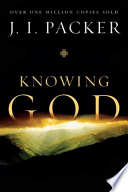
Somehow I have never read Knowing God by J. I. Packer, though I have heard it is wonderful. The title came to my attention again a few weeks ago, and I thought it might be a good time to start it. Then I saw that Tim Challies was leading readers through the book for his Reading Classics Together Series on Thursdays, and that added impetus to read it now, along with the fact that a few blog friends will be reading it at this time as well.
I’ve only participated in Tim’s Reading Classics Together one other time, with The Disciples of Grace by Jerry Bridges. I had decided I wasn’t going to blog about this book every week like I did then, especially since Tim has closed comments on his blog and readers can only participate via a Facebook group for that purpose. I’m really sad about that, for a number of reasons. But as I read the first chapter, I decided it would help me get more out of it and cement what I was learning to keep notes from each chapter rather than just trying to tie it all together at the end.
Chapter 1 is “The Study of God.” I don’t think I am going to summarize or outline each chapter, as Tim will probably do that. I’m just going to share a few things that stood out to me.
Packer starts out with a lengthy quote from Spurgeon extolling the virtues of studying God, reproduced here. Packer counters charges that such a study would be boring, impractical, and irrelevant and instead asserts that “it is the most practical project anyone can engage in” (p. 19).
He talks in the preface and some in the chapter about the spirit of the modern age of skepticism, and here comments, “I ask you for the moment to stop your ears to those who tell you there is no road to knowledge about God, and come a little way with me and see. After all, the proof of the pudding is in the eating, and anyone who is actually following a recognized road will not be too worried if he hears nontravelers telling each other that no such road exists” (p. 19).
Packer warns that, “To be preoccupied with getting theological knowledge as an end in itself, to approach Bible study with no higher a motive than a desire to know all the answers, is the direct route to a state of self-satisfied self-deception. We need to guard our hearts against such an attitude, and pray to be kept from it” (p. 22).
“There can be no spiritual health without doctrinal knowledge; but it is equally true that there can be no spiritual health with it, if it is sought for the wrong purpose and valued by the wrong standard” (p. 22). I very much appreciate that he doesn’t downplay Bible study or knowledge – too many people today, trying to make the same point Packer does, tend to set up false dichotomies about whether we love God or the Bible when we actually learn to love God through the Bible. Rather, he says, yes, study God’s Word – that’s how we learn what He wants us to know about Him – but don’t stop with the academics and the facts. Yearn to get to know God Himself through your study of His Word.
The psalmist [of Psalm 119] was interested in truth and orthodoxy, in biblical teaching and theology, not as ends in themselves, but as means to the further ends of life and godliness. His ultimate concern was with the knowledge and service of the great God whose truth he sought to understand (pp. 22-23).
One of the ways we do this is by meditation, “the activity of calling to mind, and thinking over, and dwelling on, and applying to oneself, the various things that one knows about the works and ways and purposes and promises of God. It is an activity of holy thought, consciously performed in the presence of God, under the eye of God, by the help of God, and as a means of communion with God. Its purpose is to clear one’s mental and spiritual vision of God, and to let His truth make its full and proper impact on one’s mind and heart. It is a matter of talking to oneself about God and oneself; it is, indeed, often a matter of arguing with oneself, reasoning oneself out of moods of doubt and unbelief into a clear apprehension of God’s power and grace” (p. 23).
Chapter 2, “The People Who Know Their God,” Packer expands on the theme of knowing God vs. just knowing about Him. Daniel 11:32b says, “the people that do know their God shall be strong, and do exploits,” or, as another version states it, “shall stand firm and take action.” Drawing from the book of Daniel, he notes and discusses that:
Those who know their God have great energy for God.
Those who know their God have great thoughts of God.
Those who know their God have great boldness for God.Those who know their God have great contentment in God.
It’s not too late if you’d like to join in on this study. We’re reading and discussing two chapters a week, and the chapters are easy to read and not long. I am finding it very beneficial so far.
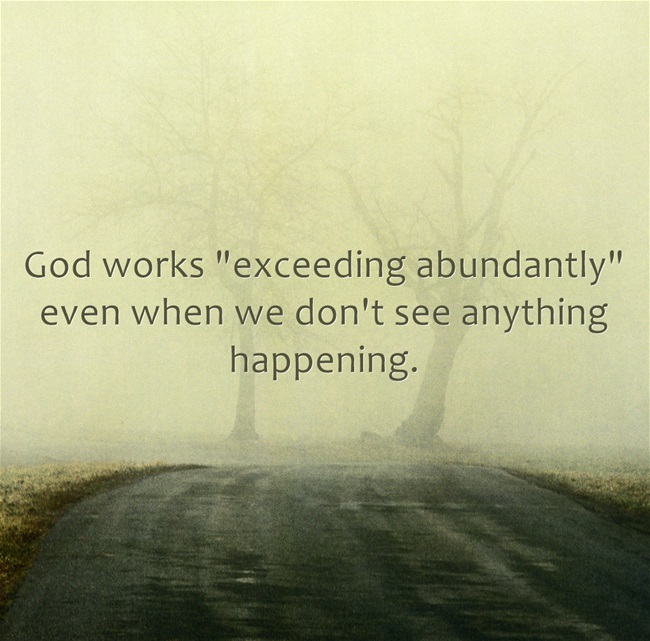
In one of those “one thought leads to another” progressions, a line in girltalk’s post this morning, “No Grace For Your Imagination,” stood out to me: “But for today’s sufficient trouble there is God’s more-than-sufficient grace.” That reminded me of Ephesians 3:20: “Now unto him that is able to do exceeding abundantly above all that we ask or think, according to the power that worketh in us.” That, in turn, got me to thinking that we tend to associate “exceeding abundantly” as “big and dramatic,” but often the process of God’s working is barely perceptible. We also tend to associate it with material needs, and it can apply to those, but look at the prayer requests that proceeded this tribute to God:
For this cause I bow my knees unto the Father of our Lord Jesus Christ, Of whom the whole family in heaven and earth is named, That he would grant you, according to the riches of his glory, to be strengthened with might by his Spirit in the inner man; That Christ may dwell in your hearts by faith; that ye, being rooted and grounded in love, May be able to comprehend with all saints what is the breadth, and length, and depth, and height; And to know the love of Christ, which passeth knowledge, that ye might be filled with all the fulness of God. Now unto him that is able to do exceeding abundantly above all that we ask or think, according to the power that worketh in us, Unto him be glory in the church by Christ Jesus throughout all ages, world without end. Amen.
This passage, along with Colossians 1:9-14 and Philippians 1:9-11, is one that I often pray for myself and my loved ones. The particular qualities mentioned are not only unseen and internal (though the results of them are seen), they’re also the kinds of things we don’t receive in a moment. They take time to grow and develop.So praying for them can often seem discouraging because we “don’t see anything happening.” Yet even in those, especially in those, we can trust God to work “exceeding abundantly.”
For years I had written Bible verses out at the bottom of my letters to my father. He never commented on them, so I just assumed he skipped over them, thinking, “There she goes again” while rolling his eyes. Yet he told the pastor who led him to the Lord that he had read them. My mother, as well, went from not wanting to hear about the things of the Lord to being very open to them at the end of her life. If I had asked her what caused the change or how it happened, she probably could not have told me. I’ve mentioned before a missionary who longed and prayed to be more loving, and turned from berating herself to instead meditating on God’s love for her, resulting in changes she wasn’t even aware of until people commented to her husband about the change in her. Many of us have experienced being given grace and strength for a trial that we didn’t “feel” so much at the time, but looking back, we wondered how we ever got through it and knew we could only have done so by God’s grace.
Recently a friend shared a painful incident that had occurred in her life, and when a couple of us who were listening tried to express sympathy, her tone changed to one of upbeat cheeriness while she tried to assure us everything was ok and she was rejoicing in the Lord.
It’s not the first time that kind of thing has happened.
As Christians, when we face some kind of trial, we remind ourselves of Biblical truth: God is in control, this has not taken Him by surprise, He has a purpose for it, something to teach us in it; He wants to grow our faith by it; He will give us the grace and strength to deal with it. Those are comforting and do help us as we work through the situation.
On top of that, we’re conscious that other people are watching, and we want to be a good testimony and to glorify God in our responses. So sometimes we translate that into putting on a happy face before others and dealing with our confusion and pain in private.
I’ve mentioned that I used to do this after contracting transverse myelitis and finding an online support group of TM patients and caregivers. Honestly, at first I didn’t join them with the idea of trying to be a good testimony. I was just looking for answers in an era when I couldn’t find information anywhere else (thankfully there is a great amount of information available now). But as I interacted with the group, I did realize that I couldn’t help but share God’s grace in dealing with me and helping me cope. I wanted to represent Him well, so I shared only the positive and kept to myself the hard days and frustrations. Later on another Christian joined the group, and she was refreshingly honest and real about her struggles, yet still expressed faith and reliance on God. That was one incident that helped me realize that having joy in the Lord is not the same thing as grinning and bearing it or keeping a stiff upper lip.
The Bible is full of God’s people speaking honestly about their pain and trouble. The Psalms especially are balm for a weary soul. Lamentations shares the full emotion resulting from God’s judgment even while acknowledging God’s justice in His actions. Paul says, “ We are troubled on every side, yet not distressed; we are perplexed, but not in despair; Persecuted, but not forsaken; cast down, but not destroyed; Always bearing about in the body the dying of the Lord Jesus, that the life also of Jesus might be made manifest in our body” (2 Corinthians 4:8-10). He admits to being troubled, perplexed, and cast down while still testifying to God’s keeping him from being distressed, in despair, forsaken, and destroyed. Even our Lord Jesus “offered up prayers and supplications with strong crying and tears unto him that was able to save him from death” (Hebrews 5:7).
I admit it’s hard sometimes to find the balance. We do want to honor the Lord in our trials and not sound like we’re complaining. But I think it helps people more to see us apply Biblical truth to our painful situation rather than acting like we’re above it all and unaffected. Thus, I’d rather hear, “It hurts that so many special things were stolen in the break-in, but it’s a reminder to us that thieves do break through and steal in this world, and we’re to store up treasures in heaven” than an attempt to brush it off. Or, “God, this disease really hurts today. I so wish and pray you’d take it from me. In the meantime, please give me the grace to deal with it.” Or, “I don’t understand why God took my wife home so early, and it hurts like crazy, but I depend on His grace moment by moment.” In one of Elisabeth Elliot’s writings, she said that even with knowing so many wonderful things God did as a result of her husband’s death, that still didn’t satisfy. God can save people and draw them to a closer walk with Him or into service for Him without taking someone’s life to do so. Yet she accepted it and trusted Him in the midst of it. The “peace that passes understanding” that God gives when we take our requests to Him with prayer and thanksgiving doesn’t deny the pain or problems: in fact, it’s all the more marvelous because it occurs in the midst of the pain and problems.
It doesn’t dishonor God to say that something hurts or confuses us. It might dishonor Him to wallow in it without looking to Him. But when we look to Him, honor Him, rejoice in Him, and trust Him even while acknowledging painful or frustrating situations, people see His grace is sufficient for any need.
For this thing I besought the Lord thrice, that it might depart from me. And he said unto me, My grace is sufficient for thee: for my strength is made perfect in weakness. Most gladly therefore will I rather glory in my infirmities, that the power of Christ may rest upon me. Therefore I take pleasure in infirmities, in reproaches, in necessities, in persecutions, in distresses for Christ’s sake: for when I am weak, then am I strong. 2 Corinthians 12:8-10
The parable of the sower speaks of different “soils” of the heart that produced different results from the sowing of the Word of God. What can we do to help our hearts be “good ground” so that God’s Word can take root and bring forth fruit?
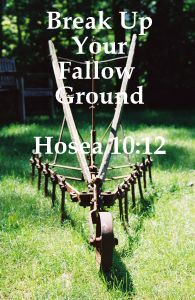
1. Hosea 10:12 says, “ Sow to yourselves in righteousness, reap in mercy; break up your fallow ground: for it is time to seek the LORD, till he come and rain righteousness upon you.” Jeremiah 4:3 also speaks of breaking up our fallow ground.
2. We need to remove the “stones,” the hard places of our willfulness, and the “thorns” of the cares and pleasures of this life which want to choke out the Word. In a different seed metaphor, the seed being ourselves this time, John 12: 24-25 says, “Verily, verily, I say unto you, Except a corn of wheat fall into the ground and die, it abideth alone: but if it die, it bringeth forth much fruit. He that loveth his life shall lose it; and he that hateth his life in this world shall keep it unto life eternal.” In order to bring forth spiritual fruit we have to be willing to die to our own plans, dreams, desires, and will and yield all of those things to the Lord. This sounds so difficult, and it is, but the more we know the Lord, the more we can trust Him with all of those things and stop grasping them for ourselves, thinking we can protect them. His way really is so much better, but often we can’t see that til we get on the other side of the issue at hand, til after we’ve yielded. That’s where faith comes in — faith in Who He is, His love, wisdom, and goodness.
3. Psalm 25:9 says, “ The meek will he guide in judgment: and the meek will he teach his way.” Elisabeth Elliot writes in Keep a Quiet Heart, “Meekness is teachability. ‘The meek will he teach his way’ (Psalm 25:9, KJV). It is the readiness to be shown, which includes the readiness to lay down my fixed notions, my objections and ‘what ifs’ or ‘but what abouts,’ my certainties about the rightness of what I have always done or thought or said. It is the child’s glad ‘Show me! Is this the way? Please help me.’ We won’t make it into the kingdom without that childlikeness, that simple willingness to be taught and corrected and helped. ‘Receive with meekness the engrafted word, which is able to save your souls’ (James 1:21, KJV). Meekness is an explicitly spiritual quality, a fruit of the Spirit, learned, not inherited. It shows in the kind of attention we pay to one another, the tone of voice we use, the facial expression.”
4. Psalm 25:14 says, “The secret of the LORD is with them that fear him; and he will shew them his covenant.” Reverence for the Lord makes us teachable. Proverbs 1:7 says, “The fear of the LORD is the beginning of knowledge: but fools despise wisdom and instruction.”
5. In Matthew 15:16 and Mark 7:13, Jesus tells the Pharisees and scribes that they have made the commandment or word of God “of none effect” through their traditions. That is a scary thought, that we can diminish the effectiveness of the Word by our preconceived notions or our imposing on the Word our own ideas of what it says or means.
6. In John 7:17, Jesus says, “If any man will do his will, he shall know of the doctrine, whether it be of God, or whether I speak of myself.” A willingness to do His will makes us teachable.
This is not meant to be an exhaustive list, and there are probably many other aspects to consider, but, if you’re like me, this is more than enough to get started.
What do we do, though, if we’re not feeling particularly meek, if we know we don’t reverence the Lord as we ought, if we’re feeling stubborn and willful and we know it is wrong, but we don’t know quite what to do with ourselves? Should we avoid the Word, then, thinking it will be useless with our hearts in that condition? That’s exactly what we need not to do. One definition for “fallow” at Dictionary.com is “not in use; inactive.” The last thing we need is to let the “ground” of our hearts remain inactive. That’s one of the times we need the Word the most.
When I am feeling like that, first of all I pray and confess that to the Lord and ask Him to change my heart. Then I look up verses like three in Psalm 80 which say, “Turn us again, O God, and cause thy face to shine; and we shall be saved,” or Psalm 85:6: “Wilt thou not revive us again: that thy people may rejoice in thee?” or Psalm 119:36-37: “Incline my heart unto thy testimonies, and not to covetousness. Turn away mine eyes from beholding vanity; and quicken thou me in thy way” or Psalm 119: 10-11: “ Teach me to do thy will; for thou art my God: thy spirit is good; lead me into the land of uprightness. Quicken me, O LORD, for thy name’s sake: for thy righteousness’ sake bring my soul out of trouble.” (If you have a concordance or Online Bible program, it’s very helpful to search for the word “quicken” and read through the verses that contain that word, and use those in your own prayers.
When we go to Him confessing our lack of meekness, reverence, and willingness and asking Him to work on us in those areas, then He can use His Word to begin to plow up the soil of our hearts and make “good ground.”
If we leave a field untended, it grows weeds and the ground hardens again. So this plowing must be a continual process. It might sound painful, “but no chastening for the present seemeth to be joyous, but grievous: nevertheless afterward it yieldeth the peaceable fruit of righteousness unto them which are exercised thereby” (Heb. 12:11). The more our hearts are “weeded” and kept soft and pliable, the more the seed of God’s Word can take root and bring forth fruit.
Break up my fallow ground, Give a heart just like your own. Where your word will find sweet soil Everywhere that it is sown. Break up my fallow ground, Rid my heart of sinful stone. Break up my fallow ground–My heart your throne
Lord you saved me with your blood you shed on Calvary, And sweet blessings you have given everyday. But my stubborn heart has often not been yielded To your plan you had for me–your perfect way.
Every day I am so easily distracted from the glory and the joy of serving Thee. Wicked pride and bitterness are there to strangle, Sinful habits keep me from the victory.
Break up my fallow ground, Give a heart just like your own. Where your word will find sweet soil Everywhere that it is sown. Break up my fallow ground, Rid my heart of sinful stone. Break up my fallow ground–My heart your throne
I discovered the following on the back of a church bulletin in a box I was cleaning out. It was written by a former pastor of our family’s, Jesse L. Boyd, for whom our son, Jesse, was named.
Are Your Free?
One of the frequent cries of our day is, “I want to be free.” Well, what is freedom? It is not the living of life without restraints of law.
It is not licentiousness or immorality, because their slimy arms can soon wrap us up in their dark and dismal prison-house of suffering.
It is not the lack of government, but rather the privilege of having the right of freely enjoying one’s own government.
It is true Americanism: founded on the Holy Bible, bequeathed to us by our forefathers, and symbolized in Old Glory — The Star-Spangled Banner — “Oh, long may it wave o’er the land of the free, and the home of the brave.”
It is the privilege of spending one’s treasure, of spilling one’s blood, and of being prompted by the spirit of liberty to stand against despotism and tyranny.
It is liberty and loyalty combined.
It is the enjoyment of civil and religious liberty.
It is the title to justice.
It is living as one should; no wicked man lives as he should, therefore, he is never free.
It is having full mastery over all matter.
Freedom ends where tyranny begins.
It comes by mastering one’s self.
It comes through knowing the truth. “Ye shall know the truth, and the truth shall make you free” (John 8:32).
It comes through receiving Jesus Christ as Lord and Saviour. “If the Son therefore shall make you free, ye shall be free indeed” (John 8:36). “It was for freedom that Christ set us free; therefore keep standing firm and do not be subject again to a yoke of slavery” (Galatians 5:1, NAS). “For the law of the Spirit of life in Christ Jesus hath made me free from the law of sin and death” (Romans 8:2). Hallelujah! What a Saviour!
Freedom is that which one receives from God in the new birth. Man cannot govern himself, because, when all restraints are taken away, then evil dethrones him. He can only find rest (soul rest; freedom) in the arms of Jesus Christ. Are you free?
I’ve seen this quote all over Pinterest in various forms, attributed to various authors: “Sometimes it’s better to be kind than right. We don’t need a brilliant mind that speaks, but a patient heart who listens.” Sometimes the word “nice” is substituted for “kind.”
I think what people who propose this have in mind is interpersonal relations. We probably all know someone who “always has to be right.” Now, most of us want to be right. No one wants to go around misinformed or holding onto opinions that are known to be wrong or foolish. But most of us have at least enough humility to realize that we might unwittingly be wrong sometimes. Some people are hard to be convinced of that, though.
This quote might also refer to those people’s little idiosyncrasies that can rub each other the wrong way. How the toilet paper goes on the roll. Where to squeeze the toothpaste tube. It’s usually best to let those things go and compromise for the sake of the relationship. The person who has to have everything his or her way because of course that’s the only right way can make everyone else miserable.
But in some cases, being wrong can be deadly. The wrong wire cut on the bomb. The wrong medical procedure or medicine. The wrong path to a broken bridge. The wrong opinion about who Jesus is or how one can know Him.
Unfortunately in my particular circles in Christendom, people can sometimes use truth like a steamroller or bullhorn or club. Arrogance does not make the gospel winsome or inviting; harshness can turn people off to the truth.
In addition, we need to care about the whole person, not just their response to our truth. Years ago when my sister attended the church I was attending at the time, she had a number of people wanting to take her under their wing and advise her along the way. She needed the advice, but she felt like all anyone was interested in was telling her what she should be doing: no one wanted to just befriend her. When I first became a Christian, I had to realize that my relationship with my lost family couldn’t be just about my trying to witness to them. That only made them feel like a “project.” I needed to listen to them, do things with them, just love them.
Sometimes we have to wait until a person is ready before we can tell them things they need to hear. Jesus told the disciples once, “I have yet many things to say unto you, but ye cannot bear them now” (John 16:12).
And sometimes He shared truth that the other person did not receive, and He let him walk away, like the “rich young ruler.” He didn’t call him back, soften the message, or backtrack so the relationship could continue. When God brings a person to confront their dearest idol, it’s a crisis, and He wants them to see it for what it is and repent. Thankfully in His grace He’ll often bring a person to that point a number of times (I’ve always hoped that that man came back to the Lord at another time). Chris Anderson makes the point that in our day, there is a rush to get such a person to the “sinner’s prayer” and gloss over their heart issues: “How many such men have been led in a sinner’s prayer that salved their consciences but didn’t save their souls? How many have thus been unwittingly inoculated against the truth? How many have left churches lost and relieved rather than lost and sorrowful?” We need to allow time for godly sorrow to do its work toward repentance unto salvation.
In addition, God, through the New Testament writers, said that sometimes an issue is so important that His people need to take a stand and separate from others:
II Thess. 3: 6: Now we command you, brethren, in the name of our Lord Jesus Christ, that ye withdraw yourselves from every brother that walketh disorderly, and not after the tradition which he received of us.
II Thess. 3: 14-15: And if any man obey not our word by this epistle, note that man, and have no company with him, that he may be ashamed. Yet count him not as an enemy, but admonish him as a brother.
I Cor. 5:9-11: I wrote unto you in an epistle not to company with fornicators: Yet not altogether with the fornicators of this world, or with the covetous, or extortioners, or with idolaters; for then must ye needs go out of the world. But now I have written unto you not to keep company, if any man that is called a brother be a fornicator, or covetous, or an idolator, or a railer, or a drunkard, or an extortioner; with such an one no not to eat.
II Cor. 6: 14: Be ye not unequally yoked together with unbelievers: for what fellowship hath righteousness with unrighteousness? and what communion hath light with darkness? (This does not mean we’re not supposed to interact at all with unbelievers, but we’re not to be “yoked” together in situations like marriage).
And the apostles could also seem harsh in their warnings against false teachers, but the truth in question was so vital, and error in its regard so eternally deadly, that strong warnings were needed.
So is it more important to be nice or kind than to be right? It depends on the issue in question and the needs of the people involved. It’s best to be both if possible. The Bible speaks often of God’s kindness and admonishes us in many places to be kind. In interpersonal relationships, especially, we’re to “Put on therefore, as the elect of God, holy and beloved, bowels of mercies, kindness, humbleness of mind, meekness, longsuffering; Forbearing one another, and forgiving one another, if any man have a quarrel against any: even as Christ forgave you, so also do ye” (Colossians 3: 12-13). In larger issues where a right view is essential, we don’t need to convey or defend truth in an unnecessarily harsh, negative, gripy, or cynical way. But cutting corners on the truth in an effort to be nice is neither kind nor loving.
Recently I was reading a few paragraphs about the brief life of William Borden. Instead of going into the family business and leading the privileged life of a millionaire, he wanted to be a missionary. Not waiting until he got to the field to begin to minister, he was known for his walk with God and his efforts to reach people all through his college and graduate years. Then he died of spinal meningitis at the age of 25.
That brought to mind others whose walk with God and service for Him in their youth have been exemplary, yet they died relatively young: Jim Elliot, Nate Saint, Henry Martyn, Robert Murray McCheyne, David Brainerd, and others. The question comes unavoidably to mind: since they were so godly, so useful, so effective, why did God take them Home so young when they could have had decades of service in which to accomplish much for Him here?
I don’t know that we’ll ever have the answer to that: it’s wrapped in the mystery of God’s will and sovereignty. Somehow when someone like that dies, especially before their time, humanly speaking, somehow it does inspire others to try to become more like them, so that may be one purpose.
But I saw a new way to look at it this time. What if, instead of taking them home “early,” God had planned before they were even born that they would only live 25-30 years, and they just made the most of it?
Jim Elliot wrote in his journal, before he ever went to the mission field or heard of the people for whom he would give his life:
Seems impossible that I am so near my senior year at this place, and truthfully, it hasn’t the glow about it that I rather expected. There is no such thing as attainment in this life; as soon as one arrives at a long-coveted position he only jacks up his desire another notch or so and looks for higher achievement – a process which is ultimately suspended by the intervention of death. Life is truly likened to a rising vapor, coiling, evanescent, shifting. May the Lord teach us what it means to live in terms of the end.
He makes His ministers a flame of fire. Am I ignitable? God deliver me from the dread asbestos of ‘other things.’ Saturate me with the oil of the Spirit that I may be a flame. But flame is transient, often short-lived. Canst thou bear this, my soul – short life? In me there dwells the Spirit of the Great Short-Lived, whose zeal for God’s house consumed Him. ‘Make me Thy Fuel, Flame of God.’
God, I pray thee, light these idle sticks of my life and may I burn for Thee. Consume my life, my God, for it is Thine. I seek not a long life, but a full one, like you, Lord Jesus.
The ESV version of Psalm 139:16 says, “Your eyes saw my unformed substance; in your book were written, every one of them, the days that were formed for me, when as yet there was none of them.” Some might live only a few hours, a few years, or several decades. God knows our days. We don’t know how many of them we might have. It’s vital to live them all for Him.
That doesn’t necessarily mean becoming a missionary. Not everyone is called to that. It simply means living in close fellowship with Him and being a light for Him in whatever He calls us to: being a student, raising little ones for Him, caring for loved ones, showing forth His love in the home, workplace, and neighborhood.
So teach us to number our days, that we may apply our hearts unto wisdom. Psalm 90:12
For what is your life? It is even a vapour, that appeareth for a little time, and then vanisheth away. James 4:14b
Spots of spilled food or splashed mud and wrinkled clothes can usually be repaired, thankfully, but other spots are more of a problem.
In regular exchanges between Father Tim and his wife, Cynthia, in Jan Karon’s Mitford books, she joyously exclaims that she loves something, then he will ask, “What don’t you love?” She usually replies with three items, one of which is often “age spots.”
I share her dislike and dismay over those pesky blotches. They’re popping up all too frequently, and there doesn’t seem to be much one can do about them.
Another dismaying sign of aging is wrinkles. Hopefully most of one’s wrinkles will mark laugh lines rather than frown creases, but neither is really a welcome sight. I have dry skin, which was responsible for my not having many pimples in my teens, for which I was glad. But I didn’t learn until later that same dry skin would betray me by wrinkling earlier than my oilier counterparts. In the hormonal changes of middle age, I once experienced the ultimate injustice of a big fat pimple right in the middle of a wrinkled forehead. It didn’t seem like those two should go together!
Spots and wrinkles in one’s character, though, are worse than the biggest age spot and the most wrinkle-prone linen and harder to deal with. Too often my good deeds are splotched with wrong motives. Fissures of selfishness seem to grow deeper and longer every day. My efforts to clean up those spots or iron out those wrinkles only seem to add more.
In the 1720s, Benjamin Franklin “conceiv’d the bold and arduous project of arriving at moral perfection. I wish’d to live without committing any fault at any time; I would conquer all that either natural inclination, custom, or company might lead me into.” He made a chart listing thirteen virtues, and placed a dot beside each one he violated every day, with the goal that eventually he’d be able to live with a completely clean chart. But it was never spotless. He had to admit that “I never arrived at the perfection I had been so ambitious of obtaining, but fell far short of it, yet I was, by the endeavour, a better and a happier man than I otherwise should have been if I had not attempted it.”
Even though we might become “better and happier” by trying to develop virtue, we can never become perfect, and perfection is what is required to be right with God and to get into heaven. Revelation 21:27 says of heaven, “But nothing unclean will ever enter it, nor anyone who does what is detestable or false, but only those who are written in the Lamb’s book of life” (ESV). Jesus said, “Be ye therefore perfect, even as your Father which is in heaven is perfect.” Even if we could be completely perfect and sin-free from this moment forward, we have all the sins of our past still spotting our souls.
It would be hopeless except that “Christ also loved the church, and gave himself for it; That he might sanctify and cleanse it with the washing of water by the word, That he might present it to himself a glorious church, not having spot, or wrinkle, or any such thing; but that it should be holy and without blemish” (Ephesians 5:25-27).
Only Jesus is free of spots or wrinkles of wrong thinking and wrongdoing.
How much more shall the blood of Christ, who through the eternal Spirit offered himself without spot to God, purge your conscience from dead works to serve the living God? Hebrews 9:14.
Forasmuch as ye know that ye were not redeemed with corruptible things, as silver and gold, from your vain conversation received by tradition from your fathers; But with the precious blood of Christ, as of a lamb without blemish and without spot. (1 Peter 1:18-19).
Only Jesus can cleanse us and remove the wrinkles in the depths of our souls:
And from Jesus Christ, who is the faithful witness, and the first begotten of the dead, and the prince of the kings of the earth. Unto him that loved us, and washed us from our sins in his own blood. (Revelation 1:5)
This then is the message which we have heard of him, and declare unto you, that God is light, and in him is no darkness at all. If we say that we have fellowship with him, and walk in darkness, we lie, and do not the truth: But if we walk in the light, as he is in the light, we have fellowship one with another, and the blood of Jesus Christ his Son cleanseth us from all sin. If we say that we have no sin, we deceive ourselves, and the truth is not in us. If we confess our sins, he is faithful and just to forgive us our sins, and to cleanse us from all unrighteousness. (1 John 1:5-9)
I don’t know whether our bodies in heaven with retain the spots and wrinkles they had on earth, but I am sure we won’t care then. However, I am intensely, eternally thankful that when we believe on Jesus Christ as our own Lord and Savior, our souls are thoroughly cleansed now and through all eternity from any hint of a blemish or wrinkle.
Be diligent that ye may be found of him in peace, without spot, and blameless. (2 Peter 3:14b).
I lay my sins on Jesus, The spotless Lamb of God; He bears them all, and frees us From the accursed load. I bring my guilt to Jesus, To wash my crimson stains White in His blood most precious, Till not a spot remains.
I lay my wants on Jesus: All fullness dwells in Him; He heals all my diseases, He doth my soul redeem. I lay my griefs on Jesus, My burdens and my cares; He from them all releases; He all my sorrows shares.
I rest my soul on Jesus, This weary soul of mine; His right hand me embraces, I on His breast recline. I love the Name of Jesus, Emmanuel, Christ, the Lord; Like fragrance on the breezes His Name abroad is poured.
I long to be like Jesus, Meek, loving, lowly, mild; I long to be like Jesus, The Father’s holy Child; I long to be with Jesus, Amid the heavenly throng; To sing with saints His praises, To learn the angels’ song.
~ Horatius Bonar
Just as I am, and waiting not to rid my soul of one dark blot, to thee, whose blood can cleanse each spot, O Lamb of God, I come, I come.