God’s Messengers

I’ve been going through some old posts lately and came across this, from when I used to host “The Week in Words.” It was originally posted August 9, 2010, and it convicted me again today:

From the Elisabeth Elliot e-mail devotionals, this taken from her book A Lamp For My Feet:

How can this person who so annoys or offends me be God’s messenger? Is God so unkind as to send that sort across my path? Insofar as his treatment of me requires more kindness than I can find in my own heart, demands love of a quality I do not possess, asks of me patience which only the Spirit of God can produce in me, he is God’s messenger. God sends him in order that he may send me running to God for help.

Sometimes the very circumstance in our lives that we’re chafing against is the one God is using to work something necessary into our hearts and characters that we would not learn or develop any other way.

That goes along with something I read at Washing the Feet of the Saints:

In a recent conversation with a delightful young friend, we considered what it means to die to self, particularly in the ordinary tasks of every day life, and to live sacrificially in our home and community to the glory of Christ.

The “dying” this young lady referenced was a simple household chore that had nothing to do with family/elderly caregiving, but it’s application was obvious. My friend lamented that it should be easier to put her desires and contentment aside for the benefit of other. “But then it wouldn’t be dying,” I countered.

Camouflaging Dirt

Photo courtesy of morguefile.com

Photo courtesy of morguefile.com

Years ago when my youngest was still a baby and we were moving to another state, a house we looked at had all white cabinets, flooring, and appliances in the kitchen. I thought to myself, “This will never work with three boys.” But that is the house we ended up buying, and a funny thing happened. Because everything was white. I noticed streaks and smudges right away and cleaned them up as I noticed them. That kitchen was probably cleaner than any of my kitchens with darker floors and wooden cabinets mainly because I don’t notice dirt and smears against the wood as easily as against white. I was shocked recently to open a wooden cabinet door and notice when the light hit it just right that it was covered in dust that I had been totally unaware of. Sometimes I think I have dusted the wooden end tables or swept the parquet floor thoroughly — until the sunlight comes through the windows at just the right angle, and then I see spots I missed.

We used to have stovetops that had metal (aluminum, I think) removable burner pans that would catch all the gunk and spills, which would then get encrusted and hardened with the heat from cooking. I tried to keep on top of the spills, but eventually I had to do something with the burner pans. When I could find cheap replacements, I’d just buy those and toss the old ones. When the replacements got too expensive, I came across a tip to put the burner pans in a big pan of water with some baking soda, bring it to a boil, and then just let them sit in the hot water for a while. Somehow that did make them easier to clean even the caked-on stuff. But it was tedious. My stovetop now is totally while and doesn’t have removable burner pans, so, because the spills are more obvious, I clean them as I go and rarely have to do a major cleaning there.

Sometimes when we’re looking for furniture, appliances, or flooring, we want something that doesn’t show dirt. I still think that way in some areas. I wouldn’t want a totally black or white car: the black shows up pollen and dust, the white shows up everything else.

But I’ve come to prefer white in a kitchen, partially because it makes the room lighter, brighter, and more open and airy, but also because I like to be able to see and keep on top of the dirty stuff rather than wonder what I am going to discover with a closer look.

One church we were in had flooring in the kitchen/fellowship area that looked dirty all the time. It wasn’t unclean: it was just that the color and pattern made it look grimy. Recently we went looking for flooring for our bathroom, which came with carpeting, which is gross in a bathroom. A lot of the vinyl flooring we looked at had the same feature: a swirly pattern looked to me like smudges, and dots looked like something had spilled that needed to be cleaned up. I guess the designers figured that’s one way to hide dirtiness: camouflage it so it always looks dirty anyway.

And then sometimes we can’t see dirt when our eyesight fails. I was cleaning a windowsill recently and thought I was done until I put on my reading glasses, and then the windowsill didn’t look very clean at all. One of the signs of my mother-in-law’s aging was that she didn’t see things that weren’t clean. She had always been very industrious, but the older she got, the more we found areas that were sticky or covered in dog hair that she would have clean if she had realized, but she just didn’t see it.

I’ve often thought, when I see sunlight showing up the dust I missed, that I should probably dust or sweep at that time of day so I can see better and do a better job in that light. I’ve also thought that it was a good analogy of the need to shine the light of God’s Word on my life. Everything may look okay to me, but my spiritual sight may need adjustment. My human dimness may have camouflaged an unkind thought as justifiable or missed a selfish motive. And I need to compare myself not to my fellow creatures with their own smudges, but to the blazing holiness of the Son of God. Why would we do that when none of us can come close at all, when we look so shabby and dingy in that light? Because that’s the best way to see what needs to be taken care of. And instead of fearing to come to that light, we can have confidence that “If we confess our sins, he is faithful and just to forgive us our sins, and to cleanse us from all unrighteousness” (1 John 1:9) and we can have assurance that we can “come boldly unto the throne of grace, that we may obtain mercy, and find grace to help in time of need” (Hebrews 4:16).

One of our sons, when he was very little, used to have a hard time admitting he had done anything wrong. Often we took him to Proverbs 28:13: “Whoever conceals his transgressions will not prosper, but he who confesses and forsakes them will obtain mercy.” “If we say that we have no sin, we deceive ourselves” (I John 1:8a). As long as we cover, camouflage, excuse, or miss seeing our sins, faults, and flaws, we’re stuck with them. But if we see, acknowledge, confess our sins to the Lord and forsake them, He will cleanse us.

Sometimes when we discover a mess we had missed, we can be discouraged at the work needed to clean it up. Sometimes when I start to clean one area, I notice five others that need work, and it can be discouraging. But spiritually, Jesus has done all the work. He took all of our sin and all of God’s wrath towards it on Himself on the cross. When we believe on Him, our sinfulness is exchanged for His righteousness. Though we still have to battle sin in this life, we can be cleansed, and in heaven we’re given white robes, the Bible says. I sometimes joke that I can’t wear white til I get to heaven because of my propensity to spill or brush against something messy and end up with a spotted garment. What a joy it will be in that day to have sin totally removed so it can’t touch us any more. But what a joy in our day that though our “sins be as scarlet, they shall be as white as snow” (Isaiah 1:18).

Search me, O God, and know my heart: try me, and know my thoughts: And see if there be any wicked way in me, and lead me in the way everlasting. Psalm 139: 23-24

Create in me a clean heart, O God; and renew a right spirit within me. Psalm 51:10

Book Review: Songs of the Morning: Stories and Poems for Easter

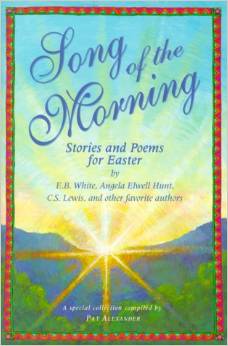
Song of the MonringSongs of the Morning: Stories and Poems for Easter was compiled by Pat Alexander and includes excerpts from the writings of C. S. Lewis, E. B. White, Dickens and others, some (mostly poems) written by children. I had bought it ages ago from a clearance section, put it on my shelf, noticed it it off and on through the years, and kept forgetting about it at Easter time. Finally this year I remembered to pull it out in the weeks preceding Easter. I like to read something devotional pertaining to Easter during that time, and while this wasn’t that exactly, it was both pleasant and beneficial.

I don’t think I realized, or I had forgotten, that it was geared primarily to children, probably the same age as those who would be able to read the Narnia series. But adults can gain from it, too.

I like that it couches the Easter story within historical context. The first section is “How It All Began” and begins with a short excerpt from a children’s Bible about God creating the world and sin entering in (Pat Alexander also wrote The Lion’s Children’s Bible, which I had not heard of before this, so I don’t know how well it expresses Biblical truth, but the excerpts I read here were fine). Then there are Narnia excerpts about the founding of Narnia and the White Witch and a couple of other sources to further illustrate those truths.

Other sections follow a similar pattern and focus on the birth of Christ, the triumphal entry on Palm Sunday, the crucifixion, and the resurrection. There’s also a section of “The Greatest Love,” with several historical and story illustrations of sacrificial love (like Sydney Carton’s in A Tale of Two Cities and a story about a boy’s dog risking its life to save the boy’s), one called “It’s All Right,” dealing with how new life in Christ should affect our lives in practical terms, like forgiveness of others, and a final one called “A New Beginning.”

The stories come from a variety of countries. Some are old, some are new. Some are from adults’ work, some from children’s books. Some are fun, some are serious. Pat did a fine job putting all these sources together. It doesn’t look like the book is in print any more, but there are copies that can be purchased online, or perhaps you can keep an eye out for it at library sales and such.

(This review will also be linked to Semicolon‘s Saturday Review of Books.)

He Is Risen Indeed!

10299841_641701779216757_2112017931_n

Happy Easter!

Is it nice to call someone a false prophet or a false teacher?

Caution

I don’t know whether it’s nice. But sometimes it is necessary, and oftentimes it is the most loving thing one can do.

The Bible has some pretty serious things to say about false prophets and false teachers:

Jesus said, “Beware of false prophets, which come to you in sheep’s clothing, but inwardly they are ravening wolves.” Matthew 7:15

But there were false prophets also among the people, even as there shall be false teachers among you, who privily shall bring in damnable heresies, even denying the Lord that bought them, and bring upon themselves swift destruction. And many shall follow their pernicious ways; by reason of whom the way of truth shall be evil spoken of. II Peter 2:1-3

Beloved, believe not every spirit, but try the spirits whether they are of God: because many false prophets are gone out into the world. I John 4:1

I marvel that ye are so soon removed from him that called you into the grace of Christ unto another gospel: Which is not another; but there be some that trouble you, and would pervert the gospel of Christ. But though we, or an angel from heaven, preach any other gospel unto you than that which we have preached unto you, let him be accursed. As we said before, so say I now again, if any man preach any other gospel unto you than that ye have received, let him be accursed. Galatians 1:6-9

If there arise among you a prophet, or a dreamer of dreams, and giveth thee a sign or a wonder, And the sign or the wonder come to pass, whereof he spake unto thee, saying, Let us go after other gods, which thou hast not known, and let us serve them; Thou shalt not hearken unto the words of that prophet, or that dreamer of dreams: for the Lord your God proveth you, to know whether ye love the Lord your God with all your heart and with all your soul. Ye shall walk after the Lord your God, and fear him, and keep his commandments, and obey his voice, and ye shall serve him, and cleave unto him. Deuteronomy 13:1-4

I don’t recall seeing in Scripture anything along the lines of “He doesn’t speak the truth, but he is very kind…or gives food to the poor…or has such a nice family…” or whatever. For one thing, those “good works” don’t give anyone points with God. For another, the falsehood is such an important issue that it trumps whatever else the person might be doing.

And what I am doing I will continue to do, in order to undermine the claim of those who would like to claim that in their boasted mission they work on the same terms as we do. For such men are false apostles, deceitful workmen, disguising themselves as apostles of Christ. And no wonder, for even Satan disguises himself as an angel of light. So it is no surprise if his servants, also, disguise themselves as servants of righteousness. Their end will correspond to their deeds. II Corinthians 11:12-15, ESV.

I’m not talking about every little thing people can disagree about in the Bible. People can have different views of baptism, church government, election and free will, the best Bible versions, standards of modesty, etc., and still each love God and teach the major truths of the Bible. While all of these are important and we should study the Scripture to be fully persuaded in our own minds, the Bible also teaches that people can have different convictions and should be able to still get along. I think as modern day Christians we have spent way too much time fighting amongst brethren on these things and have gotten sidetracked from the bigger picture of sharing God’s Word and making disciples (for Him, not for our views).

But there are majors issues – the fundamentals, if you will – truths that to deny would be to deny Christ and mislead people into tragedy: who God is, how a person can be rightly related to Him, the Deity of Christ, the inspiration and verity of the Bible, the death, burial, and resurrection of Christ, among others. When a person is wrong on these, I believe it is harmful to dwell only on the “good” he seems to be doing without warning people of his falsehoods. We don’t want to do anything to give credence to his message. That’s why I said earlier that calling a false prophet or teacher what he is can be the most loving thing you can do if it keeps someone from blindly following him into error.

I don’t think that means we have to set up web sites as false teacher watchdogs. I have come across a few like that, and though I am sure the owners meant well, the sites I have seen come across as harsh and unbalanced.

I also don’t think it means that if someone said they read a book or listened to a message from someone we would consider to be a false teacher, that we have to “pounce” on them and rip the teacher to shreds. We should be kind and compassionate with the person we’re speaking to, and part of that may be acknowledging that the person they are listening to might have some good points. We can prayerfully continue and bring biblical truth to bear in the conversation. If a person is really entrenched, we may need to just deal with one aspect at a time.

Jude 1:3 says, “Beloved, when I gave all diligence to write unto you of the common salvation, it was needful for me to write unto you, and exhort you that ye should earnestly contend for the faith which was once delivered unto the saints.” We are called to contend for the faith. Many of the epistles do just that in dealing with falsehoods making the rounds, even to the point of naming names. Interestingly, I had this started this post last week and saved it, and then last Sunday our Sunday School teacher started teaching from Jude. He said the Greek word for “contend” is used only one time in the Bible, and that is in this passage, and it has the idea of an athlete pouring everything into competing and winning with total commitment. Ephesians 5:11 goes on to say, “And have no fellowship with the unfruitful works of darkness, but rather reprove them.”

Besides contending for the faith, we need to clearly separate from false teaching.  Romans 16:17-18 says, “Now I beseech you, brethren, mark them which cause divisions and offences contrary to the doctrine which ye have learned ; and avoid them. For they that are such serve not our Lord Jesus Christ, but their own belly; and by good words and fair speeches deceive the hearts of the simple.” 2 John 1:9-11 says, “Whosoever transgresseth , and abideth not in the doctrine of Christ, hath not God. He that abideth in the doctrine of Christ, he hath both the Father and the Son. If there come any * unto you, and bring not this doctrine, receive him not into your house, neither bid him God speed: For he that biddeth him God speed is partaker of his evil deeds.”

Considering the above, when I quote someone or review a book, if I have some minor issues I might say something like, “I don’t agree with everything he said but I think there are good things to be gleaned from the book.” But if the author is wrong on the major issues, I can’t leave at “I disagree with some things he says”: I feel I must warn my own readers about this person’s falsehoods. Then if they want to go on and read the book, that is up to them, but at least they’ll know to compare what was written with what the Bible teaches (something we should be doing anyway.)

Warning of false teaching is one way we can we can contend for truth; we also need to be sharing truth proactively, as the Biblical writers did as well. Some years ago when David Koresh was in the news, I was astonished to hear an interview with one of his disciples commenting on his knowledge of the Bible. That person had to have had an amazing lack of previous Bible teaching or reading to think a thing like that. That’s one reason, among many others, that I have a passion to get people into the Word of God for themselves: it teaches us to know Him and His truth, helps us grow in Him, and keeps us from being deceived by false teachers who would lead us astray.

While we don’t need to set ourselves up as the False Teaching Police and become consumed with ferreting out falsehoods, we should be in the Word of God enough to recognize when we come across false teaching of it and be able to articulate the truth. It may be one thing that makes a difference in the hearts of those who hear us.


How Not to Become an Old Biddy

Crabby-Old-Lady

After I was married but before I had children, I worked for some years at a fabric shop. We had a variety of customers of all ages, but some of the ones that stood out to me were the older ladies. Some were very sweet. I remember one, after I had spent a great deal of time helping her (to choose some buttons, if I remember correctly), saying, “You’ve been so kind – here, let me buy you a cocoa” while she put some change on the counter. I don’t remember what I did in response: I remember thinking I probably shouldn’t take her money, but I didn’t want to offend her, either.

On the other hand, other older ladies were…cantankerous, to put it nicely. Really, all customers could fit into either of these categories, but somehow they seemed sharper and more focused in old age.

I remember thinking that I hoped when I became an old lady, I’d be one of the nicer ones. Then, of course, it dawned on me that I was in the process of becoming the kind of older lady I would be, and I needed to start working on that now.

Now I am in my “middle years,” but with “old age” looming some time in the future (when exactly it starts keeps getting pushed back further and further 🙂 ), I’ve started to think in a more concentrated manner about becoming the right kind of older lady. So I thought I’d preach to myself a little bit in preparation. You’re welcome to read along. Keep in mind I am preaching to myself, not older ladies – that’s not my place.

Avoiding the wrong kind of old age:

Having a know-it-all attitude. Years and experience can provide more wisdom, but we should never get to the place where we can’t humbly receive what someone else has to say.

“The way we always did it” syndrome. Every new generation brings with it new vocabulary, new technology, new methods. Older people can help younger ones discern between new methods and old truth and try to keep the latter from sliding into oblivion, but we shouldn’t insist that everything be done the way we always did it (or gripe when it isn’t).

Being busybodies. Many years ago, an older lady in our church at the time told one young mom of seven that she was having too many children too close together, and another young married lady, who with her husband wanted to wait until he was out of school before starting a family, that she needed to get busy and start having children. You can imagine that both women were hurt and offended. I am sure that was not the older woman’s intent and that she thought she was helping others with the benefit of her accumulated wisdom, but she overstepped. Before sharing advice, we really need to seek the Lord about whether it is really needed and how and when it should be shared.

Being quick to judge.

Gossiping.

Impatience. You would think a person would increase in patience over the years, but I have not found that to be the case for myself. This is one area I know I especially need to work on.

Forgetting what it is like to be young, to have small children. etc.

Sharp words.

Being caught up in our physical issues. I have mixed emotions about this one. One does start having more physical issues the older one gets, and we shouldn’t expect older people to try to cover that up: we need to listen and empathize. We know how we feel now when we’re ill or hurting for a few days or weeks: imagine if that was the norm and not the occasional occurrence. On the other hand, if I expand my horizons a little bit, it will probably help my own outlook as well as give me something else to talk about.

Developing into the right kind of old age.

Keep in the Word of God. If you’ve read it through several times during your life, you may feel like you’ve got it all down. But we always have room to learn and grow spiritually: we always need fresh communion with our heavenly Father.

Take an interest in others. One serious problem for older people in our churches, as they wane in energy or start having physical problems and can’t attend as often, is that we tend to forget them. Or we hope they’re doing ok but neglect taking the time to make contact, especially if they don’t have e-mail or aren’t on Facebook where we can do so easily. As we age we may get to a place where we can’t contact others, but until then, as much as possible we can take the initiative to make a phone call or send a note.

Look for ways to serve others. You may not be able to head VBS or organize a banquet or serve in the ways you used to, but you can look for ways you can serve in your present capacity.

Don’t stop learning and growing.

Come to terms with a failing body. I don’t mean that we stop taking care of ourselves, but we realize that our physical bodies come with a limited shelf life. Years ago I heard a radio preacher say that one reason God lets our bodies start failing us as we get older is to make us more willing to give them up when the time comes. Each aging problem is a reminder that I won’t live on this earth forever, and I need to be prepared for eternity.

Don’t be bitter. People have failed us and will continue to. “Let all bitterness, and wrath, and anger, and clamour, and evil speaking, be put away from you, with all malice: And be ye kind one to another, tenderhearted, forgiving one another, even as God for Christ’s sake hath forgiven you.” (Ephesians 4:31-32).

Seek God’s will and wisdom in sharing advice. The Bible does say one thing older women are supposed to do is teach the younger (Titus 2:3-5), but it’s not always easy to know how to go about it. Dispensing unwanted advice right and left is not usually received well, especially, when it is done with harshness and impatience and a superior attitude. We need to pray much and be sensitive to the Holy Spirit’s leading in speaking to others.

Remember God has a purpose for your being here. I’ve heard older women wonder why they are still here when many of their loved ones have passed on and they can’t do much any more. Perhaps God wants you to minister in prayer for others or to be a godly example in your circumstances: perhaps He want to bless and grow others as they care for you.

Throughout my life, from my teens until now, God has placed older women at the stage just ahead of where I am whose example I can learn from. From single college girls to young wives to young parents to parents of older kids and then teens, and now facing the almost empty nest years and “middle age,” I’ve had godly examples to look to. I was inspired by one older lady where we used to live who was put into a frustrating situation of having to retire earlier than expected from a job she loved. She could have become bitter at the situation, but she came to terms with it and went on to find other ways to serve. I watched her make a point to welcome new people at church and invite them to sit with her, have other women two or three at a time over to her house for lunch, and visit with a couple of ladies in assisted living a few times a month. A couple of older ladies in our church now are consistently cheerful and take an active interest in others. One writes notes to my mother-in-law and gets together regularly with another older lady (neither of them drives, but the daughter of one takes them to a restaurant and then picks them up when they’re done).

My own mother-in-law has been a great example to me. I used to say I wanted to live until I was 100: after seeing what she has gone through in the last several years, I’ve amended that to “I want to live until I’m 100 if I can live in my own home, go to the bathroom by myself, and take care of myself.” I hope that will be the case, but God may allow something different in my life as He has in hers. So often when we’re changing her or positioning her or giving her a shower, I think, “You know, I would hate this – I would hate having other people have to handle me and take care of my most intimate needs and not be able to do anything for myself.” She probably would have felt the same way: everyone wants to be able to take care of themselves. But now that she is in this situation, she doesn’t complain (except maybe when our hands are too cold or when we have to wash a contracted hand that hurts) and is usually upbeat and cheerful. She thanks us for the least little thing we do for her. I remind myself that God gives grace for what we need when we need it: I don’t have the grace for old age now, but whatever situation God puts me in at that time, He will provide the grace then for it.

The Bible does have specific instruction for older women:

The aged women likewise, that they be in behaviour as becometh holiness, not false accusers, not given to much wine, teachers of good things; That they may teach the young women to be sober, to love their husbands, to love their children, To be discreet, chaste, keepers at home, good, obedient to their own husbands, that the word of God be not blasphemed. Titus 2:3-5

A godly example of an older lady is found in I Timothy 3:9b-10:

…having been the wife of one man. Well reported of for good works; if she have brought up children, if she have lodged strangers, if she have washed the saints’ feet, if she have relieved the afflicted, if she have diligently followed every good work.

Some of the older women in the Bible that stand out to me are Elisabeth, Mary’s cousin; Anna, who served God in the temple and told others about the coming Messiah; Lois, Timothy’s grandmother, whose “unfeigned faith,” along with that of his mother Eunice, surely influenced him.

And there is specific encouragement for that time of life:

Cast me not off in the time of old age; forsake me not when my strength faileth. Psalm 71:9

Those that be planted in the house of the Lord shall flourish in the courts of our God. They shall still bring forth fruit in old age; they shall be fat and flourishing; To shew that the Lord is upright: he is my rock, and there is no unrighteousness in him. Psalm 92:13-15

And even to your old age I am he; and even to hoar hairs will I carry you: I have made, and I will bear; even I will carry, and will deliver you.  Isaiah 46:4

Can you think of any other truths we need to keep in mind for our old age? Have you had any godly examples of older ladies in your life?


Just to Leave in His Dear Hand

I was looking for this poem to share with a friend a few days ago, and I had thought it was on my blog somewhere. I couldn’t find it, so I thought it was high time to add it here. I originally saw the last stanza somewhere, and it wasn’t until looking it up online that I discovered it was part of a longer poem (it might possibly be a hymn, but I’ve never heard it set to music). It’s still the first line of the last stanza that comes to me most often.

I’ve seen this under the titles “How to Trust” and “The Secret of a Happy Day.” I don’t know which was the original, but they both work.

JUST to let Thy Father do what He will;
Just to know that He is true, and be still.
Just to follow, hour by hour, as He leadeth;
Just to draw the moment’s power, as it needeth.
Just to trust Him, this is all. Then the day will surely be
Peaceful, whatso’er befall, bright and blessed, calm and free.

Just to let Him speak to thee, through His Word,
Watching, that His voice may be clearly heard.
Just to tell Him everything, as it rises,
And at once to bring to Him all surprises.
Just to listen, and to stay where you cannot miss His voice,
This is all! and thus today, you, communing, shall rejoice.

Just to trust, and yet to ask guidance still;
Take the training or the task, as He will.
Just to take the loss or gain, as He sends it;
Just to take the joy or pain as He lends it.
He who formed thee for His praise will not miss the gracious aim;
So today, and all thy days, shall be moulded for the same.

Just to leave in His dear hand little things;
All we cannot understand, all the stings.
Just to let Him take the care sorely pressing;
Finding all we let Him bear changed to blessing.
This is all! and yet the way marked by Him who loves thee best:
Secret of a happy day, secret of His promised rest.

– Frances Ridley Havergal

Are We Responsible for God’s Reputation?

One of the things writing does for me is to help me think things through in ways that I can’t always do mentally. With writing I can take each strand of swirling thoughts, lay it out in black and white, follow it through to completion, go on to another, put them all together in some order, and then stand back and take a look at them. When I try to do that without writing them down, they just continue to swirl, and I can only think about one part for a brief time.

Something that’s been on the back of my mind for months is an offhand statement I saw on someone’s blog. When I go to a new blog, if what I see there interests me, I often will check out the “About Me” section to find out a little more about the person, to get more of an idea of who it is I am reading about. A part of what this particular blogger wanted people to know about her was that she was taught in her church and youth group to keep certain standards in order to maintain a good testimony before others, so people would think well of her God by what they saw her do;  but as she got older she felt that many of those standards went beyond the parameter of what she was called to do, and furthermore, she felt that she was not responsible for God’s reputation, that He was big enough to take care of that on His own. She wasn’t advocating a total overthrow of any standards at all, but she was refusing to place them on that level on importance.

Now, I agree with this young woman that some people go beyond what the Bible actually teaches or implies in their standards, and that some place their standards almost on par with the ten commandments and look quite condescendingly at anyone who practices something different than they do, and that both of those approaches are wrong. What I mean by standards are the practical ways people work out their beliefs and convictions that may vary from person to person (Romans 14) as opposed to the bedrock doctrinal truth that there can be no variations on.

But what really stood out to me and has had me pondering these many months is the thought that we are not responsible for God’s reputation. Is that true?

First my mind went back to verses in the New Testament about doing or not doing things so that God’s Word is not blasphemed. For instance in Titus 2:3-5, older godly women are instructed to teach younger women in a variety of areas – soberness (self-control in the ESV), loving husband and children, being “discreet, chaste, keepers at home, good, obedient to their own husbands,” so that “the word of God be not blasphemed” (reviled in the ESV). The word of God can be blasphemed when I am indiscreet, lacking in self-control, or unloving to my family? Apparently so.

In I Timothy 6:1, servants were to “count their own masters worthy of all honour, that the name of God and his doctrine be not blasphemed.”

I Peter 2:11-12 says, “Beloved, I urge you as sojourners and exiles to abstain from the passions of the flesh, which wage war against your soul. Keep your conduct among the Gentiles honorable, so that when they speak against you as evildoers, they may see your good deeds and glorify God on the day of visitation.”

Philippians 4: 5 says, “Let your reasonableness be known to everyone. The Lord is at hand.”

Philippians 1:27 says, “Only let your manner of life be worthy of the gospel of Christ, so that whether I come and see you or am absent, I may hear of you that you are standing firm in one spirit, with one mind striving side by side for the faith of the gospel.”

In II Corinthians 6:3-4a. Paul says, “We put no obstacle in anyone’s way, so that no fault may be found with our ministry, but as servants of God we commend ourselves in every way.”

In the Old Testament, God’s reputation was a motive for prayer. When God was going to destroy the Israelites for their lack of faith in going into the promised land, Moses prayed:

“Then the Egyptians will hear of it, for you brought up this people in your might from among them, and they will tell the inhabitants of this land. They have heard that you, O Lord, are in the midst of this people. For you, O Lord, are seen face to face, and your cloud stands over them and you go before them, in a pillar of cloud by day and in a pillar of fire by night. Now if you kill this people as one man, then the nations who have heard your fame will say, ‘It is because the Lord was not able to bring this people into the land that he swore to give to them that he has killed them in the wilderness.’” (Numbers 14:13-16).

In Psalm 106:21, 27, David prays, “But you, O God my Lord, deal on my behalf for your name’s sake; because your steadfast love is good, deliver me!…Let them know that this is your hand; you, O Lord, have done it!

The sake of God’s name is a factor in many prayers and actions in the Bible, so I think, yes, we should be concerned about how we are representing God in what we say and do. Stated a little differently, I Corinthians 6:19-20 conclude that we should not do certain things because “your body is a temple of the Holy Spirit within you, whom you have from God? You are not your own, for you were bought with a price. So glorify God in your body.”

That doesn’t mean different people can’t have different standards. I think people’s carping about other people’s different standards does far more harm to the reputation of God’s people than the different standards do. The Bible does teach grace in dealing with others who may not see everything quite the same way we do. But our motivating factor should be God’s honor and glory: even those with different practices in Romans 14 each did what they did “as unto the Lord.”

On the other hand, sometimes God does call someone to do something that seems harmful to their reputation, and to His. Mary’s reputation suffered as well as Jesus’s by the virgin birth, but it suffered in the eyes of people who didn’t believe it, and someday it will be vindicated. There are actions of God, or sometimes what seems to be a lack of action, that cause some to call Him unfair. But off the top of my head, areas in which people criticize God come down to problems on our end of things, not His. We don’t see the big picture or understand all His purposes and lack faith in His character, His wisdom, His love, etc.  He is willing to risk being misunderstood to do what is right and necessary in any given situation and He wants us to know Him and trust Him even when everything doesn’t make sense to us.

When Jesus lived on the earth, He “made Himself of no reputation” and “though he was in the form of God, did not count equality with God a thing to be grasped.” He did defend and explain His Father and even His own actions sometimes, but He wasn’t grasping after His rights or His “place” as the Son of God.

It is a misguided attempt to defend God’s reputation that sometimes earns Christians and the God they think they are representing a bad reputation. In almost any online forum, when a non-Christian makes a disparaging remark about God or the Bible or Christianity, you can count on some Christian leaping to God’s defense. That is not a bad thing in itself, but it can be if it is done harshly or condescendingly. Just this morning I came across a blog post about why Christians don’t seek to avenge insults against God: He Himself showed people grace in their ignorance and unbelief when He died for them on the cross, and in His love and longsuffering He waits and draws them to Himself. He wants us to show that same grace, love, kindness, and longsuffering. Of course we can and should soak ourselves in His Word and attempt to explain or put things into perspective for others and ask God to make it plain to them. Jude 3 speaks of “earnestly contending for the faith,” and I Peter 3: 14b-16 says, “But even if you should suffer for righteousness’ sake, you will be blessed. Have no fear of them, nor be troubled, but in your hearts honor Christ the Lord as holy, always being prepared to make a defense to anyone who asks you for a reason for the hope that is in you; yet do it with gentleness and respect, having a good conscience, so that, when you are slandered, those who revile your good behavior in Christ may be put to shame.” That’s quite a different stance than “pouncing” on someone for saying something out of line with the Bible.

The more I think about this issue, the more I realize it is probably too big a topic for one simple blog post. But here are some conclusions I think I can draw so far:

1. Yes, God can take care of His own reputation. He is willing to be misunderstood in the short term, but some day everything will be set to rights and people will see and know Him for who He really is.

2. We can and should contend for the faith and have a reason for the hope that lies within us, but we should be gracious and respectful about it.

3. We do represent God both to other Christians and to unbelievers and we do need to be aware that our actions and attitudes reflect on Him favorably or unfavorably.

4. That will filter down into our everyday lives and standards. But I don’t think the emphasis should be on keeping standards in order to maintain a good testimony. That puts all the focus on the outward form rather than the inward reality. As Erin Davis said in What to Say to That Immodestly Dressed Girl at Church:

This requires an important shift. We need to stop asking, “How can we get our girls to dress modestly?” and start asking, “How can we get our girls to be passionate students of God’s Word?” Hebrews 4:12 tells us that God’s Word works like a sword, surgically removing those parts of our hearts that don’t line up with the holiness of God. Which would you prefer? A girl who covers up out of obligation, or a girl who chooses to change because of God’s work in her through His Word?

Now, when it comes to immodesty, especially with three sons, my first instinct would be to say, “Let’s cover up first, even if it is out of obligation, and then we’ll study the reason for it.” 🙂 There may be times for that kind of an approach: as a parent, often you have to require certain actions and standards for your children even if they don’t understand the reasons behind them. But the motivation, the overarching focus should be love for God and living for Him and what pleases Him and brings Him glory. It should be that inner love that works itself out into our everyday actions. In one biography I read years ago, a young person had grown up with certain standards against “worldliness” which she then joyfully jumped into when she turned away from God for a time. But once she came to truly know Him, the more she grew in her knowledge of Him and love for Him, the more those things just fell away on their own.

From a writerly point of view, I should probably let this sit a few more days and tighten, organize, and “polish” it better. But I am going to let it stand as a “thinking through my fingers” post.

What are your thoughts about our responsibility for God’s reputation?

Book Review: Let Every Heart Prepare Him Room

Let Every HeartForgive me for spending the first week of the year catching up with Christmas reviews. As I said yesterday, I don’t usually have the computer time when I finish these to talk about them, and when I do I feel it’s probably too far past Christmas. But Let Every Heart Prepare Him Room: Daily Family Devotions for Advent by Nancy Guthrie is another that I’ve read several times now and want to share more about with you.

This book is written in a much different style than her compilation of essays in Come Thou Long Expected Jesus that I discussed yesterday. It’s written for use as a family devotional, so the language is in a simper style that I think very young children could comprehend, but I enjoyed it even as an adult reading for myself. Each chapter ends with a prayer, some discussion questions, and a few more Scriptures on the topic of the chapter. There are 31 readings: I like that it doesn’t stop at Christmas but extends through the month. (I know I said I liked that Come Thou Long Expected Jesus only had 22 readings, but those in this book are short enough that I don’t think it would be a problem to keep up with all month). The sizing of the book, too, is small enough that I think children would be comfortable holding it and taking a turn at the family reading.

In addition, there are lined pages where you can jot down anything you want to remember about the discussions aroused from the readings and a few pages of Christmas songs with their history.

The readings cover several topics that you would expect, but also a few you might not have thought of, such as this quote:

When you look at something through a magnifying glass, it looks much bigger than it actually is. Is that what Mary meant when she said, “My soul magnifies the Lord”? Was she trying to make God look bigger than He actually is?

 We can never make God bigger or greater than He is. The truth is, we can never fully take in or understand God’s greatness. But we can magnify Him. We magnify God not by making Him bigger than He truly is, but by making Him greater in our thoughts, in our affections, in our memories, and in our expectations. We magnify Him by having higher, larger, and truer thoughts of Him. We magnify Him by praising Him and telling others about His greatness so they can have bigger thoughts about Him, too.

 Sometimes we wonder why we aren’t happy, why we make sinful choices, why we feel distant from God. Often it’s because we have small thoughts about God and magnified thoughts of ourselves, our wants, our rights, our accomplishments. Mary, the one God chose to be the mother of His Son, could have easily allowed thoughts of herself to become larger, even prideful. But instead of magnifying herself, she magnified the Lord (p. 29).

And this:

Sometimes we are given a gift that we think is not really useful to us, and therefore we never take it out of the box. We stash it away in a closet or on a shelf somewhere in case we need it someday. Sadly, that’s what some people do in regard to Jesus. They want to keep him handy for when something comes along that they can’t handle on their own, but for now they have no interest in making him part of their day-to-day lives, and so they put him on the shelf. They simply don’t believe he is as good as the Bible says he is, and so they have no real or lasting joy in having received this great gift (p. 79).

Day 17’s reading on “Glory Revealed” is one that especially stood out to me.

I appreciate Nancy’s thoughtfulness and depth in these devotionals, even couched as they are in simple language.

I’ve used this book several times, once with Jesse when he was younger and then on my own. It’s one I am sure I will use again, and I am happy to recommend it to you.

(This will also be linked to Semicolon‘s Saturday Review of Books.)


Book Review: Come Thou Long-Expected Jesus

Long Expected JesusI’ve read Come Thou Long Expected Jesus:Experiencing the Peace and Promise of Christmas, compiled by Nancy Guthrie, many times, but somehow I have never reviewed it. Probably because, like this year, I’ve finished it right in the busiest of the Christmas season, and by the time I had time to go over it, felt it was too far past Christmas to review. But I am not letting that happen this year. 🙂

In Nancy’s preface, she tells of Christmases where all the activities had been accomplished, but her heart wasn’t truly prepared. Then she tried to find a book of Christmas readings, but the ones she found did not minister to her. She wanted to find a “book with short readings on Advent themes from a number of different writers I trust and respect; that reflected a high view of Scripture; and that put the incarnation in the context of God’s unfolding plan of redemption” (p. 10). When she couldn’t find such a book, she set out to create one, reading and editing multitudes of sermons and writings from well-known theologians and Bible teachers.

There are 22 selections on various aspects of Advent, from Mary to conception by the Holy Ghost to Joseph to the shepherds to Jesus’s humility and others, from such teachers and preachers as Charles Spurgeon, Augustine, Martyn Lloyd-Jones to Tim Keller, John MacArthur, J. I. Packer, and Ray Ortland. I don’t know all of the authors, so I wouldn’t endorse everyone 100%, but I don’t think I read anything in this particular volume that I had a problem with, at least not that I noted or can recall.

In many ways it is hard to review a book like this, with so many authors and topics. But I’ll share just a few quotes that stood out to me:

Ligon Duncan III on Joseph: “God is calling Joseph to believe his word and to act in accordance with it. And Joseph does just that. He accepts God’s word and he trusts God’s word and he relies upon God’s word and he re-orients his life to conform to that word. What a tremendous act of faith on the part of Joseph and what an example of obedience to God’s word in spite of circumstance” (p. 53).

From “For Your Sakes He Became Poor” by J. I. Packer (originally from Knowing God): “We see now what it meant for the Son of God to empty himself and become poor. It meant a laying aside of glory; a voluntary restraint of power; an acceptance of hardship, isolation, ill-treatment, malice and misunderstanding; finally, a death that involved such agony–spiritual even more than physical–that his mind nearly broke under the prospect of it. It meant love to the uttermost for unlovely human beings, that they ‘through his poverty might become rich.’ The Christmas message is that there is hope for a ruined humanity–hope of pardon, hope of peace with God, hope of glory–because at the Father’s will Jesus Christ became poor and was born in a stable so that thirty years later he might hang on a cross. It is the most wonderful message that the world has ever heard, or will hear.

We talk glibly of the ‘Christmas spirit,’ rarely meaning more by this than sentimental jollity on a family basis. But what we have said makes it clear that the phrase should in fact carry a tremendous weight of meaning. It ought to mean the reproducing in human lives of the temper of him who for our sakes became poor at the first Christmas. And the Christmas spirit itself ought to be the mark of every Christian all the year round.

…The Christmas spirit does not shine out in the Christian snob. For the Christmas spirit is the spirit of those who, like their Master, live their whole lives on the principle of making themselves poor — spending and being spent — to enrich their fellow men, giving time, trouble, care, and concern, to do good to others — and not just their own friends — in whatever way there seems need (pp. 70-72).

From “Good News of Great Joy” by Raymond C. Ortlund, Jr.: “God is terrifying to guilty sinners, even though he is in himself gloriously beauitful. But God is pursuing us, even though we avoid him. He himself has taken the initiative to break through our terror” (p. 99).

From the same chapter: “Our good intentions are not strong enough to control our evil impulses. We need a Savior to rescue us from ourselves” (p. 100).

From “The Lessons of the Wise Men” by J. C. Ryle: “Let us beware of resting satisfied with head knowledge. It is an excellent thing when rightly used. But a person may have much of it, and still perish everlastingly. What is the state of our hearts? This is the great question. A little grace is better than many gifts. Gifts alone save no one; but grace leads on to glory” (p. 111).

There are so many others I’d love to share. Packard’s and Ortlund’s chapters impacted me the most this time, I think. There was a lot that was deep and thought-provoking in both, especially Ortlund’s on God’s glory.

Our family doesn’t celebrate Advent liturgically or ceremonially, with different candles on different days and all that, but I do like to, as Nancy wrote at the beginning, spend some time preparing for Christmas with some kind of Advent reading. This book, so far, has been the best book I have found for that. I like that it is 22 essays rather than 24 or 25 or 31: it gives one some leeway to begin early in December but not fall behind if a day or two is missed. Though the chapters are longer than the average devotional booklet, they’re not too long to read in a sitting, and I have found I do better at this stage of life with sustained thought on topics like this rather than “grab and go” devotionals. But most of all I like the richness and the depth. I had used it for several years, laid it aside for a few years, and rejoiced to read it again this year. I’m sure I will read it again many times.

(This will also be linked to Semicolon‘s Saturday Review of Books.)